HUNGARY
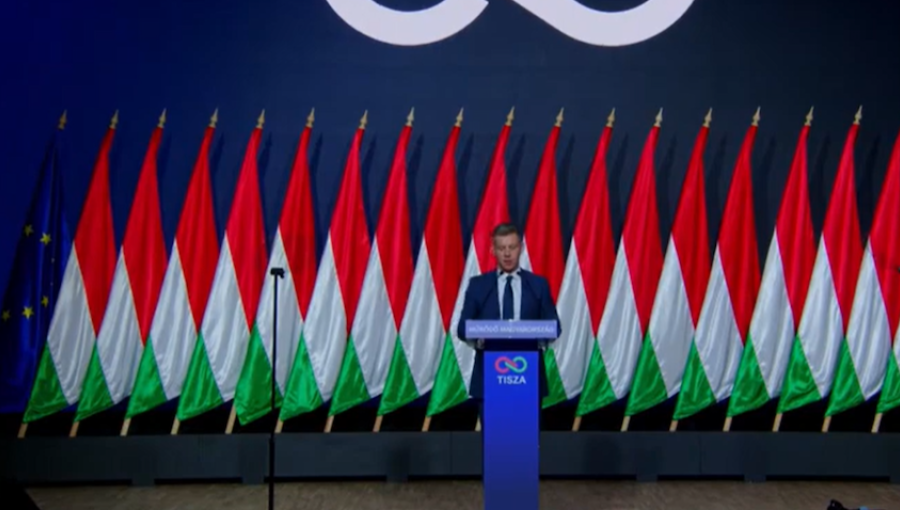
Opposition leader Peter Magyar vowed to revive Hungary’s economy, tackle corruption and restore civil liberties at a rally on February 15, which also marked the official start of the election campaign in Hungary.
Magyar promised to end a culture of hatred in Hungary and avoid stigmatising dissenters if elected, during his annual address, which came a day after Prime Minister Viktor Orban’s state-of-the-nation address. The 44-year-old former Fidesz cadre also announced the launch of a new nationwide campaign running from February 16 through the April 12 election.
"We are at a turning point; now is the time to decide whether we will remain in a regime based on fear, hatred, and theft, or whether we will finally take back our future," he told supporters at Hungexpo, the largest conference hall in Budapest.
Tisza is "on the verge of victory". "We have everything we need to win: a majority, credible candidates, a platform and experts; Tisza is ready to govern," he said, adding that all that Fidesz has to offer for the next 56 days is “ incitement, threats, discrediting and lies".
Independent polls show the opposition party has held a massive lead for two years, with at least double-digit points. Analysts, however, have cautioned that because of the electoral system distortions engineered by Fidesz, Tisza would likely need to achieve a 4-5pp lead to secure a parliamentary majority.
"Over the next eight weeks, a power-hungry, mafia-like state, terrified of losing its grip on power, will unleash the most disgusting things on Hungarian society, and the secret service and propaganda machine, built at a cost of hundreds of billions, will unscrupulously seek to discredit anyone who stands in their way," he added.
"If they can pry into my private life, then they can do the same to everyone else's private life," he said, referring to the existence of a sex video with his former girlfriend taped illegally in August 2024 after a party in a downtown Budapest apartment.
Magyar offered a vision of a country "where politics does not mean surveillance, fear, and blackmail, but peace, tranquillity, and security for everyone."
The Hungarian economy “has not taken off and is at a dead end”, Magyar said and accused the prime minister and his allies of enriching themselves, claiming public funds were diverted to private yachts and investment funds.
Magyar promised that, if elected, his government would ensure “full transparency of public contracts” and recover resources Hungary has been deprived of during the past 16 years. He also pledged to restore freedoms, condemning what he described as government surveillance of opponents and restrictions on the judiciary, academia, media, civil society, and minority rights.
He also said that his party "represents peace at home and around the world, and Tisza and its community reject war and all forms of violence". Magyar said that Tisza would maintain the southern border fence, take strict action against illegal migration, reject the migration pact and Ukraine's accelerated accession to the EU, and did not want to reinstate compulsory military service.
The Tisza government would offer Hungary a functional vision for the national economy, with European Union funds brought home, SMEs supported, innovative start-ups encouraged, and high-value-added, rule-abiding foreign investment that largely employs Hungarians and pays taxes.
The economic model of Fidesz "has gone from assembly plants to toxic death factories in sixteen years", he said, referring to the ongoing scandal at Samsung SDI's lithium-ion battery plant, 25km north of Budapest.
Investigative outlet Atlatszo.hu revealed that a South Korean manufacturer was concealing the extent of toxic chemical exposure affecting workers at a plant near Budapest. The government knew about the environmental hazards but failed to enforce the rules and instead provided hefty subsidies to expand the plant, the report said.
Magyar outlined the Tisza government's key priorities, pledging to prioritise worker health, local safety and environmental protection. He condemned the state of child protection and health care, promising open-ended budgets, improved institutions, faster adoptions, and more professional staff. Magyar also vowed to boost health-care financing by HUF500bn annually.
Reiterating his earlier promise, he said that in order to "eradicate corruption", Hungary would immediately join the European Public Prosecutor's Office and establish the National Asset Recovery and Protection Office in charge of reclaiming assets.
Magyar once again called on Orban to engage in public debate, saying, "Let's have a debate about the things that really matter: health care, wages, housing, education, the Hungarian economy, and bringing EU funds home."
A day before his campaign speech, Magyar and his team, including energy expert Istvan Kapitany and foreign policy expert Antia Orban, met with European leaders on the sidelines of the Munich Security Conference.
In Munich, he met Croatian Prime Minister Andrej Plenkovic and agreed with Polish Prime Minister Donald Tusk to give a renewed momentum to Visegrad Group cooperation. Tusk confirmed that Poland would support the release of HUF8 trillion (€21bn) in frozen EU funds to Hungary after anti-corruption measures are implemented.
The opposition leader conducted private talks with German Chancellor Friedrich Merz in Bavaria, emphasising that a future Tisza government’s top priority would be the recovery of EU funds owed to Hungary.
He stated that his administration would promptly implement stringent anti-corruption measures while safeguarding judicial independence, press freedom, and academic autonomy. Magyar also confirmed that his party would oppose accelerated EU membership for Ukraine and pursue a strict policy on illegal migration, rejecting the UN migration pact.

No comments:
Post a Comment