Thursday, March 06, 2025

Nuclear Abolition is Focus of UN Meetings in New York

 March 6, 2025

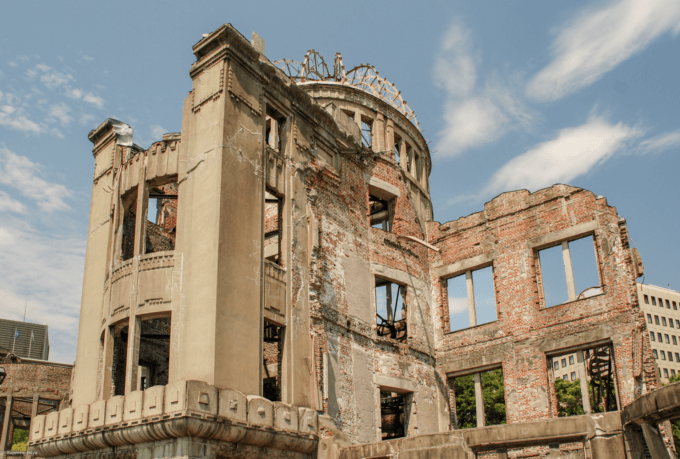
Photograph Source: xiquinhosilva – CC BY 2.0

All this week, professional dreamers who insist on the abolition of nuclear weapons have been meeting at the United Nations in New York. The very upbeat gathering was the 3rd “Meeting of States Parties,” a treaty-speak for the 73 UN member states that ratified the 2017 Treaty on the Prohibition of Nuclear Weapons (TPNW).

What’s so extraordinary about the TPNW, in the words of the International Campaign to Abolish Nuclear Weapons which helped shepherd the treaty through the UN negotiating process and won a Nobel Prize for it, is that “it is the first globally applicable treaty that categorically prohibits the most destructive, inhumane instruments of war ever created.”

The prohibition applies only to states that ratify, so the U.S. can continue its 80-year H-bomb frenzy of radioactive pollution and global bomb threats — known quaintly as “deterrence” — a collapsed charade of terror and unimaginable risk-taking that most of the world has renounced.

Among the 73 “states parties” at this week’s meetings are major players on the world stage including Brazil. There are also over a dozen treaty “signatory states” from the Americas — putting the USA’s absence to shame — including Mexico, Costa Rica, Guatemala, Honduras, Nicaragua, Panama, Paraguay, Peru, Ecuador, El Salvador, Chile, Bolivia, Cuba, Uruguay, and Venezuela.

Combined, the TPNW’s parties and signers total 94, one-half of the United Nations’ 193 members. This treaty is a colossal accomplishment of common sense, defogging and popular good will which has triumphed over relentless public and private pressure, threats and backroom villainy by nuclear weapons states that pretend their doomsday devices still serve a necessary function.

While 122 UN member voted in 2017 to adopt the TPNW, nicknamed the “nuclear ban treaty,” and global enthusiasm for it is most pronounced in the developing world whose economies, environments, and health statistics would improve following the renunciation of their civilization-ending weapons by the increasingly isolated nuclear-armed states.

The treaty’s international appeal can be understood by reading its preamble:

Reaffirming that any use of nuclear weapons would be abhorrent to the principles of humanity and the dictates of public conscience…

Cognizant that the catastrophic consequences of nuclear weapons cannot be adequately addressed, transcend national borders, pose grave implications for human survival, the environment, socioeconomic development, the global economy, food security and the health of current and future generations, and have a disproportionate impact on women and girls, including as a result of ionizing radiation.…

This year, Nukewatch co-director Kelly Lundeen is in New York leading a small delegation of colleagues. Their particular focus among NGO side events is Article 6 of the treaty, which requires providing adequate medical care, rehabilitation and psychological support for individuals affected by the use or testing of nuclear weapons. Widespread radioactive fallout from Bomb testing has harmed millions of individuals in the Marshall Islands and Nevada (bombed by the US), Australia (UK), Algeria (France), Kazakhstan (USSR), and Lop Nor in the Gobi desert (China).

Article 6 is partly where the 3rd MSP’s dreaming comes in, because the governments responsible for the bomb testing’s radioactive poisoning, maiming, and debilitation of individuals even in their own countries, have so far refused to sign on.

This belligerent scofflaw gangsterism on the part of nuclear weapons states grows more odious, fraudulent, and transparently absurd with every new ascension of another TPNW state party.

Today, D. Trump shoots his mouth off about nuclear disarmament, so the craziness of what Rex Tillerson called the “fucking moron” might accidentally result in something with a shred of value.

Does anyone still believe that “nuclear deterrence” policy retains validity? Considering just the Russian invasion of Ukraine, one knows Western nuclear weapons have always been rationalized as the “deterrent” that kept Russia from taking military action in Europe. This fraud can be abandoned.

Another grim and mortifying reason that nuclear weapons can be abandoned is that they are unnecessary for war-making powers bent on mass destruction. Today’s photographs of a rubblized Gaza, and 2003 photos of the rubblized streets of Baghdad, show nuclear bomb-like devastation caused by modern Israeli and U.S. “conventional” explosives. The new chemical bombs are so devastating that nuclear attacks are stupidly redundant, only make the rubble bounce, and can be trashed.

John LaForge is a Co-director of Nukewatch, a peace and environmental justice group in Wisconsin, and edits i

A Single Drone Can Turn the “Peaceful Atom” Into World War 3


March 6, 2025

Getty Images and Unsplash+.

Vladimir Putin right now has in his sights nearly 300 pre-deployed atomic weapons set to easily launch a radioactive apocalypse with a single drone strike.

He may already have crashed an early warning into the sarcophagus at Chernobyl.

And taken as a whole, the “Peaceful Atom” lends a terrifying reality to Donald Trump’s Oval Office threat of an impending World War 3.

Some 180 operational “Peaceful Atom” reactors now operate throughout Europe. There are 93 more in the US, 19 in Canada, two in Mexico.

Putin, or anyone else of his ilk, would need precisely one technician with one weaponized drone to turn any “peaceful” nuke into a radioactive apocalypse.

When Donald Trump brought Ukraine’s Volodymir Zelensky into the Oval Office to accuse him of flirting with “World War 3,” atomic reactors were among the specifics he failed to cite.

As of today, more than 50 commercial nuclear power plants are considered operable in France. Another 130+ operate in Belarus; Belgium; Bulgaria; the Czech Republic; Finland; Hungary; the Netherlands; Romania; Slovakia; Slovenia; Spain; Sweden; Switzerland; Ukraine; the UK (Germany, Italy and Lithuania have gone nuke-free).

Six reactors are under unstable Russian control at Ukraine’s Zaporizhzhia; two more are in Kursk, now a hotly contested war zone. Russia has a further three dozen.

Each could blanket the globe with atomic radiation, as has Chernobyl Unit 4 since it exploded on April 26, 1986.

The still-hot Chernobyl core could explode yet again.

Europe has collectively spent more than $2 billion to cover that core with a giant sarcophagus, the world’s largest movable structure.

On February 14, 2025, it was struck by a military drone.

Putin denies ordering the hit. His supporters say it could have been a “false flag.” But the drone itself was of an Iranian design widely used by the Russians.

On-going maintenance at Chernobyl has been conflicted and highly suspect, especially as impacted by the Russian invasion. After decades of denial, nuke supporters admit that what’s left of Chernobyl #4 could explode again. A definitive 2007 study by the Russian Academy of Sciences put the downwind human death toll at more than 985,000…and rising.

Three melt-downs and four explosions at American-designed reactors at Fukushima have raised the stakes. Caused by an earthquake and tidal wave, their lost cores still send unfathomable quantities of radioactive poisons into the Pacific, with no end in sight.

Both Fukushima and Chernobyl have released far more radioactive cesium and other deadly isotopes than did the atomic bombings at Hiroshima and Nagasaki. No western insurer will gamble against the likelihood of a new catastrophe caused by natural disasters, faulty designs, operator error, or acts of terror…drone-inflicted or otherwise.

Even without drone attacks, America’s 21st century reactor projects are catastrophic economic failures. Two at VC Summer, South Carolina, are dead, at a cost of $9 billion. Two more at Vogtle, Georgia, came in years behind schedule, billions over budget and completely incapable of competing with renewables. Talks of reviving shut reactors like Three Mile Island in Pennsylvania, Michigan’s Palisades and Duane Arnold in Iowa all depend on huge federal subsidies to cover vastly inflated market prices.

Parallel projects in France, Britain and Finland are also very late and far beyond budget.

Soaring costs and lagging production schedules have already killed the first order from NuScale, the first licensed US producer of Small Modular Reactors.

No significant supply from SMRs can be realistically expected in less than a decade. None can be protected from drone attacks.

But the billions SMR (Silly Mythological Rip-offs) backers want to squander on this pre-failed technology will help keep Europe dependent on Putin’s gas.

Germany has shut all its reactors, as have Italy and Lithuania. Putin’s war has destabilized their fossil fuel supply, especially complicating Germany’s transition to 100% renewables, still likely within the next decade.

Corporate hype will not can’t deliver any new nukes, big or small, that can compete with wind, solar, battery backup or increased efficiency, all of whose cost projections continue to plummet.

And no explosion at a wind turbine or solar panel will ever cause a radioactive apocalypse.

But whoever attacked the Chernobyl sarcophagus has made it clear that as long as atomic reactors continue to operate, World War 3 is just a drone strike away.

Harvey Wasserman wrote THE PEOPLE’S SPIRAL OF US HISTORY: FROM JIGONSASEH TO SOLARTOPIA.  Most Mondays @ 2-4pm PT, he co-convenes the Green Grassroots Election Protection Zoom (www.electionprotection2024).  The Mothers for Peace (www.mothersforpeace.org) could use your help in the struggle to shut the Diablo Canyon nukes.  

We Urgently Need a Global Peace Movement to Combat Climate Change and Avoid Nuclear Apocalypse


 March 4, 2025
Facebook

Image by Valeriia Miller.

Reading all the news in my temporary flat at Cambridtge University, where my wife is on a year’s sabbatical leave, I’m able to view all the slaughter in the world and the chaos, increasingly blatant presidential power-grabbing and corporate influence in the US with a certain degree of detachment. That has made me think that it is time for a reassessment of the whole international political situation we’ve been mired in since the end of World War II.

These days seem so reminiscent of 1938, or even 1913, those years leading up to the two World Wars, when there was a grim, seemingly inevitable slog towards war in Europe and, in the case of WWII, also in the western Pacific. During both those antebellum times there were interlocking webs of mutual assistance treaties that had been created as bulwarks against a war, premised on the notion that if attacking a weak country would mean going to war against a number of countries bound by treaty to come to that country’s assistance, such an initial attack would not happen.

In the end, that idea failed catastrophically and in fairly short succession. Instead of preventing war, such treaties instead assured that any first attack would spread like the spark of a prairie fire that under dry climate conditions, or, in a political context, an environment of mutual distrust and paranoia, spreads out of control. In a span of just 31 years during the first half of the 20th Century, that resulted in a total of 85-107 million civilian and military deaths — 70-85 million of these occurring in WWII, and 15-22 million in WWi.

With the benefit of hindsight, I have to say it looks like the tired trope that WWII happened because British Prime Minister Neville Chamberlain appeased Adolf Hitler, has it wrong. Chamberlain was mindful of the incredible destructive power of the modern military war machines of the major powers in the late ‘30s and was trying to prevent a war from happening. He failed not because he was naive but because the network of treaties obliged Britain and France to go to war against Germany once Hitler and Stalin attacked Poland which then meant a war across virtually all of Europe and in its colonial possessions. Similarly, in 1914, a massive war was assured by the interlocking mutual assistance treaties among the European powers, who ended up having to go to war over a single anarchist’s assassination of the heir to the Austrian throne since not responding would have besmirched the honor of those bound by the treaties.

But surely both those wars could have been avoided and over 100 million lives saved — 100 million men, women and children!. As war clouds began to loom on the horizon both times, the governments of the various potential combatants should have held a grand meeting and worked out a rational solution to their disagreements, grievances, fears and perceived threats. Doing so would not have been seen by the populations of the nations as appeasement but as cause for relief.

In today’s world, where we have incomparably more destructive weapons that would make a global conflict vastly more lethal, with death tolls numbered in the billions, not millions, and could potentially wipe out what passes for “civilization,” quite possibly humanity, and even potentially life on Earth. (The total tonnage of explosives used in all of WWII, including the two atomic bombs dropped by the US on Hiroshima and Nagasaki, was 3 megatons. Since the largest thermonuclear bomb in the US nuclear arsenal at present, the B83 is 1.2 megatons, that means just three of these bombs, each designed to be delivered by a low-flying B-1 bomber moving at supersonic speed, would alone significantly exceed the destructive power of all weapons used by all sides in WWII. And there would be hundreds or even thousands of nuclear bombs used in a global nuclear war, or even in a war between two of the larger nuclear nations. )

Back in the most scary days of the Cold War and nuclear arms race, British philosopher and Nobel Peace Laureate Bertrand Russell, in calling for nuclear disarmament, was widely linked to the protest chant “Better Red than Dead!” Though he insisted it wasn’t his phrase, he said he agreed with its rationality. Certainly in the era of nuclear weapons its opposite, “Better dead than Red,” makes no sense at all, since opposing launching a nuclear war is not an act of individual courage, but rather of mass murder/suicide. Meanwhile, the problem with mutual assistance treaties is that they automate the decision to go to war once one country attacks another that is protected by such a pact. No matter the reason for the invasion, the signers all are bound to join the fray. That is unacceptable madness where nuclear weapons are involved.

Given this reality, and the numbers of human beings who would die in even a limited war between two nuclear nations, it is time for the nations of Europe and the Asia-Pacific and the United States, to come together in a global conference to de-escalate the rhetoric, the threats, and the paranoia and to work out a way to get along. The starting point is a global ceasefire in all conflicts and the calling of a global peace conference. The people of the world need to demand this of their leaders.

There is, we know, a crisis facing humanity that is much bigger than any crisis faced by individual nations. A crisis of survival that while it may not be felt yet or acknowledged by many, is inexorably approaching. That is the climate catastrophe of global heating which will make the world unlivable at worst, and certainly incapable of supporting even the current population of 8.31 billion people alive today.

That crisis is daunting already and will become increasingly daunting as the years slip by with no concerted global action to address it. Humanity has thus far done little and in many cases has been slipping backwards, particularly in the US. In fact quite the opposite, the nations of the world together spent $2.1 trillion on war and preparation for war in 2024 and are on track to spend more this year even if a major war doesn’t break out.

The US, by conservative estimates, spent $811 billion that year, almost three times China, the second biggest arms spender at $298 billion. America’s arms spending also exceeds the spending of the next nine biggest military spenders, including China, India, Saudi Arabia, Russia, the United Kingdom, Germany, France, Japan, and South Korea.

it is thus incumbent on the US, the country with the largest and most powerful military the world has ever known—one which enjoys the most geographically protected location, bounded as it is by thousands of miles of ocean separating it from countries that could even contemplate attacking it—to take the first step in moving towards a world without war.

How such a winding down of the threat of war can be worked out at the United Nations remains to be seen. But the first task, which would set things moving in the right direction, would be to end the very dangerous war between Ukraine and Russia, and the Israeli war on Gaza. and the West Bank.

Both these conflicts should be resolvable. In the case of Ukraine, it is clear that Russia invaded Ukraine, but it is also clear that the invasion of Ukraine was driven by a legitimate fear Russia — a nation repeatedly attacked over its history by powerful nations to its west — had of the US-promoted drive to sign up nations that were formerly under the control of the Soviet Union or were part of the old Soviet Union, bringing them under the protection of NATO and even placing US military equipment and nuclear weapons and delivery systems at bases in those countries near to or even bordering Russia, and was pushing to do the same with Ukraine, a former soviet (state) of the USSR.

There had been a golden opportunity, with the 1991 collapse of the Communist government of the USSR and its dissolution into the Russian Federation and a group of smaller new independent states. At that point Russia, whose economy was in collapse, would have welcomed being brought into the European Union and NATO (the military pact created expressly to “contain” the USSR), but the US was not interested in doing that, so it didn’t happen.

Even Henry Kissinger, the hardline Secretary of State and national security advisor to Richard Nixon during the Vietnam War, a committed anti-Communist and no soft-hearted peacenik, at that historical inflection point in world history, had argued against the US “taking advantage” of Russian weakness to expand NATO and against continuing with the “containment strategy” of the Cold War. Instead of listening to him, a series of US presidents beginning with Bill Clinton and on through Joe Biden did just that, with the result that Russia recovered economically and rearmed in response to the threat posed by NATO and turned towards a increasingly powerful ally, China, leading to the situation we have today.

“Stupid’ is the only word to apply to US policy since the Reagan-Gorbachev summit that brought an end to the Cold War and the only major nuclear disarmament agreement of that frightening era.

With Russia having invaded and conquered 20% of Ukraine and with the US and a number of major NATO allies having provided Ukraine with over a billion dollars’ worth of advanced weaponry to combat Russian troops and even to launch missiles and drones deep into Russian territory, it will be difficult now to get back to a condition of mutual trust, but it must be done. And again, it has to be the US that takes the lead. It is not the US that is threatened, it is the European countries that remember being attacked by Germany (and in Poland’s case, the Germany and the Soviet Union) in 1939, and it is Russia, attacked by France in 1812 and by Germany in 1941-45 ad that the we were threatening with nuclear missiles and in nuclear-capable bombers and supersonic fighter bombers placed in NATO countries throughout the Cold War, and that was having NATO bases placed in countries right on its borders in the more recent 1991-2022 period.

So let’s, as citizens of the US, start letting our government — Senators, Representatives and President Trump and the mass media — know that we want an honest peace in Europe. The US and the European nations of NATO need to offer an end to all the sanctions that have been plaguing Russia in return for an immediate ceasefire, a neutral an independent Ukraine, recognition of the majority Russian regions of eastern Ukraine as either an autonomous state or as part of Russia, following an internationally supervised plebiscite, and a dismantling of the anachronistic NATO, with the proviso that NATO could be revived if Russia were to return to hostilities against Ukraine. In return, Russia would be invited to become part of the European Economic Community.

Turning to the Gaza war, the solution is relatively simple: That festering sore of a captive and subjugated Palestinian population under the thumb of the Israeli state has been allowed to go on for way too long. Again its roots go back to the Cold War that followed World War II, which saw the US adopt and bankroll the new state of Israel founded in 1948 as a reliable ally in the strategically important oil-rich Middle East and North Africa at a time that the Arab nations and the Persian nation of Iran were trying to rid themselves of the colonial bonds and legacy of France and the UK. So important to the US was Israel during that era of US-USSR global rivalry that Washington allowed Israel to establish a theocratic apartheid and specifically Jewish state, with Palestinians suffering political exclusion, second-class status, pogroms, property expropriation, and expulsions.

All that abuse of a captive people has to end in order for peace to come to that powder-keg region. The US alone has the power to stop it. Israel’s genocidal leveling of Gaza over the last two years had been perpetrated largely using the planes, howitzers, tanks, rockets, bombs and diplomatic cover provided by the United States. If the Trump administration and Congress were to cut off those weapons and the spare parts needed to keep American planes flying, Israel would have to back off. The US could demand that Jewish Israeli settlers who been allowed to expropriate and move into territory in the conquered and Israeli-occupied West Bank must be compelled to return stolen lands, IDF forces would have to leave Palestinian territory, and a major redevelopment program to enable the creation of a viable Palestinian state would have to be undertaken.

After those two conflicts are resolved, the world can move on to solving other smaller conflicts, and proceed with a phased reduction by all countries of their outsized military forces, beginning with the US, which should offer an immediate unilateral 25% reduction in its military budget, including offering to a negotiate major reduction in its and Russias’s still absurdly huge nuclear stockpiles. (Russia has 5977 nuclear weapons and the US has 5428 — numbers so large that if even a significant percent of them were used by only one country in a successful first-strike, would destroy both countries and much of the world.)

The time for such action to move towards global peace is now!

President Trump claims he wants peace, both in Ukraine and in Gaza, but he’s going about it wrong. It’s not “Peace through American strength” that the world needs; it’s leadership towards global peace through example by the world’s most powerful nation“ that is called for at this historic time. And that will only happen if the American people, many of whom are fed up with massive military spending of needed funds, demand it.

Then we can really start to confront the real enemy of mankind: climate apocalypse.

This article by Dave Lindorff appeared originally in ThisCantBeHappening! on its new Substack platform at https://thiscantbehappening.substack.com/. Please check out the new site and consider signing up for a cut-rate subscription that will be available until the end of the month.

CRIMINAL TERRORIST STATES

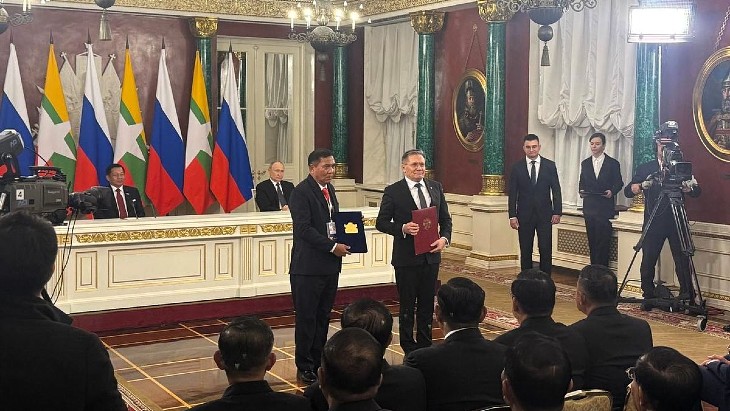
Myanmar and Russia sign SMR cooperation agreement


Wednesday, 5 March 2025

An intergovernmental agreement signed during a state visit to Russia covers cooperation on the development of a 110 MW small modular reactor project in Myanmar.

Myanmar and Russia sign SMR cooperation agreement
(Image: Rosatom)

The agreement sets out the terms and main areas of interaction between the parties and the possibility of a further expansion of capacity to 330 MW. It was signed by Rosatom Director General Alexei Likhachev and Myanmar's Science and Technology Minister Myo Thein Kyaw. A memorandum of cooperation in the field of nuclear and radiation safety was also signed.

Agreements on establishing cooperation between the two countries in the peaceful use of nuclear technology were signed in February 2023, with other agreements also now in place covering workforce training and infrastructure.

Although Myanmar was a founding member of the International Atomic Energy Agency, it does not have any nuclear energy at the moment. It signed a country programme framework with the IAEA in 2016 and also joined the Convention on Nuclear Safety in the same year. It has been a signatory of the Nuclear Non-Proliferation Treaty since 1992. In 2019, Myanmar produced 24.3 TWh of energy with 13.7 TWh from fossil fuels and 10.5 TWh from hydro - Rosatom is also working with Myanmar on a 200 MW wind power plant in the country.

After talks with Myanmar's Prime Minister Min Aung Hlaing, Russian President Vladimir Putin told reporters the two countries were "exploring opportunities for cooperation in the energy sector ... including the use of renewable energy sources" and said the intergovernmental agreement relating to the SMR "paves the way for providing Myanmar’s economy with affordable and environmentally friendly energy. This will serve as a strong impetus for further economic growth, the creation of thousands of new jobs, and the development of highly skilled national personnel".

Russia already has a land-based SMR under construction and a sea-based one operating and it sees considerable export potential. Last year Uzbekistan signed a contract for a six-unit SMR plant, featuring six of the 55 MW RITM-200N pressurised water reactors adapted from the RITM-200 used in Russia's nuclear icebreakers.

ANSTO begins decommissioning Australia's first reactor


Tuesday, 4 March 2025

Work has started on the first stage of decommissioning HIFAR, Australia's first nuclear reactor, which shut down in 2007 after nearly 50 years in operation.

ANSTO begins decommissioning Australia's first reactor
HIFAR's control room will be included in the first stage of decommissioning work (Image: ANSTO)

The 10 MWt reactor's full name is the High Flux Australian Reactor, but it is usually known as HIFAR. Located at Lucas Heights, near Sydney, ANSTO - Australia's nuclear science and technology organisation - is the reactor's licensed owner and former operator.

ANSTO CEO Shaun Jenkinson said the commissioning of the reactor in 1958 had formally ushered in Australia's nuclear age, with its distinctive white circular steel frame forming a prominent south Sydney landmark for nearly 70 years. "As a multi-purpose 10 megawatt reactor, HIFAR pioneered Australia's nuclear medicine production and silicon irradiation capabilities, and housed the first neutron beam research instruments - all of which paved the way for the sovereign capabilities we have here at ANSTO today," he said.

The reactor's fuel and heavy water coolant were removed within a year of its closure. In 2023, ANSTO submitted a licence application to Australia's nuclear regulator ARPANSA to begin early stages of decommissioning. After review, public consultation and assessment, ARPANSA gave its approval for the start of limited decommissioning in December 2024.

ANSTO Senior Project Manager Brett Wheeler said it had taken 10 years of planning and preparations ahead of ARPANSA's licence approval. "The job at hand for now is to remove only the internal infrastructure and radioactive components inside the 21-metre-tall facility," he said, adding that there are no plans to dismantle the exterior structure - including HIFAR's iconic white exterior shell - until later.

"A driving factor in starting the decommissioning work was to take advantage of the collective knowledge of the HIFAR team, many of whom are now approaching retirement," he said. "So it’ll be a fitting send-off for the decades spent working with such an iconic piece of Australia's scientific and engineering history.”

The first stage of Phase A of the decommissioning project is expected to be completed by 2026 and will include the removal of the six neutron beam instruments, two fuel flasks, rig support equipment, silicon storage blocks, the fuel assembly station, general utilisation equipment, and the control room. The next two Phase A stages and Phase B, which will include the decommissioning of the reactor core, will require additional approvals from ARPANSA.

Most of the waste generated from Phase A decommissioning will be solid waste that can be safely recycled after final characterisation, ANSTO said. The small quantity of radiological waste will be managed and stored safely onsite at Lucas Heights in existing purpose-built facilities, while any hazardous (non-radiological) waste, such as lead and lead-based paints, will be disposed of offsite at a purpose-built facility. 

Construction of HIFAR commenced in 1955, and the reactor went critical in January 1958. It was officially unveiled by Australian Prime Minister Robert Menzies in April that year. It was superseded by ANSTO's OPAL multi-purpose research reactor in 2006 and officially shut down by then-Federal Science Minister Julie Bishop in January 2007.

Cabinet moves to reverse Italy's anti-nuclear stance

Monday, 3 March 2025

Italy's Council of Ministers has approved a draft law calling for the government to adopt a series of legislative decrees to create the legal framework for the reintroduction of nuclear power, which was phased out following a referendum in 1987.

Cabinet moves to reverse Italy's anti-nuclear stance
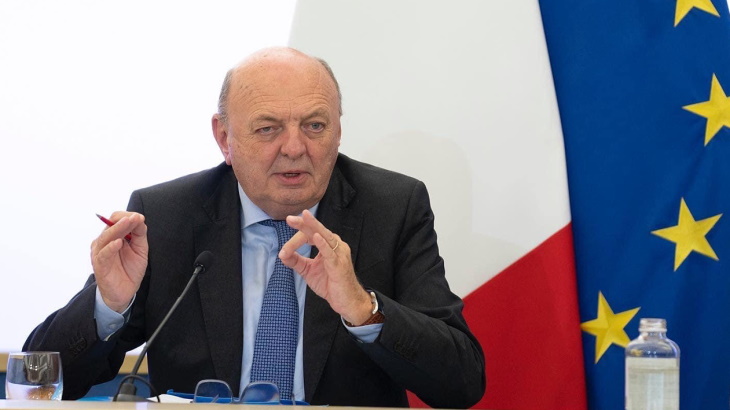
Pichetto Fratin speaking at a press conference following the cabinet meeting (Image: Ministry of Environment and Energy Security)

On 28 February, on the proposal of President Giorgia Meloni and the Minister of the Environment and Energy Security Gilberto Pichetto Fratin, the Council of Ministers (the Italian cabinet) approved the draft delegation law on 'sustainable nuclear energy'.

The government said the text is aimed at "the inclusion of sustainable nuclear and fusion in the so-called 'Italian energy mix' and intervenes organically from an economic, social and environmental perspective, within the framework of European decarbonisation policies with a time horizon of 2050, consistently with the objectives of carbon neutrality and security of supply".

It added that the intervention aims to: ensure continuity of energy supply in the presence of a constant increase in demand and promote the achievement of energy independence; contribute to the decarbonisation objectives necessary to tackle climate change; and ensure the sustainability of costs borne by end users and the competitiveness of the national industrial system.

The draft law says that Italy should make "a clear break ... with respect to the nuclear plants of the past" and "use of the best available technologies, including modular and advanced technologies". It calls for the government to establish an independent authority for the regulation, supervision and control of nuclear infrastructures.

"Promoters of nuclear projects must provide adequate financial and legal guarantees to cover the costs of construction, operation and decommissioning of the plants and for risks, even those not directly attributable to them, arising from nuclear activity," it adds.

The draft law requires the government to adopt a series of legislative decrees, within 12 months of entry into force, to "organically regulate the entire life cycle of the new sustainable energy, through the drafting of a national programme: from the testing, localisation, construction and operation of the new reactors, to the issue of manufacturing and reprocessing of the fuel will be addressed in a circular economy vision". It will also "serve to provide training and information tools, train new technicians and professionals in the sector, and identify benefits for the territories involved".

The draft law will now be submitted to parliament for final approval.

"With the latest generation nuclear, together with renewables, we will be able to achieve the objectives of decarbonisation, guaranteeing the full energy security of the country," Minister Pichetto Fratin said. "In this way, Italy is ready to face the challenges of the future."

The background
 

Italy operated a total of four nuclear power plants starting in the early 1960s but decided to phase out nuclear power in a referendum that followed the 1986 Chernobyl accident. It closed its last two operating plants, Caorso and Trino Vercellese, in 1990.

In late March 2011, following the Fukushima Daiichi accident, the Italian government approved a moratorium of at least one year on construction of nuclear power plants in the country, which had been looking to restart its long-abandoned nuclear programme.

The public mood has changed since then, and in May 2023, the Italian Parliament approved a motion to urge the government to consider incorporating nuclear power into the country's energy mix. In September last year, the first meeting was held of the National Platform for a Sustainable Nuclear, set up by the government to define a time frame for the possible resumption of nuclear energy in Italy and identify opportunities for the country's industrial chain already operating in the sector.

Italy's government included potential nuclear capacity - up to 16 GW/20-22% of capacity by 2050 - in its National Integrated Energy and Climate Plan, which was submitted to the European Commission on 1 July 2024.

Speaking the following day at the Global Energy Transition Congress in Milan, Pichetto Fratin, said: "We expect to be able to reach about 8 GW from nuclear power by 2050, covering more than 10% of the nation's electricity demand. This percentage may increase to over 20-22% by fully exploiting the potential of nuclear power in our country."

World Nuclear News


PDAC 2025: SMRs to help decarbonise mining in Canada


SMRs are emerging as a potential option for decarbonising mining operations, with Canada leading the way.
March 4, 2025
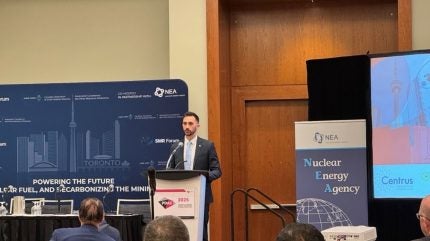
Ontario’s Minister of Energy and Electrification, Stephen Lecce, speaking at PDAC2025. Credit: Caroline Peachey.

Small modular reactors (SMRs) are expected to help decarbonise mining operations in Canada, according to speakers at PDAC 2025 in Toronto.

“The question is no longer if SMRs will play a role in powering mining, but really how quickly we can bring these projects online and scale their development,” said Ontario’s Minister of Energy and Electrification, Stephen Lecce, speaking at the SMR Forum co-hosted by the Canadian Association of Small Modular Reactors and the OECD Nuclear Energy Agency (NEA).

Lecce explained that the mining sector is experiencing surging demand for critical minerals, bringing with it growing electricity demand.

“We have been told by the Independent Electricity Systems Operator that [by 2050] we are going to need 75% more power. Mining’s demand will be even higher in the north, growing by 81% by 2050,” he said.

“This means we need to act today to ensure we have the reliable and affordable power required to build out that demand.”

According to the Ontario Mining Association, there are currently 36 active mining operations in the province and 32 significant exploration projects, mostly focused on critical minerals.

John Arthur Gorman, president of Westinghouse Canada, also stated that the country’s “biggest challenge is decarbonising its heavy industry, mining and other natural resources sectors” for which “small modular reactors are so vitally important”.

Lecce said that the Canadian Nuclear Safety Commission is expected to give the green light for construction of unit 1 of the Darlington new nuclear project “later this year”.

The project involves the construction of four General Electric Hitachi BWRX-300 SMRs, with the first unit set to be in place by 2030, followed by three more in the mid-2030s.

“This won’t just be a milestone for our province but a defining moment for the global nuclear industry,” Lecce said.  

In subsequent remarks on the PDAC exhibition floor, Lecce pointed to Canada’s vision to export SMRs, pointing to commitments with the Estonia, Czech Republic and Polish governments.

Despite the opportunity, a recent report by the NEA identified several barriers to SMR adoption at mine sites, including uncertainty around cost, regulation, permitting and public perception.

When evaluating an SMR programme, organisations could be considering up to 50 attributes spanning technology, regulatory, operational, jurisdictional and social implications, according to Norm Sawyer, president of ION Nuclear Consulting.

He also pointed out that the life cycle of a nuclear project is “100 years, cradle to grave”, while mines do not necessarily operate for this long. Speakers at the event also agreed on the importance of engaging indigenous communities early in the process, as well as the need for effective workforce strategies for SMR deployment.

Nuclear Power and Rare Earths Pique U.S. Interest in Armenia

By Eurasianet - Mar 05, 2025

Armenia is trying to attract US diplomatic attention by highlighting trade and investment opportunities in mining and nuclear power.

The US Embassy in Yerevan has shown support for Armenia's decision to guarantee a $150 million loan for a US-Canadian gold mining venture.

Armenia is considering bids from US, Russian, and South Korean firms to build a new nuclear reactor, potentially shifting away from reliance on Russia.


Armenia, a country making a geopolitical pivot away from Russia toward the West, is finding success in attracting US diplomatic attention by playing up opportunities for trade and investment in the mining and nuclear power sectors.

Since taking the reins of government in January, the Trump administration’s outlook on Eurasia has fixated on securing deals involving rare earths and nuclear power, underscored not only by the White House’s attempted minerals deal with Ukraine, but also via comments made by Secretary of State Marco Rubio during a late February conversation with Uzbekistan’s foreign minister.

Given the diplomatic focus on minerals in Washington, it is not a surprise that the US Embassy in Yerevan lauded the Armenian government’s decision on February 28 to guarantee a $150 million loan enabling a US-Canadian firm, Lydian Canada Ventures, to finish building extraction and smelting facilities for a gold mining venture. Environmental protesters forced a halt in 2018 to development of the Amulsar gold deposit and the venture had been in limbo since then.

“Armenia is open for U.S. businesses, and the U.S. Embassy is proud to support as we work toward a more prosperous future together,” read an embassy statement posted on Twitter, now dubbed X.

Meanwhile, Armenian officials are dangling the prospect that a US firm could build a new nuclear reactor in Armenia to replace the outdated Metsamor power station. Firms from Russia, the United States and South Korea have reportedly submitted bids. David Khudatyan, the government minister overseeing the tender process, did not provide an indication of when the winning bidder would be announced.


“We continue to study proposals for the construction of a new nuclear station. … A decision has not yet been made,” Khudatyan stated during a recent cabinet meeting. Current plans call for the new nuclear facility to become operational within 10 years. The aging Metsamor plant, which supplies about 40 percent of Armenia’s power needs, is slated to undergo a refurbishment in 2026 to extend its lifespan until the replacement facility can go into service.

Russia’s Rosatom will update Metsamor and was long assumed as having the inside track on securing the contract to build the new plant. But the rapid deterioration of Armenia’s and Russia’s strategic partnership, coupled with Prime Minister Nikol Pashinyan’s eagerness to secure US backing for his “Real Armenia” initiative to remake the country’s political culture, would seem to raise the odds that the United States could emerge as the winner of the bidding process.

By Eurasianet.org


Penn State applies to build Westinghouse microreactor


Wednesday, 5 March 2025

Pennsylvania State University has initiated the application process to construct a Westinghouse eVinci microreactor at a new research facility at its University Park campus.

Penn State applies to build Westinghouse microreactor
eVinci (Image: Westinghouse)

Westinghouse and Penn State signed a memorandum of understanding in May 2022 to partner on research and development efforts focused on exploring and applying nuclear engineering and science innovations to societal needs. The research initiative at the university is called FRONTIER (Forging a Renaissance of Nuclear Through Innovation, Entrepreneurship, and Research). They also began discussions about siting a Westinghouse eVinci microreactor at University Park.

The partners have now announced that Penn State submitted a letter of intent to the US Nuclear Regulatory Commission (NRC) on 28 February, the first step in the application process to install an eVinci.

"Today, the university announced its intent to make Westinghouse's eVinci microreactor a research priority," said Andrew Read, senior vice president for research at Penn State. "We believe this technology has the potential to change how we think of and use nuclear energy. And with Pennsylvania's and Penn State's rich history in nuclear research, FRONTIER is the team to lead this endeavour."

Tonya Peeples, Harold and Inge Marcus Dean of Engineering at Penn State, added: "We hope to leverage our legacy and produce new research using this new nuclear technology. We intend to advance and develop the skilled workforce needed in all areas, including engineering, construction, AI, operations, project management, licensing, safety, security, supply chain and many more."

As part of the application process, Penn State will continue to engage with the NRC and determine possible locations for the facility.

"Penn State's new University Park research facility will further solidify Pennsylvania as one of the world's leading nuclear innovation hubs," said Jon Ball, president of eVinci Technologies at Westinghouse. "We look forward to bringing our advanced eVinci technology to the FRONTIER programme to find new ways of harnessing nuclear energy while providing students and researchers with unprecedented opportunities."

Westinghouse says the factory-built eVinci reactor - which has very few moving parts - works essentially as a battery, providing the versatility for power systems ranging from several kilowatts to 5 megawatts of electricity. It can also produce high temperature heat suitable for industrial applications, including alternative fuel production such as hydrogen, and has the flexibility to balance renewable output. In September last year, the company became the first of three microreactor developers supported by the US Department of Energy's National Reactor Innovation Center to submit a Preliminary Safety Design Report, a milestone towards testing at Idaho National Laboratory.

Amentum awarded Sizewell C project management contract

Wednesday, 5 March 2025

US-based engineering company Amentum has been selected as sole programme and project management delivery partner for the planned Sizewell C nuclear power plant in the UK.

Amentum awarded Sizewell C project management contract
The signing of the contract by (from left) Jon Fowler, Amentum Vice President for Nuclear Power; Nigel Cann, Sizewell C Joint Managing Director; and James Bull, Amentum New Nuclear Director of Frameworks (Image: Amentum)

As well as programme and project management, Amentum will support delivery teams from Sizewell C Ltd with digitally aligned project controls, engineering and technical services, and innovative infrastructure solutions for site management. The contract duration is until the plant begins generating electricity.

"Amentum's global programme management capabilities and international nuclear new-build experience will help us deliver the game-changing benefits and cost savings of replicating Hinkley Point C's reactor design, while supporting our commitment to creating jobs and skills in the UK and maintaining the national capability essential for the nuclear renaissance," said Nigel Cann, Joint Managing Director of Sizewell C.

"Our international programme management experience and the learning from our work at Hinkley Point C will help to advance a project which is crucial for job creation and economic growth across the country," said Andy White, senior vice president of Amentum Energy & Environment International.

The EDF-led plan is for Sizewell C to feature two EPRs producing 3.2 GW of electricity, enough to power the equivalent of around six million homes for at least 60 years. It would be a similar design to the two-unit plant being built at Hinkley Point C in Somerset, with the aim of building it more quickly and at lower cost as a result of the experience gained from what is the first new nuclear construction project in the UK for about three decades.

Sizewell C Ltd, a standalone company, is 76% owned by the UK government, which has pledged investment totalling GBP2.5 billion (USD3.2 billion).

The project is due to receive its Final Investment Decision in the government's upcoming Spending Review.

Norwegian regulator approves transfer of Halden licence

Wednesday, 5 March 2025

The Norwegian Radiation and Nuclear Safety Authority has given its approval for Norwegian Nuclear Decommissioning to assume responsibility for the nuclear fuel and materials testing reactor at Halden, which is to be decommissioned. It is now up to the government to grant an operating licence.

Norwegian regulator approves transfer of Halden licence
(Image: NND)

Established as an agency under the Ministry of Trade, Industry and Fisheries in February 2018, Norwegian Nuclear Decommissioning (NND) is responsible for decommissioning the research reactors and other related nuclear infrastructure, as well as the safe handling, storage and disposal of radioactive waste.

NND submitted an application in December 2022 for a licence to own and operate the two Norwegian nuclear facilities in Halden and Kjeller, as well as the operation of the waste landfill for low- and intermediate-level radioactive material in Himdalen. The current licence holder is the Institute for Energy Technology (IFE).

Norway's two research reactors - the nuclear fuel and materials testing reactor at Halden and the JEEP-II neutron scattering facility at Kjeller - were declared permanently shut down by IFE in June 2018 and April 2019, respectively.

In December last year, DSA submitted a recommendation on NND's licence application for the Halden nuclear power plant. The licence is granted by the government, based on DSA's recommendation. DSA recommended that the licence should be transferred no earlier than 1 March this year, and pointed out several conditions that must be in place before the licence transfer. DSA announced that these conditions would be assessed in connection with NND's application for operating approval. 

DSA has now said that NND has followed up on its recommendations.

"Based on a comprehensive assessment of the facility's technical condition, operating regulations, safety measures and emergency response plan, as well as the facility's management and personnel, DSA grants NND approval to operate the nuclear facility in Halden from the time NND receives a licence for the facility," it said.

"In assessing NND's application for operating approval for the nuclear plant in Halden, we have emphasised that the additional conditions we described in the recommendation must be met," said DSA Director Per Strand. "We now believe that they are, which is why we have given our approval for operation."

He added: "We now consider that everything is clear on our part for NND to take over the concession for the nuclear plant in Halden and ensure the safe operation of the plant."

Thorcon applies to build Indonesia's first nuclear power plant

Wednesday, 5 March 2025

PT Thorcon Power Indonesia has submitted documents to Indonesia's nuclear regulator, initiating the licensing process for the construction of a power plant based on its advanced molten salt reactor technology. A site at Kelasa Island, located in Central Bangka, is being investigated to host the plant.

Thorcon applies to build Indonesia's first nuclear power plant
A rendering of one of the reactor modules Cans (Image: Thorcon)

PT Thorcon Power Indonesia (PT TPI) - a subsidiary of Thorcon International, a Singapore-based company - submitted its Site Evaluation Programme (PET) and Site Evaluation Management System (SMET) documents for approval to Indonesia's Nuclear Energy Regulatory Agency (BAPETEN) during a meeting held on 13 February at BAPETEN's Jakarta office. It was presented by Thorcon Chief Nuclear Officer Kun Chen to BAPETEN's Deputy Chairman Haendra Subekti.

"With this submission, PT TPI officially becomes the first NPP licence applicant in Indonesia's history, positioning the country for a new era of nuclear energy innovation and development," Thorcon said.

It added that it is "fully committed to addressing any feedback from BAPETEN during the review process to ensure a swift and thorough evaluation".

The submission follows almost two years of pre-licensing consultations. In March 2023, PT TPI and BAPETEN signed an agreement to officially start a '3S' (safety, security and safeguards) consultation in preparation for licensing a demonstration 500 MWe Thorcon molten salt reactor. The consultation included: a review of the master plan document for the construction of the plant; consultation on the roadmap related to the reactor prototype and the Non-fission Test Platform (NTP) facility; preparation of technical and non-technical documents related to the reactor prototype and NTP required for licensing; and consultation on reactor design approval.

PT TPI's proposed plant is based on technology developed by the US DOE Oak Ridge National Lab in the 1960s. It will feature the Thorcon 500, a 500 MWe molten salt reactor (MSR) power plant, comprised of two low-enriched-uranium-fueled 250 MWe reactors in two replaceable, sealed 'Cans'. At any one time, just one of the Cans of each power module is producing thermal power. After eight years of operation, the nuclear module is disconnected, replaced with a new one, and towed to a maintenance centre for Can replacement.

MSRs use molten fluoride salts as primary coolant, at low pressure. They may operate with epithermal or fast neutron spectrums, and with a variety of fuels. Much of the interest today in reviving the MSR concept relates to using thorium (to breed fissile uranium-233), where an initial source of fissile material such as enriched uranium needs to be provided.

"Designed for modular manufacturing, the Thorcon 500 aligns with the highest international safety standards and is expected to play a key role in Indonesia's energy transition," the company said. "After the initial plants is successfully deployed, Thorcon intends to develop a local manufacturing assembly line for Thorcon reactors, fostering the growth of a new industrial sector in Indonesia."

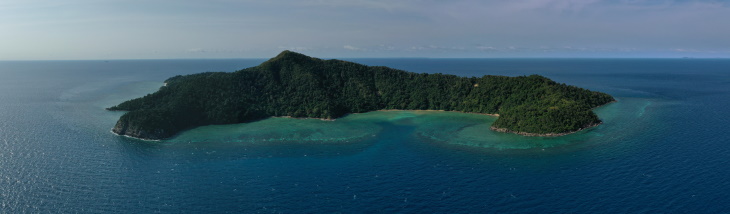
A preliminary site survey conducted on Kelasa Island, located in Central Bangka in Bangka Belitung Province has identified the site as "a strong candidate" for the plant, Thorcon said. "The survey focused on safety, ecological, and site suitability factors, with initial results showing promise for further studies."


Kelasa Island (Image: Thorcon)

"We are thrilled to announce that PT TPI has become the first applicant for a nuclear power plant licence in Indonesia," said Chen. "This submission marks a historic moment for Indonesia, and we are proud to be leading the charge in bringing innovative nuclear energy solutions to the nation. We are fully prepared to collaborate with BAPETEN and undergo a rigorous evaluation process. Our commitment is to bring Indonesia's first operational nuclear power plant online by 2032 or earlier, supporting the country’s economic growth, energy security, and sustainability."

"We recognise and appreciate the efforts of PT TPI for their proactive consultations within the 3S framework," BAPETEN's Subekti said. "This approach ensures that all safety and security aspects are addressed and will help minimise technical and administrative obstacles as the licensing process continues."

The Indonesian government has committed to implementing an energy transition to reduce climate change and achieve net-zero emissions by encouraging research and development of renewable power generation technologies. The government is targeting 8 GWe of installed capacity to come from nuclear power plants in 2035, increasing to 54 GWe in 2060.

PT TPI said its proposed plant "will provide a stable, low-cost source of baseload electricity that will complement renewable energy sources like solar and wind".

Trial run at Finnish encapsulation plant completed

Wednesday, 5 March 2025

Finnish radioactive waste management company Posiva announced it has completed a demonstration of the functionality of the used nuclear fuel encapsulation plant at Olkiluoto.

Trial run at Finnish encapsulation plant completed
(Image: Posiva)

The encapsulation plant is part of Posiva's final disposal facility complex. Once the final disposal operation starts, used nuclear fuel will be transported from interim storage to the encapsulation plant where it will be packed into final disposal canisters made of copper and spheroidal graphite cast iron. From the encapsulation plant, the canisters will be transferred into the underground tunnels of the repository, located at a depth of 400-450 metres, and further into deposition holes lined with a bentonite buffer.

Posiva has now completed the Trial Run of Final Disposal (TRFD) at the encapsulation plant. The fifth and final canister used in the trial run - which began in August last year - has been encapsulated, subjected to a construction inspection, and transferred successfully to the underground storage at a depth of 430 metres. In the so-called retrieval test, one canister was retrieved back to the encapsulation plant according to plans.

"This was a significant milestone of the test production stage," said Posiva Production Director Karri Osara. "We are now in a good position and feeling positive to move forward and go underground to continue the Trial Run at the final disposal repository. We have an extremely high mindset to execute TRFD to a high standard and safely."

The Trial Run of Final Disposal next continues underground once individual tests have been acceptably completed on all the underground production equipment. During the Trial Run, the operation of the complete final disposal facility is tested. Instead of actual used nuclear fuel, the trial run is conducted using non-radioactive test elements. Areas identified at the encapsulation plant as needing improvement included adjustments of some equipment.

The government granted Posiva a construction licence for the project in November 2015 and construction work on the repository started in December 2016. Once it receives the operating licence, Posiva can start the final disposal of the used fuel generated from the operation of TVO's Olkiluoto and Fortum's Loviisa nuclear power plants. The operation will last for about 100 years before the repository is closed.

 World Nuclear News