Thursday, March 06, 2025

Catholic women go on Lenten strike to highlight their work in the church

(RNS) — The Synod on Synodality disappointed many women’s hopes that it would recognize women’s essential role in the church. A women’s strike, they hope, will make their point.

Flyers for the Catholic Women Strike initiative. 
(Images courtesy of Women’s Ordination Conference)


Claire Giangravé
March 5, 2025


(RNS) — As Lent began on Ash Wednesday (March 5), Catholic women frustrated over being disenfranchised by the church despite promises of greater recognition are going on strike, withholding numerous services and ministries to their Catholic parishes, schools and universities.

Organized by the Women’s Ordination Conference, a 50-year-old group based in Rome that advocates for women to be made priests, bishops and deacons, the Catholic Women Strike is planned to go through Easter, April 20. It also includes a day of action on March 9, where women are invited to protest and advocate for greater inclusion and influence in the church.

“We’re calling the women of the Catholic Church to join together in striking from sexism by withholding labor, time and financial resources from the church during Lent,” said Kate McElwee, executive director of the Women’s Ordination Conference.


The conference has prepared a toolkit to answer questions about how to participate in the strike, suggesting that women refrain from attending Mass, send letters to their local priest or bishop highlighting the need for recognition of women’s roles or withhold donations and work.

According to church data, women perform the vast majority of the work in churches and dioceses and make up 80% of lay ecclesial ministers.

The recently ended Synod on Synodality, a three-year-long global consultation of Catholic faithful called by Pope Francis in 2021, raised hopes that the church might open the door for women to be ordained as deacons, who may perform some of the church’s seven sacraments and preach at Mass. Women’s roles in the church was among the top concerns of Catholics in the consultation that went on in parishes and dioceses, with most saying they’d like to see women have a greater say in decisions.

But before the synod’s final meeting in Rome, where women were given a vote in the proceedings alongside bishops and other clergy, the pope put the brakes on the push for women deacons, saying the question “was not yet mature.” He instead created a study group to further discern the church’s options.
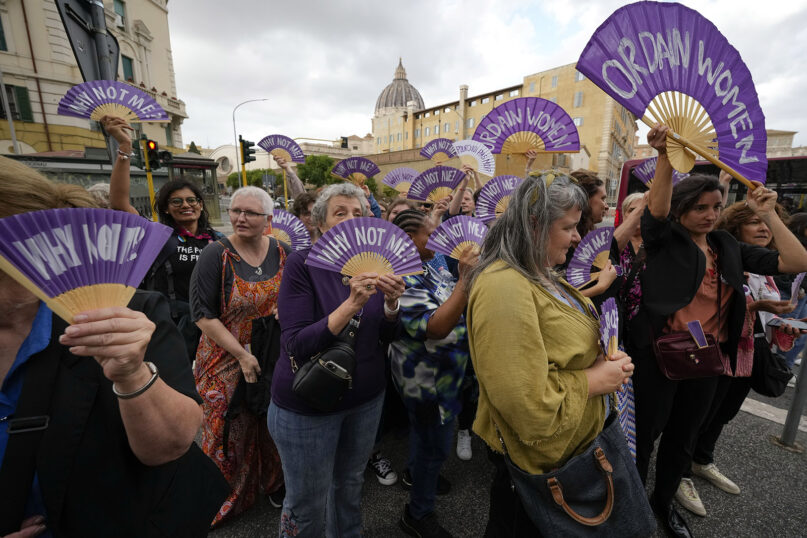
Advocates for women’s ordination hold banners during a protest in Rome just in front of the Vatican, where Pope Francis is holding the Synod of Bishops, Oct. 4, 2024. 
(AP Photo/Andrew Medichini)

“Following the Synod on Synodality and the lack of concrete actions for women and women’s greater participation in the life of the church, there was a lot of disappointment, anger and heartbreak,” said McElwee.

McElwee said that it’s hard to gather data on how many women will take part in the strike but said she was hearing from women working in embassies, universities, schools and dioceses, from the United States to Poland and Italy. Many women who volunteer in their parishes are also taking part in the initiative.

Suzanne Holt-Savage, 62, a lay Dominican associate who worships at Christ on the Mountain Catholic Church in Lakewood, Colorado, said she learned about the strike in an email from the Women’s Ordination Conference and decided to lead a group of 10 women to participate and lead a witness outside the Denver Cathedral Basilica of the Immaculate Conception on March 9.

“I had misgivings about the Synod on Synodality, but I still hoped it would bring women’s ordination forward, and it really didn’t,” Holt-Savage said in a phone interview.

She said she already sent an email to her priest explaining why she won’t be attending Mass on Sundays and that she will also withhold her donations. Holt-Savage explained that she has longed for women to have a greater voice in the Catholic Church, adding that she was struck on the few occasions she heard women in other denominations preach.

“Having more girls grow up seeing the likes of Bishop (Mariann) Budde, what she said from the pulpit, that’s what I want,” Holtsavage said, referring to the Episcopal bishop of Washington who made an appeal for mercy during a prayer service attended by President Donald Trump the day after his inauguration. “That was so fantastic to me, seeing a woman speaking like that, having that platform,” she added.

Kelly Hamilton, 66, one of the women who will protest outside the Denver cathedral, said she can’t do much more for the strike. She performs countless ministries for the Christ on a Mountain parish, including leading the choir as a soloist and working on a committee to provide underprivileged families with everything from Christmas gifts to grocery cards. Hamilton also visits nursing homes with the parish’s deacon to make sure that the elderly have the Eucharist once a month. During her interview with RNS, she was cooking a casserole for a funeral service.

“I will not withhold my ministry because, to me, it would hurt other people. It would hurt mostly the women that I work alongside, because their workload would double,” she said, “but I do see the necessity of having more power, or at least have a place at the table in the church, and we really don’t have that.”

Hamilton said she was among those who were disappointed by the synod’s failure to recognize the role of women and the female diaconate, especially after she had taken part in several synodal meetings in the parish, where the question was front and center.

“You kind of wonder, why am I going to all these meetings and giving all this time when my voice isn’t going to be heard? So I just keep on working, because I will never leave the Catholic religion, because I don’t feel like I can change it if I leave it,” she said.


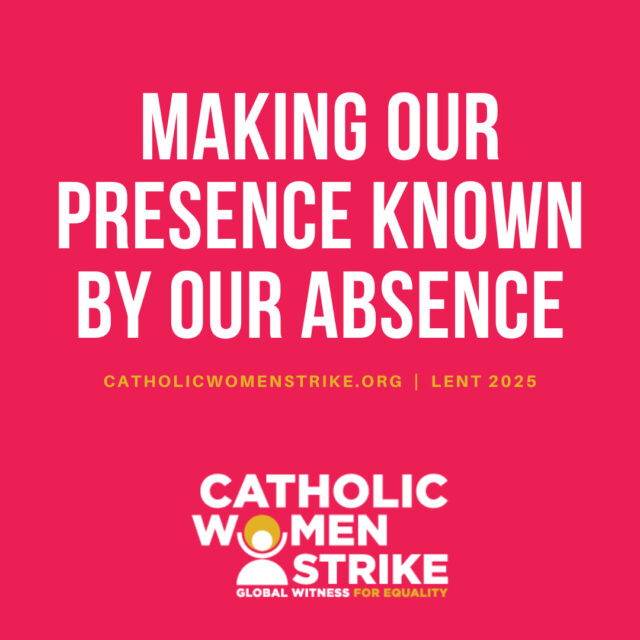
Flyer for the Catholic Women Strike initiative. (Image courtesy of Women’s Ordination Conference)

If women’s roles are a concern in U.S. churches, said Elisa Belotti, 28, a Catholic in Brescia, in northern Italy, simply not showing up at church gatherings or Mass would be counterproductive in Italy.

“If you are a woman who is very active in promoting women’s roles, they might be happy if you are not there,” she said. “Being present is also a form of resistance that needs to be maintained.”

Instead, as a member of Italian Women for the Church, a separate Catholic feminist organization, she will join the strikers by focusing on raising awareness about the work women already do in the church and informing as many people as possible about the strike and the reasons behind it.


“We want the church to be evangelizing and open to everyone who wants to be a part of this faith,” Belotti said, adding that she hopes “this strike will be the necessary jolt to have a more concrete understanding of the problems that exist.”
As Black History Month ends, a reading list for the rest of the year

(RNS) — An arsenal of 28 books that should make it possible for 'whosoever will' to learn and grow.

(Photo by Alexandra Fuller/Unsplash/Creative Commons)

Cheryl Townsend Gilkes
February 28, 2025

(RNS) — I always tell people that, as a college professor, I got to do the two things I loved best in the world — read and talk. One thing I miss most now that I am emerita is the opportunity to prescribe books for students to read. I not only recommended books to my students but had fantasies that they would run out to buy my recommendations and take them to the beach to read in the summer.

Several years into teaching I discovered that some of my students were not only buying and reading the books I recommended, but they were sending them and the assigned reading for my courses home to their parents. Some parents actually thanked me at graduation for what they learned from the books their children had sent home.

I especially enjoyed teaching, and recommending, during Black History Month. Beginning as “Negro History Week” in 1926, Black History Month was created by Carter Godwin Woodson, the first African American to receive a Ph.D. in history from Harvard University, in part to equip teachers with materials about African Americans and their experiences. Woodson chose the second week in February in order to celebrate the birthdays of Frederick Douglass, (Feb. 14) and Abraham Lincoln (Feb. 12).

In 1915, Woodson had founded the Association for the Study of Negro Life and History (now the Association for the Study of African American Life and History), perhaps the only learned society supported by local chapters of community members as well as a national membership of professional historians and other scholars.

Woodson also founded Associated Publishers, which, in addition to publishing the Journal of Negro History, prepared kits for teachers at all educational levels. Woodson took advantage of the contradictions built into de jure segregation to reach the majority of African American school children in their segregated schools.

Church leaders also became members of his association. One of his supporters, Nannie Helen Burroughs, who had begun her career as the corresponding secretary of the National Baptist Convention Foreign Mission Board, mobilized her denomination’s women, the principal educators in their churches — the convention had previously been associated with a company that encouraged Black pride through “colored dolls” manufactured through the National Negro Doll Company. In 1927, Burroughs addressed the annual meeting of the association, insisting that it was “the duty the Negro owes to himself to learn his own story.”

In cooperation with the Women’s Auxiliary of the National Baptist Convention, Burroughs founded the National Training School for Women and Girls, making one of its graduation requirements the delivery of a public address on what was then called “Negro History.” She envisioned unleashing an army of articulate Black women household domestics as missionaries who could advocate on behalf of Black people. In that spirit, throughout my time as a professor of African American studies and sociology, I repeatedly told people that African American Studies is missionary work.

We are currently facing a moment when racial antipathy has (again) taken control of key segments of American governance. The Trumpian notion of civil rights enforcement in higher education seeks to stop discussions about race or identity. A white person who feels uncomfortable with class discussions about race or specific “ethnic” experiences may claim discrimination. Educational policies aiming to provide relief for people and groups who have experienced historical legal adversity are now being turned on their heads and used as examples of so-called reverse discrimination. Whole disciplines are under threat in institutions that receive federal funds.

The aim is a kind of cultural homicide the Rev. Martin Luther King Jr. decried in his last book, “Where Do We Go From Here? Chaos or Community,” published in 1967. In the book, King lamented the failure of American education to include the African American experience. He described an incident at his children’s newly desegregated school in which students presented a public program on the multiple ethnic traditions comprising American music that ignored totally the contributions of African Americans.

The incident left King and his wife, music educator Coretta Scott King, experiencing “a combination of indignation and amazement.” He wrote, “I wept within that night. I wept for my children and all black children who have been denied a knowledge of their heritage; I wept for all white children, who, through daily miseducation, are taught that the Negro is an irrelevant entity in American society; I wept for all the white parents and teachers who are forced to overlook the fact that the wealth of cultural and technological progress in America is a result of the commonwealth of inpouring contributions.” In King’s view, exclusion and erasure victimizes everyone and reinforces a vicious form of racism.

In hopes of counteracting these trends in some small way, I will end Black History Month by recommending an arsenal of 28 books that should make it possible for “whosoever will” to learn and grow. We cannot allow the politics of hate to succeed in fostering the racism of “cultural erasure.” We need to celebrate and learn now more than ever, for the healing of the nation.


(Photo by Hermann Traub/Pixabay/Creative Commons)

A More Perfect Party: The Night Shirley Chisholm and Diahann Carroll Reshaped Politics,” by Juanita Tolliver (2025)

An African History of Africa: From the Dawn of Humanity to Independence,” by Zeinab Badawi (2025)

Black in Blues: How a Color Tells the Story of My People,” by Imani Perry (2025)

Bouki Fait Gombo: A History of the Slave Community of Habitation Haydee (Whitney Plantation) Louisiana, 1750-1860,” by Ibrahima Seck (2014)

Carver: A Life in Poems,” by Marilyn Nelson (2001)

Creating Black Americans: African-American History and Its Meanings, 1619-Present,” Nell Irvin Painter (2006)

Dancing in My Dreams: A Spiritual Biography of Tina Turner,” by Ralph Craig III (2023)

Down, Up, and Over: Slave Religion and Black Theology,” by Dwight N. Hopkins (2000)

Ella: A Novel,” by Diane Richards (2024)

Gullah Geechee Home Cooking: Recipes from the Matriarch of Edisto Island,” by Emily Meggett (2022)

Healing for the Soul: Richard Smallwood, the Vamp, and the Gospel Imagination,” by Braxton D. Shelley (2021)

Homecoming: Healing Trauma to Reclaim Your Authentic Self,” by Thema Bryant (2022)

James: A Novel,” by Percival Everett (2024)

Jesus and the Disinherited,” by Howard Thurman (1949)

Legacy: A Black Physician Reckons with Racism in Medicine,” by Uche Blackstock, M.D. (2024)

My Face Is Black Is True: Callie House and the Struggle for Ex-Slave Reparations,” by Mary Frances Berry (2005)

Our Secret Society: Mollie Moon and the Glamour, Money, and Power Behind the Civil Rights Movement,” by Tanisha C. Ford (2023)

Prayers for Dark People,” by W.E.B. Du Bois (1909-1910)

Somebody’s Calling My Name: Black Sacred Music and Social Change,” by Wyatt Tee Walker (1979)

Taking the Arrow Out of the Heart: Poems,” by Alice Walker (2018)

The Collected Poems of Audre Lorde,” by Audre Lorde (1997)

The Mis‑Education of the Negro,” by Carter G. Woodson (1933)

The Souls of Black Folk,” by W.E.B. Du Bois, (1903)

The Weeping Time: Memory and the Largest Slave Auction in American History,” by Anne C. Bailey (2017)

There Is a River: The Black Struggle for Freedom in America,” by Vincent Harding (1981)

Under the Skin: The Hidden Toll of Racism on American Lives and on the Health of Our Nation,” by Linda Villarosa (2022)

We Are the Leaders We Have Been Looking For,” by Eddie Glaude Jr., (2024)

When Sunday Comes: Gospel Music in the Soul and Hip-Hop Eras,” by Claudrena Harold (2020)


Cheryl Townsend Gilkes. (Courtesy photo)
(Cheryl Townsend Gilkes is an assistant pastor for special projects at Union Baptist Church in Cambridge, Massachusetts, and the John D. and Catherine T. MacArthur Professor Emerita of African American Studies and Sociology at Colby College. The views expressed in this commentary do not necessarily reflect those of Religion News Service.)


Organizing the Battery Belt

In deep-red Hardin County, Kentucky, workers are trying to unionize a new electric vehicle battery plant. If Donald Trump scraps the IRA, it may cost thousands of his supporters safe, well-paying jobs.

March 2, 2025
Source: Jacobin


BlueOval SK workers in Hardin County discuss unionization. (Courtesy of the UAW)


On a bright winter afternoon in Hardin County, Kentucky, I drive through a snowy residential neighborhood, rural enough for a bird of prey with a critter in its talons to fly above my windshield. Then, turning a corner, I come to a massive, sprawling factory actively being built.

Smokestacks pump. Bulldozers push dirt. There are actually twin factories going up, side by side. A steady stream of Korean specialists — here from their homes six thousand miles away to train local workers — throw on hard hats and light cigarettes on their way into the plant. Somber warnings posted in English and Korean forbid anyone from capturing footage inside the plant. I loiter outside the metal detectors and the rest of the beefy security apparatus snapping photos on my phone until a guard hustles out ordering me to delete them. I feel like I’ve wandered into an exclusionary zone where a top-secret military base is being hastily constructed.

This is the electric vehicle battery plant BlueOval SK, a joint venture between American car giant Ford and the South Korean electric vehicle battery company SK On. Along with its sister plant in Tennessee, this will be the largest manufacturing project Ford has ever undertaken.

BlueOval SK is part of a rapid-fire blitz in American manufacturing pushed by generous corporate incentives in the Biden administration’s landmark 2022 Inflation Reduction Act, or the IRA. Aiming to both fight climate change and boost American manufacturing, the Biden administration calculatedly tied the IRA’s green energy provisions to job creation. An estimated $422 billion in overall investments and 400,000 jobs have been announced in clean energy since the IRA was passed. More than half of those jobs are in Republican-held congressional districts like Hardin County.

Outside of Tennessee and Kentucky, plants like BlueOval SK have sprouted up in Indiana, Ohio, Georgia, and North and South Carolina. Collectively, these manufacturing facilities have already garnered a nickname: the battery belt. But President Donald Trump, backed by 64 percent of Hardin County voters in the 2024 election, is vowing to stop the growth of the electric vehicle industry, which could soon endanger the prospects for both BlueOval SK and its workers. Republican lawmakers in this district are faced with a question: Will they stand with Trump or their own constituents’ livelihoods?

“We’re in the early stages of a once-in-a-century transition,” says Nick Nigro, founder of the clean-energy research firm Atlas Public Policy. In the electric vehicle industry, the paramount concern is the United States falling too far behind to the currently dominant Chinese market. “What’s on the line right now — it’s not just the jobs of today, it’s the jobs of the future. If we lose this market today, China and the rest of the world blows past us. The way for us to reduce the risk of losing jobs is to keep building the products of the future — and, frankly, to go faster.”

Now here’s the thing about all those new battery belt jobs: they can be extremely dangerous. Workers at battery plants face a harrowing array of hazards, from fires to toxic fumes to “acid spills potent enough to eat through flesh and bone.”

In Hardin County, those threats have supercharged a union drive. BlueOval SK won’t begin production in Kentucky until later in 2025, but its workers have already filed for an election to join the United Auto Workers (UAW), the powerful union representing nearly 400,000 members nationwide. Their unionization fight will come under a Trump administration that is actively reversing pro-union Joe Biden–era policies and a recently confirmed labor secretary, Lori Chavez-DeRemer, who has already walked back her past support for legislation that supports union organizing.

Halee Hadfield — a quality operator at BlueOval SK — says that higher wages that might come through bargaining would be “gravy on the biscuits.” But what she really cares about is her health. Hadfield and her coworkers hope that by unionizing, they can win proper safety protocols and personal protective equipment.

“I’m twenty-fix,” she says. “I don’t wanna breathe in these fumes and go to the doctor at thirty-six because I have a cough that won’t stop and get told, ‘You have six months to live, you’re dying of cancer.’” Hadfield says she’s been explicitly told in training classes that the company is prioritizing its production goals over everything, including worker safety.

“All they care about is making batteries and making money,” Hadfield says. “I get that — we all have an interest in whether or not this company succeeds. But not at the expense of my literal life. Or anyone else’s.”

At BlueOval SK, the workers building the future of the car industry are in an unprecedented situation. They’re hoping Trump won’t kill their jobs. And they’re hoping their jobs won’t kill them.
How Trump Is Plotting to End the Electric Car

In his January 20 inauguration speech, Trump promised that “we will build automobiles in America again at a rate that nobody could have dreamt possible just a few years ago,” meaning gas-powered cars, and boasted that his actions were all about “saving our auto industry and keeping my sacred pledge to our great American autoworkers.”

Rob Collette, a fortysomething self-described “punk-rock kid” covered in tattoos, is an operator in the formation process at BlueOval SK. Despite what Trump might suggest, Collette is very much an American autoworker. And he is a true believer in electrification and BlueOval SK. “The technology, the facility, the machinery,” he says. “It’s blown my mind.”

Several months back, while out on a cigarette break at work, Collette fell amid construction material. His foot caught on scaffolding, and his body landed awkwardly. He knew immediately that he’d broken his hip. Colette sees his injury as part of a pattern of neglect from BlueOval SK that means “nobody feels safe.”

But despite his injury, Collette can’t wait to get back to the job. He’s now in physical therapy twice a week, working as hard as he can on his rehabilitation.

“This is the future,” he says. “To be lucky enough to be a part of it — I feel it’s a blessing. We all want to build the best batteries available — we wanna ring bells.”

In an executive order released on the day of his inauguration, Trump promised “to eliminate the ‘electric vehicle mandate.’” While the order itself was largely ceremonial, the Trump administration has now begun to roll back Biden’s incentives. Actions have ranged from pausing a fund for electric vehicle charging stations to freezing all federal climate spending. While federal judges have instructed the administration to unfreeze the money, the disruption is already impacting projects nationwide. Additionally, the Trump administration’s Environmental Protection Agency has stated that it plans to end the contracts for $20 billion in clean energy funds already allocated to communities across the country.

The ultimate goal for many Congressional Republicans will be to repeal parts or all of the IRA. Rep. Brett Guthrie (R-KY), who represents Hardin County in the House, has championed that cause.

Elected as the chair of the House Energy and Commerce Committee in December just after Trump’s election victory, Rep. Guthrie has attacked the IRA, referring to some of its provisions as “Green New Deal slush fund[s].” But when it comes to the IRA’s provisions boosting electric vehicles, Guthrie has not been so outspoken. When Kentucky’s BlueOval SK plant was first announced in 2021, Rep. Guthrie was happy to boast that the investment was “innovative” and “historic” for “hardworking Kentuckians.”

Guthrie’s office did not respond to multiple requests for comment for this piece.

Despite having greatly benefited from the IRA, Tesla CEO and close Trump advisor Elon Musk supports Trump’s move to reverse its policies. “Take away the subsidies,” Musk has posted on X/Twitter. “It will only help Tesla.” The reason is both cynical and simple: Musk is likely betting that doing away with said subsidies will hurt his competition more than it will hurt him. As the American Prospect’s David Dayen has put it, Tesla would be “pulling up the ladder after climbing it themselves.”

BlueOval SK estimates it will employ five thousand people when fully up and running in Kentucky. According to a 2023 report commissioned by the Hardin County Chamber of Commerce, BlueOval SK has the potential to create more than eight thousand additional local jobs along with other ancillary effects: more housing, better hospital services, more students enrolled in the local school system.

The IRA accelerated the electric vehicle industry both by providing tax credits to consumers to incentivize them to purchase electric cars and by providing massive tax credits to the companies producing the vehicles and their component parts. On an earnings call soon after the IRA passed, Ford’s CEO estimated its credits could be worth up to $7 billion for the company over just the next few years. The federal government has also awarded more than $23 billion in loans and grants to the electric vehicle industry. That, in turn, led to roughly $150 billion in private investments.

Just before Biden left office, BlueOval SK received its $9.63 billion federal loan in full, a spokesperson for the company confirmed. “We will monitor changes made by the current administration and adapt as needed,” the spokesperson told me. “However, our vision of electrification remains a key part of the future.”

Hadfield says that she and her coworkers do at times have friendly debates about Trump’s policies and their potential impacts on their jobs, but that ultimately any differences in opinion are largely swept away by their symbiosis on the union efforts.

As for her personal point of view, she says, “There’s been subsidies for Wall Street. There’s been subsidies for oil companies. I don’t understand what the issue would be with subsidies as it pertains to investing in the future — quite literally — of mobility.”
Going Home With All Your Fingers and Toes

Many of the states making up the battery belt, including Kentucky, have right-to-work laws, legislation supported by Trump and his new labor secretary that makes it harder for unions to collect dues and bargain. In 2023, the UAW won huge gains for their workers at plants owned or operated by Ford, General Motors, and Stellantis — including pay raises and improved profit sharing — after the “stand-up strike,” an innovative approach in which a collective 50,000 workers struck in waves for over a month. In the wake of the strike’s success, the UAW began branching out to the American South, where unions have historically struggled to gain ground.

The IRA offers manifold gifts to corporations, but it does not mandate any basic manufacturing labor conditions that companies must meet to qualify for all that free money. So while politicians love to boast that manufacturing facilities like the ones growing throughout the battery belt are bringing “good jobs” to their local economies, it’s often up to those workers to ensure that their jobs are, in fact, safe and well-paying.

The headquarters of the UAW’s Hardin County branch is a low, utilitarian brick building fronted by an American flag and, on a recent crisp winter night, slick patches of ice. Inside, BlueOval SK workers chat happily while rooting through boxes of bright red shirts reading “Future UAW member.” On one wall, a righteous bald eagle cruises alongside a relevant slogan: “AMERICA WORKS WHEN YOU BUY AMERICAN.”

Emily Drueke, a cheery twentysomething wearing a pink sweater and a penguin-shaped backpack, tells me that the issues she and her coworkers face range from lackluster health insurance to a literal bat infestation at a makeshift training center for BlueOval SK hires. “I saw one chase a girl,” Drueke says. “I was like, ‘Oh, I’m glad that ain’t me.’”

Then there’s the constant fear of fires and explosions stemming from the highly combustive nature of the raw materials in the plant. In training, they were told to refer to any such incidents by the mild euphemism “thermal events.” In South Korea, explosions at battery plants have led to mass casualties.

Driving around near BlueOval SK, you’ll see a crop of billboards plugging the plant. One reads “Kentucky is electric” and features a worker decked out in elaborate, futuristic personal protective equipment. In training, Halee Hadfield says, she was shown image after image of workers similarly decked out in what she calls “astronaut suits.”

When Hadfield actually began work, she was shocked to see that she wasn’t given enough respirators, professional-grade masks needed to filter out fumes and chemicals. “Thanks for the $60 branded company hoodie,” she seethes, “but I want my fucking respirator!” Borrowing an internet term referring to online impostors, Hadfield jokes, “I feel like I got catfished.”

If BlueOval SK’s union drive is successful, it won’t be the first battery belt facility to unionize. A few hundred miles north, in Lordstown, Ohio, employees at Ultium Cells — a joint venture between General Motors and LG Energy Solutions — now work under a UAW-negotiated contract that has stipulated pay raises, strict limits to chemical exposure, and the presence of full-time on-site health and safety representatives.

During their union push, Ultium employees reported frequent incidents involving exposure to toxic fumes, leading to dizziness, vomiting, and a string of other medical conditions. After one such exposure, an Ultium employee reported, “I come home every day, and I’m blowing black stuff out of my nose.” Proper safety protocols in battery plants are designed to minimize exposure and risk, but some of the materials are known to be carcinogenic. At Ultium, employees working in electrode mixing are now required to get tested for cancer every three years.

In 2023, the Ultium plant suffered an explosion. A subsequent investigation by the Occupational Safety and Health Administration (OSHA), the federal agency focused on worker safety, found that Ultium had not adequately trained its employees on safety protocols, did not properly label chemicals, did not provide eyewash stations and emergency showers, and “did not comply with federally required safety standards for the use of personal protective equipment, including respirators.”

In 2024, OSHA cited another SK On plant in Georgia for a variety of violations. In a statement, an OSHA representative said, “We have found SK Battery America failing in their responsibility to meet required federal standards designed to help every worker end their shift safely.”

In response to questions about safety concerns at BlueOval SK in Kentucky, a spokesperson provided a statement: “Personal protective equipment (PPE) is always required within the working areas of our facility. Our team members are provided PPE and instructed on how it is to be properly worn for optimal protection. We believe any claims to the contrary are not only false but malicious.”

As for the union drive, the statement reads, “Most of the team who will work at BlueOval SK Battery Park have not yet been hired.” It also notes that the UAW “is trying to rush BlueOval SK into unionization before our full workforce has the opportunity to make a truly free and informed choice.”

OSHA is part of the Department of Labor, which, along with much of the federal government, has become a target for Elon Musk’s Department of Government Efficiency. Musk is not necessarily an impartial actor: OSHA has repeatedly fined multiple Musk-owned companies for workplace safety violations. According to a 2023 Reuters investigation, Musk’s rocket company SpaceX has racked up hundreds of unreported workplace accidents involving “crushed limbs, amputations, electrocutions,” and one death.

At BlueOval SK, workers say they have heard instructors refer to regulations from OSHA as “a speed bump.” Hadfield believes that BlueOval SK management doesn’t “understand that OSHA regulations are written in blood — that people had to die for it to get this serious.”

BlueOval SK workers say their frustrations are counterbalanced by the energy they get from the union drive and the promise the plant holds. Drueke says that union organizing meetings “remind me of church — the good parts! You leave feeling so happy. We all understand that this is for everybody in the plant — for everybody that’s ever going to step into the plant, even if it’s my great-grandkid. I want them all to go home with all their fingers and toes and no diseases.”
The Republicans Defending the IRA

Keith Taul, Hardin County’s judge/executive — effectively its mayor — works out of a spacious corner office in a municipal building with the slight air of a modernist prison. We sit at a wide desk, a bowl of peppermints between us.

BlueOval SK is located in Glendale, a tiny unincorporated town within Hardin County known for a quaint restaurant, the Whistle Stop, that bills itself as the “Home of the Million Dollar Ham.” The plant’s presence, Taul says, means Hardin County locals can access “really good jobs, right here, close by, so you don’t have to go somewhere to find work and support a family and buy a home.”

Those jobs are being created in the wake of the Biden administration’s costly push to support the American electric vehicle industry. But if Trump fights the growth of that same industry, Taul says, he’s okay with it.

“We do have a massive EV battery plant here in Hardin County, and it has the capability of hiring a bunch of people — not just for Hardin County but this whole region, this whole state, really,” Taul says. “We need to support it. I want it to succeed.” But, Taul says, “I’m a Republican, okay? So I take the side of ‘let the industry grow as it needs to grow.’ I don’t know about the amount of money that it’s taken to try to incentivize electric vehicles.”

Taul is also “skeptical” about the climate change that is motivating the push for electric vehicles: “I don’t know that the almighty God said that our climate was always going to stay the same.”

As the battery belt has grown, some House Republicans have expressed conditional support for the IRA. Speaker Mike Johnson (R-LA) himself has said he wants to use a “scalpel, not a sledgehammer” when approaching the IRA. In a meeting of the Ways and Means Committee held just after Trump’s 2025 inauguration, Republicans from Georgia to Michigan backed the bill.

“I ask that you proceed with caution when addressing provisions” that have created “thousands of jobs both throughout my district and across the country,” Rep. Erin Houchin (R-IN) said. “Upending these incentives could have severe economic consequences if not approached thoughtfully.”

The same day as the Ways and Means meeting, Rep. Houchin released a statement praising Trump for “making good on his promises to restore this country,” adding that the “executive orders issued on Day One” — which included the order aggressively attacking electric vehicles — “are common sense and have seen widespread support.”

How much of the IRA will Republicans actually scrap — at Trump’s urging and, in many districts, against their constituents’ own interests?

Rep. Don Bacon (R-NE) voted against the IRA but is now fighting to protect its provisions that boosted wind energy and the biofuel industry in his Nebraska district and throughout the state. (He says his opposition to the IRA was primarily rooted in its expansion of the IRS.) “I know a lot of Republican businessmen that have invested millions of dollars” in clean energy, he says. “You can’t withdraw these tax credits once people are already invested. These tax incentives are creating jobs. That’s a good thing.”

When we speak in early February, Rep. Bacon has just gotten out of a series of hours-long meetings with congressional Republicans and Trump in part about the IRA. “Some guys are hard of hearing. They keep saying let’s gut the IRA. I said, ‘Dudes — no. Let’s come to reality. You’re not getting the support.’”

Back in Kentucky, Gov. Andy Beshear, a Democrat, is bullish on his state’s electrification plan and its job growth potential. While appearing on a decarbonization panel recently, Beshear explained his support for plants like BlueOval SK by referencing the collapse of the local coal industry. “I never wanted our people to be behind that curve again,” Beshear said, and to “have to suffer the job losses.”

“The desire for sustainability was there before the previous administration, and it will remain after the current administration,” he added. “A lot of people have tried to fight the future, and no one’s ever won.”
Next Up: Win a Union Election

On my last night in Hardin County, I go back to the local UAW hall. The vibe isn’t as chummy as my first visit. BlueOval SK appears to have begun its anti-union push, the organizers report; employees have been ushered into meetings with outside consultants. Tonight, organizers have been role-playing conversations they may have with coworkers and management about the union. “You can feel the temperature turn up,” Bill Wilmoth, an impassioned organizer, tells me.

Wilmoth worries that less-informed or newer workers — “people that are already a little nervous, a little scared, a little uncertain in this environment” — will be easily frightened away from joining the union by these meetings. “It’s morally unconscionable,” he says. “Doggone it, how can you knowingly — now knowingly — prey on people?”

Traditionally known as “captive audience meetings,” such gatherings were declared to be unfair labor practices by Biden’s National Labor Relations Board (NLRB, empowering workers to avoid the anti-union propaganda. William B. Cowen, the board’s Trump-appointed acting general counsel, has already indicated he will push the board to overturn that decision; Cowen is also indicating he will encourage the board to reverse recently established standards protecting workers from company interference in union elections.

While Trump claims the mantle of working-class protector, his administration’s policies could make it exceedingly difficult for the workers at BlueOval SK to win their union.

Those workers know that the future of their livelihoods may depend on decisions made in Washington, DC. And Wilmoth — a self-described “right-wing libertarian” — expresses hope that Trump’s relationship with Musk means he might, ultimately, continue the federal government’s support of electric vehicles. Ultimately, though, the workers are confident that BlueOval SK will continue to grow alongside the electric vehicle industry because they trust that the future is coming.

“Years ago, when everybody was driving horses and buggies, they said, ‘These Ford Model T’s wasn’t never gonna take off;” says Wilmoth’s coworker Chad Johnson. “Over time, it doesn’t matter who’s in the White House or who’s in the Kremlin — these things are gonna take off.”

Walking out of the UAW hall at the end of the night, Johnson and Wilmoth joke around about typo-laden memes attacking their union drive that have been spreading online. They’re holding thick stacks of union leaflets. Tomorrow they’ll be at the plant early, before their shifts, to hand out the material for folks who can’t make it to the nighttime organizing meetings. The date for the union election has not yet been set by the NLRB, but these workers want to do as much as they can before that day comes.

“I don’t see anything dampening my confidence in what we’re doing,” Johnson says. “It’s a resolve that nothing’s going to stand in the way. It’s not a matter of if we win — it’s when we win and how big we win.”

As they scatter carefully over the icy parking lot to their cars, Wilmoth shouts out through the darkness: “And after we win, we’ll invite you to the party!”


Amos Barshad is the author of No One Man Should Have All That Power: How Rasputins Manipulate The World. He lives in London.
For a Democratic Society, Democratize Finance
March 4, 2025
Source: Jacobin


Image by Carlos Delgado, Creative Commons 3.0


Michael McCarthy’s The Master’s Tools opens with an evocative description of life under a new social order.

“It’s a sunny Friday morning in 2045, and you’re running late for a meeting to deliberate over and agree on the priorities of the city.” You ride to the meeting on a public railway network and step off into the Public Finance District, “where the streets were converted into pedestrian zones after huge investments in transportation eliminated the need for cars.” When you arrive at the People’s Bank of Los Angeles, you join an assembly made up of your fellow workers, and together you set about deciding how to spend the city’s budget.

This vignette works because it is based on democratic innovations that already exist. McCarthy’s vision is not some unrealistic socialist utopia; it’s based on proposals — from community wealth building to participatory budgeting — that exist right now, if you know where to look.

All over the world, citizens are developing new models of local democracy to facilitate public involvement in decision-making. The democratic revival is visible everywhere from Reykjavik, where Icelanders used a participatory budgeting process to allocate more funding to tackling homelessness, to Rosario, where local Argentinians came together to resist gentrification and build a network of cooperatives that could serve the needs of their community.

But up to now, these powerful initiatives have remained localized islands of public power in a sea of oligarchic control. Why? The Master’s Tools provides one answer: if we want to democratize society, we need to democratize finance.
The Neoliberal Revolution

The familiar narrative about the rise of finance in the 1980s is that financial institutions grew so powerful they came to dominate all other areas of society. Productive investment declined as short-term, speculative investment ballooned. Governments felt unable to regulate and control financial institutions due to their immense size and influence over the economy. Financialization is presented as a neutral and inevitable process over which we, as citizens, had little control.

This narrative conceals more than it reveals. Drawing on Nicos Poulantzas, McCarthy argues that the capitalist state has to be understood as a social relation: “the political expression of active material forces — in particular, class struggles — whose power is both produced and reproduced through its formal institutions.” This perspective informs McCarthy’s, and my own, view of the neoliberal revolution of the 1980s, when finance capital became hegemonic.

Proponents of neoliberal policies argued that their political project aimed to promote human freedom, which had been compromised by the social democratic politics of the postwar period. They proposed measures to constrain the size and power of the state to create more space for economic interactions within the free market, supervised by an economized state apparatus.

As I argue in Vulture Capitalism, neoliberalism has not resulted in smaller states or freer markets, but a regime of oligarchic capitalist planning. This was no coincidence. A closer look at their proposals indicates that the neoliberals never really sought to shrink the state or free the market. They sought to shift the balance of power in society away from workers and toward capital — particularly finance capital. As McCarthy puts it, “The shift toward finance principally involved a fight from above, in which the political establishment acted on behalf of capitalism in general to break the power of the unions and workers in the US and the UK.”

The capitalist state was an active participant in the transformation of society and the economy under neoliberalism. Central banks used their power to wage class war on workers. Police forces were empowered to take on those who dared to fight back. The New Deal regulatory agenda was dismantled and replaced with a global system of rules agreed on by governments and private financial institutions. The state did not shrink under financialization; rather, its power became “intertwined . . . with that of financial institutions.”

Neither was the nonfinancial corporation “taken over” by finance. Instead, corporate governance became financialized — shareholders and executives came to focus on corporate balance sheets and share prices over all other metrics. This shift did not take place because bankers or asset managers somehow took over the boardroom; it took place because the interests of corporate executives and shareholders became much more closely aligned with those of bankers and asset managers.

The results of financialization are well known, and McCarthy charts them adeptly. Households became highly indebted, which increased the risks to workers of fighting back against exploitation. Middle-class households used this debt to accumulate assets, which made them identify with the interests of capital. The growing power of finance transformed the nature of corporate investment, leading to “underinvestment in the specific productive projects that society desperately needs.” Instead, financial institutions focused on short-term returns, aware that the governments they had captured would bail them out if things turned south.

McCarthy’s accurate and comprehensive description of the process of financialization sets up the central dilemma of the book: “Who controls investment?” The answer of course is capital and, in particular, finance capital. And the result of the finance sector’s unaccountable control over this critical economic process is not simply the growth of inequality, the increasing severity of financial crises, and the breakdown of the climate, but also the erosion of our democracy. As McCarthy says:


The twenty-first century has thus far been a century of mesmerizing surplus extraction, worker precariousness, macroeconomic instability, and climate catastrophe. . . . How have the financial institutions and actors that benefit from [these processes] . . . pulled off this self-defeating heist? The answer is their power in politics and the near-complete absence of the power of the demos in modern democracies.
Insulated From Democracy

In a capitalist society, financial decision-making is insulated from democracy, even as the decisions taken by financial institutions shape the trajectory of that society and the lives of all the economic actors who compose it. Financial institutions are responsible for making critical decisions about the allocation of credit and investment, with little public oversight, with the sole concern of augmenting their own wealth and power.

The power of financial institutions within a capitalist economy is a central component of what in Vulture Capitalism I call “capitalist planning.” Free-market theorists would respond by arguing that financial institutions do not plan per se; they simply respond to market signals. The job of a good wealth manager is to pick out the investments that are likely to generate the highest return for his clients. The market decides; financial institutions follow.

But this logic only applies in the make-believe universe inhabited by professional economists. In reality, the decisions made by financial institutions shape which investments become profitable, and which fall by the wayside. Financial institutions do not simply follow the market; they often lead it. These institutions are capable of wielding such power because they are, to some extent, insulated from competition. Yet this immense power is not constrained by any democratic accountability.

McCarthy deftly explains how the power of big finance rests on its “asset power”: that is, its power “over the productive assets at the core of a political economy’s accumulation model that they direct.” Capital’s control over productive assets, McCarthy argues, underlies all the other forms of power it is able to wield in a capitalist economy. Without this control over society’s productive capabilities, capitalists would not have the organizational, financial, and structural resources to “push and prod their way through the chess game of capitalist democracy.”

Rather than constraining the power of productive capital relative to finance capital, financialization has augmented the asset power of capital as a whole by making assets more mobile and more liquid. When capital assets are fixed and illiquid, it is harder to move them out of the country — as in capital flight — or cease investment altogether — as with capital strikes. Financial assets that are fixed in place, argues McCarthy, “always face a greater risk of being subject to democratic demands for appropriation, redistribution, and . . . democratic extension.”

The process of financialization has undermined this fixity, augmenting the asset power of capital. This relationships works in a number of different ways:


States have a far harder time taxing mobile assets, mobility makes the provision of social services more difficult, and labor and social democratic parties find it far harder to win meaningful reform when capital can be diverted outside of a political territory.

McCarthy uses the examples of Salvador Allende’s Chile and François Mitterrand’s France to show how finance capital learned early on how to use its power to discipline sovereign governments into submission.

But it’s not just that financial institutions are able to wield power over workers; it’s that they wield much of their power through workers. The privatization of pensions, a central part of the neoliberal revolution, resulted in the growth of large asset managers, responsible for the investment of other peoples’ savings without any democratic oversight. These institutions have channeled workers’ savings into industries that undermine their interests, such as the oil industry. They then use their power as shareholders to enforce corporate practices that further undermine workers’ interests by, for example, demanding cost-cutting measures such as wage cuts to boost returns.

In McCarthy’s view, the political power of finance capital is in large part “an effect of large numbers of people relying on financial assets to generate their own incomes and savings.” The very fact that we rely on financial institutions to manage our pensions and provide us with loans and bank accounts allows them to deepen and extend their power over our lives.
Democratize Finance

The concentrated power of finance means that investment is weighted toward assets that harm the interests of workers and strengthen those of capital. We live in a world of underinvestment in essential public goods such as affordable housing, public transport infrastructure, and renewable energy. At the same time, companies responsible for wrecking the climate, poisoning workers’ bodies, and corrupting our democracies find it easy to access lending and investment.

This imbalance is an inevitable result of the concentrated power of finance capital. You wouldn’t expect an authoritarian ruler to pay much attention to the interests of his citizens as long as there was no threat of revolution. In the same way, why should financial institutions pay attention to the interests of ordinary people who have no role in financial decision-making processes?

The only way out of this bind, argues McCarthy, is to democratize finance. McCarthy proposes a new vision of economic democracy, based on the ancient Athenian model. He proposes the establishment of new financial institutions governed by “minipublics” — much like the one described in the introduction — that would be charged with determining how the resources of their town, region, or nation should be invested.

The minipublics that would govern these new financial institutions would be chosen through a process of sortition, through which members are selected at random to ensure broad social representation. McCarthy writes:


These new democratized financial institutions, at every scale, should be built on a dialogic process of deliberation that not only [identifies] socially and ecologically desirable ways to allocate investment and credit but also [helps] to articular a common working-class political culture and identity, while at the same time giving a platform to the particular needs, grievances, and concerns of subsections of the demos.

He argues that choosing assemblies through sortition is the “most feasible and desirable way to bring working people into meaningful political deliberation and decision making.” He draws on examples from around the world to make his case. Ireland’s citizens’ assemblies helped to create consensus on controversial issues such as abortion and same-sex marriage. In Bogotá, Colombia, the Itinerant Citizen Assembly was set up to develop collective recommendations to the city council on issues such as urban planning. The government of Ostbelgien, Belgium, has set up a permanent citizens’ council to survey public opinion and develop policy proposals.

McCarthy argues that this model could be scaled up to create a tiered network of institutions governed by democratic bodies that would make decisions around investment. For example, a community-based public bank governed by a minipublic of local citizens might decide to invest in affordable housing, community parks and gardens, or community energy companies. At the national level, a public investment bank governed by a representative panel of citizens might decide to direct investment toward renewable energy or improving public transport infrastructure.
Taking On Capital

The vision McCarthy suggests should appeal to voters across the political spectrum. Those on the Left will appreciate his proposals to challenge the concentrated power of finance capital. Those in the center will appreciate his focus on citizens’ assemblies as a means to strengthen crumbling liberal democracies. Even some on the Right should appreciate the idea of handing power back to communities and allowing them to make decisions about their collective futures. The Master’s Tools provides a model that puts meat on the bones of the pro-Brexit slogan “Take Back Control.”

For precisely this reason, these proposals will be fiercely resisted by capital and its allies throughout the state. Financial institutions would resist any move to curtail their powers over investment. If this model was passed into law, these institutions would likely respond with capital flight or capital strike. But they would probably use their coordinated power to prevent these proposals from entering the political mainstream in the first place.

This is the main challenge McCarthy’s model faces: it requires a mass political movement to get off the ground. The democratization of finance is not something that can happen through legislative fiat. As McCarthy himself acknowledges, the capitalist state is a social relation, and legislative outcomes reflect the balance of power in society. His measures, if implemented, would go some way to shifting that balance of power. But this is precisely why they would never be enacted from the top down.

The catch-22 of democratizing finance is the same one that plagues all debates on the Left about policy change: you need power to get power. This is why it is so important for the Left to focus on building power at the grassroots. Realizing the promise of democratic innovations like community wealth building requires the democratization of finance. But the democratization of finance requires building power in communities, workplaces, and on the streets. These two visions of political change — bottom up, and top down — are not competing, but complementary.

Were the Left able to build the foundations required for the construction of this model, the rewards would be significant. The Master’s Tools promises the creation of a society based on equity, public participation in decision-making, and the redirection of investment toward solving the greatest challenges humanity faces. The book is a clarion call to rethink the foundations of our financial system and build a democracy that works for the many, not the few.

Grace Blakeley is a staff writer at Tribune (UK), and the author of Stolen: How to Save the World from Financialisation.


On Transitioning to a Participatory Economy
March 5, 2025
Source: Participatory Economy Project


I wrote a recent essay on how the model of a participatory economy (MPE) can help preserve the environment. I reposted that essay on Daily Kos, a website aligned with the Democratic Party in the United States. My goal was to widen awareness of MPE with an audience that I thought might be receptive, but I was stunned to see the very first comment in reply to my post:

“How do we start implementing this today?”

I have to admit, I was taken aback by the question, and I gave an answer that was less-than-satisfying, comparable to saying “we need to build awareness, go tell your friends”. But upon reflection I was also encouraged by the comment: Maybe we are closer than any of us realize to instantiating a participatory economy. If so, then we need to take the question seriously. How do we start implementing this? Assuming that MPE is what we want, what is the step-by-step process to instantiate it? What is the recipe to follow where I do something as step one then I do something else as step two and then continue for some number of steps and at the end of it the world is transformed into a participatory economy?

This is a question about what’s been called transition strategy, a topic that should get more attention but doesn’t. (Some of the reasons why merit a separate discussion, perhaps a separate essay of their own.) As Robin Hannel, co-inventor of MPE, wrote in 2005: “If I had a nickel for every person who told me how much they liked the idea [of MPE], but could not imagine any way to get there from where we are today, I would already be retired.”

It seems daunting and seemingly insurmountable, but then so did inventing the model that addressed a problem which “perplexed” John Maynard Keynes himself. If we could provide an answer to the question “What are you for?” then we can surely provide an answer to the question “How are you going to make it happen?” In this essay, I will try to provide an answer, however flawed and tentative it may be.
Some past literature on transition strategy

Fortunately, I’m not the first to wrestle with the question. Robin Hahnel at the end of his excellent book “Economic Justice and Democracy” addressed the transition strategy with three broad categories: “Economic Reform Campaigns”, “Economic Reform Movements”, and “Experiments in Equitable Cooperation”. That is, a variety of efforts are necessary to build the movement for a better society.

Eric Patton wrote on ZNet an outstanding essay called “Winning” in which he outlined an approach to society-wide transformation. The key point is “the real threat is always that of a good example”. That is, we should build an example “too large to ignore” which would then inspire people on the left to learn about MPE and then begin demanding it, leading to a cascade of positive effects on the left and then across the society on the whole.

The book Real Utopia, a compilation of essays from a number of participatory society advocates (disclosure: I helped write an essay in the book), includes two essays that squarely work on society-wide transition theory. In one essay, Ezequiel Adamovsky proposes an organization that serves as a safe-space of sorts for various social justice movements which he calls the Assembly of the Social Movement (ASM). Different movements assemble into the ASM, which then grows over time and exerts its power in various ways for social betterment. In another essay, Brian Dominick outlines the task in broad strokes as follows:


We are back to looking at strategy in terms of steps instead of fell swoops. We change some minds…we build some institutions and an increasingly cohesive movement; that movement helps change more minds; those minds resist oppressive institutions and help develop liberatory ones. The process continues until we have changed a ‘critical mass’ of institutions and minds. At that point, the institutions we’ve already built are seen as the pioneer projects of a new society, prompting us to fall in line or be rendered obsolete.
Institutions and minds

If we follow Dominick’s statement, which are echoed as well by Patton and by Hannel, that is what we need to achieve: a critical mass of institutions and minds. That leads to some questions: How many institutions have we built? How many minds have we won over? What is our “conversion rate”? Sad to say, I’m not sure of any efforts that track that (that would be another follow-up essay, perhaps a follow-up project). I think that MPE advocates should keep track of the numbers of institutions and minds won over, and in so doing track our progress. If those numbers are not increasingly growing, we would know that something is wrong and we can course-correct if need be.

When it comes to creating institutions, I would offer some points to keep in mind.

Add in charisma, fun, and joy. If we think we have a better model, it should be the kind of thing that should inspire people to want to be a part of it. We shouldn’t have to preach and convert and whine; it should be demonstrated automatically. We’re part of something awesome and incredible; don’t you want to be a part of this? The institutions that we create should be so wonderful that they sell themselves (to borrow a capitalist phrase).

Defend against outside attacks. Despite the intent to make joyous institutions and a better tomorrow, there are elements in society which do not want that and will act to crush that, as they have many times in the past. To the extent possible, we should include in our institutions defense mechanisms that help protect our institutions from outside interference. Along these lines…

Have clear and explicit rules from the start. To reduce friction and avoid possible conflicts (including intrusion from outside antagonists), the institutions that we make should have explicit rules for handling various sorts of interpersonal concerns. One project along these lines may be to create an organizational rules template which can be shared and improved by participatory-minded institutions.

Be prepared to win. My interpretation of the history of both Occupy Wall Street and the Independent Media Center is that both projects were unprepared for their success and ensuing popularity, which affected the long-term prospects of both projects. There’s a belief that the institutions we create won’t catch on, but then again they might. The institutions we create need to be ready for that. How would such institutions work when scaled in size and in reach? It may be crazy to consider, but we are living in crazy times. Why shouldn’t we think about what happens when we win?

Be an explicit part of a larger whole. The institutions we create should be a larger part of a cohesive whole, and explicitly so. As an example, the institutions could be member-organizations of a larger organization that can help with outreach (maybe even a logo shared among all member-organizations). In this way, the organizations can help one another, and keep their orientation as “pioneer projects of a new society”, rather than as endangered oases in the desert of capitalism.


Mitchell Szczepanczyk is a software developer, media producer, political activist, aspiring polyglot, degree-holding linguist, and game show aficionado. He has written two e-books, and contributed to the books Real Utopia and Democratic Economic Planning. Mitchell has been involved with groups working on the heterodox economic model known as a "participatory economy"; he co-founded CAPES, the Chicago Area Participatory Economics Society, and has organized events with CAPES. He is currently helping to develop computational models of a participatory economy. A son of Polish immigrants and a native of Michigan (USA), he makes his home in Chicago where he has lived since 1996.


Trump Is Not a Localist
By Michael Shuman
March 3, 2025
Source: Main Street Journal


Photo by Priscilla Du Preez  
on Unsplash via Resilience.org


It has been dismaying to see people who should know better—I won’t name names yet—excuse the dangerous and chaotic first month of the Trump Administration as a victory for localism. Hey, they say, he’s shrinking the federal government, pulling the United States out of wars around the world, imposing tariffs to expand local production, deregulating businesses, moving controversial issues like abortion and education policy back to the states, and sticking it to Big Pharma through RFK Jr. There are grains of truth in these observations—but also shovels full of steaming bull pucky.

Let me articulate nine principles of localism, and explain how Trump is betraying all of them.

(1) Localists Need a Functional Federal Government – Localists believe in the principle of subsidiarity, where power and decision-making rests first and foremost at the local level. A powerful federal state is treated with suspicion. But localists still need a functional federal state, and what Elon Musk and his DOGE Boyz are doing right now is disabling the federal government, not shrinking it. As The Economist recently noted, DOGE is failing to reduce federal expenditures in any meaningful way. Instead, it’s slashing the very functions we most need a federal government for, such as scientific research, pandemic prevention, food safety, air traffic control, and disaster assistance. No localist wants a country with second-class universities, pandemics, food poisoning, plane crashes, and destitute victims of hurricanes, floods, and wildfires.

(2) Localists Want a Diversity of Independent Communities – Localists believe that America’s 36,000 towns should be free to choose their economic, social, and political priorities. Let Alabama be Alabama, and California be California. What the Trump Administration wants is for every community to be Alabama (or maybe Mar-a-Lago). Using every top-down executive power available (many illegal), the administration is forcing communities to abandon congestion pricing programs, climate protection initiatives, ESG criteria in investing, and DEI programs. Whether you like or dislike these programs is irrelevant. Communities should be free to decide these matters for themselves.

(3) Localists Want Free(r) Trade – As I’ve written elsewhere, tariffs are a dumb form of localization, because they raise prices for all consumers, impede business innovation, and inflame international tensions. Smart localization encourages and motivates consumers, businesses, and government agencies to buy, invest, and hire locally. Dumb localization limits choices, while smart localization improves choices. One reason the World Trade Organization, NAFTA, and other mislabeled “free trade” treaties were so awful is that they impeded local preferences. Localists want communities to be as self-reliant as possible, but also want an affordable global shopping market for things they cannot produce themselves.

(4) Localists Detest War – Wars are, at best, a terrible distraction from strengthening local economies, and at worst a menace if they decimate cities and communities (think Eastern Ukraine). Trump’s supporters say he’s ending wars in Ukraine and Gaza. We all know that’s nonsense. He’s now supporting Putin’s expansionist dreams and Netanyahu’s repressive nightmares, and just laying the foundation for future, more destructive wars. He’s also threatening Denmark to snatch Greenland, saber rattling Panama to seize control of “our Canal,” and pushing European allies to embrace proto-fascist political parties. He appears to be angling to wreck NATO, which has kept Europe free of world wars since 1945. And he has replaced disciplined generals with second-rate loyalists who he can command to carry out petty wars, some of which may be waged against American protestors in the streets.

(5) Localists Love Small Business – Small businesses are the foundation for local jobs, wealth, and democracy. Trump is creating a team of billionaires and an era of oligarchy akin to the Gilded Age of the late 1800s, when the American economy was dominated by monopolistic trusts in every sector of the economy. As of late December, thirteen billionaires had high-level positions in his administration. Many are implementing policies that enhance their wealth at the expense of small competitors. And in just a month, they have taken apart consumer protections and fired antitrust regulators that small businesses need to compete on a fair playing field. Privileging Jeff Bezos’s Amazon means decimating Main Street retailers. Greenlighting more bank mergers means destroying community banking. Big Pharma didn’t raise a single objection to RFK Jr’s nomination as HHS secretary because they know their drug and IP monopolies are safe.

(6) Localists Need a Vibrant Democracy – Democracy thrives with strong checks and balances, both within all levels of government and through decentralized power. Instead, we have a self-described “king” who wants the power to rule by executive decree. One by one, he is eliminating checks on his power, including departmental auditors, ethics whistleblowers, and an independent justice department. (If DOGE were really trying to root out corruption, it would partner with these people, not fire them.) What will happen when Trump follows JD Vance’s advice to defy court orders? Be very worried.

(7) Localists Embrace Free Speech — Localists believe in free speech, because by definition, their views, the parochial views of their community, are always different than those of the larger society. I appreciate that many Trump supporters believe he’s an avatar for the First Amendment. They detested federal efforts to correct misinformation about COVID, and proliferating speech codes (some driven by DEI extremists) at universities and on media platforms—and delight in Trump’s smashing of these. But what I see is a President who is saying, pro-Trump speech or no speech. In just a few short weeks, important government data sources (on weather patterns and disease research, for example) have been taken offline. The Associated Press has been kicked out of the White House press pool for not going along with Trump’s silly renaming of the Gulf of Mexico. Lawsuits have been initiated against The Des Moines Register for publishing an unfavorable poll, and against CBS for its editorial decisions in a teaser ad for 60 Minutes. Vocabulary sheets on gender have been circulated throughout the federal government that are as embarrassing as the DEI speech codes they were designed to remedy.

(8) Localists Need a Stable Economy – Inflation led to the ousting of governments of every political stripe across the world, and it helps explain Joe Biden’s unpopularity and Kamala Harris’ defeat. Trump ran on bringing down the price of eggs. In case you don’t grocery shop, egg prices are skyrocketing because of avian flu that is running rampant, in part because DOGE fired (and then incompetently rehired) federal workers responsible for impeding it. But it’s far worse than that. Americans are now bracing for rising prices across the board. And the pace of inflation will likely accelerate because of tariffs (which make imports more expensive) and immigrant deportations (which will create labor shortages in our farms, meat packing plants, and construction sites). We are hurtling toward an economic disaster, which will weaken local businesses, bankrupt local governments, and eviscerate democratic norms. Trump’s planned takeover of the historically independent Federal Reserve will only make matters worse. Don’t forget the relationship between inflation and democracy: Hitler used Germany’s hyperinflation as an excuse to dismantle the country’s wobbly democratic institutions in 1933-34.

(9) Localists Are Constitutionally Conservative – What I mean is that most of us value stability, and want to introduce change slowly, carefully, mindfully. The most localist country in the world, Switzerland—also one of the richest and most socially innovative countries—has shown us the value of avoiding wars through neutrality, unleashing creativity through powerful cantons and communes, and having a strong participatory democracy through regular referenda. Over 500 years, it has carefully developed a powerful, stable, constitutional system of decentralized government. The contrast with the United States today—in almost every respect—is striking. In just over a month, Trump has created chaos everywhere, blown up agencies, fired public workers willy nilly, flouted the Constitution, centralized power, squelched dissent, and begun what some fear is a slow-motion coup.

In the coming months, I worry that the list of Trump’s affronts to localists will grow significantly longer. Sure, there will also be opportunities for localists. And when they arise—crowdfunding reforms, for example—we will advocate for them. But right now, dear localists, we need hypervigilance and clarity of thinking. We still have 1,423 days to go.


Michael Shuman is director of research for Cutting Edge Capital, director of research and economic development at the Business Alliance for Local Living Economies (BALLE), and a Fellow of Post Carbon Institute. He holds an AB with distinction in economics and international relations from Stanford University and a JD from Stanford Law School. He has led community-based economic-development efforts across the country and has authored or edited seven previous books, including The Small Mart Revolution: How Local Businesses Are Beating the Global Competition (2006) and Going Local: Creating Self-Reliant Communities in the Global Age (1998). In recent years, Michael has led community-based economic-development efforts in St. Lawrence County (NY), Hudson Valley (NY), Katahdin Region (ME), Martha’s Vineyard (MA), and Carbondale (CO), and served as a senior editor for the recently published Encyclopedia of Community. He has given an average of more than one invited talk per week for 25 years throughout the United States and the world.