Saturday, March 08, 2025


From confrontation to engagement: The strategic logic of US rapprochement with Russia


Published 

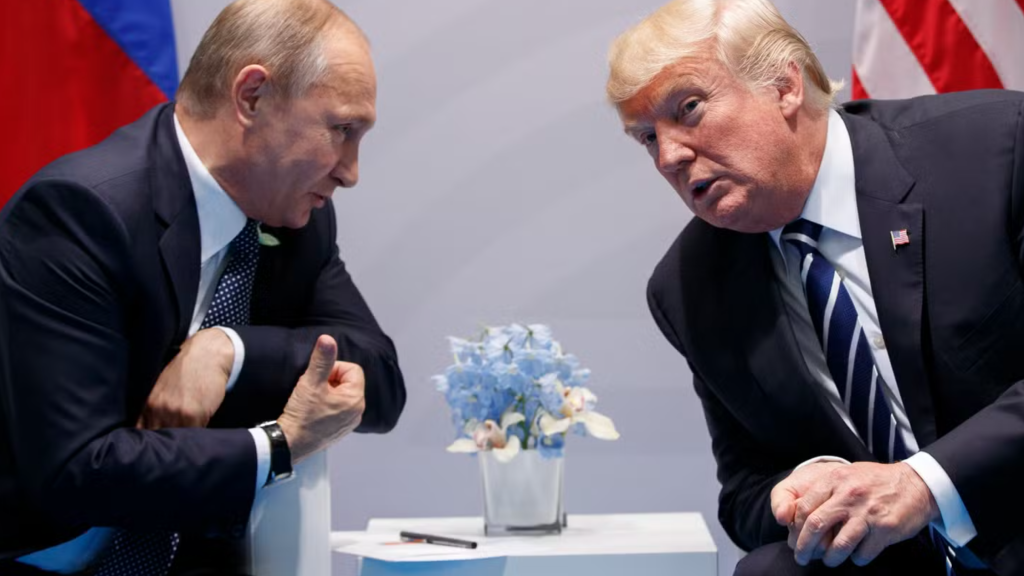
Trump and Putin talking

First published at Elusive Development.

US re-engagement with Russia under the Donald Trump administration came as a shock to many, particularly its European allies. For decades (with a brief interruption in the 1990s and early 2000s), Washington’s stance toward Moscow had been defined by containment, sanctions and military deterrence. Yet, seemingly overnight, rhetoric shifted from hostility to engagement. Was this development truly so unexpected? Beyond Trump’s numerous campaign pronouncements — most notably his claim that he could end the Russo-Ukrainian war in 24 hours — what deeper strategic logic underpins this apparent tectonic shift in US foreign policy?

Far from an impulsive departure from tradition, this recalibration reflects a broader evolution in US strategic thinking. The US is moving away from the territorialist logic of power, which relies on costly military interventions and direct control, toward a more economically-driven and cost-effective strategy of influence. At the heart of this shift is an effort to reduce strategic overhead, leverage economic tools over military force, and pursue selective engagement where it serves US interests. More critically, this shift is tied to the global realignment of power, particularly the growing challenge posed by China. If rapprochement with Russia can weaken Beijing’s influence while securing US economic and strategic advantages, the move from confrontation to engagement becomes less of an aberration and more of a calculated response to shifting geopolitical realities.

This analysis was written before the February 28 White House meeting between Trump and Ukrainian President Volodymyr Zelensky, a failed diplomatic encounter that laid bare the transactional nature, economic pragmatism and geopolitical concerns that define the current US administration’s approach to its partners — Ukraine included. While this text focuses on US-Russia relations, that meeting served as a stark illustration of how Washington’s foreign policy — often perceived as unpredictable — ultimately follows a consistent logic: prioritising strategic advantage over ideological commitments. This broader context helps explain why what some interpret as a “pivot” to Russia may, in fact, be part of a larger recalibration aimed at preserving US dominance in an increasingly multipolar world.

The declining utility of the territorialist logic

For much of the 20th and early 21st centuries, US global power was maintained through extensive military commitments, permanent alliances, and a vast security infrastructure spanning Europe, Asia and the Middle East. This territorialist logic, as conceptualised by Giovanni Arrighi, required substantial investment in military bases, overseas troop deployments and the upkeep of alliances like NATO. However, this approach has become increasingly costly and, in many cases, strategically inefficient. The wars in Iraq and Afghanistan demonstrated the limits of military interventionism, consuming trillions of dollars with little to show in terms of lasting influence. Even in Europe, the expansion of NATO has imposed additional security commitments on the US without necessarily yielding proportional strategic advantages.

David Harvey argues imperial strategies have shifted from direct territorial domination toward more flexible forms of economic and geopolitical control, where coercion, financial leverage and market mechanisms replace the need for physical occupation. The US is increasingly relying on cost-effective instruments of influence, such as sanctions, trade policies and financial restrictions, rather than direct military engagement. This shift reflects not only the economic burden of territorial control but also the changing nature of global power competition, where economic and technological supremacy matter more than the sheer number of military bases or troop deployments.

Recognising these constraints, US policymakers — especially under the Trump and Joe Biden administrations — have sought to reduce direct military obligations and instead pursue influence through economic pressure, targeted diplomacy and the strategic use of threats and incentives. This approach is evident in Washington’s recalibration of its stance toward Russia: rather than attempting to contain Russia purely through military deterrence, there is an emerging interest in selective engagement that could serve US economic and geopolitical interests while reducing long-term costs.

Economic pragmatism: A key driver of US policy

Economic considerations play a central role in the US reassessment of its stance toward Russia. Several key factors contribute to this shift.

Access to strategic resources. Russia remains one of the world’s largest producers of oil, natural gas and critical minerals (including rare earth elements essential for high-tech industries). Russia holds the largest world reserves of gas and about 10% of the world’s total reserves of rare earth elements (twice as much as Ukraine). While the US has imposed sweeping sanctions on Russian energy exports, there are indications that US businesses could benefit from selective economic engagement. For instance, recent statements by President Vladimir Putin and other Russian officials suggest that US companies are welcome to participate in Russian aluminum production, the energy sector and rare earths extraction — sectors that are crucial for advanced manufacturing and military applications.

Beyond its resource wealth, Russia’s economic structure itself presents potential opportunities for US capital. Unlike China, Russia is not a direct competitor to the US economy but rather a peripheral economy structurally dependent on integration into the global system.

Boris Kagarlitsky (2008) describes how Russia’s capitalist development has been shaped by its role as a raw material exporter, with wealth concentrated in powerful business clans or oligarchs, who control resource exports. During the 1990s economic crisis, Russia paradoxically became a financial “donor” to the global economy, as vast amounts of capital were converted into Western currencies, primarily US dollars, and moved abroad. This trend of capital outflows persisted even during Russia’s relative economic recovery in the early 2000s, highlighting the structural dependency of Russian capitalism on external markets and financial systems.

The costs of sanctions and economic decoupling. While US-led sanctions have significantly impacted the Russian economy, their impact has not been as significant as expected as the report Russian Economy at the Time of War argues. The sanctions have also had unintended consequences for Western economies, particularly in energy markets and global commodity supply chains. Europe, in particular, has faced economic turbulence due to the loss of Russian gas supplies, leading to higher energy prices and inflationary pressures. Analysts estimate that European countries have spent between 1-7% of GDP shielding consumers and firms from rising energy costs, caused in part by building new infrastructure for energy security. But the US losses were not insignificant: according to some estimates, US companies have lost $324 billion by moving out of Russia. For the US, a more flexible approach — one that balances sanctions with selective engagement — could help stabilise global markets and prevent economic fallout.

Sanction enforcement also carries costs. Apart from the relatively small costs of monitoring and enforcement (most of which are transferred to Russian counterparties), there are geopolitical costs associated with maintaining compliance. By their nature, sanctions are only effective if they are enforced beyond the target country — that is, if third parties outside of Russia comply with them. However, as the number of sanctions grows, so does the number of foreign businesses affected, many of which operate in strategically important countries for the US, such as India, the United Arab Emirates and Turkey. The imposition of secondary sanctions complicates US relations with these key partners, who may view such measures as an infringement on their sovereignty and economic autonomy. Moreover, even strategic adversaries such as China — which the US seeks to contain — become entangled in sanction enforcement, adding another layer of diplomatic and economic tension. The sanctions backfire, to borrow the title of Agatha Demarais’ book, which explains how sanctions reshape the world against US interests. The broader and more complex the sanctions regime, the more friction it generates in US global relationships, potentially undermining Washington’s ability to maintain a unified geopolitical front.

Beyond these immediate consequences, sanctions have also raised concerns about the long-term role of the US dollar in global trade. Treasury officials across various US administrations have cautioned that extensive use of financial sanctions could threaten the central role of the dollar and the US financial system. The sweeping sanctions on Russia appear to have accelerated efforts by various countries — including China — to reduce their reliance on the US dollar in international transactions, as well as on US and European cross-border payments infrastructure more generally. The US benefits economically and politically from the dollar’s status as the dominant reserve currency in the global economy. If de-dollarisation efforts gain traction on a broader scale, there could be adverse implications for US influence, financial stability, and economic leverage in global markets.

Repositioning Europe as a competitor rather than an asset. Europe has traditionally been seen as a key ally in US global strategy. However, recent policy shifts — particularly under Trump, and to a lesser extent Biden — have reframed the transatlantic relationship in more transactional terms. The US has increasingly viewed European economic power as a challenge rather than a complement to its own interests. This is reflected in Trump’s announcement of plans to impose tariffs of 25% on European Union goods, including cars and farm products. A further indication of this transactional approach includes disputes over defence spending within NATO, and Washington’s push for Europe to take on a greater share of its own security responsibilities. Such moves signal a departure from the traditional alignment between the US and Europe, instead treating the EU as an economic rival rather than an indispensable ally.

Branko Milanovic has argued that Trump’s tariff and trade policies signify the end of neoliberal globalisation as we know it. However, what if this is not the collapse of globalisation, but rather its evolution into a new form — one where US capital benefits disproportionately by securing privileged access to foreign markets for sales while also acquiring cheap raw materials under favourable conditions? From this perspective, the Western (European) policy of global fragmentation and “friend-shoring” — where supply chains are restructured to favour geopolitical allies — represents an even more isolationist shift than Trump’s rhetoric of “America First” economic nationalism (not to mention projected real GDP losses as a result of friend-shoring). Instead of an inclusive, integrated global system, the US is curating economic dependencies to sustain its own corporate dominance. The real divergence, then, is not between Trump’s vision of US global economic supremacy and Biden’s supposed return to multilateralism, but between two competing models of controlled globalisation — one overtly nationalistic, the other veiled behind strategic economic fragmentation.

By exploring rapprochement with Russia, the US may be signalling to Europe that it is not indispensable — and that Washington has alternative diplomatic options. This realignment could serve to pressure European governments to align more closely with US priorities while simultaneously reducing European influence in global affairs.

The China factor: Strategic realignment to counter a rising rival

Perhaps the most significant driver of US interest in improving relations with Russia is the broader strategic competition with China. In the past three years, Russia and China have significantly deepened their “no limits” partnership, particularly in energy trade, military cooperation and financial transactions. In 2023, bilateral trade between Russia and China reached an unprecedented $240 billion, a substantial rise from $147 billion in 2021. Russia’s pivot to China has accelerated due to Western sanctions, making Beijing Moscow’s largest trade partner and key financial backer.

For the US, this growing alignment between Russia and China represents a major long-term threat. Washington’s goal, therefore, is to prevent a full-fledged Russia-China axis by creating incentives for Russia to maintain a degree of independence from Beijing. This approach has historical precedents. During the Cold War, the US successfully exploited tensions between the Soviet Union and China, leading to Washington’s rapprochement with Beijing. This strategy weakened the Soviet position and reshaped global power dynamics.

Some US policymakers have suggested pursuing a similar approach today — this time by engaging Russia to create distance between Moscow and Beijing. President Donald Trump explicitly stated during his election campaign, “The one thing you never want is Russia and China uniting. I’m going to have to un-unite them.”

While the economic dimension of the Russia-China partnership is concerning for the US, the geo-strategic implications are even more pressing. Although there is no formal military alliance between China and Russia, the two countries have significantly increased the frequency and scale of their joint military drills. Recent activities include coordinated naval patrols and exercises in strategic areas such as the Sea of Japan and the East China Sea, signalling a robust military partnership and mutual strategic interests. This growing cooperation presents a long-term security challenge to the US and its allies in the Indo-Pacific.

Russia is often perceived as a military threat to Europe, but not an economic competitor on a global scale, unlike China. The prevailing view in Washington is that Europe can contain Russia with limited US involvement, allowing the US to focus its strategic resources on countering China’s economic and military expansion. 

Some analysts have celebrated Russia’s growing dependence on China, believing it weakens Moscow’s ability to act independently. However, the greatest nightmare for US strategists is a China that effectively turns Russia into its economic and military backyard, securing a stable source of raw materials, energy and strategic depth. Such a development would make China virtually invincible, granting it the economic and military resilience needed to challenge US dominance in the long term.

The US pivot toward Russia can be explained through the offshore balancing framework developed by John Mearsheimer and Stephen Walt. In a 2016 paper, they identified three key regions of US strategic interest — Europe, the Persian Gulf and the Asia-Pacific — where direct military entanglements are undesirable, but preventing the rise of new hegemonic powers remains a priority.

In these regions, direct military entanglements are undesirable, but preventing the rise of new hegemonic powers is crucial. Drawing from Britain’s pre-World War I balance-of-power strategy, Mearsheimer and Walt argue that China is the current rising power that requires counterbalancing. In this framework, Russia plays a crucial role due to its long land border with China, making it a potential counterweight to Beijing.

This “continental balance” means that a conflict with Russia over Ukraine or its NATO aspirations is not in the US interest. Furthermore, Europe today has enough economic and military strength to balance Russia on its own, unlike in 1945, when direct US intervention was necessary. This suggests that the US can step back, leaving a triangular dynamic where Europe keeps Russia in check, while Russia helps contain China.

Trump’s policies align with this logic: cooling relations with Europe while warming ties with Moscow. If the US can peel Russia away from China, it could achieve a double strategic win: gaining access to Russian resources and strategic positioning while weakening China’s ability to leverage Russia as an ally in a future geopolitical confrontation.

From a security standpoint, engaging Russia could also yield cooperation (or at least understanding) on issues like arms control, counter-terrorism, and regional conflicts. That is harder to achieve if Russia is fully aligned with China against the West. So, re-establishing a working relationship might pay off by reducing global polarisation — making it not just “the West versus a Sino-Russian axis,” but a more nuanced set of relationships.

The military-geopolitical dimension: US-Russia relations and the limits of Western military pressure

While economic and strategic considerations play a crucial role in shaping US-Russia relations, the military-geopolitical dimension remains equally significant. As the war in Ukraine continues, the scope of Western military pressure on Russia appears to have reached its limits — at least without crossing thresholds that could trigger direct confrontation.

Since the early stages of the war, the US and its NATO allies have incrementally increased the quality and quantity of weapons supplied to Ukraine — from light arms and Javelin anti-tank missiles to advanced artillery systems, long-range missiles and modern Western tanks. The latest phases of military aid have included F-16 fighter jets and ATACMS long-range missiles, signalling an attempt to offset Russia’s battlefield advantages without direct NATO intervention. 

However, as these arms transfers have escalated, the West now faces a dilemma: to continue the current trajectory of military aid “as long as it takes,” further depleting Western economic and military resources or engage in further escalation, such as allowing Ukraine to strike deep inside Russian territory with NATO-provided weapons or deploying Western troops, dramatically increasing the risk of direct military confrontation with Russia.

This escalation dynamic raises fundamental strategic questions for the US: How much further can Western support go before triggering a Russian response that escalates beyond Ukraine and what are the limits of US commitment to European security if the conflict spirals into a direct U.S.-Russia confrontation?

A key factor restraining unlimited escalation of Western military support is the risk of triggering a direct conflict between NATO and Russia. Under Article V of the NATO Treaty, an attack on one NATO member is considered an attack on all, necessitating a collective response. If the war were to expand — whether through direct NATO intervention, Ukrainian strikes deep into Russia using Western weapons, or Russian retaliation against NATO-linked supply lines — the US would be forced into a decision that could expose it to nuclear confrontation with Russia.

The burden of such a confrontation would overwhelmingly fall on the US, given its role as the primary provider of Europe’s security umbrella. While some European countries, notably Poland and the Baltic states, advocate for more aggressive policies toward Russia, their ability to sustain a direct military engagement with Russia without US backing is highly limited. This leaves Washington with two stark choices in the event of a major escalation: to engage in direct military confrontation with Russia, raising the risk of nuclear escalation, or recalibrate its approach, potentially negotiating de-escalation to avoid being drawn into a broader war.

How significant the risk of nuclear escalation is remains the subject of intense debate. Some analysts argue that Russia’s nuclear threats are largely rhetorical, aimed at deterring further Western involvement. Others caution that if the situation escalates beyond a certain threshold, nuclear use — whether tactical or strategic — cannot be entirely ruled out. Regardless, further military escalation and a potential direct confrontation with Russia  —a nuclear superpower possessing the world’s largest arsenal, estimated at approximately 5,889 nuclear warheads — cannot be taken lightly.

“You’re gambling with the lives of millions of people, you’re gambling with World War Three,” Trump told Zelensky during their February 28 meeting at the White House, a conversation that quickly turned tense and controversial. While this accusation may be disputed — some consider it an unfair characterisation of Ukraine’s defence efforts — it nonetheless reflects genuine US concerns about the risks of direct military confrontation with Russia. 

Trump’s remarks, regardless of political motivations, highlight a wider strategic anxiety in Washington: that continued escalation, particularly if it involves NATO’s deeper involvement or Ukrainian strikes on Russian territory with Western weapons, could push the conflict beyond a manageable threshold.

As the US calculates the costs of its military engagement and risks of direct confrontation with Russia, its decisions are also shaped by economic considerations. The US increasingly perceives Europe not just as a strategic ally but as an economic competitor, particularly as trade tensions and protectionist measures intensify. Meanwhile, Russia, despite being a geopolitical rival, is not an economic competitor and remains an insufficiently exploited yet potentially profitable market for US corporations.

From this perspective, prolonging confrontation with Russia carries economic downsides for the US — disrupting global energy markets, blocking potential US corporate access to Russian resources, and forcing continued high military expenditures to sustain European security. In contrast, a selective rapprochement with Russia — or at least a de-escalation of direct confrontation — could allow the US to reduce its military burden, reshape its economic strategy and refocus its strategic priorities on China.

Given these risks, the US may find itself reassessing its long-term posture toward Russia. While Washington has been committed to weakening Russia through sanctions and military support for Ukraine, it also faces a broader strategic reality:

  1. The US cannot afford to be drawn into a direct military conflict with Russia while simultaneously preparing for a potential future confrontation with China.
  2. Europe’s security dependence on the US means that any escalation would disproportionately expose Washington to risks that European allies are reluctant or unable to bear.
  3. A prolonged, high-risk confrontation with Russia undermines US strategic flexibility, forcing it to maintain a dual-front geopolitical posture against both Russia and China.

As a result, the US may ultimately seek to redefine its engagement with Russia — not as a shift toward accommodation, but as a way to manage escalation risks and refocus its strategic priorities.

This consideration further strengthens the logic behind exploring a recalibration of US-Russia relations, particularly in light of the growing challenge posed by China. Whether this shift materialises will depend on political will, strategic calculations, and the evolving situation on the battlefield in Ukraine. However, the limits of Western military pressure and the inherent risks of escalation suggest that a reassessment of US policy toward Russia is not only possible but increasingly necessary.

The constraints and risks of US-Russia rapprochement

Despite the strategic advantages that a recalibrated US-Russia relationship might offer, significant obstacles remain.

Deep-rooted distrust. Decades of confrontation, particularly since the Ukraine crisis, have left relations between Washington and Moscow highly adversarial. While pragmatic engagement is possible, there are deep institutional and ideological barriers to a true rapprochement. The US foreign policy establishment, particularly within the State Department, Pentagon and intelligence community, remains largely committed to a containment strategy toward Russia.

While Moscow publicly frames the US as hostile to its security and economic interests, its actual position is more complex. Russian capitalism has historically sought access to US financial markets, technologies, and investment opportunities (as discussed in the section on economic pragmatism). The pre-2014 US-Russia economic cooperation was relatively successful and widely accepted by both the Russian security apparatus and public opinion. What the Kremlin ultimately seeks is not a fundamental rupture but rather a restructured global order — one in which Russia and the US recognise each other’s spheres of influence, much like the post-World War II Yalta arrangements. In this sense, the depth of the US-Russia divide may at times be overstated, as Russia’s primary grievance is not with US power itself, but with Washington’s refusal to acknowledge Russia as an independent pole in the global system.

The Ukraine factor. US policy toward Russia remains heavily influenced by the ongoing conflict in Ukraine. Any attempt to improve relations with Moscow would likely face strong resistance from European allies, particularly Poland and the Baltic states, which view Russia as an existential threat. Additionally, Ukraine itself — heavily reliant on Western military and economic aid — would strongly oppose any engagement perceived as a concession to Moscow. A shift in US policy could also undermine transatlantic unity, weakening NATO cohesion at a time when Washington seeks to focus its strategic resources on China.

Domestic political opposition. Within the US, any move to ease tensions with Russia would be highly controversial. Both Republicans and Democrats have strong factions that view Russia as a hostile power and oppose any perceived concessions to the Kremlin. Additionally, the legacy of Russian election interference allegations and the broader narrative of Russia as an adversary have become deeply embedded in US political discourse. Any president advocating for engagement with Russia risks facing severe domestic backlash, particularly in an election cycle.

The risk of strategic overreach. If the US attempts to pivot toward Russia too aggressively, it risks overplaying its hand. Moscow may exploit Washington’s outreach to extract economic and political concessions without significantly distancing itself from China. Russia’s long-term economic trajectory is increasingly intertwined with China’s, particularly in energy exports and financial transactions. A poorly managed rapprochement could backfire, strengthening Moscow’s position without delivering meaningful strategic advantages to the US.

The military and nuclear dimension. As discussed, the risk of nuclear escalation remains a crucial constraint in US-Russia relations. Any shift toward engagement that appears to weaken deterrence or undermine NATO commitments could embolden Moscow, raising concerns among US allies. Additionally, if the Ukraine war escalates unpredictably — for example, through strikes deep into Russian territory or the deployment of Western troops in Ukraine — Washington could find itself trapped between escalation and retreat, undermining the feasibility of a diplomatic approach.

Conclusion: The future of US-Russia relations

The evolving US approach to Russia is not driven by idealism but by pragmatic geopolitical calculations. As the global balance of power shifts, Washington is reassessing its priorities: reducing expensive military commitments, ensuring access to critical economic resources and preparing for a long-term rivalry with China.

While deep-rooted antagonisms remain, selective engagement with Russia could serve multiple US objectives, from weakening China’s global position to reducing strategic burdens in Europe. However, the success of this approach depends on whether the US can navigate internal political resistance, European skepticism, and Russia’s own strategic calculus.

At the same time, the behaviour of the US administration, while outwardly shaped by Trump’s character, reflects deeper structural forces at play. The shifting US stance toward Russia is not just about diplomatic manoeuvering but a response to the ongoing crisis of capitalism, where the current model of accumulation in the US faces significant structural challenges. Mending bridges with Russia is not merely about geopolitical realignments — it is a strategy to expand the breathing space for US capitalism itself.

Trump claims that his “deals” with Russia and Ukraine will benefit the US, but it is clear that the primary beneficiary will be the US corporate sector. If everything King Midas touched turned to gold, then everything the US administration touches turns into more profits for US corporations. For US workers, any tangible benefits from this engagement will be minimal — if they materialise at all.

Ultimately, the future of US-Russia relations will be shaped by a complex interplay of economic incentives, geopolitical necessity, and global power realignments — with profound implications for the balance of power in the 21st century.


The Trump-Putin axis and its impact on global politics


Published 

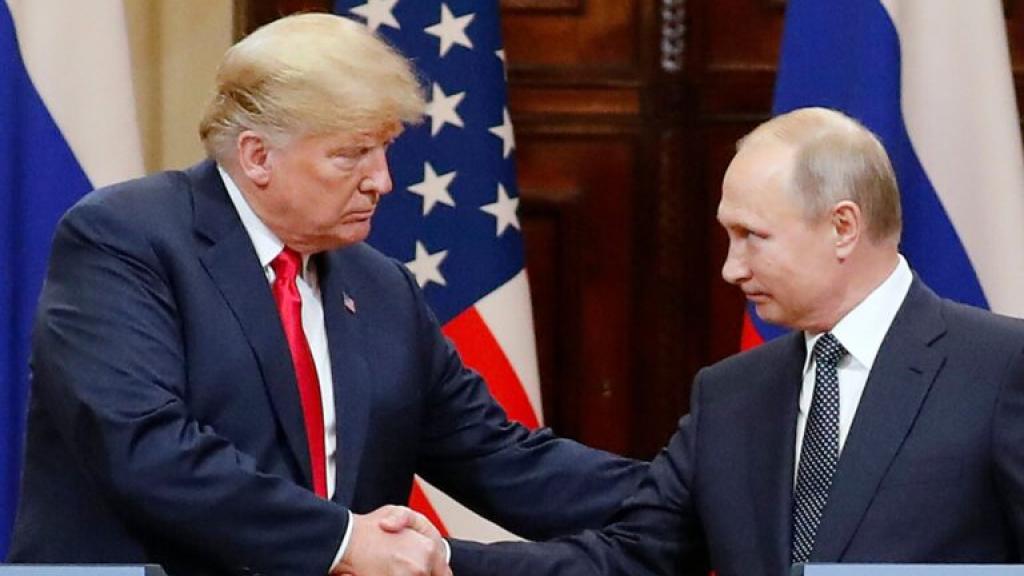
Putin and Trump in Helsinki

First published at New Politics.

Donald Trump’s forging of a political alliance with Russia’s Vladimir Putin at the expense of Ukraine’s struggle for self-determination may not be totally unexpected, but its speed and extent represent a dramatic transformation of world politics.

Nothing more sharply — and crudely — signals this transformation than Trump and J.D. Vance’s public browbeating of Ukrainian President Volodymyr Zelensky on February 28 at what was supposed to be a brief session to take questions from the press prior to a private meeting to discuss conditions for ending the war. In a breathtaking display of imperial arrogance, Trump and Vance turned the session into a shouting match as they insulted and threatened Zelensky for stating the obvious — that Putin cannot be trusted, and that any peace deal requires security guarantees for Ukraine. Trump then cancelled further talks with Zelensky and ordered him to immediately leave the country. This brazen take-down and humiliation of a democratically elected head of state for not totally submitting to U.S. dictates is unprecedented. It is as ominous as Trump’s inauguration five weeks earlier. Ukraine will be left to feel the full wrath of Putin’s murderous war machine just as Palestine is being left to face Netanyahu’s fascistic effort to annihilate its very existence.

This is hardly the first time a major imperialist power has suddenly forged an alliance with a longstanding adversary. One can recall war criminal Richard Nixon’s sudden opening to China in the early 1970s, which led to a rapprochement that ended up extending the Vietnam War by several years (Mao reduced aid to North Vietnam to curry favor with the U.S. and Nixon used his entente with him to demand greater concessions from Hanoi). But an even more striking antecedent is the Hitler-Stalin Pact of 1939. This may sound like an exaggeration — after all, the alliance between fascist Germany and Stalinist Russia gave the green light to World War II, and no one is suggesting a third world war is imminent — although the risks of it are ever-present. Nonetheless, the 1939 Pact is worth recalling since it produced a shift in world politics that had crucial ideological ramifications, as many leftists supported it in the name of opposing Western imperialism while others denounced it as a betrayal of the principles of socialism. Today’s U.S.-Putin alliance likewise has profound ideological ramifications, as seen in how leftists opposed to Ukraine’s struggle for self-determination now find their position being shared by MAGA Republicans, while others on the Left are searching for revolutionary new beginnings opposed to all forms of occupation and colonialism, from Gaza to Ukraine.

The betrayal of Ukraine

The Trump-Putin alliance was forged with the convening of direct talks on February 18 between representatives of U.S. and Russian imperialism in Saudi Arabia, a meeting that excluded both the Ukrainians and the U.S.’s European allies, some of whom were not even informed of it beforehand. These were not negotiations: Trump simply adopted virtually all of the Kremlin’s talking points without so much as suggesting a single concession from Putin. The Russian delegates could hardly conceal their shock and glee at what Trump gave away at zero cost to themselves.

On February 24, following the talks in Saudi Arabia, the Trump administration voted against a Resolution of the UN General Assembly condemning Russia’s 2022 invasion of Ukraine — the first time it did so, joining Russia, China, Belarus, North Korea, and Israel, as well as 12 other Moscow-friendly countries (93 other countries voted yes, 65 abstained). Brandishing the lie that Ukraine, not Russia, started the war, Trump clearly allied the U.S. with Putin.

Not a peep of opposition to this was heard from a single Republican member of Congress — even though many of them spent years bashing Russia and voting aid to Ukraine. Many Democrats expressed outrage but seem lost as to what to do next. So much for the claim that the U.S. ruling class has a vested interest in helping Ukraine!

Trump insists that Ukraine cannot recover twenty percent of the country that Russia occupied since 2014 and 2022, and that no U.S. troops will be used to patrol a ceasefire which is to be imposed largely on Russian terms. Nor can it join NATO, until now the inter-imperialist alliance of the U.S. and Western Europe.

Most revealing, Trump demanded that the Ukrainian government repay $500 billion to the U.S. (at least four times as much as the value of all the military and economic aid it received under Biden) by surrendering 50% of the proceeds from its sale of national resources, such as minerals, oil and gas, and port fees. Ukraine was moreover expected to repay the U.S. twice the value of any future U.S. aid (it does not indicate whether this would include any military assistance). This amounts to paying 100 percent interest on top of the total principle of a “loan.” Taken as a whole, this would entail that a higher percentage of Ukraine’s GDP become turned over to the U.S. than the allies demanded in the form of reparations from defeated Germany after World War I.

That would clearly amount to turning what is left of Ukraine (Putin is demanding annexation of parts of it he does not now control) into an outright economic colony of U.S. imperialism. If this mis-named “peace plan” were to go forward, the U.S. would reap profits at Ukraine’s expense and Russia could secure the conquest of parts of its territory while building up its diminished military apparatus (Russian forces are nearing exhaustion due to heavy losses, especially in soldiers and heavy weapons like tanks and artillery) in order to ready itself to launch a renewed assault in a few years.

Not surprisingly, Zelensky initially balked at Trump’s demands, insisting that any concessions to the U.S. contain security guarantees that could prevent the overthrow of the government or a renewal of the war. It remains to be seen if the Europeans will provide them. They too were taken aback by the recent turn of events and are unsure how to respond: most of the leaders of the European states have lived so long under the protective umbrella of the U.S. that they cannot imagine how to exist otherwise.

Zelensky has been under tremendous pressure to capitulate to U.S. demands. On February 26 a tentative agreement between Trump and Zelensky was announced that placed slightly less onerous conditions on the amount the U.S. would get from the sale of Ukraine’s natural resources. Zelensky reluctantly agreed, even though the proposal provided no security guarantees for Ukraine. Trump ruled out sending any U.S. peacekeeping forces and says the burden for providing them would fall to the Europeans — which Russia insists it will never accept. On February 26, Russian Foreign Minister Sergei Lavrov referred to any deployment of such peacekeepers as “empty talk.”

Trump claimed that the presence of U.S. companies on the ground in Ukraine to extract its mineral resources would “provide automatic security” (Ukraine does not currently have the ability to extract more than a small amount of its mineral wealth). But as many in Ukraine have pointed out, the presence of U.S. companies in eastern Ukraine did nothing to stop Putin from invading and occupying those areas. Moreover, over half of Ukraine’s mineral resources are located in the eastern part of the country which is currently occupied by Russia. Trump is surely eyeing those resources as well — which Putin would be glad to provide him with so long as Ukraine is severely weakened and demilitarized.

Meanwhile, discussions among European members of NATO about increasing military aid to Ukraine are hardly reassuring. It could take years for them to make up for Ukraine’s loss of U.S. military assistance. For example, the entire British army currently has fewer artillery pieces than one brigade possessed in the 1990s. Russia could rest and rebuild for a few years (or less) and then renew its longstanding aim to take over all of Ukraine.

Setting the record straight

The ideological fallout from the Trump-Putin alliance is already evident from the way Putin’s false claims about Ukraine are being normalized — and not alone by Trump.

Foremost among these is the claim that Ukraine started the war by provoking Russia through its repression of Russian-language speakers in eastern Ukraine and its desire to join NATO. This overlooks the fact that the war actually began in 2014, when Russia invaded eastern Ukraine and Crimea in response to a mass democratic movement on the streets of Kiev which ousted its pro-Moscow leader, Viktor Yanukovych. As he had done earlier in South Ossetia, Abkhazia, and elsewhere, Putin sent in troops (often in the guise of residents) to stoke separatist sentiment. The response of the U.S. and NATO at the time was meek: it slapped limited sanctions on Russia but did little else. When Russia launched its full-scale invasion in February 2022, the U.S. initially told Zelensky to flee the country on the grounds that there was no chance of holding off the Russian military. The Ukrainians then succeeded in doing so to the shock and surprise of both the U.S. and Putin. Only then did the pipeline of military and economic aid begin to flow from the U.S./NATO to Ukraine.

As I stated at the time of Russia’s 2022 invasion, the claim that the U.S./NATO were itching for a fight with Russia and jumped at the chance when Putin invaded gets it all wrong. Intra-imperialist conflicts are often driven by economic factors, such as the drive to accumulate capital on an ever-expanding scale at the expense of rivals. But this does not apply to the conflict between the U.S. and Russia, since the latter’s economy is too weak to pose a threat to U.S. economic dominance. As Russian sociologist Ilya Matveev puts it, “Post-Soviet Russia’s economic clout has always been far too limited to threaten the centers of capital accumulation in the Global North… In fact, the Kremlin’s decisions in 2014 and 2022 were the product of a specific ideological vision that overemphasizes Russia’s vulnerabilities and calls for preventive military action under the slogan of ‘offense is the best defense.’ Russia’s conflict with the West, unlike the U.S.-China rivalry, is rooted less in structural, particularly economic, causes and more in ideological (mis)perceptions.”

This explains why the U.S. and NATO provided enough support for Ukraine to hold off Russia but not enough to enable it to inflict a major victory. I wrote in July 2024, “That the U.S.’s conflict with Russia is not structurally rooted in the dynamics of global capital accumulation does not make it less dangerous. But it does suggest that a change of government in the U.S. in the coming months can easily lead to a rapprochement between Western imperialism and Putin’s Russia.” That has now occurred, capped off by Trump’s claim that Ukraine is responsible for starting the war.

Putin also claimed that Zelensky is an illegitimate leader of a regime stocked with “Nazis.” In fact, he was voted in through a democratic election with over 70% of the votes while the neo-fascist far-Right (which surely exists in Ukraine, as it does in virtually every European country as well as the U.S.) got 2%. Trump responded to Zelensky’s objection to being excluded from the discussions over the future of Ukraine by denouncing him as a “dictator” who has the support of only 4% of the populace. In fact, as of the end of 2024 his support was 52%, but following Trump’s reversal of U.S. policy in favor of Russia, it shot up to 63%. Many of his most prominent critics, such as Valery Zaluzhny, former Commander-in-Chief of the Army who was dismissed by Zelensky one year ago, now say they intend to vote for him once the war is over (Ukraine’s Constitution prohibits an election from being held during wartime).

Meanwhile, Putin’s effort to break apart the Western alliance, which has long been his goal, is being codified by Trump as he treats his NATO allies as an after-thought — except when it comes to prodding them to ramp up military spending so as to free the U.S. from being responsible for Europe’s security. The U.S.’s European allies are completely flummoxed by Trump’s threat to cut off military aid to Ukraine and lift sanctions on Russia: they have been thrown into a new world that their neoliberal mindset never prepared them for.

Redrawing the political map

What we are witnessing today is a redrawing of the political map, as the U.S. is now transitioning from its decades-long pursuit of single world dominance under the illusory claim of supporting democracy to forging a united front of reactionary and neo-fascist powers intent on pursuing national and regional interests.

This is not isolationism — neither Trump, Putin, nor Xi Jinping fit into that category. It is rather an effort to respond to the U.S.’s failure to secure single world domination (as seen from its defeats in Iraq and Afghanistan) by reverting to a twenty-first-century form of annexationist territorial imperialism. This was initiated by Putin’s imperialist invasion of Ukraine in 2014 and 2022, and it is now embraced by Trump as he threatens to annex Greenland, Panama, Canada, and even Gaza as he promotes Israel’s effort to expel its entire Palestinian populace. This is why Trump finds so much in common with Putin — they share a similar view of the world, in which even the pretense of international law and norms must be cast aside. This should not be written off as a mere quirk of his personality or reduced solely to his business interests (though they both play a big part): they are a reflection of a world gradually being divided up into regional power blocs based on naked national self-interest. As Peter McLaren put it, “Trump and Putin do not seek peace — they seek a pact. A deal that cements Russia’s aggression as legitimate and Ukraine’s sovereignty as expendable. A deal that undermines not only Ukraine but the very idea that nations have the right to exist beyond the will of imperial masters.”

Of course, it is not alone foreign affairs that binds Trump to Putin — at least for now (one thing about neo-fascists is that they rarely have an easy time getting along with their co-conspirators). What most of all connects them is their disdain for the advances made by women, workers, national minorities, and LGBTQ people over the past decades. The far Right sees in Putin the exemplar of the white-racist attack on democracy that they adore. As Putin stated a few years ago, “The U.S. continues to receive more and more immigrants, and, as far as I understand, the white, Christian population is already outnumbered…. We have to preserve [white Christians] to remain a significant center in the world.”

This is why those who concede even the slightest ground to Trump’s narrative on Ukraine make a big mistake when they presume it can be somehow separated from his attacks on immigrants, women, workers, and people of color in the U.S. — or separated from his unwavering support for Israel’s genocide against the Palestinians. One example is Medea Benjamin of Code Pink, who in a recent article entitled “Trump Gives Peace a Chance in Ukraine,” wrote: “On both sides of the Atlantic, Trump’s initiative [on Ukraine] is a game changer. Those of us anxious to see peace in Ukraine should applaud Trump’s initiative…. If Trump can reject the political arguments that have fueled three years of war in Ukraine and apply compassion and common sense to end that war, then he can surely do the same in the Middle East.” But the last thing that motivates Trump is compassion and common sense when it comes to Ukraine (or anywhere else) — which is why to expect him to “do the same in the Middle East” is an invitation for ethnic cleansing and genocide. He cares not a whit about the Ukrainians, and even less about “peace.” He is concerned with extracting as many resources from as many places as he can while forging a united front with like-minded authoritarians to crush what is left of democratic norms and institutions.

This is why Ukraine remains a touchstone of global politics. If Trump and Putin can succeed in curtailing its fight for self-determination, it will make it all the harder to advance freedom struggles elsewhere. Stating that fact does not entail supporting Zelensky or the current Ukrainian government, which clearly governs under a neoliberal agenda, any more than it entails supporting NATO (whose very existence we have long opposed). But as Trotsky noted in his writings on fascism, the truth is concrete: and the concrete truth is that to remain neutral in the face of occupation and colonial domination is to become its accomplice.

Oleg Shein argues, “While Putin is President — and he will be a president as long as he lives — this war will continue. The reason lies within Russia: Putin does not have a positive program, for the country. External conflict is the basis of his power. It is a way to consolidate the elite and govern the people. Perhaps the war against Ukraine will enter a phase of smoldering. But as long as Putin rules in Russia, the history of external conflict will continue.”

Solidarizing with Ukraine — and the larger struggle

Ukraine is facing a difficult situation. The ground war has not been going well for it over the last year, and a cut-off of U.S. aid is sure to make the problem worse. So far, it has received half of its armaments and aid from the EU, and a number of states (such as France and Poland) promise to contribute more. It is unclear how much of a difference that will make. But what cannot be denied is the tenacity of the Ukrainians: despite some Russian advances over the past six months, they have taken far less territory than what most analysts anticipated. Zelensky will be under continuous pressure to agree to some kind of rotten compromise, but while the Ukrainian people desperately want peace, the vast majority do not want what they call “a peace of the grave,” that would deny their right to exist as a nation and a culture. It is thus likely the struggle will go on, perhaps in the form of guerilla warfare, even if a dishonorable “peace” is imposed by the great powers behind their backs.

This too carries risks: it is possible that the far Right will grow in power in Ukraine the more desperate the situation becomes. The Ukrainian Marxist writer Hanna Perekhoda addresses this as follows: “The argument that the presence of the far right in Ukraine justifies a refusal to send arms is based on a rather blatant error of logic…. There are far-right movements in France and Germany that are infinitely more influential than in Ukraine, yet no one would dispute their right to self-defense in the event of aggression…. This argument is all the more hypocritical given that many of these same voices on the left do not hesitate to support resistance movements that include actors who are more than problematic. Why demand a purity from Ukraine that no other society is required to show when it has to defend itself? What is undeniable is that the war, which has lasted for more than ten years, has already helped to strengthen and trivialize nationalist symbols and discourse that were previously marginal. Wars do not make any society better. However, the relationship between the delivery of arms and the strengthening of the far right in Ukraine is inversely proportional. The weapons sent to Ukraine are used first and foremost to defend society as a whole against an invading army. Ukraine’s victory guarantees the very existence of a state in which citizens can freely and democratically choose their future. Conversely, nothing strengthens extreme right-wing movements or terrorist organizations more than military occupation and the systematic oppression that goes with it.”

This is not the time to refrain from solidarizing with Ukraine — it is more important than ever. It is vital not just for their sake but for ours, as we become increasingly subjected to fascistic repression inside the U.S., the extent of which has only just begun to be seen.

Peter Hudis is the coeditor (with Kevin Anderson) of The Power of Negativity: Selected Writings on the Dialectic in Hegel and Marx by Raya Dunayevskaya (Lexington Books, 2001) and author of Marx's Concept of the Alternative to Capitalism (Haymarket Books, 2013) and Frantz Fanon: Philosopher of the Barricades (Pluto Press, 2015).


So-called axis of resistance: Which way forward for Palestinian liberation?


Published 

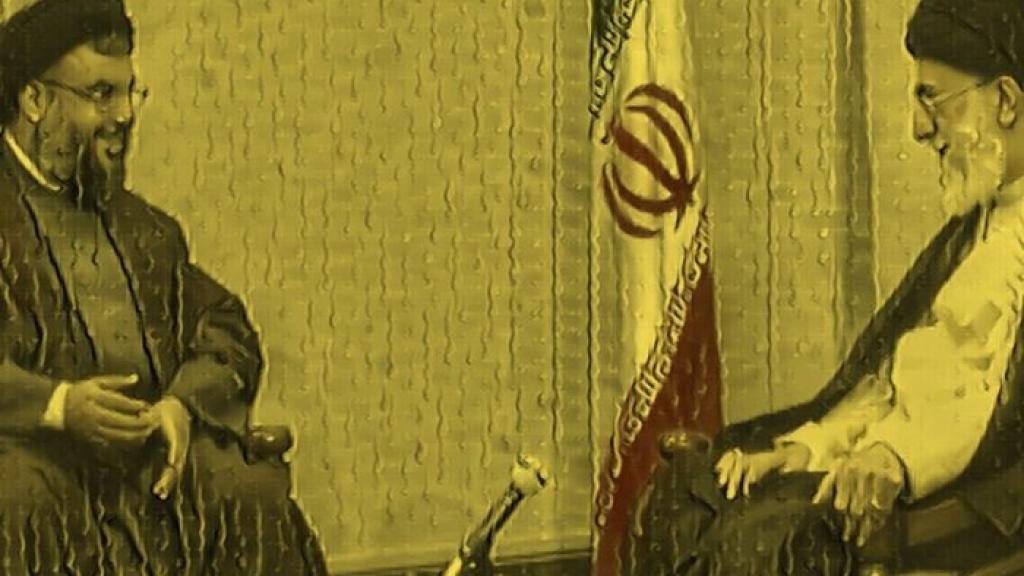
Iranian mullahs

First published at Tempest.

The ceasefire agreement between Hamas and Israel, which had conducted a genocidal war on Palestinians in Gaza for over a year, poses strategic questions for the Palestinian liberation struggle and those in solidarity with it. Up till now, the dominant strategy has been to cultivate an alliance with Iran’s so-called “Axis of Resistance” to back military assaults on Israel, but that network has suffered devastating setbacks from the combined might of Israel and the U.S.

Israel’s repeated assassination of Iranian leaders and direct attacks on Iran itself have exposed the weaknesses and challenges Iran faces in the region. Tel Aviv’s brutal war on Lebanon significantly damaged Hezbollah, the jewel in the crown of Iran’s Axis, and collectively punished the Lebanese people, particularly Hezbollah’s base in the country’s Shia population. The fall of Iran’s other close regional ally, Bashar al-Assad, has further undermined the Axis. Only the Houthis in Yemen have survived the onslaught relatively intact.

Of course, Israel did not accomplish its main goals in Gaza of destroying Hamas and ethnically cleansing the population, and it has been discredited and delegitimized globally as a genocidal, settler-colonial, apartheid state. Nevertheless, the strategy of military resistance to Israel based on support from the Axis has shown its limitations if not its inability to win liberation. So, what have we learned about the Axis? What is its future? What do the region’s masses think of the Axis? What is the alternative to the military strategy against Israel? How should the international Left position itself in these strategic debates?

Origins and development of Iran’s so-called “Axis of Resistance”

In the 2000s, the Iranian regime expanded its influence in the Middle East, primarily through The Islamic Revolutionary Guard Corps (IRGC)). It took advantage of the defeat suffered by the U.S. and its allies in their so-called War on Terror in the Middle East and Central Asia. George Bush’s ambition for regional regime change was blocked by resistance to the U.S. occupation of Iraq and Afghanistan. Iran secured allies with Iraq’s various Shia Islamic fundamentalist parties and militias and their representatives in state institutions, becoming the most influential regional power in the country.

Iran also increased its influence in Lebanon mainly through its alliance with Hezbollah, which has grown in popularity after its resistance against Israel’s 2006 war on Lebanon. Since the mid-1980s, Tehran has supported Hezbollah, providing it with funding and arms. In the 2010s, the Iranian regime also strengthened its relations with other organizations in the region, particularly the Houthi movement in Yemen, especially after Saudi Arabia’s war on the country in 2015. Since then, Iran has provided the Houthis with military support. In addition, Tehran struck a close alliance with Hamas in the occupied Palestinian territories.

Iran’s regional alliance reached its peak in the late 2010s with Hezbollah dominating the political scene in Lebanon, the Iraqi militias asserting their power, Iran’s own forces combined with those of Hezbollah backing Assad’s counter-revolution in Syria, and the Houthis securing a truce with Saudi Arabia. The IRGC has been the main agent in consolidating the Axis. It is to some extent a state within the state in Iran, combining military force, political influence, and control over a major sector of the national economy. It has carried out armed interventions in Iraq, Syria, and Lebanon.

Pursuing regional power not liberation

Iran has been attempting to achieve a regional balance of power against Israel and the U.S. as well as pursue its own military and economic aims in the region. The regime views any challenge to its influence in Iraq, Lebanon, Yemen, and the Gaza Strip, whether from below by popular forces or from Israel, other regional powers, and the U.S. as a threat to their interests. Its policy is entirely driven by its state and capitalist interests, not some liberatory project.

That explains why Iran and its allies in the Axis oppose not just other antagonistic powers, but also popular struggles for democracy and equality. The Iranian regime denies its workers basic rights to organize, collectively bargain, and strike. It crushes any protests, arresting and jailing dissidents, tens of thousands of whom languish as political prisoners in the country’s prisons. The regime imposes national oppression on Kurds as well as people in Sistan and Baluchistan repeatedly provoking resistance, most recently in 2019. It also subjects women to systematic oppression, creating conditions so intolerable that it triggered the mass movement “Woman, Life, Freedom” in 2022.

Teheran also opposes popular protests against its allies in the Axis. It condemned mass protests in Lebanon and Iraq in 2019, claiming that the United States and its allies were behind them in spreading “insecurity and unrest.” In Syria, Iran supplied its forces, fighters from Afghanistan and Pakistan, and Hezbollah’s militants as ground troops while Russia mobilized its air force to back Assad’s brutal counter-revolution against the democratic uprising in 2011.

Iran’s allies in the Axis have also crushed popular movements. In Lebanon, Hezbollah has collaborated with the rest of the country’s ruling parties, despite their disagreements, in opposing social movements that have challenged their sectarian, neoliberal order. For example, they united against the Lebanese Intifada of October 2019. Hezbollah’s leader, Hassan Nasrallah, claimed the uprising was financed by foreign powers and sent party members to attack demonstrators.

In Iraq, militias and parties allied with Iran, such as the Popular Mobilization Units, have repressed popular struggles. They launched a violent campaign of assassination and repression of civilian protesters, organizers, and journalists, killing several hundred and wounding several thousand. Both Hezbollah and the Iraqi militias justified their repression of protests in 2019 by claiming they were the catspaws of foreign powers. In reality, these were the expressions of aggrieved people fighting for legitimate demands to reform their countries, not carrying out some hidden agenda of another state. That’s why activists raised slogans like “Neither Saudi Arabia, Nor Iran” and “Neither USA, Nor Iran.”

Truth be told, Iran is not a principled or consistent opponent of U.S. imperialism. For instance, Iran collaborated with U.S. imperialism in its invasions and occupations of Afghanistan and Iraq. Nor is Iran a reliable ally of Palestinian liberation. For example, when Hamas refused to support Assad’s regime and its brutal crackdown on the Syrian uprising in 2011, Iran cut its financial assistance to the Palestinian movement.

That changed after Ismael Haniya replaced Khaled Meshaal as the leader of Hamas in 2017, restoring closer relations between the Palestinian movement, Hezbollah, and Iran. But the schisms between Iran and Palestinians remain, especially on the question of Syria. Large sections of Palestinians in occupied territories and elsewhere celebrated the fall of Iran’s ally Assad, who was widely seen as a murderous tyrant and enemy of the Palestinians and their cause.

Moreover, Hamas’s alliance with Iran has been criticized by segments of Palestinians in Gaza, even from those close to Hamas’s base. For example, a group of Palestinians tore down a billboard in Gaza City in December 2020 with a giant portrait of the late General Qassem Soleimani, who had commanded Iran’s Quds Force, just days before the first anniversary of his death. Washington’s air strike that killed Soleimani in Baghdad in 2020 was condemned by Hamas, and Haniyeh even traveled to Tehran to attend his funeral.

These groups of Palestinians denounced Soleimani as a criminal. Several other signs and banners with Soleimani’s portrait were also vandalized. In just one video, an individual called the Iranian leader a “ killer of Syrians and Iraqis.”

All this demonstrates that Iran and its allies have played a counter-revolutionary role in various countries of the region, opposing popular protests for democracy, social justice, and equality. They were never an Axis of Resistance, but an alliance committed to their members’ self-preservation and assertion of regional power.

“The Axis of Restraint”

This reality was confirmed by Iran’s response to Hamas’s October 7 attack and Israel’s genocidal war in Gaza. While the Iranian regime affirmed its support for Hamas and the Palestinians, it consistently sought to avoid any generalized war with Israel and the U.S. out of concern for its survival in power. Because of this, Iran restrained its responses to Israel’s repeated strikes against Iranian and Hezbollah targets in Syria and its assassinations of senior Iranian officials, including in Iran itself.

Tehran initially tried to put pressure on the United States by ordering pro-Iranian militias in Iraq and Syria to attack U.S. bases in Syria, Iraq, and to a lesser extent Jordan. However, after the U.S. airstrikes in February 2024, Iran reduced these attacks to a minimum. Only the Houthis in Yemen continued to target commercial ships in the Red Sea and launch some missiles against Israel.

Iran did conduct military operations directly against Israel for the first time since the establishment of the Islamic Republic of Iran in 1979, but always in a calculated manner designed to avoid any generalized confrontation. Each exchange between the two powers proves this. In April 2024, Iran launched Operation True Promise in response to Israel’s missile strike on the Iranian embassy in Damascus on April 1, which killed sixteen people, including seven members of the IRGC and the commander of the Quds Force in the Levant, Mohammad Reza Zahedi.

Before Iran retaliated, it gave its allies and neighbors 72 hours’ notice so they would have time to protect their airspace. Given this warning, Saudi Arabia and the United Arab Emirates helped neutralize the attack by sharing information with Israel and the U.S. The Saudi and Iraqi governments also allowed U.S. Air Force tanker planes to remain in their airspace to support U.S. and allied patrols during the operation.

Only after all this, did Iran launch three hundred drones and missiles at Israel, but this attack was largely symbolic and calculated to avoid causing real damage. The drones took hours to reach their destination and were easily identified and shot down. Iran importantly did not call on its allies like Hezbollah to join its attack. After the operation, Iran’s Supreme National Security Council declared that no further military action was planned and that it considered the “matter closed.”

In other words, Iran carried out the strike primarily to save face and deter Israel from continuing its attack on the Iranian consulate in Damascus. In doing so, the Iranian regime made clear that it wanted to avoid a regional war with Israel and especially any direct confrontation with the U.S. Iran acted primarily to protect itself and its network of allies in the region.

Tehran then launched a second attack of nearly 200 missiles on Israel on October 1 to “avenge” the assassinations of Hassan Nasrallah in Lebanon and Hamas leader Ismail Haniyeh in Tehran. While this was certainly an escalation on Iran’s part, it was entirely designed to prevent the loss of its credibility among its allies and Lebanese supporters Hezbollah. Yet again, the attack was limited and done in such a way as to minimize confrontation with Israel and the U.S.

It was so unconvincing as a deterrent that on October 26, Israel launched three more waves of strikes against Iran’s air defense systems, around energy sites, and missile manufacturing facilities. Tel Aviv had also wanted to bomb Iranian nuclear and oil sites but was restrained by the U.S. Several Arab countries, with which Israel maintains direct or indirect relations, also refused to let Israeli bombers and missiles fly over their territory. Nonetheless, the attacks revealed Iran’s vulnerability.

Its regional allies were similarly exposed both in their weakness and their restraint in response to Israel’s genocidal war. While Hezbollah did launch strikes into northern Israel, these were again limited and largely symbolic. And Israel called its bluff. It responded with a brutal state terrorist attack by detonating rigged pagers carried by Hezbollah’s cadres, killing untold numbers of civilians in the process. It also launched a brutal war into southern Lebanon, decimating Hezbollah as a military force and collectively punishing its supporters in the Shia population. As a result, Hezbollah has been significantly weakened.

On top of that, Iran lost its other key ally, Assad’s regime in Syria when forces toppled his regime almost without a fight. Assad was never an ally of the Palestinian liberation struggle. His regime had kept peace on its borders with Israel and, in his counter-revolutionary war in Syria, he attacked Palestinians in the Yarmouk refugee camp and elsewhere. That’s why large sections of the Palestinians celebrated the fall of the Syrian regime.

With Assad’s fall, however, Iran lost its Syrian base for logistical coordination, arms production, and arms shipments throughout the region, especially to Hezbollah. All of this has significantly weakened Tehran, both internally and regionally. That is why Iran has an interest in destabilizing Syria after the fall of the regime by fomenting sectarian tensions through its remaining networks in the country. It does not want a stable Syria, especially one with which its regional rivals can strike an alliance.

The only one of Iran’s allies that remains relatively intact is the Houthis in Yemen. Before the ceasefire, Israel repeatedly bombed Houthi forces in an attempt to weaken it and Iran’s Axis. In December 2024, Tel Aviv stepped up its campaign of strikes on ports in Hodeida, al-Salif, and Ras Isa controlled by the Houthis in order to undercut their economic base, which is derived from port taxes, customs duties, and oil shipments, reduce their military capabilities, and block Iranian weapon shipments.

Israel also wanted to interrupt Houthi attacks on merchant ships in support of Hamas and the Palestinians. These had disrupted shipping in the Bab el-Mandeb passage between the Red Sea and the Gulf of Aden, a passage through which up to 15 percent of global maritime trade passes.

As a direct result, Egypt lost considerable revenue when international shipping was diverted away from the Suez Canal to other routes. Israel’s southern port of Eilat was also paralyzed. In response to this threat to global capitalism, the U.S., Britain, and Israel launched missile strikes and bombing campaigns against Houthi targets.

While Iran promised to retaliate against Israel, it did little in the end, again wanting to avoid any direct war with Israel and the U.S. All this demonstrates that Iran’s main geopolitical objective is not to liberate Palestinians, but to use them as leverage, especially in its relations with the United States.

Similarly, Iran’s passivity in response to Israel’s war against Lebanon and its assassination of Hezbollah’s key political and military leaders has further demonstrated that its first priority is to protect its own geopolitical interests and the survival of its regime. That includes reaching a modus vivendi with the U.S. itself. Indeed, President Massoud Pezeshkian and Supreme Leader Ali Khamenei’s main goal is to cut some kind of deal with Washington, get it to lift the crippling sanctions on its economy, and normalize relations with the United States.

Iran, Russia, and pursuit of multipolarity

At the same time, Iran’s weakened position has driven it deeper into the arms of Russia in an attempt to safeguard its regime. It recently inked a 20-year “Comprehensive Strategic Partnership Agreement” with Moscow pledging cooperation on trade, military projects, science, education, culture, and more. The agreement includes a clause promising that neither country would permit its territory to be used for any action that would threaten the safety of the other, nor provide any help to any party attacking either country.

The agreement entails cooperation against Ukraine, efforts to evade Western sanctions, and collaboration on the North-South Transport Corridor, Moscow’s initiative to facilitate trade between Russia and Asia. Even before this agreement, Iran had already been selling drones to Russia to attack Ukraine while Russia had been selling Iran advanced SU-35 fighter jets.

The fall of Assad and Trump’s return to the U.S. presidency certainly accelerated the finalizing of the partnership agreement. But it was mostly the result of rising challenges of both countries faced over the past few years. As noted, Tehran has suffered a tremendous setback in the Middle East, while Moscow’s failure to achieve outright victory in its imperialist war against Ukraine has undermined its geopolitical standing. And both states are suffering the consequences of unprecedented Western sanctions.

Each country is desperate to find a way out of their predicament. Their agreement is part of that effort. It promises “to contribute to an objective process of shaping a new just and sustainable multipolar world order.” This language of “multipolarity” is a cornerstone of Russian, Chinese, and Iranian geopolitical strategy. It is used to justify their own capitalist economy, imperialist or sub-imperialist policies, and reactionary social programs.

Unfortunately, some figures and movements on the left have adopted their rhetoric, promoting a vision of a multipolar system in opposition to what they see as a unipolar world dominated by the U.S. In reality, the emergence of more great and regional powers and a multipolar world of capitalist states is not an alternative to unipolarity, but a new and frankly more dangerous stage of global imperialism. While Washington’s unrivaled rule was horrific, growing inter-imperial conflict between the U.S., China, Russia, and regional powers like Iran risks world war. Remember the last multipolar world order detonated World War One and World War Two as contending imperialist states battled for hegemony over global capitalism.

In addition, great powers like China and Russia that advocate multipolarity offer no alternative for the Global South nor working class and oppressed people throughout the world. They are capitalist states whose economic policies reinforce old patterns of underdevelopment; they deindustrialize developing countries, trap them into extracting and exporting raw materials to China, and then consuming imported finished products mainly from China. While the ruling classes of these developing countries may benefit from that arrangement, the working class and oppressed suffer unemployment, precarity, and environmental devastation.

More generally, China, Russia, and the rest of the so-called BRICS (Brazil, Russia, India, China, South Africa, and others) alliance in no way challenge the Global North’s hegemony over institutions like the IMF and World Bank, nor their neoliberal framework. In fact, the BRICS states are actually seeking what they see as their rightful place at the world capitalist table.

The expansion of the BRICS proves that it is not an alternative. In January 2024, its new members invited to join include Argentina, Egypt, Ethiopia, Iran, Saudi Arabia and the UAE. No one in their right mind can claim for instance that Argentina’s state, ruled by the deranged devotee of Ayn Rand and Donald Trump, Javier Milei, offers a solution to the Global South, its workers, and oppressed. In reality, the BRICS states do not challenge the global capitalist system but contend for their slice of the pie within it.

Therefore, it is a disastrous mistake for any section of the left to side with one camp of imperialist and capitalist states against another. That does nothing to advance anti-imperialism let alone the struggles of workers and the oppressed in any state. Our political orientation should not be guided by a zero-sum choice between unipolarity versus multipolarity. In every situation, we must side with the exploited and oppressed and their struggle for liberation, not their exploiters and oppressors.

Those on the left who mimic Russia, China, and Iran’s call for a multipolar order align themselves with capitalist states, their ruling classes, and authoritarian regimes, betraying solidarity with the struggles of popular classes within them. Siding with those struggles does not and should not entail support for U.S. imperialism and its allies.1 Our solidarity must not be with either camp of capitalist states but with workers and the oppressed. Of course, each camp of states will try to turn those struggles to their advantage. But that danger cannot become an alibi to withhold solidarity with legitimate struggles for emancipation.

If internationalism — the hallmark of being on the left — is to mean anything today it must entail support of popular classes in all countries as an absolute duty, regardless of which camp they are in. Such struggles are the only way to challenge and replace repressive and authoritarian policies. That is true in the U.S. as well as in China or any other country.

We must oppose any regime’s cynical slander of legitimate protest as the result of foreign interference or challenge to their sovereignty. That is the politics of right-wing nationalism, not socialist internationalism.

Against imperialism and sub-imperialism, for emancipation from below

Such an approach is essential, especially with the reconfiguration of regional power in the Middle East and the return of Trump to power in the U.S. Iran and its Axis has been dramatically set back. The U.S., Israel, and their allies are now emboldened. Iran’s position in future negotiations with Trump is weakened, and its economy continues to deteriorate under sanctions and its own capitalist crisis.

Faced with this predicament, Tehran will likely reconsider its regional strategy. It could conclude that its best option may be to acquire nuclear weapons to strengthen its deterrence capacity and improve its position in future negotiations with the United States.

The left, especially in the U.S. and Europe, must oppose any further belligerence by Israel and the U.S. against Iran or any other regional power. We must also oppose their economic war on Iran through sanctions, which disproportionately impact the country’s working classes. No one on the left should support the U.S. state and its Western allies; they remain the biggest opponent of progressive social change in the world.

However, we should not fall for the politics of “my enemy’s enemy is my friend” and support Washington’s main imperial rival, China, nor lesser enemies like Russia. They are no less predatory and avaricious imperialist states, as Beijing’s record in Xinjiang and Hong Kong attests, as does Moscow’s similarly brutal one in Syria and Ukraine. Nor should anyone on the left support the authoritarian, neoliberal, and patriarchal Iranian regime and its reactionary and repressive policies against its own people and those in other countries such as Syria.

The Islamic Republic of Iran is an enemy of the working classes in Iran and the region and is not fighting for their people’s emancipation. The same is true of Iran’s allies like Hezbollah in the region, which have all played a counter-revolutionary role in their respective countries. And, as their record during Israel’s genocidal war on Gaza proves, neither Iran nor any other force in the so-called “Axis of Resistance” have genuinely rallied to fight for the liberation of Palestine. Iran in particular has only opportunistically used the Palestinian cause as leverage to achieve its wider objectives in the region.

In the current situation, it is likely in the short term that U.S. imperialism will benefit from the weakening of Iran and its regional network. At the same time, the crisis of capitalism in the region remains unresolved, inequality continues to grow, and with that grievances among workers and the oppressed mount by the day. All this will continue to produce explosive struggles as they have over the last decade and a half. So, as we oppose U.S. and other imperialisms and regional powers, our solidarity must be with popular struggles that widen the democratic space for popular classes to self-organize and constitute a counter-power to their own ruling classes and their imperial sponsors.

What way forward for Palestinian liberation?

Only such a strategy has the chance of transforming the region’s existing order in a progressive and democratic manner. It is also the cornerstone of an alternative strategy for Palestinian liberation to the failed one of reliance on Iran’s Axis.

As the last year has proved, Israel depends not just on the U.S., its imperial sponsor, to defend its colonial rule, but also on all the surrounding states. These have all either normalized relations with Israel, reached de facto agreements of mutual recognition, or offered at best self-serving, inconsistent, and unreliable opposition.

Moreover, Washington’s rivals, China and Russia, have proved themselves unreliable. They invest in Israel, only offer symbolic criticism, and agree with U.S. imperialism’s proposed but never implemented two-state solution, a fake solution that if it were ever enacted would at best ratify Israeli conquest and apartheid. As a result, Palestinians cannot look to any of the regional states or any imperialist power as reliable allies in their liberation struggle.

But Palestinians on their own cannot win liberation. Israel is a major economic and military power far superior to the Palestinians. And, unlike apartheid South Africa, which depended on and exploited Black workers, Israel does not rely on Palestinian labor. It does not play a key role in its capital accumulation process.

In fact, Israel’s historic aim as a settler colonial project has been to replace Palestinian labor with Jewish labor. Therefore, Palestinian workers on their own do not have the power to overthrow the apartheid regime as Black South African workers did.

So, who are the Palestinians’ natural, reliable allies in the struggle for liberation? The region’s popular classes. Given their own history of colonial rule, the overwhelming majority identify with the struggle of the Palestinians. Moreover, Israel’s ethnic cleansing of Palestine has driven its people into all the surrounding states as refugees, cementing ties between the region’s people. Finally, the masses in the Middle East and North Africa oppose their own governments’ either collaboration with or fake resistance to Israel.

Thus, the region’s popular classes are collectively oppressed by the state system, their interests in challenging that system are tied together, and they possess tremendous power to shut their economies down including the oil industry — a power that can undermine the entire world economy. These facts foster regional solidarity from below based on tremendous power capable of winning collective liberation against the regional state system. This is more than just potential.

Over the last century, the dialectical relationship between Palestinian liberation and regional popular struggle has been repeatedly demonstrated. When Palestinians resist, their fight has triggered regional struggles, and those struggles have fed back into the one in occupied Palestine. The power and potential of this regional strategy have been demonstrated on several occasions. In the 1960s and 1970s, the Palestinian movement sparked a rise in class struggle throughout the region. In 2000 the Second Intifada ushered in a new era of resistance, inspiring a wave of organizing that finally exploded in 2011 with revolutions from Tunisia to Egypt to Syria.

Similarly, inspired by these revolutionary uprisings a few months later, tens of thousands of refugees organized protests in May 2011 at the closest point to the borders of Palestine in Lebanon, Syria, Jordan, the West Bank, and the Gaza Strip to commemorate the Nakba and demand the right of return. Hundreds of Palestinian refugees residing in Syria were able to penetrate the Golan Heights barriers and enter Palestine, waving Palestinian flags and the keys to their Palestinian homes. Predictably, Israeli forces repressed violently these demonstrations, killing ten near the Syrian border, another ten in Southern Lebanon, and one in Gaza.

In the summer of 2019, the Palestinians of Lebanon staged massive protests for weeks in refugee camps against the Labor Ministry’s decision to treat them as foreigners, an act they saw as a form of discrimination and racism against them. Their resistance helped inspire the broader Lebanese uprising of October 2019.

This history demonstrates the potential for a regional revolutionary strategy. The united revolt has the power to transform the entire Middle East and North Africa, toppling regimes, expelling imperialist powers, and ending both these forces’ support for the State of Israel, weakening it in the process. Far-right minister Avigdor Lieberman recognized the danger that regional popular uprisings posed to Israel in 2011 when he said the Egyptian revolution that toppled Hosni Mubarak and opened the door to a period of democratic opening in the country was a greater threat to Israel than Iran.

This regional revolutionary strategy must be complemented in the capitalist metropoles by working-class solidarity against their imperialist rulers. This is not an act of charity but in the interests of those classes, whose tax dollars are diverted from desperately needed social and economic programs into support for Israel and whose lives are routinely wasted in imperial wars and interventions to buttress Israel and the region’s existing state order.

But such solidarity will not happen automatically; the left must cultivate it politically and agitate for it in practice. The left’s most important task is to win unions, progressive groups, and movements to support the campaign for Boycott Divestment and Sanctions against Israel to end imperialist political, economic, and military support for Tel Aviv. Such anti-imperialist struggle and solidarity can weaken the imperialist powers, Israel, and all the other despotic regimes in the region, opening space for mass popular resistance from below.

This regional and international revolutionary strategy is the alternative to reliance on Iran’s so-called Axis of Resistance. That has failed. Now we need to build a genuine axis of resistance from below: the popular classes in Palestine and the region backed up by anti-imperialist solidarity in all the great power states rooted in popular struggles of working people against their ruling classes. Only through such a strategy can we build the counter-power to liberate Palestine, the region, and our world from the clutches of imperialism and the global capitalist system behind it.

Joseph Daher is a Swiss-Syrian left-wing activist and scholar. He is author of Hezbollah: The Political Economy of the Party of God (2016), Syria After the Uprisings: The Political Economy of State Resilience (2019), and Palestine and Marxism.(2024).


To save the environment, we must end the profit system


Published 

Dollars versus Earth

Republished from Climate and Capitalism

In this interview with Claudia Antunes from Sumaúma, Ian Angus talks about the ideas set out in Facing the Anthropocene and explains the origin of his thought.

Claudia Antunes: Many people have questioned the decision by the International Union of Geological Sciences’ sub-commission not to endorse the idea that we have entered the Anthropocene. Could this decision lend support to climate change deniers?

Ian Angus: You have to understand that this formal process took place within the geological organization, which has historically been very conservative. From the beginning of this discussion of the Anthropocene, many in the older generation of geologists have been hostile to the whole process. First, because the discussion did not start with geologists; it started with Earth System scientists, so it came from outside. Second, this is a social and economic crisis, in addition to a natural crisis, and many opponents of the Anthropocene concept spent their whole lives working for oil companies or mining companies. Since that is what geologists mostly do, there is resistance to any change at all as well as to this particular proposal. In addition, political currents that are strongly opposed to social change influenced the process. So, it is not surprising this happened.

What political effects will that have?

I suspect the people who deny climate change will use this. They will say: “See, the geologists don’t agree with you.” But in fact, the concept of the Anthropocene, whether or not the geologists formally endorse it, has been widely accepted in the world of the earth sciences. Most other disciplines and very large numbers of geologists have already accepted the concept.

Some claim the sticking point was about when the Anthropocene began. Some argue that, more broadly, it can be said that the Earth System began changing with agriculture. Does this argument make sense?

That argument ignores the distinction between change and qualitative change to the system. There is no question that human beings have been changing their environments for thousands of years. What we have not had before the past seventy years is change that actually alters the way the Earth System works, an actual break with the conditions that have been dominant on Earth for some twelve thousand years.

I do not think most of these people are climate change deniers. They would say, yes, the climate is changing, but technology is going to fix it. The basic argument is: we have changed the planet before, we have invented new ways of doing things, and we will continue to do so. In some sense, they have taken the word Anthropocene, which comes from “human” in Greek, and say humans have been doing things forever. They have rejected the idea that the new epoch is the result of radical changes in human society that are modifying Earth.

In Facing the Anthropocene, you offer a clear explanation of the previous role of carbon in the atmosphere, and how this has changed in recent decades as a result of human activities. Could you summarize this explanation a little?

If we go back some two billion years, there have been times when the earth was frozen solid and other times when the whole earth was tropical and even more than tropical. These shifts occurred naturally, as a result of the way the earth’s orbit works and other factors. But we know that for the past two to three million years at least, the level of carbon dioxide in the atmosphere has only varied within very narrow limits.

Somebody has described carbon dioxide as our thermostat: Turn it up a little bit, it gets hotter; turn it down a little bit, it gets colder. We can look at the record of carbon dioxide, which is preserved mainly in the ice in Antarctica and Greenland, and we can show how the earth’s climate has changed closely in line with the variation in the amount of carbon dioxide. The range of changes was very small. During the last Ice Age, which ended twelve thousand years ago — a very short time in Earth history — the amount of carbon dioxide in the atmosphere was not much less than it has been until recently. It only took a small shift for the transition to the Holocene to occur.

In the last 11,700 years, the earth’s climate has been relatively stable. All of the great human civilizations developed during this period, when you had a climate warm enough for agriculture, when ice was restricted to certain limited parts of Earth, and so on. We have had variations, but small ones.

Then, in the past century — and really just in the past forty or fifty years — the amount of carbon dioxide in the atmosphere has soared. It is getting close to double what it was for that long period. We can already see the consequences of this. The climate is shifting in real time, much, much faster than has ever happened by natural processes. Changes that took hundreds of thousands or millions of years in the past are now occurring in years or decades.

You mentioned that some people believe humans will invent technology to deal with this. But even the International Energy Agency, formed of thirty-one member countries and thirteen association countries, does not think so. According to the agency, carbon capture technologies fall far short of what is needed to control global heating and extreme weather events.

Exactly. Part of capitalist ideology is that no matter what the problem, there is a technical fix. Because if there is no technical fix, then there is something wrong with the society, and the defenders of the society do not want to believe this.

Even if tomorrow we invented a carbon capture technology that would remove CO2 from the atmosphere effectively and quickly, it would still probably be centuries before it had any significant effect. Today, a very small number of carbon capture projects are removing carbon dioxide from the atmosphere, and the amount collected is the equivalent of taking a few hundred automobiles off the roads. It is nothing compared with the size of the problem.

I would like to situate the ideas about ecosocialism that you set out in your book, including your emphasis on the concept of metabolic rift in the history of anticapitalist thought. What kind of current of thought do you represent and who are your predecessors? Who has inspired your thinking?

In the 1960s and ’70s, when I was first involved in socialist movements, we tended to say socialism would solve everything—sort of the socialist equivalent of the capitalist idea that technology would solve it all. The environmental issue was not considered a big deal. Now that is not fair to the whole of the left. John Bellamy Foster, in The Return of Nature: Socialism and Ecology, shows that there were radical scientists from the time of Karl Marx into the late twentieth century who were seriously looking at these questions and showing how economic and ecological change are related and need to be addressed together. From the 1980s onward, a growing layer of socialists started to call attention to environmental destruction. Initially, they did not talk so much about global warming, but about pollution, loss of biodiversity, and the overexploitation of nature.

But did Marx talk about this in his works?

There has been a tendency to think Marxism had nothing to say about this. Sometimes I think it is because people have read only three or four books by Marx. But Marx wrote an enormous amount, as did Frederick Engels. In this debate, the people who influenced me the most were two U.S. scholars. One is Foster, whom I have just mentioned, a professor at the University of Oregon and the editor of Monthly Review. The other was Paul Burkett, who was a professor at the Indiana State University.

Almost simultaneously, but working separately, they published two very powerful books. Foster’s was Marx’s Ecology: Materialism and Nature, and Burkett’s was Marx and Nature: A Red and Green Perspective. What they did was go back to Marx’s work to see what Marx actually had to say, not what people thought he had to say.

Do not forget that a lot of what people thought Marx said actually reflected the Soviet Union’s intensive production policies, which tended to copy what the capitalist countries had done. People who were environmentally conscious looked at that and concluded that there was no difference between capitalism and socialism. They wrote off Marxism because of the activities of one specific group of Marxists.

What both Burkett and Foster did, from very different angles, was to show that Marx’s work contained a deep ecological analysis, even though the word “ecology” had not been invented, and Marx never wrote “I am an ecologist.”

Marx was a materialist. His starting point was that people have to eat before they can do anything else. We have to eat; we have to meet our physical needs. In order to do that, we have to produce, and it is the economy at large that actually creates humans. It is our interaction with nature that makes all this possible. All of that is in Marx and Engels’s works, but people did not look for it because they were not thinking about the environmental issue. Foster, Burkett, and then other people who followed them did.

An important thing that came out of this research, that Foster particularly emphasized, is how much Marx used the concept of metabolism, which was a brand-new idea.

The word originally appeared in German as Stoffwechsel in 1815. Around the 1840s, it started to become a big thing in science. Scientists discovered the cell, they discovered how soil worked, and they realized all life depended on a constant exchange and interaction of energy and material. Life was not possible without taking matter and energy materials from nature, and returning them in changed forms to nature. These processes were cyclical; if nature did not constantly recycle everything, life would not have lasted.

Did Marx follow this debate?

The life sciences developed rapidly in the 1840s and ’50s, at the same time that Marx was writing. He probably got the term metabolism from Roland Daniels, a communist who took part in the uprisings of 1848 in Germany. Daniels was a doctor and scientist, and wrote a book called Mikrokosmos that took the concept of metabolism and applied it to society. Marx had already been using the concept, but without the word itself. In the 1850s, however, he began integrating it into his more general analysis of society and the economy. This appears in the texts he wrote in the 1850s, in the Grundrisse, and particularly in the 1860s, when he was writing Capital.

Marx was especially influenced by Justus von Liebig, a German chemist who is known as the father of organic chemistry. English agriculturalists, who had a problem with declining agricultural productivity, invited Liebig to examine the problem. He told them: “You’re taking all of the nutrients out of the soil and you’re not putting any back. You can’t do that forever. There’s a metabolism here that you have to maintain.” Marx read Liebig carefully — in the 1860s, when he was working on Capital, he wrote to Engels and said he had learned more from reading Liebig than all the economists put together.

How did he use Liebig’s observations in his writings?

He said that there is a universal metabolism. All of nature works this way, not just agriculture, and what we see in agriculture is a rift, a break between the nutrients we take out and the nutrients we put back in. In the natural world, plants grow, they die, animals eat the plants, they die, and their bodies go into the land, which then uses them to grow plants again, but as agriculture became a mass industry, that cycle was broken. Food was shipped to large cities, and then everybody’s waste was dumped in the river. All of those nutrients, instead of going back to the land, polluted rivers and ended up in the ocean.

That’s the origin of the concept that has come to be called “metabolic rift theory,” the idea that many of our environmental problems result from breaks and disruptions in the normal cycles that make life possible on Earth. For hundreds of millions of years, we breathed in oxygen, we breathed out carbon dioxide, and plants did the opposite. That was a fairly stable cycle, but now we are pumping out far more carbon dioxide than nature can absorb by its natural processes. Something else has to change, and that is the planet’s temperature.

At the time, Marx was writing in an intellectual environment that was increasingly separating the world of humans from the world of nature and emphasizing human control over it. In the book Less Is More: How Degrowth Will Save the World, the anthropologist Jason Hickel calls this “dualism.” Did Marx and other socialists of the time buy into that idea?

The word “dualism” can be a little tricky to use, but Marx wrote in one of his earlier works that to say that humans change nature is simply to say that humans change themselves because we are part of nature. But he also said that we are something new; prior to our arrival, there was no species that had the ability to change the environment on the scale that we have. So, although we are part of nature, we are also changing nature, which is also changing us. From a Marxist point of view, the issue is not “dualism” or “monism” but “dialectics,” that is, the relationship between the part and the whole. We are part of the whole, but we are also a unique part that is changing the whole.

You are proposing an “ecological society” or “ecological civilization.” Why do you think an ecological society has to be socialist?

Let us start off with capitalism. The main driving force of capitalism is to make a profit, to increase the wealth of a small layer of people. That is its whole objective. Many things follow from that. One of them is a society with a short-term view of everything. From the point of view of a capitalist, if I can make money today, it is better than making money tomorrow, and I am always competing with other capitalists in order to increase my wealth or income, or even just to stay in business. I must constantly find ways to generate more capital, more revenue to make my capital bigger. It is a society that ultimately cannot plan except for short-term gains in wealth.

Only by eliminating the profit motive as the driver of the economy is it going to be possible to stop large-scale destruction of the environment, because ultimately, the way you get richer is by destroying the environment, taking the natural world and converting it into money. That is what socialism aims to change, eliminating the profit motive as the central driver of the economy.

Many other things, obviously, go along with socialism, but that is fundamental: shift the drivers of economic and social decisions to, in Burkett’s term, “sustainable human development.” Our aim is a better world for humans to live in that is sustainable in the long term.

Marx says that we do not own the earth, we are just its temporary possessors, and we must leave it in good condition for future generations. We only have to look at our world now to recognize that we are in a social and economic system for which future generations just do not count. It is today that counts. You never see a politician give a speech that does not talk about economic growth. They say we need more, but it is not more leisure time, or more and better medical care for everybody. It is not more literature or a better way of life. It is more wealth, specifically, more capital.

When you say an ecological society has to be socialist, that we have to remove profit and growth from the equation, do you also identify with the movement calling for “degrowth”?

It is important to understand that the ecosocialist movement that started in the 1990s developed in parallel to the degrowth movement, which was happening mainly in Europe. A lot of the early work in degrowth assumed that all of this growth was just a problem of bad ideas; all we have to do is tell everybody: “No, do it this way,” and everybody will. They tended not to have a social or economic analysis. Some of them did very good work describing what the problems were but not explaining them.

That has shifted over time. I do not agree with everything Hickel writes, but I think that he is hitting the right points. Foster recently wrote a major article about the need to plan for degrowth. He took the idea that we need degrowth but put it in the context of the social and economic changes that are necessary to get there. It is not going to happen because you wish for it. It is only going to happen when we have a society that breaks with the profit motive and moves toward planning for sustainable human development.

We need to look at degrowth as a social issue and think about advertising, military spending, and other things that produce profit but also produce a negative effect on ordinary people’s lives, whether they realize it or not.

You talk about this at length in your book.

Yes, I talk about the things that we could stop doing easily. It would not cause anyone grief if there were no television commercials. Except, of course, the people who were selling things on television. That part of the economy that is entirely given over to selling things and creating new wants is extraordinarily large. Of course, the amount of the economy that is devoted to killing people through military industries is also extraordinarily large. You could cut it by 50, 90, or 100 percent, and the impact on ordinary people would be very slight.

The linguist and leftist intellectual Noam Chomsky does not like the term “degrowth” because it frightens people, especially in the Global South, where many people have nothing. Is it not a way to avoid saying “postcapitalism” directly?

I am also not a fan of the term, but like “Anthropocene,” it is the word we have. The issue is not simple degrowth but rather how to redirect resources to the 90 percent of the world’s population who do not have enough by any measure. We need to level out the global use of resources in a planned way to create the least environmental disruption possible.

The historian Adam Tooze, who is not a Marxist, gave a lecture about the Anthropocene at the end of 2023 at Princeton University, where he said that despite President Joe Biden’s proposed spending on his “climate package,” economic growth in the United States is still being propelled by military spending. At the same time, the fossil fuel emissions of the U.S. military have yet to be mentioned in global climate agreements. This is an issue you also explore in your book.

John Maynard Keynes, the great British economist, argued that the capitalist economy could be kept going simply by the government spending lots of money whenever there was an economic downturn. What we actually got was what has been called “military Keynesianism.” Since the Second World War, the economies of the major capitalist countries have been heavily dependent on military spending. They spend far more than ever shows up in the budgets, because it is not just what is earmarked for the Armed Forces or weapons, but everything that supports those activities. Military spending has been responsible for a good part of what is called growth in capitalism.

Setting aside the benefit of not having wars, redirecting military spending would free up so many resources to solve the issue of inequality in the Global South, to overcome poverty worldwide, to defeat diseases, and so on. It would give us the ability to decide, “we’re not taking this out of nature anymore,” and use the money to reforest, clean the oceans, etc. It is only a handful of countries that have such high military budgets—the United States, according to some estimates, spends more on the military than all of the other countries in the world put together. If you want to define where you would start with degrowth, that is the place to start.

Many people who promote a postcapitalist economy emphasize something called a “care economy,” where there would be increased investments in people, communities, and services that care for nature, the elderly, children, and the sick. What do you think?

Without even going into that particular economic analysis, I think the concept is important. The Big Fail: What the Pandemic Revealed about Who America Protects and Who It Leaves Behind, by Joe Nocera and Bethany McLean, shows brilliantly how in this society the benefits always go to a tiny minority. I assume this is true in Brazil, and I know it is true in Canada, where I live. Here in Ontario, one of the richest provinces in Canada, when COVID-19 began, there were signs everywhere saying “thank you” to nurses and doctors. Politicians gave speeches about how the frontline health care workers were so essential and important. But at the same time, the government of Ontario passed a law preventing nurses from negotiating higher wages. So, in reality, the politicians did not really care. I think a large driver of socialist society will be ensuring that nobody falls through the cracks.

A question of great importance to Brazil is how the current system of food production results in deforestation and soil contamination. There is now a lot of discussion about the need to change the system we adopted during the so-called Green Revolution. In your work on an ecological society, have you ever explored this term?

I wrote an article in 2023 about soy cultivation and its gigantic impact not just on Brazil, but on South America and the world in general. There is a lot of talk of “feeding the world,” except the money is not being invested in food for people. Huge expanses of the natural world are being used mainly to feed chickens and pigs. It is an incredibly inefficient form of production because you are using a high-energy product to feed domestic animals, which are only then used to feed people. You lose energy at every level.

It is a really destructive way to feed the world. Soy growers cut everything down and create huge plots to grow soy and nothing else. We are mostly not talking about individual farmers as the problem here, but giant agricultural corporations. Many people who live off the land are deprived of access to it.

You mentioned the Green Revolution, which was supposed to solve the so-called problem of overpopulation in the Global South by replacing peasant farming with large-scale chemical farming based on large inputs of artificial fertilizers and large-scale extraction of water. This increase in the production of maize, wheat, or several other products was made possible by environmental destruction on a massive scale.

We would need a radical reduction in the use of fossil fuels to limit the rise in the planet’s temperature to below 2 degrees Celsius by the end of the century, compared to pre-industrial levels. In this context, how do you evaluate where we are in the global discussion of ecosocialism?

The Italian Marxist Antonio Gramsci spoke of “pessimism of the intellect, optimism of the will.” That was his attitude to life, and it is the attitude I try to have myself. When I look at the current situation and the apparent complete unwillingness of our rulers to make any substantive changes in the right direction, I feel very unhappy with the world my children and grandchildren will inherit. I do not see how we could keep global warming under 1.5 degrees Celsius or even 2 degrees.

However, history shows that the world can change rapidly. The key question is: Are we going to see large numbers of people start moving for change? Ecosocialists aim to help people in thinking about this and figuring out what to do.

A few years ago, there were plans to run a pipeline through the town where I live. It would have carried substantial amounts of tar sands oil, really dirty oil. Even though this is a very conservative town, we had meetings and rallies, and we stopped the project. Now that was a small victory for a small town, but we need to build on such victories before time runs out.