Saturday, March 08, 2025

International Law at a Crossroads: Can Gaza Spark a Global Reckoning?


 March 7, 2025
Facebook

Image by Wesley Tingey.

International law is fighting for relevance. The outcome of this fight is likely to change the entire global political dynamics, which were shaped by World War II and sustained through the selective interpretation of the law by dominant countries.

In principle, international law should have always been relevant, if not paramount, in governing the relationships between all countries, large and small, to resolve conflicts before they turn into outright wars. It should also have worked to prevent a return to an era of exploitation that allowed Western colonialism to practically enslave the global south for hundreds of years.

Unfortunately, international law, which was in theory supposed to reflect global consensus, was hardly dedicated to peace or genuinely invested in the decolonization of the South.

From the invasion of Iraq and Afghanistan to the war on Libya and numerous other examples, past and present, the UN was often used as a platform for the strong to impose their will on the weak. And whenever smaller countries collectively fought back, as the UN General Assembly often does, those with veto power, military, and economic leverage used their advantage to coerce the rest based on the maxim, “might makes right.”

It should therefore hardly be a surprise to see many intellectuals and politicians in the global south arguing that, aside from paying lip service to peace, human rights, and justice, international law has always been irrelevant.

This irrelevance was put on full display through 15 months of a relentless Israeli genocidal war on Gaza that killed and wounded over 160,000 people, a number that, according to several credible medical journals and studies, is expected to dramatically rise.

Yet, when the International Court of Justice (ICJ) opened an investigation of plausible genocide in Gaza on January 26, followed by a decisive ruling on July 19 regarding the illegality of the Israeli occupation of Palestine, the international system began showing a pulse, however faint. The International Criminal Court’s (ICC) arrest warrants were another proof that West-centered legal institutions are capable of change.

The angry American response to all of this was predictable. Washington has been fighting against international accountability for many years. The US Congress under the George W. Bush administration, as early as 2002, passed a law that shielded US soldiers “against criminal prosecution” by the ICC to which the US is not a party.

The so-called Hague Invasion Act authorized the use of military force to rescue American citizens or military personnel detained by the ICC.

Naturally, many of Washington’s measures to pressure, threaten, or punish international institutions have been linked to shielding Israel under various guises.

The global outcry and demands for accountability following Israel’s genocide in Gaza, however, have once again put Western governments on the defensive. For the first time, Israel was facing the kind of scrutiny that rendered it, in many respects, a pariah state.

Instead of reconsidering their approach to Israel, and refraining from feeding the war machine, many Western governments lashed out at civil society, for merely advocating the enforcement of international law. Those targeted included UN-affiliated human rights defenders.

On February 18, German police descended on the Junge Welt venue in Berlin as if they were about to apprehend a notorious criminal. They surrounded the building in full gear, sparking a bizarre drama that should have never taken place in a country that perceives itself as democratic.

The reason behind the security mobilization was none other than Francesca Albanese, an Italian lawyer, an outspoken critic of the Israeli genocide in Gaza, and the current United Nations Special Rapporteur on the occupied Palestinian territories.

If it were not for the UN’s intervention, Albanese could have been arrested simply for demanding that Israel must be held accountable for its crimes against Palestinians.

Germany, however, is not the exception. Other Western powers, lead amongst them the US, are actively taking part in this moral crisis. Washington has taken serious and troubling steps, not just to protect Israel, and itself, from accountability to international law, but to punish the very international institutions, its judges, and officials for daring to question Israel’s behavior.

Indeed, on February 13, the US sanctioned the ICC’s chief prosecutor due to his stance on Israel.

After some hesitance, Karim Khan has done what no other ICC prosecutor had done before: issuing, on November 21, arrest warrants for two Israeli leaders, Prime Minister Benjamin Netanyahu and then-Defense Minister Yoav Gallant. They are currently wanted for “crimes against humanity and war crimes.”

The moral crisis deepens when the judges become the accused, as Khan found himself at the receiving end of endless Western media attacks and abuse, in addition to US sanctions.

As disturbing as all of this is, there is a silver lining, specifically an opportunity for the international legal and political system to be fixed based on new standards, justice that applies to all, and accountability that is expected from all.

Those who continue to support Israel have practically disowned international law altogether. The consequences of their decisions are dire. But for the rest of humanity, the Gaza war can be that very opportunity to reconstruct a more equitable world, one that is not molded by the militarily powerful, but by the need to stop senseless killings of innocent children.

Ramzy Baroud is a journalist and the Editor of The Palestine Chronicle. He is the author of five books. His latest is “These Chains Will Be Broken: Palestinian Stories of Struggle and Defiance in Israeli Prisons” (Clarity Press, Atlanta). Dr. Baroud is a Non-resident Senior Research Fellow at the Center for Islam and Global Affairs (CIGA), Istanbul Zaim University (IZU). His website is www.ramzybaroud.net


Why Defunding of USAID is No Help to Cuba


 March 7, 2025
FacebookTwitter

Image by Yerson Olivares.

Interviewed on March 2, Cuban Vice-Foreign Minister Carlos Fernández de Cossío reacted to the Trump administration’s move to dismantle the U.S. Agency for International Development (USAID). He granted that “some of these [USAID] programs do benefit some countries … [but the agency] has been employed [also] to foment a fake opposition, create dissident groups, and provoke protest demonstrations in certain countries. That’s of course been the case with Cuba.”

He added that, “One might suppose that with the closing of USAID … funds supplied for counterrevolutionary groups may disappear … [However,] It’s logical to assume that the State Department, (which administers USAID) is going to make sure it retains the power to continue channeling funds of this kind for the same purposes.”

Communicating on social media two days later, Cuban Chancellor Bruno Rodríguez predicted that Secretary of State Marco Rubio, interim USAID chief will use the remaining USAID funds “for subversive programs against Cuba and not for international development … in tune with his corrupt personal agenda.”

The Kennedy administration created USAID in 1961 as an arm of U.S. anti-Soviet foreign policy. Ever since, it has funded humanitarian aid programs that extend worldwide. These have enhanced food security, education and pro-women initiatives, measures against illicit drugs, and, most notably, lifesaving projects targeting infectious diseases such as malaria, polio, tuberculosis, and, most tellingly, HIV/AIDS.

Foreign recipients and domestic facilitators of these humanitarian-aid contracts have complained about the recent voiding of 90% of USAID contracts that, altogether, are worth $54 billion.

Beginning in the 1990s, USAID added so-called democracy-promotion programs. Targeting left-leaning governments, these represent the “stick” corresponding to the “carrot” of humanitarian aid. Reporter Tracy Eaton showed that total U.S. government spending from 2001 to 2021 aimed at political destabilization in Cuba amounted to $218,367,438.

The breakdown was “$125,986,260 to support democratic participation and civil society; $35,714,592 for human rights programs; and $25,078,917 for media and free flow of information.” Of this last amount, The National Endowment for Democracy, which receives 95% of its funds from Congress, supplied 62%; USAID funded the rest.

According to Reporters without Borders, “in 2023, [USAID] funded training and support for 6,200 journalists, assisted 707 non-state news outlets, and supported 279 media-sector civil society organizations [in 30 countries] … The 2025 foreign aid budget included $268,376,000 allocated by Congress to support “independent media and the free flow of information.”

Criticism of USAID pro-democracy programs, recently from Secretary of State Rubio, has long centered on misuse of funds by U.S. contractors that send the money to dissidents in targeted countries. There are these instances involving Cuba: an adverse U.S. Government Accounting Office report in 2006, the $500,000 sequestered in 2008 by an associate of the Center for a Free Cuba, and The Cuban American National Foundation’s subsequent report indicating that less than 17% of funds authorized in Washington actually arrive in Cuba.

Journalist recipients of U. S. largesse throughout Latin America, including in Cuba, have bemoaned the funding cut-off. As communicated by the conservative El Pais newspaper in Spain, Mexico-based Rialta News, “founded … by a group of Cuban intellectuals,” announced that, “A Cuba without an independent press will be a country where totalitarianism can operate with impunity.”

El Toque, another alternative Cuba news service, has dismissed half of its employees and, reportedly, will no longer be able to attract freelancers. It issued a “desperate call to its readers for contributions.” Miami-based CubaNet received $500,000 from USAID in 2024 to reach “young Cubans through objective and uncensored multimedia journalism” It too is seeking donations from readers, as is the Spanish-based Diario de Cuba.

Pressure is clearly mounting for the U.S. government to resume paying for political destabilization in Cuba. Mauricio Claver-Carone, Trump’s special envoy for Latin America, insisted to an interviewer that, following a review and elimination of corruption, funding will soon be restored to dissident organizations and media in Venezuela, Nicaragua, and Cuba.

Meanwhile the U.S. government has imposed new restrictions on Cuba’s economy and humanitarian endeavors, or renewed old ones:

*Trump once more designated Cuba falsely as a state sponsor of terrorism.

*License was restored for heirs of former property owners in Cuba to use U.S. courts to sue third-country entities making use of those nationalized properties now, this in accord with Title III of the Helms Burton Law of 1996.

*The United States on January 31 added new businesses, especially tourist facilities, to its list of such entities off limits to U.S. visitors to the island, the pretext being that they are controlled by Cuba’s military.

*U.S. authorities on January 31 added Cuba’s Orbit S.A. company to the restricted list. Previously, it had handled Western Union’s remittance transactions on behalf of Cuban families in the United States. The resulting block on remittances is a blow to recipients in Cuba and to Cuba’s economy.

*On February 25, Secretary of State Rubio announced visa restrictions and other measures against persons, Cuban and otherwise, involved with Cuba’s medical missions abroad. The U.S. claim is that these healthcare workers represent forced labor. In fact, they save lives in dozens of countries lacking decent healthcare and, in some instances, payments for their services do support Cuba’s economy.

W.T. Whitney Jr. is a retired pediatrician and political journalist living in Maine.

Tesla: An Appeal for an International Anti-Fascist Campaign


March 7, 2025
Facebook

Photograph Source: Becker1999 – CC BY 2.0

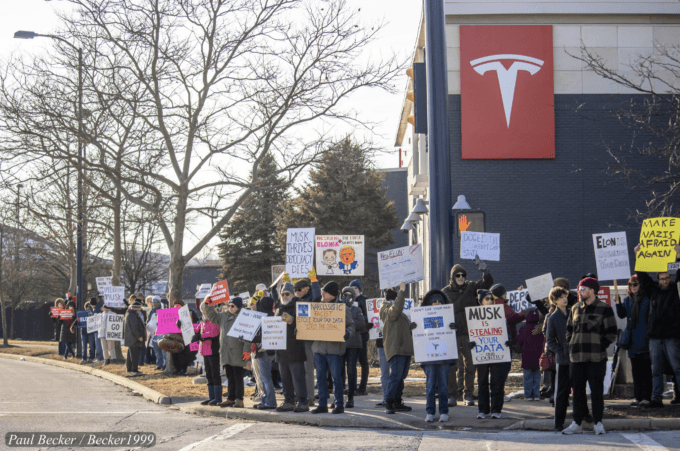
Over the last few weeks, Tesla has become the target for a growing, largely social media organized campaign across the United States. This past weekend alone, CNN reported:

Demonstrators gathered at more than 50 Tesla showrooms across the United States on Saturday in protest of CEO Elon Musk’s role in slashing government agencies as part of the so-called Department of Government Efficiency established by President Donald Trump.

This was probably an undercount. If you follow the mainstream media alone, you’ll miss out on some protests. Our protests in Chicago have received no media coverage, and there has been scant coverage of protests in the suburbs. While many of the protests have been organized by Indivisible, the nationwide campaigning group of liberal and progressive Democrats, the outpouring of protests at Tesla showrooms is much greater than one organization.

Musk is despised by millions of people around the globe. The world’s richest man and best known Nazi, Musk personifies everything that is wrong with the world today. Tesla takedown is a positive development in the struggle against the Trump regime and Fascism in the United States.

Henry Ford comes to mind as the last major auto industrialist who was identified closely with Fascism. In many ways, Ford thrusted political antisemitism into the mainstream of U.S. society through his newspaper the Dearborn Independent. But, Ford was on the wrong side of the New Deal and preparations for WWII.

Today, according to Harold Meyerson:

Fast-forward now to Elon Musk, who today has no qualms about neo-Nazis ruling Germany. Quite unsolicited, Musk has tweeted (X-ed?) his way into Germany’s parliamentary election, which will be held next month, beginning by arguing that “only the AfD can save Germany.” The Alternative for Germany is a far-right, vehemently anti-immigrant and racist party that has grown in strength, particularly in the economically depressed states that were formerly part of East Germany, since it was founded a dozen years ago. Musk has argued that it’s not a neo-Nazi party, but a number of self-professed neo-Nazis and Holocaust deniers have been in the party’s leadership, while the German government views it as a potentially violent threat to German security.

Yet, unlike Ford, Musk had attained political power that a few years ago would have been unimaginable.

Musk is, however, vulnerable. His interventions in European politics have led to sales of cars to plummet. Tesla’s stock has declined significantly. Major pension funds have dropped their ownership of Tesla stock and prominent people have sold their cars. The various Tesla models have gone from being seen as saving the environment to be a Nazi vehicle, like the Volkswagen in the 1930s.

Like Henry Ford, Elon Musk is a fanatical opponent of unions in his workplaces from California to Sweden to Berlin. We see Tesla workers as our allies. Ford was the last of the Big Three U.S. automakers to be unionized by the United Auto Workers (UAW) in 1941, following a bitter strike on the eve of U.S. entry into the Second World War. Musk’s political power can ultimately only be curtailed if the workers in his car and battery plants are organized.

There is still much to do in the United States to combat Elon Musk, but more needs to be done internationally. Tesla takedown is a rare opportunity for anti-Fascists, climate change activists, and supporters of trade unions and democratic rights across the globe to come together with one target. We should make the most of this opportunity now. Organize or join protests at Tesla outlets in your country. Our international unity will make a difference.