Saturday, March 08, 2025

The Origins of the Venezuelan Gang Tren de Aragua and Why US Policies May Only Make it Stronger


 March 7, 2025
Facebook

When the U.S. government deported 177 Venezuelans on Feb. 20, 2025, the Department of Homeland Security alleged that 80 of the deportees were members of the Venezuelan gang Tren de Aragua.

U.S. news outlets report that members have set up shop in at least 16 states and are “wreaking havoc on communities across the nation.”

According to Fox News, in February 2025 there was an “infestation” of Tren de Aragua members in an apartment building in Aurora, Colorado.

Suspected Tren de Aragua members have been arrested in FloridaPennsylvaniaNew YorkCaliforniaTexas and other states.

The U.S. State Department went so far as to designate Tren de Aragua a foreign terrorist organization in an effort to stop “the campaigns of violence and terror committed by international cartels and transnational organizations.”

There is little reliable information about Tren de Aragua – but no shortage of sensationalist news reports and Immigration and Customs Enforcement raids claiming to target them.

We are sociologists who have spent a combined 37 years researching gangscrime and policing in Venezuela. Our research in Venezuela, and our colleagues’ research in other countries, suggests that incarceration and mass deportations of Venezuelans living in the U.S., whether they have ties to the group or not, will likely strengthen Tren de Aragua rather than cripple it.

Indeed, we have already seen how these strategies contributed to the expansion of street gangs in El Salvador and Honduras by creating new opportunities for members to network and become more organized.

What is Tren de Aragua?

According to investigative journalists and a handful of academic studies, Tren de Aragua was initially founded by Hector “El Niño” Guerrero and two other men in 2014. The three men were imprisoned in Tocorón prison in the state of Aragua.

By 2017, Tren de Aragua began to be known as a “megabanda,” a category the local press in Venezuela use to refer to large organized criminal groups. The term arose to highlight the size of some street gangs, which at the time was unprecedented in Venezuela.

Since its beginning, the gang has depended heavily on extortion. It also sells street drugs, but that has been a much less important source of revenue for it.

Tren de Aragua’s growth surged as a result of mass incarceration policies that began under Venezuela’s former President Hugo Chávez and expanded under current President Nicolás Maduro. Incarceration rates began to increase in 2009 and were exacerbated by police raids deployed in 2010 in marginalized neighborhoods across the country. Venezuela’s prisons became filled with young, poor men.

Crowded together in inhumane conditions, the men began to organize into prison gangs with clear hierarchies. They accumulated vast profits by charging prisoners fees for food, use of space and protection from inmate violence. They also opened and ran businesses, including a club, inside Tocorón prison.

Members of different gangs in and outside the prison also began to communicate and share information about criminal activities such as kidnapping and extortion. This strengthened social networks and expanded their illegal enterprises.

Tren de Aragua eventually took control of Tocorón prison as the government became unable to manage daily life inside its walls. It had become one of the largest and best organized gangs in Venezuela.

Criminal enterprise grows

Since 2014, an economic and humanitarian crisis has devastated Venezuela, causing many Venezuelans to migrate.

Venezuela had one of the highest displacement rates in the world between 2014 and 2018, when at least 3 million people left the country.

Tren de Aragua, still based in the Tocorón prison at that time, took advantage of this mass migration. It expanded the group’s business portfolio to include human trafficking and sexual exploitation of Venezuelan female migrants in Chile, Colombia and Peru.

It’s unclear how far beyond Venezuela Tren de Aragua has spread. While the group has certainly expanded operations into the Latin American countries mentioned above, research shows common criminals have posed as Tren de Aragua members in both Colombia and Chile.

Moreover, the arrest of alleged Tren de Aragua members for committing crimes in the U.S. and other countries does not mean that the gang has set up shop in those places. Gang members, same as non-gang members, migrate during crises. They may continue to commit crimes in new places after they arrive. However, it’s important to note that immigration in the U.S. is consistently linked with decreases – not increases – in both violent crime and property crime.

Even some local police departments have questioned the gang’s expansion into the U.S.

In Aurora, police refuted both the mayor’s and President Donald Trump’s claims about the apartment complex being taken over by the gang. And the New York Police Department recently reported that suspected Tren de Aragua members there are largely focused on snatching mobile phones and robbing department stores – hardly the crimes of a transnational criminal empire or terrorist organization.

Making matters worse

Deportations do not address the urgent situation faced by many migrants who leave their homelands in search of a better, safer future.

When governments prioritize the spectacle of deportations to deal with migration, they contribute to the expansion of even more resilient networks of criminal enterprises.

Recent history bears this out.

In El Salvador in the 1990s and early 2000s, incarceration, deportations and repressive policing policies contributed to the evolution of youth street gangs such as the Mara Salvatrucha, or MS-13, into transnational extortion rackets that spread across Central America.

These same policies could also contribute to the growth of Tren de Aragua within Latin America.

Prison isolates large groups of excluded and marginalized people and constrains them to brutal conditions. This enables and encourages the social networks that fuel illegal markets and criminal activity beyond the walls of prisons.

Rising xenophobia

Another harmful outcome of the policies we have discussed here is that they may fuel xenophobia toward and criminalization of Venezuelan immigrants living in the U.S.

This closes off opportunities and harms people already devastated by economic, political and humanitarian crises in their home country.

Venezuelans have responded with their characteristically incisive and biting humor.

Many have used social media to parody news outlets and political speeches, and Venezuelans regularly post memes and videos that mock the automatic association made between them and Tren de Aragua.

The satiric news site El Chigüire Bipolar posted stories titled “The United States confirms that Venezuelans are Tren de Aragua members from birth” and “ICE agents detain newborn that might be Tren de Aragua leader in the future.”

Meanwhile, recent cuts in U.S. foreign aid to countries with large Venezuelan populations, such as Colombia and Peru, will likely exacerbate the migration crisis by constraining opportunities for Venezuelans.

Future waves of migrants will be easy prey for criminal organizations like Tren de Aragua, which has turned human trafficking into a lucrative business. And with current policies of cutbacks, incarceration and repression, Tren de Aragua will likely continue to grow and fill its coffers.The Conversation

This article is republished from The Conversation under a Creative Commons license. Read the original article.


“Black Earth Rising”: a Preview


 March 7, 2025
Facebook

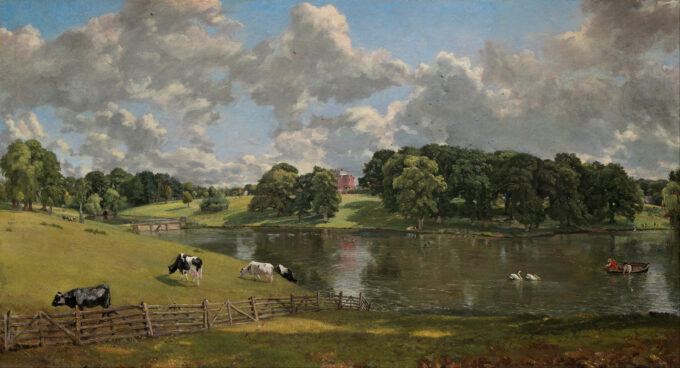
Wivenhoe Park by John Constable.

“Black Earth Rising: Colonialism and Climate Change in Contemporary Art” is a large art exhibition to be held at the Baltimore Museum of Art, May 18 to September 21, 2025. Then the show travels to Europe. Here I present a preview review just of the catalogue, which is published by Thames & Hudson. The guest curator Ekow Eshun has worked with support from Katie Cooke, Baltimore Museum Manager of Curatorial Affairs. And the authors of the catalogue include Anna Arabindan-Kesson and Macarena Gómez-Barris. This exhibition, which presents more than 150 artists, many of them well known, deserves to be seen. But obviously even viewing these excellent illustrations cannot serve as substitutes for the artworks themselves. Here, then, in anticipation is a commentary on the fully illustrated catalogue, which contains important texts by the curators. I focus on this argument and one of its implications, in anticipation of viewing the exhibition. Putting their account in art historical perspective, I raise questions about its political significance.

An enormous amount of varied visual materials are assembled here. Frank Bowling, Middle Passage (1970) shows the slave ships. Kara Walker’s Restraint (2009) depicts an individual slave woman. And Anna Bella Geiger, Native Brazil— Alien Brazil (1976-77) presents the brutal history of that country. Finally, Alfredo Jarr’s Gold in the Morning B (1985) is an image of a mining site. Traditionally European landscape painting has very often been associated with escape from the urban environment. Looking at their Claudes or their Constables, the busy prosperous city dwellers could enjoy imagining being in their countryside house. But when we become aware that this ‘nature’ is a construct, the product of painstaking human labor, as much as the city environment, then making that contrast will seem more problematic. The countryside in Constable’s Wivenhoe Park (1816), the famous painting which was the stalking horse for Ernst Gombrich’s Art and Illusion, is a creation of human activity. As you can see by reading his text, or just by looking closely, it’s a working site, the property of the privileged people who own the land. And so leftist commentators have been legitimately much concerned to observe that a real act of repression is required to subtract out the workers whose activity creates those beautiful sites. Indeed, in his painting Constable shows the grand manor house of the property owners in the distance. A generation or two ago, John Berger and other left-wing commentators created an intellectual stir by focusing on these historical realities, which lie behind these beautiful depicted scenes. “Black Earth Rising” takes that critical political discussion a step further, in a dramatic unexpected way. We are very well aware of the dramatic present ecological problems. And we have seen, also, many shows devoted to non-white artists. This important exhibition connects them, by scrutiny of the racial dimensions of ecology.

“Black Earth Rising” presents maps showing the history of colonialism. Thus Jaune QUick-to-See Smith’s Tribal Map (2000) remaps the United States according to Indian tribal areas. Ingrid Pollard’s Valentine Days (2017) uses hand-tinted photographs to rework archival images of plantation life. And Todd Gray’s Sumptuous Memories of Plundering Kings (2021) reworks old photographs of Africa. Presenting the legacies of slavery and colonialism, the exhibition shows images of plantations as seen from the vantage point of the slave worker. Urging that we think seriously about how to reclaim nature, it presents images of the history of our long colonial exploitation of nature. Judging just by the catalogue, the power of the exhibition lies in its massive presentation of visual materials making this argument. Traditional histories of landscape painting show beautiful sites from the viewpoint of the victors. This exhibition presents what effectively is the other side of that picture, the ravaged landscapes as viewed by the victims of colonialism. You really need the text to understand the essential unity of these visual themes, for — as this evidence shows — the land looks very different if you’re forced to work on it.

Recently there has been a great deal of discussion in the United States and also internationally about art by Black people. And, also, and this is usually a separate topic, for some time visual artists of al races have often been dealing with climate change. What’s worth of attention, then, is the novel connections that this exhibition makes between these two themes. Aptly enough, so the museum press release explains, the phrase terra preta—Portuguese for “black soil”— refers to a type of fertile earth found in the Amazon Basin that was created by ancient Indigenous civilizations. Of course climate change affects everyone, but how and how much it affects you personally is typically a function of your race. The older leftist literature devoted to landscape painting takes note of the price of these landscapes. This show takes the argument a dramatic step further. Nature isn’t so beautiful when you look at this history.

The catalogue presents a convincing case for its claims, but doesn’t take up a crucial political issue. And so what I wish to discuss briefly are the implications of this analysis. As we all surely know right now, acknowledging responsibilities for serious unjustified inequalities is often politically perilous. The Germans acknowledged the Holocaust only after their unconditional surrender in 1945. And the United States is not yet prepared to pay reparations for slavery, which is an obviously comparable case.“Black Earth Rising” surely calls for grand changes in how we understand injustice. And since the responsibility lies primarily with White people, this show is surely to cause heated international discussion. It very hard to imagine, in the present state of things, how our nation will respond constructively. For that reason, this show is likely to be immensely important. Should we feel pessimistic? Allow me, if you will, to conclude on a speculative optimistic note.

It might be argued that the kind of self-critical evaluation of a culture of its own history such as is promoted by “Black Earth Rising” is a great constructive achievement. Nietzsche’s The Genealogy of Morality presents such a view of Western critical evaluation of Christian morality. The ultimate aim of the European search for truth led, so he claims, to dramatic self-critical reflection. Now, then, we could apply his argument to the history of colonialism ecology presented in this exhibition. Just as it is a magnificent achievement for a person to honestly judge themselves self-critically; so, it could be argued, it’s a great achievement for a culture to honestly evaluate its history, however painful that awareness may be be.

I wish that this might be true. But everything I see about recent history suggests that this line of thought is hopelessly overoptimistic. More likely, I think, people prefer to have delusions about their history rather than face uncomfortable truths. This, alas, is the dominant trend of American culture right now. Still, if that pessimistic prediction is correct, then this impressive catalogue tells us all too much about ourselves.

David Carrier is a philosopher who writes art criticism. His Aesthetic Theory, Abstract Art and Lawrence Carroll (Bloomsbury) and with Joachim Pissarro, Aesthetics of the Margins/ The Margins of Aesthetics: Wild Art Explained (Penn State University Press) were published in 2018. He is writing a book about the historic center of Naples, and with Pissarro he conducted a sequence of interviews with museum directors for Brooklyn Rail. He is a regular contributor to Hyperallergic.