Making America White Again: The Deafening Silence of Black MAGA
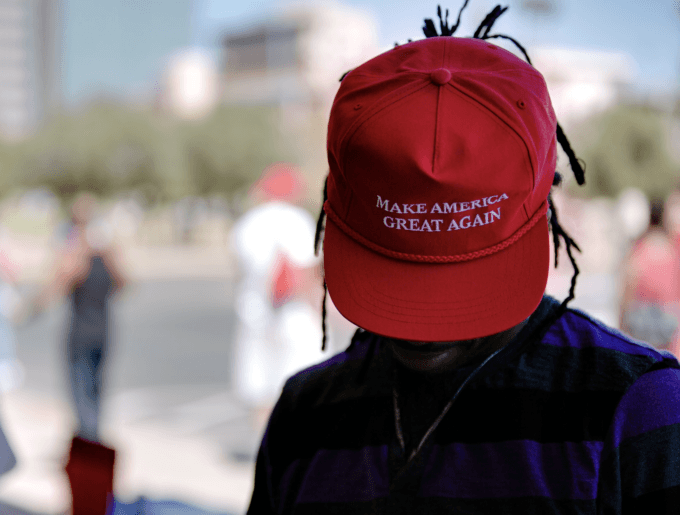
Image by Johnny Silvercloud.
During the 2024 election campaign, candidate Donald Trump’s most controversial rally occurred at New York’s Madison Square Garden. A comedian on the program referred to the island of Puerto Rico — and by implication Puerto Ricans — as garbage. He and the Trump campaign were rightfully pilloried and called out for his disgusting bigotry.
Little notice was given, however, to another noxious racist moment at the same event. On Trump’s playlist for the rally was the Confederate and White nationalist anthem “Dixie.” Notably, that song was played as Trump loyalist and harsh defender Representative Byron Donalds (R-FL) was coming on stage. Donalds is African American and perhaps Trump’s most visible Black sycophant. While Black social media and journalists crucified Trump and Donalds over the incident, for Black MAGA supporters, the episode was simply put in the memory hole.
They were muted as well when Trump and vice-presidential candidate J.D. Vance spread racist falsehoods about Haitians supposedly eating cats and dogs in Springfield, Ohio. They seemed to be the only people in the country who didn’t hear what everyone else had heard — a fabrication of stunning proportions.
Trump and MAGA’s White Nationalist Rampage
The silence of Black MAGA supporters in the face of Trump’s and Vance’s bigotry during the campaign has carried over to the second Trump era. Now that he’s president again, their voices are being quelled as his White-power, autocratic government takes shape.
The president has spent almost every day of his second term in office so far raging against diversity, equity, and inclusion (DEI), issuing executive orders of a White nationalist flavor, attacking a federal workforce that’s disproportionately people of color, and making it clear that rolling back civil rights and Black social and education advances is one of his top priorities. Nearly every move of his has involved nods to racist themes and aims. That includes his effort to defy the Constitution and try to eliminate birthright citizenship, his mass firings and funding freezes while he vanishes DEI programs across the federal government, his plan to deport millions of undocumented immigrants (of color), and even his take on the wildfires in Los Angeles and the Washington area airplane-helicopter disaster.
Trump thinks of his racialized and racist perspective on such events as “common sense.” Consider that a shield for his bias against and antipathy to science and evidence, as well as his visceral inability to see Black people and other people of color in any position of authority and expertise outside of sports and entertainment.
His vitriol against the world’s most marginalized and poor has led him to try to completely shut the door on illegal (and even legal) immigration — with a single exception. Recently, he spread his arms and opened America’s visa gates to Afrikaners, the Whites whom he (along with Elon Musk) has determined are an oppressed minority in South Africa. Falsely claiming that their lands have been seized by the South African government and that they face genocide, in an executive order he called them “victims of unjust racial discrimination.” He also wrote on social media, “Any Farmer (with family!) from South Africa, seeking to flee that country for reasons of safety, will be invited into the United States of America with a rapid pathway to Citizenship.” Perhaps it’s a coincidence that Elon Musk, Trump’s co-president, who traffics in racist themes about race and intelligence online, is South African Apartheid-era born.
It must be strongly emphasized that Trump’s executive order and his multiple social posts on the subject are not only blatant lies but align with the work of South African and American White supremacists who have falsely charged that a “genocide” is indeed occurring there. And speaking of White supremacists, add to that list his decision to release the White supremacists and neo-Nazis who were among the mob that stormed the U.S. Capitol on January 6, 2021 (with, of course, Trump’s blessing and encouragement). With the stroke of a pen, he absolved violent and White nationalist criminals who had carried signs supporting the Holocaust and yelled racist epithets at Black Capitol police officers.
His war against Black agency has been happily joined by his MAGA allies in Congress. Representative Andrew Clyde (R-GA), for example, threatened to cut off millions of dollars in aid to the District of Columbia unless Mayor Muriel Bowser removed street art that read “Black Lives Matter” and renamed the area adjacent to it (previously known as Black Lives Matter Plaza) Liberty Plaza. Clyde claimed that the art was a “divisive slogan.” It went unmentioned that, if he genuinely wanted to get rid of divisive racial symbols, he could start at home. According to the Equal Justice Institute, Clyde’s state of Georgia is host to “more than 160 monuments honoring the Confederacy.”
Silence Is Not Golden
All of this is part of Trump’s lawless and corrupt war on democracy and the strategic divisiveness that is both his brand and his currency. The convicted-felon-in-chief’s usurpation of power has been as shameless as it is brazen, as he attempts to impose a government that could be characterized as racially authoritarian. In fact, racism should really be considered the central characteristic of Trump 2.0.
And what has been the response of Black Republican members of Congress to such behavior? Where is the pushback from his (once upon a time) only Black cabinet member, former HUD Secretary Ben Carson? Has there been any reaction from Snoop Dogg, Nelly, or other pro-Trump rappers who claim affinity with the Black grassroots? The answer, of course, is not a peep. Most have run for cover, pretending that Trump is not who he has always been: a serial racist attempting to reshape the nation into a far-right, anti-democratic, White, Christian nationalist stronghold.
Some of his prominent Black acolytes have, in fact, gone on the record opposing “equity” and DEI in general. Byron Donalds, for example, says he has issues with “equity” because it puts a person’s demographic ahead of his “actual qualifications.” It should be noted that, during the 2024 campaign, Donalds, whom Trump was then supposedly considering as a vice-presidential candidate, stated that the Jim Crow segregation era hadn’t actually been so bad because “the Black family was together” and “Black people voted conservatively.”
But qualifications or even competency are not really the issue. As New York Times columnist Jamelle Bouie wrote, “Donald Trump does not care about merit.” It couldn’t be plainer or simpler than that. In late February, with the encouragement and full support of Department of Defense Secretary Pete Hegseth, Trump fired Gen. CQ Brown, Jr., from his position as chairman of the Joint Chiefs of Staff. There is little doubt that Trump got rid of him because he was Black and had been outspoken on issues of race and inclusion. Hegseth accused him of having a “woke agenda.” Brown, a four-star general, is to be replaced by Dan Caine, who, you undoubtedly won’t be shocked to learn, is White and a three-star general.
On the rare occasions when Black MAGA denizens have actually addressed the president’s pathological drive to resegregate the country, it has been to protect him and his policies from criticism. The Black Conservative Federation (BCF), for example, issued a statement, riven with White House talking points, defending Trump’s (probably illegal) federal funding freeze, even as it was being condemned broadly by so many, including some of his Republican allies. Echoing Trump, it stated without evidence that the freeze would do no harm to programs like the Supplemental Nutrition Assistance Program, Medicare, and Social Security while ignoring the massive negative impact it was going to have on Head Start, Medicaid, and other programs. To the BCF’s embarrassment, the president was forced to rescind the order 48 hours after it was issued.
Their one-sided loyalty to Trump knows no bounds. Last year, BCF created and presented him with the “Champion of Black America” award at their gala. And that was no joke. He gleefully accepted the award while making awkward racial remarks to the mostly White crowd. The BCF also held an inauguration event for him with tickets ranging in price from $5,000 to $100,000 dollars, which, according to the group, was soon sold out.
The BCF declared on its Facebook page that it is proud to celebrate Black History Month (BHM) and encourages everyone to “celebrate the rich tapestry of contributions made by African Americans throughout history.” Yet there was not one word addressing the cancellation of BHM events at numerous departments across the federal government following the orders of the nation’s White-supremacist-in-chief to quash DEI and any programs that seemed related to it. The Defense Department issued a memo declaring “identity months dead,” while the Transportation Department gleefully announced that it “will no longer participate in celebrations based on immutable traits or any other identity-based observances.”
Far-right political scientist and Trump booster Carol Swain, best known for the Islamophobic rant that forced her to leave her tenured position at Vanderbilt University, wrote a mumble-jumble article hailing his attack on DEI. Although like some other Black conservatives she benefited from affirmative action, she now wants to pretend that DEI is an evil distortion of civil rights. She advocates for the neutral language of “nondiscrimination,” “equal opportunity,” and “integration,” suggesting that they are acceptable conservative values unlike “diversity,” “equity,” and “inclusion.” She seems pathetically unaware that Trump has no love for civil rights, voting rights, or affirmative action.
Out of Touch with the Black Majority
It must be noted that Black MAGA is overwhelmingly out of sync with the Black community in general. In large numbers, African Americans support DEI, affirmative action, and other hard-won programs that provide opportunities historically denied thanks to racial prejudice and discrimination. Black opposition to Trump is not just due to the racist slander and bile he now aims at people of color, but also to a well-documented history of bigotry. His long record of housing discrimination and advocacy for voting suppression flies in the face of the Fair Housing Act and the Voting Rights Act of the 1960s, signature victories for the civil rights and Black power movements that Trump and his Black supporters now disparage.
Trump garnered only single-digit support from Blacks in his 2016 and 2020 presidential campaigns. Despite an effort to scam Black voters with Trump-created Black groups and false claims of surging Black support, he won only six percent of the Black vote in 2016 and eight percent in 2020.
In the 2024 election, Trump won between 13% and 16% of the Black vote. This was a rise from, but not a great leap above, that eight percent (documented by the Pew Research Center) in his 2020 loss to Joe Biden.
More recent data shows Trump rapidly losing whatever Black support he had. A YouGov and the Economist poll in February found that only 24% of Black Americans approved of Trump’s job performance so far, while about 69% disapproved. In that poll, White approval was 57% and Hispanic approval 40%.
Denied a Role in Trump’s New Administration
In the new Trump administration, Black Republicans have essentially no perch from which to speak out (even if they wanted to). Trump has one African American in his cabinet, HUD Secretary Scott Turner, as was true with Ben Carson in his first term. Both were ghettoized at HUD. And Turner has recently bent the knee and essentially surrendered HUD to Elon Musk’s rampaging “Department” of Government Efficiency. Turner, in fact, even formed a DOGE Task Force that will certainly lead to staff cuts at HUD (but no guarantee whatsoever of any savings). In the meantime, HUD canceled $4 million in DEI contracts.
Trump also nominated former football star and disastrous Senate candidate Herschel Walker to be ambassador to the Bahamas. Walker, who had to be chaperoned to interviews during his 2020 Senate campaign by Senator Lindsey Graham and others due to his striking inability to make it through an interview without numerous gaffes, has no qualifications whatsoever to be an ambassador.
While some of Trump’s Black supporters have grumbled privately about being ostracized and marginalized, they dare not speak out publicly or demonstrate anything less than 100% fealty. And they are hardly the only Blacks suffering job losses because of Trump.
His goal to get rid of tens of thousands of federal workers will have an immediate impact on the economic and social health of the Black community. After all, African Americans constitute a disproportionate number of federal workers, a key area of employment that helped build the Black middle class. While African Americans constitute about 12.5% of the population, they are about 19% of the federal workforce. And being central to DEI, they are essentially guaranteed to be first on the chopping black.
Yet Black MAGA gathered for a Trump-led Black History Month celebration at the White House, clearly unphased by the irony of such a grim Saturday Night Live-style moment. Like his previous BHM events, it was, of course, mostly about Trump. Some of his favorite old and new Black sycophants were there, including far-right Christian activist and niece of Martin Luther King, Jr., Alveda King; golfer Tiger Woods (rumored to be dating Trump’s ex-daughter-in-law); HUD Secretary Scott Turner; Senator Tim Scott; and Trump youth organizer C.J. Pearson.
In an interview, Pearson stated that “President Trump’s anti-DEI policies aren’t promoting racism but what they are doing is manifesting the dream of the great Martin Luther King, Jr.: a nation where one isn’t judged by the color of their skin but instead by the content of their character.” Pearson was making this claim while, across the federal government, departments and agencies were canceling Black History Month celebrations and “identity” events.
As the crowd drank wine and ate snacks, neither Trump nor any of the attendees mentioned the elephant in the room: the president’s savage anti-DEI campaign.
Unless there is organized and mobilized political resistance, President Trump will continue to throw racist tantrums and engage in dangerous, even potentially disastrous, racist policies for the next three years and 10 months while Republicans, including Black MAGA types, stand by in a distinctly cowardly fashion. And count on one thing, as is likely to be true of so many other aspects of Donald Trump’s policies: their capitulation will not age well.
This piece first appeared on TomDispatch.