The Iran War and America’s Fascist Rebirth
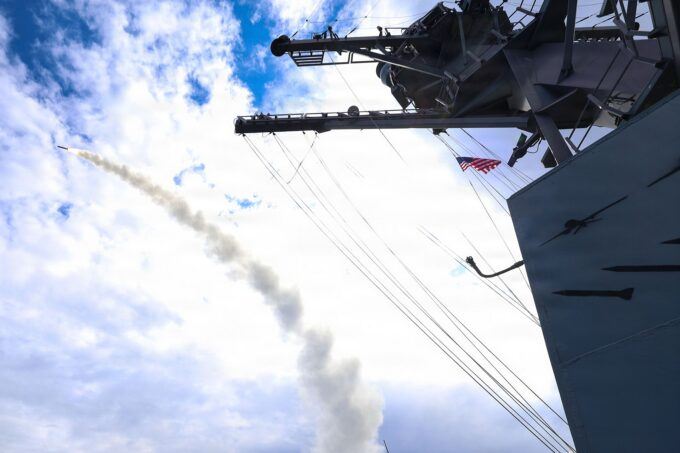
Photograph Source: U.S. Navy photo – Public Domain
The onset of “Operation Epic Fury” against Iran was accompanied by a promise to keep America safe from a rising Iranian nuclear threat. President Trump announced “major combat operations,” claiming that nuclear talks with Iran had failed after just days, and that “our objective is to defend the American people by eliminating imminent threats from the Iranian regime.”
The conflict has destabilized neighboring countries, with hundreds of Iranian missiles fired at Kuwait, UAE, and Qatar as Iran announced it was targeting U.S. “military assets” in the region. Reporting also suggested that Iranian missiles have targeted civilian infrastructure in neighboring countries. The New York Times reported that “U.S. officials reaffirmed that there would be no letup in the American and Israeli strikes” after nearly a week of conflict, “which they said had devastated Iran’s ballistic missile program and its naval fleet.” CBS reported that “Americans are being urged to leave 14 countries in the region because of ‘serious safety risks.” Human rights reporting within less than a week of the onset of U.S.-Israeli strikes estimated that more than 1,000 Iranian civilians were killed.
The stakes of this conflict extend well beyond Iran’s alleged nuclear threat, and Trump’s justification for war does more than invoke national security. The structure of his argument reflects a governing logic associated with fascist politics, in which national death is declared, enemies are cast as existential threats, and executive authority expands in the name of survival. Fascism is not reducible to uniforms or formal dictatorship. It is defined by a recurring pattern: the nation is described as degraded, rebirth is promised, enemies are framed as mortal dangers, and emergency becomes the justification for concentrating power.
Roger Griffin famously defined fascism as palingenetic ultranationalism, the myth of national rebirth after periods of alleged decadence and decline. Classical fascist movements did not merely lament decline; they treated civilizational decay as a condition that demanded rupture. Rebirth was not merely ornamental language but a structural horizon that directed political action toward the reconstruction of the state. Violence was justified as regenerative because it was tethered to an institutional project that sought a new political order.
Trump’s rhetoric adopts the language of decline and rebirth yet departs from this classical model in a decisive way. In his second inaugural address in January 2025, he declared that “America’s decline is over.” In this week’s State of the Union, he also described the United States as “a dead country” before his return to office. These statements frame the nation in biological terms, casting it as lifeless and degraded while positioning executive authority as the animating force capable of restoring vitality. Legitimacy is measured in terms of life and death rather than institutional continuity.
The crucial shift lies in how we understand this nation’s future. Classical fascism tied its rhetoric of rebirth to a concrete institutional horizon that aimed to stabilize a new political order. Trumpism also invokes rebirth. Restoration is proclaimed even as the emergency of rising fascism intensifies. But the nation is described as revived while simultaneously portrayed as perpetually endangered. No defined constitutional reconstruction follows the promise of renewal, and no stable institutional horizon anchors the announced transformation. In this formation, the promised glory of a new future becomes rhetorical rather than substantive.
What replaces the nation’s declared decline is a form of survival politics. The central political question ceases to be what kind of order will be built and becomes whether the nation will live or die. Executive authority is justified not by reforms in institutional design but by the need to confront ongoing “dangers.” When a nation is described as “dead” and adversaries are characterized as embodiments of terrorism and death and hate, survival is elevated above law. Immediate force appears necessary, and restraint appears reckless.
Robert Paxton has asked whether leaders normalize violence and erode institutional constraints through a process of gradual escalation of extremist ideology and politics. Repeated invocation of existential danger to justify unilateral military action in the absence of clear evidence of an immediate threat lays waste to constitutional limits and reshapes public expectations of executive authority. Violence gradually shifts from an extraordinary response to a routine instrument of foreign policy, as we see in multiple conflicts in Venezuela and Iran initiated in less than a year, and in the militarization of domestic policy with ICE attacks on American cities and their peoples. With Operation Epic Fury, U.S. strikes reveal a political formation in which national death is declared, survival is elevated above the law, and executive authority consolidates through the normalization of continuous emergency. Crisis becomes the condition through which governance proceeds.
Contrary to Trump’s rhetoric about rebirth and protecting lives, U.S. actions in Iran constitute a war crime. The United Nations Charter holds the status of Constitutionally protected law in the U.S. since the nation ratified it after World War 2, and as recognized in the Supremacy Clause, which holds foreign agreements and treaties ratified by the U.S. to be part of the highest law of the land. The UN Charter, codified on principles of preventing unlawful aggression, clearly states that the use of force by one country against another is only lawful under two circumstances. One is if the UN Security Council authorizes force, which it did not in the case of the U.S. strikes against Iran. The second is if the use of force is in “self-defence if an armed attack occurs against a member of the UN.”
The Trump administration claims to be protecting Americans from an Iranian threat. But no international monitors have ever documented that Iran has nuclear weapons. And U.S. leaders for decades have claimed that Iran is perpetually on the brink of developing nuclear weapons, making a mockery of the claim that there is an imminent threat from the country. Jason Stanley has argued that fascist politics relies on enemy construction and the normalization of a permanent threat. We see this with Iran via administration saber rattling over its two terms about an imminent Iranian threat that fails to materialize. When imminence stretches indefinitely, notions of “crisis” lose their substance and become an enduring feature of governing.
Americans who oppose Trump’s actions in Iran will find little reason to hope that most of his supporters will sour on Trump’s aggression, or participate in a larger anti-war movement to build public opposition to this war. During Trump’s first term, nearly two-thirds of his supporters indicated there was nothing he could do as president to make them not support him. Similarly, during his second term, an Associated Press poll from late February of this year found that 60 percent of Republicans shared “a great deal or quite a bit” of “trust” in Trump to “make the right decisions about the use of military force” against alleged external threats. And nearly as many Republicans in a late February YouGov poll indicated that they supported U.S. military force against Iran. Once the strikes began, partisan support grew, with 77 percent of Republicans supporting Trump’s strikes, despite nearly 6 in 10 Americans disapproving of military action.
Republican support is unlikely to wane when the President receives unqualified support from his base, even as most of his supporters embrace blatantly contradictory foreign policy positions when prompted to do so by Trump himself. For example, in a national poll that we designed that was conducted in late 2025, we found that 64 percent of Republicans agreed with Trump’s promise to “end the endless wars in the Middle East.” Yet, 65 percent of Republicans also supported “the Trump administration’s bombing of Iran’s enrichment facilities based on the promise to keep Americans safe from nuclear threats.”
These sentiments reveal Trump’s incredible Orwellian power to foster confusion and contradiction among his supporters in pursuing foreign wars. This conclusion is not surprising considering the cult-like mentality expressed by two-thirds of his supporters that Trump can’t say or do anything that would cause them to not support him.
Rising fascism means governing through crisis. The nation is depicted as in a state of perpetual “death,” while external adversaries are framed as existential threats to its survival. Executive power is the instrument of restoration, and legal constraints are discarded. Supporters can accept even contradictory foreign policy positions because the organizing logic is not policy coherence but the superior judgment of the leader.
Fascism doesn’t require the suspension of elections or the formal declaration of dictatorship. It operates in a constitutional order that is hollowed out of constraints against the leader. The repeated invocation of national death provides the moral urgency for the expansion of executive power, while the promise of rebirth remains perpetually deferred. The ongoing strikes against Iran cannot be dismissed as an isolated episode of foreign policy excess. They exemplify a governing logic in which crisis authorizes force, survival is elevated above law, and executive power consolidates through continuous emergency.
Anthony DiMaggio is a Professor of Political Science at Lehigh University. He is the author of a dozen books on American politics, including most recently (with Henry Giroux), Fascism on Trial: Education and the Possibility of Democracy (Bloomsbury, 2024).
Dean Caivano is an Assistant Professor of Political Science at Lehigh University. He is the author of The Necro-President: Trump, MAGA, and the Decline of the American Republic (Springer, 2025).
Catastrophe in the Gulf: Trump’s War on Iran
Photograph by Nathaniel St. Clair
So Donald Trump finally did it: he started a major war on Iran at the behest of the Israel lobby. Already U.S. bases in the Gulf states have gone up in flames, with confirmation from Bahrain that every building in the U.S. navy fifth fleet (near Manama) has been destroyed, U.S. servicemen are dead, the Abraham Lincoln aircraft carrier hastily retreated, Iraqis have risen up against their American occupiers, Israel is getting bombed to smithereens, Iranian ballistic missiles have hit the U.K. airbase in Cyprus, Hezbollah has entered the chat by targeting northern Israel with its cruise missiles, and that’s just for starters. Trump already asked the Iranians for a ceasefire, but they said no dice. They know damn well they were too nice back in June, that consenting to the ceasefire Israel begged for was taken as a sign of weakness rather than what it was, namely decency and restraint. They will not make the same mistake twice.
The U.S. and Israel were imbecilic enough to start this war, but Iran will finish it. Iran is not interested in a truce, especially after the assassination of the ayatollah and other war crimes, among them the U.S. bombing of a girls’ school. Tehran aims to keep firing its many hypersonic missiles – for which U.S. air defense is useless and so is any U.S. or Israeli counterattack, since we in the west have zero hypersonic missiles and have been incapable of developing them, despite deceitful pentagon hype – and Iran will keep firing those missiles until the entire security architecture of West Asia is permanently altered: in other words, Iran aims to smash the base of U.S. power in the Gulf, basically to evict the U.S., which, with all the alerts for Americans to leave every country in the region, is already well underway. Iran will wage this war on its own terms and will conclude it, when it’s darn ready to, on its own terms.
As if this weren’t enough of a debacle for the U.S., Iran has closed the Strait of Hormuz – as it threatened to do if attacked. The only ships getting through are Russian and Chinese, Iran’s allies, as I predicted on this site weeks ago. As of March 2, first day of business since the Strait closed February 28, the price of oil shot up to $82 a barrel. Expect it to go higher. Goldman Sachs analysis March 2 predicted a one-month disruption would drive European natural gas prices up 130 percent. That was the same day Iran said it was ready for a six-month war. Roughly 20 percent of the world’s oil passes through the Strait of Hormuz, and 30 percent of its LNG. It was not secret that Iran could and would close the Strait. That alone made attacking the Persian nation stupendous madness.
But Israel wanted to attack. Israeli prime minister Benjamin Netanyahu needed it for the next election, and Tehran’s support for allies like Hezbollah, the Houthis, Iraqi fighters and the Palestinians was regarded by Jerusalem as intolerable. As are Iran’s hypersonic missiles, not its non-existent nuclear program. These were what spurred Israel to attack and indeed, as soon as Iran struck back, Israel proclaimed a total siege of Gaza and tightened its grip on the West Bank. Gaza was pretty much already under siege, despite Trump’s so-called truce, overseen by his ghastly Board of Empire, a truce that mendaciously proclaimed 600 aid trucks per day would enter the enclave – ho! Ho! More like 100, so the Gazans became very dependent on programs like the World Central Kitchen, which was serving 1 million hot meals daily when Israel struck Iran. Now, with this new siege, WCK head chef Jose Andres says it will run out of supplies in a week. What will Gazans eat then? Grass? That seems to be the barbaric Israeli plan, because as far as Jerusalem is concerned, Palestinians are there to be ethnically cleansed and, worse, are allied with Iran, and therefore, in the current struggle, anything goes. Israel has also counterattacked in Lebanon (where, despite the supposed truce, it never stopped bombing). Hezbollah is of course a more formidable opponent than starved, traumatized, homeless and destitute Gazans. Expect to see more of Hezbollah’s missiles landing on northern Israel in the weeks to come.
As of March 2, the U.S. acknowledged the deaths of four soldiers – if you believe that low number, I have a bridge to sell you – and general Dan Caine told the New York Times, “We expect to take additional losses.” Well, duh. What about the CIA outpost in Dubai that Iran blasted or all those hotels to which U.S. troops were told to flee, sans uniforms, and which Iran attacked with drones? Also in the color-me-dubious bucket, the three F-15s that supposedly got shot down by friendly fire over Kuwait March 2. Friendly fire? Really? More likely, as military expert William Schryver noted on X, “the Iranians are launching MANPAD missiles from loitering drones, and they set up an ambush for these F-15s.” Meanwhile, general Caine told the Times that more troops would soon head to the Persian Gulf. This is profoundly stupid. It amounts to throwing good money after bad.
Trump predicted on March 2 that U.S. and Israeli strikes on Iran could continued for “four to five weeks.” Uh, sure. That means retaliation will last even longer. It means U.S. air defense interceptors will be down to nada, zip and Iranian hypersonic missiles will freely hit and obliterate their targets – namely U.S. bases, Israel, and U.S. navy ships. All the while Israel claims only 10 Israelis have been killed – again, take a look at that bridge I’m selling.
The soi-disant thinking, I guess, was that by assassinating the ayatollah, the U.S. and Israel would somehow “decapitate” the Iranian government. This was arrant nonsense. The 86-year-old ayatollah delegated his powers to the military weeks ago in anticipation of his welcomed martyrdom, and other religious leaders – far more hardline than ayatollah Khamenei – are ready to step into his shoes when asked. Basically the U.S. and Israel bumped off a moderate religious leader, who will be quickly replaced by someone much less moderate, while insuring that the military fights ferociously to the finish. All as the price of oil skyrockets. Quite the genius strategy.
Most market observers agree that oil prices could top $100 per barrel if the Strait remains closed a long time, “or if the war spills over,” per NPR March 2, “into neighboring countries and destroys oil infrastructure,” which it is already doing. “Saudi Arabia says it has shot down drones targeting an oil refinery, while Qatar Energy says two natural gas facilities have been attacked.” However, the Iranian news agency Tasmin blames Israel for trying to frame Iran for the attack on the Saudi Aramco oil refinery. This is credible. Israel would like nothing better, as journalist Mark Ames noted on X, than to bust up the Saudi/Iranian rapprochement brokered by China in 2023.
If Trump now concedes that the war will last weeks – his attempt at a speedy ceasefire having encountered an Iranian rebuff, as Iran announces it’s hunkering down for a six-month war – then expect the price of oil to shoot through the roof. That means real pain for Americans at the pump. How much pain? Five dollars, 10 dollars a gallon? Who knows? The sky’s the limit. And the stock market is already sagging. That’s what happens when you start a stupid, lousy war with a significant regional power armed to the teeth with hypersonic missiles that you can’t block and that can freely turn off the world’s energy spigot. On March 2, meathead secretary of war Pete Hegseth had the brazen nerve to claim that Iran started the war but the U.S. would finish it. Hello? Does he think we’re all morons? Like him? He’s just making shit up outta thin air. If the U.S. didn’t start the Iran War, who did? Santy Claus?
It is frankly very disturbing that highly placed U.S. officials are of such low caliber that, like Hegseth, they believe they can utter such lying inanities and no one will challenge them. Do they honestly believe we are all as demented as they are? Do they believe the hogwash regurgitated out of their mouths? The answer is yes. They do. And that’s how we got into this unspeakable disaster in the first place. So you better buckle up. Iran ain’t backing down and the price of oil ain’t dropping. You and I have to live with this. It’s gonna be a long war.


No comments:
Post a Comment