Saturday, March 29, 2025


Chick Corea: A Work in Progress


Facebook

  March 28, 2025

Image from A Work in Progress… On Being a Musician: Volume 1, Revised by Chick Corea, used under Fair Use: Commentary.

A Work in Progress… On Being a Musician: Volume 1, Revised

by Chick Corea

Published in 2019 by Chick Corea Productions, Inc.

Oversize paperback, 8½” by 11″, 64 pages, illustrated, no ISBN, no list price.

A Work in Progress is a fitting title for a book with a scant 40 pages of actual text. The pages are oversized at 8½” x 11″, but the type is also oversized, with generous margins and ample line spacing. It almost looks like a children’s book or a book of poetry.

A Work in Progress is closer to a work of poetry. Pianist, composer, and bandleader Chick Corea shares pearls of wisdom polished over decades of performance and groomed through rounds of revision from 1988 to 2019. Corea amassed an amazing 27 Grammy Awards before his death in 2021 at the age of 79.

One of the ways Corea grows a composition is by listening back to recordings of his own playing and fixing the timing on phrases as a piece takes shape. A Work in Progress could similarly be seen as a suite with generous space, graceful transitions, and highly-refined motifs imparting the wisdom of a recognized jazz master.

Corea lists 19 “personal policies” as a musician. Roughly half of them can be summed up as, “Don’t take crap from anybody.” A sample:

Don’t stop.

Don’t compromise.

The audience can respond or not.

To each his own.

The first half of Corea’s list is all tenacity, and the second half is about honesty, ethics, and supporting those who supported you.

A Work in Progress contains a pianist’s view of learning the piano, performing, and composing. Corea highly recommends watching other pianists play, as opposed to listening, studying scores, or reading biographies. He writes about seeing his fingers as drumsticks, and provides sheet music for a riff called “10 Drumsticks.” Corea writes, “I’ve found good control of rhythm to be the single most important element in making good music.”

Corea laments all the time he wasted fighting with bad pianos. He learned to “have a friendly attitude toward [the piano] and try to utilize its best qualities.” When accompanying a soloist, Corea recommends, “leaving big spaces when [the soloist] is making expressive phrases.” He refers to composing as a “musical game,” one Corea finds difficult to play unless driven by the pressure of an upcoming performance or recording.

A final thought on the calligraphic illustrations throughout the short book. I assume they are by Chick Corea, although no credit is given and they are unsigned. After wandering around with A Work in Progress for a couple weeks, I came to see the illustrations as integral to the text. They imply the same lessons in an elegant form.

I recommend A Work in Progress for collectors who are interested in piano instruction or in Chick Corea, or both. For the general public, the book is not an autobiography and lacks any of the usual elements of musical biography one might expect, such as memories of gigs or band members, or even a timeline of Corea’s amazing accomplishments as one of the greatest pianists in the history of jazz.

Steve O’Keefe is the author of several books, most recently Set the Page on Fire: Secrets of Successful Writers, from New World Library, based on over 250 interviews. He is the former editorial director for Loompanics Unlimited.


Trees, Singing and Silent


 March 28, 2025
Facebook
A close-up of a pianoAI-generated content may be incorrect.

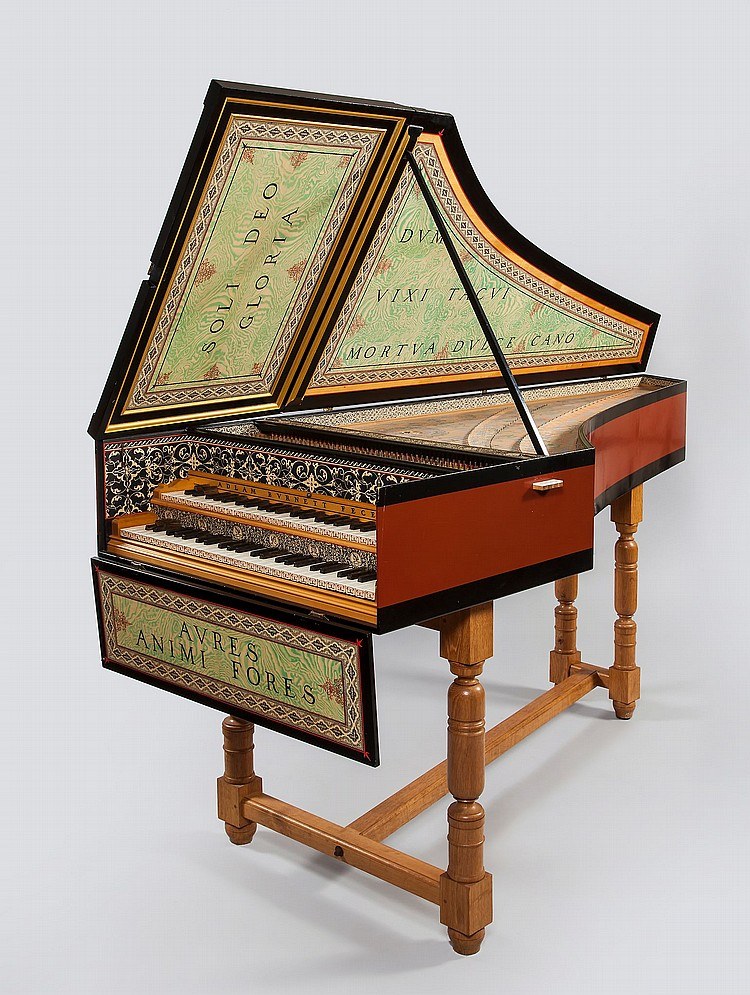
Harpsichord after Andreas Ruckers, Antwerp 1638, built by Adlam Burnett, 1983.

Inscribed on the nameboard of an ottavino spinet (a small tabletop, or even laptop, harpsichord) dated 1710 and now in the Russell Collection of musical instruments at the University of Edinburgh, runs the motto: “Dum vixi tacui: mortua dulce cano” (While living I was silent; dead, I sing sweetly). Nothing is known about the builder, one Petrus Orlandus, although reigning scholarly opinion holds that this Pietro Orlando came from Palermo, the length of Italy (and across the Strait of Messina) from the Val di Fiemme in the mountains of Northern Italy where the spruce soundboard may well have come from. Perhaps the preciousness of the natural material elicited, even if indirectly, the maker’s expression of the resonant truth—and abiding guilt—that a living thing had had to die so that his creation could spring to sounding life.

“Messiah” violin by Antonio Stradivari, Ashmolean Museum, University of Oxford.

Some keyboard instrument builders of the present day, such as the Fazioli piano makers and Bizzi harpsichords) tout the quality of their materials, boasting that their soundboards, the essential element of resonance, are carefully sourced from the Val di Fiemme, rebranded in their advertising copy as the Stradivarius Valley. The prospective buyer dreams that her harpsichord or piano will sing like “The Messiah,” the sobriquet of one of the master violin makers most famous, and perhaps most valuable products, now in the Ashmolean Museum at Oxford University. There this “as new” instrument spends its time in a climate-controlled glass case, visible but silent.

The motto of the Russell Collection ottavino truncates a couplet associated with the 16th-century luthier Kaspar Tieffenbrucker, who was born in from Füssen southern Bavaria in the in the northern shadow of the Alps, 170 miles away from the Val di Fiemme: “Viva fui in sylvis: sum dura occisa securi. Dum vixi tacui: mortua dulce cano” (I was alive in the woods: I was cut down by the hard axe. While living I was silent; dead, I sing sweetly.) (The term “luthier” refers not just to lute makers, as one might initially think, but to skilled craftspeople building stringed musical instruments.)

Tieffenbrucker’s name served as a prop for spuriously “ancient” (but masterfully made) violins counterfeited in the shop of Jean-Baptiste Vuillaume (who, not coincidentally, once owned the Stradivarius “Messiah”) in 19th-century Paris. Tieffenbrucker didn’t even make violins, but mostly guitars, lutes and viols. But they were of wood too, and Tieffenbrucker’s expiatory Latin lines artfully acknowledged the violence that is often hidden behind beauty.

Gasparo Duiffopruggar (aka, Kaspar Tieffenbrucker), engraving by Pierre Woeiriot (1532-1599).

In 2014 Aaron Allen, a scholar helping to shape the subfield of what has come to be known as eco-musicology, published “Fatto di Fiemme’: Stradivari’s violins and the musical trees of the Paneveggio.” The article told a heartening, yet admonitory tale of the power of art and careful stewardship of natural resources to hold off the insatiable human desire for wood. The value of violins trumped the rabid demand for planks and masts for the vast Venetian navy being built a hundred miles southwest of the spruce forests on the Adriatic coast. The “Stradivarius” Valley is now in the Parco Naturale di Paneveggio, some hundred miles northeast of Cremona, the birthplace of the violin and also once part of the Venetian Empire.

Cremonese violins are much smaller than Venetian war galleys. Now, a more recent musical technology requires the harvest of the descendants of the trees used by Stradivari.

The Fazioli company makes concert grand pianos that are the battleships of concert stages and billionaires’ drawing rooms. The family business originally produced upscale office furniture from exotic woods—teak, mahogany, rosewood—but turned to piano-making in 1981 under the leadership of Paolo Fazioli. He is a mechanical engineer but was also trained as a pianist and composer. The firm now makes the most expensive pianos in the world. The price-tag on their 10-foot concert grand approaches $300,000. About 170 pianos of various sizes (all large) are now produced in the Fazioli factory in Sacile, a town halfway between the Val di Fiemme and Venice. With an engineer in the driver’s seat of the firm, it’s not surprising that these instruments handle like Formula 1 race cars—light to the touch and super responsive.

The cast-iron frame was the crucial design and manufacture innovation that allowed the 19th-century piano to increase in power so as to be heard in ever larger concert halls and against ever larger orchestral numbers arrayed for the concerto showpieces of the Romantic repertoire. The German word for this construction is Vollpanzerplatte—full armor plate. “Panzer” conjures images of a battle-ready tank. Without the metal plate, the inexorable force of the high-tension wires would accordion the piano into a heap of splinters.

Buttressed by these armaments is the fine- and straight-grained soundboard from the Val di Fiemme. Fazioli draws on the mystique of Stradivarius and the “Forest of Violins” in the marketing of their pianos.

I have played a Fazioli piano in a San Francisco mansion where the instrument stretches out grandly in the living room. Behind it, a picture window delivers a view of the Gold Gate Bridge so close you feel that if the seven-octave expanse of the keyboard added just a few more notes below its allotment of 88 that the extra keys would rest on the span’s towers so that the piano’s hammers would strike the vertical cables and sound them like strings.

Inside, the massive case is veneered in blond maple that contrasts the with brooding, yet brilliant exterior. To open the piano, one props up the lid on its stick and is amazed that the giant, thin wing does not bow or warp. The visual impression becomes one of interior lightness, sound escaping the forces of gravity that the sheer size and weight of the instrument cannot physically defy.

The action—the ingenious mechanism of wooden (and increasingly, carbon fiber) batons, springs and pins that translates the motion of the fingers to the felt-covered hammers—is exceedingly user-friendly: responsive not only to caresses, but also tothe blows of pianistic heavyweights. The instrument is shaped like the lift-giving limb of a bird. Again, the German word for the grand piano is illuminating—Flügel (wing). Maybe one is meant to feel more like a jet pilot than a race driver, flying above the world firing off missiles of art. The biggest Fazioli model is the F-308, which sounds to me like an American fighter plane of the future.

I found the Fazioli all too perfect: too engineered, the sound lacking in grain, the touch wanting of texture. The piano I’ve played hovering above the Golden Gate is more musical machine than musical instrument.

The Fazioli website trumpets the manufacturer’s commitment to sustainability. The company offers other veneers than just ebony, the default-setting for formal venues: after black on a dealer’s drop-down menu, one can choose blue, macassar, pyramid mahogany, red, tamo, or white. Logged, often illegally in Indonesia, macassar is a threatened species.

The 170 pianos made annually by Fazioli count as a whole fleet of giant crafts launched every year. With respect to the materials sourced from the Val di Fiemme nearer the Fazioli factory than those far-off forests of macassar and mahogany, not every red spruce yields soundboard-quality wood. The vast majority of trees felled there go to other purposes. A true accounting of the environmental impact of piano production has yet to be made on this region. Against stiff competition from luxurious, but still cheaper Steinways made in the U. S. A. and Germany, Yamahas from Japan and a host of newer companies, Fazioli has penetrated the global market, exporting its instrument to places as far as you can get from the source of their soundboards.

Nor has the musical mileage put on these pianos by wealthy buyers been measured. These pianos are prestige objects that come from wood that did not sing when alive and is, I suspect, mostly mute now as furniture, even though the most tuneful wood in the world was killed—by the chainsaw not the hard axe—to make them.

Next week: Musical Instruments, Extreme Weather and Material Acknowledgments.

David Yearsley is a long-time contributor to CounterPunch and the Anderson Valley Advertiser. His latest albums, “In the Cabinet of Wonders” and “Handel’s Organ Banquet” are now available from False Azure Records.


This is a Time for Re-creation and Reimagining, Not for Tepid Nostalgia


 March 28, 2025

Image by Markus Spiske.

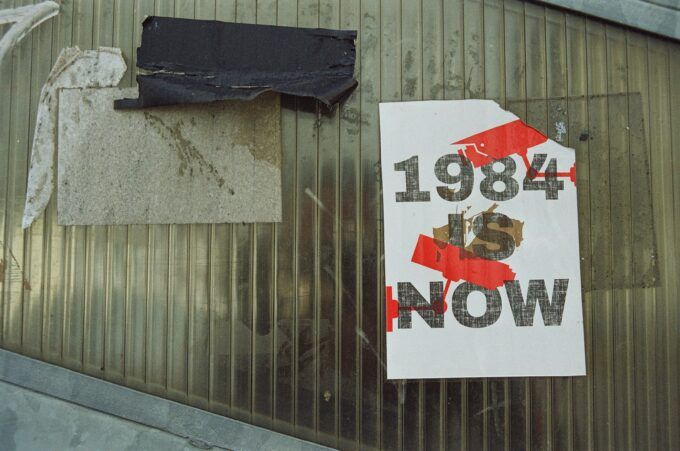
George Packer recently wrote an Atlantic piece that cleverly situated the Trump regime within a familiar Orwellian framework. According to Packer, Lindsey Graham, Mike Johnson and other slavish Trump sycophants have become comically ridiculous (Packer references Henri Bergson’s theory of comedy) in direct proportion to their ability to absurdly and mechanically mimic Trump’s perspective with the same rhetorical mannerisms that they had employed mere months ago to argue the exact opposite point of view. “Without missing a beat” they once spoke skillfully on behalf of Zelenskyy and now (in robotic fashion) they laud Putin. They are stooges of the moment, laughable figures right out of the pages of “1984.”

As Packer sees it, the old order of American NATO alliances had “made the past eight decades uniquely stable and prosperous in modern history.” In his view, the US descent into realms of Orwellian mendacity originates with the antics of Trump and his lapdogs. Packer does not trace the US embrace of dystopian culture to, say, renaming the US military juggernaut the Department of Defense – an example of Orwellian deception far more confusing than playing a game of musical chairs with global alliances.

Packer’s calculus proposes that the danger of Trump stems from his power to humiliate and control his underlings in such a fashion that only he retains the ability to speak his mind, while all of the lesser accoutrements of the MAGA-sphere are reduced to being mechanized puppets.

I worry that many mainstream, liberal pundits have made fascism into a Trump-centric formula – liberals like Packer betray nostalgia for past glories of American democracy and the world order that the US largely controlled after WW II, and dominated almost completely after the Soviet fall. Like most instances of political nostalgia, this view depends on a myopic distortion. The uniquely prosperous and stable eight decades that Packer lauds were eight decades of war, regime change, colonial extraction and – notably – eight decades of gathering extinction, environmental degradation and skewed wealth.

We can either see Trump as a fracture in time, a great misfortune, a lightning bolt from hell intent on destroying a formerly beneficent arrangement of policies and alliances, or we can alternatively see Trump as a representation of American values – a mirror of the culture we created. The schism between liberals and progressives hinges on whether or not one views Trump as an aberration, or a preordained end point of systemic failure.

By the same token we might raise a skeptical eye at Packer’s revisionist assessment of Marco Rubio and his passive discomfort as an extra in the theatrical meeting with Trump, Vance and Zelenskyy:

“He sat mute throughout the Oval Office blowup while his principles almost visibly escaped his body, causing it to sink deeper into the yellow sofa. Having made his name in the Senate as a passionate defender of democracy and adversary of authoritarianism, he must have suffered more than others from the inner contortions demanded by the new party line—they were written on his unhappy face.”

I have far more curiosity about the inner contortions that George Packer employed to rehabilitate Marco Rubio – a stick figure neocon with predictable views on corporately inflicted climate overheating (he doesn’t believe in it), gun control (he doesn’t believe in it), and abortion (he doesn’t believe in it). The one thing that Rubio believes in with undeterred passion is war, and this, in Packer’s view, makes him a “passionate defender of democracy and adversary of authoritarianism.” Apparently, Rubio’s enthusiasm for giving the authoritarian genocidaire, Netanyahu, a blank check for all the bombs of his dreams has no effect on Packer’s assessment.

Rubio’s constricted body language during the Trump/Zelenskyy showdown seemingly provides Packer with the pretext to assume that Republican capitulation to Trump conceals, in at least some instances, an internal moral crises. It may be that Rubio had some sort of confused hiccup, a moment of puzzlement as the story line shifted on a dime, or it may be that Rubio recoiled at his passive role, his mandate to be a mute walk-on in a drama that might have been more persuasive had he been excluded.

Packer gives himself license to fantasize about the allegedly tortured inner life of sycophants, and that troubles me. If we overly humanize Trump’s henchmen and speculatively envision them as ambivalent victims of Trump’s alleged mystical powers, we miss the seriousness of our predicament. US politicians have been morally castrated as a matter of structural design, for, at least the eight decades of my lifetime. Trump can’t be blamed for the vacuous surrender to corporate schemes that US politicians dependably perform. Give Trump credit for exploiting the soulless dregs that he has surrounded himself with, but he did not drain the humanity from Marco Rubio. The moral desert that comprises the center of the former Florida senator resulted from a drought that long preceded Trump.

Packer concludes his piece by asserting that the public view of the Russian/Ukraine conflict has not followed the narrative plot that Republican politicians newly embrace. The public still reviles Putin and two thirds of Americans (according to polls that Packer cites) want to continue to arm Ukraine. In Packers view, America’s public approval for arming Ukraine “might be America’s last best hope.” This misses the larger issue – how did the US become a rapidly consolidating fascist country with politicians (centrist Democrats, neocons, libertarians, MAGA loyalists), all playing their preassigned bit parts?

The true masters of the system, the military industrialists and the corporate profiteers lose nothing if the US shifts alliances. The public support for Ukraine is little more than a lingering reflection of recent media perspectives. The public is always at the mercy of mass media and corporate control of information. In a country that has spent more money on military spending than the nine leading global competitors combined, the US public still fails to react with alarm. Militaristic propaganda is at the heart of public control, and there are not even vestiges of antiwar passion detectable within the congressional body.

The anomie and gloom that characterize the public mood as fascism threatens to attain consolidation and crush all dissent, cannot be remedied by backward steps into the immediate neoliberal system that gave rise to Trump in the first place.

A proposed withdrawal into the recent past of Biden, or even Obama (if it were even possible to do so – it isn’t), condemns the public to accept a retreat into familiar safety – a set of governmental policies that the late David Graeber attributed to “dead zones of the imagination.”

Graeber noted that:

“…revolutionary moments always seem to be followed by an outpouring of social, artistic and intellectual creativity. Normally unequal structures of imaginative identification are disrupted; everyone is experimenting with trying to see the world from unfamiliar points of view; everyone feels not only the right, but usually the immediate practical need to re-create and reimagine everything around them.”

A true resistance to fascism would involve something more powerful than fatuous dreams about an idealized past. After all, superficial fantasies about the virtues of the past are Trump’s shtick. I believe that we have two real choices – capitulation or revolution. The option of stepping meekly into the immediate past, as Packer proposes, will excite almost no one. This is a time – taking inspiration from David Graeber – for re-creation and reimagining.

This piece first appeared on Nobody’s Voice.

Phil Wilson is a retired mental health worker who has written for Common Dreams, CounterPunch, Resilience, Current Affairs, The Future Fire and The Hampshire Gazette. Phil’s writings are posted regularly at Nobody’s Voice.

Education Matters


March 28, 2025


FacebookTwitter

As Horace Mann noted in 1837, the purpose of education is: 

to inspire the love of truth as the supremist good, and to clarify the vision of the intellect to discern it.  We want a generation … above deciding great and eternal principles upon narrow and selfish grounds.  Our advanced state of civilization has evolved many complicated questions respecting social duties.  We want a generation…capable taking up these complex questions, and of turning all sides of them towards the sun.

But too often that is not what schools and universities in advanced countries are turning out today.  Instead, by guiding students into science, technology, engineering and math (STEM) classes they are too often turning out individuals José Ortega y Gasset in his book Revolt of the Masses characterized as learned ignoramuses whose “inner feeling of dominance and worth” induce them to wish to predominate outside their specialty.  In other words, they are turning out too many Elon Muss.  It is past time, therefore, for teachers of STEM classes to address human rights issues in their classrooms.

The solution, in short, is consilience.  Consilience, as E. O. Wilson pointed out in his book by that name, refers to the “linkage of the sciences and humanities.” “But what,” you might ask, “does physics, or computer science or technology or engineering or mathematics and statistics have to do with human rights?”  And the answer, you may be surprised to learn, is: “quite a lot.”

Start, for example, with physics, a science that has given us nuclear power plants and nuclear weapons.  Students in physics and the other hard sciences, in other words, can use the knowledge they acquire to help improve our lives or destroy them.  Hence in those classes, as well as in classes in the social sciences and humanities, they should learn that knowledge is power and comes with the responsibility to use it for the benefit of others.  Students in a physics class, for example, might be asked to think about the quandary many physicists faced when asked to join the Manhattan Project and help develop the first atom bomb.  Consequently, they might come away from their studies aware that upon witnessing the first test of the bomb, Robert Oppenheimer, the theoretical physicist who directed the project is said to have exclaimed “now I am become Death, the destroyer of worlds.”

Now leave physics and move on to classes where students study computer programming.  Clearly students in those and other technology classes should be made aware, that, in the words of  former United Nations High Commissioner for Human Rights Michelle Bachelet’s “The digital revolution is a major global human rights issue. Its unquestionable benefits do not cancel out its unmistakable risks. Hence, we can’t afford to see cyberspace and artificial intelligence as an ungoverned or ungovernable space–a human rights black hole?”  And given that awareness they might then be asked to address the question the Kemper Human Rights Education Foundation posed last year regarding how they would deal with the problem of the spread of hate speech on the internet?

Finally consider students studying mathematics and/or statistics.  Teachers of mathematics can help their students learn, among other things, how mathematics can be used to help conceptualize and measure social welfare.  And as Jessica Utts, the past president of the American Statistical Association pointed out, students studying statistics should be taught how to avoid violating human rights while measuring progress in realizing them.

Unfortunately, however, in the increasingly technological environment in which young people are growing up today many of the brightest among them are tracked into STEM classes so challenging that they don’t have time to spend on classes in the humanities or social sciences.  Hence, it is increasingly important that human rights issues that should be and often are addressed in those classes are touched on as well in the classes in the hard sciences, engineering, statistics, and mathematics that they do end up taking.

This year will be the 25th year KHREF has sponsored essay contests for high school students in the U.S. and other countries.