Sunday, June 22, 2025


Why Trump Bombed Iran: Preserving US and Israeli Nuclear Supremacy in the Middle East


by  | Jun 22, 2025 |

Ironically, Iran is a member of the Non-Proliferation Treaty (NPT), which Israel shuns. As shown by The Fall of Israel (2025), the US/Israeli path to the carnage across the Middle East was paved almost 60 years ago.

Yom Kippur War

Israel first crossed the nuclear threshold on the eve of the Six-Day War in May 1967, when Prime Minister Levi Eshkol secretly ordered the nuclear reactor scientists in Dimona to assemble two crude nuclear devices. The crude atomic bombs “were readied for deployment on trucks that could race to the Egyptian border for detonation in the event Arab forces overwhelmed Israeli defenses.”

At the eve of Yom Kippur in 1973, despite advance intelligence about the impending attack, Prime Minister Golda Meir decided not to launch a pre-emptive strike fearing the U.S. response could prove adverse as it had in 1956. Mobilization proved grossly inadequate; for a few days, Israel faced an existential threat.

Even the normally sober Defense Minister Moshe Dayan was rattled enough to later tell Meir that “this is the end of the Third Temple.” It was a reference to the collapse of the state of Israel. But “Temple” was also the code word for nuclear weapons.

On the night of October 8, Meir and her kitchen cabinet had thirteen 20-kiloton atomic bombs assembled. Their destructive potential was higher than that of the atom bomb dropped on Hiroshima, with an explosive yield of the equivalent of about 15 kilotons of dynamite.

At the edge of a nuclear war

The Israelis planned to use the bombs against Egyptian and Syrian targets if Arab forces would advance too far. Leaks suggest that the primary purpose was strategic deterrent; but it also signaled a tentative “Samson Option”; that is, a massive potential Israeli retaliation as a “last resort” option.

At the time, the implications of the devastating aftermath of even tactical nuclear strikes were not well-known. As the Soviets began to resupply Arab forces, particularly Syria, Meir requested Nixon for help with military supply.

After the full nuclear alert, Israelis began to load the warheads into waiting planes. Cognizant of the potential implications, Nixon ordered a full-scale strategic airlift operation to deliver weapons and supplies to Israel. By the time the aid arrived, Israel was gaining the upper hand in the war.

After those days on a nuclear edge, nothing would ever remain the same in the Middle East. American military aid to Israel contributed to the 1973 OPEC embargo against the United States, which was lifted in March 1974, and subsequently to the overthrow of the Shah in Iran 1979, followed by another oil crisis.

The twin crises and the postwar economic expansion ended with devastating stagflation, which led to record-high interest rates. As the Keynesian era faded away, monetarism coupled with Reagan’s rearmament drives ensued.

Nuclear stockpiles

The conventional estimate is that Israel’s nuclear stockpile comprises some 90 nuclear warheads, which makes the tiny country the world’s 9th largest nuclear power. However, unofficial estimates vary. The conventional estimate is at the lower end of a possible range that some analysts suggest could be as high as 200, up to 400 nuclear weapons. The latter would make it the world’s 4th largest nuclear power, right after Russia, the U.S., and China, and before France, the UK, India and Pakistan.

World Nuclear Forces
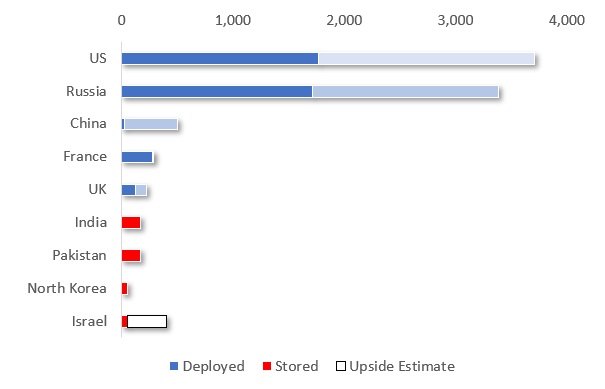
Source: SIPRI, author, January 2024

Most Israelis perceive Iran as the primary nuclear risk. Israel has a broad range of nuclear weapons, while Iran may have enriched enough nuclear material to build them but is thought not to have done so, as of yet. Such weapons, were they to exist, would be deeply underground, possibly inaccessible even by a nuclear strike. In such scenarios, large civilian hubs would not be collateral damage, but intended mass targets.

According to some projections, nuclear weapon detonations in Iran’s densely populated cities would likely result in millions of dead, with tens of millions of injured and without adequate medical care, a devastating loss of municipal infrastructure, long-term disruption of economic, educational, and other essential social activity, and a full breakdown in law and order. These nightmares include thermal burn and radiation patients who would have to suffer their extreme pains without any treatment.

Stated doctrine of “nuclear ambiguity”

Officially, Israel has a long-standing policy of nuclear ambiguity. While it has used psychological warfare leaks to signal its disproportionate nuclear deterrence, it neither officially confirms nor denies that it possesses nuclear weapons. In public, the standard statement has been that “Israel will not be the first country to introduce nuclear weapons to the Middle East.”

Yet effectively, the Israeli policy is more preemptive by nature.

The country first flirted with the nuclear option at the eve of the 1967 War, concerned that it might lose. Since the early 1960s, Israel has relied on what investigative journalist Seymour Hersh has described as the Samson Option. The term refers to the biblical figure of Samson who pushed apart the pillars of a Philistine temple bringing down the roof. In the process, he killed not just his enemy, the Philistines, but himself as well. It suggests an ultimate deterrence strategy of massive retaliation.

In October 1973, amid the Egyptian-Syrian invasion, Golda Meir and Moshe Dayan mobilized nuclear warheads for possible use, which led to president Nixon’s massive rearmament drive and the rapid deepening of the bilateral military ties – and eventually the symbiotic relationship that President Trump touted in his Sunday White House commentary, right after the US attacks against Iran’s nuclear enclaves.

The Begin Doctrine

In 1981, Israel destroyed Iraq’s nuclear reactor Osirak as the Begin government initiated its war on Lebanon. Despite public criticism by the Reagan administration, the U.S. and Israel signed a strategic memorandum of understanding and began to deepen bilateral ties in defense. The Osirak attack gave rise to the Begin nuclear doctrine, which allows no “hostile” regional state to possess nuclear military capability.

Begin described the strike as an act of “anticipatory self-defense at its best.” He framed it as a long-term national commitment.

We chose this moment: now, not later, because later may be too late, perhaps forever… Then, this country and this people would have been lost, after the Holocaust. Another Holocaust would have happened in the history of the Jewish people. Never again, never again!… We shall not allow any enemy to develop weapons of mass destruction turned against us.

In a sense, the Begin doctrine reflected the right-wing Likud party’s offensive view of national security. But it also represented continuity and can be dated to the early 1960s Operation Damocles, Mossad’s covert campaign to assassinate Nazi Germany’s rocket scientists working for Egypt to develop bombs using radioactive waste. The legendary head of Mossad, Isser Harel, recruited former Nazis to provide intelligence on Arab countries.

When I met Harel in the mid-1970s, he denied all such stories. But subsequently, he confirmed them. One of these hired hands was the legendary Waffen-SS commando Otto Skorzeny, who had served as adviser to Egypt’s President Nasser. There is a straight line from Operation Damocles to Israel’s 1981 attack on Iraq’s Osirak nuclear reactor and the subsequent targeted killings of Iranian nuclear scientists, particularly since 2010 – and up to the present.

The far-right Messianic dream to “nuke Gaza”

A month after the Hamas offensive of October 7, Netanyahu’s heritage minister Amichai Eliyahu suggested that one of Israel’s options in the war against Hamas was to drop a nuclear bomb on the Gaza Strip. As the story spread internationally, it was quickly disavowed by PM Netanyahu, but he did not fire his minister.

The far-right Eliyahu objected to allowing any humanitarian aid into Gaza, saying, “we wouldn’t hand the Nazis humanitarian aid because there is no such thing as uninvolved civilians in Gaza.”

In a way, Eliyahu got what he wished for. By late April 2024, Israel had dropped more than 70,000 tons of bombs over Gaza, surpassing the bombing of Dresden, Hamburg, and London combined during World War II. That amounts to more than 30 kilograms of explosives per individual on mainly women and children.

Furthermore, the weight of the U.S. nuclear bombs dropped on Hiroshima and Nagasaki in Japan was estimated at about 15,000 tons of explosives. Even before the Rafah offensive in May 2024, Gaza had been bombed almost five times more than that. Reflecting extraordinary brutality and blind disregard to human life, it was a shocking war crime with no parallel in recent history.

What made it all the more stunning was the Biden-Harris complicity coupled with the hollow assurances that “we are working 24 hours a day for peace” with the whole world watching the other way.

“Peace through strength”

According to US intelligence assessments, Iran was up to three years away from being able to produce and deliver a nuclear weapon. While Israel built its case for war, the US didn’t buy it. The problem is that President Trump did.

It is the notorious “peace through strength” premise that Trump relied on when US struck three major Iranian nuclear sites, joining overtly the Israeli air campaign against nuclear program that it had until then supported mainly covertly.

American diplomacy no longer exists. It has been replaced by diplomatic deception and historically unprecedent lethal force. All gloves are now off. The premise that the Iran attacks reflect a “mission accomplished” couldn’t be more off. The carnage hasn’t ended. It has begun.

The author of The Fall of Israel (2025), Dr. Dan Steinbock is an internationally-renowned visionary of the multipolar world and the founder of Difference Group. He has served at the India, China and America Institute (USA), Shanghai Institutes for International Studies (China) and the EU Center (Singapore). For more, see https://www.differencegroup.net

Skewed Diplomacy: Europe, Iran and Unhelpful Nuclear Nonsense


Farce is a regular feature of international relations. It can be gaudy and lurid, dressed up in all manner of outfits. It can adopt an absurd visage that renders the subject comical and lacking in credibility. That subject is the European Union, that curious collective of cobbled, sometimes erratic nation states that has pretensions of having a foreign policy, hints at having a security policy and yearns for a cohering enemy.

With its pre-emptive attack on Iran’s nuclear facilities and much civilian infrastructure besides, Israel is being treated as a delicate matter. Condemnation of its attacks as a violation of Article 2(4) of the United Nations Charter, which prohibits the threat or use of force against independent, sovereign states, should have been a formality. Likewise, the violation of the various protocols dealing with the protection of civilian infrastructure and nuclear facilities.

Rather than chastise Israel for committing a crime against peace, Iran was chided for exercising a retaliatory right that arose the moment Israeli weaponry started striking targets across the country on June 12. A villain had been identified, but it was not Israel.

With this skewed and absurd assessment of self-defence, notably by the Europeans and the US, French President Emmanuel Macron could only weakly declare that it was “essential to urgently bring these military operations to an end, as they pose serious threats to regional security.” On June 18, he gave his foreign minister Jean-Nöel Barrott the task of launching an “initiative, with close European partners, to propose a […] negotiated settlement, designed to end the conflict.” The initiative, to commence as talks on June 20 in Geneva, would involve the foreign ministers of France and Germany, along with Iran’s own Abbas Araghchi and relevant officials from the European Union.

Not much in terms of detail has emerged from that gathering, though Macron was confident, after holding phone talks with Iranian President Masoud Pezeshkian, of a “path” that would “end war and avoid even greater dangers”. To attain that goal, “we will accelerate the negotiations led by France and its European partners with Iran.”

It has been reported that the E3 countries (France, Germany and the UK) felt that Israel would refuse to accept a ceasefire as things stood, while the resumption of negotiations between Tehran and Washington seemed unlikely. With these factors in mind, the proposal entailed conducting a parallel process of negotiations that would – again, a force of parochial habit – focus on Iranian conduct rather than Israeli aggression. Iran would have to submit to more intrusive inspections, not merely regarding its nuclear program but its ballistic missile arsenal, albeit permitting Tehran a certain uranium enrichment capacity.

It was clear, in short, who was to wear the dunce’s hat. As Macron reiterated, Tehran could never acquire nuclear weapons. “It is up to Iran to provide full guarantees that its intentions are peaceful.”

A senior Iranian official, speaking to Reuters on condition of anonymity, saw little to impress him. “The discussions and proposals made by the Europeans in Geneva were unrealistic. Insisting on these positions will not bring Iran and Europe closer to an agreement.” Having given the proposals a cold shower, the official nonetheless conceded that “Iran will review the European proposals in Tehran and present its responses in the next meeting.”

The European proposals were more than unrealistic. They did nothing to compel Israel to stop its campaign, effectively making the Iranians concede surrender and return to negotiations even as their state is being destabilised. While their command structure and nuclear scientific establishment face liquidation, their civilian infrastructure malicious destruction, they are to be the stoic ones of the show, turning the other cheek. With this, Israel can operate outside the regulatory frameworks of nuclear non-proliferation, being an undeclared nuclear weapons state that also refuses to submit to inspections by the International Atomic Energy Agency.

The European proposition would also do nothing to stop what are effectively war crimes happening, and being planned, in real time. The EU states have made little of the dangers associated with Israel’s striking of nuclear facilities, something they were most willing to do when Russia seized the Zaporizhzhia plant from Ukraine in March 2022. During capture, the plant was shelled, while the ongoing conflict continues to risk the safety of the facility.

The International Committee for the Abolition of Nuclear Weapons (ICAN) has also drawn attention to the critical risks associated with attacking nuclear facilities. “The use of force against nuclear facilities,” it stated in a media release, “violates international law and risks radioactive contamination with long-term consequences for human health and environment.” That same point has been made by the director general of the IAEA, Rafael Marino Grossi. “Military escalation,” stated Grossi on June 16, “threatens lives, increases the chance of radiological release with serious consequences for people and the environment and delays indispensable work towards a diplomatic solution for the long-term assurance that Iran does not acquire a nuclear weapon.”

US President Donald Trump’s own assessment of the EU’s feeble intervention was self-serving but apposite. “Nah, they didn’t help.” The Iranians did not care much for the Europeans. “They want to speak to us. Europe is not going to be able to help on this one.” In fact, the European effort, led unconvincingly by Macron, is looking most unhelpful.

Binoy Kampmark was a Commonwealth Scholar at Selwyn College, Cambridge. He lectures at RMIT University, Melbourne. Email: bkampmark@gmail.comRead other articles by Binoy.
The Invention of the Iranian Threat

Where does the Western obsession with Iran come from? The “Ayatollah regime” is said to threaten world peace. U.S. intelligence agencies and the military see things differently.

LONG READ


A man looks at a billboard featuring the portraits of (Left to Right) Hassan Nasrallah, the slain former leader of Hezbollah; Iran's late president Ebrahim Raisi; Iran's Supreme Leader, Ayatollah Ali Khamenei; and Iran's slain commander Qasem Soleimani, in Srinagar, Jammu and Kashmir, on June 17, 2025.
(Photo: Firdous Nazir/NurPhoto via Getty Images)

David Goessmann
Jun 20, 2025
COMMON DREAMS

At the G7 summit in Canada, Germany, France, Italy, Japan, Canada, and the U.S. adopted a joint resolution on Israel's attack on Iran. It states: "Iran is the principal source of regional instability and terror."

Iran Is to Blame

It was also emphasized that Israel has the right to react to Iranian threats. "We affirm that Israel has a right to defend itself."


While Israel has continued to fire missiles at Iran in recent days and Iran has responded with attacks on Israel, there is now a threat that the U.S. will be actively drawn into the war.

Does Iran have the same right to bomb Israel because it secretly acquired nuclear weapons long ago, did not sign the Nuclear Non-Proliferation Treaty, and does not allow inspectors, unlike Iran?

At the same time, Tehran is being blamed for the escalation of the conflict. According to the G7, Iran is the real threat and danger to the region and in Western countries it is said that Israel was forced to carry out the "preventive strikes."

Israel's Self-Defense

But the question is whether Iran poses any threat to Israel and the region at all. What is behind the Western obsession with Tehran as the hostile troublemaker in the Middle East?

Since the outbreak of the Gaza war, Tel Aviv has attacked Iran and Iranian facilities several times. In April 2024, the Iranian embassy in Damascus, Syria, was bombed. At the end of July, Israel directly attacked the Iranian capital Tehran with a targeted strike against the political leader of Hamas, Ismail Haniyeh.

Under international law, these attacks constitute illegal acts of aggression. The reason for this is obvious. The use of force between states is prohibited under the United Nations Charter and is only legitimate within extremely narrow limits. Only defense against an imminent, ongoing attack from outside that can only be repelled by military means is permitted.


Preventive Strikes

However, since there was no ongoing or imminent attack by Tehran that Israel was defending itself against, the attack is justified by Israel and the West claiming that Iran was on the verge of acquiring nuclear weapons. Hence, it was a preventive strike, they say.

German Chancellor Friedrich Merz said in an interview at the G7 summit that he believes Israeli Prime Minister Benjamin Netanyahu that there had been an emergency situation to which Israel responded with the right to self-defense. Neither Merz nor Netanyahu explained what this emergency situation was based on.

All Israeli attacks against Iran are therefore illegal under international law and, moreover, unprovoked.

However, the justification that Iran was in the process of producing nuclear weapons is worthless. Even if this were the case, it is not a legitimate reason for war under the U.N. Charter—quite apart from the fact that the Netanyahu government's bombings sabotaged Washington's nuclear negotiations with Tehran.

Or does Iran have the same right to bomb Israel because it secretly acquired nuclear weapons long ago, did not sign the Nuclear Non-Proliferation Treaty, and does not allow inspectors, unlike Iran?

Secret Services: No Nuclear Weapons Program


But the statement is not even factually correct. According to Israeli political analyst Ori Goldberg, secret services worldwide, including those of the U.S. and Israel's Mossad, continue to see no nuclear threat from Iran. For instance, the threat assessment by Tulsi Gabbard, director of National Intelligence of the United States, on March 26, states:
The IC [Intelligence Community] continues to assess that Iran is not building a nuclear weapon and Supreme Leader Khomeini has not authorized the nuclear weapons program that he suspended in 2003.

Thus, since the 1990s, the fatwa against weapons of mass destruction, which includes the ban on nuclear weapons, has continued to apply in Iran. This is also in line with the assessments of the International Atomic Energy Agency (IAEA), which recently criticized Iran's violations of the Nuclear Non-Proliferation Treaty but was still unable to detect a nuclear weapons program in the country.

Unprovoked Aggression

Contrary to repeated claims, U.S. intelligence agencies also believe that Iran is not only not seeking to acquire a nuclear weapon, but is also up to three years away from being able to manufacture such a weapon and deliver it to a target of its choice.

All Israeli attacks against Iran are therefore illegal under international law and, moreover, unprovoked. Remember the war in Ukraine. There, it has been repeatedly emphasized in the West that Russia started the war "unprovoked."

In the case of Israel, this term is now absent from debates in Europe and the U.S. Instead, Iran is counterfactually accused of being responsible for Israel's attacks.


History of the Iranian Threat


The narrative of an Iranian threat has a long history. For over 40 years, since the 1979 revolution and the overthrow of the unpopular, pro-Western Shah government, the U.S. and Israel in particular have seen the country as a threat. This has to do with the fact that the resource-rich state with a population of today over 90 million people not only has become independent from the West, but also turned against external interference in the region as a major regional power.

It sided with the Palestinians against Israel's occupation and apartheid policies and its prevention of a Palestinian state, as well as with Hezbollah in Lebanon and the Houthis in Yemen, who were defending themselves against acts of aggression by Israel and the Gulf states, all with U.S. support.

In the end, Iran is primarily concerned with its own national security, which dominates its foreign and military agenda.

In recent decades, Iran's stance in international relations has been shaped by a whole series of experiences. These range from the Iran-Iraq War of the 1980s to the U.S. policy of containment, the 2003 invasion of Iraq, and Tehran's calculated support for the occupation of Baghdad as revenge for its earlier defeat.

Iran's Defensive Strategy

Despite all the rhetoric spread in the United States and Europe, it is clear to everyone that Tehran is not pursuing an aggressive, offensive agenda in the region.

As early as 2010, a Pentagon report to the U.S. Congress on Iran's military strength stated that "Iran's security strategy is based first on deterring an attack." It is just not capable of anything more. "Iran's military strategy is designed to defend against external or 'hard' threats from the United States and Israel."

Pentagon Report

This is also evident in its military programs, including its focus on infantry units at the borders, according to the Pentagon report. The defensive military doctrine is "designed to slow an invasion and force a diplomatic solution to hostilities."

The U.S. Department of Defense told the U.S. Congress that the focus is on deterring acts of aggression. This also includes the possibility that the country could acquire nuclear weapons.

At the time, the Pentagon emphasized Iran's low defense spending compared with the standard in the region. Today, in 2024, Israel's military budget, including U.S. aid, stands at around $46.5 billion.

In comparison, Iran, which is 10 times larger, spends only around $7.9 billion, with a downward trend due to the sanctions, while the U.S. has ended up with astronomical military spending of around $1 trillion. So much for the balance of power.

Deterrence Instead of Attacking


More recent security studies also emphasize that Iran continues to pursue a defensive strategy, albeit with a stronger forward defense agenda in recent years, as evidenced by its support for the Lebanese Hezbollah, Iraqi groups, and the Yemeni Houthis. Security expert Matthew McInnis, a former U.S. deputy special representative for Iran at the State Department, wrote:
The Iranian military is still dominated by defensive doctrines oriented around four primary objectives: securing the regime (or protecting the government from subversion and instability); territorial defense; demonstrative deterrence (or displays of force); and retaliatory deterrence (or a "threat in response to threat"). The centerpiece of Iran's deterrence strategy, retaliatory deterrence, aims to convince an adversary to refrain from or quickly deescalate conflict through the threat of retaliatory action, such as terrorist, missile, or cyber attacks.

Vali Nasr, professor of International Affairs and Middle East Studies at the Johns Hopkins School in Washington, D.C., former adviser to the U.S. State Department, and one of the renowned Iran experts in the U.S., explains that Western politicians have a misunderstanding of the Iranian approach.


Logic of Survival

It is not so much ideological or religious, but rather calculated and pragmatic. Iranian foreign policy is dominated by a logic of survival and the wounds of history.

Nasr speaks of a "strategy of resistance" with which Tehran is trying to sit out and wear down U.S. pressure. The leadership has repeatedly demonstrated its willingness to seize diplomatic opportunities, promote regional détente, and act with calculated restraint while assuming a siege mentality.

Nasr sees Iran's reconciliation with Saudi Arabia in 2023, brokered by Beijing; its partnerships with regional proxies; and its strengthened relations with Russia and China as attempts to gain breathing space and secure pragmatic safeguards against pressure from the West.

In the end, Iran is primarily concerned with its own national security, which dominates its foreign and military agenda. In Nasr's new book, which has just been published, entitled Iran's Grand Strategy: A Political History, the Middle East expert argues that "Iran is the enemy the West created." For the book, he conducted numerous interviews with Iranian insiders.

Western Opinion Making

Despite Iran's widely acknowledged defensive and reactive strategy in security circles, Tehran continues to be regarded by the political public in the U.S. and Europe as the greatest threat to the region and to Israel.

Since there is no military threat, the West is focusing on rhetorical threats made by the Iranian leadership against the "Zionist regime" and the U.S. On the other hand, they refer to Iran's intention to develop nuclear weapons to wipe out Israel.
Double Standards

As for Iranian rhetoric, it hardly exceeds what is regularly announced by the other side. Not only Israel, but also the U.S. government has repeatedly threatened Iran with attacks and even nuclear strikes.

During the latest negotiations, U.S. President Donald Trump warned that if Tehran did not completely abandon its nuclear program, including for civilian use, there would be "all hell to pay," while "all options are on the table"—which is an implicit threat of a nuclear strike. All in defiance of international law.

What worries the West, especially the U.S., most is that Iran is going its own way, resisting Washington's interventions and exerting influence on other states, so that the U.S. could lose its dominance in the oil- and gas-rich region.

Western and Israeli calls for regime change in Iran and the assassination of Iranian military personnel and nuclear scientists by Washington and Tel Aviv are also frequently used means of destabilizing the political leadership in Tehran.

In Iran, it is well known that regime change by the West is also a historical reality. In 1953, the U.S. and Britain organized a military coup to overthrow Iran's parliamentary government and install the dictatorship of the Shah, which was responsible for one of the worst human rights records in the world.

Western-Israeli Aggression

In contrast to Iran, the U.S., NATO allies, and Israel have also behaved aggressively in the region for decades with military invasions, political assassination programs, and threats.

These include the various Lebanon wars and Israel's 20-year occupation of southern Lebanon with U.S. support; the U.S. wars in Afghanistan and Iraq from 2001 and 2003, respectively; drone and assassination programs (2,700 illegal political killings in 70 years by Israel alone, according to an analysis by an Israeli journalist). In addition there was the brutal war in Yemen waged by the Gulf Alliance, supported with weapons from the West.

Iran, on the other hand, has not behaved aggressively for hundreds of years, invading and occupying other countries. The only aggressive act Iran has committed was in the 1970s under the Shah, supported by the U.S. At that time, three Arab islands were occupied.


The Real Threat Posed by Iran


So when the West talks about the Iranian threat, it is not a military threat. There are other reasons why Tehran is nevertheless perceived as a threat from a Western and Israeli perspective.

What worries the West, especially the U.S., most is that Iran is going its own way, resisting Washington's interventions and exerting influence on other states, so that the U.S. could lose its dominance in the oil- and gas-rich region.

It is no coincidence that Iran has some of the world's largest proven oil and natural gas reserves and ranks third in the world in oil reserves and second in natural gas reserves.


Tehran Does Not Want Nuclear Weapons


As for the threat posed by Iranian nuclear weapons, Iran has repeatedly made it clear that it does not want to develop nuclear weapons. When the Joint Comprehensive Plan of Action was adopted in Vienna in 2015, making Iran a nuclear-weapon-free zone, Iranian Foreign Minister Javad Zarif said, "Now it is high time that we expand that zone to encompass the entire Middle East." Israel, the nuclear power, must follow suit.

The U.S. attacked Iraq, not North Korea, as part of the so called "axis of evil." That's because North Korea can deter a possible U.S. invasion with nuclear weapons.

Howekver, Trump unilaterally withdrew from the Iran agreement, which was concluded under U.S. President Barack Obama and successfully limited the enrichment of weapons-grade material in exchange for sanctions relief, during his first term in office in 2018, escalating the conflict.

The nuclear-free zone in the Middle East also continues to await implementation, although it is supported by Iran, Egypt, and the Conference of Non-Aligned States. But the U.S. is blocking it in order not to jeopardize Israel's nuclear arsenal.

Pressure on Tehran

Trump initially resumed negotiations with Iran in his second term. But at the same time, he demanded that Tehran end all uranium enrichment, which is unacceptable to the country because it would also rule out the civilian use of nuclear power for Iran. Experts called Trump's ultimatum a dangerous blackmailing that would ultimately lead to war, which is what happened.

As already mentioned, the U.S. military and intelligence services are discussing a possible Iranian nuclear weapons program, which is currently not believed to exist, as a defensive deterrent. Iran would only consider such a program if Tehran were forced to do so by an escalating threat.

Nuclear Weapons as a Deterrent


Accordingly, the conservative Israeli military historian Martin Levi van Crefeld wrote in the International Herald Tribune after the start of the Iraq War in 2004 in an article entitled "Sharon on the Warpath: Is Israel Planning to Attack Iran?":
Iran is now surrounded by American forces on all sides—in the Central Asian republics to the north, Afghanistan to the east, the Gulf to the south, and Iraq to the west… Wherever U.S. forces go, nuclear weapons go with them or can be made to follow in short order. The world has witnessed how the United States attacked Iraq for, as it turned out, no reason at all. Had the Iranians not tried to build nuclear weapons, they would be crazy.

Van Crefeld emphasizes that Iran is ruled by Islamic fundamentalists. But most commentators familiar with the country do not consider its government irrational. "Saddam Hussein attacked Iran, not the other way around; since then, Iran has been no more aggressive than most other countries."

And we should bear in mind: The U.S. attacked Iraq, not North Korea, as part of the so called "axis of evil." That's because North Korea can deter a possible U.S. invasion with nuclear weapons.

Israel's war against Iran with U.S. assistance and Washington's possible active entry into the hostilities could now give the leadership in Tehran a strong argument for finally acquiring nuclear weapons as a deterrent, which it does not really want.


Who Is Threatening Whom?


The threat posed by Iran is largely an invention of the West. The world's population, and especially those in the region, see the U.S. and Israel as the main sources of instability and a threat to world peace, not Iran. Militarily, the Iranian threat is virtually non-existent.

Certainly, no one wants Iran to have nuclear weapons. But the pursuit of nuclear weapons would ultimately be a response to Western and Israeli threats and acts of aggression, against which Tehran wants to have a deterrent.

A way to reduce the threat level would be for Israel to end its hostilities against other countries, which are contrary to international law; to renew the successful Iran deal; to create a nuclear-weapon-free zone in the Middle East (Israel would then have to give up its nuclear weapons); and to stop the genocidal Gaza War waged by the Netanyahu government, which is keeping Israel on a never-ending warpath.


Our work is licensed under Creative Commons (CC BY-NC-ND 3.0). Feel free to republish and share widely.


David Goessmann
David GoeĂŸmann is a journalist and author based in Berlin, Germany. He has worked for several media outlets including Spiegel Online, ARD, and ZDF. His articles appeared on Truthout, Common Dreams, The Progressive or Progressive International. In his books he analyzes climate policies, global justice, and media bias.
Full Bio >


Alarm as White House Says Trump Has Not Ruled Out Dropping Nuclear Weapon on Iran


An expert at the Federation of American Scientists warned that "radioactive fallout would be intense" if the U.S. deployed a penetrator nuke.


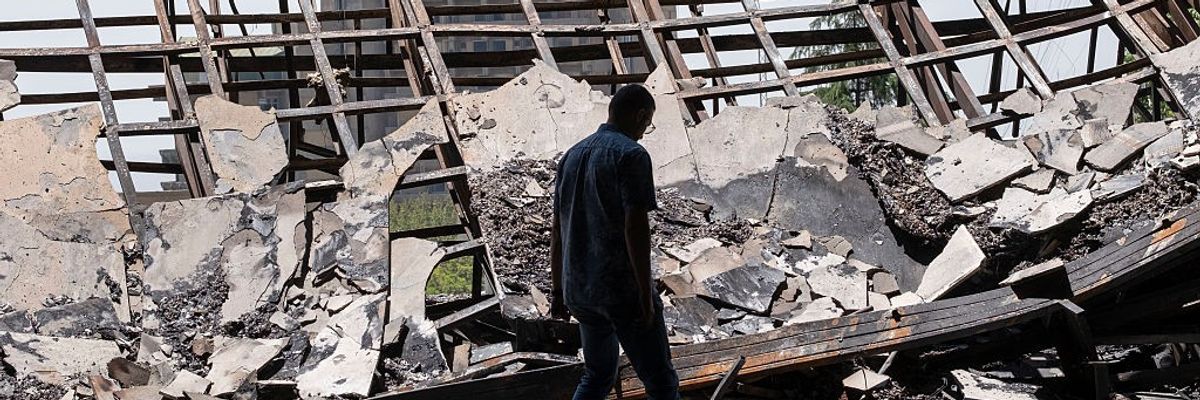
An Iranian man walks through the debris of the headquarters of the Islamic Republic of Iran News Network in Tehran, Iran on June 19, 2025.
(Photo: Morteza Nikoubazl/NurPhoto via Getty Images)

Jake Johnson
Jun 20, 2025
COMMON DREAMS

The White House said Thursday that President Donald Trump has not ruled out dropping a nuclear weapon on Iran as he considers options for joining Israel's escalating and increasingly deadly war.

An unnamed Trump administration official told Fox News senior White House correspondent Jaqui Heinrich that "none of the options are off the table," denying a Guardian report that said the president was "not considering using a tactical nuclear weapon" on Iran's heavily entrenched Fordow nuclear site.

Trump's reported consideration of a nuclear option comes amid internal concerns that the 30,000-pound bunker-buster bombs the U.S. possesses within striking distance of Iran would be insufficient to destroy Fordow. The massive bombs have never been used in active combat.


Trump is expected to decide whether to join nuclear-armed Israel's assault on Iran "within two weeks," White House Press Secretary Karoline Leavitt told reporters Thursday, reading a message that she described as coming directly from the president. Trump denied a Wednesday Wall Street Journalstory suggesting that he had already approved a plan to attack Iran.

Use of a nuclear weapon against Iran in a purported effort to stop the country from developing a nuke of its own—despite U.S. intelligence indicating that Iran's leadership has not decided to pursue one—would be catastrophic, according to experts and opponents of American intervention in the conflict.

Hans Kristensen, director of the Nuclear Information Project at the Federation of American Scientists, warned that "radioactive fallout would be intense" if the U.S. deployed a B61-11 penetrator nuke.

Jeffrey Lewis, a professor at the Middlebury Institute, echoed that concern:


Eli Clifton, a senior adviser at the Quincy Institute for Responsible Statecraft, expressed astonishment at the Trump White House's position.

"The U.S. is considering using a nuclear weapon for the first time since Hiroshima and Nagasaki because our client state murdered our Iranian negotiating partner and started a war?" Clifton asked.

News that the White House has not ruled out a nuclear attack on Iran also drew the attention of Russia, which has the world's largest nuclear arsenal.

"There have been a lot of speculations," Kremlin spokesman Dmitry Peskov said Friday. "This would be a catastrophic development, but there are so many speculations that in fact, it's impossible to comment on them."

While the White House stressed that all options are on the table regarding military action in Iran, Leavitt said Thursday that Trump believes there is a "chance for substantial negotiations."

Anti-war campaigners interpreted that message as evidence that the growing pressure campaign against a military attack is having an impact.

"The anti-war movement is working," said the advocacy group Demand Progress. "There are Iran war powers votes coming up in Congress soon. Time to keep the pressure up. Use our tool at 1833STOPWAR (dot) com or call 1-833-STOP-WAR to connect with offices after entering your zip code."

Leavitt on Thursday dodged a reporter's question on whether Trump would seek congressional approval for a U.S. strike on Iran.

Jennifer Kavanagh, director of military analysis at the think tank Defense Priorities, said in a statement Thursday that "the notion that the United States can conduct a few airstrikes and declare victory is an illusion."

"Any direct U.S. military strike on Iran is likely to mission creep into regime change or collapse or spiral into a long, protracted war," Kavanagh warned. "Israel's strikes on Iran may make U.S. diplomatic efforts more difficult, but there is still a chance at a deal—and plenty of time to pursue one through negotiations."


Don’t Let Tyrant Trump Plunge Us Into War With Iran

With American public opinion strongly against another American war in the Middle East, Trump continues to behave as if he is above the law.


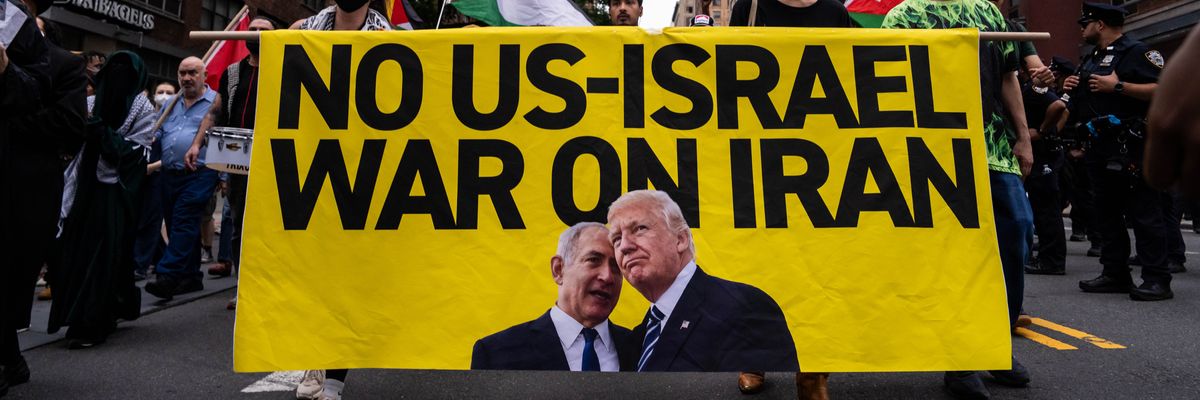
People march during a rally calling for the Trump administration not to go to war with Iran, on June 18, 2025 in New York City.
(Photo: Adam Gray/Getty Images)

Ralph Nader
Jun 21, 2025
COMMON DREAMS

White House Press Secretary Karoline Leavitt told the truth about Tyrant Trump the other day regarding President Donald Trump’s war with Israel against Iran. She said, “The President hears all voices across the country, and he makes decisions based on his instincts.”

His instincts are wrapped around his ego, his fantasies, and his overbearing arrogance. Imagine Trump ordering 10 million Iranians to evacuate their nation’s capital, or bragging that “we (sic) control the entire skies over Iran.”

What he isn’t boasting about is the increased flow of U.S. bombs and missiles being shipped to Israel and the U.S. Navy’s daily firing at incoming Iranian missiles, and the tight planning and coordination with Israel’s military regarding targets and intelligence.

On June 18, Trump said, “Nobody knows what I’m going to do.” Trump has no idea what he should do.

All this war making and threats of much more by Trump, including annihilating Iran’s Supreme Leader, the Ayatollah Khamenei, constitutes the most serious impeachable offense our Founders strove to safeguard against. The war declaration power is EXCLUSIVELY exercised by Congress (Article I, Section 8, Clause 1). The Founders most adamantly rejected the idea of a king plunging the nation into wars.

With American public opinion strongly against another American war in the Middle East, now with Iran, and after the Iraq disaster, Trump continues to behave as if he is above the law. He said in July 2019, “With Article II, I can do whatever I want as president.” He has also trampled the rule of law, doing this with over 100 illegal executive orders, damaging the American people in scores of deadly and costly ways at a worsening pace, and his threats of violence against foreign countries.

On June 18, Trump said, “Nobody knows what I’m going to do.” Trump has no idea what he should do. He is personally weighing the messages from his egomaniacal Minder and, thus far, Master, Israel’s cunning tyrant, Prime Minister Benjamin Netanyahu. Knowing that Trump likes to be with a winner, the Israeli leader can point to many wars that Israel has won. Netanyahu can say that with the U.S. 30,000 lb. bombs to knock out Iran’s nuclear program, he will give credit to Trump and tout him as a peacemaker. He can cite Israel’s past bombings, killings, and sabotage against Iran as proof that Iran is a “paper tiger” incapable of much retaliation.

On the other hand, Trump knows that actions in the Middle East trigger unforeseen or unintended consequences. He has long denounced the bungling of the wars in Iraq and Afghanistan. His own intelligence community tells him Iran is “not actively building a nuclear weapon.” Israel, on the other hand, has about 200 nuclear warheads and a rapid delivery system.

How the climate worsens. In 2007, then presidential aspirant Senator Joe Biden shouted on Chris Matthews’ “Hard Ball” that he would lead a campaign to impeach President George W. Bush if he attacked Iran without a congressional declaration of war. Contrast this with last Wednesday’s assertion by retired General David Petraeus, the general who led the 101st Airborne Division in the criminal invasion of Iraq and who was former President Barack Obama’s CIA director from 2011 to 2012. He went berserk, saying Trump should order the Ayatollah Khamenei to completely dismantle Iran’s nuclear program (including nuclear energy) or face “the complete destruction of your country and your regime and your people.” If he refuses, Petraeus urges, Trump can “reluctantly… blow them to smithereens.”

Ninety million people. Are you crazy David? No blowback afterward, David? Without a congressional declaration of war, self-styled military historian Petraeus? He is outdoing the reemerging armchair neocons led by Bill Kristol, who pressed the Bush regime and American soldiers into the bloody Iraq quagmire.

Ironically, Trump is being blasted by his own MAGA mega-influencers—Steve Bannon, Tucker Carlson, and Dave Smith et al.—for betraying his campaign promises to stop “endless wars” and reject the “Deep State” and Empire. They are really incensed to take their denunciations at face value. Dave Smith told his large following that Trump should be “…impeached and removed from office…”

As for Iran, which has not invaded anybody in some 250 years, it gets little diplomatic empathy. After all, the U.S. overthrew Iran’s popular, newly elected Prime Minister Mohammad Mosaddegh in 1953 and installed the dictator Shah. It was bloodily invaded by a U.S.-backed Saddam Hussein in the early 1980s; was targeted along with Iraq and North Korea as part of the “Axis of Evil” by George W. Bush; and has been subjected to terror, sabotage, and military encirclement since then by the U.S. and Israel. Maybe the autocratic Iranian state has been terrified into building proxies in Syria and Lebanon, now demolished.

What would we do as a nation if confronted with such overwhelming force and regular attacks? Hardliners in Europe and the U.S. are further demanding that Iran even dump its ballistic missile capability—a level of forced unilateral disarmament, while exposed to the Israeli enemy armed to the nth degree that is actually using armed terror at will in Gaza, the West Bank, Lebanon, and Syria—completely defenseless targets of the Israeli empire.

It could be a demonstration of some moral courage and patriotism if some retired Generals, (e.g., Mark Milley, Jim Mattis, John Kelly), who were in the first Trump administration, would inform the American people of their views regarding consequences of the new war in the Middle East being considered by Trump and his warmongering, incompetent Secretary of Defense Pete Hegseth. The same holds for the silent retired presidents George W. Bush (perhaps he has learned something from his destruction of Iraq?) and Democrats Bill Clinton, Obama, and Biden.

The bottom line is whether the Rule of Tyrant Trump or the Rule of Law will prevail. As The New York Times lead editorial on June 19, 2025, trumpeted: ONLY CONGRESS CAN DECLARE WAR.


Bombing Iran Is Part of the USA's Repetition Compulsion for War, War, War

"As we have seen yet again in recent hours, the political and media culture of the United States is heavily inclined toward glorifying the use of the USA’s second-to-none destructive air power."


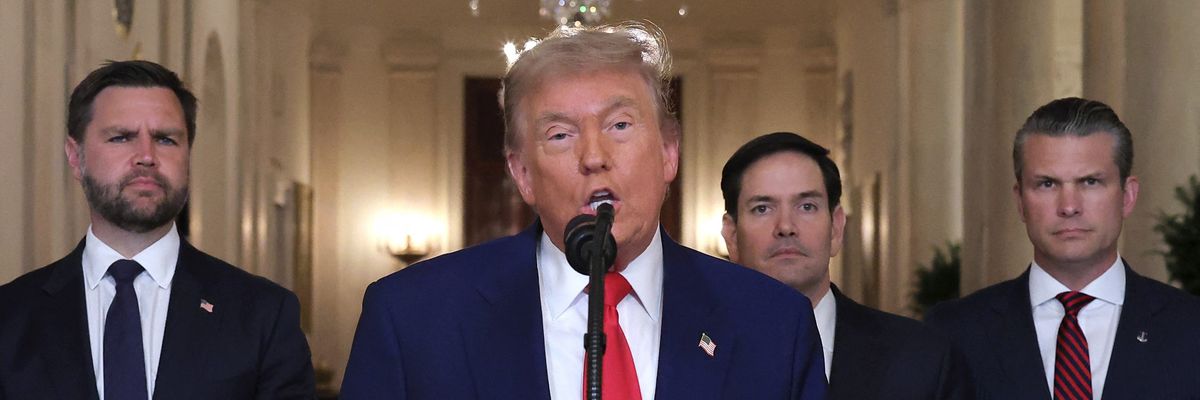
U.S. President Donald Trump addresses the nation, alongside U.S. Vice President JD Vance (L), U.S. Secretary of State Marco Rubio (2nd R), and U.S. Secretary of Defense Pete Hegseth (R), from the White House in Washington, D.C. on June 21, 2025.
(Photo: Carlos Barria/POOL/AFP via Getty Images)

Norman Solomon
Jun 22, 2025
COMMON DREAMS

Twenty years ago, one day in June 2005, I talked with an Iranian man who was selling underwear at the Tehran Grand Bazaar. People all over the world want peace, he said, but governments won’t let them have it.

I thought of that conversation on Saturday night after the U.S. government attacked nuclear sites in Iran. For many days before that, polling clearly showed that most Americans did not want the United States to attack Iran. “Only 16 percent of Americans think the U.S. military should get involved in the conflict between Israel and Iran,” YouGov pollsters reported, while “60 percent say it should not and 24 percent are not sure.”

But as a practical matter, democracy has nothing to do with the chokehold that the warfare state has on the body politic. That reality has everything to do with why the United States can’t kick the war habit. And that’s why the profound quests for peace and genuine democracy are so tightly intertwined.

On Saturday evening, President Trump delivered a speech exuding might-makes-right thuggery on a global scale: “There will be either peace or there will be tragedy for Iran far greater than we have witnessed over the last eight days.”

More than ever, the United States and Israel are overt partners in what the Nuremberg Tribunal in 1946 called “the supreme international crime”—“planning, preparation, initiation or waging of a war of aggression.”

Naturally, the perpetrators of the supreme international crime are eager to festoon themselves in mutual praise. As Trump put it in his speech, “I want to thank and congratulate Prime Minister Bibi Netanyahu. We worked as a team like perhaps no team has ever worked before.” And Trump added: “I want to thank the Israeli military for the wonderful job they’ve done.”

A grisly and nefarious truth is that, in effect, the Israeli military functions as part of the overall U.S. military machine. The armed forces of each country have different command structures and sometimes have tactical disagreements. But in the Middle East, from Gaza and Iran to Lebanon and Syria, “cooperation” does not begin to describe how closely and with common purpose they work together.

More than 20 months into Israel’s U.S.-armed siege of Gaza, the genocide there continues as a joint American-Israeli project. It is a project that would have been literally impossible to sustain without the weapons and bombs that the U.S. government has continued to provide to the Orwellian-named Israel Defense Forces.

The same U.S.-Israel alliance that has been committing genocide against Palestinians in Gaza has also enabled the escalation of KKK-like terrorizing and ethnic cleansing of Palestinian people in the West Bank. The ethnocentric arrogance and racism involved in U.S. support for these crimes have been longstanding, and worsening along with the terrible events.

The same alliance is now also terrorizing Iranian society from the air.

As we have seen yet again in recent hours, the political and media culture of the United States is heavily inclined toward glorifying the use of the USA’s second-to-none destructive air power. As if above it all. The conceit of American exceptionalism assumes that “we” have the sanctified moral ground to proceed in the world with a basic de facto message powered by military might: Do as we say, not as we do.

While all this is going on, the word “surreal” is apt to be heard. But a much more fitting word is “real.”

“People who shut their eyes to reality simply invite their own destruction,” James Baldwin wrote, “and anyone who insists on remaining in a state of innocence long after that innocence is dead turns himself into a monster.” Now, people in the United States have real-time historic opportunities – to do everything we can to take nonviolent action demanding that the U.S. government end its monstrous role in the Middle East.


Norman Solomon is the national director of RootsAction.org and executive director of the Institute for Public Accuracy. The paperback edition of his latest book, War Made Invisible: How America Hides the Human Toll of Its Military Machine, includes an afterword about the Gaza war.
Full Bio >


Ocasio-Cortez says Iran bombing is grounds for Trump impeachment

Mychael Schnell
Sat, June 21, 2025 
THE HILL


Rep. Alexandria Ocasio-Cortez (D-N.Y.) on Saturday night said President Trump’s decision to strike three of Iran’s nuclear sites is grounds for impeachment, becoming one of the first elected Democrats to back the constitutional punishment after the attack in the Middle East.

Trump announced Sunday night that the U.S. executed a “spectacular military success” in Iran, striking three nuclear facilities — including Fordow, which is hidden deep in a mountain south of Tehran. He warned that the U.S. would order additional strikes if Iran does not come to the table to negotiate a peace agreement.

While several House Democrats slammed Trump’s strike as unconstitutional, Ocasio-Cortez was one of a select few to go a step further and categorize the move as impeachable.

“The President’s disastrous decision to bomb Iran without authorization is a grave violation of the Constitution and Congressional War Powers,” Ocasio-Cortez wrote in a post on the social platform X. “He has impulsively risked launching a war that may ensnare us for generations. It is absolutely and clearly grounds for impeachment.”

Article 1 of the Constitution gives Congress the authority to “declare war,” one of the largest powers held by the legislative branch. In the past, however, presidents of both parties have struck adversaries militarily without approval from Congress.

Ocasio-Cortez argued that by striking the Iranian nuclear facilities without authorization from lawmakers on Capitol Hill, the president breached the Constitution and congressional war powers.

The strike came after days of debate in Washington over whether the U.S. should get involved in the Israel-Iran conflict, which escalated after Israel struck Iranian nuclear sites in what it dubbed a preemptive attack, prompting back-and-forth strikes between the two countries in the Middle East.

It remains unclear if Democrats will pursue impeachment against Trump in the wake of the strike on the three Iranian nuclear facilities. If the party were to pursue the punishment, however, it would be doomed to fail since Democrats are in the minority in both chambers.

At least two House Republicans were, however, critical of Trump’s strike. Rep. Thomas Massie (R-Ky.), who had been pushing against U.S. intervention in the Israel-Iran conflict, wrote on X: “This is not Constitutional.”

Rep. Warren Davidson (R-Ohio) wrote on X: “While President Trump’s decision may prove just, it’s hard to conceive a rationale that’s Constitutional. I look forward to his remarks tonight.”

House Democrats impeached Trump twice during his first term — once over allegations that he pressured Ukraine to investigate former President Biden, and a second time following the Jan. 6, 2021, attack on the Capitol. The Senate acquitted him both times.

House Minority Leader Hakeem Jeffries (D-N.Y.) on Saturday night said Trump “failed to seek congressional authorization for the use of military force” and that “Congress must be fully and immediately briefed in a classified setting” — stopping short of mentioning the Constitution or impeachment.


Trump rips Massie over Iran strike comments, threatens to campaign for primary challenger
USA TODAY

House Minority Whip Katherine Clark (D-Mass.), meanwhile, said Trump’s decision to strike the nuclear facilities “is unauthorized and unconstitutional.”

Republicans are largely defending the strike. A White House official told The Hill that Trump gave congressional leaders “a courtesy heads-up,” and the White House has said Trump has the constitutional authority to strike Iran as commander in chief.

Additionally, Speaker Mike Johnson (R-La.) appeared to push back on the Democratic criticism, arguing that the president respects the Constitution but needed to act in a swift fashion.

Johnson was briefed on the strike beforehand, a source familiar with the matter told The Hill.

“The President made the right call, and did what he needed to do,” Johnson wrote in a post on X. “Leaders in Congress were aware of the urgency of this situation and the Commander-in-Chief evaluated that the imminent danger outweighed the time it would take for Congress to act. The world’s largest state sponsor of terrorism, which chants ‘Death to America,’ simply could not be allowed the opportunity to obtain and use nuclear weapons.”

“The President fully respects the Article I power of Congress, and tonight’s necessary, limited, and targeted strike follows the history and tradition of similar military actions under presidents of both parties,” he added.

At least one other House Democrat backed impeachment in the wake of the attack on Iran: Rep. Sean Casten (D-Ill.) said the strike was “an unambiguous impeachable offense” — while nodding to the extreme unlikeliness of a Democratic minority impeaching a Republican president.

“This is not about the merits of Iran’s nuclear program. No president has the authority to bomb another country that does not pose an imminent threat to the US without the approval of Congress. This is an unambiguous impeachable offense,” he wrote in a lengthy thread on X.

“I’m not saying we have the votes to impeach. I’m saying that you DO NOT do this without Congressional approval and if Johnson doesn’t grow a spine and learn to be a real boy tomorrow we have a BFing problem that puts our very Republic at risk.”

“A final note of clarification. I am open to the idea that the US should attack Iran. But I am not open to the idea that Congress cedes all authority to the executive branch. No matter how many lickspittle sycophants in the GOP argue to the contrary,” he added.


'Grounds for impeachment': NBC host confronts JD Vance on Iran strike

David Edwards
June 22, 2025 
RAW STORY


NBC/screen grab

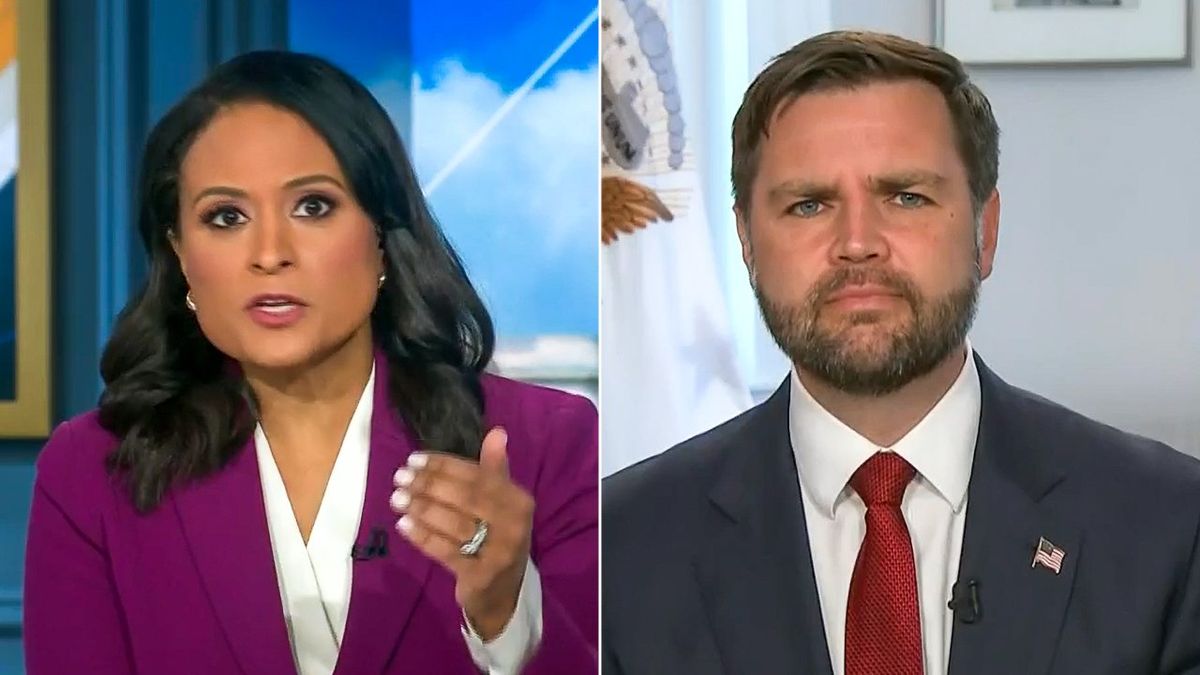
NBC host Kristen Welker told Vice President J.D. Vance that lawmakers were reacting to President Donald Trump's Iran strike by calling for his impeachment.

"Many Republicans supportive, but Congressman Thomas Massie saying this was unconstitutional," Welker said on Sunday. "Congresswoman Alexandria Ocasio-Cortez saying it's grounds for impeachment, saying the president should have gotten congressional approval first."

"What do you say to members of Congress who say it was unconstitutional for the president to act unilaterally?" she asked.

"First of all, the President has clear authority to act to prevent the proliferation of weapons of mass destruction, and the worst weapon of mass destruction of them all is nuclear," Vance replied. "The idea that this was outside of presidential authority, I think any real serious legal person would tell you that's not true."

"And the second thing is, Kristen, I certainly empathize with Americans who are exhausted after 25 years of foreign entanglements in the Middle East," he continued. "I understand the concern, but the difference is that back then we had dumb presidents, and now we have a president who actually knows how to accomplish America's national security objectives."


Watch the video below from NBC News or at the link.


After Trump's Bombing, Sanders Condemns 'Lies' Over Iran Nuclear Threat

"We cannot allow ourselves to be dragged into another Middle East war based on lies."


U.S. Sen. Bernie Sanders (I-Vt.) speaks at a rally in Tulsa, Oklahoma on June 21, 2025.
(Photo: screenshot/@BernieSanders/X)

Julia Conley
Jun 22, 2025
COMMON DREAMS

While a number of statements by members of Congress in the wake of U.S. President Donald Trump's bombing of Iranian nuclear facilities focused largely on the fact that the White House acted without congressional authorization—a constitutional violation—U.S. Sen. Bernie Sanders expressed anger over another aspect of the unilateral military action: the "lies" that the Trump administration is telling the public to justify the bombing.

The White House's act of war against Iran, said the Vermont independent senator, was just the latest in a long line of military boondoggles that followed lies powerful politicians told about the threats posed by foreign countries—before taking action that ultimately killed millions of people while doing nothing to protect U.S. security.

"In the 1960s the United States government lied to the American people and took us into a terrible war in Vietnam," said Sanders. "The result of that war was that over 58,000 young Americans died and many more came back wounded both in mind and in spirit. Millions of Vietnamese were also killed."

Decades later, Americans were told by then-President George W. Bush that the U.S. must act quickly to stop Iraq from building "weapons of mass destruction"—with U.S. officials following the guidance of Israeli Prime Minister Benjamin Netanyahu.

"The United States invaded Iraq and became embroiled in a long civil war there. No weapons of mass destruction were ever found. That war was based on a lie—a lie which cost us 4,492 young Americans, 32,000 wounded, over half a million Iraqis and trillions of dollars," said Sanders.

"The American people are being lied to again today," he added. "We cannot allow history to repeat itself."

U.S. intelligence agencies have assessed that Iran is not attempting to build a nuclear weapon with its enriched uranium stockpile, backing up repeated statements from Iranian officials who have said the country's nuclear program is used only for peaceful civilian purposes.

Sanders' statement came several hours after he learned while speaking at a rally in Tulsa, Oklahoma that Trump had bombed Iran, authorizing strikes on three nuclear facilities, which Iranian officials condemned as a violation of international law.

At the rally, supporters erupted in a chant of "No more war!" after Sanders read Trump's statement on the attack.


The spontaneous display of outrage over the latest U.S. attack on the Middle East underscored the reality of the moment, saidThe Nation writer Jeet Heer, as one poll released Thursday showed that just 8% of Americans favored the U.S. becoming directly involved in Israel's attacks on Iran that began earlier this month.

"There is only one off-ramp from Trump's mad rush to war: the quick mobilization of an anti-war opposition," said Heer. "The people are ready."


As the Trump administration boasted about the "severe damage" the strikes had done to Iran's nuclear program, progressive strategist Waleed Shahid called on Democratic lawmakers to tap into voters' palpable outrage—not about Trump's failure to seek congressional authorization for the strikes, but about the fact that the U.S. is pursuing a war in Iran at all while repeating Netanyahu's unsubstantiated claims about the Iranians' ability to produce a nuclear bomb.

"No one ever won a fight yelling, 'Congressional authorization.' Voters need clarity amid the chaos," said Shahid. "Lead with this: No more blank checks for corrupt and endless foreign wars, we're here to focus on fighting for working Americans."

Shahid's comments echoed Sanders' statement decrying Trump's lies.

"The U.S. faces enormous problems here at home, which we must address," said Sanders. "We cannot allow ourselves to be dragged into another Middle East war based on lies."