Sunday, June 22, 2025

As Kremlin Promotes Ties With S. Africa, FESCO Launches New Durban Service

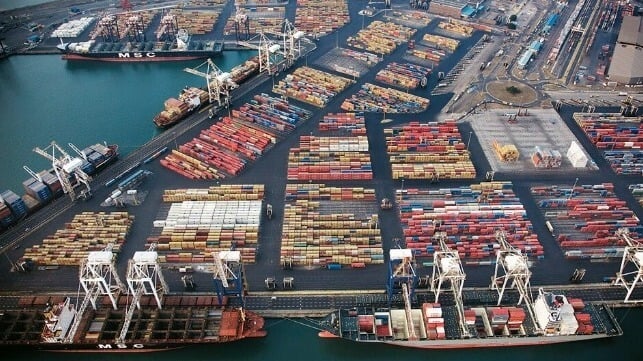
Port of Durban (Media Club / CC BY SA 3.0)
Port of Durban (Media Club / CC BY SA 2.0)

Published Jun 22, 2025 6:50 PM by The Maritime Executive


As part of its global expansion drive, Russia’s top container line FESCO has launched a new service linking key ports with Durban, South Africa. The launch of the service was revealed last week by German Maslov, FESCO’s Vice President for the Liner and Logistics Division.

For South African exports, FESCO will utilize its regular service from Novorossiysk and St. Petersburg to India’s Nhava Sheva. The cargo will then be transshipped by feeder vessels bound for South Africa. As for the imports from South Africa to Novorossiysk, FESCO will transship the cargo via Nhava Sheva or Jebel Ali (UAE) ports. The containers heading to St. Petersburg will be routed through India’s Mundra port.

Since the launch of FESCO’s Indian line in 2023, the service has grown by almost 10 times, becoming one of the best routes for the small shipping company. The service mainly operates to India’s western ports of Nhava Sheva and Mundra.

Currently, the FESCO Indian Line West (FIL-W) marine service is operated by two containerships with a total cargo capacity of around 2,100 TEU. The vessels provide a regular service every 18 days, with transit time of about 17 days from Novorossiysk to western India. Last year, FESCO shipped more than 16,000 TEU through its Indian Line service, which is 7 times higher than in 2023.

Overall, FESCO operates a fleet of 30 vessels and a container capacity of more than 200,000 TEU. The company has a strong Intra-Asia service with regular schedules to Malaysia and Vietnam.

FESCO’s launch of a South African service comes at a time Russia wants to boost its trade turnover with the country, with which it enjoys warm and well-established political ties. Last week, South African Vice President Paul Mashatile made a state visit to Russia, where he met President Vladimir Putin and other senior government officials.

The two sides emphasized bilateral cooperation, specifically in agriculture, energy and logistics. “The volume of trade between Russia and South Africa is about $1.3 billion. We would like to triple this amount in the next 4-5 years,” said Mashatile.

However, a major barrier to trade between Russia and South Africa has been distance and unreliable logistics services. The launch of FESCO’s direct sea route will help solve this challenge.

Top image: Port of Durban (Media Club / CC BY SA 2.0)


Study: Life At Sea is the Most Dangerous Way to Earn a Living

NOT BEING A COP OR FIREFIGHTER

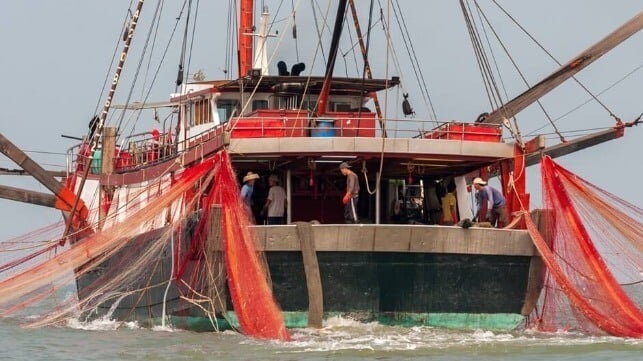
Trawler at work off China (iStock / Winhorse)

Published Jun 22, 2025 9:20 PM by The Maritime Executive


Working on or near the sea is the most dangerous way to make a living, according to new survey results from the Lloyd's Register Foundation and Gallup. People that the survey categorized as "ocean workers" - a broad group containing "those who work on or near the water" - reported higher rates of injury than any shoreside industry grouping.  

According to the poll, fully 25 percent of all "ocean workers" reported experiencing harm on the job within the past two years. This was seven points higher than the global average, and more than twice the rate of reported injuries in the safest sector, the utility industry. 

Workers in this broad category reported lower rates of safety training than workers in shoreside industries. 32 percent said that they had received occupational safety and health training at some point in the past, compared to 38 percent of workers in all other industries. They were also much less likely to tell anyone about it if they got hurt, reflecting a cultural preference for toughness. Only 41 percent of workers who reported that they got hurt at sea said that they reported the incident, 10 points less than the average in other industries. 

Lloyd's Register Foundation also found that - as could be expected from the seagoing life - "ocean workers" were more exposed to risk from weather than any other group. 33 percent reported serious personal harm from severe weather within the last two years, compared to just 20 percent of other workers. 

However, the results may not be representative of risks faced by seafarers in commercial maritime commerce: the poll's "ocean worker" statistics include injury rates in the fishing industry, which has a higher risk profile than that found in commercial shipping. In the United States, the workplace fatality rate in the fishing industry is 28 times higher than the national average for all industries. Worldwide, the Pew Charitable Trusts estimates that about 100,000 people die in the fishing industry each year, with many deaths unreported due to the informal, exploitative practices of IUU fishing operators.  


What Happens When a Country Sinks?

The archipelagic Pacific nation of Tuvalu has called for an international sea level rise treaty, and here’s what that looks like.

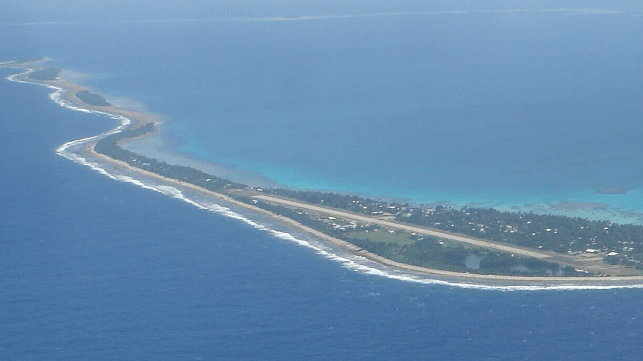
Funafuti Atoll, Tuvalu (Gabriella Jacobi / CC BYSA 3.0)

Published Jun 22, 2025 10:05 PM by The Lowy Interpreter


[By Sheridan Ward]

What happens when a country ceases to exist? Where do its people go, who no longer have a citizenship to protect them? Statelessness usually follows conflict, or the dissolution or unification of a country, such as occurred with the Soviet Union, Yugoslavia, South Sudan, and East Germany. But what happens if a country sinks? The international community hasn’t had to face this issue – until now.

This month, world leaders met to attend the 2025 UN Ocean Conference, held in France. In his speech, Tuvalu’s Prime Minister Feleti Teo called for“the development of an international treaty on sea level rise, to enshrine the legal rights of affected states and people, including the principles of statehood continuity, and the permanency of maritime boundary”. So let’s delve into this, and what such a treaty could mean for Tuvalu and other low-lying nations.

Tuvalu is well known for being vocal in its plight to fight rising sea levels, and for good reason – 95 per cent of Tuvalu could be underwater during high tide by 2100.

In terms of precedent, Tuvalu has a similar bilateral treaty; the Falepili Union with Australia, signed in November 2023. This world-first treaty affirms that Australia will continue to uphold the statehood, sovereignty, and rights of the people of Tuvalu, even if the physical land of Tuvalu should be rendered uninhabitable by sea level rise. It also commits to working together to help its citizens remain in Tuvalu through the use of climate adaptation strategies and emerging technologies.

Tuvalu is well known for being vocal in its plight to fight rising sea levels, and for good reason – 95 percent of Tuvalu could be underwater during high tide by 2100. In 2022, Tuvalu made headlines worldwide for suggesting it will become the first digital nation, with plans for an online metaverse to preserve its islands, culture, history, and landmarks should the country become fully submerged. Anyone could visit this incredible Pacific paradise – but only through a virtual reality headset!

While these efforts may appear defeatist, they play two vital roles. First, they create awareness that this issue isn’t hypothetical, it’s immediate. Tuvalu may disappear within our lifetimes. Second, they prepare contingency plans to protect citizens and their culture should the international community fail to halt the rate of climate change in time.

Tuvalu is far from alone. It’s one of four low-lying atoll nations: Marshall Islands (highest point, 10 meters), Maldives (5.1 meters), Tuvalu (4.6 meters), and Kiribati. Kiribati has 32 islands under 8 meters, plus one higher island, Banaba (81 metres), but whose area is only 6 square kilometers and therefore not large enough to accommodate climate refugees. Also impacted by rising sea levels are the Small Island Developing States (SIDS), a coalition of 39 member countries and 18 non-sovereign nations, with a combined population of 65 million people. Together, SIDS work at the UN level to advocate for climate action, with many already witnessing rising tides wash away homes and farming land.

An international treaty on sea level rise would extend the guarantees that Tuvalu has through the Falepili Union to all SIDS nations, and ensure policy coherence across the world should countries start to disappear. It would notably guarantee the continued citizenship of a vanished country, and the continued statehood of that nation. Under the Universal Declaration of Human Rights, every person has the right to nationality, yet there is currently no precedent for what happens should a country’s territory physically disappear. Without such a treaty, a citizen of a sunken country could face statelessness, their passport may cease to be recognized, they could be unable to legally and safely relocate to another country, and they may be barred from accessing basic human rights, education, healthcare, or employment.

An international treaty would also recognize the permanency of maritime borders. Currently, these are defined as distance from the low-water line along the coastline – straightforward for continental countries. In archipelagic states, these are measured from the outermost islands and reefs. However, as sea levels rise, islands will disappear. They already are.

In Solomon Islands, five uninhabited islands (Kale, Kakatina, Rapita, Rehana, and Zollies) have completely disappeared. The island of Nuatambu lost more than half its inhabitable area between 2011 and 2016, and Taro, Choiseul Province’s capital, may need to relocate soon, given its elevation of only 2 meters. Kiribati even lost two islands, Abanuea and Tebua Tarawa, back in 1999.

If low-lying outer islands disappear, this could potentially redefine maritime borders – or lead to international disputes over them. Maritime boundaries delineate where states can exercise exclusive control, including preventing illegal, unreported and unregulated fishing, extracting resources, and managing conservation and natural resources. An international treaty that recognises the permanency of maritime boundaries would ensure states have a legal basis to protect their maritime waters from foreign exploitation should outer islands disappear.

In an ideal world, the international community ensures that pre-existing agreements to halt sea level rise are met. However, that is not the current reality. Tuvalu’s call this month to adopt an international treaty on sea level rise is a dire one. It’s an acknowledgement that we may not be able to act in time to save Tuvalu, but we can take proactive steps to protect those most vulnerable in the worst-case scenario. Australia and Tuvalu have already pioneered the Falepili Union bilaterally. It’s time to look at taking it international.

Sheridan Ward is a researcher on non-militarization and countries without sovereign military institutions. She holds a BA in International Security from the ANU and a Masters of Sustainable Development and Diplomacy from the United Nations Institute of Training and Research / The University for Peace, based in Costa Rica.

This article appears courtesy of The Lowy Interpreter and may be found in its original form here.

Top image: Funafuti Atoll, Tuvalu (Gabriella Jacobi / CC BY SA 3.0)

The opinions expressed herein are the author's and not necessarily those of The Maritime Executive.
 

Limited Use of Diego Garcia Reflects its Diminished Value After Handover

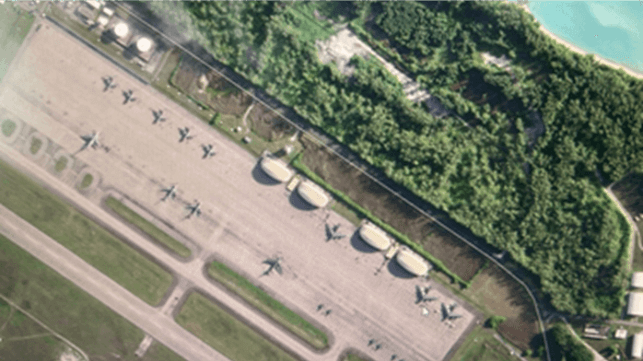
The South Ramp on Diego Garcia on June 22 (Sentinel-2)
The sparsely-inhabited South Ramp on Diego Garcia on June 22, little changed from before the attack on Iran (Sentinel-2)

Published Jun 22, 2025 2:51 PM by The Maritime Executive


Both before and after the devastating US attack on Iranian nuclear enrichment sites at Fordow, Natanz and Isfahan, US deployments of aircraft to the Naval Support Base airfield on Diego Garcia are illustrating the flaws in the agreement which the United Kingdom and Mauritius agreed on May 22, following the US administration’s support for the deal.

The agreement hands formal sovereignty of the archipelago, which has been owned by the United Kingdom since 1814, to Mauritius, in return for an immediate leaseback of the Diego Garcia base and a surrounding 24-mile buffer zone to the UK. The deal in theory permits the continued operation of the joint UK/US base on the island for the next 99 years, an additional 40-year extension, and with a right of first refusal thereafter. The deal is not yet legally ratified, but common practice is to respect provisions of such international agreements during ratification periods.

Amongst a number of clauses to the agreement is one which obliges the United Kingdom to ‘expeditiously inform’ Mauritius of any attack mounted on a third party directly from Diego Garcia. The clause could be subject to a wide variety of interpretations, and the UK’s Attorney General is already indicating that he believes this to encompass an obligation to report such attacks in advance. Mauritius is a close ally of China, so the obligation to inform could result in breaches to operational security of US and British plans. In due course, there is to be an official Mauritian presence on Diego Garcia, able to report on comings and goings – and provide even earlier warnings and indicators to friends in Beijing.

At a time when the United States is deploying hundreds of additional aircraft into airfields in and adjacent to the region, nothing much seemed to change on Diego Garcia - indicating that in any contingency planning for operations against Iran, Diego Garcia did not feature as a forward operating base. On June 19, in the run-up to the US attack on June 21/22, the complement of aircraft seen in a snapshot of the South Ramp at Diego Garcia included four B-52s, six F-16Es, five KC-135s and one large transport aircraft - the same force composition which has been in place since US B-2s left the airfield on May 25.

In the hours after the attack, this force composition had changed very little. In imagery taken around midday on June 22, there were still the same four B-52s, six F-16Es, five KC-135s and one large transport aircraft on the South Ramp, suggesting that none of the aircraft were directly involved in mounting the attacks on Iran.

US operational planners have some flexibility in making contingency plans. They appear to have chosen to avoid any potential problems by minimizing the use of Diego Garcia in their campaign strategy. But in the long term, the conflict over Iran is a test of the UK-Mauritius agreement.

There will no doubt be a review post-campaign of the continued utility of the base if its operational use is stymied in times of tension. If it was decided that mounting elements of the attack from Diego Garcia would either have caused legal difficulties for the United Kingdom, or compromised operational security by virtue of the need to notify Mauritius, then the whole purpose of the agreement - for the United States to have continued use of a secure base untrammeled by the need to secure diplomatic permissions - may have been undermined. The United Kingdom will not only be committing to paying Mauritius an annual rent of $220 million for each of the first three years, $160 million for the next ten years, and then $160 million adjusted annually for inflation thereafter, all a cost to the UK defense budget - but the value of the base to the United States will have been diminished.


The Chagossians’ (Imperfect) Victory Is a

 Testament to the Power of Resistance


The Chagossians’ return to most of their homeland is a victory for resolving conflicts through diplomacy rather than force, as well as for decolonization and international law.


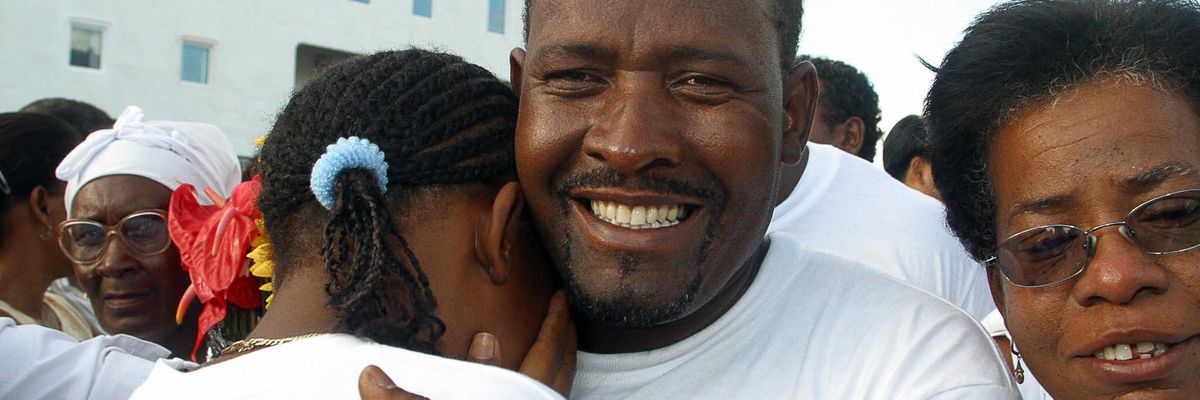
Olivier Bancoult (C) leader of the Chagossian community in Mauritius hugs with his wife and daughter Elvina before taking a boat trip to the Chagos Islands, on March 30, 2006 from the harbor of Port Louis, Mauritius.
(Photo: Ali Soobye/AFP via Getty Images)


David Vine
Jun 22, 2025
COMMON DREAMS

At a time when many may feel that good news has gone the way of the dodo, look no further than the homeland of that long-extinct bird—Mauritius—for a dose of encouragement. There, among the islands of the Indian Ocean, news can be found about the power of resistance and the ability of small groups of people to band together to overcome the powerful.

Amid ongoing slaughter from Gaza and Ukraine to Sudan and the Congo, the news also offers a victory for resolving conflicts through diplomacy rather than force. It’s a victory for decolonization and international law. And it’s a victory for Africa, the African diaspora, and Indigenous and other displaced peoples who simply want to go home. To the shock of many, President Donald Trump actually played a role in making such good news possible by bucking far-right allies in the United States and Britain.

While the victories the Chagossians, a group numbering less than 8,000, finally achieved last month are anything but perfect, they wouldn’t have happened without a more than half-century-long struggle for justice.

The news came in late May when the British government signed a historic treaty with Mauritius giving up Britain’s last African colony, the Chagos Islands, and allow the exiled Chagossian people to return home to all but one of them. The British also promised to pay an estimated £3.4 billion over 99 years in exchange for continuing control over one island, the largest, Diego Garcia. Though few in the U.S. even know that it exists, the Chagos Archipelago, located in the center of the Indian Ocean, is also home to a major U.S. military base on Diego Garcia that has played a key role in virtually every U.S. war and military operation in the Middle East since the 1970s.

Diego Garcia is one of the most powerful installations in a network of more than 750 U.S. military bases around the world that have helped control foreign lands in a largely unnoticed fashion since World War II. Far more secretive than the Guantánamo Bay naval base, Diego Garcia has been, with rare exceptions, off limits to anyone but U.S. and British military personnel since that base was created in 1971. Until recently, that ban also applied to the other Chagos Islands from which the Indigenous Chagossian people were exiled during the base’s creation in what Human Rights Watch has called a “crime against humanity.”

While the victories the Chagossians, a group numbering less than 8,000, finally achieved last month are anything but perfect, they wouldn’t have happened without a more than half-century-long struggle for justice. A real-life David and Goliath story, it demonstrates the ability of small but dedicated groups to overcome the most powerful governments on Earth.

A History of Resistance

The story begins around the time of the American Revolution when the ancestors of today’s Chagossians first began settling on Diego Garcia and the other uninhabited Chagos islands. Enslaved at the time, they were brought from Africa, along with indentured laborers from India, by French businessmen from Mauritius who used the workers to build coconut plantations there.

Over time, the population grew, gaining its emancipation, while a new society emerged. First known as the Ilois (the Islanders), they developed their own traditions, history, and Chagossian Kreol language. Although their islands were dominated by plantations, the Chagossians enjoyed a generally secure life, thanks in part to their often militant demands for better working conditions. Over time, they came to enjoy universal employment, free basic healthcare and education, regular vacations, housing, burial benefits, and a workday they could control, while living on gorgeous tropical islands.

“Life there paid little money, a very little,” one of the longtime leaders of the Chagossian struggle, Rita Bancoult, told me before her death in 2016, “but it was the sweet life.”
“The Footprint of Freedom”

Chagos remained a little-known part of the British Empire from the early 19th century when Great Britain seized the archipelago from France until the 1950s when Washington grew interested in the islands as possible military bases.

Amidst Cold War competition with the Soviet Union and accelerating decolonization globally, U.S. officials worried about being evicted from bases in former European colonies then gaining their independence. Securing rights to build new military installations on strategically located islands became one solution to that perceived problem. Which is what led Stuart Barber, a U.S. Navy planner, to find what he called “that beautiful atoll of Diego Garcia, right in the middle of the ocean.” He and other officials loved Diego Garcia because it was within striking distance of a vast region, from southern Africa and the Middle East to South and Southeast Asia, while also possessing a protected lagoon capable of handling the largest naval vessels and a major air base.

In 1960, U.S. officials began secret negotiations with their British counterparts. By 1965, they had convinced the British to violate international law by separating the Chagos Islands from the rest of its colony of Mauritius to create the “British Indian Ocean Territory.” No matter that United Nations decolonization rules then prohibited colonial powers from chopping up colonies when, like Mauritius, they were gaining their independence. Britain’s last--created colony would have one purpose: hosting military bases. U.S. negotiators insisted Chagos come under their “exclusive control (without local inhabitants)”—an expulsion order embedded in a parenthetical phrase.

British officials and American sailors rounded up people’s pet dogs, lured them into sealed sheds, and gassed them with the exhaust from Navy vehicles before burning their carcasses.

U.S. and British officials sealed their deal with a 1966 agreement in which Washington would secretly transfer $14 million to the British government in exchange for basing rights on Diego Garcia. The British agreed to do the dirty work of getting rid of the Chagossians.

First, they prevented any Chagossians who had left on vacation or for medical treatment from returning home. Next, they cut off food and medical supplies to the islands. Finally, they deported the remaining Chagossians 1,200 miles to Mauritius and the Seychelles in the western Indian Ocean.

Both governments acknowledged that the expulsions were illegal. Both agreed to “maintain the fiction” that the Chagossians were “migrant laborers,” not a people whose ancestors had lived and died there for generations. In a secret cable, a British official called them “Tarzans” and, in a no less racist reference to Robinson Crusoe, “Man Fridays.”

In 1971, as the U.S. Navy started base construction on Diego Garcia, British officials and American sailors rounded up people’s pet dogs, lured them into sealed sheds, and gassed them with the exhaust from Navy vehicles before burning their carcasses. Chagossians watched in horror. Most were then deported in the holds of overcrowded cargo ships carrying dried coconut, horses, and guano (bird shit). Chagossians have compared the conditions to those found on slave ships.

In exile, they effectively received no resettlement assistance. When The Washington Post finally broke the story in 1975, a journalist found Chagossians living in “abject poverty” in the slums of Mauritius. By the 1980s, the base on Diego Garcia would be a multibillion-dollar installation. The U.S. military dubbed it the “Footprint of Freedom.”

An Epic Struggle

The Chagossians have long demanded both the right to go home and compensation for the theft of their homeland. Led mostly by a group of fiercely committed women, they protested, petitioned, held hunger strikes, resisted riot police, went to jail, approached the U.N., filed lawsuits, and pursued nearly every strategy imaginable to convince the U.S. and British governments to let them return.

In the late 1970s and early 1980s, Chagossian protests in Mauritius won them small amounts of compensation from the British government (valued at around $6,000 per adult). Many used the money to pay off significant debts incurred since their arrival. Chagossians in the Seychelles, however, received nothing.

Still, their desire to return to the land of their ancestors remained, and hope was rekindled when the Chagos Refugees Group sued the British government in 1997, led by Rita Bancoult’s son, Olivier. To the surprise of many, they won. Over several tumultuous years, British judges ruled their expulsion illegal three times—only to have Britain’s highest court repeatedly rule in favor of the government by a single vote. Judges in the U.S. similarly rejected a suit, deferring to the president’s power to make foreign policy. The European Court of Human Rights also ruled against them.

A Strategic Alliance

Despite the painful defeats, Chagossian prospects brightened when the Chagos Refugees Group allied with the Mauritian government to take Britain to the International Court of Justice. Aided by Chagossian testimony about their expulsion, which an African Union representative called “the voice of Africa,” Mauritius won. In 2019, that court overwhelmingly ruled that Mauritius was the rightful sovereign in Chagos. It directed the U.K. to end its colonial rule “as rapidly as possible.” A subsequent U.N. General Assembly resolution ordered the British “to cooperate with Mauritius in facilitating the resettlement” of Chagossians.

Backed by the U.S., the British initially ignored the international consensus—until, in 2022, Prime Minister Liz Truss’ government suddenly began negotiations with the Mauritians. Two years later, a deal was reached with the support of the Biden administration. The deal recognized Mauritian sovereignty over Chagos but allowed Britain to retain control of Diego Garcia for at least 99 years, including the continued operation of the U.S. base. The Chagossians would be allowed to return to all their islands except, painfully, Diego Garcia and receive compensation.

The Chagos Refugees Group and other Chagossian organizations generally supported the deal, while continuing to demand the right to live on Diego Garcia. Some smaller Chagossian groups, especially in Britain (where many Chagossians have lived since winning full U.K. citizenship in 2002), opposed the agreement. Some still support British rule. Others seek Chagossian sovereignty.

Right-wing forces in Britain and the United States quickly tried to kill the deal. Former Prime Minister Boris Johnson, Brexit protagonist Nigel Farage, and then-Senator Marco Rubio campaigned for continued British colonial rule, often spouting bogus theories suggesting the agreement would benefit China.

Donald Trump’s election and the appointment of Rubio as secretary of state left many fearing they would kill the treaty. Instead, when Prime Minister Keir Starmer visited Washington, Trump indicated his support. A finalized treaty was in sight.

An Imperfect Victory?

In the last hours, the deal was briefly blocked by a lawsuit that a judge later dismissed. “I’ve been betrayed by the British government,” Bernadette Dugasse, one of two Chagossians who brought the suit, said of the treaty. “I will have to keep on fighting the British government till they accept for me to settle” on Diego Garcia (where she was born).

Dugasse’s suit and plans for additional legal action are being funded by a shadowy “Great British PAC” that won’t disclose its donors. The group is led by right-wing political figures still trying, in their words, to “Save Chagos.” However, “saving Chagos” doesn’t mean saving Chagos for the Chagossians, but “saving” it from the end of British colonial control. In other words, right-wing figures are cynically using Chagossians to try to uphold the colonial status quo. (Even Dugasse fears she’s being used.)

On the other hand, the Chagos Refugees Group and many other Chagossians are celebrating, at least partially. For the first time in more than half a century of struggle they can go home to most of their islands, even if they, too, criticize the ban on returning to Diego Garcia and the shamefully small amount of compensation being offered: just £40 million earmarked for a Chagossian “trust fund” operated by the Mauritian government (with British consultation). Divided among the entire population, this could be as little as £5,000 per person for the theft of their homeland and more than half a century in exile. (People in car accidents get far more.)

Chagossians, backed by allies in Mauritius and beyond, are continuing their struggle for the right to return to Diego Garcia, for the reconstruction of Chagossian society in Chagos, and for full, proper compensation.

“I’m very happy after such a long fight,” Sabrina Jean, leader of the Chagos Refugees Group U.K. Branch, told me. “But I’m also upset about how the U.K. government continues to treat us for all the suffering it gave Chagossians,” she added. “£40 million is not enough.”

The Mauritian government should benefit more unambiguously than the Chagossians: The treaty formally ends decolonization from Britain, reuniting Mauritius and the Chagos Islands. Mauritius will receive an average of £101 million in rent per year for 99 years for Diego Garcia plus £1.125 billion in “development” funds paid over 25 years.

“The development fund will be used to resettle” Chagossians on the islands outside Diego Garcia, said Olivier Bancoult, now the president of the Chagos Refugees Group, about a commitment he’s received from the Mauritian government. “They have promised to rebuild Chagos.”

Bancoult and other Chagossians insist they also should receive some of the annual rent for Diego Garcia. “Parts of it needs to be used for Chagossians,” he told me by phone from Mauritius.

The continuing ban on Chagossians living on Diego Garcia clearly violates Chagossians’ human rights as well as the International Court’s ruling and that U.N. resolution of 2019. Human Rights Watch criticized the treaty for appearing to “entrench the policy that prevents Chagossians from returning to Diego Garcia” and failing to acknowledge U.S. and British responsibility for compensating the Chagossians and reconstructing infrastructure to enable their return.

“We will not give up concerning Diego,” Olivier Bancoult told me. For those born on Diego Garcia and those with ancestors buried there, it’s not enough to return to the other Chagos islands, at least 150 miles away. “We will continue to argue for our right to return to Diego Garcia,” he added.

While U.S. and British officials have long used “security” as an excuse to keep Chagossians off the island, they could, in truth, still live on the other half of Diego Garcia, miles from the base, just as civilians live near U.S. bases worldwide. Civilian laborers who are neither U.S. nor British citizens have lived and worked there for decades. (Chagossians will be eligible for such jobs, although historically they’ve faced discrimination getting hired.)

That the U.S. military has ended up a winner in the treaty could explain Donald Trump’s surprising support. The treaty secures base access for at least 99 years and possibly 40 more.

Which means the treaty is a setback for those Mauritians, Americans, and others who have campaigned to close a base that has cost U.S. taxpayers billions of dollars and has been a launchpad for catastrophic wars in the Middle East, which a certain president claimed to oppose.

While many Chagossians are privately critical of the base that caused their expulsion and occupies their land, most have prioritized going home over demanding its closure. The campaign to return has been hard enough.

Ultimately, I’m in no position to decide if the Chagos treaty is a victory or not. That’s for Chagossians and Mauritians to decide, not a citizen of the country that, along with Great Britain, is the primary author of that ongoing, shameful crime.

Let me note that victories are rarely, if ever, complete, especially when the power imbalance between parties is so vast. Chagossians, backed by allies in Mauritius and beyond, are continuing their struggle for the right to return to Diego Garcia, for the reconstruction of Chagossian society in Chagos, and for full, proper compensation. The Mauritian and British governments can correct the treaty’s flaws through a diplomatic “exchange of letters.”

“We are closer to the goal” of full victory, Olivier assured me. “We are very near.”

Having won the right to return to most of their islands after 50 years of struggle, Olivier has been thinking a lot about his mother, longtime leader Rita Bancoult. “I would like that my mom would be here, but I know if she would be here, she would be crying,” he said, “because she always believed in what I do, and she always encouraged me to go until the destination, the goal.”

For now, inspired by the memory of his mother and too many Chagossians who will never see a return to their homeland, Olivier told me, “lalit kontin.” The struggle continues.

© 2023 TomDispatch.com


David Vine
David Vine is associate professor of anthropology at American University in Washington, D.C. His latest book, "Base Nation: How U.S. Military Bases Abroad Harm America and the World," is part of the American Empire Project (Metropolitan Books). He is also the author of "Island of Shame: The Secret History of the U.S. Military Base on Diego Garcia." He has written for the New York Times, the Washington Post, the Guardian, and Mother Jones, among other publications.
Full Bio >
72% of Americans Say the Rich 'Have Too Much' as GOP Pursues Another Handout for Billionaires


A newly released survey underscores that "Americans have a solid grasp of the highly unequal concentration of wealth in the United States—and they think it's rotten."


Jake Johnson
Jun 20, 2025
COMMON DREAMS

Nearly three-quarters of Americans believe that the rich in the United States "have too much" and two-thirds feel the ultra-wealthy are not paying enough in taxes, according to survey results released Thursday by The New Republic.

The survey, conducted in April with a representative sample of more than 950 registered voters nationwide, shows "broad frustration with how wealth is distributed in America, specifically the extreme concentration of wealth among the superrich," the magazine reported in its write-up of the results, which came just ahead of the latest swing of Sen. Bernie Sanders' (I-Vt.) popular "Fighting Oligarchy" tour.


U.S. Sen. Bernie Sanders (I-Vt.) speaks during a stop of the "Fighting Oligarchy" tour on April 14, 2025 in Nampa, Idaho.
(Photo: Natalie Behring/Getty Images)

"If the poll can be summarized in one sentence, it's this: Americans have a solid grasp of the highly unequal concentration of wealth in the United States—and they think it's rotten," wrote The New Republic's Ryan Kearney.

Asked "which of the following statements comes closest to your view on how wealth is distributed in America today," 72% of survey respondents—including 45% of those who voted for President Donald Trump in 2024—chose "the rich have too much," while just 6% said "the poor have too much" and 22% said "things are about fair the way they are."

Few respondents, across party lines, said they believe the richest 0.1% and 1% are paying their fair share of taxes, according to the survey, and 66% said they think the wealthiest Americans are paying "too little" in taxes.

The findings were published as Trump and GOP lawmakers in Congress worked to pass another round of tax breaks that would disproportionately benefit the wealthiest Americans.

The Institute on Taxation and Economic Policy has estimated that the House-passed GOP budget reconciliation package would deliver $124 billion in net tax cuts to the richest 1% of Americans in 2026.

"Wages aren't keeping up with the rising cost of living, and the shrinking availability of living-wage jobs is compounding the strain. The consequences for working families are becoming increasingly severe."

In an effort to rally opposition to the Republican bill—which also includes unprecedented cuts to Medicaid, federal nutrition assistance, and green energy programs—Sanders will be holding a series of events in the U.S. South in the coming days, starting with a "Fighting Oligarchy" rally in McAllen, Texas on Friday night.

"Sanders will target deep red districts currently held by Republicans, including the hometown of Republican House Speaker Mike Johnson (R-La.)," the senator's team said in its announcement of the swing last week. "The tour serves as a pressure campaign, aiming to force vulnerable congresspeople to vote against any cuts to Medicaid, housing, nutrition, education, and other basic needs to pay for more tax breaks for the richest people in this country."

Sanders' "Fighting Oligarchy" rallies across the U.S. have tapped into widespread discontent with the lopsided distribution of wealth in the United States and outsize political influence of a handful of powerful billionaires as workers struggle to afford basic necessities.

Last year, according to a UBS report published earlier this week, the U.S. added more than 1,000 millionaires per day on average, continuing a long-running trend of unequal wealth accumulation at the top.

Meanwhile, a new analysis from the Ludwig Institute for Shared Economic Prosperity (LISEP) estimates that what the group describes as the "true rate of unemployment"—which counts "the jobless plus those seeking, but unable to find, full-time employment and those in poverty-wage jobs"—rose to 24.3% last month, just one indicator of workers' growing struggles in the U.S.

"Over the past four months, we've seen a stagnation in job opportunities that pay above poverty wages, particularly for low- and middle-income workers," said LISEP chair Gene Ludwig. "As economic uncertainty grows, more Americans are losing ground. Wages aren't keeping up with the rising cost of living, and the shrinking availability of living-wage jobs is compounding the strain. The consequences for working families are becoming increasingly severe."


Ghastly: a Glyph


 June 23, 2025
Facebook

Ed Sanders is a poet, musician and writer. He founded Fuck You: a Magazine of the Arts, as well as the Fugs. He edits the Woodstock Journal. His books include: The FamilySharon Tate: a Life and the novel Tales of Beatnik Glory.


On Being Trump’s Director of National Intelligence


Part 1


On 17 June, a member of the media asked Trump: “Tulsi Gabbard testified in March that the intelligence community said that Iran wasn’t building a nuclear weapon.”

Trump brusquely responded, “I don’t care what she said. I think they are very close to having one.”

This is just another instance of the rudeness, arrogance, and imbecility of Trump. First, Trump chose Gabbard to be his director of national intelligence.

Second, the assessment of Iran having a nuclear weapon program or not is not Gabbard’s assessment. It is, as she testified, on the “Annual Threat Assessment of the U.S. Intelligence Community”: “the collective assessment of the 18 U.S. intelligence elements making up the U.S. Intelligence Community and draws on intelligence collection, information available to the IC from open-source and the private sector, and the expertise of our analysts.”

During the 25 March threat assessment, Gabbard testified:

The IC continues to assess that Iran is not building a nuclear weapon and Supreme Leader Khamanei has not authorized the nuclear weapons program he suspended in 2003.

Third, since Gabbard, the messenger, was belittled by Trump as “wrong,” then the U.S. Intelligence Community must likewise be held by Trump to be wrong. People are then left with Trump’s uncertainty, revealed by his “I think…,” as to Iran working on developing nuclear weapons. That begs the question of whether Americans want to see their sons and daughters go to war based on what Trump thinks over the assessment of 18 intelligence agencies?

Nonetheless, Gabbard has tried to regain Trump’s good graces by, like Trump, discrediting the media. She posted on X.com:

However, if one watches the linked source above, it corroborates that the media, in this case, accurately reflected the intelligence community’s assessment as related by Gabbard. Thus, Gabbard’s X post makes her come across as sycophantic. Not a good look for a politician or non-politician.

If the ins and outs of politics is Gabbard’s bag — and it certainly seems to be — then she is in a tough spot. She already was forced, more-or-less, to leave the Democratic Party. And besides the Republican Party, there is no other major party to join in the United States,

Part 2: Nonetheless, Tulsi Gabbard still has her supporters in some independent media circles.

Kim Petersen is an independent writer. He can be emailed at: kimohp at gmail.com. Read other articles by Kim.