Wednesday, July 30, 2025

American Nukes Are Back in the UK


July 29, 2025
By: William Lawson

The not-so-secret deployment of nuclear 
weapons to Europe is meant to send a signal to Russian adventurism.

American nuclear bombs appear to have returned to RAF Lakenheath for the first time since 2008. While the US Air Force and Defense Department do not comment on the presence of nuclear weapons at a given location, the F-35A-equipped 493rd Fighter Generation Squadron (FGS) seems to be making no secret of its new capability. The 493rd FGS is part of Lakenheath’s 48th Fighter Wing.

A 2023 Air Force press release stated that the 493rd and 495th FGSs joined the 492nd and 494th FGSs to replace the 748th Aircraft Maintenance Squadron as part of the Air Force’s Combat-Oriented Maintenance Organization (COMO) structure. The new alignment breaks large aircraft maintenance squadrons into smaller FGSs to “foster unity of effort between maintenance and operations as well as enhance readiness of the squadrons.”

The Air Force also noted that the 493rd and 494th are the first fifth-generation squadrons of their kind in the European Theater. The other two 48th Fighter Wing Squadrons currently fly the F-15E Strike Eagle, though the Air Force has announced that its F-15Es will soon be withdrawn from Lakenheath. Their replacements have yet to be confirmed, but F-35As would make sense, especially since 2021 saw Lakenheath become the first F-35 base outside the United States.

Both the F-35A and the F-15E are capable of carrying the B-61 nuclear gravity bomb, including the precision-guided B61-12 version. Whether the now-nuclear-capable 48th Fighter Wing will adopt a strike profile or serve in a support role to other nuclear-equipped NATO units is unclear.

Circumstantial Evidence of Nuclear Weapons Deployment

The evidence for nukes at Lakenheath is circumstantial but telling. The Federation of American Scientists noted a line in the Defense Department’s fiscal year 2023 budget request referring to upgrading the infrastructure of nuclear weapons storage sites. The United Kingdom was added to the list of existing nuclear bases in Western Europe and Turkey. Satellite imagery has confirmed ongoing work on nuclear weapons infrastructure, including at Lakenheath in the United Kingdom.

Subsequent Pentagon documents have referred to “special storage” site upgrades in the UK. Lakenheath’s nuclear past makes it the only realistic candidate for such upgrades. Defense Department procurement contracts also note the 48th Fighter Squadron’s “upcoming nuclear mission,” while other documents reference specific nuclear weapons training being given to personnel at Lakenheath.

Less reliable, but still intriguing evidence comes from open-source intelligence accounts on social media noting the movement of an Air Force C-17A flight from the US to Lakenheath. The aircraft is assigned to the 62nd Airlift Wing and is known to be the only one of its kind certified for nuclear transport missions. The aircraft, callsign RCH4574, returned to its base in the United States after delivering its cargo.

Finally, the 493rd FGS itself provides a prominent clue. The squadron provided a challenge coin for last weekend’s Royal International Air Tattoo Show at RAF Fairford. It features the 493rd’s Grim Reaper logo, along with a falling bomb and the squadron’s motto, “Prepare to Meet Thy Maker.” But the key element is the “coin’s” shape. Instead of the familiar round, flat piece of metal, it is shaped like a nuclear mushroom cloud, with one side featuring orange, red, and yellow colors. Hardly subtle.

Deterring Russia Could Be the Goal

The not-so-secret deployment of nuclear weapons to Europe is meant to give pause to Russian adventurism. The US Air Force seems to have been deliberately open about this deployment. Of course, the signs are there for anyone who knows where to look, but there seems to have been little effort to camouflage the service’s movement.

Assuming that nuclear bombs are now at Lakenheath, or soon will be, the entire enterprise seems geared to serving notice to Vladimir Putin that the US Air Force is ready for any escalation of his current efforts in Ukraine.

About the Author: William Lawson

William Lawson is a military historian focusing on World War II and twentieth-century conflicts and the American Civil War. His specialty is operational-level warfare, especially American amphibious doctrine. He writes on history, politics, and firearms for multiple publications and historical journals. He serves on the editorial advisory board for the Saber & Scroll Journal and Military History Chronicles and is a member of the Society for Military History and the American Historical Association. Lawson is based in Virginia.

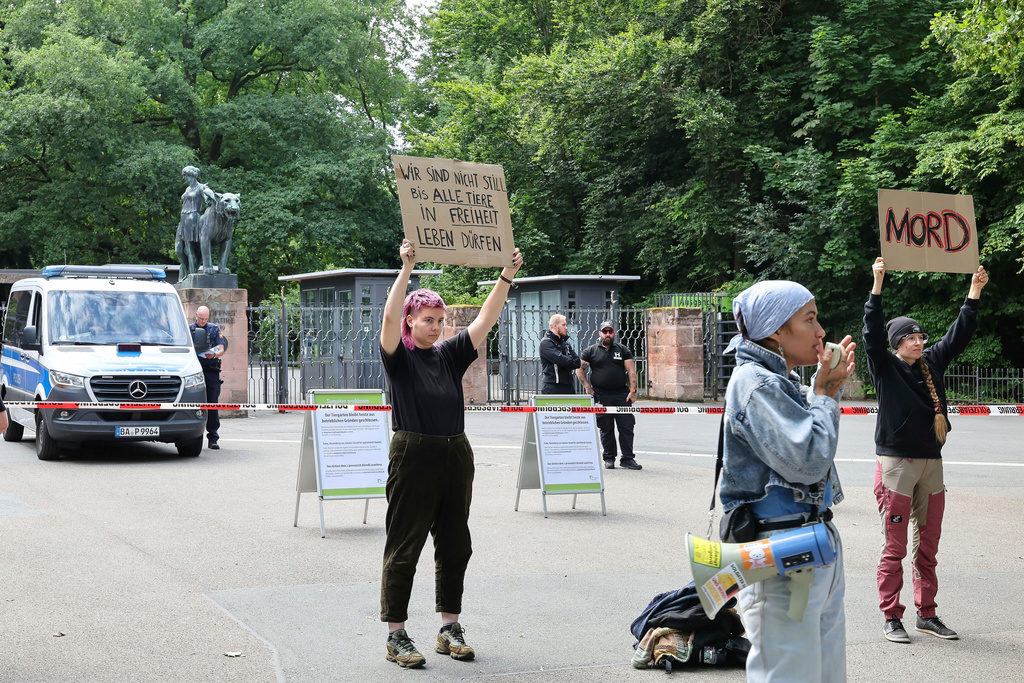
ZOO'S ARE PRISONS

German zoo faces protests after killing 12 healthy baboons


By —Associated Press
Jul 29, 2025

BERLIN (AP) — A zoo in the German city of Nuremberg said it killed 12 baboons on Tuesday despite protests, capping a saga rooted in concerns that the zoo had too little space to house a growing group of the animals.

The Tiergarten Nürnberg zoo first announced plans to kill baboons it didn’t have space for in February 2024. It has said that it examined offers to take in some of the animals but was unable to make any of them work.

The plans drew criticism from animal protection groups. They also drew protests at the zoo, which said on Monday that it would have to start preparing to kill baboons. On Tuesday morning, it announced that it was closing for the day for unspecified “operational reasons.”

On Tuesday afternoon, police said seven activists climbed over a wall into the zoo, and one woman glued her hands to the ground. The group was detained a few meters (yards) inside the entrance.

Shortly afterward, the zoo said it had killed 12 baboons. The deputy director, Jörg Beckmann, said the zoo had chosen animals that weren’t pregnant females or part of studies, and that they were shot. Samples were taken for research purposes, and the bodies were then to be fed to the zoo’s predators.

Zoo director Dag Encke told a news conference that the killings followed “yearslong consideration.” He argued that they had become necessary to maintain a healthy population because having a group that had outgrown its accommodation and couldn’t be reduced by other means was pushing the zoo into conflict with animal protection laws.

Animal rights groups said they filed a criminal complaint against the zoo’s management, arguing that the killings themselves violated animal protection laws and that the zoo had failed in its breeding management. Laura Zodrow, a spokesperson for the Pro Wildlife group, said in a statement that “this killing was avoidable and, from our point of view, is unlawful.”

READ MORE: A quarter of the world’s freshwater animals are threatened with extinction, new research shows

The zoo’s population of Guinea baboons had grown to 43 and was too big for a house opened in 2009 for 25 animals plus their young, leading to more conflicts among the animals.

The zoo has said it did take steps in the past to address the issue, with 16 baboons moving to zoos in Paris and China since 2011. But those zoos, and another in Spain to which baboons were previously sent, had reached their own capacity. An attempt at contraception was abandoned several years ago after failing to produce the desired results.

Animals are regularly euthanized in European zoos for a variety of reasons. Some past cases have caused an outcry; for example, one in 2014 in which Copenhagen Zoo killed a healthy 2-year-old giraffe, butchered its carcass in front of a crowd that included children and then fed it to lions.

Beasts of. Burden. Capitalism · Animals. Communism as on ent ons. s a een ree. Page 2. Beasts of Burden: Capitalism - Animals -. Communism. Published October ...


Too many male animals in zoos could hamper conservation of endangered species, warn scientists


University of Bath


The largest-ever study of over 2.6 million zoo birth records reveals skewed sex ratios in endangered species, from lemurs to elephants. The international team of scientists behind the study emphasise that it is vital that zoos take into account the ratios of males to females born in captivity when planning conservation projects and breeding programmes for endangered species to avoid the silent threat of having too many of one sex.

Biases in sex ratios of populations can dramatically increase the risk of extinction by limiting genetic diversity, increasing inbreeding and making the population more vulnerable to collapse. In captivity, a bias towards one sex can also cause problems with how to house animals safely to avoid conflicts.

Until now, there has been very little data collected on animals born in captivity. However, an international team of scientists led by the Milner Centre for Evolution at the University of Bath (UK) has published the most comprehensive study so far investigating the birth sex ratios (BSR) of animals in captivity.

Using evolutionary theory and advanced statistical methods, they found that BSR could be predicted by factors such as mating systems, sexual size dimorphism (differences in size between males and females of the same species) and brood size.

Their study, published in the journal Scientific Reports, investigated over 450 species of birds and mammals, including 30 endangered species such as Asian elephants, tigers and pygmy hippos with significantly biased BSRs.

They found that whilst lions have roughly equal numbers of males and females born, cheetahs have more male offspring and tigers have a bias towards females. Scientists were surprised to find that Asian elephants displayed a male bias, which is concerning given their matriarchal system where few males reproduce.

In mammals, mating system was a significant predictor of sex ratio bias, with monogamous species tending to produce more male offspring. For example, ring-tailed lemurs – the most common zoo animal in the world – form long-term pair bonds and showed strong male biases in zoo births.

In birds, they found that clutch size and sexual size dimorphism – the difference in sizes between males and females – were more predictive of BSR bias.

Bird species where the males were larger than the females tended to hatch more females in each clutch. Species with larger clutch sizes also resulted in a bias towards females.

“This is the largest study of birth sex ratios in zoo animals, giving us a much better understanding of the factors that shape sex ratio variation in different species,” said Oscar Miranda, first author of the study and researcher at the University of Debrecen (Hungary), who will join the Milner Centre for Evolution at the University of Bath this September to begin his PhD.

“Our findings show that even well-managed zoos may be silently accumulating sex biases that threaten the survival of endangered species.”

Professor Tamás Székely, from the Milner Centre for Evolution and Department of Life Sciences at the University of Bath (UK), said: “Our study highlights the need for zoos to collaborate more closely with each other and share data on their animals so they can manage the conservation and breeding of endangered species.

“No single zoo can prevent extinction on its own. But together, by monitoring birth sex ratios, we can turn a quiet demographic threat into a manageable challenge.”

Tensions in Syria’s Sweida city are emblematic of wider national problems


As Sweida region descends into bloodshed, can Syria rebuild while its new rulers repeat past failures?


Written by Democracy In Exile
Posted 29 July 2025


Screenshot from video uploaded to YouTube by Associated Press in Sweida city, Syria. Fair Use

This article by Anagha Nair was first published on Democracy in Exile on July 22, 2025. This edited version is published on Global Voices as part of a media partnership agreement.

The communities of Sweida in southern Syria have historically maintained a tense yet functional relationship. Despite their long-running cycle of clashes and periods of peace, they have coexisted as neighbors for hundreds of years.

Now, that appears to have changed.

The latest fighting began on July 11, when a group of Sunni-Arab Bedouins — an ethnic and religious majority but ethnic nomadic minority in the country — kidnapped and robbed a Druze vegetable seller. The incident, following months of low-level frustrations between the two groups, sparked a round of tit-for-tat attacks that soon escalated into a full-fledged conflict.

The fighting between Sweida’s Druze — an offshoot of Shi'ite Islam and a Syrian minority comprising about 3 percent of the country’s religious diversity but a majority in Sweida — and the historically nomadic Bedouin tribes of southern Syria quickly spiraled out of control. Both groups are heavily armed and driven by a deep sense of loyalty towards their communities.

As such, Sweida transformed into a killing ground over the past week, burning under the weight of sectarian struggle, external interests and governance failures.

Tensions between the Druze and Syria’s new government have been high since the toppling of Bashar al-Assad’s regime in December 2024. With regular negotiations between the community and Damascus’s interim leaders from the now-dissolved Hay’at Tahrir al-Sham (HTS), the groups had maintained a fragile peace.

However, in April 2025, the Druze-majority areas of Jaramana and Ashrafiyet Sehnaya in Damascus experienced heavy clashes between forces affiliated with the interim government and Druze factions following the circulation of a fake audio recording of a Druze official insulting the Prophet Muhammad.

Amid the chaos of the latest conflict, the Syrian government deployed its security forces to Sweida on July 14, following agreements with Druze leaders. The goal was to establish a security presence to regain peace.

However, not long after the deployment, Hikmat al-Hijri — one of three Druze spiritual leaders in Syria — reversed his stance, calling for international protection and rejecting the ceasefire with Damascus and the Bedouin tribes.

Following the entry of the Syrian government’s forces, well-documented evidence points to many of them joining the Bedouin clans. Videos that went viral on social media show multiple violations against Druze civilians and surrendered fighters, ranging from shaving their moustaches — seen as a symbol of honor for the community — to gruesome mass killings.

Revenge killings


Amir,* an English teacher from Sweida, is a member of the Druze community who was caught in the crossfire. He spoke to Democracy in Exile from his home on July 16 between the sounds of shelling and bullets. Amir sent his family to a safer location but stayed home to host and protect women from his community.

“The [interim government] had agreed to enter here peacefully … suddenly we woke up yesterday to the noise of shelling and bombing … the news started to come,” he explained, listing “raping, stealing and killings on the roads” as some of the many violations in the governorate.

On July 15, the Israeli government said it directed its military to “immediately attack the regime forces and the weaponry that entered the Sweida area,” following through on their demand that southern Syria remain demilitarized. Later, they launched an airstrike on the ministry of defense in the center of Damascus, alongside numerous other government positions, in a clear signal to the interim authorities.

Following a hastily established truce with the Druze on July 16 and the withdrawal of governmental troops following those Israeli attacks, state media announced an eruption of “revenge killings” against Bedouin communities, including civilians, by Druze militias.

Ahmad,* a Bedouin man from Al Mazraa, explains how he fled his village with 15 families, including his 85-year-old mother, fearing persecution by the Druze.

“Armed factions led by Sheikh Hikmat al-Hijri’s Military Council besieged the clans in their villages, cut the supply of bread and medicine and didn’t let us go to hospitals because we are Sunni Muslims,” he said from a temporary accommodation in the Damascus suburbs.

Soon, Bedouin tribes from around the country, including the northern governorate of Aleppo, mobilized to join the fighting. Interim President Ahmed al-Shara’a hailed the move as “heroic,” while asking them to comply with the ceasefire and adhere to state orders.

Like many others, Ahmad blames the violence primarily on al-Hijri and the Sweida Military Council, perceived to be under the former’s command. Researcher Aymenn Jawad al-Tamimi, however, frames this as a dangerous misconception, explaining that Druze factions that previously disagreed with al-Hijri ultimately fought against the opposing forces as the threat to their broader community became apparent.

He also stresses that the violence propagated by some Druze extremist groups against Bedouins was being falsely associated with al-Hijri and his “separatist” ideals, ignoring the nuance in al-Hijri’s stance and fracturing the prospect for national unity. Most, if not all, Druze factions ultimately ended up fighting the interim authority security forces and Bedouin militias.

Catastrophic events

Joseph Daher, an academic specializing in the political economy of Syria, Lebanon and Palestine, explained in an interview with Democracy in Exile that the conflict in Sweida must be observed within the larger framework of Assad's fall, highlighting that it symbolized the government’s intention “not to allow any kind of actors challenging the central power — Damascus and Hayat Tahrir al-Sham.”

“[The government] used confrontation between Druze and Bedouins to say, ‘We're coming to Sweida to create order,’ while they were fighting on the side of the Bedouins— not stopping the fighting,” he added.

He went on to explain how national and international actors have instrumentalized existing sectarian divides, potentially creating a shift in sentiment among the Druze. The community was already grappling with a fraught relationship with the new, Islamist-led government. In March 2025, Syria witnessed the mass killing of Alawite civilians in the coastal area of Latakia, revealed in an investigation to have Damascus’s direct involvement.

“Among the vast majority, Druze, whether in Syria or Lebanon, reject Israel, but [these recent events] could push some sections, still very much a minority, to seek or accept forms of collaboration with the devil to be able to survive,” Daher noted.

Amir, for instance, emphasized that his priority was the safety of his community, using nearly an identical expression.

“We don’t support any military actions against Syria, but what are we supposed to do? If you were here [as] a civilian, unarmed and someone [was] coming to kill you, I think you’d take help from the devil,” he argued.

At the time, Amir explained the dire humanitarian condition he was facing, where his community was running out of food. As the day continued, the situation worsened as Sweida was besieged following the Bedouin advance. Its main hospital was running out of supplies.

On July 19, the government secured a fragile ceasefire deal. The dust slowly began to settle. Bedouin troops withdrew, and the siege was partially lifted. The first humanitarian aid convoys entered the ravaged city since the start of the fighting.

Yet, the question remains: What does this latest episode of violence entail for Syria, which only recently began recovering from its long civil war?

Daher describes the events as “catastrophic” on all levels.

“Ahmed al-Shara’a, in some ways, came out weaker in this episode,” he says. “If he's politically weaker, he’s going to be less willing to accept any kind of dissent within the country.”

The Bedouin-Druze clashes, and the government’s involvement in them, could jeopardize ongoing negotiations with the Kurd-led Syrian Democratic Forces [SDF], who control most of northeastern Syria under autonomous rule. Since the fall of the regime, al-Shara’a has engaged in negotiations with the SDF for integration into the Syrian state — talks that the recent fighting will almost certainly impact.

Daher outlines a path for preventing further catastrophes, including prior tragedies in Syria’s northwest and south.

“Rather than seeking to consolidate your power … You know you’re weak and cannot control everything. No one is asking you to [control everything] — share power,” he says, addressing the government.

He adds that, now more than ever, the role of civil society, including political parties, trade unions, and professional associations, is crucial. These groups must build a “counter society” in support of state-building.

“Even in liberal democracies, if you don't have a strong civil society and strong social movements, the government usually will go forward with its policies,” he explains.

“This is not particular to Syria, but even in Syria, it's more difficult because we had 14 years of war and 50 years of dictatorship.”


al-Sharaa or al-Julani? IDF still suspicious of Syrian leader after Sweida massacre - analysis

IDF sources view the two names symbolically, likening them to a "Dr. Jekyll and Mr. Hyde" duality, suggesting a true internal struggle within Syria's leader and his shifting alliances

.
From Islamist rebel chief to statesman, embraced by major world leaders, Syria's interim President Ahmed al-Sharaa has undergone a stunning transformation in just six months since ousting longtime strongman Bashar al-Assad.
(photo credit: LUDOVIC MARIN,OMAR HAJ KADOUR/AFP via Getty Images)

JERUSALEM POST
JULY 29, 2025 

The IDF is still suspicious of Syria's leader and wondering whether, between two of his names symbolic of his dual identities, he will turn out to be more of his jihadist past as Mohammad al-Julani or Ahmed Al-Sharaa, the suit and tie wearing technocrat official he has portrayed himself as since taking power from the Assad regime in December 2024.

IDF sources treat the two names as symbolic, with almost a "Dr. Jekyl" and "Mr. Hyde" dual personality quality, making it clear that they do believe there is a true internal struggle going on within Syria's leader as well as among his various allies and potential allies who are trying to pull him in one direction or another.

In the balance is whether Israel now has a new, greater threat in Syria than even the Assad regime, if not in sophistication of weapons, then in ferocity and commitment of its forces to invading and fighting against non-Muslims.

Or now has a unique opportunity to reach a long-term stable ceasefire or even normalization with a country which has been hostile to Jerusalem since the founding of the state, including a new regime which will continue to cut off any Iranian attempts to reform a ring of fire around its borders.

To date, the IDF gives very high marks to al-Sharaa and his forces for preventing Iran and Hezbollah from smuggling arms through Syria into Lebanon.

Leader of new Syrian administration, Ahmed al Sharaa and Turkish Foreign Minister Hakan Fidan (not seen) watch the view of Damascus on Mount Qasioun following their meeting in Damascus, Syria on December 22, 2024 (credit: Murat Gok/Anadolu via Getty Images)


It also gives high marks to him for keeping out Iranian forces in general, though a small number of Islamic Revolutionary Guard Corps officials have managed to remain in parts of Syria.

Both in private but also in public, al-Sharaa has said he has no desire to fight Israel and could even potentially reach normalization with it sometime in 2026.

These are remarkable and strategic changes which could see Syria join the Abraham Accords - something no one would have thought remotely possible a year ago.

However, Israel has seen downsides which suggest that "Dr. Julani," who spent years leading a wing of al-Qaeda terrorists, could still be in the picture right behind "Mr. al-Sharaa."

In the Spring, allies of Julani massacred Alawite-Shiite Syrians in Western Syria, and last week, some of his allies massacred Syrian-Druze in Sweida in southern Syria.

Israel verbally blasted Julani for allowing - or some say behind the scenes ordering - some of his forces to massacre the Alawites and said this proved he was stil a dangerous jihadist who the West should shun, but took no large actions to protect them because it was far off from Israel's border and because the Alawites are open enemies of Israel.

In contrast, the IDF said that to try to stop Julani's forces from massacring Syrian Druze in Sweida last week, it had attacked Syrian forces allied with Julani 140 times, including the Syrian Defense Ministry Headquarters in Damascus.

With Sweida, Israel intervened both because it was closer to its border and because of the alliance between Israel and the Druze population, some of whom are Israelis and some who are in Syria.

The above Israeli attacks in Syria were in addition to a total of 300 general attacks by the IDF in Syria in 2025, often against military vehicles or capabilities, and not against Julani's forces.

Israel had attacked far more Syrian Assad-era military targets in a blitz of attacks in December 2024 - as many as 600 targets using 1,800 munitions - as soon as the Assad regime fell and before Julani had truly solidified his hold on power.

Regarding Julani's handling of the Sweida incident, IDF sources said that they did not believe he had intended the massacre to occur, but that it had happened since he does not yet have control over aspects of his Syrian forces whose backgrounds are entirely jihadist.

Still, IDF sources would admit that he could have taken stronger measures to avoid such a massacre, and other top Israeli defense establishment sources have exclusively told the Jerusalem Post that Julani is not to be trusted, no matter how well he dresses.

There is an additional complication that Julani may not agree to normalization without a return of the Israeli side of the Golan Heights, something which the 1990s Rabin, Netanyahu, and Barak governments seriously considered, but which has left the Israeli lexicon since ISIS took over large portions of Syria for a time during the 2010s.

Also, to achieve any long-term ceasefire, Julani would demand that Israel withdraw from the buffer zone it took in southern Syria in December 2024, and the latest massacre in Sweida makes it less likely that Israel will do so in the near future, absent heavy pressure from the Trump administration.

Further, IDF sources warned that Julani could come under the influence of Turkey and Qatar, both powers that have helped him and his forces with weapons and financing to overthrow the Assad regime.

From the perspective of worrying about a Turkey-Qatar-Syria alliance, it might be better for Israel if the West and the Saudis continue to warm up to Julani and to help him with funding, so as to try to keep him under some Western-Saudi influence, which is more friendly to Israel.

Based on those concerns, IDF sources said that Israel hotly debated whether it should go as far as to target the Syrian Defense Ministry during the Sweida episode.

Some were concerned that such an attack could push Julani into the hands of Turkey and Qatar and away from the West and from any improved arrangements with Israel.

In that spirit, the IDF did not rush to attack the ministry, but rather tried other, less serious attacks first to hint to Julani to control his forces.

However, IDF sources said that once Julani ignored the initial, smaller level attacks, Israel thought it had no choice other than to attack a bigger target to try to end the massacre.

There were also complexities in that Julani's forces and allies were split into three groups, including jihadist militias with around 3,000 fighters, the more formal army with 3,000-4,000 fighters, and some defense ministry forces.

Despite efforts to bring all of the militias into the army, either Julani lacks the power to make all of his allies join the army, or he has decided that allowing certain allied militias to continue to exist to do dirty work on behalf of his army, is a useful tactic for promoting massacres against his enemies, while having plausible deniability.

After all of this, Julani is still viewed as an undecided-unclear figure - new ally or new foe - even nine months after taking power.
Other problems remain in SyriaThere are around 3,000 Palestinian Islamic Jihad fighters, a few hundred Hamas fighters, and a medium number of ISIS fighters.

In terms of the hundreds and then around 1,000 Israeli Druze who broke into Syria past IDF forces during the Sweida episode, as well as the 100 Syrian Druze who entered Israel illegally then, the IDF was surprisingly unapologetic about the incident.

The IDF did say that there would be more physical barriers and forces trained to stop such low-scale public order problems in the future (generally, soldiers are trained to fight terrorist invaders heading into Israel, not to stop unarmed Israeli Druze from leaving it in large groups to help their brethren try to survive a massacre.)

But IDF sources also said that a battalion commander had decided to physically open a gate to allow Israeli-Druze into Syria when he thought that the physical pressure they were placing on the gate was itself dangerous.

Not only is this battalion commander not being reprimanded, but IDF sources said that they believed he had acted exactly the right way under complex circumstances.

According to IDF sources, the only alternative for IDF troops to what actually happened would have been to start shooting at the knees of unarmed Israeli-Druze trying to break through the border, something which probably also would have led to accidental deaths, and according to the IDF, much worse criticism than the criticism it ended up receiving.

There was also discussion of the idea that Sweida was so far away, at 80 kilometers from the border, that the IDF may have had an idea that the Israeli-Druze would not actually get very far on foot and would have to return home shortly after their "invasion" to help their brethren.
China hails Malaysia's role in achieving Thai-Cambodia ceasefire

Japan, Vietnam, Indonesia, Pakistan welcome ceasefire, laud ASEAN chair Malaysia for its role

Saadet Gokce |29.07.2025 - TRT/AA

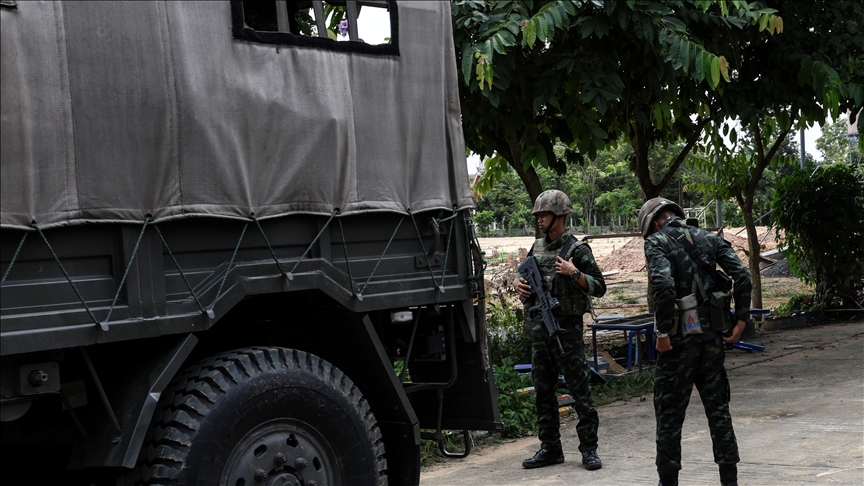
Thai military personnel (Photo by Valeria Mongelli)

ISTANBUL

China on Tuesday hailed Malaysia's role in achieving a ceasefire between Thailand and Cambodia after five days of fighting, which left dozens dead and injured.

Beijing "commends and welcomes" the international community, "especially" the chair of the Association of Southeast Asian Nations, Malaysia, for "actively promoting talks between the two countries," Foreign Ministry spokesman Guo Jiakun told a news conference in the Chinese capital, Beijing.

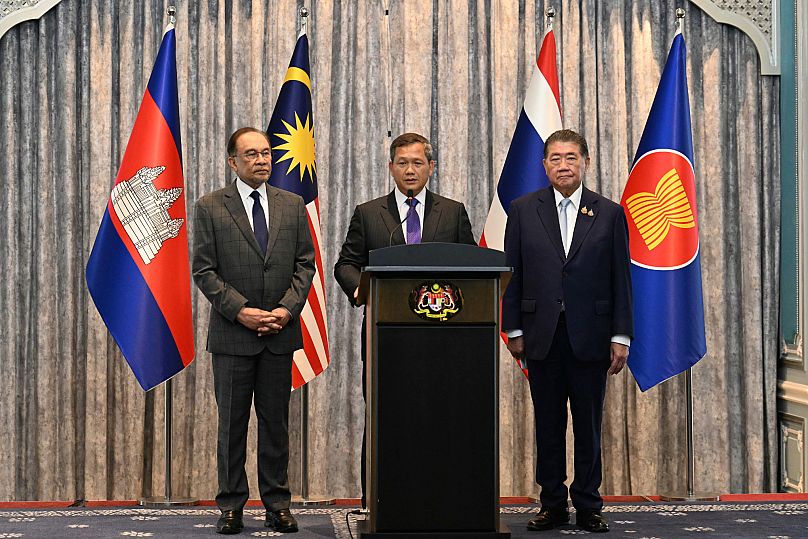
Malaysian Prime Minister Anwar Ibrahim announced the "immediate and unconditional" ceasefire on Monday, following a meeting between Cambodian Prime Minister Hun Manet and acting Thai Prime Minister Phumtham Wechayachai in Kuala Lumpur.

The armed conflict along the disputed border between the two countries resulted in the deaths of dozens of people, including soldiers.

China will "play a constructive role for consolidating the ceasefire consensus," Guo added.

Japan also welcomed the ceasefire agreement, saying that "a sound relationship between Cambodia and Thailand is extremely important for peace and stability in the region," according to a statement from the Foreign Ministry.

Tokyo also commended the "diplomatic efforts of all parties involved in achieving this agreement, including Malaysia as the host of the special meeting and the United States as the co-organizer," it said.

Separately, Vietnamese Foreign Ministry spokeswoman Pham Thu Hang also welcomed the "immediate and unconditional ceasefire."

Indonesian President Prabowo Subianto, during a meeting with the Malaysian prime minister in Jakarta on Tuesday, also hailed Anwar Ibrahim for brokering the ceasefire, according to the Antara news agency.

"This (ceasefire) is a breakthrough of critical importance. We want ASEAN to remain committed to resolving conflicts peacefully through consultation, discussion, and negotiation," Prabowo said.

Pakistan also welcomed the "successful conclusion" of the meeting hosted by Malaysia on the Cambodia-Thailand situation.


Thai, Cambodian militaries chart path forward after deadly border fight

Regional commanders agreed to halt gunfire and troop movements as displaced residents began a wary trek home.


This image released by the Royal Thai Army on July 29, 2025, shows commanders of the Royal Thai Army, right, and Royal Cambodian Army, left, meeting at the Thai-Cambodia border near the Chong Chom border crossing between Thailand's Surin province and Cambodia's Oddar Meanchey province.
This image released by the Royal Thai Army on July 29, 2025, shows commanders of the Royal Thai Army, right, and Royal Cambodian Army, left, meeting at the Thai-Cambodia border near the Chong Chom border crossing between Thailand's Surin province and Cambodia's Oddar Meanchey province. (Royal Thai Army via AFP)

BANGKOK, Thailand – Military leaders from Thailand and Cambodia met on Tuesday to agree on details of a ceasefire, brokered amid pressure from the U.S., that halted five days of deadly skirmishes along their disputed border.

Regional military commanders along the 800-kilometer border agreed to halt gunfire, refrain from moving troops and establish direct bilateral communications, according to a Thai army spokesman and a spokesperson from the Cambodian defense ministry.

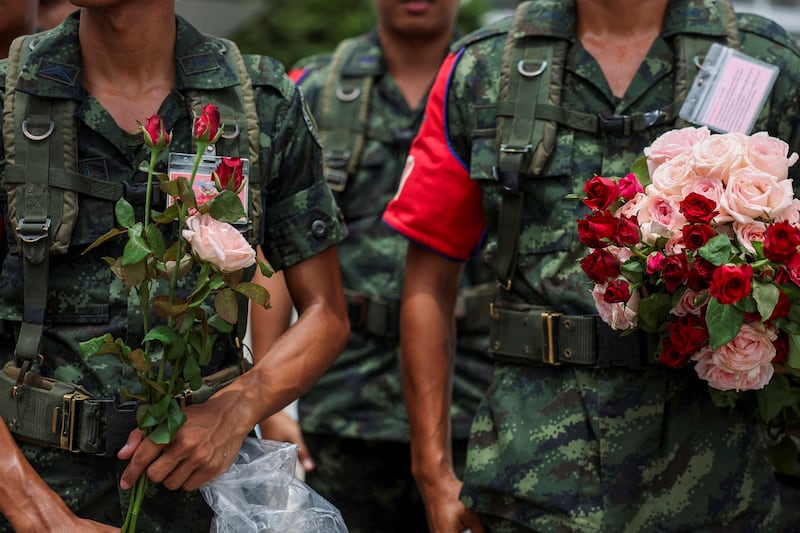
Thai soldiers hold flowers received from supporters at army headquarters in Bangkok, July 29, 2025.
Thai soldiers hold flowers received from supporters at army headquarters in Bangkok, July 29, 2025. (Chalinee Thirasupa/Reuters)

Acting Thai Prime Minister Phumtham Vejjayachai on Tuesday accused Cambodian troops of violating the ceasefire. The Thai government said it had filed a complaint about the alleged violation to Malaysia, the U.S. and China.

Cambodia’s defense minister, Tea Seiha, denied the claim, writing on Facebook that Cambodia’s armed forces has been strictly observing the truce. He said the Cambodian defense ministry would lead a delegation of foreign diplomats to observe the border.

Local sources near the border told RFA that gunfire was heard periodically in the predawn hours on Tuesday. An Agence France-Press journalist near the border said the sound of gunfire stopped ahead of the midnight deadline, a quiet that continued into Tuesday evening.

Thailand’s Phumtham and Prime Minister Hun Manet of Cambodia appeared together on Monday to announce the ceasefire, brokered with Prime Minister Anwar Ibrahim of Malaysia, the annual chair of the ASEAN regional bloc.

The announcement came amid pressure from U.S. President Donald Trump, who said that continued fighting could stall negotiations for a trade deal with the U.S. Both countries face a 36% tariff on their goods unless a reduction can be negotiated. After the deal was announced, Trump said he had spoken with both leaders and told his team to restart talks.

At least 43 people were killed and around 300,000 were displaced during the fighting, which included jets, rockets and artillery.

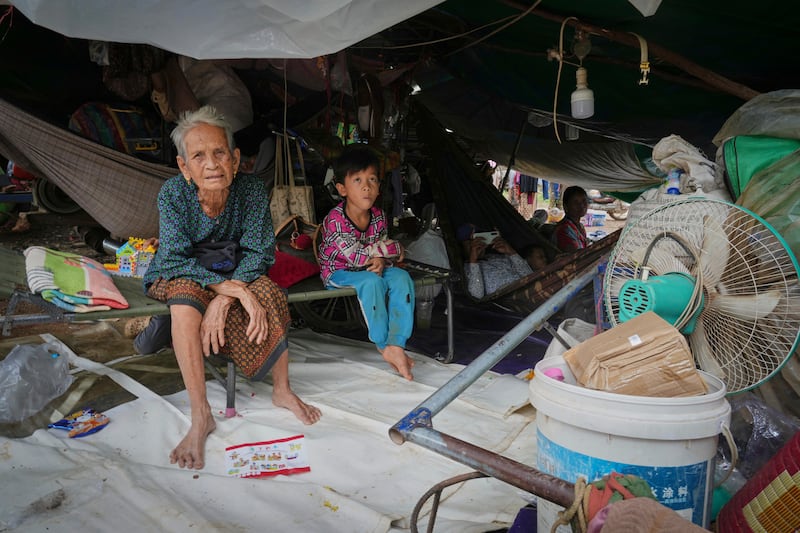
Cambodian villagers sit under a tent at resettlement camp in Wat Phnom Kamboar, Oddar Meanchey province, Cambodia, July 29, 2025.
Cambodian villagers sit under a tent at resettlement camp in Wat Phnom Kamboar, Oddar Meanchey province, Cambodia, July 29, 2025. (Heng Sinith/AP)

Some locals, like Cambodian Soklang Slay, expressed wariness as they returned to their homes on Tuesday.

“I am very concerned that new fighting may break out. Thailand often provokes the fighting first, but then accuses Cambodia. Their aims is that they want to occupy our temples [along the border]. I really don’t want to see any new fighting happen,” he told the Associated Press.

Supalak Ganjanakhundee, an author and former editor of the Nation newspaper in Bangkok who lives in his hometown in Kantharalak district, Sisaket province, was among those displaced. He had to evacuate, he said, and lost his cattle and his chance to harvest ripe durian fruit.

“The recent border skirmish between Thailand and Cambodia was senseless and served no real benefit to either nation. It did, however, serve the interests of the Thai military and Cambodia’s ruling family,” he told RFA, referring to the spat between Hun Manet and suspended Thai Prime Minister Paetongtarn Shinawatra.

“Politically, the conflict has placed the government of Prime Minister Paetongtarn Shinawatra on the brink of collapse. The failure of coherent diplomacy has opened the door to external interventions — most notably by the United States and China — complicating an already volatile situation.”

To resolve their issues long-term, he said both countries must accept the presence of international observers to monitor and verify the truce’s implementation.

“At the same time, they must reactivate dormant bilateral mechanisms to address critical issues of border security and the long-overdue boundary demarcation,” he said.

Includes reporting by RFA Khmer and Pimuk Rakkanam for RFA, as well as Agence France-Presse, The Associated Press, and Reuters.


Thailand accuses Cambodia of 'deliberately' violating ceasefire hours after it came into force


Copyright AP Photo

By Gavin Blackburn
Published on 29/07/2025 - EURONEWS


The truce, which was signed in Malaysia, was supposed to come into force at midnight, bringing an end to cross-border clashes that have killed at least 41 people and displaced thousands.

Authorities in Thailand have accused Cambodia of violating the ceasefire the two countries agreed to on Monday, following economic pressure from the Trump administration.

The truce, which was signed in Malaysia, was supposed to come into force at midnight, bringing an end to cross-border clashes that have killed at least 41 people and displaced thousands.

The Thai army accused Cambodia of launching attacks in multiple areas early on Tuesday but Cambodia said there was no firing in any location.

Thailand later said fighting had stopped after military commanders along the border from both sides met.

They agreed to halt troop movements, avoid escalation and establish coordination teams ahead of a joint border committee meeting in Cambodia on 4 August, army spokesperson Major General Winthai Suvaree said.

Malaysia's Prime Minister Anwar Ibrahim, centre, Cambodia's PM Hun Manet left and Thailand's acting PM Phumtham Wechayachai after talks in Putrajaya, 28 July, 2025 AP Photo

Cambodian Defence Minister Tea Seiha said he spoke to his Thai counterpart about "incidents" that occurred during the implementation of the ceasefire but stressed the Cambodian army abided by the truce.

He said Cambodian defence officials will lead a delegation of diplomats, foreign military attachés and others to observe the situation.

The Thai government separately said it has lodged complaints to Malaysia, the US and China about Cambodia’s alleged breach of the ceasefire agreement.

Along the border, there were signs of calm with some of the more than 260,000 people displaced by the fighting returning to their homes.


Ceasefire struck under US pressure

Cambodian Prime Minister Hun Manet and Thailand's acting Prime Minister Phumtham Wechayachai agreed to an “unconditional” halt in fighting on Monday in talks hosted by Malaysian Prime Minister Anwar Ibrahim.

He called the ceasefire a "vital first step towards de-escalation and the restoration of peace and security."

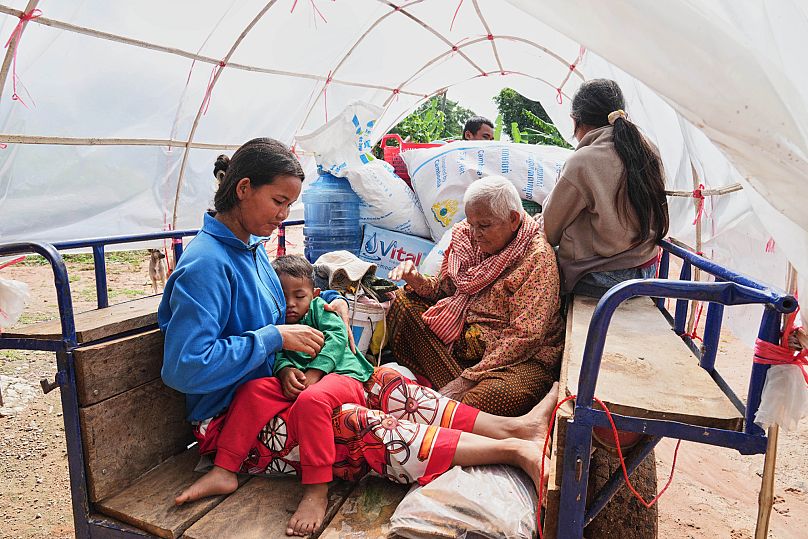
A Cambodian family sits on a tractor cart as they return home from a temporary shelter in Prasat Roboeuk village, 29 July, 2025 AP Photo

Secretary of State Marco Rubio said the US applauded the ceasefire declaration.

"President Trump and I are committed to an immediate cessation of violence and expect the governments of Cambodia and Thailand to fully honour their commitments to end this conflict," Rubio said in a statement.

Hun Manet said on Tuesday that Trump had called to offer congratulations for the peace agreement.

He posted on social media that Trump pledged the US would join the monitoring process along with Malaysia to ensure the ceasefire is implemented.

Trump also called Phumtham after his return to Bangkok.

Phumtham said Trump told him that Thailand’s talks with Washington to negotiate tariff levels on Thai exports could now proceed and that he would seek to make them as favourable as possible.

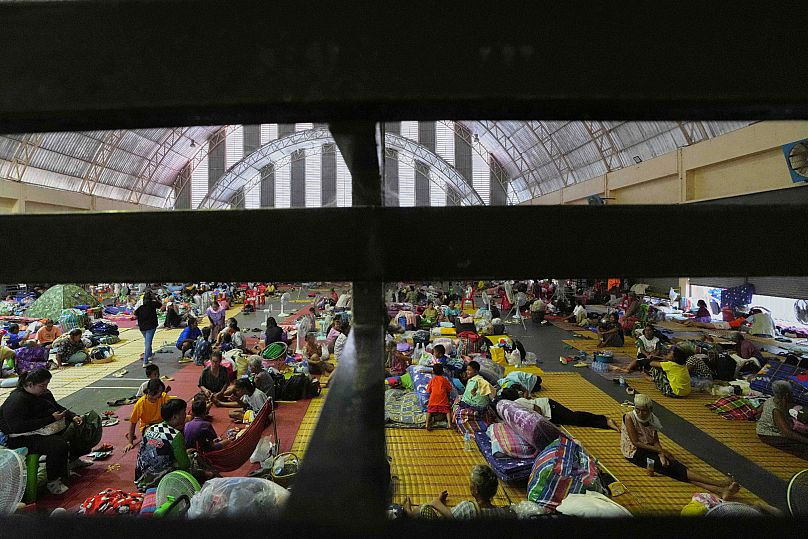
Thai residents who fled homes following clashes rest at an evacuation centre in Surin province, 29 July, 2025 AP Photo

The ceasefire comes days before the US is expected to announce new trade tariff decisions.

Cambodia and Thailand have both been two of the hardest-hit countries as a result of Trump’s trade war, with a 36% tariff on goods from both countries due to take effect on Friday.

Trump had warned that the US might not proceed with trade deals with either country if hostilities continued, giving both sides a face-saving justification for halting the clashes.

Caution among border residents

Cambodia and Thailand have clashed in the past over their 800-kilometre border.

The latest fighting began on Thursday after a landmine explosion wounded five Thai soldiers.

Tensions had been growing since May when a Cambodian soldier was killed in a confrontation that created a diplomatic rift that roiled Thailand's domestic politics.

Residents on both sides of the border expressed relief about the ceasefire but remained wary, unsure how long the peace would last.

Related
Tens of thousands displaced as border clashes between Thailand and Cambodia escalate
Thailand declares martial law in border districts as conflict with Cambodia worsens

"I am very concerned that new fighting may break out. Thailand often provokes the fighting first, but then accuses Cambodia. Their aims is that they want to occupy our temples. I really don’t want to see any new fighting happen," said Soklang Slay, as he helped his daughter move back into her home in Cambodia's Oddar Meanchay province.

Meanwhile, in Thailand's Surin province, local community leader Kritsada Jindasri said he heard heavy firing and explosions on Monday night before silence fell at midnight.

"We are still cautious. We still don't totally believe (that it would stop). We still wait to assess the situation," said Kitsada, who had stayed back along with 60 other community leaders after some 400 villagers evacuated last week.

Fukushima nuclear plant clean up faces new delay in removing melted fuel debris


July 29, 2025  / CBS/AP

The start of full-scale removal of melted fuel debris at the tsunami-wrecked Fukushima Daiichi nuclear power plant in Japan will be delayed for several years, the latest setback announced by the plant's operator.

The Tokyo Electric Power Company Holdings, or TEPCO, said it will need 12 to 15 years of preparation – or until 2037 or later – before starting the full-scale removal of melted fuel debris at the No. 3 reactor. The preparation, it said, includes reducing radiation levels and building necessary facilities in and around the reactor.

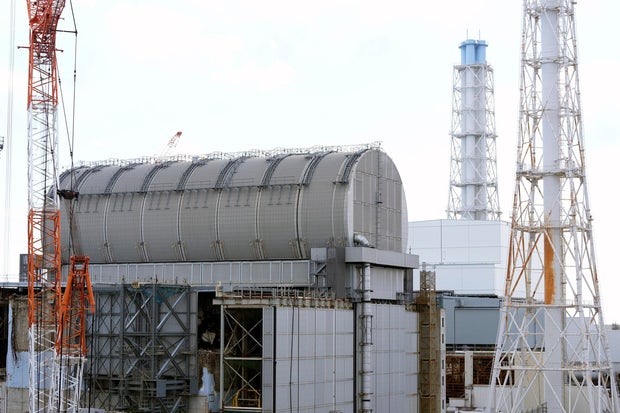
The Unit 3 reactor, covered with protective housing at the Fukushima Daiichi nuclear power plant, is run by Tokyo Electric Power Company Holdings (TEPCO).EUGENE HOSHIKO / AP

Overall, at least 800 tons of melted nuclear fuel have mixed with broken parts of internal structures and other debris inside the three reactors that suffered meltdowns after the 2011 earthquake and tsunami.

The delay again sets back the 2051 target set by Japan's government and TEPCO for decommissioning the plant.

A test retrieval of a tiny sample of melted fuel debris in November was already three years behind, and some experts estimate that the decommissioning work could take more than a century.

TEPCO said it plans to stick to the current completion target of 2051.

"Realistically, we are aware of the difficulty (to achieve the target) but we will not drop the goal just yet, as we still don't have a clear work schedule after the full-scale removal begins," said Akira Ono, chief decommissioning officer at TEPCO.

Ono said TEPCO plans to examine preparation work necessary at the two other reactors within the next couple of years, ahead of full-scale melted fuel retrieval.

After small missions by robots to gather samples, experts will determine a larger-scale method for removing melted fuel, first at the No. 3 reactor.

In March 2024, TEPCO released a dozen images taken by the miniature drones sent deep into a badly damaged reactor at the plant, showing displaced control equipment and misshapen materials. The photos were the first from inside the main structural support called the pedestal in the hardest-hit No. 1 reactor's primary containment vessel, an area directly under the reactor's core.