Saturday, November 08, 2025

Mamdani’s New York win takes free public transport vision to the next level
NOVEMBER 6, 2025

By Fare Free London

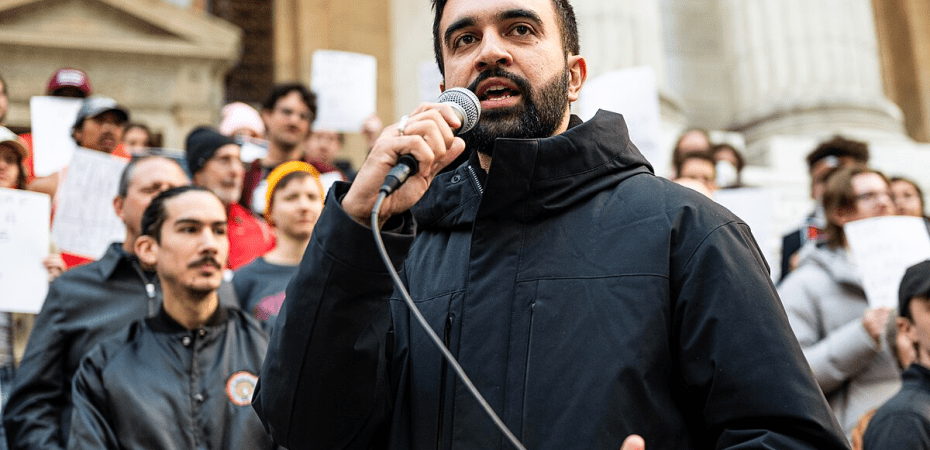
Zohran Mamdani’s victory in the New York mayoral election shines a spotlight on the potential for free public transport in the world’s biggest cities. Making the city’s buses “fast and free” is one of Mamdani’s key election pledges.

His manifesto aims to “lower the cost of living for working-class New Yorkers”. It promises to scrap bus fares, freeze rents, provide free child care up to the age of five, and set up a chain of municipally-controlled grocery shops.

The zero-fares scheme would have to be agreed with New York’s Metropolitan Transportation Authority (MTA), which is run by the New York state government – most likely by New York City back-filling the $6-800 million/year hole it would leave in the MTA budget.

Pearl Ahrens of Fare Free London said: “This win has international resonance. If New York City can consider making buses free, so can London and other big world cities.

“There are smaller cities successfully running free public transport – more than 130 of them in Brazil, and European capitals including Luxemburg, Belgrade (Serbia) and Tallinn (Estonia). Glasgow, with more than 600,000 people, is committed to running a pilot scheme next year.

“New York City, which, like London, has more than 8 million people, can take this to the next level.”

New York transport researcher Charles Komaroff said in an interview with Fare Free London that Mamdani’s election campaign – based on “affordability” via free buses, free child care and low-cost groceries – had powerful symbolism in the city.

Komaroff authored a detailed appraisal of the scheme, published in April this year by the Nurture Nature Foundation, that has been a potent weapon for supporters of free buses. It concludes that, in money terms, the scheme will produce benefits for New Yorkers worth at least twice as much as the $600+ million it will cost.

The report estimates that the scheme will increase bus use by 23%, and shows that it will simplify bus travel, as boarding will be quicker, and speed up journey times by at least 7%.  

Komaroff said in interview that funds for the scheme would most likely have to be transferred from the city’s budget to the MTA. “Ethically and politically, this money should be raised by taxes on millionaires and billionaires.”

Fare-free travel was trialled on five New York City bus routes during the year to September 2024. The pilot “dramatically increased” passenger numbers, by 30% on weekdays and 38% at weekends, providing “clear economic relief to low-income riders”, Mamdani and New York state senator Michael Gianaris wrote afterwards. Assaults on drivers fell by 38%.

More details, and more comments from Charles Komaroff, on farefreelondon.org.

Image: Zohran Mamdani https://commons.wikimedia.org/wiki/File:Zohran_Mamdani_at_the_Resist_Fascism_Rally_in_Bryant_Park_on_Oct_27th_2024.jpg Author: Bingjiefu He, licensed under the Creative Commons Attribution-Share Alike 4.0 International license.


London Mayor Sadiq Khan congratulates Zohran Mamdani on New York mayoral victory as he takes dig at Trump


5 November, 2025 
Left Foot Forward

“New Yorkers faced a clear choice – between hope and fear – and just like we’ve seen in London – hope won."
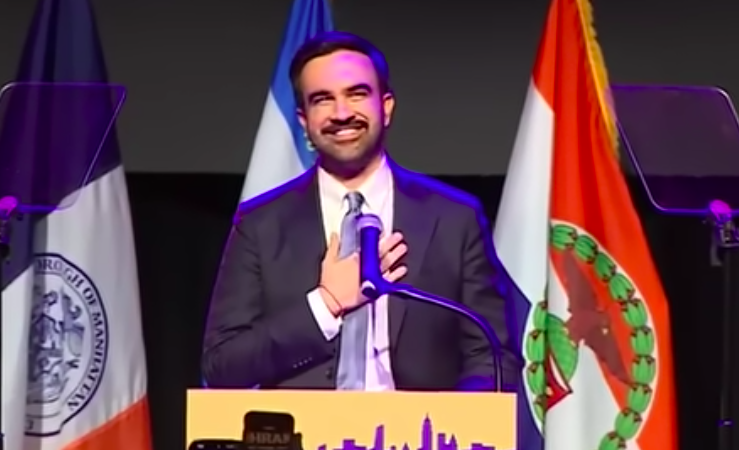


The Mayor of London Sadiq Khan has congratulated Zohran Mamdani following his election victory in the New York mayoral race, which makes him the city’s youngest mayor since 1892, as well as its first Muslim and South Asian mayor.

Despite repeated Islamophobic and bigoted attacks from the right-wing press as well as being labelled a ‘communist’ by Donald Trump who threw his weight behind Cuomo, Mamdani 34, defeated former governor Andrew Cuomo and Republican Curtis Sliwa.

Congratulating Mr Mamdani on what he called an “historic campaign” on social media, Sir Sadiq said: “New Yorkers faced a clear choice – between hope and fear – and just like we’ve seen in London – hope won.

“Huge congratulations to @ZohranKMamdani on his historic campaign.”

Trump has previously targeted Khan with Islamophobic slurs, with both politicians clashing in the past.

In September, Trump took aim at Khan during a speech at the UN, where he falsely claimed that London wanted to “go to sharia law” under its “terrible mayor”.

His comments were condemned by a number of Labour MPs with Khan responding himself calling Trump ‘racist, sexist and Islamophobic’.

Basit Mahmood is editor of Left Foot Forward


‘This week brought good news for Democrats and progressives in the UK and worldwide’

Shutterstock

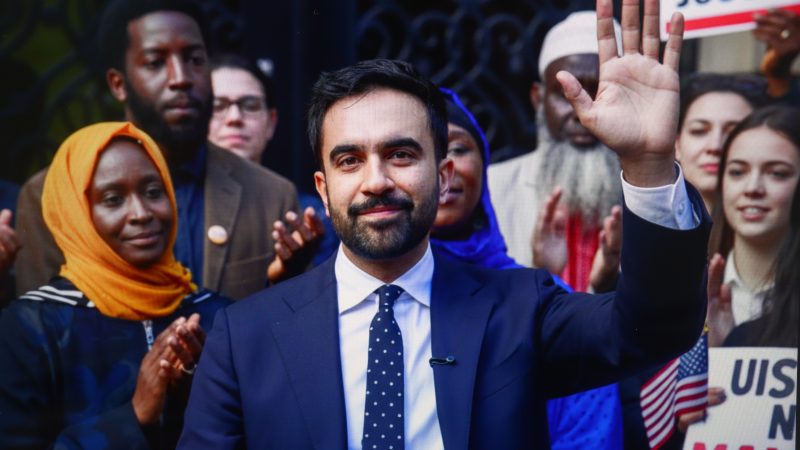
Demeaned and taunted by President Trump for nine dispiriting months, Democrats finally had a chance on Tuesday to respond with something more than theatrical gestures of resistance. Tapping a rich vein of anti-Trump sentiment, a party famished for wins racked up one after another in America’s odd-year elections. 

Suddenly, Democrats seem politically relevant again. The victories, coming in mainly blue states and cities, don’t necessarily presage big gains in next year’s national midterm elections. For that, they’ll need to win on more competitive terrain. Nonetheless, Tuesday’s outcomes confirmed growing public dismay with Trump’s imperious rule, as well as Democrats’ ability to start reclaiming ground he seized in last year’s presidential contest. 

This is good news for Labour activists in the UK and around the world, as it shows the fractures in the administration are beginning to take political effect.

Most consequential were the big Democratic victories in Virginia and New Jersey. Abigail Spanberger won the Virginia’s governor’s race by 15 points, leading a sweep of top state offices that flipped the state back into the blue column. Democrats also added seats in the state legislature, amassing their biggest majority since 1989.

READ MORE:

In New Jersey, despite polls showing a tight race, Rep. Mikie Sherrill cruised to a 13-point win over her Trump-endorsed Republican opponent. Spanberger and Sherrill exemplify a new breed of pragmatic Democrats who have distanced themselves from the unpopular cultural fixations of the progressive left.

Both describe themselves as “security moms” – Spanberger was a CIA agent and Sherrill flew helicopters for the Navy. Their national security credentials and moderate reputations made it hard for their opponents to tar them as “weak and woke.”

Spanberger and Sherrill focused their campaigns on lowering living costs and keeping communities safe. They emphasised building more affordable housing, holding energy prices down and assuring access to health care. As her opponent harped incessantly on the spectre of transgender women undressing in girl’s bathrooms, Spanberger called for getting culture war politics out of public schools. 

Both unquestionably got a lift from tying their opponents to Trump. According to exit polls, 55 and 56 percent of voters in New Jersey and Virginia respectively disapprove of the president’s job performance. Not surprisingly, Spanberger did especially well in Northern Virginia, where tens of thousands of federal workers have either been fired by DOGE, laid off by the government shutdown or been forced to take buyouts.  

Trump proved to be a turnout magnet for Democrats. This highlights the fatal flaw in his strategy of maximum political polarisation. By offering his opponents nothing but the back of his hand, Trump motivates furious Democrats to turn out in droves. And by excluding them from government decisions, he ensures that he and his party bear the full weight of public frustration with federal sins of commission and omission. That’s why the Republicans appear to be losing the blame game over the ongoing government shutdown. 

Turnout also surged in New York, where two million voters showed up for a three-way race for mayor. The winner was rookie phenomenon, Zohran Mamdani, at 34 the city’s youngest as well as first Muslim mayor. 

Mamdani ran an exciting and impressive race, even if most of his radical proposals for municipal socialism – public grocery stores, free buses and tuitions and other government goodies to be financed by taxing oligarchs – seem fanciful rather than bold. 

Mamdani also stressed making urban life more affordable and his message of radical change resonated in some lower-income and immigrant neighborhoods as well as upscale precincts. But while his loud and proud embrace of democratic socialism may thrill cosmopolitan elites – including fellow travelers like Britain’s Jeremy Corbyn, it won’t travel far beyond big coastal metros.

Against a scandal-plagued opponent, former Democratic Governor Andrew Cuomo, Mamdani managed to win only half the vote. His Democratic predecessors as mayor typically won about two-thirds of the city’s voters. 

What’s more, Cuomo won non-college voters in New York – the group Democrats must do better with to revive their national competitiveness. 

Subscribe here to our daily newsletter roundup of Labour news, analysis and comment– and follow us on BlueskyWhatsAppX and Facebook.

In contrast, Spanberger and Sherrill demonstrated crossover appeal to the voters Democrats need to build durable majorities.  Both won independents, including voters who supported Trump last year. They also made notable gains in exurban, small town and rural communities.  

Most promising of all, among Latino voters, support for the Democratic candidates grew by 9 points in New Jersey and five points in Virginia. Black voters also shifted toward the Democrats, though less dramatically. And Republican candidates for governor lost under 30 voters by almost 40 points.  

Another big winner on Tuesday was California’s Democratic Governor, Gavin Newsom. He championed Proposition 50, which draws a map of Congressional districts more favorable to Democrats. It’s designed to counter Trump’s attempts to pressure Texas and other red states to produce new maps favoring Republicans before the midterm. Nearly 65% of California voters backed the measure, which could produce five new Democratic House seats. 

Will the Republican rout prompt rethinking in the White House? One possibility is that Trump will instruct pliant GOP Congressional leaders to end the government shutdown. Another is that the Supreme Court will invalidate his spurious national security rationale for imposing tariffs, which are driving up costs for consumers and businesses. 

This much seems certain: If Trump doesn’t change course and start fulfilling his pledges to get prices and living costs down soon, Democrats will have an even better midterm election next year. 

For those watching from across the Atlantic, it’s an encouraging set of results, especially when we look beyond the headlines dominated by the New York contest. But Democrats have their work cut out to show to the American public that the party has changed and is ready to lead again if we are to translate this success into sustained victories at the midterms in the path to the next Presidential election. 

 ‘Earth’s Greatest Enemy’ Shows Us We Have No Choice


A new documentary details how the US military is destroying all forms of life—from oceans, plants, and animals to the communities it attacks and even the people who fight its wars.


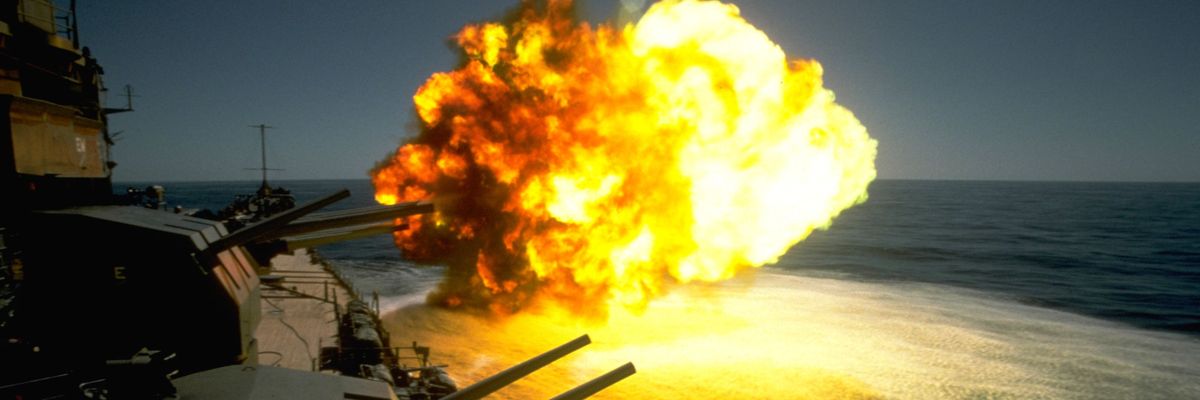
The battleship USS Missouri (BB-63) fires one of its Mark 7 16-inch/50-caliber guns during exercise RIMPAC ‘90 near Hawaii.
(Photo by CORBIS/Corbis via Getty Images)
Danaka Katovich
Nov 08, 2025
Common Dreams

In the opening scene of Abby Martin and Mike Prysner’s new documentary, Earth’s Greatest Enemy, an unhoused veteran sits and plays piano in an encampment in Brentwood, California. He lives in an encampment popularly known as “Veterans Row,” where tents are draped in US flags and people walking by are reminded of how often the U.S. military chews people up and spits them out. The man starts reciting the lines to an old Army recruiting commercial; the film cuts to the commercial itself, featuring the same unhoused veteran. He still remembers all the lines.

Earth’s Greatest Enemy is a documentary about the climate crisis and imperialism: how the US military is the largest institution pushing us toward ecological collapse. At face value, the opening scene of a veteran who lives out on the street might seem unrelated. Over the course of the film, Martin, with careful precision, illustrates that the destruction of the climate by the US military is not only being done to the environment around us, but being done to us, as is shown in the scenes highlighting the contaminated water at Camp Lejeune.


Report Details How ‘Gas-Fed AI Boom’ Set to Blow Up US Climate Goals


The Librarian’s Call: Documenting Is Resistance

Earth’s Greatest Enemy captures the unfathomable breadth of ecological and human suffering caused by militarism. It covers the cost of war to the oceans, animal and plant life, fresh water, and more. If someone lives in the belly of this military beast, Earth’s Greatest Enemy should be a required watch.

One segment of the film focuses on the US military’s impact on Earth’s oceans, specifically during the US-led war games, RIMPAC, the largest maritime military exercise in the world. They fly Growler jets over the ocean and practice sinking exercises, exploding decommissioned ships in the open water. They fire live rounds and pollute the ocean for five or six straight weeks. Martin documents the US military detonating mountains in Okinawa and taking the dirt to fill in coral reefs so the military can use the land for part of a base. One of the film’s most surprising revelations is that the US military determines how many sea mammals they can kill. All of this, of course, affects fishing and biodiversity that sustains the oceans—and human and animal life around the world, most directly the people of the Pacific, whether it be Hawai’i, Okinawa, or the other islands where the US has set up permanent military outposts.

To fight for the future of the planet, we in the anti-war movement must join forces with the climate movement. Our enemies are one and the same: the war profiteers and politicians driving us toward climate collapse.

Earth’s Greatest Enemy also explores the water pollution caused by the US military. Halfway through the film, we hear from Kim Ann Callan, who has spent the last 15 years uncovering the impact of toxic waste from the military at Camp Lejeune. For years, the military poisoned the groundwater, which, in turn, poisoned military families. As a result, whole families got sick with cancer; the US military tried to cover it up. The film shows Callan walking through a cemetery with rows of gravestones of infants, with headstones reading “born and died” on the same date. Multiple families lost more than one baby to the illnesses caused by the military’s pollution.

Callan reflects: “Going into this, I had a whole different vision of the military. And I had a lot of respect for the military… I don’t have respect for the government or the military anymore.” The poisoning of military families on the base didn’t just happen at Camp Lejeune: The film exposes how toxic US military bases are worldwide—with just as devastating stories in each of the 800-plus military bases globally in over 80 countries and in hundreds throughout the US.

Martin, of course, discusses the impact conventional warfare has on the planet, like when the US or one of its proxies, like Israel, relentlessly bombards land over an extended period of time. The result is often total ecocide, where survivors have next to nothing left to grow and live off of.

The film reveals the cumulative impact of the bullets fired in Iraq. Conservative estimates suggest that, for every person killed in the US wars on Iraq and Afghanistan, more than 250,000 bullets were used. Each bullet injects lead, mercury, and depleted uranium into air, water, and land. Furthermore, studies have found titanium in the lungs of US soldiers on bases and in the hair samples of children in Iraq and Afghanistan. The US wages wars not only on the air, water, and land, but also on bodies, bloodlines, and generations of human beings.

The US military is destroying all forms of life. And for what? Even those who fight the wars are ultimately left out on the street when they return home.

By the end of the film, it’s abundantly clear: The US military is truly Earth’s greatest enemy. It controls—and threatens all life on Earth. Yet as organizers within the anti-war movement, it’s abundantly clear how siloed the fight against it can be from the rest of the environmental movement. To fight for the future of the planet, we in the anti-war movement must join forces with the climate movement. Our enemies are one and the same: the war profiteers and politicians driving us toward climate collapse.

Organizers on the front lines of the struggle against this planetary crisis of militarism—from Hawai’i to Okinawa to Atlanta—understand this. The struggle for the land is inextricably bound to the struggle against militarism. We have no choice but to cut through the political, philanthropic, and organizational red lines that separate us. Because, as Martin and Prysner elucidate, through compassionate human storytelling and radically honest journalism, the war machine will eventually come for us all. We must act now.


Our work is licensed under Creative Commons (CC BY-NC-ND 3.0). Feel free to republish and share widely.


Aaron Kirshenbaum
Aaron Kirshenbaum is CODEPINK's War is Not Green campaigner and East Coast regional organizer. Based in, and originally from, Brooklyn, New York, Aaron holds an M.A. in Community Development and Planning from Clark University. They also hold a B.A. in Human-Environmental and Urban-Economic Geography from Clark. During their time in school, Aaron worked on internationalist climate justice organizing and educational program development, as well as Palestine, tenant, and abolitionist organizing.
Full Bio >

Danaka Katovich
Danaka Katovich is CODEPINK's national co-director. Danaka graduated from DePaul University with a bachelor's degree in Political Science in November 2020. This was originally published on Danaka’s Substack, Proof That I’m Alive. You can subscribe here: https://danaka.substack.com/
Full Bio >

The Hemispheric Presidency: Emergency Powers and the New US Doctrine in Latin America

IMPERIALIST PIRACY ON THE HIGH SEAS AGAIST FISHING BOATS

Trump’s emerging doctrine is anchored in the expansion of presidential authority, representing the full extension of the unitary executive theory or the imperial presidency into the sphere of foreign policy.


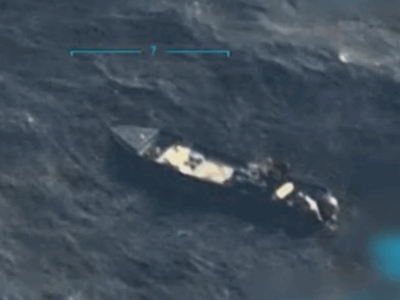
A video shared by Secretary of Defense Pete Hegseth shows a boat about to be struck in the Caribbean on November 6, 2025.
(Photo by Pete Hegseth/X/Screengrab)


Jose Atiles
Nov 08, 2025
Common Dreams


The latest round of deadly boat strikes, which killed 3 people—bringing the total death toll to at least 70 since September—are confirmation that the second Trump administration has decisively refocused US foreign policy toward Latin America and the Caribbean.

Long treated as a secondary concern, including during President Donald Trump’s first term, when attention centered on China, the Middle East, and Eastern Europe, the region has returned to the forefront of US global strategy. But what is emerging is not a revival of Cold War containment or the Monroe Doctrine. It is the consolidation of a new US doctrine, one that aims to fuse emergency powers, economic warfare, and militarization into a unified hemispheric order.


‘We Have Lived This Nightmare Before’: Latin American Lawmakers Condemn Trump Extrajudicial Killings


Senate Dems Aim to Stop Trump ‘From Dragging This Country Into War’ With Venezuela

This emerging doctrine is anchored in the expansion of presidential authority. It represents the full extension of the unitary executive theory or the imperial presidency into the sphere of foreign policy, an effort to normalize executive unilateralism as the organizing principle of US governance at home and abroad. Trump’s approach reveals how emergency powers techniques, such as executive orders, emergency declarations, and budgetary discretion, are being implemented as instruments of foreign policy.

This realignment is only possible because of the profound transformations generated by the War on Drugs and the War on Terror, which over the last three decades expanded the legal and institutional capacity of the US executive branch to govern through permanent emergency. What began as exceptional counterinsurgency frameworks, asset seizures, sanctions, and military authorizations without congressional approval has evolved into the standard operating logic of the US government.

Under Trump, these tools have coalesced into a coherent hemispheric project.

Emergency powers serve as the connective tissue linking military strikes, financial bailouts, and sanctions into a coherent system of hemispheric governance.

The Trump administration’s foreign policy rests on a single assumption: that the president can act independently of Congress, international law, and long-standing diplomatic norms. This logic manifests through unilateral bailouts, economic and financial sanctions, and militarized interventions.

For instance, the Trump administration’s authorization of 17 direct boat strikes in the Caribbean illustrates how the administration treats military action as an extension of executive discretion. In a highly contested argument, the Trump administration has maintained that the president has the legal authority to carry out these attacks.

The attacks are against vessels allegedly linked to narcotics operations, though many lacked the capacity or cargo to justify the strikes. Some accounts note that the goal with these strikes is not interdiction, but provocation, using force to engineer confrontation and accelerate regime change in Venezuela.

The Caribbean, once imagined as America’s “backyard,” has become the theater where emergency powers are rehearsed as everyday statecraft.

The economic arm of this doctrine operates on the same logic. On October 17, the administration announced a $40 billion bailout for Argentine President Javier Milei, the self-styled “anarcho-capitalist” who wields a chainsaw as a symbol of his promise to “cut the state.” Half of the funds came from US public reserves and half from private investors, without congressional approval.

The measure was less about stabilizing Argentina’s economy than about underwriting a radical neoliberal experiment that mirrors Trump’s domestic agenda. Milei’s program, including privatizing pensions, slashing social services, and gutting labor protections, has been hailed in Washington as proof of “fiscal responsibility.”

But as Mother Jones revealed, hedge-fund billionaire Rob Citrone, who had recently invested heavily in Argentine debt, maintained close ties with Treasury Secretary Scott Bessent, raising questions about conflicts of interest and influence peddling.

In this context, the bailout secures a government ideologically aligned with Trumpism while reinforcing US financial dominance. More importantly, the US taxpayers’ bailout played a key role in Milei’s victory on October 26’s legislative elections, giving him a lifeline to address the economic stability exacerbated by Milei’s own policies. Thus, through the language of crisis management, the executive transforms financial rescue into a form of governance by decree.

The military dimension of this doctrine is even more telling. The Caribbean has become the primary stage for the remilitarization of US power and the enactment of presidential emergency authority abroad. In recent months, the Pentagon launched the largest regional deployment in decades.

In late October, the aircraft carrier USS Gerald R. Ford left the Croatian port of Split for the Caribbean, joined by seven other warships and dozens of fighter jets. More than 10,000 US troops are currently deployed in the area, half aboard naval vessels and half stationed in Puerto Rico. The deployment followed a series of military practices and intelligence operations aimed at destabilizing the government of Nicolas Maduro, all justified by executive authorizations and emergency powers.

Here, Puerto Rico plays a decisive role. The archipelago’s colonial status allows the administration to deploy forces, intelligence, and financial instruments beyond the constraints of congressional oversight. Its ports and bases have been reactivated as platforms for surveillance, drone operations, and logistics under the pretext of “regional security.” The remilitarization of the archipelago echoes the Cold War, when Puerto Rico served as the hinge for US interventions in the Dominican RepublicGrenada, and Central America. To its environmental, social, and politico-economic detriment, Puerto Rico has been placed at the center of the US intervention on Venezuela, Colombia, and other “enemies” of the Trump administration.

Parallel to the military buildup, the administration has expanded its economic warfare campaign across the hemisphere. Economic and financial sanctions on Venezuela have deepened, further debilitating its oil sector and currency circulation, while the Treasury has introduced new tariffs and sanctions on BrazilColombia, and Cuba. The coordination between the State Department and Treasury has transformed sanctions into weapons of punishment, instrumentalizing law to produce political compliance.

Furthermore, on November 5, the US Supreme Court heared arguments in a case on that could redefine the presidential emergency powers under the International Emergency Economic Powers Act (IEEPA). The case stems from President Trump’s use of IEEPA to impose sweeping global tariffs, actions he justified as responses to “unusual and extraordinary threats” to US national security and the economy. The court’s decision will determine whether the president can unilaterally wield emergency powers to reshape trade policy, bypassing Congress and potentially transforming emergency authority into a routine tool of governance.

These sanctions, tarrifs, and “boat strike” authorizations were issued through executive orders, bypassing both congressional approval and multilateral oversight. Emergency powers serve as the connective tissue linking military strikes, financial bailouts, and sanctions into a coherent system of hemispheric governance.

Within this architecture, Puerto Rico stands as the linchpin. Its colonial legal status allows Washington to merge colonial governance with global military reach. The archipelago is now both a financial enclave and a military platform, where the imperial presidency meets authoritarian neoliberalism.

Thus, what is emerging is a new doctrine of foreign policy based on emergency powers. This policy deploys tools once reserved for domestic crises to govern an entire hemisphere. Under Trump, Latin America and the Caribbean have become extensions of the US executive powers, managed through decrees, loans, and strikes, all justified as acts of necessity, all serving the same logic of control.


Our work is licensed under Creative Commons (CC BY-NC-ND 3.0). Feel free to republish and share widely.


Jose Atiles
Jose Atiles is an associate professor of Criminology, Law, and Society at the University of Illinois, a Public Voices fellow of the OpEd Project, and the author of “Crisis by Design: Emergency Powers and Colonial Legality in Puerto Rico,” which analyzes the role of law, emergency powers, and colonial structures in producing and exacerbating political and economic emergencies.
Full Bio >


US Strikes on Drug Smuggling Boats Prompt Warning for Commercial Ships

US strike on drug boat
U.S. has conducted its 17th acknowledge strike on drug-running boats (Hegseth on X)

Published Nov 7, 2025 5:04 PM by The Maritime Executive


The U.S. on Friday, November 7, announced its latest strike on a small boat in the Caribbean believed to be smuggling drugs. It is the 17th reported strike, and as the U.S. continues its offensive, warnings are going out for the possible consequences for commercial shipping, which has already been used by the cartels to often unsuspectingly ferry the narcotics overseas.

The latest strike was announced online by Pete Hegseth, who said, “three male narco-terrorists were killed.” He continues to assert that these boats are “operated by a Designated Terrorist Organization,” while saying the strikes will continue until the groups stop smuggling drugs into the United States.

By the latest count, the U.S. has now destroyed 17 boats and one semi-submersible. The death count stands at 69 or 70 people, with only two or three people surviving the initial attacks. 

While Hegseth continues to label the operators of the boats “narco-terrorists,” Associated Press issued a lengthy story piecing together the details on nine of the individuals after interviews in Venezuela. It concludes that the boats are drug runners, but mostly operated by ordinary individuals, and not the leaders of the cartels or gangs. They write that the men were crewing the boats for the first or second time and were laborers, a fisherman, a taxi driver, or low-level career criminals.

Global insurance company Gard, which bills itself as the world's leading provider of marine insurance and energy insurance, advises that cocaine smuggling is on the increase and cites data from the United Nations Office on Drugs and Crime reporting that cocaine flows to Europe have increased dramatically compared to North America. They highlight the need for vigilance and preventive measures in the shipping industry and call for fair treatment of crews when smuggled drugs are found in the cargo or aboard the ships. 

“Use of the military against suspected drug smuggling boats by the current U.S. administration may also push more activity toward commercial vessels,” advised Gard. It notes that the high-risk areas for cocaine smuggling include Colombia, Ecuador, Peru, Mexico, Brazil, and Venezuela. “Patterns may change due to increased pressure by law enforcement, both by authorities in countries of production and countries where the drugs are found,” they advise.


Senior loss prevention specialists at Gard prepared a detailed analysis of the consequences of drug smuggling for the commercial shipping industry. The article warns that “rising cocaine production and evolving trafficking routes are creating serious risks for commercial vessels.”

They report that packages may be placed by rogue employees working for shipping companies or terminals, and that there have been reports of drug traffickers disguised as port officials and stevedores. The European authorities have also warned that ports have been infiltrated by the drug cartels.

“In Gard’s experience, cocaine trafficking using commercial vessels as unwitting ‘drug mules’ is increasing with the associated perils to crew and ship when drugs are found.” They report that most often the drugs are hidden in containers either with the cargo or in the structure, but have also been found in bulk cargoes. It also says that its experience shows there are only a small number of cases where drugs are discovered on board or attached to a vessel. 

The U.S.’s high-visibility strikes came as the U.S. Coast Guard also reported it achieved a new record for cocaine seizures. The service maintains interdiction patrols in both the Caribbean and Pacific, which seize the boats and turn over the individuals for prosecution. 

Opposition continues to the lethal strikes despite Donald Trump and Pete Hegseth saying they are necessary, legal, and will continue. Experts have noted that it stops only a small amount, and it does nothing to address the demand and addictions among the American public. 

The U.S. Congress has also questioned the strikes and highlighted that it was not being briefed, and no evidence was presented to support the contention that the efforts were based on intelligence and known drug traffic routes. A Congressional briefing was conducted on November 5. It came after the Senate last month narrowly rejected a resolution calling for Congressional approval for the strikes in the Caribbean. On Thursday, November 6, the Senate also narrowly voted down a measure requiring military approval for any military action against Venezuela. 

Hegseth wrote today on social media, “If you want to stay alive, stop trafficking drugs. If you keep trafficking deadly drugs – we will kill you.” 


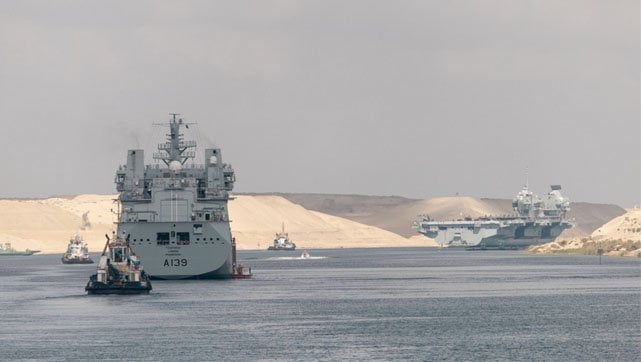
HMS Prince of Wales Fills Void in Mediterranean as USS Ford Heads West

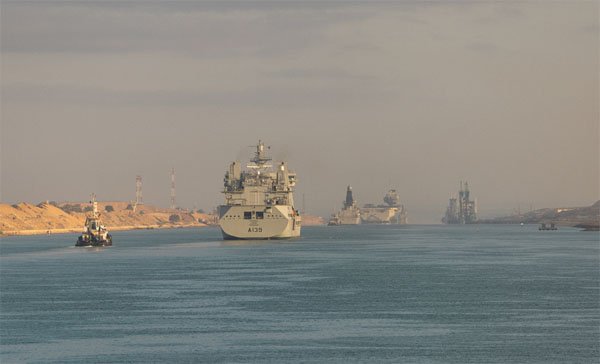
UK warships in Suez Canal
HMS Prince of Wales and RFA Tideforce head north up the Suez Canal (Sjøforsvaret - Norwegian Armed Forces)

Published Nov 7, 2025 2:51 PM by The Maritime Executive


The UK carrier strike group (CSG) led by HMS Prince of Wales (R09) having transited the Suez Canal is now in the central Mediterranean and participating in the early phases of the Italian-led Exercise Falcon Strike 25. During a pause in Souda Bay, command of Prince of Wales was passed from Captain Will Blackett to Captain Ben Power, and the frigate HMS Richmond took the opportunity to conduct anti-submarine warfare with the Greek Navy.

Prince of Wales is now in the sea space vacated by USS Gerald R. Ford (CVN-78), which sailed through the Straits of Gibraltar and into the Atlantic on November 5, preceded by the Arleigh Burke Class guided missile destroyer USS Bainbridge (DDG-96) and the fast combat support ship USNS Supply (T-AOE-6). Ford has reportedly been ordered to head towards Venezuela, although online spotters have identified that she appears to be lingering near Africa.


Task force heading through the Suez Canal (Sjøforsvaret - Norwegian Armed Forces)


The UK CSG now comprises Norwegian Nansen Class frigate HNoMS Roald Amundsen (F311), Type 45 destroyer HMS Dauntless (D33), Type 23 frigate HMS Richmond (F239), the Italian Carlo Bergamini Class frigate ITS Luigi Rizzo (F595) and the fleet resupply ship RFA Tideforce (A139). RFA Tideforce came through the Suez Canal from the Mediterranean into the Red Sea in order to support the CSG when it made the Suez transit.

Falcon Strike 25 is a two-week complex joint exercise involving both ground-based air and sea forces from Italy, Greece, Norway, the United Kingdom and the United States. For the exercise, Prince of Wales will for the first time have on board its full complement of F-35B aircraft, which will operate with Harrier aircraft from the Italian Navy.


Top DOJ Lawyer Claims Trump Doesn’t Need

Congressional Approval for Boat Strikes


A DOJ lawyer told Congress that the strikes — which Trump says are in “self-defense” — don’t put troops in harm’s way.


By Sharon Zhang , 
November 4, 2025

As the Trump administration blows past a key congressional deadline, a top lawyer in the Department of Justice has claimed that the executive branch does not need the approval of Congress to continue conducting boat strikes in and around the Caribbean — an assertion outside experts say is patently false.

Last week, Office of Legal Counsel T. Elliot Gaiser told a small group of members of Congress that the administration does not have to follow the 1973 War Powers Resolution and its mandate that Congress must approve of armed conflict conducted by the U.S.

The briefing was made just before the end of the 60-day deadline established by the legislation. The legislation requires the president to acquire approval for sustained military action within 60 days of an initial notification of actions. This deadline passed on Monday. Gaiser said that the administration is not going to seek approval or an extension of the deadline.

In an email to The Washington Post, a senior official said that strikes do not rise to the level of “hostilities,” as defined under the law.

The administration’s reasoning, it seems, is that “even at its broadest … [it] has been understood to apply to placing U.S. service-members in harm’s way,” and that the current engagement does not do so — even as the administration claims that the current operation is conducted in self-defense.

Related Story

Pentagon Admits to Striking Boats Without Identifying Victims’ Drug Links
The White House cannot “satisfy the evidentiary burden” to prosecute those they have been killing, one lawmaker said. By Chris Walker , Truthout October 31, 2025


“The operation comprises precise strikes conducted largely by unmanned aerial vehicles launched from naval vessels in international waters at distances too far away for the crews of the targeted vessels to endanger American personnel,” the email said.

Experts say this reasoning is patently wrong. Brian Finucane, senior advisor for the International Crisis Group’s U.S. program, pointed out that Congress has previously noted that the resolution purposefully used a broader term — “hostilities” — rather than a narrower term — “armed conflict.” This was so that it could encompass not just attacks, but also a “clear and present danger of armed conflict.”

Further, last month, Trump explicitly said that the administration was engaged in “armed conflict” in its boat strike campaign.

“[F]or the administration to claim U.S. forces are in an armed conflict but not hostilities would be nonsensical to those members of Congress who passed the legislation,” Finucane wrote for Just Security.

Officials’ assertion of control over war powers is a show of how the Trump administration seems to be shifting its legal reasoning on the fly to continue its strikes. Trump, for his part, appears unconcerned with legal reasoning, simply saying last month: “I think we’re just gonna kill people that are bringing drugs into our country, okay? We’re going to kill them.”

Trump administration officials are also purposefully withholding information from lawmakers. Last week, in a separate briefing, the administration excluded Democrats in a briefing with Senate Republicans on the strikes. And in briefings so far, lawmakers say the Pentagon has not provided lists of which gangs they’re targeting or the identities of those killed.

In fact, Rep. Adam Smith, the top Democrat on the House Armed Services Committee, told The New Republic that the administration said they are targeting anyone “affiliated” with “narco-terrorist” groups — and that the administration won’t even explain what constitutes an “affiliation.”

“They did not in any way, shape, manner, or form explain what the ceiling and floor are for ‘affiliated,’” Smith said. Smith added that the administration’s treatment of survivors of the strikes — all of whom so far have been repatriated to their home countries — underscores the illegality of the operations.

Smith says he told administration officials: “So what you’re telling us is you need less evidence to kill somebody than you do to hold them.”

Meanwhile, the operation is seemingly constantly on the verge of expanding into a ground war. Last week, Miami Herald and The Wall Street Journal reported that the U.S. is prepared to strike ground targets within Venezuela.

In response to these reports, President Donald Trump said their claims are “not true” — even though, just weeks before, Trump said that the administration is “certainly looking at land now” for strikes.


The United States Continues Its Attempt to Overthrow Venezuela’s Bolivarian Revolution

With rapid military escalation and a redeployed ‘War on Drugs’ narrative, the Trump administration appears to be laying the groundwork for an attack on the Venezuelan people.

by Vijay Prashad / November 8th, 2025

Children play on the beach during a security deployment in Anzoátegui, Venezuela, 19 September 2025. Credit: Rosana Silva R.

Since early September, the United States has given every indication that it could be preparing for a military assault on Venezuela. Tricontinental: Institute for Social Research partnered with ALBA Movimientos, the International Peoples’ Assembly, No Cold War, and the Simón Bolívar Institute to produce red alert no. 20, ‘The Empire’s Dogs Are Barking at Venezuela’, on the potential scenarios and implications of US intervention.

In February 2006, Venezuelan President Hugo Chávez travelled to Havana to receive the United Nations Educational, Scientific and Cultural Organisation’s José Martí Prize from Fidel Castro. In his speech, he likened Washington’s threats against Venezuela to dogs barking, saying, ‘Let the dogs bark, because it is a sign that we are on the move. ’ Chávez added, ‘Let the dogs of the empire bark. That is their role: to bark. Our role is to fight to achieve in this century – now, at last – the true liberation of our people.’ Almost two decades later, the empire’s dogs continue to bark. But will they bite? That is the question that this red alert seeks to answer.

The Sound of Barking
In February 2025, the US State Department designated a criminal network called Tren de Aragua (Aragua Train) as a ‘foreign terrorist organisation’. Then, in July, the US Treasury Department added the so-called Cartel de los Soles (Cartel of the Suns) to the Office of Foreign Assets Control’s sanctions list as a ‘transnational terrorist group’. No previous US government report, either from the Drug Enforcement Administration (DEA) or the State Department, had identified these organisations as a threat, and no publicly verifiable evidence has been offered to substantiate the claimed scale or coordination of either group. There is no evidence that Tren de Aragua is a coherent international operation. As for the Cartel de los Soles, the first time the name appeared was in 1993 in Venezuelan reporting on investigations of two National Guard generals – a reference to the ‘sun’ insignia on their uniforms – years before Hugo Chávez’s 1998 presidential victory. The Trump administration has alleged that these groups, working with Venezuelan President Nicolás Maduro’s government, are the primary traffickers of drugs into the US – while providing zero evidence for the connection. Moreover, reports from the UN Office on Drugs and Crime (UNODC) and the DEA itself have consistently found Venezuelan groups to be marginal in global drug trafficking. Even so, the US State Department has offered a $50 million reward for information leading to Maduro’s arrest – the largest in the programme’s history.


Members of the first cohort of the Tactical Method of Revolutionary Resistance (Método Táctico de Resistencia Revolucionaria, MTRR) course smile after completing training at the Commando Actions Group in Caracas, Venezuela, October 2025—credit: Miguel Ángel García Ojeda.

The US has revived the blunt instrument of the ‘War on Drugs’ to pressure countries that are not yielding to its threats or that stubbornly refuse to elect right-wing governments. Recently, Trump has targeted Mexico and Colombia and has invoked their difficulties with the narcotics trade to attack their presidents. Though Venezuela does not have a significant domestic drug problem, that has not stopped Trump from attacking Maduro’s government with much more venom. In October 2025, the Venezuelan politician María Corina Machado of the Vente Venezuela (Come Venezuela) movement won the Nobel Peace Prize. Machado was ineligible to run for president in 2024 largely because she had made a series of treasonous statements, accepted a diplomatic post from another country in order to plead for intervention in Venezuela (in violation of Article 149 of the Constitution), and supported guarimbas (violent street actions in which people were beaten, burned alive, and beheaded). She has also championed unilateral US sanctions that have devastated the economy. The Nobel Prize was secured through the work of the Inspire America Foundation (based in Miami, Florida, and led by Cuban American lawyer Marcell Felipe) and by the intervention of four US politicians, three of whom are Cuban Americans (Marco Rubio, María Elvira Salazar, and Mario Díaz-Balart). The Cuban American connection is key, showing how this political network that is focused on the overthrow by any means of the Cuban Revolution now sees a US military intervention in Venezuela as a way to advance regime change in Cuba. This is, therefore, not just an intervention against Venezuela, but one against all those governments that the US would like to overthrow.


A woman holds a rifle during a security deployment in the Petare neighbourhood of Caracas, Venezuela, 15 October 2025. Credit: Rosana Silva R.

The Bite
In August 2025, the US military began to amass naval forces in the southern Caribbean, including Aegis-class destroyers and nuclear-powered attack submarines. In September, it began a campaign of extrajudicial strikes on small motorboats in Caribbean waters, bombing at least thirteen vessels and killing at least fifty-seven people – without offering evidence of any drug trafficking links. By mid-October, the US had deployed more than four thousand troops off Venezuela’s coast and five thousand on standby in Puerto Rico (including F-35 fighter jets and MQ-9 Reaper drones), authorised covert operations inside the country, and flown B-52 ‘demonstration missions’ over Caracas. In late October, the USS Gerald R. Ford carrier strike group was deployed to the region. Meanwhile, Venezuela’s government has mobilised the population to defend the country.


A woman from the Peasant Militia (Milicia Campesina) holds a machete during her graduation as a combatant from the MTRR course, October 2025. Credit: Rosana Silva R.

Five Scenarios for US Intervention
Scenario no. 1: the Brother Sam option. In 1964, the US deployed several warships off the coast of Brazil. Their presence emboldened General Humberto de Alencar Castelo Branco, chief of the Army General Staff, and his allies to stage a coup that ushered in a twenty-one-year dictatorship. But Venezuela is a different terrain. In his first term, Chávez strengthened political education in the military academies and anchored officer training in defence of the 1999 Constitution. A Castelo Branco figure is therefore unlikely to save the day for Washington.

Scenario no. 2: the Panama option. In 1989, the US bombed Panama City and sent in special operations troops to capture Manuel Noriega, Panama’s military leader, and bring him to a US prison while US-backed politicians took over the country. Such an operation would be harder to replicate in Venezuela: its military is far stronger, trained for protracted, asymmetric conflicts, and the country boasts sophisticated air defence systems (notably the Russian S-300VM and Buk-M2E surface-to-air systems). Any US air campaign would face sustained defence, making the prospect of downed aircraft – a major loss of face – one Washington is unlikely to risk.

Scenario no. 3: the Iraq option. A ‘Shock and Awe’ bombing campaign against Caracas and other cities to rattle the population and demoralise the state and military, followed by attempts to assassinate senior Venezuelan leadership and seize key infrastructure. After such an assault, Nobel Peace Prize winner Machado would likely declare herself ready to take charge and align Venezuela closely with the US. The inadequacy of this manoeuvre is that the Bolivarian leadership runs deep: the roots of the defence of the Bolivarian project run through working-class barrios, and the military would not be immediately demoralised – unlike in Iraq. As the interior minister of Venezuela, Diosdado Cabello, recently noted, ‘Anyone who wants to can remember Vietnam… when a small but united people with an iron will were able to teach US imperialism a lesson’.


The commander general of the Bolivarian National Police, Brigadier General Rubén Santiago, holds a rifle with a sticker of Chávez’s eyes during a security deployment in Petare. Credit: Rosana Silva R.

Scenario no. 4: the Gulf of Tonkin option. In 1964, the US escalated its military engagement in the Vietnam War after an incident framed as an unprovoked attack on US destroyers off the country’s coast. Later disclosures revealed that the National Security Agency (NSA) fabricated intelligence to manufacture a pretext for escalation. The US claims it is now conducting naval and air ‘training exercises’ near Venezuelan territorial waters and airspace. On 26 October, the Venezuelan government said it had received information about a covert CIA plan to stage a false-flag attack on US vessels near Trinidad and Tobago to elicit a US response. Venezuelan authorities warned of US manoeuvres and said they will not give in to provocations or intimidation.

Scenario no. 5: the Qasem Soleimani option. In January 2020, a US drone strike ordered by Trump killed Major General Qasem Soleimani, head of Iran’s Quds Force. Soleimani was one of Iran’s most senior officials and was responsible for its regional defence strategy across Iraq, Lebanon, Gaza, and Afghanistan. In an interview on 60 Minutes, former US chargé d’affaires for Venezuela James Story said, ‘The assets are there to do everything up to and including decapitation of [the] government’ – a plain statement of intent to assassinate the president. After the death of President Hugo Chávez in 2013, US officials predicted that the project would collapse. Twelve years have now passed, and Venezuela continues along the path set forth under Chávez, advancing its communal model whose resilience rests not only on the revolution’s collective leadership but also on strong popular organisation. The Bolivarian project has never been a one-person show.

China and Russia are unlikely to permit a strike on Venezuela without pressing for immediate UN Security Council resolutions, and both routinely operate in the Caribbean, including joint exercises with Cuba and global missions such as China’s Mission Harmony 2025.

A member of the Juventud Socialista de Venezuela (Socialist Youth of Venezuela) shows a coin given to graduates of the MTRR course during a security deployment in La Guaira, Venezuela, October 2025. Based on the methods of Vietnamese General Võ Nguyên Giáp, the MTRR course is designed to train people with no prior military experience for possible guerrilla warfare. Credit: Rosana Silva R.

We hope that none of these scenarios come to pass and that the United States takes its military options off the table. But hope alone is not enough – we must work to expand the camp of peace.

Originally published on  Tricontinental: Institute for Social Research

Vijay Prashad is an Indian historian and journalist. Prashad is the author of twenty-five books, including The Darker Nations: A People’s History of the Third World, The Poorer Nations: A Possible History of the Global South, and The Withdrawal: Iraq, Libya, Afghanistan, and the Fragility of U.S. Power Noam Chomsky and Vijay Prashad. Read other articles by Vijay, or visit Vijay's website.


Caribbean Leaders Call for Unified Latin American Resistance to US Attacks

The US has now struck 18 vessels and killed 70 people in its ongoing onslaught in the Caribbean and Pacific.
November 7, 2025

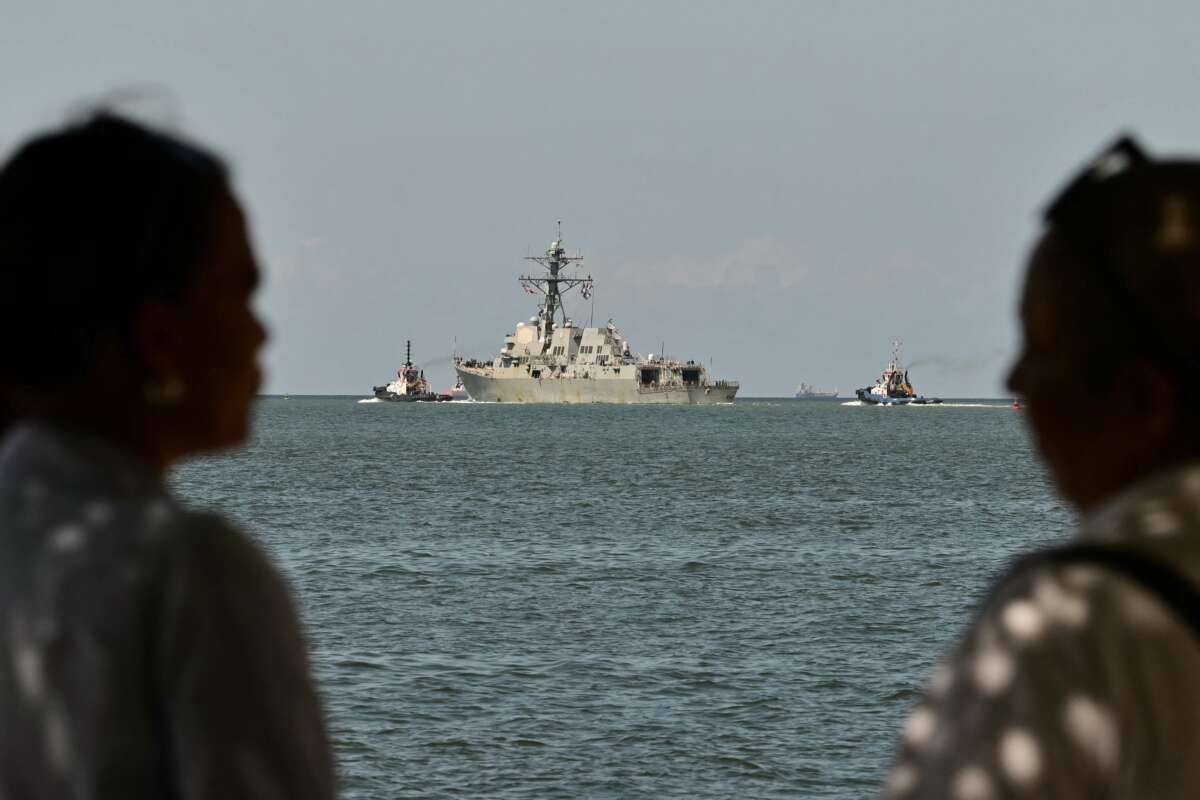
People watch the USS Gravely, a U.S. Navy warship, departing the Port of Spain on October 30, 2025. The warship arrived in Trinidad and Tobago on October 26, 2025, for joint exercises near the coast of Venezuela.
MARTIN BERNETTI / AFP via Getty Images

The tiny Caribbean island nation of Barbados — with a population roughly the size of Anchorage, Alaska, or Lincoln, Nebraska — might not be the country one would first imagine taking the lead to stand up to U.S. military actions and ambitions in the region. But as the Trump administration continues to attack boats, first in the Caribbean Sea and now in the Pacific, leaders in Barbados have been vocal.

“As a small state, we have invested tremendous time and energy and effort in establishing and maintaining our region as a zone of peace,” Barbados Prime Minister Mia Mottley said at a conference in late October. “Peace is critical to all that we do in this region, and now that peace is being threatened, we have to speak up.”

Mottley called on other leaders in the region to denounce the U.S. military buildup in the Caribbean and the U.S. strikes on more than 18 vessels that, as of November 7, had killed at least 70 people in the Caribbean and Pacific.

U.S. officials say these boats are carrying dangerous drugs like fentanyl and cocaine to the United States. They say the people killed on these boats are drug traffickers. They provide no evidence for these claims, and in fact, administration officials have also admitted that the military doesn’t identify the individuals on the boats before hitting them.

Ben Saul, the UN Special Rapporteur for the protection of human rights while countering terrorism, has called the attacks a “crime against humanity.”


Top DOJ Lawyer Claims Trump Doesn’t Need Congressional Approval for Boat Strikes
A DOJ lawyer told Congress that the strikes — which Trump says are in “self-defense” — don’t put troops in harm’s way.  By Sharon Zhang , Truthout  November 4, 2025


Family members of the victims who have been found say the people on the boats are just fishermen. They accuse the United States of flouting international law to push its military agenda in Latin America and the Caribbean.

“I believe that the time has come for us, therefore, to be able to ensure that we do not accept that any entity has the right to engage in extrajudicial killings of persons that they suspect of being involved in criminal activities,” said Mottley. “We equally do not accept that any nation in our region or the greater Caribbean should be the subject of an imposition upon them of any unilateral expression of force and violence by any third party or nation.”

Mottley is one of many of Caribbean leaders who have condemned the Trump administration’s actions. But there is also division, particularly due to the outsized role of the U.S. in the region.

On October 18, Mottley met with the leaders of the other Caribbean Community (CARICOM) member nations. They released a joined statement reaffirming the need for peace, dialogue, and the “unequivocal support for the sovereignty and territorial integrity of countries in the Region.”

“The fact that they’re speaking up is highly significant,” Alexander Main, the Director of International Policy at the Washington, D.C.-based Center for Economic and Policy Research, told Truthout. “These Caribbean governments are very reliant on the U.S. in a number of ways, economically, and have been in a vulnerable position, particularly since the passage of Hurricane Melissa in that area where U.S. help is badly needed.”

This week the U.S. State Department said the United States would provide $24 million in assistance to the Bahamas, Cuba, Haiti, and Jamaica, following the destruction wrought by the hurricane.

One CARICOM country, however, did not endorse the declaration against the U.S. strikes — Trinidad and Tobago. Prime Minister Kamla Persad-Bissessar has openly supported U.S. President Donald Trump and his actions in the region. She says Trinidad has been impacted by drug violence and Trump’s attacks are trying to make their country safe.

“He is committed to the fight against drug trafficking within our region. My Government will continue to support the US military drug interdiction exercises within the region,” Persad-Bissessar told the Trinidad Express.

The island of Trinidad is just off the coast of Venezuela — only 6.8 miles at its closest point.

The atmosphere in Trinidad is “tense,” Trinidadian journalist Soyini Grey told Truthout.

“We’re not accustomed to this type of war-like language and these actions,” she said. “So, narco strikes in the Caribbean is odd and bodies washing up on shores or citizens being killed — we had two of our citizens killed in, I believe, strike five. So, that has been very disquieting. And then, when we reach out to the prime minister for comment, she’s very evasive.”

Grey says schools were closed in the capital on October 31 and grocery stores were overrun with people trying to stock up when news reports suggested that U.S. strikes on Venezuela were imminent. Grey says the Trinidadian military went on high alert and troops were called to bases across Trinidad.


“U.S. government officials have committed a murder and violated our sovereignty in territorial water.”

While the attacks expected in those reports have yet to occur, recent actions from the U.S. besides the boat strikes have still given plenty of reason for an abundance of caution. In mid-October, Trump authorized the CIA to carry out covert action in Venezuela. He told reporters the U.S. was considering direct strikes on Venezuela.

“We are certainly looking at land now, because we’ve got the sea very well under control,” Trump said.

The United States has amassed an unprecedented number of ships and military assets in the region — reportedly the largest military buildup in the Caribbean since the 1962 Cuban Missile Crisis. When the aircraft carrier USS Gerald R. Ford — the largest warship ever built — arrives in the Caribbean, there will be over a dozen ships and more than 10,000 military personnel.

The Trump administration has labeled drug groups in the region as “foreign terrorist organizations,” in what legal experts say is an attempt to justify military action. Meanwhile, Trump has accused — again, without evidence — Venezuelan president Nicolas Maduro of being a narcotrafficking kingpin. He doubled a bounty on Maduro’s head to $50 million in August.

Maduro has denounced Trump’s threat of military operations in the country and accused Washington of “fabricating a war.”

The Venezuelan government was outspoken against the first boat attack. “But since then, it hasn’t exactly reacted,” Ricardo Vaz, a journalist in Venezuela with Venezuelanalysis told Truthout. “I think the government is really trying to avoid any kind of falling for provocations or unnecessarily escalating the rhetoric.”

For good reason — Trump has shown himself to be unpredictable. And the U.S. government has hit back against Latin American leaders who have denounced its campaign in the Caribbean and Pacific.


“Historically, the only way that Latin America has managed to stave off catastrophic U.S. intervention is to come together as a region, and we haven’t seen enough of that beyond rhetoric.”

In late September, the Trump administration revoked the U.S. visa of Colombian President Gustavo Petro. The revocation came after Petro spoke to protesters in New York City, encouraging U.S. soldiers to refuse orders from Trump. Last month, the United States further sanctioned Petro and his family. Trump has promised to cut off all U.S. aid to Colombia.

Petro has been one of the most outspoken voices against the U.S. military actions in the region, calling the boat attacks “murder.”

“U.S. government officials have committed a murder and violated our sovereignty in territorial water,” Petro posted on social media. He named one Colombian man, Alejandro Carranza, who was killed in a U.S. attack, calling him a “lifelong fisherman.”

In mid-October, Petro called on Latin American countries to “unite now to reject and react, beyond mere rhetoric, against any aggression against the homeland of Bolívar and the Latin American and Caribbean territory. Venezuela belongs to Venezuelans.”

“We’ve seen some really promising rhetoric and arguments expressed by Petro, but it’s not enough,” Alexander Aviña, an associate professor of Latin American history at Arizona State University and an expert on the drug war, told Truthout. “Historically, the only way that Latin America has managed to stave off catastrophic U.S. intervention is to come together as a region, and we haven’t seen enough of that beyond rhetoric.”

“I think also Mexico needs to be a lot stronger, more forceful in pushing back against what the U.S. is planning to do in the Caribbean, because eventually, it’s going to boomerang on them,” he said.

That boomerang now seems to be in motion. On November 3, news outlets reported the Trump administration was drawing up blueprints to send U.S. troops to combat drug cartels in Mexico— with or without the support of the Mexican government.

“The United States is not going to come to Mexico with the military,” President Claudia Sheinbaum had previously said in August. “We cooperate, we collaborate, but there is not going to be an invasion. That is ruled out, absolutely ruled out.”

Sheinbaum has also denounced the U.S. boat attacks, some of which have been hitting closer to Mexico.

On October 28, U.S. forces killed 14 people in four alleged “drug boat” strikes in the Eastern Pacific, roughly 400 miles from the Mexican city of Acapulco. Sheinbaum dispatched the Mexican navy to search for survivors.

“We do not agree with these attacks,” she said during her regular morning press conference. “We want all international treaties to be respected.”

But Main says Mexico is in a difficult position.

“Sheinbaum has definitely expressed her strong disagreement with these extrajudicial killings in the region,” said Main. “But they’re about to enter into renegotiation of the United States-Mexico-Canada agreement. They’re also negotiating the security cooperation with the U.S. and doing everything they can to avoid the U.S. violating their sovereignty in a significant way.”

The United States-Mexico-Canada Agreement (USMCA) was Trump’s renegotiation of the 1994 North American Free Trade Agreement. USMCA rolled out in 2020, but the trade deal goes under review every six years, and analysts say Trump is likely pushing for a hefty renegotiation ahead of the July 2026 deadline.

The Cuban and Brazilian presidents have also condemned the strikes. In Brazil, President Luiz Inácio Lula da Silva has offered to help mediate between Venezuela and the United States even as his own country is negotiating over its own trade war with the United States, after Trump slapped Brazil with a 50 percent tariff for bringing his ally former president Jair Bolsonaro to trial for plotting to carry out a coup.

Aside from leaders, there is popular movement across Latin America against the lethal U.S. actions in the Caribbean. People have protested in Cuba, Trinidad and Tobago, and Venezuela.

But the U.S. military push into the Caribbean comes at a time when the region is far from united. Trump allies like Argentina’s Javier Milei, El Salvador’s Nayib Bukele, and Ecuador’s Daniel Noboa have staunchly backed the U.S. lethal attacks on supposed “drug boats.”

Bukele and Noboa have alleged ties to drug groups and narcotrafficking.

“The problem is that, unlike the Pink Tide at the beginning of the 2000s, we now we have a South America that is not so ideologically cohesive,” Brazilian International Relations professor Camila Feix Vidal told Truthout, referencing the shift toward left-wing governments emblematic of that era. “So, it will be very difficult to have a regional unity to denounce this type of action.”

“I think that, once again, as we have seen throughout history, this shows that the United States is not reliable, and that it acts by force for its own ends.”