The United States Continues Its Attempt to Overthrow Venezuela’s Bolivarian Revolution
With rapid military escalation and a redeployed ‘War on Drugs’ narrative, the Trump administration appears to be laying the groundwork for an attack on the Venezuelan people.
by Vijay Prashad / November 8th, 2025
Children play on the beach during a security deployment in Anzoátegui, Venezuela, 19 September 2025. Credit: Rosana Silva R.
Since early September, the United States has given every indication that it could be preparing for a military assault on Venezuela. Tricontinental: Institute for Social Research partnered with ALBA Movimientos, the International Peoples’ Assembly, No Cold War, and the Simón Bolívar Institute to produce red alert no. 20, ‘The Empire’s Dogs Are Barking at Venezuela’, on the potential scenarios and implications of US intervention.
In February 2006, Venezuelan President Hugo Chávez travelled to Havana to receive the United Nations Educational, Scientific and Cultural Organisation’s José Martí Prize from Fidel Castro. In his speech, he likened Washington’s threats against Venezuela to dogs barking, saying, ‘Let the dogs bark, because it is a sign that we are on the move. ’ Chávez added, ‘Let the dogs of the empire bark. That is their role: to bark. Our role is to fight to achieve in this century – now, at last – the true liberation of our people.’ Almost two decades later, the empire’s dogs continue to bark. But will they bite? That is the question that this red alert seeks to answer.
The Sound of Barking
In February 2025, the US State Department designated a criminal network called Tren de Aragua (Aragua Train) as a ‘foreign terrorist organisation’. Then, in July, the US Treasury Department added the so-called Cartel de los Soles (Cartel of the Suns) to the Office of Foreign Assets Control’s sanctions list as a ‘transnational terrorist group’. No previous US government report, either from the Drug Enforcement Administration (DEA) or the State Department, had identified these organisations as a threat, and no publicly verifiable evidence has been offered to substantiate the claimed scale or coordination of either group. There is no evidence that Tren de Aragua is a coherent international operation. As for the Cartel de los Soles, the first time the name appeared was in 1993 in Venezuelan reporting on investigations of two National Guard generals – a reference to the ‘sun’ insignia on their uniforms – years before Hugo Chávez’s 1998 presidential victory. The Trump administration has alleged that these groups, working with Venezuelan President Nicolás Maduro’s government, are the primary traffickers of drugs into the US – while providing zero evidence for the connection. Moreover, reports from the UN Office on Drugs and Crime (UNODC) and the DEA itself have consistently found Venezuelan groups to be marginal in global drug trafficking. Even so, the US State Department has offered a $50 million reward for information leading to Maduro’s arrest – the largest in the programme’s history.
Members of the first cohort of the Tactical Method of Revolutionary Resistance (Método Táctico de Resistencia Revolucionaria, MTRR) course smile after completing training at the Commando Actions Group in Caracas, Venezuela, October 2025—credit: Miguel Ángel García Ojeda.
The US has revived the blunt instrument of the ‘War on Drugs’ to pressure countries that are not yielding to its threats or that stubbornly refuse to elect right-wing governments. Recently, Trump has targeted Mexico and Colombia and has invoked their difficulties with the narcotics trade to attack their presidents. Though Venezuela does not have a significant domestic drug problem, that has not stopped Trump from attacking Maduro’s government with much more venom. In October 2025, the Venezuelan politician María Corina Machado of the Vente Venezuela (Come Venezuela) movement won the Nobel Peace Prize. Machado was ineligible to run for president in 2024 largely because she had made a series of treasonous statements, accepted a diplomatic post from another country in order to plead for intervention in Venezuela (in violation of Article 149 of the Constitution), and supported guarimbas (violent street actions in which people were beaten, burned alive, and beheaded). She has also championed unilateral US sanctions that have devastated the economy. The Nobel Prize was secured through the work of the Inspire America Foundation (based in Miami, Florida, and led by Cuban American lawyer Marcell Felipe) and by the intervention of four US politicians, three of whom are Cuban Americans (Marco Rubio, María Elvira Salazar, and Mario Díaz-Balart). The Cuban American connection is key, showing how this political network that is focused on the overthrow by any means of the Cuban Revolution now sees a US military intervention in Venezuela as a way to advance regime change in Cuba. This is, therefore, not just an intervention against Venezuela, but one against all those governments that the US would like to overthrow.
A woman holds a rifle during a security deployment in the Petare neighbourhood of Caracas, Venezuela, 15 October 2025. Credit: Rosana Silva R.
The Bite
In August 2025, the US military began to amass naval forces in the southern Caribbean, including Aegis-class destroyers and nuclear-powered attack submarines. In September, it began a campaign of extrajudicial strikes on small motorboats in Caribbean waters, bombing at least thirteen vessels and killing at least fifty-seven people – without offering evidence of any drug trafficking links. By mid-October, the US had deployed more than four thousand troops off Venezuela’s coast and five thousand on standby in Puerto Rico (including F-35 fighter jets and MQ-9 Reaper drones), authorised covert operations inside the country, and flown B-52 ‘demonstration missions’ over Caracas. In late October, the USS Gerald R. Ford carrier strike group was deployed to the region. Meanwhile, Venezuela’s government has mobilised the population to defend the country.
A woman from the Peasant Militia (Milicia Campesina) holds a machete during her graduation as a combatant from the MTRR course, October 2025. Credit: Rosana Silva R.
Five Scenarios for US Intervention
Scenario no. 1: the Brother Sam option. In 1964, the US deployed several warships off the coast of Brazil. Their presence emboldened General Humberto de Alencar Castelo Branco, chief of the Army General Staff, and his allies to stage a coup that ushered in a twenty-one-year dictatorship. But Venezuela is a different terrain. In his first term, Chávez strengthened political education in the military academies and anchored officer training in defence of the 1999 Constitution. A Castelo Branco figure is therefore unlikely to save the day for Washington.
Scenario no. 2: the Panama option. In 1989, the US bombed Panama City and sent in special operations troops to capture Manuel Noriega, Panama’s military leader, and bring him to a US prison while US-backed politicians took over the country. Such an operation would be harder to replicate in Venezuela: its military is far stronger, trained for protracted, asymmetric conflicts, and the country boasts sophisticated air defence systems (notably the Russian S-300VM and Buk-M2E surface-to-air systems). Any US air campaign would face sustained defence, making the prospect of downed aircraft – a major loss of face – one Washington is unlikely to risk.
Scenario no. 3: the Iraq option. A ‘Shock and Awe’ bombing campaign against Caracas and other cities to rattle the population and demoralise the state and military, followed by attempts to assassinate senior Venezuelan leadership and seize key infrastructure. After such an assault, Nobel Peace Prize winner Machado would likely declare herself ready to take charge and align Venezuela closely with the US. The inadequacy of this manoeuvre is that the Bolivarian leadership runs deep: the roots of the defence of the Bolivarian project run through working-class barrios, and the military would not be immediately demoralised – unlike in Iraq. As the interior minister of Venezuela, Diosdado Cabello, recently noted, ‘Anyone who wants to can remember Vietnam… when a small but united people with an iron will were able to teach US imperialism a lesson’.
The commander general of the Bolivarian National Police, Brigadier General Rubén Santiago, holds a rifle with a sticker of Chávez’s eyes during a security deployment in Petare. Credit: Rosana Silva R.
Scenario no. 4: the Gulf of Tonkin option. In 1964, the US escalated its military engagement in the Vietnam War after an incident framed as an unprovoked attack on US destroyers off the country’s coast. Later disclosures revealed that the National Security Agency (NSA) fabricated intelligence to manufacture a pretext for escalation. The US claims it is now conducting naval and air ‘training exercises’ near Venezuelan territorial waters and airspace. On 26 October, the Venezuelan government said it had received information about a covert CIA plan to stage a false-flag attack on US vessels near Trinidad and Tobago to elicit a US response. Venezuelan authorities warned of US manoeuvres and said they will not give in to provocations or intimidation.
Scenario no. 5: the Qasem Soleimani option. In January 2020, a US drone strike ordered by Trump killed Major General Qasem Soleimani, head of Iran’s Quds Force. Soleimani was one of Iran’s most senior officials and was responsible for its regional defence strategy across Iraq, Lebanon, Gaza, and Afghanistan. In an interview on 60 Minutes, former US chargé d’affaires for Venezuela James Story said, ‘The assets are there to do everything up to and including decapitation of [the] government’ – a plain statement of intent to assassinate the president. After the death of President Hugo Chávez in 2013, US officials predicted that the project would collapse. Twelve years have now passed, and Venezuela continues along the path set forth under Chávez, advancing its communal model whose resilience rests not only on the revolution’s collective leadership but also on strong popular organisation. The Bolivarian project has never been a one-person show.
China and Russia are unlikely to permit a strike on Venezuela without pressing for immediate UN Security Council resolutions, and both routinely operate in the Caribbean, including joint exercises with Cuba and global missions such as China’s Mission Harmony 2025.
A member of the Juventud Socialista de Venezuela (Socialist Youth of Venezuela) shows a coin given to graduates of the MTRR course during a security deployment in La Guaira, Venezuela, October 2025. Based on the methods of Vietnamese General Võ Nguyên Giáp, the MTRR course is designed to train people with no prior military experience for possible guerrilla warfare. Credit: Rosana Silva R.
We hope that none of these scenarios come to pass and that the United States takes its military options off the table. But hope alone is not enough – we must work to expand the camp of peace.
Originally published on Tricontinental: Institute for Social Research
Vijay Prashad is an Indian historian and journalist. Prashad is the author of twenty-five books, including The Darker Nations: A People’s History of the Third World, The Poorer Nations: A Possible History of the Global South, and The Withdrawal: Iraq, Libya, Afghanistan, and the Fragility of U.S. Power Noam Chomsky and Vijay Prashad. Read other articles by Vijay, or visit Vijay's website.
The US has now struck 18 vessels and killed 70 people in its ongoing onslaught in the Caribbean and Pacific.
By Michael Fox ,
November 7, 2025
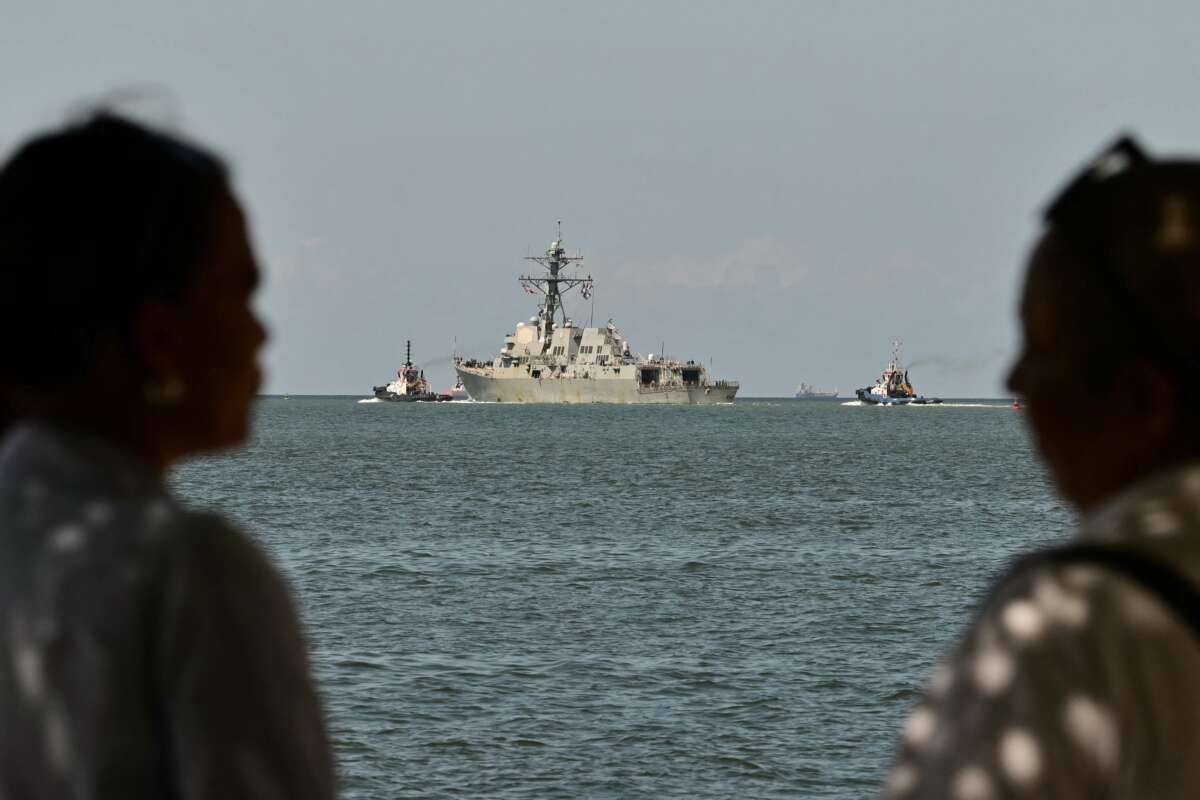
People watch the USS Gravely, a U.S. Navy warship, departing the Port of Spain on October 30, 2025. The warship arrived in Trinidad and Tobago on October 26, 2025, for joint exercises near the coast of Venezuela.
MARTIN BERNETTI / AFP via Getty Images
The tiny Caribbean island nation of Barbados — with a population roughly the size of Anchorage, Alaska, or Lincoln, Nebraska — might not be the country one would first imagine taking the lead to stand up to U.S. military actions and ambitions in the region. But as the Trump administration continues to attack boats, first in the Caribbean Sea and now in the Pacific, leaders in Barbados have been vocal.
“As a small state, we have invested tremendous time and energy and effort in establishing and maintaining our region as a zone of peace,” Barbados Prime Minister Mia Mottley said at a conference in late October. “Peace is critical to all that we do in this region, and now that peace is being threatened, we have to speak up.”
Mottley called on other leaders in the region to denounce the U.S. military buildup in the Caribbean and the U.S. strikes on more than 18 vessels that, as of November 7, had killed at least 70 people in the Caribbean and Pacific.
U.S. officials say these boats are carrying dangerous drugs like fentanyl and cocaine to the United States. They say the people killed on these boats are drug traffickers. They provide no evidence for these claims, and in fact, administration officials have also admitted that the military doesn’t identify the individuals on the boats before hitting them.
Ben Saul, the UN Special Rapporteur for the protection of human rights while countering terrorism, has called the attacks a “crime against humanity.”
The tiny Caribbean island nation of Barbados — with a population roughly the size of Anchorage, Alaska, or Lincoln, Nebraska — might not be the country one would first imagine taking the lead to stand up to U.S. military actions and ambitions in the region. But as the Trump administration continues to attack boats, first in the Caribbean Sea and now in the Pacific, leaders in Barbados have been vocal.
“As a small state, we have invested tremendous time and energy and effort in establishing and maintaining our region as a zone of peace,” Barbados Prime Minister Mia Mottley said at a conference in late October. “Peace is critical to all that we do in this region, and now that peace is being threatened, we have to speak up.”
Mottley called on other leaders in the region to denounce the U.S. military buildup in the Caribbean and the U.S. strikes on more than 18 vessels that, as of November 7, had killed at least 70 people in the Caribbean and Pacific.
U.S. officials say these boats are carrying dangerous drugs like fentanyl and cocaine to the United States. They say the people killed on these boats are drug traffickers. They provide no evidence for these claims, and in fact, administration officials have also admitted that the military doesn’t identify the individuals on the boats before hitting them.
Ben Saul, the UN Special Rapporteur for the protection of human rights while countering terrorism, has called the attacks a “crime against humanity.”

Top DOJ Lawyer Claims Trump Doesn’t Need Congressional Approval for Boat Strikes
A DOJ lawyer told Congress that the strikes — which Trump says are in “self-defense” — don’t put troops in harm’s way. By Sharon Zhang , Truthout November 4, 2025
Family members of the victims who have been found say the people on the boats are just fishermen. They accuse the United States of flouting international law to push its military agenda in Latin America and the Caribbean.
“I believe that the time has come for us, therefore, to be able to ensure that we do not accept that any entity has the right to engage in extrajudicial killings of persons that they suspect of being involved in criminal activities,” said Mottley. “We equally do not accept that any nation in our region or the greater Caribbean should be the subject of an imposition upon them of any unilateral expression of force and violence by any third party or nation.”
Mottley is one of many of Caribbean leaders who have condemned the Trump administration’s actions. But there is also division, particularly due to the outsized role of the U.S. in the region.
On October 18, Mottley met with the leaders of the other Caribbean Community (CARICOM) member nations. They released a joined statement reaffirming the need for peace, dialogue, and the “unequivocal support for the sovereignty and territorial integrity of countries in the Region.”
“The fact that they’re speaking up is highly significant,” Alexander Main, the Director of International Policy at the Washington, D.C.-based Center for Economic and Policy Research, told Truthout. “These Caribbean governments are very reliant on the U.S. in a number of ways, economically, and have been in a vulnerable position, particularly since the passage of Hurricane Melissa in that area where U.S. help is badly needed.”
This week the U.S. State Department said the United States would provide $24 million in assistance to the Bahamas, Cuba, Haiti, and Jamaica, following the destruction wrought by the hurricane.
One CARICOM country, however, did not endorse the declaration against the U.S. strikes — Trinidad and Tobago. Prime Minister Kamla Persad-Bissessar has openly supported U.S. President Donald Trump and his actions in the region. She says Trinidad has been impacted by drug violence and Trump’s attacks are trying to make their country safe.
“He is committed to the fight against drug trafficking within our region. My Government will continue to support the US military drug interdiction exercises within the region,” Persad-Bissessar told the Trinidad Express.
The island of Trinidad is just off the coast of Venezuela — only 6.8 miles at its closest point.
The atmosphere in Trinidad is “tense,” Trinidadian journalist Soyini Grey told Truthout.
“We’re not accustomed to this type of war-like language and these actions,” she said. “So, narco strikes in the Caribbean is odd and bodies washing up on shores or citizens being killed — we had two of our citizens killed in, I believe, strike five. So, that has been very disquieting. And then, when we reach out to the prime minister for comment, she’s very evasive.”
Grey says schools were closed in the capital on October 31 and grocery stores were overrun with people trying to stock up when news reports suggested that U.S. strikes on Venezuela were imminent. Grey says the Trinidadian military went on high alert and troops were called to bases across Trinidad.
“U.S. government officials have committed a murder and violated our sovereignty in territorial water.”
While the attacks expected in those reports have yet to occur, recent actions from the U.S. besides the boat strikes have still given plenty of reason for an abundance of caution. In mid-October, Trump authorized the CIA to carry out covert action in Venezuela. He told reporters the U.S. was considering direct strikes on Venezuela.
“We are certainly looking at land now, because we’ve got the sea very well under control,” Trump said.
The United States has amassed an unprecedented number of ships and military assets in the region — reportedly the largest military buildup in the Caribbean since the 1962 Cuban Missile Crisis. When the aircraft carrier USS Gerald R. Ford — the largest warship ever built — arrives in the Caribbean, there will be over a dozen ships and more than 10,000 military personnel.
The Trump administration has labeled drug groups in the region as “foreign terrorist organizations,” in what legal experts say is an attempt to justify military action. Meanwhile, Trump has accused — again, without evidence — Venezuelan president Nicolas Maduro of being a narcotrafficking kingpin. He doubled a bounty on Maduro’s head to $50 million in August.
Maduro has denounced Trump’s threat of military operations in the country and accused Washington of “fabricating a war.”
The Venezuelan government was outspoken against the first boat attack. “But since then, it hasn’t exactly reacted,” Ricardo Vaz, a journalist in Venezuela with Venezuelanalysis told Truthout. “I think the government is really trying to avoid any kind of falling for provocations or unnecessarily escalating the rhetoric.”
For good reason — Trump has shown himself to be unpredictable. And the U.S. government has hit back against Latin American leaders who have denounced its campaign in the Caribbean and Pacific.
“Historically, the only way that Latin America has managed to stave off catastrophic U.S. intervention is to come together as a region, and we haven’t seen enough of that beyond rhetoric.”
In late September, the Trump administration revoked the U.S. visa of Colombian President Gustavo Petro. The revocation came after Petro spoke to protesters in New York City, encouraging U.S. soldiers to refuse orders from Trump. Last month, the United States further sanctioned Petro and his family. Trump has promised to cut off all U.S. aid to Colombia.
Petro has been one of the most outspoken voices against the U.S. military actions in the region, calling the boat attacks “murder.”
“U.S. government officials have committed a murder and violated our sovereignty in territorial water,” Petro posted on social media. He named one Colombian man, Alejandro Carranza, who was killed in a U.S. attack, calling him a “lifelong fisherman.”
In mid-October, Petro called on Latin American countries to “unite now to reject and react, beyond mere rhetoric, against any aggression against the homeland of Bolívar and the Latin American and Caribbean territory. Venezuela belongs to Venezuelans.”
“We’ve seen some really promising rhetoric and arguments expressed by Petro, but it’s not enough,” Alexander Aviña, an associate professor of Latin American history at Arizona State University and an expert on the drug war, told Truthout. “Historically, the only way that Latin America has managed to stave off catastrophic U.S. intervention is to come together as a region, and we haven’t seen enough of that beyond rhetoric.”
“I think also Mexico needs to be a lot stronger, more forceful in pushing back against what the U.S. is planning to do in the Caribbean, because eventually, it’s going to boomerang on them,” he said.
That boomerang now seems to be in motion. On November 3, news outlets reported the Trump administration was drawing up blueprints to send U.S. troops to combat drug cartels in Mexico— with or without the support of the Mexican government.
“The United States is not going to come to Mexico with the military,” President Claudia Sheinbaum had previously said in August. “We cooperate, we collaborate, but there is not going to be an invasion. That is ruled out, absolutely ruled out.”
Sheinbaum has also denounced the U.S. boat attacks, some of which have been hitting closer to Mexico.
On October 28, U.S. forces killed 14 people in four alleged “drug boat” strikes in the Eastern Pacific, roughly 400 miles from the Mexican city of Acapulco. Sheinbaum dispatched the Mexican navy to search for survivors.
“We do not agree with these attacks,” she said during her regular morning press conference. “We want all international treaties to be respected.”
But Main says Mexico is in a difficult position.
“Sheinbaum has definitely expressed her strong disagreement with these extrajudicial killings in the region,” said Main. “But they’re about to enter into renegotiation of the United States-Mexico-Canada agreement. They’re also negotiating the security cooperation with the U.S. and doing everything they can to avoid the U.S. violating their sovereignty in a significant way.”
The United States-Mexico-Canada Agreement (USMCA) was Trump’s renegotiation of the 1994 North American Free Trade Agreement. USMCA rolled out in 2020, but the trade deal goes under review every six years, and analysts say Trump is likely pushing for a hefty renegotiation ahead of the July 2026 deadline.
The Cuban and Brazilian presidents have also condemned the strikes. In Brazil, President Luiz Inácio Lula da Silva has offered to help mediate between Venezuela and the United States even as his own country is negotiating over its own trade war with the United States, after Trump slapped Brazil with a 50 percent tariff for bringing his ally former president Jair Bolsonaro to trial for plotting to carry out a coup.
Aside from leaders, there is popular movement across Latin America against the lethal U.S. actions in the Caribbean. People have protested in Cuba, Trinidad and Tobago, and Venezuela.
But the U.S. military push into the Caribbean comes at a time when the region is far from united. Trump allies like Argentina’s Javier Milei, El Salvador’s Nayib Bukele, and Ecuador’s Daniel Noboa have staunchly backed the U.S. lethal attacks on supposed “drug boats.”
Bukele and Noboa have alleged ties to drug groups and narcotrafficking.
“The problem is that, unlike the Pink Tide at the beginning of the 2000s, we now we have a South America that is not so ideologically cohesive,” Brazilian International Relations professor Camila Feix Vidal told Truthout, referencing the shift toward left-wing governments emblematic of that era. “So, it will be very difficult to have a regional unity to denounce this type of action.”
“I think that, once again, as we have seen throughout history, this shows that the United States is not reliable, and that it acts by force for its own ends.”


No comments:
Post a Comment