The Hemispheric Presidency: Emergency Powers and the New US Doctrine in Latin America
IMPERIALIST PIRACY ON THE HIGH SEAS AGAIST FISHING BOATS
Trump’s emerging doctrine is anchored in the expansion of presidential authority, representing the full extension of the unitary executive theory or the imperial presidency into the sphere of foreign policy.
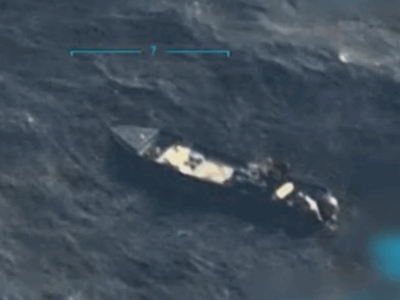
A video shared by Secretary of Defense Pete Hegseth shows a boat about to be struck in the Caribbean on November 6, 2025.
(Photo by Pete Hegseth/X/Screengrab)
Jose Atiles
Nov 08, 2025
The latest round of deadly boat strikes, which killed 3 people—bringing the total death toll to at least 70 since September—are confirmation that the second Trump administration has decisively refocused US foreign policy toward Latin America and the Caribbean.
Long treated as a secondary concern, including during President Donald Trump’s first term, when attention centered on China, the Middle East, and Eastern Europe, the region has returned to the forefront of US global strategy. But what is emerging is not a revival of Cold War containment or the Monroe Doctrine. It is the consolidation of a new US doctrine, one that aims to fuse emergency powers, economic warfare, and militarization into a unified hemispheric order.
‘We Have Lived This Nightmare Before’: Latin American Lawmakers Condemn Trump Extrajudicial Killings
Senate Dems Aim to Stop Trump ‘From Dragging This Country Into War’ With Venezuela
This emerging doctrine is anchored in the expansion of presidential authority. It represents the full extension of the unitary executive theory or the imperial presidency into the sphere of foreign policy, an effort to normalize executive unilateralism as the organizing principle of US governance at home and abroad. Trump’s approach reveals how emergency powers techniques, such as executive orders, emergency declarations, and budgetary discretion, are being implemented as instruments of foreign policy.
This realignment is only possible because of the profound transformations generated by the War on Drugs and the War on Terror, which over the last three decades expanded the legal and institutional capacity of the US executive branch to govern through permanent emergency. What began as exceptional counterinsurgency frameworks, asset seizures, sanctions, and military authorizations without congressional approval has evolved into the standard operating logic of the US government.
Under Trump, these tools have coalesced into a coherent hemispheric project.
Emergency powers serve as the connective tissue linking military strikes, financial bailouts, and sanctions into a coherent system of hemispheric governance.
The Trump administration’s foreign policy rests on a single assumption: that the president can act independently of Congress, international law, and long-standing diplomatic norms. This logic manifests through unilateral bailouts, economic and financial sanctions, and militarized interventions.
For instance, the Trump administration’s authorization of 17 direct boat strikes in the Caribbean illustrates how the administration treats military action as an extension of executive discretion. In a highly contested argument, the Trump administration has maintained that the president has the legal authority to carry out these attacks.
The attacks are against vessels allegedly linked to narcotics operations, though many lacked the capacity or cargo to justify the strikes. Some accounts note that the goal with these strikes is not interdiction, but provocation, using force to engineer confrontation and accelerate regime change in Venezuela.
The Caribbean, once imagined as America’s “backyard,” has become the theater where emergency powers are rehearsed as everyday statecraft.
The economic arm of this doctrine operates on the same logic. On October 17, the administration announced a $40 billion bailout for Argentine President Javier Milei, the self-styled “anarcho-capitalist” who wields a chainsaw as a symbol of his promise to “cut the state.” Half of the funds came from US public reserves and half from private investors, without congressional approval.
The measure was less about stabilizing Argentina’s economy than about underwriting a radical neoliberal experiment that mirrors Trump’s domestic agenda. Milei’s program, including privatizing pensions, slashing social services, and gutting labor protections, has been hailed in Washington as proof of “fiscal responsibility.”
But as Mother Jones revealed, hedge-fund billionaire Rob Citrone, who had recently invested heavily in Argentine debt, maintained close ties with Treasury Secretary Scott Bessent, raising questions about conflicts of interest and influence peddling.
In this context, the bailout secures a government ideologically aligned with Trumpism while reinforcing US financial dominance. More importantly, the US taxpayers’ bailout played a key role in Milei’s victory on October 26’s legislative elections, giving him a lifeline to address the economic stability exacerbated by Milei’s own policies. Thus, through the language of crisis management, the executive transforms financial rescue into a form of governance by decree.
The military dimension of this doctrine is even more telling. The Caribbean has become the primary stage for the remilitarization of US power and the enactment of presidential emergency authority abroad. In recent months, the Pentagon launched the largest regional deployment in decades.
In late October, the aircraft carrier USS Gerald R. Ford left the Croatian port of Split for the Caribbean, joined by seven other warships and dozens of fighter jets. More than 10,000 US troops are currently deployed in the area, half aboard naval vessels and half stationed in Puerto Rico. The deployment followed a series of military practices and intelligence operations aimed at destabilizing the government of Nicolas Maduro, all justified by executive authorizations and emergency powers.
Here, Puerto Rico plays a decisive role. The archipelago’s colonial status allows the administration to deploy forces, intelligence, and financial instruments beyond the constraints of congressional oversight. Its ports and bases have been reactivated as platforms for surveillance, drone operations, and logistics under the pretext of “regional security.” The remilitarization of the archipelago echoes the Cold War, when Puerto Rico served as the hinge for US interventions in the Dominican Republic, Grenada, and Central America. To its environmental, social, and politico-economic detriment, Puerto Rico has been placed at the center of the US intervention on Venezuela, Colombia, and other “enemies” of the Trump administration.
Parallel to the military buildup, the administration has expanded its economic warfare campaign across the hemisphere. Economic and financial sanctions on Venezuela have deepened, further debilitating its oil sector and currency circulation, while the Treasury has introduced new tariffs and sanctions on Brazil, Colombia, and Cuba. The coordination between the State Department and Treasury has transformed sanctions into weapons of punishment, instrumentalizing law to produce political compliance.
Furthermore, on November 5, the US Supreme Court heared arguments in a case on that could redefine the presidential emergency powers under the International Emergency Economic Powers Act (IEEPA). The case stems from President Trump’s use of IEEPA to impose sweeping global tariffs, actions he justified as responses to “unusual and extraordinary threats” to US national security and the economy. The court’s decision will determine whether the president can unilaterally wield emergency powers to reshape trade policy, bypassing Congress and potentially transforming emergency authority into a routine tool of governance.
These sanctions, tarrifs, and “boat strike” authorizations were issued through executive orders, bypassing both congressional approval and multilateral oversight. Emergency powers serve as the connective tissue linking military strikes, financial bailouts, and sanctions into a coherent system of hemispheric governance.
Within this architecture, Puerto Rico stands as the linchpin. Its colonial legal status allows Washington to merge colonial governance with global military reach. The archipelago is now both a financial enclave and a military platform, where the imperial presidency meets authoritarian neoliberalism.
Thus, what is emerging is a new doctrine of foreign policy based on emergency powers. This policy deploys tools once reserved for domestic crises to govern an entire hemisphere. Under Trump, Latin America and the Caribbean have become extensions of the US executive powers, managed through decrees, loans, and strikes, all justified as acts of necessity, all serving the same logic of control.
Our work is licensed under Creative Commons (CC BY-NC-ND 3.0). Feel free to republish and share widely.
Jose Atiles
Jose Atiles is an associate professor of Criminology, Law, and Society at the University of Illinois, a Public Voices fellow of the OpEd Project, and the author of “Crisis by Design: Emergency Powers and Colonial Legality in Puerto Rico,” which analyzes the role of law, emergency powers, and colonial structures in producing and exacerbating political and economic emergencies.
Full Bio >
US Strikes on Drug Smuggling Boats Prompt Warning for Commercial Ships

The U.S. on Friday, November 7, announced its latest strike on a small boat in the Caribbean believed to be smuggling drugs. It is the 17th reported strike, and as the U.S. continues its offensive, warnings are going out for the possible consequences for commercial shipping, which has already been used by the cartels to often unsuspectingly ferry the narcotics overseas.
The latest strike was announced online by Pete Hegseth, who said, “three male narco-terrorists were killed.” He continues to assert that these boats are “operated by a Designated Terrorist Organization,” while saying the strikes will continue until the groups stop smuggling drugs into the United States.
By the latest count, the U.S. has now destroyed 17 boats and one semi-submersible. The death count stands at 69 or 70 people, with only two or three people surviving the initial attacks.
While Hegseth continues to label the operators of the boats “narco-terrorists,” Associated Press issued a lengthy story piecing together the details on nine of the individuals after interviews in Venezuela. It concludes that the boats are drug runners, but mostly operated by ordinary individuals, and not the leaders of the cartels or gangs. They write that the men were crewing the boats for the first or second time and were laborers, a fisherman, a taxi driver, or low-level career criminals.
Global insurance company Gard, which bills itself as the world's leading provider of marine insurance and energy insurance, advises that cocaine smuggling is on the increase and cites data from the United Nations Office on Drugs and Crime reporting that cocaine flows to Europe have increased dramatically compared to North America. They highlight the need for vigilance and preventive measures in the shipping industry and call for fair treatment of crews when smuggled drugs are found in the cargo or aboard the ships.
“Use of the military against suspected drug smuggling boats by the current U.S. administration may also push more activity toward commercial vessels,” advised Gard. It notes that the high-risk areas for cocaine smuggling include Colombia, Ecuador, Peru, Mexico, Brazil, and Venezuela. “Patterns may change due to increased pressure by law enforcement, both by authorities in countries of production and countries where the drugs are found,” they advise.
Senior loss prevention specialists at Gard prepared a detailed analysis of the consequences of drug smuggling for the commercial shipping industry. The article warns that “rising cocaine production and evolving trafficking routes are creating serious risks for commercial vessels.”
They report that packages may be placed by rogue employees working for shipping companies or terminals, and that there have been reports of drug traffickers disguised as port officials and stevedores. The European authorities have also warned that ports have been infiltrated by the drug cartels.
“In Gard’s experience, cocaine trafficking using commercial vessels as unwitting ‘drug mules’ is increasing with the associated perils to crew and ship when drugs are found.” They report that most often the drugs are hidden in containers either with the cargo or in the structure, but have also been found in bulk cargoes. It also says that its experience shows there are only a small number of cases where drugs are discovered on board or attached to a vessel.
The U.S.’s high-visibility strikes came as the U.S. Coast Guard also reported it achieved a new record for cocaine seizures. The service maintains interdiction patrols in both the Caribbean and Pacific, which seize the boats and turn over the individuals for prosecution.
Opposition continues to the lethal strikes despite Donald Trump and Pete Hegseth saying they are necessary, legal, and will continue. Experts have noted that it stops only a small amount, and it does nothing to address the demand and addictions among the American public.
The U.S. Congress has also questioned the strikes and highlighted that it was not being briefed, and no evidence was presented to support the contention that the efforts were based on intelligence and known drug traffic routes. A Congressional briefing was conducted on November 5. It came after the Senate last month narrowly rejected a resolution calling for Congressional approval for the strikes in the Caribbean. On Thursday, November 6, the Senate also narrowly voted down a measure requiring military approval for any military action against Venezuela.
Hegseth wrote today on social media, “If you want to stay alive, stop trafficking drugs. If you keep trafficking deadly drugs – we will kill you.”
HMS Prince of Wales Fills Void in Mediterranean as USS Ford Heads West
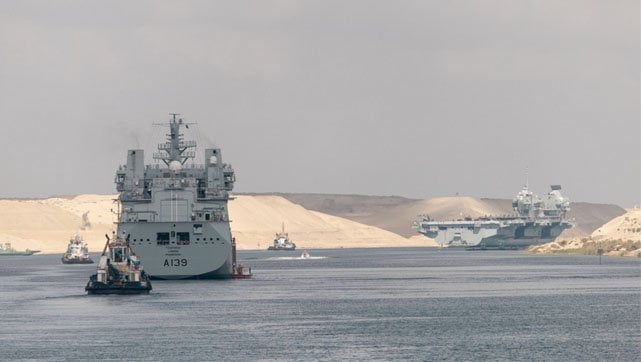
The UK carrier strike group (CSG) led by HMS Prince of Wales (R09) having transited the Suez Canal is now in the central Mediterranean and participating in the early phases of the Italian-led Exercise Falcon Strike 25. During a pause in Souda Bay, command of Prince of Wales was passed from Captain Will Blackett to Captain Ben Power, and the frigate HMS Richmond took the opportunity to conduct anti-submarine warfare with the Greek Navy.
Prince of Wales is now in the sea space vacated by USS Gerald R. Ford (CVN-78), which sailed through the Straits of Gibraltar and into the Atlantic on November 5, preceded by the Arleigh Burke Class guided missile destroyer USS Bainbridge (DDG-96) and the fast combat support ship USNS Supply (T-AOE-6). Ford has reportedly been ordered to head towards Venezuela, although online spotters have identified that she appears to be lingering near Africa.
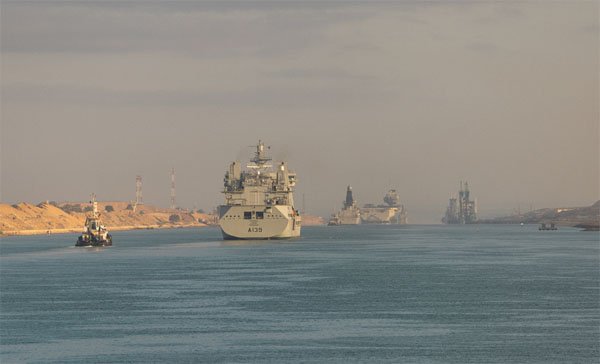
Task force heading through the Suez Canal (Sjøforsvaret - Norwegian Armed Forces)
The UK CSG now comprises Norwegian Nansen Class frigate HNoMS Roald Amundsen (F311), Type 45 destroyer HMS Dauntless (D33), Type 23 frigate HMS Richmond (F239), the Italian Carlo Bergamini Class frigate ITS Luigi Rizzo (F595) and the fleet resupply ship RFA Tideforce (A139). RFA Tideforce came through the Suez Canal from the Mediterranean into the Red Sea in order to support the CSG when it made the Suez transit.
Falcon Strike 25 is a two-week complex joint exercise involving both ground-based air and sea forces from Italy, Greece, Norway, the United Kingdom and the United States. For the exercise, Prince of Wales will for the first time have on board its full complement of F-35B aircraft, which will operate with Harrier aircraft from the Italian Navy.
Top DOJ Lawyer Claims Trump Doesn’t Need
Congressional Approval for Boat Strikes
A DOJ lawyer told Congress that the strikes — which Trump says are in “self-defense” — don’t put troops in harm’s way.
By Sharon Zhang ,
As the Trump administration blows past a key congressional deadline, a top lawyer in the Department of Justice has claimed that the executive branch does not need the approval of Congress to continue conducting boat strikes in and around the Caribbean — an assertion outside experts say is patently false.
Last week, Office of Legal Counsel T. Elliot Gaiser told a small group of members of Congress that the administration does not have to follow the 1973 War Powers Resolution and its mandate that Congress must approve of armed conflict conducted by the U.S.
The briefing was made just before the end of the 60-day deadline established by the legislation. The legislation requires the president to acquire approval for sustained military action within 60 days of an initial notification of actions. This deadline passed on Monday. Gaiser said that the administration is not going to seek approval or an extension of the deadline.
In an email to The Washington Post, a senior official said that strikes do not rise to the level of “hostilities,” as defined under the law.
The administration’s reasoning, it seems, is that “even at its broadest … [it] has been understood to apply to placing U.S. service-members in harm’s way,” and that the current engagement does not do so — even as the administration claims that the current operation is conducted in self-defense.
Related Story
Pentagon Admits to Striking Boats Without Identifying Victims’ Drug Links
The White House cannot “satisfy the evidentiary burden” to prosecute those they have been killing, one lawmaker said. By Chris Walker , Truthout October 31, 2025
“The operation comprises precise strikes conducted largely by unmanned aerial vehicles launched from naval vessels in international waters at distances too far away for the crews of the targeted vessels to endanger American personnel,” the email said.
Experts say this reasoning is patently wrong. Brian Finucane, senior advisor for the International Crisis Group’s U.S. program, pointed out that Congress has previously noted that the resolution purposefully used a broader term — “hostilities” — rather than a narrower term — “armed conflict.” This was so that it could encompass not just attacks, but also a “clear and present danger of armed conflict.”
Further, last month, Trump explicitly said that the administration was engaged in “armed conflict” in its boat strike campaign.
“[F]or the administration to claim U.S. forces are in an armed conflict but not hostilities would be nonsensical to those members of Congress who passed the legislation,” Finucane wrote for Just Security.
Officials’ assertion of control over war powers is a show of how the Trump administration seems to be shifting its legal reasoning on the fly to continue its strikes. Trump, for his part, appears unconcerned with legal reasoning, simply saying last month: “I think we’re just gonna kill people that are bringing drugs into our country, okay? We’re going to kill them.”
Trump administration officials are also purposefully withholding information from lawmakers. Last week, in a separate briefing, the administration excluded Democrats in a briefing with Senate Republicans on the strikes. And in briefings so far, lawmakers say the Pentagon has not provided lists of which gangs they’re targeting or the identities of those killed.
In fact, Rep. Adam Smith, the top Democrat on the House Armed Services Committee, told The New Republic that the administration said they are targeting anyone “affiliated” with “narco-terrorist” groups — and that the administration won’t even explain what constitutes an “affiliation.”
“They did not in any way, shape, manner, or form explain what the ceiling and floor are for ‘affiliated,’” Smith said. Smith added that the administration’s treatment of survivors of the strikes — all of whom so far have been repatriated to their home countries — underscores the illegality of the operations.
Smith says he told administration officials: “So what you’re telling us is you need less evidence to kill somebody than you do to hold them.”
Meanwhile, the operation is seemingly constantly on the verge of expanding into a ground war. Last week, Miami Herald and The Wall Street Journal reported that the U.S. is prepared to strike ground targets within Venezuela.
In response to these reports, President Donald Trump said their claims are “not true” — even though, just weeks before, Trump said that the administration is “certainly looking at land now” for strikes.
.png)

No comments:
Post a Comment