Sunday, December 14, 2025

Trump just took this giant step towards authoritarian rule — and the media ignored it

Jim Naureckas, 
Common Dreams
December 13, 2025
COMMENTARY


The Trump FBI is drawing up an enemies list that could encompass well over half the US public: Do you “advance … opposition to law and immigration enforcement”? Do you have “extreme views in favor of mass migration and open borders”? Show an “adherence to radical gender ideology,” meaning you think trans people exist? Do you exhibit (what the Trump administration would interpret as) “anti-Americanism,” “anti-capitalism,” or “anti-Christianity”? Do you display “hostility towards traditional views on family, religion, and morality”?

Congratulations — you may be headed for Attorney General Pam Bondi’s “list of groups or entities engaging in acts that may constitute domestic terrorism.”

“Terrorism,” of course, is the magic word that strips you of all sorts of legal protections, especially in the post-9/11 era.

This is from a Justice Department memo obtained by independent journalist Ken Klippenstein (12/6/25) — which goes on to instruct the FBI to set up “a cash reward system” for people who turn in those promoting such thoughtcrime, and “establish cooperators to provide information and eventually testify against other members” of groups with these dangerous ideas.

This is the implementation of the Trump administration’s avowed policy of criminalizing dissent — in the words of the NSPM-7 decree, outlawing “organized campaigns of … radicalization … designed to … change or direct policy outcomes” (FAIR.org, 10/3/25; CounterSpin, 10/17/25) — and as such is another giant step towards authoritarianism. Establishment media didn’t see it that way, however.

As Klippenstein (12/9/25) pointed out, virtually no corporate media outlets covered this catastrophic memo, and those who did report on it did a generally poor job.

The Guardian headline (12/5/25) was “Pam Bondi Tells Law Enforcement Agencies to Investigate Antifa Groups for ‘Tax Crimes,’” and Bloomberg Law (12/5/25) had “Bondi Orders FBI Extremism Intelligence Review with Antifa Focus” — completely misleading framing that suggests that if you’re not “Antifa,” the memo isn’t about you.

Here’s Reuters’ entirely unhelpful “summary” (12/4/25):Bondi orders FBI to prioritize domestic terrorism investigation


Memo targets antifa and similar groups

FBI to develop strategies to disrupt criminal networks

DOJ calls for prosecuting extremist groups for tax crimes

The DOJ is issuing marching orders for a witch hunt, and Reuters presents it with a straight face as an effort to go after “domestic terrorism,” “criminal networks,” and “extremist groups” who commit “tax crimes.” Who could object to that?

Among corporate media outlets, only The Hill (12/5/25), a specialty outlet aimed at congressional staffers and lobbyists, conveyed the enormity of the directive. Its second paragraph read:
Bondi’s memo could be the starting point for charges against a number of left-leaning advocacy groups and nonprofits the Trump administration has accused without evidence of having ties to extremists.

The Hill‘s Rebecca Beitsch quoted Andrew Bataj of the group Whistleblower Aid: “This memo expressly seeks to redefine political dissent against the president as domestic terrorism.”

But beyond that, to get actual coverage of the threat DOJ is posing to civil liberties and democracy itself, you had to go to independent outlets like Democracy Now! (12/8/25) and the Lever (12/8/25). The counterrevolution will not be televised.


Jim Naureckas is editor of FAIR (Fairness & Accuracy In Reporting). He is the co-author of "Way Things Aren't: Rush Limbaugh's Reign of Error." He was an investigative reporter for In These Times and managing editor of the Washington Report on the Hemisphere.
Trump's illegal plot could force US troops to make an unthinkable choice

 Common Dreams
December 12, 2025 


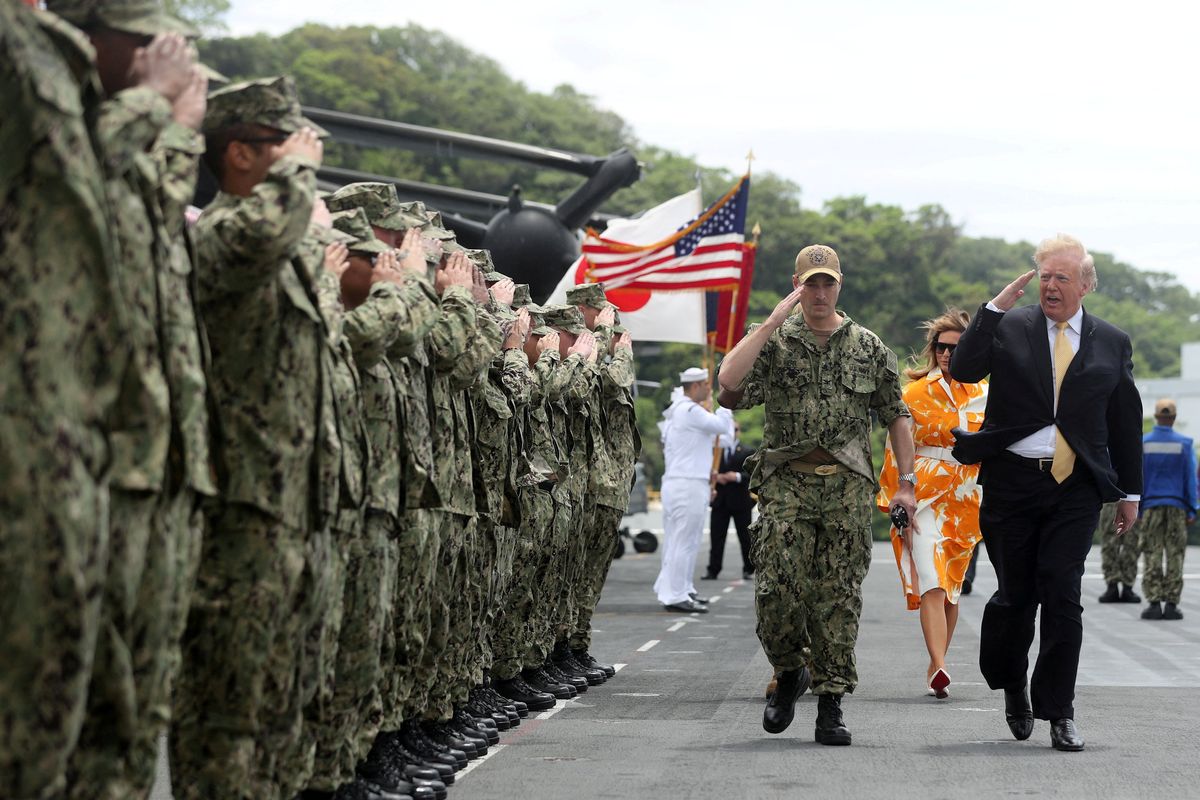
Donald Trump salutes troops aboard the USS Wasp in Yokosuka, south of Tokyo, in 2019. REUTERS/Jonathan Ernst

Every man and woman who enlists in the United States Armed Forces raises their right hand and swears a solemn oath. It is a ritual of profound transformation, marking the passage from private citizen to guardian of the Republic. Yet buried within the cadence of those familiar words lies a paradox that has haunted battlefields from the Ardennes to the Euphrates. We swear to obey the orders of officers appointed over us, yes — but first, we swear to support and defend the Constitution of the United States.

That order of precedence is not accidental. In the American military tradition, loyalty to principles supersedes loyalty to any person, rank, or administration. This hierarchy of allegiance creates the most difficult, perilous, and essential duty a service member holds: the duty to refuse an unlawful order.

Today, that duty is no longer theoretical. When political leaders announce intentions to “soon” strike Venezuela on land, they are not merely rattling sabers — they are proposing an act that would be illegal under both US law and international law.

The Constitution vests Congress, not the president, with the authority to declare war. Absent congressional authorization, a unilateral ground invasion would be unconstitutional. Under the United Nations Charter, such aggression would also violate international prohibitions against war absent self-defense or Security Council approval. To obey such a command would not be discipline; it would be complicity in a crime.

The Uniform Code of Military Justice (UCMJ) is explicit. Article 90 requires obedience only to lawful orders. This distinction is the firewall between a professional military and a Praetorian Guard or armed mob. A lawful order relates to military duty and promotes the well-being of the unit. An unlawful order — one that directs a crime, violates the laws of war, or targets civilians — is not an order at all. It is a solicitation of conspiracy. To obey such a command is not fidelity to the oath; it is betrayal of it.

The ghost of Nuremberg hangs over every discussion of this duty. Following World War II, the United States led the world in establishing that “I was just following orders” is no defense for atrocities. We hanged men who claimed they were merely cogs in a machine of state violence. We cannot, morally or legally, hold our enemies to a standard we refuse to apply to ourselves. If we demand recognition of human rights, our own bayonets must be clean.

We have our own examples of this precipice. In 1968, amid the horror of My Lai, Warrant Officer Hugh Thompson Jr. saw American troops slaughtering unarmed Vietnamese civilians. He did not follow the flow of the operation. He landed his helicopter between villagers and advancing Americans, ordering his gunners to fire on his countrymen if they continued the massacre. Thompson was treated as a pariah for years, but today he is recognized as a paragon of military ethics. He understood his oath was not to the madness of the moment, but to the enduring values of the nation he served.

We must acknowledge the terrible weight this places on the individual soldier, marine, sailor, or airman. In the fog of war, where adrenaline spikes and intelligence is imperfect, distinguishing lawful from unlawful orders is agonizing. A soldier is trained to react instantly; hesitation is often synonymous with death. Asking a 19-year-old lance corporal to act as a constitutional jurist in the heat of battle is an immense demand.

Yet it is a necessary one. The complexities of modern conflict — counterinsurgency, urban warfare, domestic support operations — blur the lines between combatant and civilian. In these gray zones, the moral compass of the individual service member is often the only safeguard against atrocity.

Furthermore, domestic political turmoil raises the stakes. Should the military ever be called upon to act on American soil in ways that violate constitutional rights, the “duty to refuse” moves from theory to the final safeguard of democracy. The Founding Fathers feared a standing army for this reason; they mitigated that fear by tethering loyalty to law, not leaders.

We must train for disobedience as rigorously as we train for obedience. Troops must understand that refusal to violate the law is not mutiny, but fidelity. A military that follows orders without question is a weapon that can be turned against the very people it was built to protect. A military that thinks, judges, and holds the law above rank is the shield of a free republic.

The uniform does not silence conscience. When the order comes to cross the line — to torture, to target the innocent, to invade a sovereign nation without lawful authority — the American soldier has a duty to stand firm, look their commander in the eye, and say, “No.”

In that moment, they are not breaking ranks. They are keeping the faith.Nile Stanton was a professor for the University of Maryland University College for 20 years, both online and in five European countries. All of his students were active duty members of the US armed forces. During that period, he taught 32 iterations of the advanced course called "Law, Morality, and War." He learned a few things from the troops.


  • Nile Stanton was a professor for the University of Maryland University College for 20 years, both online and in five European countries. All of his students were active duty members of the US armed forces. During that period, he taught 32 iterations of the advanced course called "Law, Morality, and War." He learned a few things from the troops.
Trump's lurch into naked piracy shows the danger of oil but we still have a way to beat it

Common Dreams
December 13, 2025


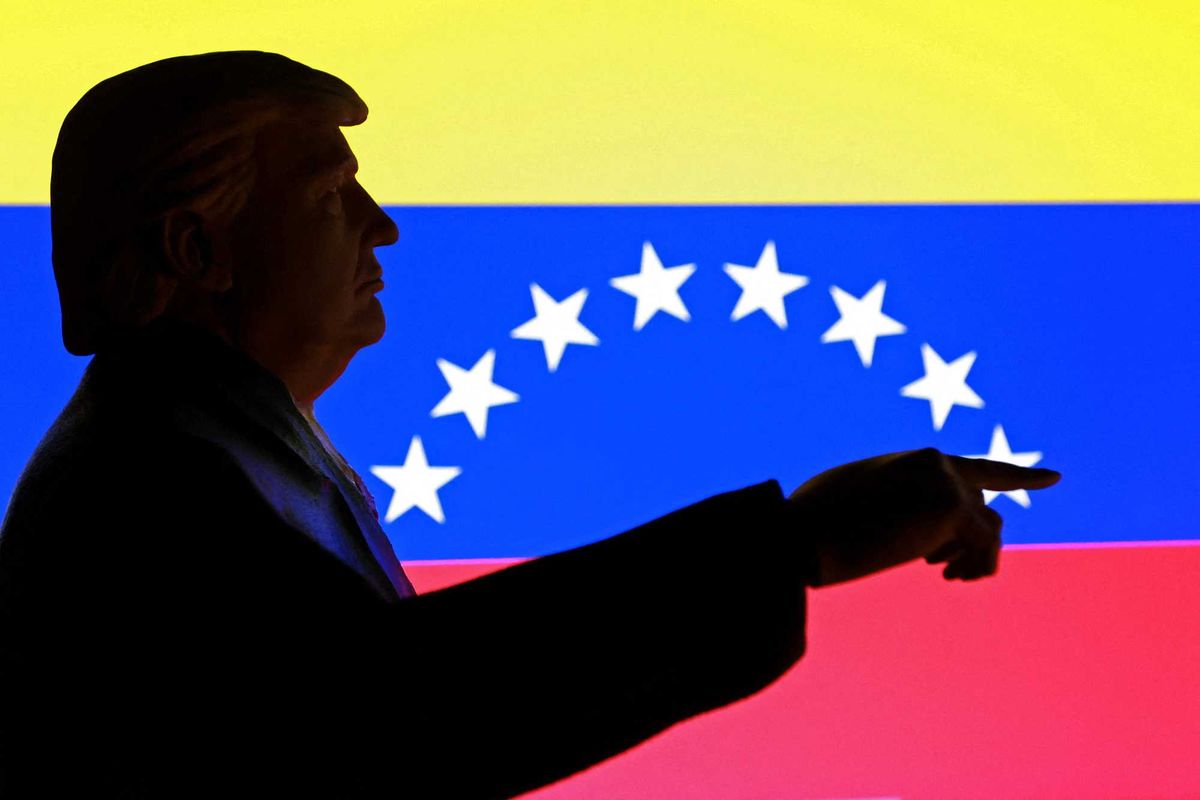
A 3D-printed miniature model depicting Donald Trump appears in front of Venezuelan flag. REUTERS/Dado Ruvi


I don’t know enough maritime law to tell you exactly why it’s wrong for America to be dropping troops onto tankers to seize them — just to say that, no matter what legalistic excuse the administration cooks up, it looks exactly like being a pirate. (It’s worth remembering that the US Navy was founded largely to take on piracy, and thanks to the Barbary corsairs, the early Americans had a lot to say about the subject. George Washington, for instance: Pirates are “enemies to mankind.”)

But I can tell you this. In the ever-shrinking mind of our current president, the reason why it’s good to seize a tanker is because it carries oil, and oil is the source of all strength, his contemporary equivalent to pieces of his eight. It’s “a large tanker, very large,” Mr. Trump explained, continuing (inevitably) to describe it as “the largest one ever seized actually.” When asked what would happen to the cargo, he said, “I assume we’re going to keep the oil.”

Oil is, and always has been, at the center of our concerns with Venezuela, which has the world’s largest proven reserves (though much of it is in the incredibly dirty and hard-to-recover form of tarsands). At the moment it’s a major supplier to China, and it claims sovereignty over a major oil field in Guyana which has attracted big investment from Exxon and Chevron.

So if you wonder why we’ve been attacking “drug boats” from Venezuela on the grounds that they’re carrying fentanyl, which Venezuela does not produce, that may give you some sense. Indeed the pressure has been so intense that the Maduro government in Caracas apparently offered to essentially turn over its oil and mineral resources to America in October negotiations. We’ve apparently decided we’d rather just take them.

This kind of coercion on behalf of the hydrocarbon industry is becoming old hat for the Trump administration. It’s used tariff policy, for instance, to force country after country to agree to buy huge quantities of American liquefied natural gas. As CNBC reported last spring regarding one deal with the EU:

“They’re going to have to buy our energy from us, because they need it,” Trump told reporters at the White House. “We can knock off $350 billion in one week,” the president said. The European Union faces a 20 percent tariff rate if it does not reach a deal with Trump.

(Justin Mikulka has a pointed take on why this strategy won’t work for the LNG industry, and new data emerged this week showing just how badly it is going to penalize Americans who depend on propane for heating, since they’re now competing with so many other places for our supply of natural gas).


And of course in another sense we’ve been pirating the atmosphere for more than a century, filling up what is a common property with our emissions — America got rich burning fossil fuels, and the main result for other countries will be an ever higher temperature.

But for the moment let’s just think about the flow of oil, because it’s been behind, in large part, so much of the geopolitical tension of the last hundred years. Japan’s quest for oil played some real role in the attacks on Pearl Harbor; Germany invaded the USSR in no small part to secure the oil fields of the Caucasus. The Suez crisis hinged on the transport of oil to Europe. OPEC seized on our thirst for oil as a powerful weapon in the 1980s, and America’s determination to keep oil flowing has determined much of our global stance in the postwar years — I’ll never forget a sign I saw at an early demonstration against the war in Iraq: “How did our oil end up under their sand?”

The point here is that conflict like this is probably inevitable as long as the world depends on an energy source that is available only in a few places. Control of those places becomes too important — you end up with oligarchs, and with people who want to topple them.

So how nice to imagine a world where location doesn’t matter — where instead we depend on energy from the sun and the wind, available everywhere. In the crudest terms, it’s going to be difficult to fight a war over sunshine. No one will ever seize a tanker to get at its supply of solar energy. Which is good news for everyone except those profiting from the current paradigm — Trumpism represents its dying twitches, but obviously those twitches can do great damage.

Yes, we need sun and wind power to take a bite out of the climate crisis. But we also need it to take a bite out of the authoritarianism crisis. Our job is to make this transition happen faster; every new solar panel erodes just a little bit the logic of oil imperialism. The push for clean energy is the push for peace.
Why Syria needs better governance...and a new kind of opposition


Saturday 13 December 2025, by Joseph Daher


Large rallies in support of Syria’s ruling authorities were organised last month across various cities controlled by Ahmed al-Sharaa’s government. Whilst they were presented as demonstrations ‘against division’ and for the unity of the country, sectarian slogans were heard amongst protesters.

It was a similar case for the massive demonstrations celebrating the first anniversary of the Assad regime’s fall. These events highlight the country’s obvious political and socio-economic fragmentations today.

Since the ousting of the former Syrian regime, the political transition has served as an opportunity for the current ruling authorities, led by Hay’at Tahrir Sham (HTS), to consolidate their power over political and economic institutions. In these months, grave human rights violations have took place under their watch, notably the coastal and Sweida massacres. And, the leadership’s pursuit of neoliberal and austerity measures have resulted in high levels of poverty continuing across the country.

It is unsurprising that it is within such a context that protests demanding democratic and socio-economic rights have been on the rise in recent months.
Security, democracy and inclusion

Recently, sections of the Alawite communities protested the ongoing violations that they’ve been subject to since the fall of Assad. They called for security, particularly against continuous killings and kidnappings (particularly of women), federalism, and denounced the disproportionate arbitrary layoffs that they’ve experienced at the hands of state administrations, as well as the high cost of living.

In fact, Ghazal Ghazal, the head of the Alawite Islamic Council in Syria and Diaspora, called for a boycott of the celebrations marking the fall of the former regime, and urged Alawites to stay home during a "general strike" from December 8-12 to protest against the “new oppressive regime”.

Similarly in Sweida, there are ongoing demonstrations opposing the grave human rights violations that were committed by the ruling authority and its affiliated armed groups against civilians since the summer. Alongside the killings, the population has been victim to the abduction (particularly of women), and forced displacements, often on sectarian grounds.

Meanwhile, Kurdish national rights remain ignored – even at times rejected – by the ruling authorities. Furthermore, negotiations with the Autonomous Administration in North and East Syria (AANES) during what is supposed to be a process of integration with Damascus, have reached a deadlock over disagreements regarding military, civil and economic matters.

More generally, the ruling authorities have taken measures to strengthen their control over society, including by trying to reduce democratic rights.

In recent months, local authorities have not hesitated to impose restrictions on the organisation of political conferences. While these measures were mostly informal initially, thing are slowly being set into stone. For example, in November, the Syrian Ministry of Tourism issued a circular requesting tourist establishments refrain from hosting any events or conferences of a political nature without prior approval from the General Secretariat for Political Affairs.

This has meant that the General Secretariat for Political Affairs – which was only established by the Ministry of Foreign Affairs following the fall of Assad – now has extended powers, including monitor political activities.

In some cases, there’s been an outright cancellation of events, like the Political Thought: Necessity or Not? seminar that was organised for November by former political prisoner Aslan Abdel Karim. Local authorities claimed that this was because the association organising the conference was unlicensed, but the law allows associations that have applied for a license (which was the case here), to continue their activities until a final decision is made.

Similarly, in mid-October, numerous Syrian organisations and associations criticised the directive of the Minister of Social Affairs and Labour over her approach to NGOs. They accused her of using practices, “based on a repressive Associations Law that was long used by the previous regime to curb NGO activities, prosecute their members, and imprison them”.

This has added to wider questions about restrictions to freedom of expression that have been witnessed. Whilst, certainly, local and international press have had much more freedom to operate in Syria since Assad’s fall, there have nevertheless been reported attacks on researchers and journalists.

Just last month, Syrian activist and political researcher Laith al-Zoubi was imprisoned and tortured by authorities, this was without any issuing of an arrest warrant or referral to the judiciary.
Protest

The country’s growing socio-economic challenges have been increasingly met with criticism towards government policies from Syrians. Other than their desire to accumulate capital in large luxurious real estate projects, no reconstruction policy or plan has been put forward by the current ruling authorities. And the people are clearly not happy.
Related

Some have even taken to demonstrating against real estate projects like that of Kuwait-based Al-Omran Real Estate Development Co. (owned by a Syrian businessman). The “Boulevard of Victory” urban development initiative in Homs, was the target of local protest that saw people holding banners reading: “No boulevard, no to displacement ”. A comparison was even made to the ‘Home Dream’, an urban redevelopment plan that was devised under Bashar al-Assad.

The organised action led the company to announce it would cancel the part of its plan that ran through the contested neighbourhood.

In education, teachers went on strike for several weeks and demonstrated in front of government institutions in Aleppo and Idlib, under the slogan "The movement continues until our demands are met,". They are demanding permanent employment, the swift reinstatement of those who were sacked, and salary increases that match the soaring cost of living.

Strike were also organised by minibus drivers in Damascus, as well as workers at private company Madar Aluminum, demanding better working and living conditions.

This month, employees of the port of Tartous staged a sit-in in front of the governorate building to protest their transfer – which they were informed about via WhatsApp and without any prior knowledge – to distant locations in Jarablus and al-Bukamal border crossings in the Eastern governorates.

Additionally, with a massive increase in electricity tariffs many across the country expressed their anger, and in cities like Salamiyeh and Homs, demonstrations were called. Electricity prices could potentially increase from an exorbitant 3000% to 6000% in each household, assuming a continuous supply of electricity.

Ultimately, whatever the level of the rise, many will be forced to ration their electricity consumption, and more broadly this will result a new rise in inflation rates.

Despite the rise of the minimum wage since the end of July (to $68 per month), the majority of the population, whether employed by the state or the private sector, cannot cover their needs with their salaries. According to estimates made by Qasioun, at the end of September the minimum cost of living for a five-member Syrian family living in Damascus reached around $645. And, large sections of society are dependent on the remittances which are sent by loved ones abroad.

The response by the Minister of Finance, has been to announce an increase to salaries (by 200%), of workers in the health and education sectors. However, this potential future rise is still insufficient to alleviate a struggling population and counter the constant increase in the cost of living.

In this context, and as we mark the first anniversary since Assad’s fall, it is crucial that any authoritarian practices by the new ruling authorities are opposed. Simultaneously, an economic project that strives to achieve social justice, redistributes wealth, and implements a reconstruction process that benefits most of the population, must be built.

What Syria urgently requires as global media and leaders engage in debates over its future, is an alternative political project that combines democratic, social, and economic rights, and fosters cooperation and collaborations among various protest movements and more generally the larger Syrian population in all its diversity.

9 December 2025

Source: The New Arab.

Attached documentswhy-syria-needs-better-governance-and-a-new-kind-of_a9311.pdf (PDF - 921.7 KiB)
Extraction PDF [->article9311]

Syria
Syria’s future won’t be secure through Israel normalisation
Suweida Under Fire: The Consolidation of Power in Damascus, and Sectarianism
Syria and the Dangers of Playing with Fire
Three Requisites for Syria’s Reconstruction Process
Syria: Fishing in Troubled Waters

Joseph Daher is a Swiss-Syrian academic and activist. He is the author of Syria After the Uprising: The Political Economy of State Resilience (Pluto, 2019) and Hezbollah: The Political Economy of Lebanon’s Party of God (Pluto, 2016), and founder of the blog Syria Freedom Forever. He is also co-founder of the Alliance of Middle Eastern and North African Socialists.

NATO Rutte’s Berlin Speech: Not About Russia, but About the End of Rational Politics

And how it made me think of Hitler


Inside NATO’s cathedral of fear, weapons become sacraments and projection becomes liturgy. From the stained-glass altar, thunderous light strikes Russia and China — not as analysis, but as ritual. This is not about Putin. It is about the West’s collapse into psycho-political theatre.

Mark Rutte’s Berlin speech in December 2025 has been hailed as a wake‑up call for NATO. But the deeper truth is this: Rutte’s speech is not about Russia and China at all. It is about NATO itself, and about the fundamental transformation of politics into psycho‑political theatre where rational policy has become impossible. The “red threat” he invoked is less an empirical reality than a stage device in a liturgical performance.

From Policy to Performance

Compared with a good month ago, Rutte’s purpose is alarm/urgency instead of agreement/consensus. His tone is existential/dramatic instead of pragmatic/institutional. His focus was on the survival of Europe instead of the credibility of NATO, and hinting that more than 5% of GNP may be needed. His threat perception is now that “Russia is already at our doorstep,” and that China is behind it, where it was a more general enemy image and Ukraine focus in November 2025. Significantly and amateurishly, he condescendingly calls Putin “this guy.” These are very significant escalatory changes.

Watch the full speech here, delivered about 13 minutes after that of the German foreign minister, Wadephul, which is an intellectual bottom feeder in poor English. And here is NATO’s transcript of Rutte’s speech, should you prefer to study it more closely.

Politics once meant rational calculation: weighing interests, negotiating compromises, balancing costs and probabilities. That paradigm has collapsed. In its place stands a new order: politics as performance. Leaders no longer persuade with evidence; they dramatise with sermons. Rutte’s Berlin speech exemplifies this shift. His words were not analytical but eschatological: “Russia is already at our door. NATO and Europe could be Putin’s next target.” This is not policy analysis; it is liturgy. (See postscript below, too).

NATO as Church

The speech revealed NATO’s metamorphosis into a church‑like institution.

  • Doctrine: NATO embodies goodness; Russia embodies evil.
  • Congregation: The Military‑Industrial‑Media‑Academic Complex, MIMAC, creates and repeats the creed.
  • Rituals: Summits, communiqués, budget votes, press conferences, and speeches function as sacred ceremonies.
  • Eschatology: The apocalypse — Russia’s attack — is always imminent, never arriving, sustaining endless vigilance and ever-increasing military expenditures, never peace. It is not the purpose.

In this church, Rutte plays the priest. His sermon is not about Russia’s actual capabilities or intentions; it is about reaffirming NATO’s faith in its own innocence and moral superiority. The congregation responds with offerings: pledges of 5% GDP for defence, tithes to the military‑industrial altar. More about NATO as church in my 2022 abolish NATO analysis.

Psycho‑Pathological Rhetoric

Rutte’s rhetoric falls squarely into a tradition that includes Saddam Hussein, George W. Bush, and Adolf Hitler. Each claimed to be surrounded by enemies, each insisted on the necessity of defence, and each justified aggression by projecting evil onto the other side. The formula is always the same: we are threatened all the way around, and we must defend ourselves — no matter the reality.

Hitler invoked Versailles and “Jewish Bolshevism” to justify expansion. Saddam invoked imperialism and Zionism to justify repression and war. Bush invoked weapons of mass destruction to justify the invasion. Rutte invokes Putin to justify NATO’s expansion and militarisation. The psycho‑pathological script is identical: paranoia, projection, eschatology, and self‑sanctification.

And here lies the danger: there is an increasing risk that the Rutte‑type of performance, whether intended or not, will have the same consequence for Europe as Hitler’s did. Once politics becomes theatre of paranoia, escalation is not a possibility but a destiny.

The Absurd Stage

The absurdity of this transformation is striking. It resembles Ionesco’s The Chairs, where the stage fills with empty chairs until there is no room left for the characters themselves. In NATO’s theatre, the “chairs” are weapons, budgets, and warnings — multiplying endlessly until politics itself disappears. The room is filled with arsenals, slogans, and rituals, leaving no space for rational analysis or genuine diplomacy.

Groupthink thrives in this closed theatre. Leaders, media, and academics repeat the same refrains, trapped inside the box of paranoia. The more they echo each other, the less reality intrudes. The absurdity is not comic but tragic: a self‑reinforcing ritual that consumes substance and replaces it with performance.

The Red Threat as Stage Device

The “red threat” is not a description of Russia’s actual power. NATO remains technologically superior, vastly richer, and more expansive than Russia. Yet Rutte insists NATO is fragile, vulnerable, at risk of annihilation. This inversion of reality is the hallmark of absurd theatre: the stronger actor plays the victim, the weaker is cast as omnipotent aggressor. The red threat is a stage device, a prop that sustains the liturgy of fear.

Why Politics Has Changed

Readers will ask: Why has politics changed so dramatically? The answer lies in the decline of the West itself. The United States, NATO, and the European Union are facing the long arc of imperial exhaustion. Economic stagnation, social fragmentation, and geopolitical overreach have eroded confidence. As substance weakens, performance intensifies. The sermon replaces the policy because the empire no longer has coherent strategies to offer.

Rutte’s speech is therefore not only a symptom of NATO’s paranoia but of the West’s decline. The liturgical theatre of threat and innocence is the last refuge of a system that senses its own fragility. The louder the sermons, the weaker the empire beneath them.

The Existential Change

The tragic fact is that Rutte’s speech demonstrates the end of rational politics. There is no longer space for cohesive, analytical policy. What remains is performance: sermons of paranoia, rituals of spending, choruses of media repetition. Politics has mutated into psycho‑religious theatre, where leaders preach, congregations respond, and the apocalypse is always imminent.

Thus, the speech is not about Russia and China at all. It is about NATO’s transformation into a church of paranoia and projection in which the sermon itself is the policy. The red threat is not a geopolitical reality but a liturgical necessity. And in this theatre — absurd, pathological, and imperial in decline — substance has vanished; only performance remains.

Post‑script

The tragic transformation of politics described above makes it rather meaningless for an organisation like TFF to continue publishing rational analyses, as if today’s world were still guided by reason, concepts from peace research, international relations, or political science. With few exceptions, the omnipresent geo‑politico‑military day-to-day commentators do not seem to have noticed this change and speak now into a vacuum — into something that once existed but no longer does.

As TFF turns 40 on January 1, 2026, we therefore move in new directions – or do the same with new means and perspectives: toward idea‑producing visions and conceptual innovations that humanity will need in the multi‑nodal, networking world that will emerge after the fall of the US/Western empire and its institutions.

Our basic mission remains the same: Promoting the UN norm of making peace by peaceful means. But either you adapt the methods and perspectives to the ways of the world or you perish – or stop. TFF does not stop. We believe in the fundamental – superior – values of nonviolence, educated conflict-management and peacemaking over primitive and kakistocratic urges of militarism and pathological war-mongering in the name of fake peace.

Jan Oberg is a peace researcher, art photographer, and Director of The Transnational (TFF) where this article first appeared. Reach him at: oberg@transnational.orgRead other articles by Jan.

The British Government’s Open-and-Shut Case against Russia Is Empty

Part 2: The Truth Revealed by the Hughes Report


Read Part 1.

Anthony Hughes was in such a hurry to open and shut the British Government’s case against President Vladimir Putin for the Novichok chemical warfare attack in England in 2018, he failed to tie the top button of his shirt.

This was also a precaution against choking on what Hughes recited as his conclusions to more than seven years of investigations, five months of autopsy, toxicology, and post-mortem pathology, then just 24 days of public hearings,  which he read from a prepared script on his desk. At the 21-minute mark,  to the doctors, lawyers, policemen, intelligence agents, and “to the many people who made the vital administrative arrangements for the Inquiry to function at all,” Hughes looked down to read out “thank you very much”; shuffled the pages into a notebook, and left the room.  No public or press questions were allowed.

It had taken a special kind of expertise for Hughes – titled Lord Hughes of Ombersley — to exclude the four crucial pieces of evidence which surfaced in the inquiry he has conducted since 2022 into the cause of Dawn Sturgess’s death.  This is the evidence (1) that the alleged Russian Novichok weapon, a bottle of perfume, was planted by British government agents in Sturgess’s kitchen twelve days after police drug squad searches had failed to find it; (2) that the colour of the liquid in this bottle was yellow, according to an expert witness, when Novichok is colourless; (3) that the only witness to finding the perfume bottle and giving it to Sturgess, her boyfriend Charles Rowley, was so incapable of telling the truth he was excluded from testifying in public; and (4) that the expert pathologists who had conducted the post-mortem investigations between July and November 2018 had recorded enough fentanyl, cocaine and other drugs in Sturgess’s bloodstream to have been the cause of her heart and then brain death  before Novichok was detected by the British chemical warfare laboratory at Porton Down.

Instead, Hughes has reported only the evidence to fit the British government’s version of a Russian attack with Novichok.

The judge did more. He reported that what he had been told of the Russian recovery of Crimea in March 2014 and the shoot-down of Malaysia Airlines Flight MH17 four months later was “the most likely analysis” of President Putin’s motivation for ordering the Novichok operation of 2018.

Hughes went further still.

“There are two more pieces of evidence,” he declared in last week’s report,   “which may be relevant to the question of Russian state responsibility for the events into which I had to inquire. One concerns an incident near to the Organisation for the Prohibition of Chemical Weapons (OPCW) in the Netherlands. The other concerns Alexei Navalny. Both are examples of second-hand evidence, or hearsay, which can of course be reliable, but which I did not have the opportunity to explore in any detail… Neither of the two additional areas of evidence now summarised would be enough by themselves to justify the conclusions which I have reached here. But both may provide some limited additional support for those conclusions, at which I arrived without needing to call upon them, and I ought to refer to them both” [page 90].

This was Hughes sticking his neck well beyond his shirt collar: the official terms of reference limited him to investigating  “how; when and where [Dawn Sturgess] came by her death; and the particulars (if any) required by the Births and Deaths Registration Act 1953 to be registered concerning the death; Identify, so far as consistent with section 2 of the Inquiries Act 2005, where responsibility for the death lies.”

The evidence of Russian military operations he accepted had come from “closed Inquiry hearings in January 2025,” Hughes said. “The hearings lasted several days. Attendance at the hearings was limited to myself, members of the Inquiry Team, and appropriate members of the teams for His Majesty’s Government (HMG) and Operation Verbasco. The hearings took place in a government building in London. During the closed hearings, as in the open hearings, I heard oral evidence from witnesses and also received submissions from Counsel regarding documentary evidence. A number of witnesses were called and questioned during the closed hearings. The witnesses included Commander Dominic Murphy (Commander of the Metropolitan Police Counter Terrorism Command (SO15)), MK26 (Chemical and Biological Scientific Adviser, Defence Science and Technology Laboratory (Dstl), Porton Down) and also witnesses represented by HMG. The HMG witnesses included individuals who had been personally involved in making decisions regarding Sergei Skripal’s security prior to March 2018”  [page 121].

The last sentence identifies the MI6 or Secret Intelligence Service (SIS). Together with the other UK government agencies, police,  and officials engaged in the manufacture and testing of chemical warfare weapons, this was a conference to compose evidence made up to look like a cross-examination and interrogation, but kept secret to shut out doubt.

Hughes is a retired appeals court judge who was paid by the Home Office to take over the Sturgess investigation after two inquest coroners had been removed and the inquest itself replaced by a public inquiry. The government’s first reason for that was to allow untested evidence from the security and intelligence services to be given in secret that would be inadmissible in a regular coronial court inquest. The second reason was to frustrate a multi-million pound compensation claim which lawyers for the Sturgess family and boyfriend Rowley were making against the Home Office for negligence in protecting her from the Russian threat.

Hughes blocked this money shot on the second last page of his report. “I have considered whether there were steps that the British state ought to have taken to avoid the Salisbury and/or the Amesbury events. First… I do not think that the assessment that Sergei Skripal was not at significant risk of assassination by Russian personnel can be said to have been unreasonable, although, of course, events unhappily demonstrated that it was wrong… Nor, for the same reasons, do I consider that the attack on Sergei Skripal ought to have been avoided by the kind of additional security measures which I was asked to consider. The only such measures which could have avoided the attack would have been such as to hide him completely with an entirely new identity, and to prevent him and his family from having any continued contact. As at 2018, the risk was not so severe as to demand such far-reaching precautions”  [page 125].

Here is how Hughes disposed of the evidence casting the greatest doubt on his conclusions.

The bottle of perfume was planted twelve days after Sturgess’ collapse and death, and after thorough police searches for evidence of illegal drugs – Hughes ignores the evidence.


Source: “The Dawn Sturgess Inquiry,” page 155-56.

In his report Hughes fails to explain why it took twelve days for the Wiltshire drug squad to find the bottle which was visible on the kitchen shelf, according to this police photograph:


Source: “The Dawn Sturgess Inquiry,” page 79.

“The source of their exposure must lie,” Hughes concluded, “with the bottle later found – when it was possible to make a safe search – in the Muggleton Road flat…The search process was painstaking and therefore protracted, given that it was plain from the condition of both Dawn Sturgess and Charlie Rowley that there was a great risk of Novichok contamination and the nerve agent might be anywhere in the flat. Special arrangements had to be devised for handling items recovered without risk of contamination – this included the need for ‘Russian doll’ metal boxes for transport to Dstl [Defence Science and Technology Laboratory, Porton Down] for testing. The searchers found – in some rubbish in a plastic bag on the kitchen floor – what appeared to be an opened and empty small box for ‘Nina Ricci’ perfume. Later, as the search progressed, they found a small bottle sitting on the kitchen worktop to one side of the sink, and in amongst a clutter of glasses and other unconnected items. The bottle had a kind of push-down applicator attached to its top. The liquid inside was fairly viscous” [page 78].

Implied by Hughes here is that the delay in finding the bottle was caused by the time required for safety reasons. He omits the evidence presented in the open court hearings that there had been extensive and painstaking searches, first by the ambulance crews on the scene on June 30, then by the police who published their accounts at the time that they were looking for illegal drugs and injection paraphernalia, had found them, and warned the public of dealers attempting to sell more.  No witness has been recorded in evidence from the South Western Ambulance Service or the Wiltshire county police to tell Hughes their searches were delayed at the house for hazardous material security reasons. Hughes invented this fiction.

The alternative explanation is that the delay in finding the alleged Novichok weapon was caused by the time required by the British government’s Porton Down laboratory to fabricate the bottle with its liquid contents and plant it at the scene. Hughes covered up by failing to investigate.

What colour was the liquid in the perfume bottle which Hughes accepted to have been the cause of Sturgess’ death?

A direct request to researchers publishing on A-234, the standard chemical designation for the Novichok class of nerve agents, has revealed that the Iranians who reported synthesizing the chemical agent in 2016, reply that Novichok is colourless. The British, Americans, Czechs, and Koreans who have done the same laboratory work and who held stocks of the nerve agent before 2018, refuse to say what colour their Novichok is.

And yet, despite all the preliminary vetting by British intelligence agents, years of double-checking by government officials, and months of closed-door sessions and redactions ordered by Hughes, the truth has managed to slip out. A man named Josep Vivas, a Spaniard living in Barcelona, was the unintended, unguarded source.

His evidence appears in the record of the Hughes proceedings for November 28. [page 1]. Hughes doesn’t mention the name or the evidence in his report.


Left: the Iranian proof of Novichok manufacture in 2016 Researchgate.net. Right: this, the only comprehensive study of the Novichok case, revealed the clue of the colour of Novichok at publication of January 2025.  

Vivas was a vice president of Puig, the company which manufactures and sells the bottled perfume branded Nina Ricci which in the British Novichok story has been turned into the Russian murder weapon.

“I am making this statement,” Vivas signed for the Hughes  Inquiry on February 12, 2024, “in addition to a letter I provided on 27 July 2018.   Prior to me writing and signing that letter, I was shown a number of images of a small perfume bottle branded ‘Nina Ricci Premier Jour Perfume’. The images I viewed were under police exhibit reference [redaction tagged VN551/10]. I was shown further images of a perfume box labelled as ‘Premier Jour Nina Ricci’. This was under police exhibit reference [redaction tagged VN521/3]. On Friday 2nd February 2024, I was again shown the images of [redaction tagged VN551/10] and [redaction tagged VN521/3] before signing this statement and I set out my observations on them below.”

The photographs of the poison bottle shown in public on November 28, 2024, were censored – a large black mark was pasted across the bottle contents. But British agents had shown Vivas the photographs just days after July 11, 2018, when the bottle was purportedly discovered at the Sturgess crime scene. Vivas was shown the photographs again more than five years later, before he testified before Hughes. He saw the bottle without the black mark.

The key observation he confirmed he had seen on both occasions was this: “The liquid inside the bottle. Premier Jour perfume is pale pink, and from the photos I observe that the liquid contained in the bottle is yellow.”

If the perfume is pink; if Novichok is colourless; and if the liquid in the murder weapon was yellow, then the liquid in the perfume bottle allegedly used by Sturgess cannot have been Novichok.

QED – Quod erat demonstrandum, as the ancient lawyers used to conclude their proofs.

The colour yellow was a British fabrication; the black mark was British camouflage. And yet the secret slipped out into the open by Hughes’s mistake. The bottle which Sturgess allegedly sprayed herself with did not contain Novichok.


Left, Josep Vivas; right, Charles Rowley.

The only witness to the existence of the perfume bottle before Sturgess allegedly used it was Charles Rowley, but Hughes ruled he was unable to give consistent and credible evidence and was excluded from public testimony and cross-examination.

“It is impossible,” Hughes reported, “to avoid the conclusion that by now Charlie Rowley was – no doubt with good intentions – simply creating false memories (confabulating) or reconstructing  events, and was, moreover, astute to pick up hints from the interviewing officers which he may have misinterpreted as endorsing the theory that the discovery had been (a) in a bin near the charity shops and (b) during the week before Saturday 30 June 2018. Neither of those propositions was in any way supported by any independent evidence, save that such bins were often his targets… The same applies to a much later interview in February 2019, when Charlie Rowley said that he did not think that he had had the bottle for more than four days… Nothing is added by a valiant attempt by the police on 15 July 2019 to compose a witness statement of his recollections for the Inquest… Here, Charlie Rowley returned to the assertion that the bottle had been picked up in the street on his way to the pharmacy, either in Salisbury or Amesbury, whilst adding that he might have picked it up from the charity bins “the day before” (Friday 29 June 2018). It follows that I derive no assistance from Charlie Rowley’s understandably fallible memory on the subject of when and where he came into possession of the bottle. I do, however, find that it is more probable than not that he did find it somewhere, and that for this to happen it must have been left somewhere in a public or semi-public place by those who had used Novichok on Sunday 4 March 2018 on the front-door handle of Sergei Skripal’s house” [page 84].

“More probable than not that he did find it somewhere” is less probable than that Rowley did not find the perfume bottle anywhere; did not give it to Sturgess; did not know how it showed up in his kitchen days after the police searches of the house had uncovered drug paraphernalia and illegal drugs but not the bottle of the yellow liquid.

Hughes was right to find that Rowley was “creating false memories”. That’s because he could not remember what had been fabricated after he and Sturgess had been taken to hospital. Rowley could not remember what he hadn’t done. He couldn’t testify that he had found the perfume bottle because he hadn’t found it. Rowley’s memory failure — “no doubt with good intentions” in Hughes’s endorsement – was evidence there had been no perfume bottle in the house when Sturgess had the heart attack which killed her.

The toxicological evidence of Sturgess’s blood samples establishes that the combination of drugs in Sturgess’s bloodstream, including fentanyl and cocaine, was the probable cause of her death – Hughes ignores the evidence.

Source: U of Leicester, East Midlands Forensic Pathology Unit Post-Mortem Examination Report: Dawn Sturgess Full Report

In the evidence presented at the Hughes hearings, Guy Rutty testified as the pathologist engaged by the Home Office; he was appointed together with Dr Philip Lumb by the Wiltshire County coroner, David Ridley, to conduct the autopsy on Sturgess’s body and gather the post-mortem evidence.  Note that from Rutty’s partially redacted documents, the location of the “designated mortuary” was kept secret. Evidence unreported by Hughes has ruled out the location as Salisbury hospital where Sturgess had died, or the local undertaker, Chris White Funeral Directors,  which took the body from the mortuary the day before the funeral on July 30. The location, in fact, was DSTL Porton Down;  its representatives were recorded as attending the autopsy.

The procedure started at 1320 on July 17 and continued until just after midnight. The date on the report is November 29, 2018. That means more than five months had elapsed between the post-mortem and the signing of Rutty’s report. The dates given for the consultations which Rutty records with others ran from mid-July to September 16. The date for the DSTL Porton Down report he attached to his own has been classified,  but meetings and exchanges of notes between Rutty and Porton Down agents are dated by Rutty on July 26 and August 2.  Hughes omits to investigate the reason for the delay until end-November for completing the report; Rutty doesn’t reveal it.

“A toxicology result,” according to Rutty’s report, was also entered which showed the presence of clopidogrel, rocuronium,  atropine, cocaine and its metabolite, ephedrine and pseudoephedrine, fentanyl, midazolam, ethyl sulphate, mirtazapine and its metabolite, zopiclone and its metabolite as well as nicotine and its metabolite. An EEG (a test to look at brain activity) was performed which showed very low amplitude with little, if any cerebral activity which was considered to represent diffuse cerebral dysfunction which could be due to severe hypoxic brain injury (brain injury due to a lack of oxygen).”

The text of Rutty’s report indicates that the toxicological evidence obtained from testing of Sturgess in hospital and by an associated laboratory failed to detect Novichok  — page 23, lines 567-68. This means that the initial cause of death listed on the documents required for release of Sturgess’s body for cremation and burial did not mention Novichok. These documents – the coroner’s release, the funeral director’s cremation form – have all been kept secret.

The discovery of Novichok is reported in Rutty’s autopsy report to have occurred in November 2018 when “the second examination used an immunohistochemical approach” and “the third examination used a histochemical approach”.   Follow what Rutty told Hughes in the hearing of November 5 here.

In his official reporting Rutty used circumlocutions to conclude he couldn’t tell what drugs may have been the cause of her death. The toxicology, he said, “identified a number of therapeutic and non-therapeutic drugs to be present. Although I have not been provided [sic] with the levels of the drugs identified, I am not aware [sic] that there is any indication [sic] to suggest that the deceased’s collapse was a direct [sic] result of the action of either a therapeutic or illicit drug.” – line 273Sic marks Rutty’s evasions.


Source: U of Leicester, East Midlands Forensic Pathology Unit Post-Mortem Examination Report: Dawn Sturgess Summary Report 

In the Anglo-American law and court practice for suspicious death cases, this is the point at which evidence is either inadmissible for the prosecution’s case or short of the required standard of beyond reasonable doubt for the judge and jury. Rutty also qualified his conclusion on the cause of Sturgess’s death by saying: “I am of the opinion that these observations, although reported organophosphate toxicity, are not necessarily specific in their own right to organophosphate toxicity.”  This isn’t gobbledygook. It is Rutty’s qualification of what he was told by Porton Down and MOD to sign for cause of death. “Not necessarily specific” means no proof of Russian Novichok beyond reasonable doubt, nor even on the balance of probabilities.

In his testimony to Hughes, Rutty referred to what he had been told by Porton Down, claiming it was “independent”.  Independent of Hughes’s proceeding, Porton Down was. Independent of the UK Ministry of Defence (MOD), it was not. Whom did Rutty think he was fooling?

“I understand,” testified Rutty, “that there is independent [sic] laboratory evidence that the deceased was exposed to Novichok and that it is considered [sic] that this was through a dermal route. Thus, I am of the opinion that the clinical presentation in terms of the signs and symptoms, as well as the in-lift laboratory tests and the tests and reports received following the autopsy examination all support that Dawn Sturgess did not collapse or die from a natural medical event, an assault or the result of a therapeutic or illicit drug overdose but rather due to the complications resulting from a cardiac arrest caused by Novichok toxicity. Having been exposed to the nerve agent Novichok…appears from the information I have been provided [sic] to have occurred through a dermal exposure…”

Missing from this, the sole source of Hughes’s pathological evidence,  is the original pathologist engaged by Coroner Ridley; that was Dr Philip Lumb.  In July 2018 Rutty was accompanied by an academic colleague, also a Home Office-registered pathologist for suspicious death cases, Lumb. According to Rutty’s summary report, he “was instructed by HM Senior Coroner to be present throughout the autopsy examination and to provide a second independent report concerning the autopsy findings and death of Dawn Sturgess. I can confirm that Dr Lumb and I undertook the examination together, and that 1 have not had sight of his independent report” [page 8].

Lumb and his report have been excluded by Hughes, from the Inquiry investigations. Lumb’s “independent report”, along with what Rutty has identified as Lumb’s “autopsy contemporaneous notes” and emails the two of them have exchanged,  have been kept secret.  Since Lumb was not present in the second and third examinations conducted by Rutty in November, it is highly likely that he cannot have testified to Hughes that he detected any evidence of Novichok poisoning as a cause of Sturgess’s death. This is the reason Hughes excluded Lumb – without explanation.

Lumb, the independent medical expert who knows what killed Sturgess before Novichok was added to the death certificate by Rutty, refuses to answer press questions.

John Helmer is an Australian-born journalist and foreign correspondent based in Moscow, Russia since 1989. He has served as an adviser to government heads in Greece, the United States, and Asia, and has also worked as professor of political science, sociology, and journalism. Read other articles by John, or visit John's website.