Wednesday, January 28, 2026


Venezuela's oil reform fails to lure US majors despite push for private investment

Venezuela's oil reform fails to lure US majors despite push for private investment
While smaller independent producers expressed eagerness to pursue opportunities, major oil companies are leaning against deploying the tens of billions of dollars needed for meaningful production growth without physical security guarantees, legal certainty and competitive fiscal terms.
By bnl editorial staff January 28, 2026

Venezuela's interim government has fast-tracked sweeping changes to the country's hydrocarbon law in a bid to attract foreign capital to its battered oil industry, but major US producers remain reluctant to commit billions of dollars amid persistent legal uncertainties and the absence of security guarantees from Washington.

The legislative reform, approved in its first reading last week following the capture of President Nicolás Maduro by US special forces, marks the first substantial overhaul of Venezuela's oil sector since Hugo Chávez's 2006 nationalisation. Under the proposals, private firms would gain authority to market their crude directly, joint venture minority partners would secure enhanced technical and operational control, and the government could slash royalty payments from the current 33% rate to a minimum of 15%.

Yet the changes fall short of what international oil executives say is needed to justify large-scale investment in a country whose industry has been crippled by decades of mismanagement, corruption and underinvestment, according to lawyers and company officials quoted by Reuters.

"This is sufficient enough for the transition, until there is a permanent government in Venezuela," Ali Moshiri, chief executive of Amos Global Energy Management, told the news agency. Moshiri, whose firm holds stakes in Venezuelan energy projects, cautioned: "If you don't make this [industry] more attractive, the entire progress we want to make is going to come to a halt."

The legislation would codify a model for production-sharing agreements that has existed informally under Maduro, giving participating companies greater operational independence in managing their oilfields. Several firms already work under such arrangements, which would continue alongside traditional joint ventures where PDVSA maintains majority control.

But scepticism runs deep, stemming from concerns about Venezuela's dismal institutional track record. "The past seven decades of Venezuela's oil industry are marked by broken contracts and resource nationalism," Francisco Monaldi, director of the Latin America Energy Program at Rice University's Baker Institute, wrote in Americas Quarterly. "No agreement has survived to maturity without significant deterioration of terms."

Industry associations and legal advisers have flagged imprecise wording in the latest bill and conflicting provisions regarding commercial operations, fiscal terms and recognition of international arbitration. The reform gives Venezuela's oil ministry broad discretionary powers to approve contracts and lower royalties without consulting the National Assembly, prompting criticism from the few remaining opposition lawmakers who received the text only hours before parliamentary debate began.

Legal experts warn that additional legislative changes would be necessary to secure the $100bn that the US says Venezuela requires to revitalise its ailing energy infrastructure. Modifications to income tax legislation and the removal of so-called shadow tax provisions, which guarantee the state receives no less than half of each barrel's value, remain pending, according to six lawyers and executives who spoke to Reuters.

The caution among international majors reflects both operational and political risks. Major US producers including ExxonMobil and ConocoPhillips have outstanding legal claims over assets seized during earlier nationalisations, with Conoco's three arbitration cases valued at up to $12bn. President Donald Trump has urged claimants to drop their cases, but the unresolved claims will not vanish on their own and still compound investor wariness.

In fact, past disputes over contractual terms continue to shape their calculations. After Chávez consolidated control over PDVSA during the early 2000s, he replaced much of the state company's qualified management and engineering staff with party loyalists before imposing revised agreements that increased fiscal burdens and mandated state majority stakes. Conoco and Exxon rejected the renegotiated terms and withdrew, initiating arbitration proceedings. Chevron remained under the new arrangements, though Monaldi notes that Chávez and Maduro subsequently "kept reneging on deals with foreign investors, driving most of them out of the country."

The gap between Trump’s encouraging rhetoric and Washington’s limited policy support has also added to the uncertainty. "Oil and gas companies operate all around the world in all different settings, they're well versed in those challenges," Energy Secretary Chris Wright said in a Bloomberg TV interview, ruling out security guarantees for firms operating in Venezuela.

The American Petroleum Institute has said policy changes, security arrangements and investment protections are prerequisites for significant industry engagement. Mike Sommers, the group's president, outlined these conditions earlier this month as US refiners began purchasing Venezuelan crude at steep discounts through trading houses.

Some analysts expect the largest US producers to remain on the sidelines until clearer reforms emerge and a more representative National Assembly takes office.

“This law is a law of ambiguity, designed to avoid openly breaking with Chavez’s oil legacy,” said Jose Guerra, former director of research at Venezuela’s Central Bank, according to Al Jazeera. “It is not emphatic about private participation.”

In a similar vein, Monaldi argues that meaningful recovery requires more than legal reforms. "Venezuela needs stable, constructive relations with the US and Europe, and a permanent end to oil sanctions," he wrote. "Investors must see genuine political stability and a durable consensus among the country's leadership and society to reopen the sector to foreign participation.”

Venezuela holds roughly 17% of the world's proven oil reserves, predominantly extra-heavy crude suited to certain US Gulf coast refineries. Yet output has plummeted from 2.5mn barrels per day in the mid-2010s to approximately 1mn b/d currently, following years of sanctions, capital flight and operational deterioration.

Acting president Delcy Rodríguez, Trump’s handpicked successor to rule the country following Maduro’s ouster, has said the reform would preserve national sovereignty whilst enabling Venezuela to emerge as a major hydrocarbon producer backed by private capital. She recently met with executives from oil companies including Repsol, Chevron and Shell at PDVSA's Caracas headquarters as part of a public consultation process required before the bill can clear parliament. Investment in the oil and gas sector is projected to reach about $1.4bn this year, up from nearly $900mn in 2025, she told oil executives.

Following the meeting, Chevron's representative said the US company was prepared to continue contributing technology and expertise, pointing to its longstanding partnership in the country. In contrast, Halliburton, the US oil services company that departed Venezuela in 2019, said commercial and legal terms must be clarified before it considers re-entering a market that previously generated approximately $500mn in annual revenue.

Monaldi suggests Chevron has an extra edge because it is already on the ground with contracts offering significant development potential, allowing it to reinvest some cash flow. Spanish oil firm Repsol and perhaps Italy’s Eni could add more modest production increments. But he warns that "major projects requiring substantial fresh capital and long maturity will remain out of reach" without deeper institutional change.

In the near term, Venezuelan barrels are re-entering global markets through discounted spot trades rather than upstream investment. Refiners including Valero and Phillips 66 have bought cargoes through trader Vitol at discounts approaching $9 per barrel below Brent benchmark prices, attractive economics for Gulf Coast facilities designed to process heavy sour grades.

Venezuela's reserves present significant technical challenges. The country's largest deposits contain ultra-heavy crude that requires specialised and expensive extraction methods, and commands substantial discounts in global markets. Industry analysts say such projects would need oil prices considerably higher than current Brent levels near $50 to $55 per barrel to become economically attractive.

Production growth forecasts suggest output might increase by 200,000 to 250,000 b/d annually over four to five years, assuming investment of $10bn per year. Major oil companies, however, face difficult allocation decisions, particularly during a period of subdued prices when financial discipline typically takes precedence.

Venezuela's National Assembly, still dominated by the ruling socialist bloc despite Trump's claims of maintaining oversight following Maduro’s removal, is now expected to approve the reform after brief public consultations. The bill must still undergo article-by-article debate before enactment.

But Big Oil remains in no rush to re-enter Venezuela. The tepid response from executives at a White House meeting with Trump earlier this month laid bare the industry's hesitancy. Most brazenly, ExxonMobil chief executive Darren Woods told the gathering the oil-rich nation remained "uninvestable" after the company had its assets seized twice previously. "To re-enter a third time would require some pretty significant changes from what we've historically seen and what is currently the state," he said. Trump "didn't like" his response and threatened to keep Exxon out of the country.

While smaller independent producers expressed eagerness to pursue opportunities, major oil companies are leaning against deploying the vast sums needed for meaningful production growth without physical security guarantees, legal certainty and competitive fiscal terms – conditions that Venezuela's US-mandated reform has yet to convincingly deliver.

Syria’s al-Sharaa meets Putin as Moscow seeks to secure military bases

Syria’s al-Sharaa meets Putin as Moscow seeks to secure military bases
Russian President Vladimir Putin met with Syrian President Ahmed al-Sharaa at the Kremlin / SANA
By bna Cairo bureau January 28, 2026

Russian President Vladimir Putin met with Syrian President Ahmed al-Sharaa at the Kremlin on January 28 during the Syrian leader's official visit to Moscow.

Al-Sharaa’s aircraft landed at Vnukovo International Airport, where he was received by Russian Deputy Foreign Minister Sergey Vershinin before being delivered to the Kremlin to meet with the Russian leader, where he exchanged pleasantries.

Putin congratulated al-Sharaa on what he described as the leadership in Damascus's efforts to preserve Syria’s unity.

“Relations with Syria have deep roots,” Putin said, expressing his keenness to expand economic and trade cooperation with Damascus. adding that "the return of areas east of the Euphrates to Syrian state authority represents an important step in strengthening Syria’s territorial unity."

“Russia was ready to participate in Syria’s reconstruction, reiterating Moscow’s support for the country’s territorial integrity,” Putin added.

 Al-Sharaa welcomed Russia’s stance, praising what he called Moscow’s “positive position on Syria’s unity” and voicing hope for continued Russian support. 

He said there were “many shared issues that the two countries can work on together,” adding that Syria had overcome numerous obstacles over the past year. Ahead of the visit, the Kremlin said, “Relations with Syria are developing actively after the change of regime,” signalling continued engagement between Moscow and Damascus.

According to the Kremlin, Putin and al-Sharaa will discuss the future of Russian forces in Syria, economic cooperation and the broader regional situation. In an earlier statement, the Kremlin said the two sides intended to review “the current situation and prospects for developing bilateral relations in various fields, as well as the situation in the Middle East.”

Asked about the fate of ousted Syrian leader Bashar al-Assad, who is in Russia, the Kremlin declined to comment.

The visit will be al-Sharaa’s second to Moscow. He last travelled to the Russian capital on October 15, 2025, when he met Putin at the Kremlin.

Since Assad’s removal, Damascus under al-Sharaa has adopted a conciliatory tone towards Moscow. Weeks after Assad’s fall, Russia sent officials to Damascus, followed by al-Sharaa’s October visit to Moscow, where he received a warm reception from Putin.

Russia is seeking to secure the future of its naval base in Tartous and its Hmeimim air base, its only military facilities outside the former Soviet Union. The two bases remain a prominent and sensitive issue in political debate in both countries.

Ahead of the latest visit, Russia’s foreign ministry reiterated its respect for Syria’s sovereignty and territorial integrity, commenting on developments in northern and eastern Syria and clashes involving the Syrian Democratic Forces.

Earlier reports said that Russia has begun withdrawing military equipment and personnel from its base at Qamishli airport in northeast Syria, in what appears to be preparations for a full evacuation of the site.

Qamishli airport has been one of Russia’s most prominent military footholds in northeastern Syria since 2015, serving as a logistical and military hub following Moscow’s intervention in the conflict at the request of the Assad government.


‘Extraordinary’ trove of ancient species found in China quarry


By AFP
January 28, 2026


The Chinese team uncovered more than 150 different species between 2021 and 2024 - Copyright AFP Han Zeng


Daniel Lawler

Almost a hundred new animal species that survived a mass extinction event half a billion years ago have been discovered in a small quarry in China, scientists revealed Wednesday.

The treasure trove of fossils offers a rare glimpse into a cataclysmic event that brought a sudden end to the greatest explosion of life in our planet’s history.

The site where the fossils were found in the southern Chinese province of Hunan was “extraordinary,” Han Zeng of the Chinese Academy of Sciences told AFP.

“We have collected over 50,000 fossil specimens from a single quarry that is 12 metres high, 30 metres long and eight metres wide,” added the lead author of a new study in the journal Nature.

In this small space, the Chinese team uncovered more than 150 different species — 91 of them new to science — between 2021 and 2024.

Han described “wonderful experiences when we realised that those animals were right there on the rock.”

“Many fossils show soft parts including gills, guts, eyes and even nerves,” he added.

Among the species discovered were ancient relatives of worms, sponges and jellyfish.

They also found many arthropods — a family that includes modern-day crabs and insects — including spiny, stalk-eyed creatures called radiodonts which were the apex predator of the time.

The discovery is particularly exciting for scientists because of the period when these strange animals lived.


– Evolution’s big bang –


Life first emerged on Earth more than 3.5 billion years ago — but was little more than a layer of slime for most of our planet’s history.

Then came the Cambrian explosion, known as evolution’s “big bang”, roughly 540 million years ago.

Suddenly, most of the major groups of animals alive today — including vertebrates which would eventually include humans — evolved and started populating the world’s oceans.

This burst of life is thought to have been driven by a rise in oxygen in Earth’s atmosphere.

However it came to a sudden end when up to half of all animals died off 513  million years ago.

This mass extinction, known as the Sinsk event, is thought to have been caused by declining oxygen levels.

The animals in the Chinese quarry, which were dated to around 512 million years ago, represent the first major discovery of soft-bodied fossils that lived directly after the Sinsk event, Han explained.

This means the fossils — dubbed the Huayuan biota after the county where they were found — “open a new window into what happened,” he added.


– Safety in the cellar –


Michael Lee, an evolutionary biologist at the South Australian Museum not involved in the research, said “the new fossils from China demonstrate that the Sinsk event affected shallow water forms most severely”.

A deep-water fish called coelacanth similarly survived the mass extinction that wiped out all the dinosaurs that did not evolve into birds, he pointed out.

“The deep ocean is one of the most stable environments through geological time, in a similar way to how the cellar of a house is buffered from daily and seasonal changes and has less temperature fluctuations than the attic,” Lee told AFP.

Han said his team was also surprised that some of the animals in the quarry had also been found at Canada’s Burgess Shale site, which dates from an early period of the Cambrian explosion.

This suggests that these animals were already able to travel halfway across the world at this early stage, he added.

The Sinsk event is not considered among the best-known “big five” mass extinctions in our planet’s history.

However Han said there is evidence of 18 or more mass extinctions over the last 540 million years, calling for more attention to be paid to the immensely destructive events.

Scientists have warned that Earth is currently going through another mass extinction — this one caused by humans.
Greenland’s elite dogsled unit patrols desolate, icy Arctic


By AFP
January 28, 2026


Dogsled teams are low-tech and durable, members of the Sirius patrol argue, making them the best tool for patrolling Greenland's vastness
 - Copyright AFP Olivier MORIN


Daphnée CARAVACA, with Pia OHLIN in Stockholm

Donald Trump has ridiculed Denmark’s defence of Greenland as amounting to “two dogsleds”, but the Sirius Dogsled Patrol is no joke: the elite navy unit works in extreme conditions where only the toughest survive.

Denmark has allocated billions to beef up security of its vast Arctic island, but when it comes to policing the frozen wilderness of northern and eastern Greenland in winter, it relies on six low-tech two-man teams with a dozen dogs each.

Between January and June, when the sun begins to reappear after falling below the horizon for two months, the dogsled patrols set off for four to five months, in temperatures that can drop to -40C (-40F) and where they may not encounter another soul.

They ski alongside the dogs, covering around 30 kilometres (19 miles) a day.

The dogs pull a 500-kilo (1,100-pound) sled packed with tents specially designed for the harsh weather, food supplies, fuel and other provisions to last them to the nearest of the 50 or so supply depots dotted around the region, typically located 7-10 days’ journey apart.

The patrol monitors an area measuring 160,000 square kilometres (60,000 square miles) — the size of France and Spain.

“The reason we use a dog sled, rather than a snowmobile, is that the sled and dogs are durable. We can operate for a very, very long time over enormous distances in extremely isolated environments,” Sebastian Ravn Rasmussen, a former member of the Sirius patrol told AFP.

“A snowmobile would quickly break down under these conditions,” the 55-year-old Dane said.

“When a snowmobile breaks down — really breaks down -– you can’t go any further. And we are very, very far from home.”

“A dog sled can break down, but we can repair it. And we may lose a dog, or we may lose two or three dogs on a patrol, but we can still continue at reduced speed,” he added.

In a dire emergency, the patrols are prepared to eat the dogs to survive, though “the likelihood of that happening is very small”.

– ‘See, feel, sense’ –

The US president has repeatedly threatened to seize the mineral-rich island, an autonomous territory of Denmark, and argued that Copenhagen is not doing enough to protect it from Russia and China.

But Ravn Rasmussen said dogsled patrols are more effective than high-tech helicopters, satellites and planes.

“This area is huge, really huge,” he said.

“In winter, everything is white, and if you are flying in a helicopter, for example, and have to monitor an area, you cannot see if a snowmobile has been driven down to a fjord.”

“You simply have to get down on the ground to be able to see, feel and sense whether there have been others in the area who should not be there.”

Shorter patrols run through November and December, while in the summer, once the ice has broken up, the area is patrolled by ships.

Ravn Rasmussen said much of the military work the patrols do is classified and can’t be disclosed to the public.

They have helped cruise ships, including one grounded in 2023, and stopped a Russian expedition from entering the Northeast Greenland National Park without the necessary permits.

– Tough selection process –

The patrolmen are equipped with rifles and handguns, to be used as a last resort against angry polar bears and musk ox.

“We have to be able to cope with any situation that may occur,” Ravn Rasmussen said.

It takes the patrol three to four years to cover Greenland’s entire northern and eastern area.

Ravn Rasmussen said his feathers weren’t ruffled by Trump’s mockery.

“American presidents come and go, but the Sirius patrol will remain. This is because it is the most effective way of doing things,” he said.

Around 80 to 100 people apply to join the Sirius patrol each year, with the only prerequisite being completion of Denmark’s basic military training.

Around 30 or 35 of those are selected for rigorous physical and mental tests, and in the end, only five or six are asked to join the patrol.

They’ll be sent to Greenland for a 26-month deployment with no visits home.

Most of the members are Danes, though a handful over the years have been Greenlanders. No woman has yet applied.

The first dog sled patrols began in eastern Greenland during World War II, when they discovered and helped destroy German weather stations, denying the Germans crucial information for their U-boat campaign in the Atlantic.

The Danish military created a permanent dog sled presence in 1950.
CRIMINAL CAPITALI$M
Deutsche Bank offices searched in money laundering probe


By AFP
January 28, 2026


Deutsche Bank headquarters in Frankfurt where German prosecutors and police conducted a search in an investigation over suspected money laundering offences - Copyright AFP Kirill KUDRYAVTSEV

German prosecutors and police on Wednesday searched Deutsche Bank’s headquarters in Frankfurt and its office in Berlin in an investigation over suspected money laundering offences, officials said.

According to the Sueddeutsche Zeitung daily, the probe is connected to suspected offences in the bank’s dealings with companies linked to Russian billionaire businessman Roman Abramovich.

Prosecutors confirmed the raids at the premises of Germany’s biggest bank but did not say who was being targeted.

The Frankfurt prosecutors’ office said it was carrying out an “investigation into unknown responsible parties and employees of Deutsche Bank on suspicion of money laundering… and related additional allegations under the Anti-Money Laundering Act”.

“In the past, Deutsche Bank maintained business relationships with foreign companies that… are themselves suspected of having been used for the purpose of money laundering,” a spokesman for the office said in a statement to AFP.

It said the investigation was being carried out by a specialist economic crime unit along with the federal police.

A spokesman for Deutsche Bank confirmed the searches, and the bank said it was “cooperating fully with prosecutors” but refused to comment further.

According to financial sources, the probe relates to alleged offences committed between 2013 and 2018.

The raids come on the eve of the publication of the bank’s results for the fourth quarter of 2025.


– Legal scrutiny –


Abramovich has been sanctioned by the EU following Russia’s invasion of Ukraine.

Sueddeutsche Zeitung said Deutsche Bank was being investigated on suspicion of failing to report possible money laundering in a timely manner.

The daily reported that the investigation involves both payments that Deutsche Bank received via a Russian correspondent account and the bank’s previous dealings with Abramovich’s own companies.

According to news site Der Spiegel the search in Frankfurt involved around 30 plainclothes investigators.

Deutsche Bank has faced scrutiny on several occasions in recent years over suspicious transactions.

In 2022 its offices were raided over “suspicious activity reports filed by the bank”, again in relation to money laundering.

Media reports at the time said that the investigation centred on a transaction involving Rifaat al-Assad, the uncle of Syria’s then leader Bashar al-Assad.

The Frankfurt-based group also came under scrutiny for its role as a correspondence bank that handled foreign transactions for Danske Bank’s Estonian branch, at the centre of a 200-billion-euro ($212-billion) money-laundering affair between 2007 and 2015.

Deutsche Bank subsequently agreed to pay a fine of 13.5 million euros for failing to report suspicious activity quickly enough, after an investigation by Frankfurt prosecutors.


South Korea’s ex-first lady jailed for 20 months for taking bribes

By AFP
January 28, 2026


A man walks past a banner showing a picture of South Korea's former impeached president Yoon Suk Yeol and his wife Kim Keon Hee - Copyright AFP Olivier MORIN


Claire LEE

A South Korean judge handed the country’s former first lady Kim Keon Hee 20 months in jail on Wednesday for accepting lavish gifts from a cult-like church, but acquitted her of alleged stock manipulation and other charges.

Controversy has long followed 53-year-old Kim, while accusations of graft, influence peddling and even academic fraud have dominated her husband Yoon Suk Yeol’s time in office.

Both are now in custody — Yoon for actions taken during his disastrous declaration of martial law in December 2024 and Kim for corruption.

On Wednesday, Judge Woo In-sung of the Seoul Central District Court found Kim guilty of corruption and sentenced her to 20 months in prison.

She was found to have accepted lavish bribes from the cult-like Unification Church — including a Chanel bag and a Graff necklace.

Prosecutors requested 15 years, but Kim was acquitted of stock manipulation and violations of campaign financing laws on Wednesday, and received a far lighter sentence.

Woo said that Kim’s close proximity to the president had given her “significant influence” that she had taken advantage of.

“One’s position must never become a means of pursuing private gain,” he added.

The former first lady sat in court as the sentence was read out, wearing a black suit, a white face mask and glasses.

Kim later released a statement apologising for “the concern” she may have caused, saying that she “accepted the court’s stern criticism”.

Her lawyers told AFP Kim had not decided whether she would appeal against the decision.

Prosecutors at Kim’s final hearing in December said she had “stood above the law” and colluded with the Unification Church to undermine “the constitutionally mandated separation of religion and state”.

Min Joong-ki, a Prosecutor on the case, said at the time that South Korea’s institutions were “severely undermined by abuses of power” committed by Kim.

On Wednesday, prosecutors called the ruling “hard to accept” and said they would appeal.

The former first lady previously denied all charges against her, claiming the allegations were “deeply unjust” in her final testimony last month.

She still faces two additional trials on bribery and Political Parties Act violations over allegations that she arranged the mass enrolment of more than 2,400 Unification Church followers into Yoon’s conservative People Power Party.


– Dogged by scandal –


A self-professed animal lover known internationally for her work campaigning for South Korea to ban dog meat, Kim’s scandals frequently overshadowed her husband’s domestic political agenda.

In 2023, hidden camera footage appeared to show Kim accepting a $2,200 luxury handbag in what was later dubbed the “Dior bag scandal”, further dragging down Yoon’s already dismal approval ratings.

The scandal contributed to a stinging defeat for Yoon’s party in the general elections in April 2024, as it failed to win back a parliamentary majority.

Yoon vetoed three opposition-backed bills to investigate allegations against Kim, including the Dior bag case, with the last veto in November 2024.

A week later, he declared martial law.

Kim’s sentencing came days after former prime minister Han Duck-soo was handed 23 years in prison for aiding and abetting Yoon’s suspension of civilian rule.

And this month Yoon was sentenced to five years for obstructing justice and other crimes in the first of a number of trials linked to that declaration.

The probe into Kim also led to the arrest of Han Hak-ja, leader of the Unification Church, which claims 10 million followers worldwide and runs a vast business empire.

Also on Wednesday, the Seoul Central District Court sentenced Yun Young-ho, a former Unification Church official, to 14 months in prison for offering luxury gifts to the former first lady and providing illegal political funds to a lawmaker.

Opposition lawmaker Kweon Seong-dong, an ally of ex-president Yoon, was also jailed for two years for receiving 100 million won ($70,000) from the controversial sect.
Amazon to cut 16,000 jobs worldwide

WHITE, BLUE, PINK THE COLOR OF YOUR COLLAR DOESN'T MATTER, WE ARE ALL PROLETARIANS NOW

By AFP
January 28, 2026


The Amazon layoffs are in line with a trend to trim white-collar management jobs across big tech - Copyright AFP/File Patrick T. Fallon

US online retail and cloud computing giant Amazon said Wednesday that it would be cutting 16,000 jobs worldwide as part of a restructuring, as it focuses spending on artificial intelligence.

The job cuts, which follow already flagged plans to cut its workforce by 14,000 posts, are aimed at “reducing layers, increasing ownership, and removing bureaucracy,” senior vice president Beth Galetti said in a statement.

Media reports from October had said the roughly 30,000 job cuts planned in total would impact nearly 10 percent of the 350,000 office jobs at Amazon, without affecting the distribution and warehouse workers that make up the bulk of its 1.5 million employees.

At the time the company refused to comment on the reports, which said they came amid increased investments in artificial intelligence.

Amazon did not give any breakdown of the latest job cuts on Wednesday, saying only that “every team will continue to evaluate the ownership, speed, and capacity to invent for customers, and make adjustments as appropriate.”

The company will release its full-year 2025 results on February 5. In its last quarterly earnings statement in October, the company said it spent $1.8 billion on severance costs tied to planned job cuts.

Amazon said that new positions will be offered to employees where possible, without giving further details on which divisions will be affected by the cuts.

The layoffs are in line with a trend to trim white-collar management jobs across big tech. Microsoft in July said it had slashed a little less than four percent of its global workforce, about 15,000 jobs.

Facebook owner Meta has also cut jobs over the past year, in a move intended to remove organizational bloat following aggressive hiring during the pandemic.

Dutch tech giant ASML on Wednesday said it would cut cut hundreds of management jobs to improve internal organisation, with HP and Oracle also announcing recent layoffs.

Like other tech giants, Amazon is making massive investments to grab a slice of the AI revolution pie.

It is particularly banking on the performance of its subsidiary Amazon Web Services (AWS), the world’s leading cloud provider, which is engaged in a race against its fast-growing rivals, Microsoft Azure and Google Cloud.

And spending on developing new AI-based chips and services is growing exponentially. In December, Amazon announced that it would invest more than $35 billion in India
The top target for U.S. anti-abortion groups in 2026

U.S. House of Representatives Speaker Mike Johnson shakes hands with U.S. President Donald Trump after Trump signed the sweeping spending and tax legislation, known as the "One Big Beautiful Bill Act," at the White House in Washington, D.C., U.S., July 4, 2025. REUTERS/Leah Millis
January 24, 2026 | 

This week would have marked the 53rd anniversary of Roe v. Wade, the 1973 Supreme Court decision that legalized abortion nationwide — that is, until 2022, when the court overturned it. Since then, abortion has been banned in 13 states and severely limited in 10 others.

Yet anti-abortion activists remain frustrated, in some cases even more so than before Roe was overturned.

Why? Because despite the new legal restrictions, abortions have not stopped taking place, not even in states with complete bans. In fact, the number of abortions has not dropped at all, according to the latest statistics.

“Indeed, abortions have tragically increased in Louisiana and other pro-life states,” Liz Murrill, Louisiana’s attorney general, said at a Senate Health, Education, Labor, and Pensions Committee hearing this month.

That’s due in large part to the easier availability of medication abortion, which uses a combination of the drugs mifepristone and misoprostol, and particularly to the pills’ availability via mail after a telehealth visit with a licensed health professional.


Allowing telehealth access was a major change originally made on a temporary basis during the covid pandemic, when visits to a doctor’s office were largely unavailable. Before that, unlike most medications, mifepristone could be dispensed only directly, and only by a medical professional individually certified by the Food and Drug Administration.

The Biden administration later permanently eliminated the requirement for an in-person visit — a change the second Trump administration has not undone.

While the percentage of abortions using medication had been growing every year since 2000, when the FDA first approved mifepristone for pregnancy termination, the Biden administration’s decision to drop the in-person dispensing requirement supercharged its use. More than 60% of all abortions were done using medication rather than a procedure in 2023, the most recent year for which statistics are available. More than a quarter of all abortions that year were managed via telehealth.

Separately, President Donald Trump’s FDA in October approved a second generic version of mifepristone, angering abortion opponents. FDA officials said at the time that they had no choice — that as long as the original drug remains approved, federal law requires them to OK copies that are “bioequivalent” to the approved drug.

It’s clear that reining in, if not canceling, the approval of pregnancy-terminating medication is a top priority for abortion opponents. This month, Susan B. Anthony Pro-Life America called abortion drugs “America’s New Public Health Crisis,” referencing their growing use in ending pregnancies as well as claims of safety concerns — such as the risk a woman could be given the drugs unknowingly or suffer serious complications. Decades of research and experience show medication abortion is safe and complications are rare.

Another group, Students for Life, has been trying to make the case that the biological waste from the use of mifepristone is contaminating the nation’s water supply, though environmental scientists refute that claim.

Yet the groups are most frustrated not with supporters of abortion rights but with the Trump administration. The object of most of their ire is the FDA, which they say is dragging its feet on a promised review of the abortion pill and the Biden administration’s loosened requirements around its availability.

President Joe Biden’s covid-era policy allowing abortion drugs to be sent via mail ”should’ve been rescinded on day one of the administration,” SBA Pro-Life America’s president, Marjorie Dannenfelser, said in a recent statement. Instead, almost a year later, she continued, “pro-life states are being completely undermined in their ability to enforce the laws that they passed.”

Lawmakers who oppose abortion access are also pressing the administration. “At an absolute minimum, the previous in-person safeguards must be restored immediately,” Senate HELP Committee Chairman Bill Cassidy said during the hearing with Murrill and other witnesses who want to see abortion pill availability curtailed.

Sen. Jim Banks (R-Ind.) said at the hearing that he hoped “the rumors are false” that “the agency is intentionally slow-walking its study on mifepristone’s health risks.”


The White House and spokespeople at the Department of Health and Human Services have denied the review is being purposely delayed.

“The FDA’s scientific review process is thorough and takes the time necessary to ensure decisions are grounded in gold-standard science,” HHS spokesperson Emily Hilliard said in an emailed response to KFF Health News. “Dr. Makary is upholding that standard as part of the Department’s commitment to rigorous, evidence-based review.” That’s a reference to Marty Makary, the FDA commissioner.

Revoking abortion pill access may not be as easy as advocates hoped when Trump moved back into the White House. While the president delivered on many of the goals of his anti-abortion backers during his first term, especially the confirmation of Supreme Court justices who made overturning Roe possible, he has been far less doctrinaire in his second go-round.

Earlier this month, Trump unnerved some of his supporters by advising House Republicans that lawmakers “have to be a little flexible” on the Hyde Amendment to appeal to voters, referring to a decades-old appropriations rule that bans most federal abortion funding and that some Republicans have been pushing to enforce more broadly.

And while the anniversary of Trump’s inauguration has many analysts noting how much of the Heritage Foundation’s Project 2025 blueprint has been realized, the most headline-grabbing portions on reproductive health have yet to be enacted. The Trump administration has not, for example, revoked the approval of mifepristone for pregnancy termination, nor has it invoked the 1873 Comstock Act, which could effectively ban abortion nationwide by stopping not just the mailing of abortion pills but also anything else used in providing abortions.

Still, abortion opponents have decades of practice at remaining hopeful — and playing a long game.

HealthBent, a regular feature of KFF Health News, offers insight into and analysis of policies and politics from KFF Health News chief Washington correspondent Julie Rovner, who has covered health care for more than 30 years.

KFF Health News is a national newsroom that produces in-depth journalism about health issues and is one of the core operating programs at KFF—an independent source of health policy research, polling, and journalism. Learn more about KFF.

This article first appeared on KFF Health News and is republished here under a Creative Commons Attribution-NoDerivatives 4.0 International License
.
Rules-based trade with US is ‘over’: Canada central bank head

Bank of Canada Governor Tiff Macklem

AFP
January 28, 2026
Ben Simon

The era of rules-based trade with the United States is “over,” Canada’s central bank governor said Wednesday, echoing a stark warning from the the country’s prime minister that President Donald Trump’s impact on global trade is permanent.

Bank of Canada Governor Tiff Macklem made the comments during an interest rate announcement which held the key rate at 2.25 percent, citing “unpredictable” US trade policies.

Macklem has repeatedly warned that the bank’s efforts to forecast the Canadian economy had grown increasingly difficult given the tariffs imposed and threatened by Trump.

On Wednesday he made clear that he agrees with Prime Minister Carney, who told the World Economic Forum last week that there would be no going back to a pre-Trump normal in the US-led international system.

“It’s pretty clear that the days of open rules-based trade with the United States are over,” Macklem told reporters.

In a speech that has captured global attention, Carney said “nostalgia is not a strategy,” urging middle-sized powers who have previously benefitted from the stability of US economic dominance to recognize that a new reality had set it.

More than 75 percent of all Canadian exports go to the United States and the country remains uniquely vulnerable to Trump’s protectionism.

Macklem said Canadian growth remains stunted by US policy.

Trump’s global sectoral tariffs have hit Canada’s auto, steel, aluminum and lumber industries hard.

But the most severe disruptions may be yet to come, Macklem stressed.

Trump has so far broadly adhered to the existing North American free trade agreement, which he signed and praised during his first term.

With the United States‑Mexico‑Canada Agreement (USMCA) still holding, more than 85 percent of all bilateral trade has remained tariff‑free.

But talks on updating that deal are set for this year and the Trump administration has indicated it could seek major changes, or may move to scrap the pact entirely, an outcome that would upend the Canadian economy.

“The upcoming review of the (USMCA) is an important risk,” Macklem said.

– US fed independence –

Macklem also took aim at Trump’s apparent efforts to exert political influence on the US Federal Reserve.

“The US Federal Reserve is the biggest, most important central bank in the world and we all need it to work well,” Macklem said.

“A loss of independence of the Fed would affect us all,” he warned, but stressed that for Canada the consequences of a politically influenced Federal Reserve would likely be far-reaching, given the integrated nature of the neighboring economies.

An independent Federal Reserve is “good for America,” Macklem said.

Trump has been seeking to oust Fed Governor Lisa Cook over mortgage fraud allegations. He has also spoken out on the administration’s investigation into chairman Jerome Powell over the bank’s headquarters renovation.

In a rare rebuke this month, Powell criticized the threat of criminal charges against him, saying this was about whether monetary policy would be “directed by political pressure or intimidation.”
Nobel economist has a theory about Trump's new feud with Canada


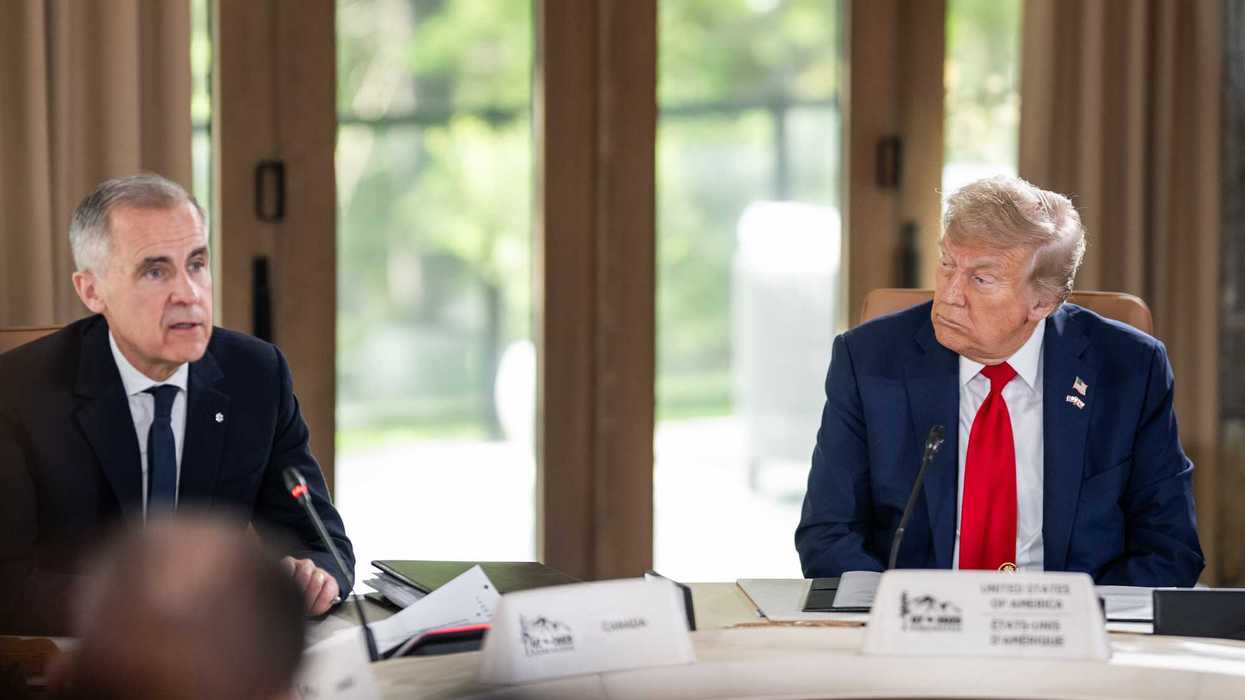
U.S. President Donald Trump with Canadian Prime Minister Mark Carney in Kananaskis, Alberta, Canada on June 16, 2025 (Official White House Photo by Daniel Torok/Flickr)

January 28, 2026
ALTERNET

During the 2026 World Economic Forum (WEF) in Davos, Switzerland, U.S. President Donald Trump and Canadian Prime Minister Mark Carney exchanged public criticism over trade and foreign policy.

Carney delivered a speech arguing that Trump's foreign and economic policies are undermining global alliances. He stated that this is causing a "rupture" in international relationships.

The Canadian prime minister told attendees, "For decades, countries like Canada prospered under what we called the rules-based international order. We joined its institutions, we praised its principles, we benefited from its predictability. And because of that, we could pursue values-based foreign policies under its protection. Even an imperfect system had profound benefits — as long as America remained both strong and virtuous."

Following Carney's speech, Trump withdrew Canada's invitation to join his Board of Peace.

Economist Paul Krugman published a column on January 27 criticizing Trump's Canada policies. Krugman argues that the U.S.-Canada relationship has deteriorated since Trump returned to power.

"We are talking about a rupture with a neighbor that was, until Trump returned to power, one of our closest allies and remains our second most important trading partner," Krugman writes. "Trump has been criticizing Canada since early last year, claiming that Canada had a $200 billion trade surplus and arguing that getting energy and auto parts from Canada constituted a U.S. subsidy to the country."

Krugman states, "For the record, trade between the U.S. and Canada is roughly balanced, and cutting off this trade would be severely damaging to both economies."

Krugman attributes Trump's approach to personal and geopolitical factors. He argues that by making a trade deal with China, Canada is reducing its dependence on the United States, which Trump opposes.

Paul Krugman's full Substack column is available at this link.


'I meant what I said': Canadian PM accuses Trump admin of lying about phone call
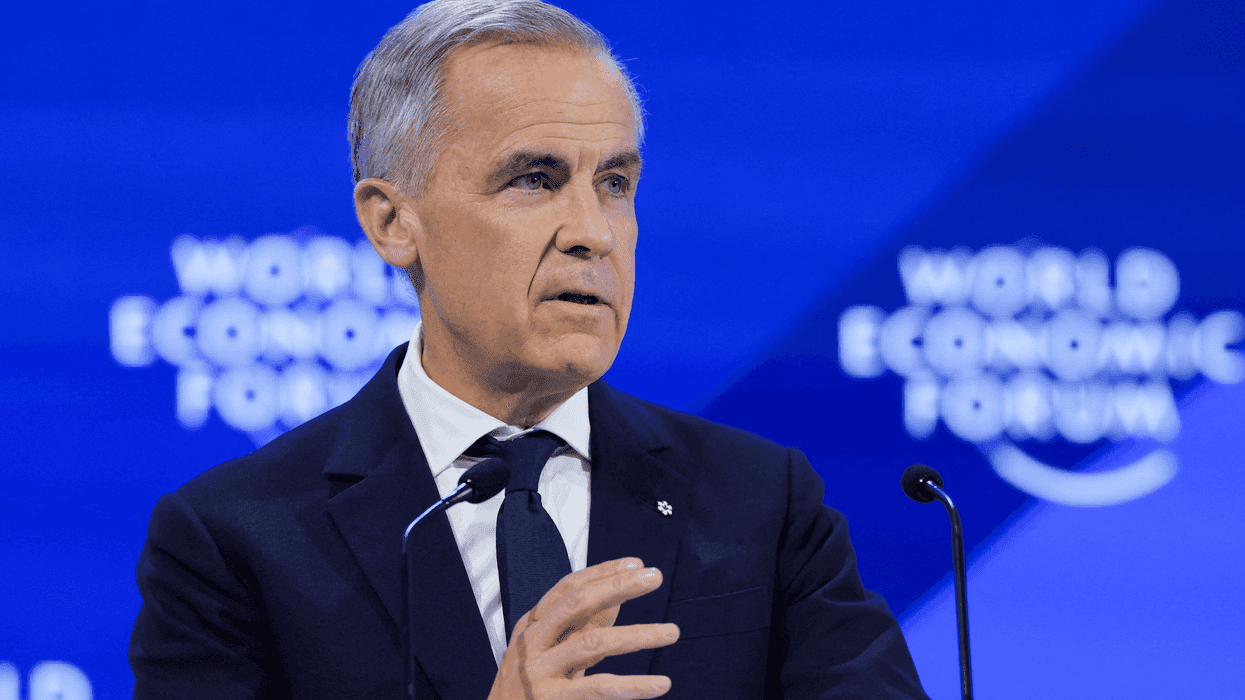

Canada's Prime Minister Mark Carney speaks during the 56th annual World Economic Forum (WEF) meeting in Davos, Switzerland, January 20, 2026. 
REUTERS/Denis Balibouse/File Photo

January 27, 2026
ALTERNET

Canadian Prime Minister Mark Carney is calling out a top official in President Donald Trump's administration and dismissing the claim that he had walked back some of his incendiary Davos speech in a phone call with the president, according to The New Republic.

During a Monday evening appearance on Fox News, Treasury Secretary Scott Bessent claimed that Carney and Trump had spoken over the phone earlier in the day, and that the prime minister had been "very aggressively walking back some of the unfortunate remarks he made at Davos." This came as the president had been ramping up tariff threats against Canada in the wake of Carney's head-turning speech.

In an address to the World Economic Forum in Davos, Switzerland, Carney argued that the era of American hegemony over the world order was at an end, owing to Trump's antagonistic treatment of allies since returning to the White House and his demand to take over Greenland from Denmark. He further argued that the middle power nations of the world must now band together to pursue their goals, rather than counting on the backing of the U.S.

The speech instantly became a hot-button topic, with a recent New York Times Opinion headline from Ezra Klein proclaiming it as the "most important foreign policy speech in years." It seemed to ruffle Trump's feathers as well, as he later went off on Canada in his own Davos speech, suggesting that Canada ought to be "grateful” for the “freebies" it gets from the U.S. and claiming that "Canada lives because of the United States."

Speaking to reporters on Tuesday, Carney rebuked Bessent for mischaracterizing his phone call with the phone call with the president. While the prime minister called the conversation a positive one, he also stressed that he did not back down from the points made in his speech.

"To be absolutely clear, and I said this to the president, I meant what I said in Davos," Carney said. "It was clear it was a broader set of issues that Canada was the first country to understand the change in U.S. trade policy that he had initiated. And we’re responding to that."

"We had a very good conversation on a wide range of subjects, ranging from the situation in Ukraine, in Venezuela, Arctic security," he added. "We discussed as well what Canada is doing, positively, and this is the context of our discussion, what Canada is doing positively to build new partnerships around the world."
Lancet Study Warns Plastics Could Cost Humanity 83 Million Years of Healthy Life

“Systemic change is needed ‘from the cradle to the grave’ of plastic production, use, and disposal,” said the lead author, calling for “ambitious action from governments and industry transparency.”


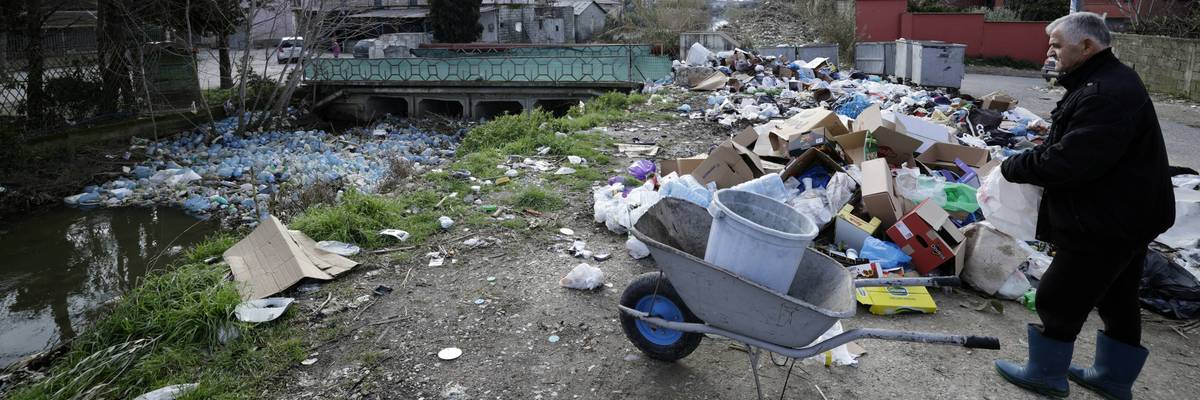
A man looks for goods to retrieve in a dumping area near plastic trash-filled floodwaters following heavy rains, in Durres, Albania on January 13, 2026.
(Photo by Adnan Beci/AFP via Getty Images)

Jessica Corbett
Jan 27, 2026
COMMON DREAMS

A study published Tuesday in the Lancet Planetary Health highlights how humanity’s continued reliance on plastics—which are primarily derived from planet-heating fossil fuels—is expected to harm global health over the next couple of decades.

Plastics life cycles emit a range of gases and pollutants that contribute to the global burden of disease, including greenhouse gases that drive climate change, air pollutants linked to respiratory illnesses, and hazardous chemicals associated with cancers and other noncommunicable diseases,” the study explains.


‘We Are Running Out of Time’: 2025 Keeps Hot Streak Alive for Global Temperatures

“These emissions occur across all stages of the plastics value chain: from oil and gas extraction, which provides the feedstocks for more than 90% of global plastics; to polymer production and product manufacturing, global transportation, recycling, and formal or informal waste management and mismanagement; to the gradual degradation of plastics in the environment,” the publication continues.

Researchers from the London School of Hygiene and Tropical Medicine (LSHTM) and University of Exeter in the United Kingdom, as well as France’s University of Toulouse, modeled various scenarios of plastics production, consumption, and disposal from 2016-40.

“The study is the first of its kind to assess the number of healthy years of life lost (‘disability-adjusted life years’ or ‘DALYS’—a measure of harm) due to greenhouse gases, air pollutants, and toxic chemicals emitted across the life cycle of plastics at a global scale,” according to LSHTM.

The team estimated that without any changes in global plastics policies and practices, annual health impacts would soar from 2.1 million DALYs in 2016 to 4.5 million DALYs by 2040—with a total of 83 million healthy years of life lost over the full study period. Under a business-as-usual scenario, 40% of the health harms would be tied to rising temperatures, nearly a third to air pollution, and over a quarter to toxic chemicals.

Because of limited data—particularly on the use stage of plastics and the chemicals they contain—lead author Megan Deeney of LSHTM told Agence France-Presse that “this is undoubtedly a vast underestimate of the total human health impacts.”


Still, the researchers were able to offer some insight into the adverse health impacts—thanks to their repurposing of modeling methods typically used to evaluate the environmental footprint of individual products and technologies.

These methods “are an increasingly important tool to tackle sustainability questions at a much larger scale,” study co-author and Exeter professor Xiaoyu Yan said in a statement. “Our study shows that this approach can help uncover the massive impacts of plastics on human health throughout the life cycle. We now need urgent action to reduce the impacts of plastics on the environment and ultimately human health.”

Deeney stressed that such action can’t be restricted to consumers. As she put it, “Our research shows that the adverse health impacts of plastics stretch far beyond the point at which we buy a plastic product or put plastic items in a recycling bin.”

In the US alone, government data suggests that just 5% of plastic waste is recycled annually, according to a Greenpeace report published last month. The advocacy group also noted that only a fifth of the 8.8 million tons of the most commonly produced types of plastics are even recyclable.

“Often the blame is put on us as individual consumers of plastics to solve the problem, but while we all have an important role to play in reducing the use of plastics, our analysis shows systemic change is needed ‘from the cradle to the grave’ of plastic production, use, and disposal,” Deeney said Tuesday. “Much more ambitious action from governments and industry transparency is needed to curb this growing global plastics public health crisis.”

The lead author said that the most effective measure is slashing the production of “unnecessary” plastic. She also pointed out that lack of data doesn’t just impact studies like this one: “Industry nondisclosure and inconsistent reporting of plastics’ chemical composition is severely limiting the ability of life cycle assessments (LCAs) to inform effective policy to protect humans, ecosystems, and the environment.”

The study comes after the latest round of global plastics treaty negotiations stalled in August—which environmentalists called an “abject failure” that should be blamed on the Trump administration, Saudi Arabia, and other major governments opposed to curbing production.

“The inability to reach an agreement in Geneva must be a wake-up call for the world: Ending plastic pollution means confronting fossil fuel interests head-on,” Greenpeace USA’s Graham Forbes said at the time. “The vast majority of governments want a strong agreement, yet a handful of bad actors were allowed to use process to drive such ambition into the ground.”


Immigrant Children Lead Uprising at Texas Detention Center


The immigrant jail, where many children are detained, has “horrible” conditions, including “putrid” drinking water.
January 26, 2026

Clouds are seen through high fencing at the now federally controlled South Texas Family Residential Prison, which houses families who are pending disposition of their immigration cases.
Jabin Botsford/The Washington Post via Getty Images

An uprising broke out at an immigrant jail in southern Texas on Saturday, with around 1,000 immigrants detained in the facility — many of them children — chanting “Libertad” and “Let us go,” according to an attorney who witnessed the event.

The protest took place at South Texas Family Residential Center in Dilley, which closed in 2024 but was reopened by the Trump administration this year to detain immigrant families.

On Saturday, facility personnel abruptly ordered immigration attorneys who were present to leave, saying “an incident” had taken place. Michigan-based immigration attorney Eric Lee, who was among those forced to leave, said he could hear shouting that sounded “high-pitched” and “urgent,” indicating that he believed there were “hundreds of children” taking part in the uprising.

Lee later said his clients told him the protest began in response to the treatment of Liam Conejo Ramos, the 5-year-old from Minnesota who was abducted, along with his father, by Immigration and Customs Enforcement (ICE) agents last week. The two were transferred to the jail, more than 1,300 miles from home, shortly after being detained.

School officials familiar with the incident say that an adult living in Liam’s home had begged for ICE agents to let Liam stay after his father was taken into custody.

Related Story

Immigrant Rights Advocates Say Trump’s First Year Was “Much Worse” Than Expected
“Trump wants us to hang our heads and give up, but that’s not happening,” says organizer Rossy Alfaro. By Derek Seidman , Truthout January 17, 2026

“There was ample opportunity to be able to safely hand that child off to adults,” Mary Granlund, chair of the Columbia Heights School Board, said during a press conference last week.

School officials also said that Liam was used as “bait” by agents, in an attempt to get other people inside the house to exit willingly.

Aerial photos of the Texas facility during the protest, taken by The Associated Press, show parents and children holding signs that read, “Libertad para los niños,” or “Freedom for the kids.” Participants in the uprising also reportedly chanted “Libertad,” and “Let us go.”

“The message we want to send is for them to treat us with dignity and according to the law,” said Maria Alejandra Montoya Sanchez, a 31-year-old who is being detained in the jail, speaking to The AP after the protest. “We’re immigrants, with children, not criminals.”

Montoya Sanchez has been imprisoned at the facility with her 9-year-old daughter since October.

Lee posted several videos of the incident on social media. Within the videos, which were recorded outside the facility, shouting and chanting can be heard from inside the jail, seemingly from children.

Live: Major demonstration by detainees at Dilley Family Detention Ctr! I was just kicked put from atty visit. Hundreds chanting what sounds like "let us out! Let us out!" pic.twitter.com/LKuOnOwEbH— Eric Lee (@EricLeeAtty) January 24, 2026

In one video, Lee recorded what sounded like children screaming, after which a guard tells him he has to leave the area, despite being outside of the jail.

“This demonstration presently comprises of about 80 percent of the detained population, over 1,000 people. … Guards are trying to physically block people from protesting,” Lee said in another post, noting that gates within the facility had been closed to prevent the uprising from spreading.

According to Lee, demonstrators were moved to protest after hearing about Liam’s story. They were also motivated to act after hearing about the size of the general strike on Friday against federal immigration agents’ presence in Minnesota.

Lee described deplorable conditions at the facility, saying it is a “horrible, horrible place.” The drinking water is “putrid,” and the food served to families who are being detained contains “bugs,” dirt, and other contaminants, the lawyer said.

“The guards are just as tough as the guards at the adult facilities,” Lee said. “This is not a place that you would want to have your child be for even 15 minutes.”

“That children and their parents would risk retribution under these conditions to speak up is a testament both to how courageous they are and how abysmal the conditions of this place is,” Lee added.


This article is licensed under Creative Commons (CC BY-NC-ND 4.0), and you are free to share and republish under the terms of the license.


Chris Walker
Chris Walker is a news writer at Truthout, based in Madison, Wisconsin. Focusing on both national and local topics since the early 2000s, he has produced thousands of articles analyzing the issues of the day and their impact on people. He can be found on most social media platforms under the handle @thatchriswalker.