Friday, January 30, 2026

We Need “Mass Leftist Media” to Fight the Distortions and Lies of Legacy Media

January 30, 2026
Photograph by Nathaniel St. Clair

We seem to be in the midst of a widening crack in the edifice that supports US ideology – denial. Even the most oblivious pundits have been crawling out from under their wormy rocks to confess that, yes, Trump is a fascist. One of the latest is Jonathan Rauch, whose brand new piece, aptly titled, “Yes It’s Fascism,” published in The Atlantic, begins with the predictable subtitle: “Until recently, I thought it a term best avoided. But now, the resemblances are too many and too strong to deny.”

One wonders where Rauch has been hibernating over the last decade. Do luminaries from the legacy media really need to watch videos of public executions on the streets of Minneapolis to grudgingly conclude that Trump and his MAGA henchmen all flaunt the familiar mien of fascism? Rauch does a decent job of cataloguing the various fascist fragments parading before our eyes – attacks on the press, on public education, on universities, on women’s rights, “promiscuous” warfare, the threat to electoral systems, the routine deployment of bluntly racist rhetoric, the expansion and mobilization of organs of state violence, and so forth. Had Rauch simply concluded his confession with his reasonably thorough list, I would have applauded his tone of apology – better late than never. But, somehow, he failed to resist the compulsion to withdraw back into a cocoon of denial:

“If, however, Trump is a fascist president, that does not mean that America is a fascist country. The courts, the states, and the media remain independent of him, and his efforts to browbeat them will likely fail. He may lose his grip on Congress in November. He has not succeeded in molding public opinion, except against himself. He has outrun the mandate of his voters, his coalition is fracturing, and he has neglected tools that allow presidents to make enduring change. He and his party may defy the Constitution, but they cannot rewrite it, thank goodness.

So the United States, once the world’s exemplary liberal democracy, is now a hybrid state combining a fascist leader and a liberal Constitution; but no, it has not fallen to fascism. And it will not.”

A more honest, objective appraisal might have tentatively concluded that Trump has not yet fully consolidated fascist control – that there are still means of potential redress. However, to argue that the US “has not fallen to fascism” is to dodge the most critical question – how did all of this so called glorious democratic history resolve into a fascist juggernaut with massive public, corporate and media support? If America “was once the world’s exemplary liberal democracy,” what has caused tens of millions of people to embrace Trump in a swooning rage? If America’s citizens have abandoned “liberal democracy” with either passionate disgust or weary indifference, then Rauch ought to explain why. The idea that Trump emerged like a meteorite from deep space, to explode upon a formerly healthy ecosystem, has been a strange delusion streaked across the pages of legacy media.

Rauch, astonishingly fails to name the mechanisms that will end fascism other than hand-waving it away with some hastily abridged optimism about Trump’s polling numbers, and the oft repeated nonsense that the MAGA coalition is fracturing – polling shows that it is as strong as ever. Rauch’s piece ought to be seen as strange and disjointed – in essence he tells his readers that Trump is indeed a fascist with the most ominous intentions, while abruptly concluding that we have little to worry about, because (somehow) the US has not, and will not “fall to fascism (and never will).” At no point in this piece are readers advised to resist, engage in civil disobedience, and organize general strikes. Rauch references Minneapolis as an example of Trump’s fascistic use of paramilitary violence, but never utters a word about the intense resolve of the people living in the twin cities who risk their lives to confront fascism. Rauch, in effect, tells these people that the constitution still protects them. Reassurances about the alleged checks and balances of US institutions insult the people being battered and abused by US fascism. You can’t logically both admit that Trump is a fascist while forecasting a happy ending.

In the same online issue of The Atlantic we can read a far more reactionary piece than the one by Rauch, entitled, “International Law is Holding Democracies Back,” by former Bush apparatchik, John Yoo. The Trump administration gambit of bombing Venezuela to “snatch-and-grab” Maduro and his wife is Yoo’s absolute wet dream. This writer has no objection to Trump’s violation of international law, but rather, proposes that international law has become an obstacle to the aspirations of “western democracies,” to remove bad dictators from power and bring in corporations for essential “reconstruction and management.” I am not making this up – nowhere does Yoo suggest, like Rauch does, that the US has become a predatory dictatorship. He continues to luxuriate in the psychotic delusion that the world exists as a bifurcated system of malicious dictators and democratic nations promoting freedom. Yoo concludes:

“Global power is shifting, and old fictions are collapsing. If international law is to retain relevance, it will have to follow power, not pretend to constrain it.”

This is absolutely the worst sort of jingoism, but it hardly represents an anomalous perspective – Andrew Favakeh, writing in ZNetwork, observes that the New York Times has recently run a series of seven op-eds advocating the continued trend of massive military spending:

“Devoting seven editorials to boosting the US military when the country’s own democracy is under threat—and Trump is using the military so irresponsibly and illegally that high-level officers are resigning—the Times demonstrated that its commitment to militarism knows few bounds.”

While we often lament the rise of far right media like Breitbart, Newsmax and FOX, it is the legacy media that has fundamentally deformed the media landscape and castrated the thinking of the Democratic Party base.

That is not to say that platforms like The Atlantic do not sometimes publish excellent journalism like this piece by Vincent Bevins exploring the worst aspects of US imperialism, or this piece by Caitlin Flanagan unpacking the inherent class inequities built into the structures of the US private education system. David Wallace Wells has done some good reporting on climate for the NYT, but the occasional gem does not discount the role that so called corporate “liberal” media plays in the larger scheme of US politics – to push the Democratic Party base toward the “center” and to gaslight “educated” readers to embrace moderate positions on climate, the economy, and, critically, to whitewash US colonial policy so that it appears to be altruistically motivated.

In a sense, the better pieces posted at The Atlantic function as a manner of “intermittent reinforcement” that draws unwary readers to accept centrist and jingoistic offerings. As long as The Atlantic, The New Yorker and the New York Times shape narratives that gain the approval of the corporate elites who pay for their advertisements, the Democratic Party will most likely continue to be a paper-mache barrier against fascism. The legacy media that runs adjacent to the policies and world views of the Democratic Party assure that class issues never usurp the prominence of identity issues. The “left” will never gain control of the above named platforms, but we can call them out and create a more vibrant alternative media system.

There are a number of non-corporate, progressive social media platforms – Secular Talk with the plain speaking, relatable Kyle Kulinski (my favorite media figure), The GrayzoneDemocracy NowEconomic Update (with Richard Wolff) and a few others that have growing lists of subscribers, but none of these compete with, say, The Fox News YouTube Channel’s 15 million subscribers, or the NYT’s 5 million YouTube subscribers. Both FOX and the NYT have massive corporate backing. Thus, the left in the US confronts a Gordian Knot – how do we reach a mass audience without the resources enjoyed by those loyal to capital.

The major themes that have to galvanize the left – socialism, degrowth/anti-consumerism, immigrant rights, peace, universal health care, sustainable agriculture/veganism, the organization and enfranchisement of tens of millions of poor people (in my view, the most critical of all issues) – all summon the ire of corporate interests. Thus, “mass leftist media” (a term so bizarre that I wince while typing it) requires the grass roots support of small donors.

Rush Limbaugh was the precursor to Trump – is Kyle Kulinski the left’s retort to Limbaugh? Kulinski has over 2 million YouTube subscribers – triple that and we have a new media landscape.

Phil Wilson is a retired mental health worker who has written for Common Dreams, CounterPunch, Resilience, Current Affairs, The Future Fire and The Hampshire Gazette. Phil’s writings are posted regularly at Nobody’s Voice.

10 Reasons Why ICE is Harassing Native Americans


 January 30, 2026

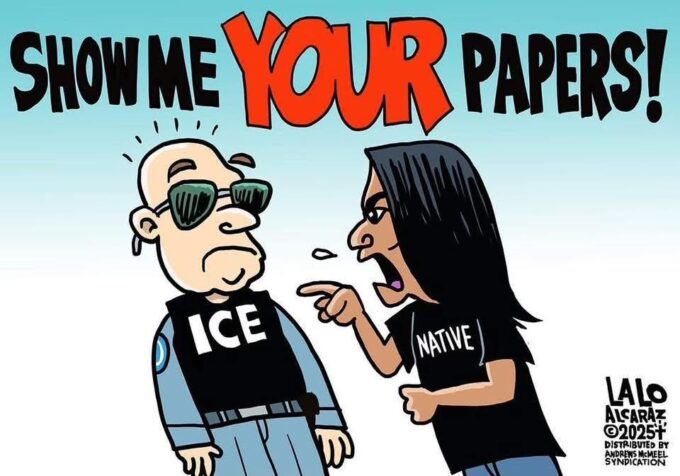
“Show Me Your Papers” cartoon by Lalo Alcatraz (shared as “kartoonist” on r/Chicano, 2025)

ICE and Border Patrol are increasingly detaining Native American citizens, and ignoring or refusing to treat Tribal ID cards as proof of citizenship. Just north of where ICE killed Minneapolis rights monitor Renee Gold, agents have detained tribal citizens in the clearly Native neighborhood around Franklin Avenue, where the American Indian Movement was itself born to monitor police brutality. In much the same way, ICE often racially profiles immigrants who have become citizens.

Many tribal leaders are speaking out, accurately pointing out that the 1924 Indian Citizenship Act granted U.S. citizenship to Native peoples, alongside their own tribal citizenship, so ICE has absolutely zero legal basis for stopping any tribal citizen. It might be easy for non-Natives to assume that ICE is simply unaware of tribal citizens’ status, and with proper education and training they will treat Native people as equal citizens, and stop the harassment.

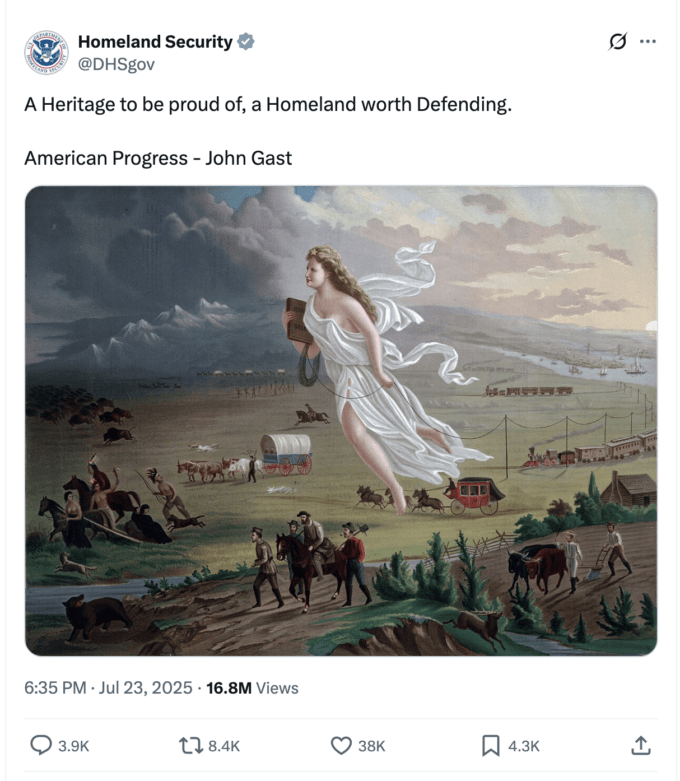
DHS post with “American Progress” recruitment ad (on X, July 23, 2025)

The problem is that ICE already knows full well that Native Americans are citizens.

Even when shown Tribal IDs and passports, many ICE agents have been dismissive or hostile. And unfortunately there’s a reason. The harassment and detention of Native Americans today is the latest episode in a long and deep history of colonizing Indigenous peoples at home and abroad.

Let’s connect the dots, to show why this trend of anti-Native harassment is no accident:

  1. Many of the immigrants terrorized by ICE are themselves Indigenous, including those from Guatemala and southern Mexico. In 2019, Trump evoked an “invasion” of Central American refugees in “caravans,” and mocked their pleas for asylum. Guatemalans working at the Trump National Golf Club were ridiculed by a supervisor as “donkeys” and “dogs.” Last year, Trump cut funding for Indigenous language translation in immigration enforcement, and sought to deport Guatemalan unaccompanied children. These Indigenous immigrants, many of them fleeing conflicts fueled by the U.S., have borne the brunt of ICE mistreatment.
  2. Ask the Native nations whose lands were crossed by the U.S.-Mexico border, such as Tohono O’odham and Kumeyaay, how for decades they’ve faced harassment by Border Patrol and ICE (and their predecessor agencies) and constantly forced to prove their citizenship or abandon their relatives south of the border. The militarization of the border and construction of the border wall increasingly cuts them off from family ties, cultural sites and knowledge, and the ability to economically trade and support each other. These tribes (and others bisected by the U.S.-Canada boundary) still face a constant struggle to safely cross the border.
  3. There’s always been an overlap between anti-Native and anti-immigrant movements, and some politicians and agencies promote both forms of racism. A 2006 ICE raid on meatpacking plants was named “Operation Wagon Train.” When Elaine Willman, founder of the anti-Native Citizens Equal Rights Alliance, was on the Toppenish City Council in central Washington, she could have pit the local Mexican immigrant population and Yakama tribal members against each other, but she instead accused tribal sovereignty of “contributing to an increase in illegal immigration.”
  4. Trump has explicitly opposed Native sovereignty, ever since he railed against tribal casino competitors in 1993. Starting in his first term, he used “Pocahontas” as a slur, hung a portrait of Andrew Jackson in the Oval Office, oil pipelines and drilling on Native lands, slashed environmental regulations and climate funds that protect Native lands, waters, and sacred sites, cut federal programs that benefit tribes, began to take tribes out of trust, and much more. Last year he drastically cut tribal college funding, and his Department of Justice tried to make the preposterous argument that “birthright citizenship” does not apply to Native Americans. Previous administrations have not been friendly to tribal interests, to varying degrees, but Trump has taken it to a higher level, especially in his second term.
  5. Department of Homeland Security recruitment ads for new ICE agents have blatantly evoked Manifest Destiny images of white supremacy that seemingly have nothing to do with immigration enforcement, including John Gast’s “American Progress” painting as “A Heritage to be proud of, a Homeland worth defending.” And just who are these newly recruited agents? Back in 2020, it was common to see armed far-right militiamen threaten anti-Trump and Black Lives Matter marches, but now these paramilitaries are notably absent at even more widespread rallies. Perhaps that’s one reason that so many ICE agents wear masks, so they won’t be unmasked as Proud Boys or Three Percenters.
  6. Anti-Indigenous theorists have usually equated tribal sovereignty with Diversity, Equity, and Inclusion (DEI), and posed Native self-determination as “special rights” based on race, rather than on tribes’ political status as nations. But as I noted in a recent post, in the past few years they’re refocusing on the “dangers” of the growing opposition to settler colonialism, whether in Palestine, South Africa, or North America. They’re now concentrating their ire on Indigenous self-determination as a threat to settler states’ entitlement to land, and on Native Studies in education as a threat to the national narrative of progress. The MAGA message is shifting away from race and toward place, and who controls natural resources. And it’s no accident that Trump threatens to annex resource-rich Greenland, just when it’s poised to become the first independent Indigenous state in the Americas. The puzzle begins to fit together.
  7. The connections between the colonization of Native America and the overseas extension of the American Empire long predate Trump. Western Army forts were the first U.S. military bases on foreign soil. The doctrine of “Manifest Destiny” was the template for the expansion of U.S. colonialism into the Caribbean, Hawai’i and other Pacific nations, the Philippines, and Vietnam. In his classic Facing West: the Metaphysics of Indian-Hating and Empire Building, Richard Drinnon documented that the “Indian Wars,” Philippine-American War, and Vietnam War used identical tactics, and rhetoric of enemy territory as hostile “Indian country.” Drinnon concluded, “In each and every West, place itself was infinitely less important…than what the white settlers brought in their heads and hearts to that particular place. At each magic margin, their metaphysics of Indian-hating underwent a seemingly confirmatory ‘perennial rebirth.’…. All along, the obverse of Indian-hating had been the metaphysics of empire building…. Winning the West amounted to no less than winning the world.” Evoking this history, it’s no accident that the military deploys “Tomahawk” missiles, and helicopters named “Black Hawk,” “Apache,” and “Chinook.”
  8. In Latin America, the source of most immigration into the U.S., Indigenous-led movements are increasingly being targeted by U.S. military and intelligence agencies in their counterinsurgency planning. The National Intelligence Council projected in 2005 that the “demands of free markets” will “drive indigenous movements, which so far have sought change through democratic means, to consider more drastic means.” The Army’s Foreign Military Studies Office (FMSO), at Fort Leavenworth, Kansas, applied this emerging doctrine in Military Review, by lumping together “Insurgencies, Terrorist Groups and Indigenous Movements,” particularly in Mexico. The FMSO’s Lt. Col. Geoffrey Demarest stated in his book Geoproperty that “The coming center of gravity of armed political struggles may be indigenous populations…” and that the Internet is increasingly being used by “Indigenous rebels, feminists, troublemakers…”
  9. The so-called “Global War on Terror” grew from Iraq and Afghanistan into Pakistan, Yemen, Libya, and Somalia, in the name of combating “Islamist terrorism.” Yet within all these countries, the main targets of the wars have been “tribal regions,” and the frontier language of Indian-fighting is becoming the lexicon of 21st-century counterinsurgency. The “Global War on Terror” has morphed into a “Global War on Tribes” (as I noted in an article with that title). Counterinsurgency doctrine views “tribal regions” as festering cauldrons of “lawlessness” and “breeding grounds” for terrorism, unless the tribes themselves are divided against each other and turned against the empire’s enemies. Robert D. Kaplan brazenly wrote in 2004 that “the American military is back to the days of fighting the Indians,” and it’s no accident that in the 2011 raid that killed Osama Bin Laden, his military codename was “Geronimo.” The “Global War on Tribes” is first and foremost a grab for the many natural resources remaining on Indigenous lands, but also a war against the very existence of “tribal regions” that are not under centralized state control, and still retain collective forms of property and social organization.
  10. The swings of the domestic Indian policy pendulum have always been tied into foreign and military affairs: the era of allotment and boarding schools with the age of imperial conquests and “English-Only” restrictions, the Indian New Deal with nonintervention abroad, the Termination Era with the Cold War against communism, tribal self-determination with the rise of national liberation movements, and the white backlash against tribal sovereignty with the far-right swing against multicultural societies. In U.S. military interventions at home or abroad, the existence of Indigenous peoples, lands, and lifeways has always been deemed a threat to the colonial order, and Trump’s administration is making that longstanding view more open and transparent with every statement and action. Restricting the rights of Native peoples and dispossessing their lands is the original disease of colonialism, not a side effect.

The fact that ICE and Border Patrol are now harassing and detaining Native citizens is a warning to the larger U.S. society. As federal Indian law scholar Felix Cohen wrote in 1953, “Like the miner’s canary,” U.S. treatment of Native peoples “marks the shift from fresh air to poison gas in our political atmosphere.” Trump began his second term by demonizing Haitians, Somalis, and Venezuelans, and is taking the next step by harassing Native citizens, and will then extend the repression to all citizens. ICE started as a bludgeon against immigrants, but is becoming a test case for expanding authoritarianism against everyone. Only by showing active solidarity with both immigrant and Indigenous communities (and other targeted communities), can we block his plans.

ICE knows that the rights of Native peoples and recent immigrants are connected, and more Americans should learn that too.

Zoltán Grossman is a Member of the Faculty in Geography and Native American and Indigenous Studies at The Evergreen State College in Olympia, Washington. He earned his Ph.D. in Geography from the University of Wisconsin in 2002. He is a longtime community organizer, and was a co-founder of the Midwest Treaty Network alliance for tribal sovereignty. He was author of Unlikely Alliances: Native and White Communities Join to Defend Rural Lands (University of Washington Press, 2017), and co-editor of Asserting Native Resilience: Pacific Rim Indigenous Nations Face the Climate Crisis (Oregon State University Press, 2012). His faculty website is at https://sites.evergreen.edu/zoltan