Sunday, February 01, 2026

 Qatar, Jordan, Egypt condemn Israeli ceasefire violations in Gaza


Palestinians search for bodies and survivors from the rubble of a police station after it was targeted by an Israeli army strike in Gaza City Saturday, Jan. 31, 2026
. (AP)


Arab News
January 31, 202622:33

Israel pounded Gaza on Saturday with some of its most intense ​airstrikes since the October ceasefire was brokered


LONDON: Qatar, Jordan and Egypt on Saturday strongly condemned Israel’s repeated violations of the ceasefire in the Gaza Strip, warning the attacks risk dangerous escalation and undermine regional and international efforts to restore stability.

Qatar’s Ministry of Foreign Affairs said the breaches, which have resulted in fatalities and injuries, threatened the political pathway aimed at de-escalation and jeopardize efforts to create a safer environment for Palestinians in Gaza, the Qatar News Agency reported.

Doha urged Israel to fully comply with the ceasefire agreement, calling for maximum restraint from all parties to ensure the success of the second phase of US President Donald Trump’s plan and the implementation of UN Security Council Resolution 2803.

The ministry also stressed the importance of creating conditions conducive to early recovery and reconstruction in the enclave.

Jordan echoed the condemnation, with its Ministry of Foreign Affairs and Expatriates describing the latest incidents as a blatant breach of the ceasefire and a dangerous escalation.

Ministry spokesperson Fouad Majali called for strict adherence to the agreement and its provisions, including the immediate, adequate and unhindered delivery of humanitarian aid to Gaza, as well as moving forward with the second phase of the deal, according to the Jordan News Agency.

Majali urged the international community to fulfil its legal and moral responsibilities to ensure Israel’s compliance, while warning against actions that could derail de-escalation efforts. He also reiterated Jordan’s call for a clear political horizon leading to an independent Palestinian state on the June 4, 1967, borders, with East Jerusalem as its capital, in line with the two-state solution and the Arab Peace Initiative.

Egypt, meanwhile, condemned what it described as recurrent Israeli breaches that have led to the deaths of at least 25 Palestinians.

Cairo warned that such actions risk turning the situation into a tinderbox and threaten ongoing efforts to stabilize Gaza at both the security and humanitarian levels.

In a statement, Egypt’s Foreign Ministry appealed to all parties to exercise maximum restraint, safeguard the ceasefire, and avoid measures that could undermine the political process. It stressed the need to maintain momentum toward early recovery and reconstruction, emphasizing that continued violations directly threaten prospects for lasting stability in the enclave.


Palestinian citizens in Israel demand more security from violence


AP
February 01, 2026

Protests and strikes are sweeping Israel over record levels of violence targeting the country’s Palestinian citizens

At least 26 people were killed in January alone, adding to a record-breaking toll of more than 250 last year


KAFR YASIF, Israel: Nabil Safiya had taken a break from studying for a biology exam to meet a cousin at a pizza parlor when a gunman on a motorcycle rode past and fired, killing the 15-year-old as he sat in a black Renault.
The shooting — which police later said was a case of mistaken identity — stunned his hometown of Kafr Yasif, long besieged, like many Palestinian towns in Israel, by a wave of gang violence and family feuds.
“There is no set time for the gunfire anymore,” said Nabil’s father, Ashraf Safiya. “They can kill you in school, they can kill you in the street, they can kill you in the football stadium.”
The violence plaguing Israel’s Arab minority has become an inescapable part of daily life. Activists have long accused authorities of failing to address the issue and say that sense has deepened under Israel’s current far-right government.
One out of every five citizens in Israel is Palestinian. The rate of crime-related killings among them is more than 22 times higher than that for Jewish Israelis, while arrest and indictment rates for those crimes are far lower. Critics cite the disparities as evidence of entrenched discrimination and neglect.
A growing number of demonstrations are sweeping Israel. Thousands marched in Tel Aviv late Saturday to demand action, while Arab communities have gone on strike, closing shops and schools.
In November, after Nabil was gunned down, residents marched through the streets, students boycotted their classes and the Safiya family turned their home into a shrine with pictures and posters of Nabil.
The outrage had as much to do with what happened as with how often it keeps happening.
“There’s a law for the Jewish society and a different law for Palestinian society,” Ghassan Munayyer, a political activist from Lod, a mixed city with a large Palestinian population, said at a recent protest.
An epidemic of violence
Some Palestinian citizens have reached the highest echelons of business and politics in Israel. Yet many feel forsaken by authorities, with their communities marked by underinvestment and high unemployment that fuels frustration and distrust toward the state.
Nabil was one of a record 252 Palestinian citizens to be killed in Israel last year, according to data from Abraham Initiatives, an Israeli nongovernmental organization that promotes coexistence and safer communities. The toll continues to climb, with at least 26 additional crime-related killings in January.
Walid Haddad, a criminologist who teaches at Ono Academic College and who previously worked in Israel’s national security ministry, said that organized crime thrives off weapons trafficking and loan‑sharking in places where people lack access to credit. Gangs also extort residents and business owners for “protection,” he said.
Based on interviews with gang members in prisons and courts, he said they can earn anywhere from thousands to hundreds of thousands of dollars, depending on whether the job is torching cars, shooting at buildings or assassinating rival leaders.
“If they fire at homes or people once or twice a month, they can buy cars, go on trips. It’s easy money,” Haddad said, noting a widespread sense of impunity.
The violence has stifled the rhythm of life in many Palestinian communities. In Kafr Yasif, a northern Israel town of 10,000, streets empty by nightfall, and it’s not uncommon for those trying to sleep to hear gunshots ringing through their neighborhoods.
Prosecutions lag
Last year, only 8 percent of killings of Palestinian citizens led to charges filed against suspects, compared with 55 percent in Jewish communities, according to Abraham Initiatives.
Lama Yassin, the Abraham Initiatives’ director of shared cities and regions, said strained relations with police long discouraged Palestinian citizens from calling for new police stations or more police officers in their communities.
Not anymore.
“In recent years, because people are so depressed and feel like they’re not able to practice day-to-day life ... Arabs are saying, ‘Do whatever it takes, even if it means more police in our towns,’” Yassin said.
The killings have become a rallying cry for Palestinian-led political parties after successive governments pledged to curb the bloodshed with little results. Politicians and activists see the spate of violence as a reflection of selective enforcement and police apathy.
“We’ve been talking about this for 10 years,” said Knesset member Aida Touma-Suleiman.
She labeled policing in Palestinian communities “collective punishment,” noting that when Jews are victims of violence, police often set up roadblocks in neighboring Palestinian towns, flood areas with officers and arrest suspects en masse.
“The only side that can be able to smash a mafia is the state and the state is doing nothing except letting (organized crime) understand that they are free to do whatever they want,” Touma-Suleiman said.
Many communities feel impunity has gotten worse, she added, under National Security Minister Itamar Ben-Gvir, who with authority over the police has launched aggressive and visible campaigns against other crimes, targeting protests and pushing for tougher operations in east Jerusalem and the occupied West Bank.
Israeli police reject allegations of skewed priorities, saying that killings in these communities are a top priority. Police also have said investigations are challenging because witnesses don’t always cooperate.
“Investigative decisions are guided by evidence, operational considerations, and due process, not by indifference or lack of prioritization,” police said in a statement.
Unanswered demands
In Kafr Yasif, Ashraf Safiya vowed his son wouldn’t become just another statistic.
He had just gotten home from his work as a dentist and off the phone with Nabil when he learned about the shooting. He raced to the scene to find the car window shattered as Nabil was being rushed to the hospital. Doctors there pronounced him dead.
“The idea was that the blood of this boy would not be wasted,” Safiya said of protests he helped organize. “If people stop caring about these cases, we’re going to just have another case and another case.”
Authorities said last month they were preparing to file an indictment against a 23-year-old arrested in a neighboring town in connection with the shooting. They said the intended target was a relative, referring to the cousin with Nabil that night.
And they described Nabil as a victim of what they called “blood feuds within Arab society.”
At a late January demonstration in Kafr Yasif, marchers carried portraits of Nabil and Nidal Mosaedah, another local boy killed in the violence. Police broke up the protest, saying it lasted longer than authorized, and arrested its leaders, including the former head of the town council.
The show of force, residents said, may have quashed one protest, but did nothing to halt the killings.
Bearing witness to the gruesome end of Western liberalism


BOOK REVIEW
Rod Such


A protest in the streets of Paris in May 2024. Anne PaqActiveStills

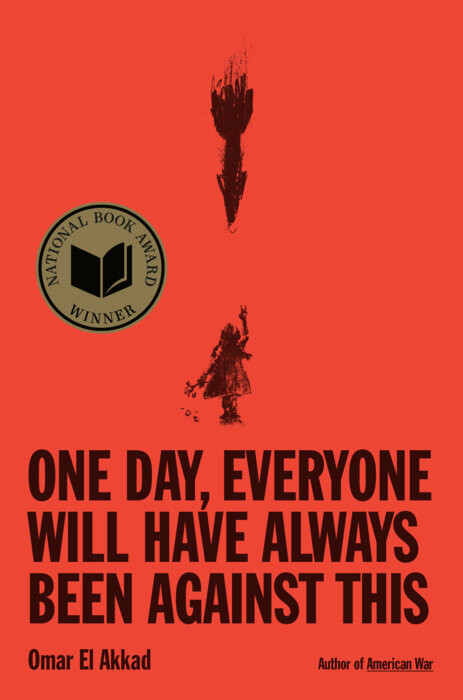
One Day, Everyone Will Have Always Been Against This by Omar El Akkad, Penguin Random House (2025)

Omar El Akkad’s One Day, Everyone Will Have Always Been Against This is a searing indictment of Western liberalism. It especially exposes corporate journalism’s distortions, lies and incitement of a genocide – even while that genocide is being livestreamed to millions of people around the world for all to bear witness.

Written during the peak of Israel’s genocidal attacks on Gaza, El Akkad’s book is a kind of meditation on genocide that will have lasting significance. In the blurbs on the back of the book cover, it is described as “part elegy, part rallying cry” and “a landmark of truth telling and moral courage.”

Its impact may be greater because it avoids the detailed documentation of the atrocities and war crimes committed or the evidence of intent needed to meet the requirements of the United Nations genocide convention.

“This is not an account of [the] carnage,” El Akkad cautions early on. Rather it is “an account of a fracture, a breaking away from the notion that the polite, Western liberal ever stood for anything at all.”

It is also an “account of an ending,” he promises, “the moment millions of people looked at the West, the rules-based order, the shell of modern liberalism and the capitalistic thing it serves, and said: I want nothing to do with this.”
Journalist turned novelist


A challenge to the fundamental liberal claim of benevolent Western empires may be the central contribution of El Akkad’s book. Its dissection of Western corporate journalism very much resembles the Palestinian poet and journalist Mohammed El-Kurd’s Perfect Victims (2025).

The very title of the book may be its most poignant and resonating insight.

One Day, Everyone Will Have Always Been Against This implies the inevitability of a universal recognition that Israel committed a genocide against the Palestinian people with the full support of the US and European states. And yet that day tragically will only come in the aftermath of the deaths, injuries and traumas inflicted on millions of Palestinians.

The title also hints at hypocrisy: The idea of “will have always been against” is emphatically not true since so many Western government officials and politicians, civil society organizations and others defended Israel and justified its atrocities at the time. The Palestinian narrative will inevitably win out, as the title implies and as many of us believe. It will become dominant, but it will still take time.

El Akkad is a journalist turned novelist who was born in Egypt, raised in Qatar and educated at the university level in Canada, where he later reported for The Globe and Mail covering the US war in Afghanistan as a war correspondent, the Arab Spring, and the US military trials of prisoners held in Guantanamo Bay. He moved to the United States, settling in the Portland, Oregon area and became better known as a novelist. His first novel, American War, was published in 2017.

His newspaper experience provides insights into the many aspects of Western journalism that come under examination in One Day. He singles out US President Joe Biden’s lies about seeing photos of beheaded babies in the aftermath of Hamas’ 7 October 2023 attack as an example of how Western journalism helps promote myths. Although news accounts eventually debunked that Biden had seen any such thing, the damage was done.

“Beheaded babies” played the role that nonexistent weapons of mass destruction and the oft-repeated “mushroom cloud” played in justifying the US invasion of Iraq. What the enemy “is believed capable of doing” is more important than what it actually did, as El Akkad puts it. For the corporate liberal media, so-called objective journalism is simply reporting what the president said, not the lie that was spread or what agenda was served by spreading it.

Also analyzed by El Akkad is the use of passive voice to obfuscate who is doing what to whom, something employed most infamously in reporting on Israel’s killing of civilians. El Akkad notes a particularly egregious example in a headline from The Guardian: “Palestinian journalist hit in head by bullet during raid on terror suspect’s home.”

El Akkad calls this out as the “heightened derangement of language for the purpose of sanitizing violence.” Yet another example is The Guardian’s coverage of Israeli soldiers firing on Palestinians seeking food, reduced to the absurd description of “food aid-related deaths.”

Because of this deliberately distorted coverage, El Akkad writes, “Palestinian reporters are in effect the world’s sole source of information about the reality of the obliteration of Gaza, the plain truth of the horror in the face of a mass propagandist effort.”
Singling out Western liberalism

Why single out Western liberalism and not Western conservatism? Liberalism’s longstanding support for Israel’s system of apartheid, occupation and ethnic cleansing of Palestinian Arabs is, of course, one reason.

But, according to El Akkad, so is liberalism’s complicity in “the Vietnamese and Cambodian and Laotian villages turned to ash,” as well as “the nice clean beach north of Tel Aviv that sits atop a mass grave” – a reference to the massacre of hundreds of people by Zionist forces in the Palestinian village of Tantura in May 1948.

The material support given by the Democratic Party and its leader Joe Biden to Israel’s ethnic cleansing and its genocidal bombing is no less morally reprehensible than Republican politician Nikki Haley signing her name on an Israeli bomb before it was dropped on Gaza.

“In times like these, one remarkable difference between the modern Western conservative and their liberal counterpart is that the former will gleefully sign their name on the side of the bomb while the latter will just sheepishly initial it,” El Akkad observes.

“And yet,” the author concludes, “against all this, one day things will change.”

The hopeful anticipation that one day, everyone will have always been against this is indeed visible in the ongoing mass movement that has seen millions of people in the West protest against the genocide.

This movement has included student encampments at universities despite massive state repression, closing down ports to prevent arms shipments to Israel and the activation of a multitude of boycott, divestment and sanctions campaigns.

The very fact that this book won the National Book Award for nonfiction in 2025 is another sign of the changing narrative.

And yet, it still needs to be said that without changing the structures behind this genocide and all forms of oppression, nothing is permanent or even guaranteed. Once-suppressed narratives can become ascendant and even dominant.

Whether they remain that way depends on dismantling the systemic features of the “capitalistic thing” that El Akkad rightly identifies as the source of the problem.

Rod Such is the author of Digging Deeper into the Meaning of Palestine (Changemaker Publications, 2025).

29 December 2025
Global Alliance for Palestine: The solidarity movement confronting Trump's 'Board of Peace' plans


With governments retreating, global Palestine solidarity has emerged as the main arena of pressure. We speak to GAFP's Dr Anas Altikriti about unity and power


Agnese Boffano
London
30 January, 2026
THE NEW ARAB

Donald Trump's renewed push for a Middle East "Board of Peace" at the World Economic Forum is being framed by its supporters as an attempt to stabilise a region in crisis.

But to critics, it represents something else entirely: a return to top-down diplomacy that sidelines Palestinians, rewards power, and repackages coercion as peace-making.

While political leaders across the world engage in grand initiatives and closed-door bargaining, one force has reshaped the conversation on Palestine more than any government since October 2023: the global solidarity movement.

From mass protests and campus organising to boycotts and union mobilisation, civil activism has challenged the elite-driven narrative and pushed Palestine to the forefront of public life — even as official policy in many capitals remains stubbornly unchanged.

For many public organisers, the shift has been unmistakable: as governments retreat from meaningful action on Palestine, the pressure has shifted to civil society.


A pro-Palestinian activist is arrested during a demonstration in London earlier this month [Getty]


But solidarity is not a single movement — it is a patchwork of coalitions, campaigns, and communities that often disagree on tactics, language, and priorities. This fragmentation, activists warn, risks turning global mobilisation into noise rather than power.

It is in this context that the Global Alliance for Palestine (GAFP) has emerged, positioning itself as an umbrella coalition designed to unify grassroots efforts internationally — and translate momentum into sustained influence.
The receding role of governments

In an interview with The New Arab, political strategist and Secretary-General of the GAFP, Dr Anas Altikriti, spoke about the declining role of governments in leading on political issues.

"When you have the Trump way of thinking, or dictating world order by a committee of the wealthy and powerful and those who really have no inkling of how ordinary human beings are suffering, it may seem like a post-apocalyptic scenario, but it is what we're seeing happen now," Dr Altikriti tells The New Arab.

Altikriti watched the events unfold in Switzerland and said he witnessed the "true erosion of what we used to call the international community and international order."


"There is now an awareness that, unfortunately, governments do not want the best for the Palestinian people"

Trump's board plans to oversee the future governance of a largely devastated Gaza, backed by a $1 billion fund. Meanwhile, Jared Kushner's $30 billion "New Gaza" plan contained multiple Arabic spelling errors, indicating that no Palestinian reviewers were involved.

"There is now an awareness that, unfortunately, governments do not want the best for the Palestinian people," Altikriti continues. "They want what makes Palestinians less of a headache, and sometimes that will be shown in positive gestures, and sometimes not."

Take the UK government as an example. Prime Minister Keir Starmer's stance on Gaza is largely seen within the pro-Palestine movement as being "morally evasive" — a politics of restraint and reassurance at a time when the scale of Palestinian suffering demanded clarity and accountability.

The opening of a Palestinian embassy in London in January 2026 was largely hailed as a "historic moment", but in practice, "it makes not a jot of a difference for someone in Gaza," Altikriti argues.

"What it does do is that it makes Western countries wash their hands and say, well, we've done what we could, what more do you want?" he adds.


US President Donald Trump formally signed off on the creation of his proposed so-called 'Board of Peace' at a ceremony held on the sidelines of the World Economic Forum in Davos [Getty]


Solidarity as the central battlefield

With governments increasingly unwilling to lead on Palestine, organisers argue that solidarity has become the primary mechanism through which public outrage seeks political consequences.

Altikriti speaks of the past two and a half years, since the start of Israel's genocide in Gaza, as a period where "several glass ceilings were broken."

In the first eight months of the war, the US saw over 12,400 pro-Palestine protests, according to the Crowd Counting Consortium.

The Columbia University Gaza Solidarity Encampment inspired actions at around 180 universities worldwide, and in the UK, organisers reported more than 600,000 people marched in London for last May's Nakba anniversary.

The unprecedented scale of public mobilisation has driven changes in divestment, academic freedom, and institutional ties to Israel's military and financial networks.

Altikriti emphasises that the issue of Gaza has galvanised a "level of public awareness that we never had before and that we couldn't even imagine before."
Related


Disunity as an obstacle facing Palestine solidarity movements


But Altikriti argues that momentum alone doesn't guarantee outcomes — especially when movements are divided.

If governments are increasingly unwilling to lead on Palestine, and solidarity is the main arena of pressure, then the question becomes organisational: what kind of structure can hold a global movement together long enough to matter?

Scholars of social movements argue that fragmentation isn't just disagreement — it's what happens when activists pull in different directions, chasing parallel goals without a shared strategy, and losing political leverage as a result.

In the context of the Palestine solidarity movement, fragmentation can take the form of tactical splits — boycotting versus lobbying — as well as messaging: language, framing, or the priorities put forward.


With the political conversation amongst Western governments being driven by the debate of the post-war governance of Gaza, Altikriti argues, "One thing that unfortunately has been playing a divisive role within the global movement is the place of Palestinian politics."

Academics, therefore, argue that disunity does not merely limit a movement's effectiveness; it makes it easier for governments to proceed as though global mobilisation is temporary, incoherent, and ultimately containable.

The option of Trump-style diplomacy exemplified by the "Board of Peace" can be seen by Western governments as an acceptable solution when the alternative is dispersed activism with no shared strategy.

Pro-Palestine protesters attend a rally outside the News Corp headquarters in New York City [Getty]


The Global Alliance for Palestine steps up

When asked about the thinking behind the formation of the GAFP, Dr Anas Altikriti said the idea was to "capitalise" on the growing support for Palestine by transforming the momentum into sustained political pressure.

Launched at a London conference in July 2025, the GAFP aims to "bring together civil society leaders, grassroots movements, and campaigners" with representatives from across dozens of countries and more than 60 organisations.

Its core mission is to "amplify and safeguard the global movement for Palestinian liberation by uniting fractured solidarity efforts into a coordinated international front".

Among the alliance's steering committee are international speakers including Jeremy Corbyn, Mustafa Baghouthi, Gerry Adams and Ronnie Kasrils.
Related


The organisation has purposely decided not to invite any members of the Palestinian Authority or other politically aligned individuals to, Altikriti explains, "not have Palestinian politics be there from the start."

The Secretary-General defines the GAFP as "an umbrella movement that doesn't request or require organisations or campaigns to dissolve. In fact, the very opposite — that these organisations are strengthened, are empowered, are given the assets and information that are required so that they can improve and they can up their performances, but with a shared kind of coordination."

To Altikriti and the founders behind the movement, unity does not equate to unanimity; the GAFP seeks to reinforce the local autonomy within these organisations while working towards a shared objective.

"We're in a context that is becoming more and more vague, and hence more and more dangerous," Altikriti tells The New Arab.

"As a result of that, we need to stay strong. We need to stay resolute. We need to be sure of where we stand and what we're trying to achieve. Otherwise, we will be swaying and shifting, just like events around us and the world around us," he adds.

"That's not good for anyone or anything that we stand up for, because the next thing that will be swaying and will be shifting are our principles and our humanity, and that's something that we can't afford to do. All of a sudden, justice will become subjective. And things like oppression, racism, war crimes, will become matters of opinion."

Trump's proposed "Board of Peace" may be only one initiative among many, but it captures a wider reality: Palestine is still being discussed as a problem to be managed, rather than a people entitled to rights.

Since October 2023, global solidarity has disrupted that script — forcing Palestine into public view when governments preferred silence.

Whether that disruption becomes lasting political leverage may depend less on the scale of mobilisation than on its coordination.

For movements built on moral urgency, unity is no longer just a slogan. It is the difference between momentum that fades and pressure that endures.


Agnese Boffano is a journalist at The New Arab, with previous experience in breaking news and OSINT investigations across the Middle East

Follow her on X: @AgneseBoffano
Trump’s Board of Peace: billionaires, cronies and genocidaires

Ali Abunimah 
21 January 2026


US President Donald Trump’s Board of Peace repackages genocide with “humanitarian” branding. Daniel TorokAvalon

Donald Trump is hard-selling a new brand, his so-called Board of Peace, as if this Orwellian name can hide the reality of the ongoing US-backed Israeli genocide in Gaza – and the chaos and conflict the American president is spreading globally from Venezuela to Greenland to Iran.

The White House is pitching this monster as a mechanism for “mobilizing international resources and ensuring accountability as Gaza transitions from conflict to peace and development.”

But it is just another vulgar pay-to-play scam with Trump claiming the role of chairman for life.

The invitation letter and draft charter say member states get three-year terms, unless they hand over $1 billion for permanent membership.


Board of predators


The White House says a “founding executive board” has already been assembled, stacked with Trump cronies, billionaire financiers and ultra-Zionists, including Secretary of State Marco Rubio, envoy Steve Witkoff, real estate developer and Trump’s son-in-law Jared Kushner, globally reviled former British Prime Minister Tony Blair, World Bank President Ajay Banga and Marc Rowan, CEO of the vulture capitalist hedge fund Apollo.

Rowan has labeled recently inaugurated New York City mayor Zohran Mamdani an “enemy” of Jews for criticizing Israel.

That’s a good indicator of how much fairness Palestinians can expect.

There is also a separate Gaza “executive board” and a “high representative” – blatantly colonial structures harkening back to the days of League of Nations mandates.
The White House also states that American General Jasper Jeffers has been appointed commander of the so-called International Stabilization Force to “establish security, preserve peace and establish a durable terror-free environment.”


“Terror,” of course, is a reference to Palestinian resistance, not to Israeli genocide.

This unaccountable force, whose makeup remains a mystery, will, according to the White House, “lead security operations” and “support comprehensive demilitarization.”


The only Palestinian participation in all this is a handpicked “technocratic” committee led by Ali Shaath, a former official in the Ramallah-based Palestinian Authority. It is supposed to manage Gaza’s affairs under external colonial supervision.
This looks like an even more degraded version of the 1993 Oslo accords, which established the Palestinian Authority as a body to collaborate with Israel against any Palestinian resistance to its deepening occupation and apartheid.

Concentration camps within concentration camps

Meanwhile, there are troubling signs that Israel – undoubtedly with full American backing – is preparing to create concentration camps for Palestinians in Gaza.

Or more accurately, concentration camps within a concentration camp.


The publication Drop Site and investigative group Forensic Architecture reported this week that “Israel is razing a strategic area of Rafah in southern Gaza, compacting the ground, and clearing rubble in a way that suggests the land is being prepared for the construction of new residential infrastructure.”


“The location lies on the northern edge of what Israeli Defense Minister Israel Katz first announced in July would be a planned ‘humanitarian city’ that would eventually house the entire population of the Gaza Strip,” the report states.


Arab regimes provide cover

So how many countries have joined Trump’s Board of Peace? It is reported that Trump invited about 50 countries to join.

The White House claims that 30 are expected to do so, but it has provided no details.

One leader who has accepted the invitation is none other than Israeli Prime Minister Benjamin Netanyahu, a fugitive from the International Criminal Court charged with crimes against humanity.

He ordered and has presided over the slaughter of at least tens of thousands of Palestinians in Gaza in the ongoing genocide, launched an unprovoked war of aggression against Iran, continues to occupy and bomb Syria and Lebanon.


Netanyahu also murdered the prime minister and senior ministers in Yemen.

This genocidaire’s government just seized and demolished the headquarters of UNRWA, the UN agency for Palestine refugees, in occupied East Jerusalem.
In a joint statement on Wednesday, Egypt, Jordan, Qatar, United Arab Emirates, Saudi Arabia, Turkey, Pakistan and Indonesia announced they were all accepting the invitation to join the Board of Peace and reaffirmed their support for what they described as the “peace efforts led by President Trump.”


They will now presumably take their seats at the table with the fugitive Netanyahu.
Other countries that have reportedly accepted Trump’s invitation include Armenia, Morocco, Vietnam, Belarus, Hungary, Kazakhstan and Argentina.


But there has also been limited pushback. France has declined, warning the board could replace the United Nations – although it is an open question how much of a loss that would be given how ineffective the world body has become.

Trump has threatened to retaliate with 200 percent tariffs on French wines.

Norway and Sweden have also refused or said they won’t sign up as things currently stand.

Others, including Canada, have been hedging, perhaps in hopes of avoiding the wrath of the mad king in Washington.

What is clear, as is so often the case, is that what starts in Palestine never stays there: Israel’s bestial experiments in human cruelty may begin in Gaza or the occupied West Bank, but quickly become models for the whole world.

So it is with this Board of Peace, which Trump and his accomplices apparently hope will be used to impose their will elsewhere across the planet.

What makes this all even more alarming is the complicity or at best negligence of perhaps the only powers that could effectively stand up to Washington.

Russia and China, which both routinely claim to defend the international system against US-engineered chaos, declined to veto UN Security Council resolution 2803, the framework that allowed Trump’s Board of Peace to move forward under a thin veil of international legitimacy.

By choosing abstention, they effectively handed Washington the cover it craved.

Their inaction, framed as diplomatic pragmatism and a response to the pleas of regional US puppets, has helped launder a genocidal apparatus as a collective international response.

At this point, the best hope to stop this madness is that Trump’s increasing aggression and threats against US vassals and allies will alienate enough countries to bring the whole project down.

The question then is whether the rest of the so-called international community – countries that still claim to uphold international law but which have cowered before the US – are ready to fulfill their binding legal obligation under the Genocide Convention to stop the US-fueled Israeli killing machine.

Nothing we’ve seen since the genocide started gives much hope that this will happen.

Ali Abunimah is executive director of The Electronic Intifada.
ANALYSIS

Gaza as a post-UN experiment: Inside Trump's Board of Peace


The Board of Peace for Gaza signals a shift away from multilateral institutions to personalised, transactional diplomacy driven by private business interests

Analysis
Giorgio Cafiero
27 January, 2026
THE NEW ARAB

US President Donald Trump’s newly created 'Board of Peace' has emerged as one of his most controversial foreign policy initiatives, drawing scepticism from close US allies and renewed accusations that he is seeking to upend the post-World War II international order.

Launched at the World Economic Forum, held earlier this month in Davos, Switzerland, the Board of Peace is to be a mechanism to oversee the “ceasefire” and reconstruction effort in Gaza in accordance with the second phase of Trump’s peace initiative announced in September 2025.

Nonetheless, the Board of Peace has since taken on a far broader and more ambiguous mission. Its charter grants it authority to intervene in conflicts worldwide, positioning it, according to critics, as a potential rival to the United Nations - one with Trump at its centre.

As chairman, he would wield veto power over key decisions, retain significant influence even after leaving office, and be able to appoint his own successor, while countries seeking permanent seats have been asked to contribute more than $1 billion.

Despite receiving provisional backing from the United Nations Security Council through a US-drafted resolution that grants it “legitimacy” through 2027, the Board of Peace has deepened divisions among global powers.

Though more than 20 nations have accepted invitations to join, initially at no cost, several European allies have refused, citing concerns about international law, governance, and the erosion of the UN’s role.

The absence of Palestinians

The Board of Peace’s structure includes powerful subcommittees, notably one overseeing Gaza’s reconstruction that features US, Israeli, Arab, and Turkish figures but excludes Palestinians - a decision that has fuelled further criticism and even friction with Israel’s own government.

Additional panels are tasked with implementing the board’s broader peace-building mandate and administering civilian affairs in Gaza.

Supporters argue the body could offer a more flexible alternative to existing institutions. But opponents warn that its concentration of authority, transactional approach to membership, and uncertain relationship with the United Nations risk reshaping global diplomacy in ways that are both unprecedented and destabilising.

Rather than being shaped by its own people, Gaza could be remade as a testing ground for externally imposed post-conflict models that prioritise profitability over justice. [Getty]

“One glaring weakness of the Gaza development plan concocted by President Trump and his son-in-law Jared Kushner is that they apparently did not consult with any Palestinians,” noted Gordon Gray, the former US ambassador to Tunisia, in an interview with The New Arab.

“It is quite possible that no Arabs were consulted at all, judging by the number of Arabic spelling errors in Kushner’s PowerPoint presentation.”

He added that the lack of answers to questions about how this plan will be implemented is another major shortcoming. Despite Kushner stressing that security in Gaza must be a top priority in order to secure investments, Trump’s son-in-law did not lay out the steps to be taken in order to establish such security, explained Gray.

The former American diplomat went on to say, “It is telling that no Palestinians or Israelis were present when Trump unveiled his so-called ‘Board of Peace.’”

The Board of Peace is about two key objectives, according to Mouin Rabbani, political analyst and co-editor of Jadaliyya. The first is disarming Hamas and other armed Palestinian groups. The second is real estate opportunities. “The Palestinian people, first and foremost those in the Gaza Strip, are a complete irrelevance, at most an obstacle to be removed,” he told TNA.

Rabbani’s assessment reflects a broader concern among analysts that the Board of Peace is less a diplomatic initiative than a vehicle for reengineering governance through economic leverage and security control. By framing peace as a technocratic problem to be solved through disarmament and investment, critics argue, the initiative sidelines questions of political rights, accountability, and self-determination.

In this reading, Gaza becomes not a site of post-conflict recovery shaped by its own population, but a testing ground for externally imposed models that prioritise profitability over justice.

“Trump is market-washing an Orwellian ‘peace’, stripping the term of every aspect of its original meaning and turning it into a device to pursue a new form of colonisation - one in which Trump is running the US not just as a cruel global empire but as a private business. Peace plans are becoming increasingly indistinguishable from business plans,” Dr Marina Calculli, assistant professor in International Relations at Leiden University, explained in a TNA interview.

“What we are seeing materialising before our eyes is an exit from politics in which Gaza is a laboratory for something spreading rapidly everywhere else - a new form of Leviathan where people are not treated as citizens, and not even subjects, but disposable bodies, whose life is valued only to the extent that they act as pacified poorly paid workers or consumers,” she added.

“When they fail to fulfil this role, their fate does not count any longer. This is how this supposed ‘peace’ is trying to render genocide not just ‘normal’ but marketable - a profitable enterprise opening new paths for business.”

The plans outlined for Gaza's reconstruction are untethered from the physical devastation on the ground, the political realities of occupation and blockade, and the basic constraints of resources, time, and security. [Getty]


International buy-in and growing fractures

Some of the countries which signed on to Trump’s Board of Peace have committed to purchasing permanent seats for $1 billion each. According to Trump, these funds will be used to finance Gaza’s reconstruction. But as Sarah Leah Whitson, executive director of Democracy for the Arab World Now (DAWN), told TNA, these pledged payments will not be sufficient for rebuilding the devastated territory.

“As welcome as international support for reconstruction is, the truth is that Israel bears legal responsibility for rebuilding Gaza in the wake of the unlawful destruction it has caused. To outsource these costs would be to reward Israel with impunity by avoiding the consequences of its crimes, both criminal and financial,” she explained.

A further set of questions arises from Trump’s invitation to Russian President Vladimir Putin to join the Board of Peace. While it remains unclear whether Putin will accept, the gesture alone has unsettled the United Kingdom and several of Washington’s other Western allies.

Putin has signalled that Moscow could contribute $1 billion to the Board, but only if the United States agrees to unfreeze Russian assets currently held under sanctions. As Dr Calculli observes, the overture to Putin reflects Trump’s characteristically transactional approach to diplomacy.

“Trump is willing to make his own interests in Palestine and Putin’s interests in Ukraine as part of a comprehensive deal, in the style of CEOs rather than statesmen. At the same time, he may be using the invitation to Putin and what could potentially come out of it as a bargaining chip to force Europe to make concessions on Greenland and Ukraine, too,” she told TNA.

Rabbani floated several possible motivations behind Trump’s decision to invite Putin to join the Board of Peace. The move may have been intended as a provocation toward European allies, NATO, and the International Criminal Court, or as an attempt to expand the board’s remit to include Ukraine, potentially sidelining the UN Security Council in the process.

“When an entire organisation is run by the whims of a single unstable individual, such questions are by definition difficult to answer,” he told TNA.

“But given a number of other members invited, I don't see anything unusual about the Putin invitation. Of course, the Europeans will yell and scream that Putin is an indicted war criminal while Netanyahu was democratically elected and a victim of anti-Semitism, etc., but they have made clear they can and should be ignored,” added Rabbani.

Peace as performance, not justice

Ultimately, the proposed Board of Peace does not read as a credible mechanism for justice or reconciliation, but rather as a hollow spectacle. By sidelining Palestinians from meaningful participation in decisions about their own land and future, the Board of Peace makes a mockery of the idea of justice.

Also troubling is how Trump’s vision for the Board of Peace extends far beyond Gaza. It gestures toward a global body operating under his personal authority, unmoored from institutional checks, international law, or even his formal role as President of the United States. This framing transforms peace from a collective, law-based endeavour into a personalised project of influence, where legitimacy flows from individual power rather than multilateral consent.

Finally, the plans outlined for Gaza’s reconstruction strain credibility to breaking point. They appear untethered from the physical devastation on the ground, the political realities of occupation and blockade, and the basic constraints of resources, time, and security.

In ignoring these realities, the plan treats reconstruction as a branding exercise rather than a material process rooted in human lives. Taken together, the Board of Peace stands not as a pathway to resolution, but as a stark reminder of how easily the language of “peace” can be emptied of meaning.

“There will be no peace in Israel-Palestine until Israeli occupation and apartheid rule over Palestine end. No measure of fantastic reconstruction planning or colonial governance structure will bring an end to these Israeli crimes, and without an end to Israeli crimes, resistance and conflict will naturally persist,” said Whitson.

Giorgio Cafiero is the CEO of Gulf State Analytics

Follow him on X: @GiorgioCafiero
Opinion

Trump's Board of Peace: A humiliating insult to Palestinians

Trump’s Board of Peace hands Gaza’s fate to unelected men, enabling Israel to intensify efforts to erase Palestinians & take their land, writes Ghada Karmi.


Ghada Karmi
27 Jan, 2026
THE NEW ARAB


A moment’s reflection shows that the Board of Peace has too complex a structure and too large a membership to be concerned with Gaza alone, writes Ghada Karmi. [GETTY]


As news of Donald Trump’s ‘Board of Peace’ initiative broke at the World Economic Forum at Davos on 22 January, some of us wondered whether we were living in a parallel universe.

There was the universe of Trump and his son-in-law, Jared Kushner, celebrating the dawn of a rosy future for Gaza - restored infrastructure, water, sewage works, hospitals, bakeries, and, on the horizon, new shiny apartment blocks, neat industrial parks, even an airport; and then there was the other universe of Israel’s non-stop bombardment of what remains of Gaza. In this reality, more than 460 people, including 100 children and three journalists, have been killed since the ‘ceasefire’ last October - and Gaza’s wretched population has been forced into freezing sodden tents, struggling to survive starvation and disease.

Israel has made no secret of its aim to get rid of Palestinians from the country altogether, expelling those who survive its assaults and starvation policies. Supported to the hilt by the US, there is no way Israel will give up a once-in-a-lifetime opportunity to fulfil its wildest dreams: a land cleared of Palestinians, their history and culture expunged from the record as if they had never been.

That is why Israel destroyed every monument and building that could attest to a Palestinian history and presence in Gaza, creating a desert incapable of sustaining life.

Related
How Britain entrenched Zionist impunity in Palestine
Balfour Declaration
Ghada Karmi


This is the real universe, not the fantasy one presented by Trump and his associates. Even so, he has managed to sideline reality by dazzling everyone with his ‘Board of Peace’ proposal. There is no doubt the Board’s elaborate structure and membership have stolen the show. The ongoing destruction of Gaza and its people, though as cruel and brutal as ever, has shrunk into the background.


UN Security Council Resolution 2803, passed unanimously in November 2025, gave Trump’s plans legitimacy. The Board of Peace he subsequently introduced and which the Resolution legitimised was at first intended to be temporary and applicable only to Gaza. Its chairman-for-life would be Donald Trump, unelected and not accountable to anyone.

Board membership was also supposed to be for three years, renewable, unless applicants wanted to have lifetime membership on payment of $1 billion. 50 membership invitations are understood to have been issued so far, of which more than 21 have been accepted. These include a majority of the Arab states, some Muslim states, and others.

Israel, invited despite its destruction of Gaza which necessitated a Board of Peace in the first place, also accepted membership.

Linked to the Board of Peace is a confusing list of several subsidiary committees: an executive committee of unclear remit whose CEO is to be chosen by Trump, and a second executive committee tasked with running Gaza and whose members include Jared Kushner, Ajay Banga, the head of the World Bank, and Britain’s former prime minister, Tony Blair. There is also a 15-member ‘Palestinian National Committee’ composed of Palestinian ‘technocrats’ to manage Gaza’s everyday affairs, but have no authority otherwise.


So far, a committee chairman has been appointed to the National Committee, but no others. Finally, there is to be a so-called International Stabilisation Force supposed to prevent a renewal of hostilities, whose membership has not been settled due to Israeli objections.

A moment’s reflection shows that the Board of Peace has too complex a structure and too large a membership to be concerned with Gaza alone. Suspicion has therefore arisen about its true function. Is it meant to be a replacement for the UN itself?

The design of its logo is certainly reminiscent of the UN’s, even though it portrays the Americas, not the world, and, unlike the UN’s, is gilded throughout. It makes Trump the effective owner of Gaza and, with his so-in-law’s real estate ‘Gaza Riviera’ ambitions, aims to convert the territory – illegally occupied according to international law – into an investment opportunity.

Other rumours have concerned Israel’s plans for Gaza’s future, none of them benign. Israel is busy entrenching itself in an expanding buffer zone grabbing more and more of Gaza’s land, which may be the first and possibly only site of Trump’s Gaza development. Unsuccessful in having expelled the population out of Gaza, Israel is said to be planning for a giant camp to intern them in Rafah. Its attempts to export Gaza’s people to other countries, including Egypt, Indonesia, Somalia, and the Congo, have so far failed.

The takeaway from these frivolous and dangerous antics, is the basic reality that Gaza is Palestinian territory, and its inhabitants are Palestinians. They must be the only people to decide their own future. How insulting to them that a cast of Western warmongers, has-been politicians, predatory capitalists, and the arch perpetrator of genocide, Israel, should be included in the ‘Board of Peace’ which will decide their fate.

Palestinians have been continually humiliated and oppressed by western colonialism and its offshoot, Zionism, from the time of the Balfour declaration of 1917 up to Trump’s Board of Peace plan in 2026. All have been projects to crush, dismiss, or sideline their rights and aspirations.

It is deeply depressing to realise that the West has learnt nothing in its long history with the Middle East: that to extend respect and friendship in their dealings with its population is far superior to contempt and aggression.

Ghada Karmi is a former research fellow at the Institute of Arab and Islamic Studies, University of Exeter. She was born in Jerusalem and was forced to leave her home with her family as a result of Israel’s creation in 1948. The family moved to England, where she grew up and was educated. Karmi practised as a doctor for many years, working as a specialist in the health of migrants and refugees. From 1999 to 2001, Karmi was an associate fellow of the Royal Institute of International Affairs, where she led a major project on Israel-Palestinian reconciliation.


Ghada Karmi
Follow Ghada on X: @ghadakarmi

Opinions expressed in this article remain those of the author and do not necessarily represent those of The New Arab, its editorial board or staff.
The U.S. occupation of Gaza has begun

The plans for Donald Trump’s “Board of Peace” show that the goal is not just to make Gaza a playground for the wealthy, but to put it under permanent American occupation.
 January 30, 2026 
MODNDOWEISS

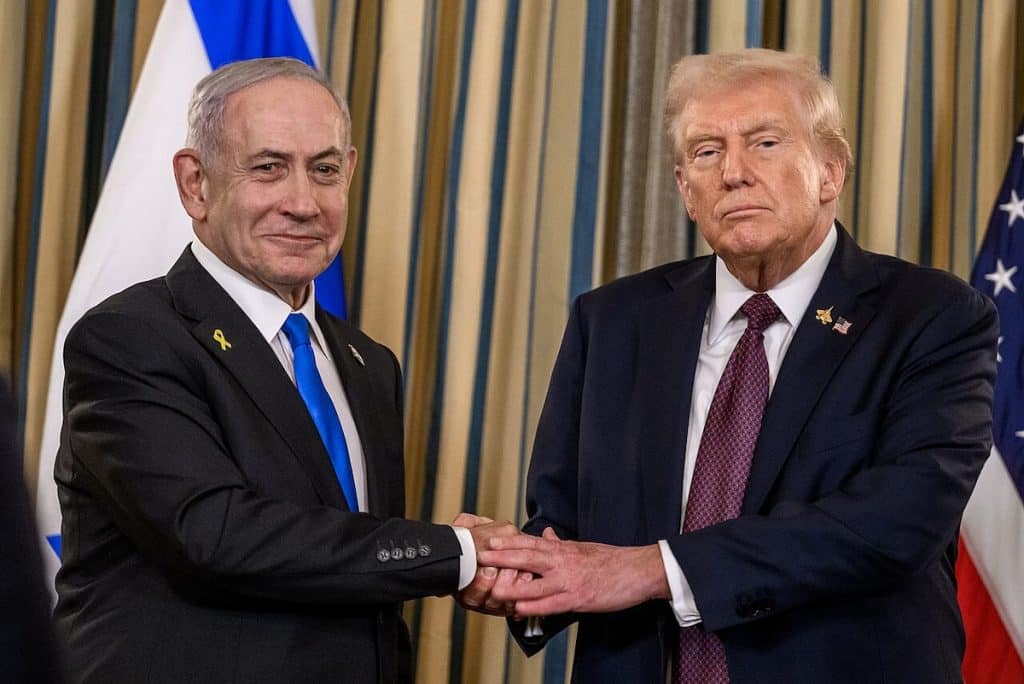
President Donald Trump and Israeli Prime Minister Benjamin Netanyahu shake hands after joint press conference announcing the U.S. peace plan for Gaza, Monday, September 29, 2025, in the State Dining Room of the White House. (Official White House Photo by Joyce N. Boghosian)

This week, Drop Site News revealed a draft resolution from Trump’s newly christened “Board of Peace.” The resolution outlines what is, in essence, Phase Two of Trump’s unrealistic peace plan that ushered in a new phase of horror in Gaza under the guise of a ceasefire.

The actions outlined in the resolution ignore realities on the ground and paint a very grim picture of what the United States is planning for Gaza. Far from abandoning the ludicrous and offensive imagery Trump shared in that AI video from last year of himself and Elon Musk on a beach in an unrecognizable Gaza, this resolution is the battle plan to turn Gaza into the playground for the wealthy that Jared Kushner presented to the World Economic Forum at Davos last week. It’s a Gaza where the only Palestinians remaining are those chosen to be the servants in the new regime.

It’s a Gaza under permanent American occupation.
The “Executive Board” that would control Gaza

The Board of Peace (BoP) itself has drawn the most attention, but it is not the focal point for Gaza. The BoP is being set up as an international force to challenge the United Nations. It is currently populated entirely by far-right and autocratic figures, and will likely stay that way.

The BoP will be headed by Donald Trump and his role as Board Chair is personal, disconnected from his role as President of the United States. He has full power over the Board’s composition and full veto power over all of its actions. Trump will remain in control of the BoP until he decides to leave or he dies, and he has the sole authority to name his successor. You couldn’t build a clearer autocracy.

The BoP can delegate its authority as it wishes, and that is what it has done regarding Gaza. The “Executive Board” (EB) is the body that will govern Gaza. The EB itself will also have other areas within its portfolio, so it, too, has delegated its power to yet another group, dubbed the Gaza Executive Board (GEB). There is considerable overlap between the members of the EB and GEB.

The members of the GEB include some very familiar names like Steve Witkoff, Trump’s lead negotiator; Susan Wiles, his Chief of Staff; Jared Kushner, his son-in-law; and Tony Blair the former PM of the UK and a war criminal in the 2003 invasion of Iraq.

The rest of the names may be less familiar, but they are all important and, together, they draw a very worrisome picture of how this Board will behave.

Minister Hakan Fidan Ali Al-Thawadi is the Minister for Strategic Affairs of Qatar. He’s been a key figure in the negotiations between the U.S. and Hamas for the past year. Israel objected to his inclusion, but not too loudly. Al-Thawadi has cultivated a strong relationship with Trump.

General Hassan Rashad is the head of Egyptian intelligence.

Marc Rowan is an American billionaire and a major donor to Donald Trump’s presidential campaign. He is the chair of the United Jewish Appeal-Federation of New York, and a major figure in the American Jewish pro-Israel community. Rowan was a leader in the effort to silence academic and student activist criticism of Israel’s genocideandled the charge for the removal of University of Pennsylvania president Liz Magill in 2024.

Minister Reem Al-Hashimy is the Minister of State for International Cooperation in the United Arab Emirates. She was a leading spokesperson in support of the Abraham Accords.

Nickolay Mladenov is a long-time Bulgarian diplomat who has served as both a member of the European Parliament and a top United Nations official. He worked closely with Blair in the Quartet—an international body ostensibly charged with promoting a two-state solution in Israel and Palestine, but which failed utterly—and supported the Abraham Accords when they were agreed upon. Mladenov was enough of a diplomat that he was able to garner public praise from Israel, the U.S., the Palestinian Authority, as well as Hamas leaders. He has also been named by Trump as the “High Representative for Gaza,” so he will have a central role beyond just GEB membership in implementing the Trump plan. Mladenov expressed skepticism about Trump’s first-term “deal of the century,” so it will be worth looking into how Mladenov won Trump over.

Yakir Gabay is an Israeli who is also a citizen of Cyprus. A billionaire real estate tycoon, Gabay made some headlines with his involvement in pressing then-New York City Mayor Eric Adams to deploy police to violently crush the anti-genocide protests at Columbia University.

Sigrid Kaag is a long-time UN diplomat and former Foreign Minister of the Netherlands. She was most recently UN Special Coordinator for the Middle East Peace Process, although she resigned from that role last June. Kaag has not commented on her supposed appointment to the GEB, and it is questionable whether she has or will actually accept this role.

Not only are there no Palestinians on the Gaza Executive Board, but there is also no one with any history of advocating for Palestinian concerns and interests. The EB, to which the GEB will serve as “advisors,” includes much of the GEB: Witkoff, Wiles, Kushner, Blair, and Rowan are also on the EB, along with U.S. Secretary of State Marco Rubio and Deputy NSA Robert Gabriel.

Trump also appointed the head of the World Bank, Ajay Banga, and lawyer Martin Edelman, who has very close ties to both Trump and the UAE, to the EB. Aryeh Lightstone, a former adviser to Trump’s first-term Ambassador to Israel, David Friedman, and Josh Gruenbaum, a bureaucrat who has worked closely with Witkoff and Kushner, were appointed as advisers to the EB.
Palestinians not included in planning Gaza’s future

While there are no Israelis on the Executive Board, it is stacked with extreme supporters of the Israeli right and of Netanyahu. This makes the vague mandate of the entire enterprise much more concerning.

The proposal published by Drop Site states that “the reconstruction and rehabilitation activities of the Board shall be dedicated solely to those who regard Gaza as their home and place of residence.”

But the proposal offers no opportunity for the people of Gaza to have any say at all in their present situation, let alone their future. The EB governs all of the laws. An American-led International Stabilization Force (ISF) controls all security.

The ISF is to be under the command of American Major General Jasper Jeffers. Trump, and Trump alone, has the power to remove the commander of the ISF and must personally approve any nominee to replace him.

The plan further states that “only those persons who support and act consistently [with Trump’s Comprehensive Plan for Gaza] will be eligible to participate in governance, reconstruction, economic development, or humanitarian assistance activities in Gaza.”


The only role currently envisioned for Palestinians in Gaza is to carry out the decisions made for them by others.

In other words, Palestinians who wish to be part of Gaza in any way must meet Trump’s litmus test of support for the external American control of the Gaza Strip. The same will be true for any business, NGO, or even individual who wants to participate in any way in rebuilding Gaza, physically, politically, or economically.

Ideally, for Trump and Jared Kushner, Gaza would be transformed into a giant “company town.” Most of the coastline would be dedicated to tourism. The bulk of Gaza’s eastern border with Israel would be dedicated to industrial zones and huge data centers, doubtless reflecting the massive investments Trump and his Emirati friends are making in AI.

In between would be residential areas separated by parks, agricultural, and sporting sites. In the West Bank, such parks and agricultural areas are frequently declared closed military zones and used for other purposes by the occupying force.

As has been apparent from the beginning, the only role currently envisioned for Palestinians is in the administration of the Executive Board’s decisions. In other words, Palestinian technocrats, laborers, and office workers would be “permitted” to carry out the decisions made for them by others.
The U.S. occupation of Gaza

This resolution provides only a bit more substance to the half-baked ideas Trump has been putting forward since October. And it continues to envision a near-future where Hamas has voluntarily disarmed, Israel has pulled out of Gaza, and the ISF has assumed security control that is welcomed by whatever Palestinians remain in Gaza.

All of that remains fully in the realm of fantasy.

Hamas has repeatedly made it clear that it is willing to discuss decommissioning its weapons, but would not disarm. Given that Israel is, once again, funding rogue Palestinian gangs in Gaza, complete disarmament is suicide for many members of Hamas, Islamic Jihad, and other factions.

The United States is discussing offering amnesty and even a buy-back program for the weapons, but these offers are hardly useful if the lives of Hamas members are put at grave risk by disarmament, even if we assume that the U.S. keeps to its word and that Israel does not itself hunt these fighters down.

Moreover, Israel is bristling at this entire plan. They prefer to bring the hammer down again on Gaza, especially now that there are no hostages, dead or alive, to be concerned with.

Netanyahu is openly stating that Israel will allow no rebuilding in Gaza—where it is killing people, including infants, not only with its weapons but by denying Palestinians the materials to shelter from the winter elements—until Hamas is “disarmed.”


What is taking shape in Gaza is a new kind of foreign occupation. This time, the U.S. would be the leading force on the ground and an American-led occupation will face resistance just as the Israeli one does.

He is also declaring that Israel will maintain “security control” over Gaza in perpetuity. Israel has informed the U.S. that it wants to expand the zone of Israeli control in Gaza—which already encompasses well over half the Strip—rather than shrink it, as called for by Trump’s plan.

Israel has already reportedly drawn up a plan for a major military operation, a return to the full-blown genocide of last year, which it plans to launch in March unless the U.S. refuses to allow it to do so.

And, finally, a great deal of ambiguity remains about the potential makeup of the ISF. While numerous states have pledged to support the disarmament of Gaza, many have also expressed reluctance to be part of the force if it means having to confront armed Palestinian resistance groups.

There is a good reason for their reluctance. What is taking shape in Gaza is a new kind of foreign occupation. This time, the U.S. would be the leading force on the ground unless it allows Israel to renew its aggression, something Trump doesn’t want. It would mark the greatest failure of his long list of failures, undermining his claim to have “ended wars all over the world.”

But foreign troops are foreign troops. It is possible that the Trump administration has bought into its and Israel’s own nonsense so thoroughly that they really believe that as long as the boot on Palestinians’ necks is not Jewish, the Palestinians can be controlled and will not fight for their freedom. Because, in their telling, the entire Palestinian struggle is only about fighting “the Jews.”

But an American-led occupation will face resistance just as the Israeli one does. That will manifest even if Hamas is disarmed.

An American occupation of Gaza on Israel’s behalf will be just as unwelcome by Palestinians as an Israeli one backed by the United States. It may take some time for the people of Gaza to regroup from the past two and a half years to organize impactful resistance, but it will come, as it always has.

The solution is simple: allow Palestinians their freedom and their rights. But that solution is beyond the imagination of Washington and Tel Aviv. So, meet the new occupation. It will be no more pleasant than the old one.