DEFYING TRUMP
Dominion Energy and Vineyard Wind Reach Milestones as Work Resumes
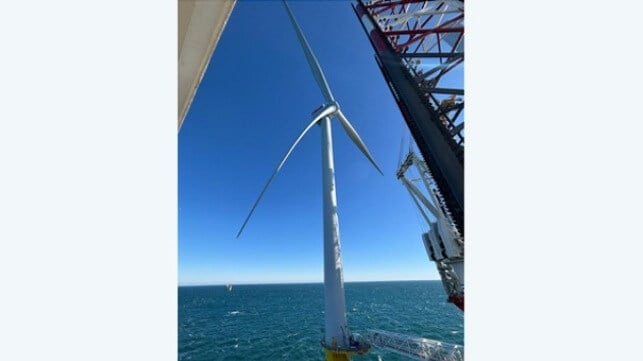
Within days of resuming work at Dominion Energy’s Coastal Virginia Offshore Wind project and Avangrid’s Vineyard Wind 1, both projects have marked key milestones. The projects argued they were at critical stages of construction in court and received preliminary injunctions to prevent the Trump administration from enforcing a stop-work order.
Dominion Energy provided a detailed update on the status of its project, reporting it has reached 71 percent completion and, critically, the first wind turbine generation was installed in January. The company’s massive wind turbine installation vessel, Charybdis (the only U.S.-flagged WTIV vessel), also began loading in December after a lengthy commissioning process and is deployed for the installations.
The presentation outlines that the project remains on track to generate its first power this quarter. Although after the delays due to the stop-work order from the Bureau of Ocean Energy Management, they have rescheduled completion to early 2027.
The company reports that 54 towers, 30 nacelles, and 26 blade sets are all on site at the Portsmouth Marine Terminal, which is being used for staging. Also, the third offshore substation has arrived at the terminal.
The month-long delay while it was fighting the stop-work order, however, was costly to the project. Dominion Energy sets the costs related to the BOEM action at $228 million. In addition, it says the Trump tariffs are estimated to add $580 million to the cost of the project. It now sets the total capital budget at $11.5 billion for the project, reporting that $9.3 billion was already invested as of the end of 2025. Dominion Energy has partnered with Stonepeak as an investor in the project, which is also sharing the costs.
Dominion Energy continues to assert that the offshore wind project “represents the fastest and most economical way to deliver nearly 3 GW to Virginia’s grid." In its filings, it emphasized the region’s critical need for power, noting it is home to key military installations, naval shipbuilding, and the U.S.’s growing AI and cyber capabilities.
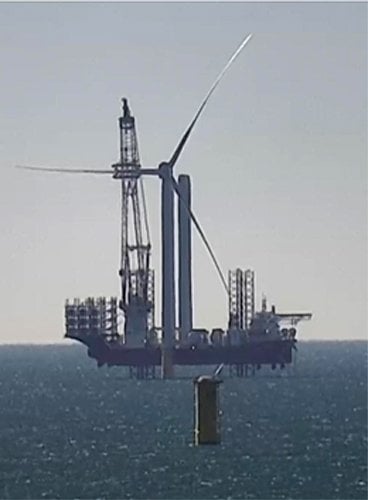
Charybdis has begun the installations (Dominion Energy)
The New England-based Vineyard Wind 1 project also resumed work this week. Local media reports on Wednesday, the 62nd and final turbine tower was sent out from the staging point in New Bedford, Massachusetts. The media story said that there were 10 blade sets, 30 blades total, still at the staging site as the construction nears completion. The installation vessel working on the project is scheduled to depart by the end of March.
Coastal Virginia Offshore Wind and Vineyard Wind 1 were two of the four projects that received preliminary injunctions against the stop-work order. Equinor’s Empire Wind and Ørsted’s Revolution Wind were also permitted to resume work, while the court today scheduled a hearing on February 2 for another Ørsted project, Sunrise Wind, which is the last of the projects seeking an injunction.
French renewable energy firm aims to
develop offshore wind in Nova Scotia
ByThe Canadian Press

HALIFAX — A French firm and its partner in South Korea are eyeing plans to develop wind projects off Nova Scotia’s coast.
Affiliated companies Q Energy France and Hanwha Ocean said Wednesday they have jointly participated in an early phase of the Canada-Nova Scotia Offshore Energy Regulator process that could lead to formal bids for seabed licenses to develop offshore wind.
The offshore regulator says its purpose at this stage is to review and identify eligible companies that can participate in the next call for bids. Companies had a 90-day window to submit their applications, which ended Tuesday.
The early interest of companies is feeding into an ambitious plan by the provincial government to significantly expand renewable energy production.
Junu Lee, CEO of Q Energy, said in an interview Wednesday the company hopes to contribute to Canada and Nova Scotia’s transition to clean energy through large-scale and sustainable offshore wind development.
“From our understanding, this offshore project would be a very important initiative in Nova Scotia... we believe this initiative would be helpful to the economic growth in Nova Scotia as well as Canada,” Lee said, adding that this application represents an early step in the process.
Ken Ilaqua, the company’s head of offshore development, said that if they are pre-qualified through this process, an estimated timeline for commissioning an offshore wind project would be sometime in 2035.
“Because there is a need for the construction for sure... but also for the transmission line and the export of the electricity generated, that will take some time. So basically I think we are talking about 2035,” Ilaqua said.
Lee noted this was just an estimate and that the company would follow the regulator’s timeline.
Colleen Fiske, a spokesperson for Canada-Nova Scotia Offshore Energy Regulator, said the regulator will not be sharing the number of applications received through the pre-qualification process nor names of companies that applied.
“To pre-qualify, companies were required to meet certain financial, technical, and legal and social criteria,” Fiske said in an email Wednesday. Interested companies were required to submit an application that demonstrates how they can meet this criteria in order to develop a project.
In June, Premier Tim Houston said the province’s plan to license enough offshore wind farms to produce five gigawatts of electricity would be increased eightfold to 40 gigawatts, well beyond the 2.4 gigawatts Nova Scotia needs.
He called on Ottawa to help cover the costs of his new Wind West project, saying the excess electricity could be used to supply 27 per cent of Canada’s total demand.
“Nova Scotia is on the edge of a clean energy breakthrough,” the Progressive Conservative premier said in an online video, adding the province is poised to become an “energy superpower.”
Earlier this month, the offshore energy regulator announced that it will begin studying areas of the ocean that could be home to the first turbines for the Wind West project. The Canada-Nova Scotia Offshore Energy Regulator said it is looking for a company to conduct a regional assessment of the studies and preliminary work needed on four patches of ocean earmarked for potential offshore wind development.
The first phase of Wind West is estimated to cost about $60 billion and would produce about five gigawatts of power by 2030. About $40 billion would be for turbine infrastructure, with another $20 billion for new transmission lines. The province has not indicated who would pay for these costs and how they would be divided. However, the provincial government has said it expects to get a four per cent royalty on the project.
If additional phases are fully constructed, the province says the project could generate more than 62 gigawatts, about a quarter of Canada’s total energy capacity.
The areas under consideration for the first phase include Sydney Bight, northeast of Cape Breton, and three more parcels off the Eastern Shore. The project envisions connecting those parcels -- French Bank, Middle Bank and Sable Island Bank -- to the mainland along an abandoned gas pipeline corridor. Sydney Bight would come ashore separately.
By Lyndsay Armstrong
This report by The Canadian Press was first published Jan. 14, 2026.


No comments:
Post a Comment