After Greenland Dispute, EU Wants to Reduce Dependence on American LNG
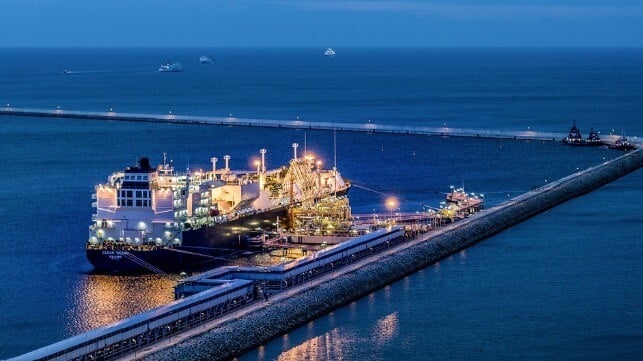
The European Union's top energy official is actively looking to source LNG from outside of the United States, the EU's biggest supplier, because of recent announcements from the White House that have deep implications for Europe's security.
Europe's energy ties with the U.S. have strengthened since the Russian invasion of Ukraine began in February 2022. Several months after Russian troops marched on Kyiv, Russian national gas company Gazprom broke its long-term supply agreements with European utilities, cutting off Europe from inexpensive pipeline gas. In the four years since, the EU has phased out most remaining sources of Russian gas, and it plans to complete that ramp-down by the end of 2027.
To fill the gap, Europe increased its pipeline gas imports from Norway and invested significantly in expanding LNG import capacity. The largest share of the extra LNG has come from one longtime trade and security partner - the United States, which has a booming LNG export industry on the Gulf Coast. Today, nearly 60 percent of European LNG imports come from American suppliers.
That urgently-needed energy supply has allowed European industry to keep running without dependence on Gazprom, an essential factor given the current and predicted levels of conflict with Russia. But the imports have also made EU energy markets dependent on America, and on American decisionmakers, to a degree that now makes some European leaders unsettled.
In a press conference Wednesday, EU energy chief Dan Jørgensen told reporters that after recent interactions with U.S. leadership, Europe is actively looking to source gas from other high-potential exporters, including Canada, Qatar and Algeria. Europe doesn't want to cut off American LNG, he said, but it has decided that it now needs to find additional strategic options. In particular, it is motivated by "the strained relationship to the U.S. and the fact that we have an American president that does not exclude using force against Greenland."
The White House's recent statements about an American need to "own" Greenland - "the hard way" if necessary, with "utilizing the U.S. military" a possible option - have pushed the EU to rethink the assumption that its U.S. gas supply will be secure, Jørgensen said. (U.S. leadership has since disavowed the idea of using force to acquire Greenland.)
The White House told Bloomberg this week that the U.S. remains Europe's most secure energy source. "Thanks to President Trump, U.S. suppliers are the best, most reliable partners, and we will continue to work with European nations to meet their energy demands with U.S. LNG," White House spokeswoman Taylor Rogers said.
Analysts see further signs of European unease in the flurry of diplomatic activity with other partners, like the EU-India "mother of all deals" trade agreement revealed on Tuesday. While the agreement was in the works for months, the timing and the terms have been widely seen as a strategic move to diversify and reduce EU reliance on the U.S. market. China may also stand to benefit from an increased European interest in alternative partners.
"While there are exceptions, there appears to be a trend of America's traditional allies derisking from [the] United States," commented Ryan Hass, a senior fellow in foreign policy at Brookings, in a recent post. "The flow of leaders to China is striking. French, Canadian, Irish, British, Korean, Finnish, and soon German leaders visiting Beijing in recent weeks. Beijing isn't making its offering more attractive or growing less aggressive. It is presenting a predictable alternative."
Top image: An LNG carrier delivers a cargo from the United States at a terminal in Poland, 2020 (PGNiG / Maciej Margas / CC BY SA 4.0)
EU Faces Hard Choices after LNG “Wake-Up Call”
- Europe is growing uneasy over its heavy reliance on U.S. LNG, with EU officials warning that energy security risks are shifting rather than disappearing.
- Diversification options are limited: sanctions on Russian gas and strict EU methane regulations effectively rule out major suppliers like Russia, Qatar, and much of U.S. LNG.
- Gas costs and policy contradictions are rising, as Europe pushes for diversification while remaining locked into record U.S. LNG imports
The European Union needs to diversify its natural gas sources, Brussels’ energy commissioner said this week, expressing a growing unease in European capitals that the EU has become too dependent on liquefied natural gas from the United States. Yet succeeding in that diversification drive will be tricky because of the bloc’s emissions-focused energy policies – and the sanctions on Russia.
“We are speaking to countries around the world that are able to deliver LNG to us,” Energy Commissioner Dan Jorgensen told media in Brussels this week, as quoted by Bloomberg. “I definitely hear this when speaking to energy ministers and heads of state from all over Europe that there is a growing concern.”
The situation represents an interesting reversal of sentiment from just four years ago. Back in 2022, the European Union declared it would switch from Russian pipeline gas as punishment for the invasion of eastern Ukraine and start buying U.S. liquefied gas instead. EU officials hailed the decision as a big step towards energy independence and praised U.S. LNG producers—and the U.S. federal government—as a reliable business partner and energy supplier.
Now, the European Union is the biggest regional buyer of U.S. liquefied gas, which seems to have been the plan all along—but that gas is coming at a steep cost, and with the federal government very different from the one of four years ago, the image of the reliable business partner and energy supplier has changed quite radically.
It was the Greenland affair that played the role of the alarm clock that woke Brussels and national capitals up. Until that point, the European leaders had apparently assumed that Trump would keep doing business with their countries—and the EU—as Biden had before him, namely by continuing the security guarantees and preferential trade arrangements that had been the hallmark of trans-Atlantic relations for decades. Only Trump did not feel like that. Trump demonstrated early on that he was coming to collect—higher NATO spending, import tariffs, and, finally, Greenland.
The myth of the friendly American LNG that could replace all Russian gas and ensure energy security for a continent was, however, dispelled even before Greenland, by Trump’s top energy man. Secretary Chris Wright stated plainly that U.S. producers of liquefied gas have no intention of complying with the EU’s new methane regulation. The regulation requires constant monitoring, tracking, and reporting of methane leaks along the LNG supply chain—and U.S. LNG producers are not investing in that. Incidentally, neither is QatarEnergy.
During his talk with reporters, Commissioner Jorgensen said that European gas buyers were eyeing Qatar, Canada, and Algeria as potential avenues for gas supply diversification. But Qatar, for one, has made it as clear as the U.S. that it will not be doing methane tracking and reporting. And it has done so repeatedly. And with the world’s two biggest LNG exporters out of the methane-reporting experiment, the EU is really short on options—especially now that the top brass in Brussels approved the total ban on any and all Russian gas imports, beginning next year. Of course, it’s still January 2026, and a lot of things could change over the next 12 months, with some observers of the EU arguing that it will soon change its tune on Russian gas. Until this argument finds factual backing, however, the EU is off Russian gas—and unless it drops the methane regulation, it is also out of Qatari and most U.S. gas, too. Alternatively, U.S. gas will simply become even more expensive, raising the question of just how long the EU would be able to afford it.
The bigger question is what the realistic alternatives to U.S. LNG are. The answer, alas, is unpleasant. There is no large enough LNG supplier to step in and take the place of the United States, not economically, at least. This means gas buyers in Europe would be scouring the world for LNG from now on in a bid to advance the new diversification vision of the Brussels political establishment.
Meanwhile, however, there is that trade deal that Commission President Ursula von der Leyen signed with President Trump last year that calls for $250 billion worth of U.S. energy imports into the EU every year until 2027. One could argue whether Trump knew the EU could not physically buy so much U.S. energy, but wanted to make them buy more oil and LNG—which is what he got, by the way. European Union imports of American LNG hit an all-time high last year, though their price was nowhere near $250 billion.
Trump probably knew the Europeans couldn’t buy $250 billion worth of oil and LNG. But if the Europeans get really serious about that diversification, the Greenland deal may be canceled in favor of another, more direct option. If anything, President Trump has proven repeatedly that he follows his own rules.
By Irina Slav for Oilprice.com
The Coming LNG Supply Wave Is Good News for Europe
- Europe’s gas storage is draining at its fastest pace in years, with inventories likely to end winter at their lowest level since 2022.
- The EU is forced to secure unusually high LNG imports through summer 2026 to meet storage targets.
- Relief is expected from a looming global LNG supply wave, led by new U.S. and Qatari export capacity.
Europe’s natural gas storage sites are depleting at the fastest pace in years, suggesting stocks would end this winter at their lowest level since 2022.
End-of-winter supply in storage at the lowest in four years means that Europe will need very high imports in the shoulder seasons and the summer to replenish the stocks to adequate levels of 80-90% full storage by November 2026, as per the EU regulations.
It’s a good thing then for Europe that the global LNG market will tilt into oversupply from this year until late this decade, as analysts and forecasters expect.
The bad news for Europe is that the current futures price curve of the European benchmark for gas trading, Dutch TTF, shows higher prices for the summer of 2026 than for the winter 2026/2027. In this market structure, backwardation, prices for nearer contracts are higher than the ones further out in time, discouraging stockpiling.
If this backwardated structure remains after the current winter ends, storing gas for the next winter would be uneconomical for operators and policy makers may have to intervene with some kind of support.
Summer gas prices in Europe are high not without a reason.
This winter, gas storage sites in Europe are draining at the fastest pace in five years, amid below-average winter temperatures which drive heating and power demand higher.
EU gas storage sites were less than 43% full at end-January, according to data from Gas Infrastructure Europe as of January 28.
LNG cargo arrivals were at less than half of the daily volumes withdrawn from storage in January.
The end-January stock levels of 42-43% are well below the 58% average for this time of the year of the past few years, signaling that Europe will have to import more gas in the summer to replenish storage supplies.
With two more months of winter heating demand and higher gas demand for power amid low solar generation, Europe is likely to find itself with just 30% full storage on April 1. This would be the lowest level for end-of-winter stocks since 2022.
So Europe will need more gas supplies for the rest of this year to meet immediate demand and store supply for the next winter. That’s why summer 2026 prices are high—higher than the winter 2026/2027 prices.
Thankfully for Europe, there is a supply wave coming this year and continuing until at least 2029 as major LNG export projects in the top exporters, the United States and Qatar, are scheduled to come online.
Europe is expected to import a record-high volume of LNG this year as stronger demand for replenishing storage sites, the phase-out of Russian supply, and continued pipeline exports to Ukraine will drive increased demand, the International Energy Agency (IEA) said in its Gas Market Report Q1 2026 last week.
After setting a record in 2025, European LNG imports are poised to reach a new all-time high of over 185 billion cubic meters (bcm) in 2026, the agency noted.
Europe’s LNG imports hit an all-time high of over 175 bcm in 2025, surging by 30% (or 40 bcm) from 2024, the report found. Key factors in the record imports were stronger domestic demand, lower piped gas imports, and higher storage injections in April-October.
European LNG netback prices remained mostly at a premium compared with key Asian markets, which incentivized flexible LNG cargoes to flow towards Europe, according to the IEA.
As global LNG supply is set to jump this year, flows to Europe should not be an issue this summer. The coming oversupply could ease market concerns about Europe’s rate of refills ahead of the next winter and flip the futures curve into favoring gas storage.
By Tsvetana Paraskova for Oilprice.com


No comments:
Post a Comment