USCG Considers Homeporting Four New Icebreakers in Alaska by 2029
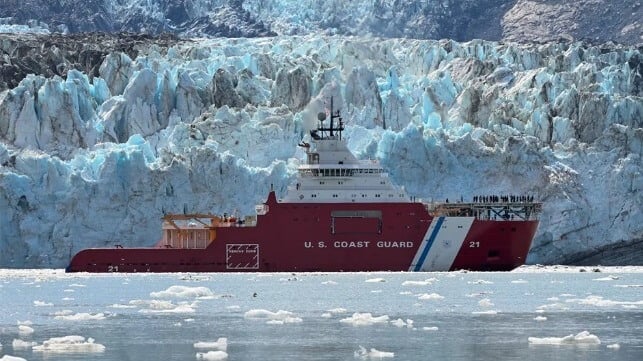
Details about the U.S. Coast Guard’s plans for expanding America’s presence in the Arctic were the focus of a Senate Commerce Subcommittee on Coast Guard, Maritime, and Fisheries hearing on January 29, reports Senator Dan Sullivan of Alaska. Among the key points revealed is that the USCG command is considering homeporting four of the new icebreakers being built in Finland and Louisiana in Alaska when they are completed.
Sullivan, a strong advocate for Alaska and supporter of the U.S. Coast Guard, highlights that the 2025 budget bill, broadly known as the “One Big Beautiful Bill,” provides strong funding for the U.S. Coast Guard’s expansion and modernization. Sullivan said that at least $25 billion is available to the USCG with funding specifically provided for three of the new icebreakers. Ultimately, Sullivan asserts there is funding for 16 new icebreakers, 22 new cutters, more than 40 new helicopters, and nearly $4.4 billion for repairs to shoreside infrastructure.
“The Coast Guard is being asked to do more across every theater,” Sullivan said to reporters, Alaska’s news outlet KTUU writes. During a press briefing, he pointed to counter-drug operations enforcement against sanctioned vessels, Indo-Pacific missions, search-and-rescue operations, and efforts to combat illegal, unreported and unregulated fishing.
During the hearing in Washington, Sullivan pressed the newly confirmed Commandant of the Coast Guard, Admiral Kevin Lunday, on the plans to expand the Arctic presence. Lunday responded that there is a range of options for consideration while saying that they were considering homeporting up to four icebreakers in Alaska. He said decisions were likely to be made later this year.
Sullivan highlights that the agreement between the United States and Finland envisions a total of 11 icebreakers in the first phase of the program. He expects it will grow to 16 icebreakers. He also points out that Alaska will receive more than $600 million for infrastructure upgrades. This includes $300 million for a new Coast Guard pier in Juneau as well as $200 million in Kodiak for homeports, $50 million for improvements in Seward, more than $65 million in Sitka, and more.
Sullivan said the USCG is projecting the work will be completed in 2029, including having the homeport for the new USCG icebreaker Storis. He said he is pushing for the timeline to be accelerated to have it ready by 2028.
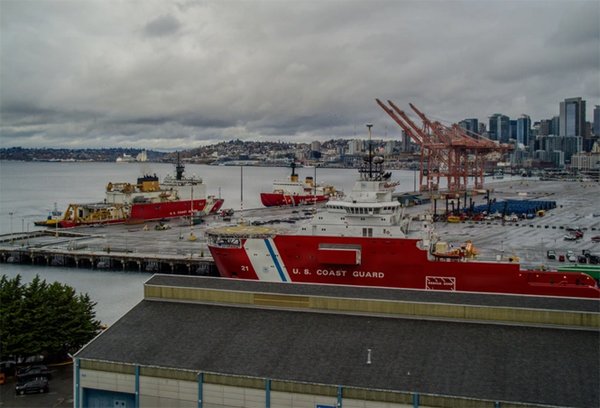
Storis, Healy, and Polar Star together in Seattle in November 2025 (USCG)
Currently, Storis is homeporting in Seattle with the other polar icebreakers, Polar Star and Healy, because the facilities in Juneau are not ready. The USCG issued an overview of her first season. While the primary goal was a training mission, she had also conducted surveillance of Chinese vessels during the deployment.
Being a converted commercial vessel, the USCG highlights that there is ongoing work to make her fully ready for the USCG. Accommodations are being expanded to increase the crew, and during the first deployment, she was using a mixed crew of 45 from the Coast Guard and 22 from the vessel’s builder, Edison Chouest Offshore, helping to teach the Coast Guard how to operate the ship. By the end of 2025, the USCG reports 12 of the civilian mariners were relieved, leaving just 10 civilians in the ship’s crew.
The first commander of Storis, Captain Corey Kerns, believes he was selected because of his engineering design background. His previous post was as a liaison to the U.S. Navy in Japan. Along with the current crew, they are also overseeing upgrades to the CIC and other key functions on the vessel, as well as developing the safety and operational protocols. Storis was the first new polar icebreaker added to the USCG in 26 years.
The USCG reports the next steps for Storis include ice trials in the spring of 2026. She is capable of handling at least six feet of ice, but the ice in September during her deployment was thinner. She is also scheduled to return to the Arctic later this year.
AMTI: China Coast Guard Focuses its Patrols on Scarborough Shoal

Scarborough Shoal has been a flash point for tensions between the Philippines and China since 2012, when Chinese forces occupied the atoll and began a years-long effort to control access. It has been the scene of multiple confrontations over the past year, including water-cannoning incidents that ended in injuries for Philippine citizens. New AIS data analysis from CSIS/AMTI reveals that the China Coast Guard is putting a new priority on presence operations at the reef: last year it more than doubled the number of vessel-days it allocated to Scarborough Shoal and largely reduced its presence at other South China Sea hot spots.
Based on satellite AIS data, AMTI calculates that the China Coast Guard maintained a vessel presence at Scarborough Shoal for 352 days last year, or roughly 96 percent of the time. The count is likely an underestimate, since missed transmissions and periods of AIS-dark operation would be undetected.
The most telling number is the sheer volume of ship-day patrol resources that the CCG assigned to Scarborough. Chinese cutters were on station at the reef for 1,099 ship-days over the span of the year, more than double the 516 ship-days spent there in 2024. Up to five CCG vessels at a time were spotted at the reef, and the typical presence on an average day was three hulls.
Even on the few days of the year when there were no signs of Chinese activity on AIS at Scarborough, there was likely a CCG cutter nearby: the Philippine Coast Guard reported a Chinese presence during most of this period. This suggests a nearly-constant CCG patrol, often augmented by PLA Navy gray-hull assets (not visible on AIS and not counted here).
Likewise, the level of effort at Sabina Shoal - just east of Philippine-occupied Second Thomas Shoal - more than doubled to 405 ship-days. There was a nearly-constant presence of one vessel at Sabina on AIS, occasionally augmented with a second. China Coast Guard crews benefit from modern basing infrastructure at nearby Mischief Reef, and the AIS tracks for one large cutter show multiple port calls at this outpost in between patrols around Sabina Shoal.
While CCG ship-days in the eastern South China Sea increased overall, the resourcing needed for the hike in presence at Scarborough and at Sabina Shoal appears to have come at the expense of other Chinese operations in the area. CCG ship-days at other previous hot-spots declined, according to AMTI, including at Luconia Shoals, Vanguard Bank, Thitu Island and Second Thomas Shoal.

No comments:
Post a Comment