Monday, February 09, 2026


Spain train strikes: Which services are still running and what are your refund rights?

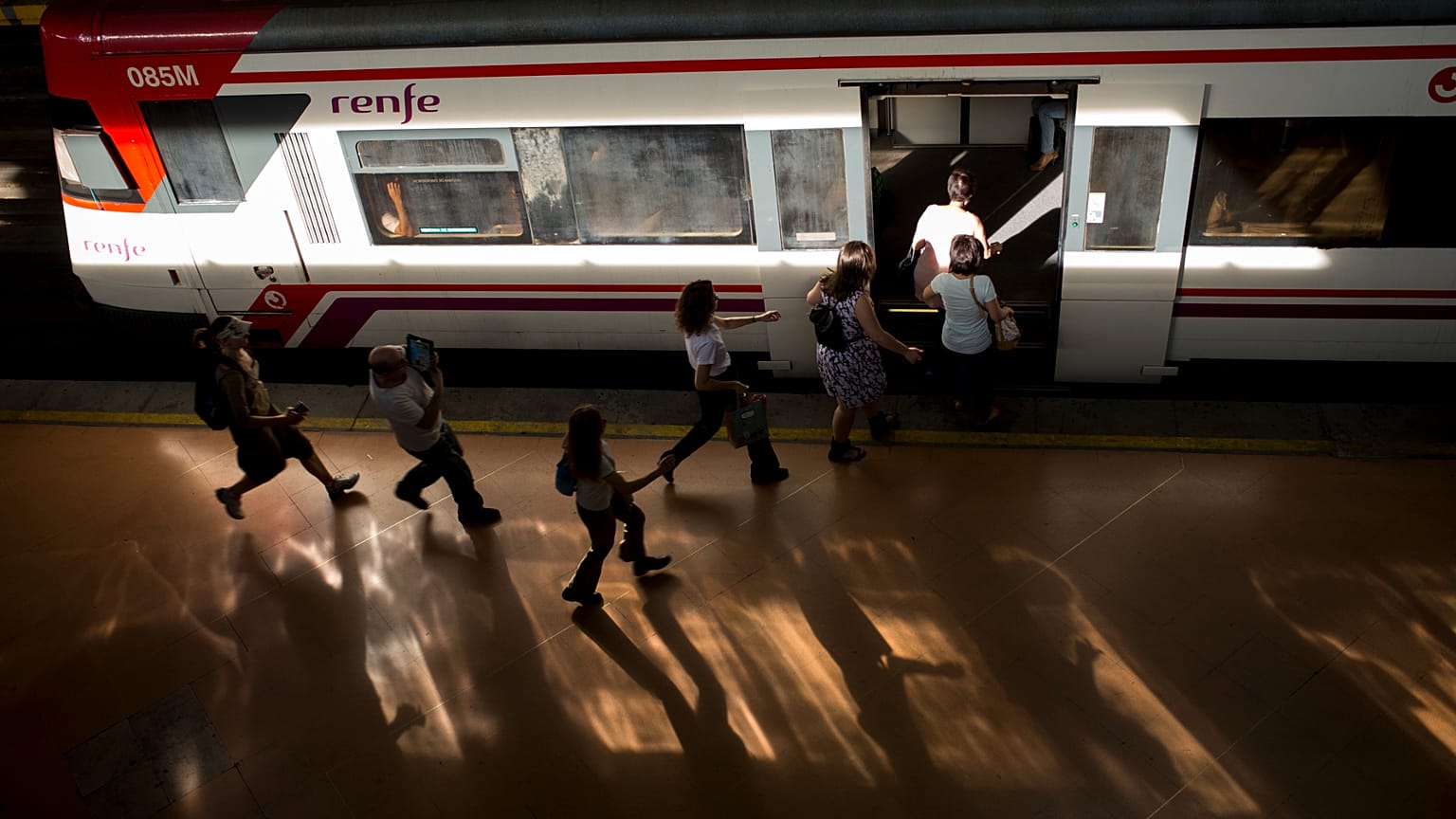
People run to catch a train during a 24-hour partial strike by train drivers at Atocha station in Madrid, 10 June 2016.
Copyright Copyright 2016 The Associated Press. All rights reserved. This material may not be published, broadcast, rewritten or redistributed without permission.

By Christina Thykjaer
Published on 

During Spain's three-day train drivers' strike, more than 330 services have been cancelled.

A train strike in Spain is causing major disruptions to passengers this week.

Train drivers and railway workers are walking out between 9-11 February. As of Monday morning, it has already resulted in the cancellation of more than 330 high-speed and medium-distance trains. Commuter services are also impacted.

The operators Renfe, Ouigo and Iryo have jointly cancelled these services as a result of the strike and are running minimum services, forcing thousands of passengers to change their travel plans.

Which trains are still running during Spain's strikes?

In order to guarantee essential journeys for citizens in Spain, the Secretary of State for Transport and Sustainable Mobility has established minimum train services during the strike days.

Renfe Cercanías (commuter) services will be maintained at 75 per cent during peak hours and at 50 per cent during the rest of the day, while 65 per cent of the usual services will run on medium-distance trains. In the case of high-speed and long-distance trains, minimum services are set at 73 per cent of scheduled journeys.

These percentages are set by the central government in accordance with current railway legislation, although there are territorial exceptions. In Catalonia, the Generalitat is responsible for determining the minimum services for suburban and regional trains operating entirely within the region, whereas in the Basque Country this falls to the autonomous government for Iberian and metric gauge suburban trains.

Ticket changes and refunds during Spain's train strikes

Renfe says affected passengers can cancel or modify their tickets at no additional cost, regardless of the sales channel used. This measure applies both to passengers whose trains have been cancelled and to those who decide not to travel during the strike.

The operators recommend that passengers check the status of services before going to stations, as train schedules may vary throughout the day.

How long will Spain's train strike last?

The strike will continue until Wednesday 11 February. It comes after unions failed to reach an agreement with the Ministry of Transport and the companies in the sector.

The trade union organisations defend the stoppages as a measure to demand labour and safety improvements.

The beginning of the year was marked by several railway accidents in Spain, including the deadliest in decades, which has intensified the debate on safety on the network, working conditions and the need to reinforce operational protocols. This has increased pressure on both companies and the administration in the midst of negotiations with the unions.

Spain has fallen behind in rail network inspection

Several specialised train drivers who were hired for network supervision by state-owned railway network manager Adif have said that they were left without assigned tasks for extended periods, despite having contracts to carry out this work, according to Spanish newspaper El Mundo.

This complaint from train drivers is part of a wider criticism of the management of rail infrastructure maintenance, which some workers see as uncoordinated and ineffective.

The fleet designed to inspect the tracks has in many cases been inoperative or in prolonged approval phases, which, in the complainants' view, has hampered the ability to continuously monitor the network.

This situation was the subject of an injunction from the Labour and Social Security Inspectorate, which pointed out the absence of work calendars and annual timetables for these drivers, a basic element to ensure that they could carry out their duties normally.


Milan protesters rally against environmentally and economically 'unsustainable' Winter Olympics


By Fortunato Pinto & Giorgia Orlandi
Published on 

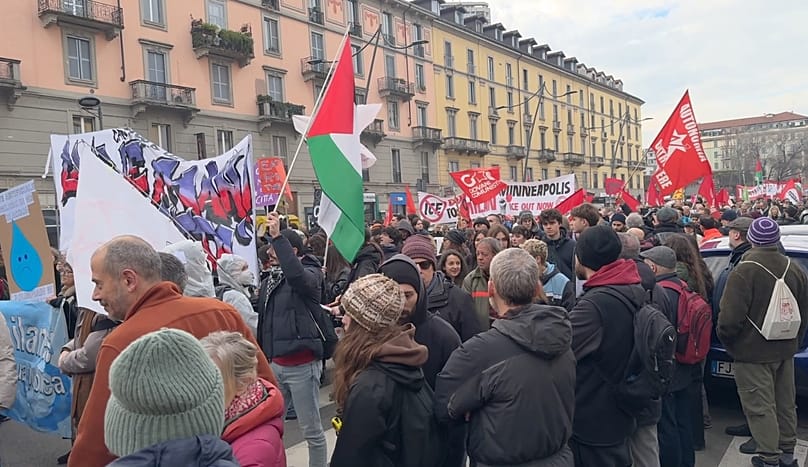
A demonstration took place in Milan on the first day of the 2026 Milan-Cortina Winter Olympics, with protesters lamenting the environmental and economic effect of the Games on the region.

The spectacular 2026 Milan-Cortina Winter Olympics opening ceremony on Friday evening evening showcased Italian culture and placed a heavy emphasis on the theme of harmony.

Nevertheless, there was no shortage of criticism, with boos directed at Israel's Olympic team, as well as US Vice President JD Vance when he appeared on the San Siro stadium's big screen.

Outside the venue, the city of Milan took centre stage on the eve of the Games - not only for high level political meetings, but also for widespread protests - Friday saw a demonstration by activists and students against the presence of the ICE. On Saturday, there was a protest organised by grassroots union against the environmental impact caused by the Winter Olympics.

A demonstration in Milan on 7 February 2026.
A demonstration in Milan on 7 February 2026. Giorgia Orlandi/Euronews

Protesters marched through the city, passing by the newly opened Olympic Village. Among the banners displayed, some read “ICE out”, while others criticised Giorgia Meloni's government as well as Milan mayor Beppe Sala.

While the march was mostly peaceful, a brief confrontation with Italian police marked the end of the demonstration.

Police fired tear gas and a water cannon at dozens of protesters who threw firecrackers and tried to access a highway near a Winter Olympics venue on Saturday.

The demonstrators appeared to be trying to reach the Santagiulia Olympic ice hockey rink after the skirmish. By then, the larger peaceful protest, including families with small children and students, had dispersed.

Earlier, a group of masked protesters had set off smoke bombs and firecrackers on a bridge overlooking a construction site about 800 metres from the Olympic Village that's housing around 1,500 athletes.

Protesters: Games environmentally and economically unsustainable

"It's public money that has been spent on a display window. It may be interesting to have these showcase events, but at a time when there is not enough money for essential things, it makes no sense to spend it in this way," a healthcare worker at the protest told Euronews.

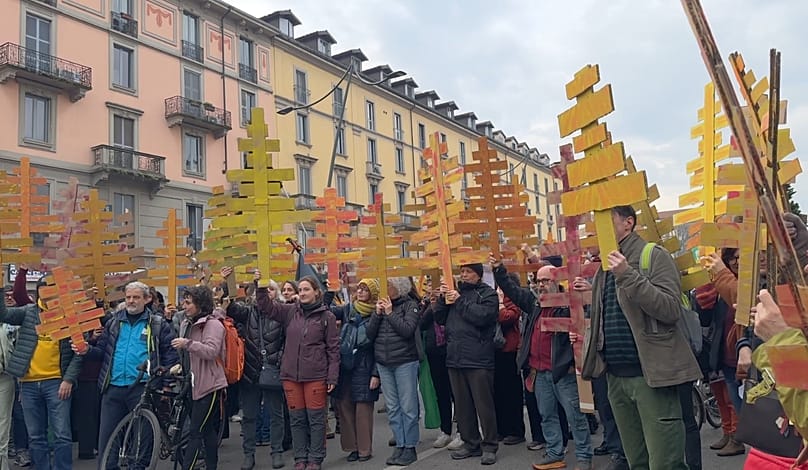
Protesters holding up signs in Milan on 7 February 2026.
Protesters holding up signs in Milan on 7 February 2026. Giorgia Orlandi/Euronews

Another protester criticised the national government and the mayor of Milan, describing the works carried out for the Games as environmentally unsustainable

A third protester criticised the Olympics because "they have not brought any wealth to the city of Milan and Lombardy". According to him, "they have taken money away from social welfare, public schools and healthcare. This money has literally been burned, and not a single lira will go to Italian citizens, particularly those in Lombardy, so these are bogus Olympics."

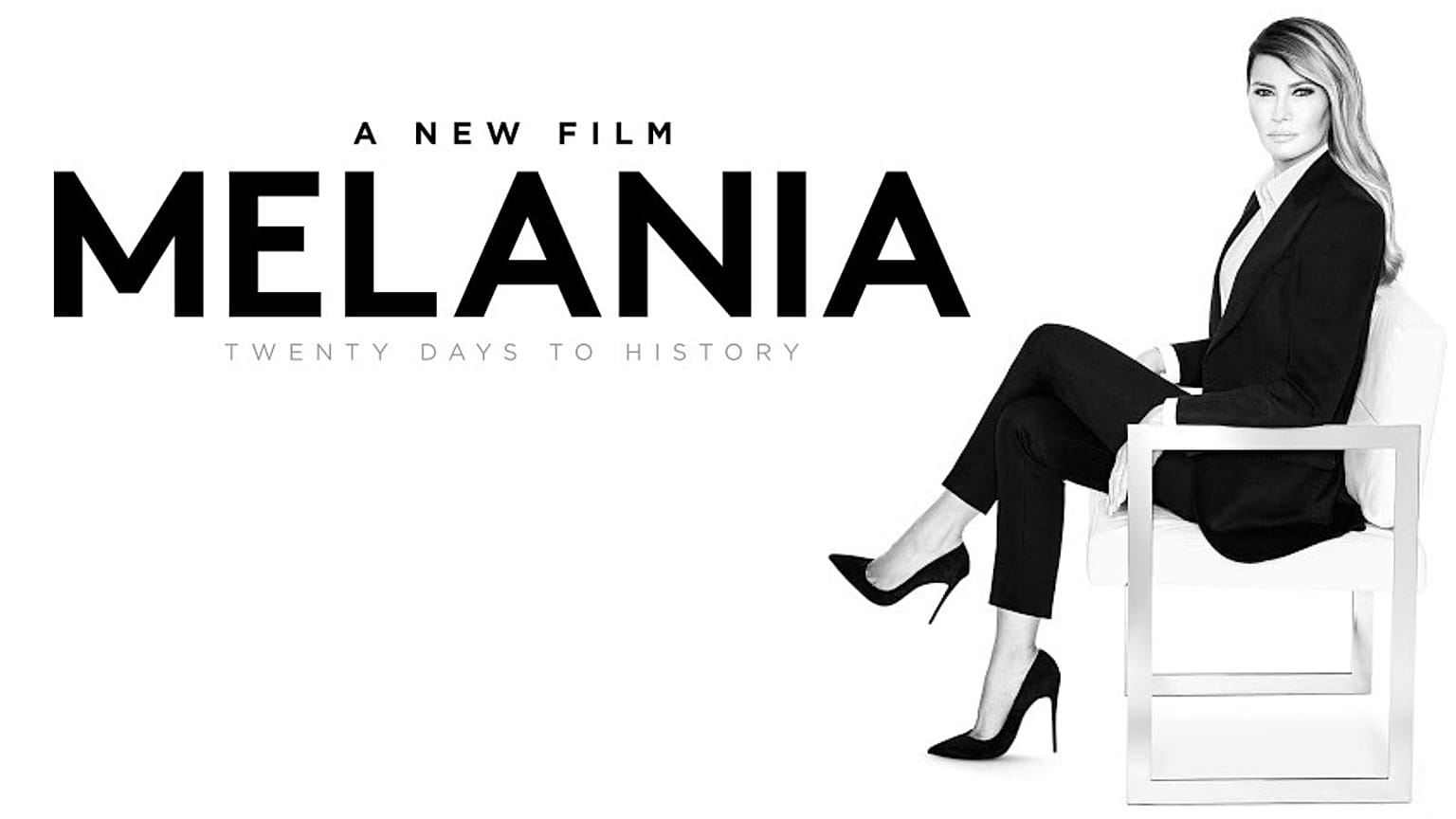
'Melania': Why the Mrs Trump documentary isn't a documentary at all

Melania - A 'documentary' worth seeing?
Copyright Amazon MGM Studios

By David Mouriquand
Published on Euronews

Euronews Culture’s David Mouriquand went to see the Melania Trump documentary ‘Melania’ so you don’t have to.

At the end of time, when the fabric of space and time has collapsed, there will be a final level boss, the gatekeeper whose vacant stare finally reveals that there is no benevolent deity to explain everything and that behind the grotesque pantomime we call life hides no greater truth. The gatekeeper of this cosmic harlequinade could very well be Melania Trump.

Harsh? Not if you’ve sat through Melania, the new documentary directed by Hollywood outcast Brett Ratner, which Amazon has spent $40m to acquire – with $28m going directly into Mrs. Trump's tailored pockets.

It follows the terrifyingly emotionless US first lady during the three weeks leading up to the second Trump inauguration, aiming to offer rare and unfiltered insider access to an inscrutable figure.

“Everyone wants to know” are Melania’s first words.

Debatable.

While there could have been a flickering ember of hope that we actually might learn something about the former model from Slovenia who ended up marrying the most anti-immigrant president the US has known, to say that Melania is short on substance is a cruel insult to things that are short on substance.

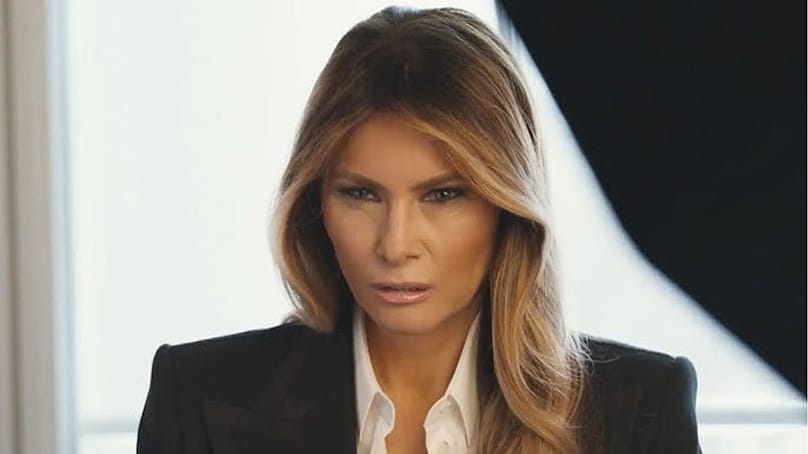
Instead of a sliver of insight on the supposed enigma hiding behind expensive designer hats or information about the true dynamics of her marriage, we only get to see a perpetually scowling figure. She selects gold eggs with caviar for the inauguration dinner. She picks out “really sharp” outfits with fashion designers. She delights us with vapid pull quotes which sound like they’ve been delivered by an AI on a quest to prove its soullessness – monotonously delivered aphorisms like “we are all bound by the same humanity” and “cherish your family and loved ones”.

Oh, we do learn that her favourite recording artist is Michael Jackson.

It was all worth it, then.

Melania Amazon MGM Studios

The only human moment in this self-congratulatory portrait of privilege, one singularly uninterested in mining anything beyond the surface, is Melania sharing that she is still grieving her “beloved mother” Amalija Knavs, who died in January 2024.

It’s a potentially interesting insight that could have provided some depth, but in lieu of injecting humanity, the personal detail only emphasises a cruel lack of empathy. We witness this when Melania unable to conjure the slightest bit of compassion at President Jimmy Carter’s funeral. She’s not thinking about the recently deceased human being or the sorrow felt by his loved ones; she only cares about her narrative.

Somewhat perversely – and this is perhaps the film’s greatest trick – Mrs. Trump’s lack of personality and overall lifelessness makes her husband come off as... whisper it... almost charismatic. Donald Trump occasionally appears in Melania, and while the lack of warmth between the two was already plain to see, he comes off as a breath of fresh air. Quite the feat.

However, even this surprising default side-effect is undercut by Donald reminding audiences that empathy is also not his forte. He heartlessly says, “This one had a hard time with that” when referring to his wife’s mother’s death.

Every pot finds a lid.

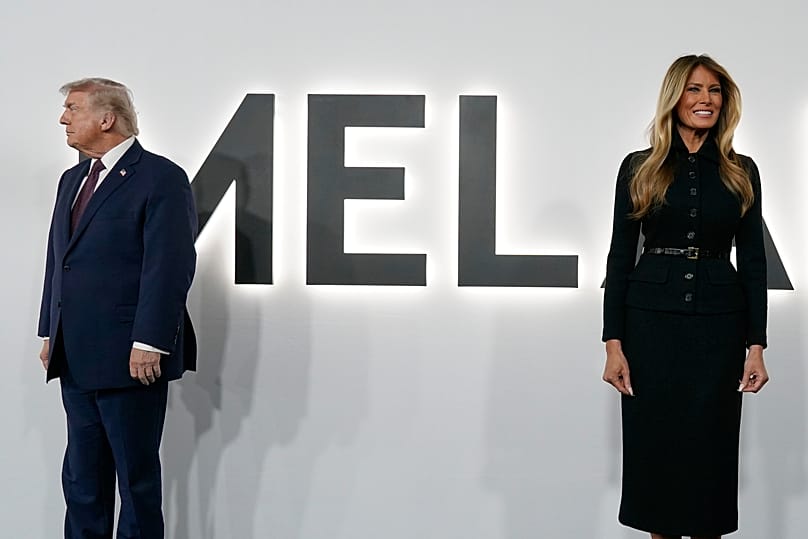
Donald Trump and Melania Trump at the premiere of 'Melania' at The John F. Kennedy Memorial Center - 29 January 2026 AP Photo

Many were quick to accuse Melania of being a despicable piece of propaganda even before seeing it. It’s not. Propaganda has a point. Forceful tools of hatred like Triumph of the Will and Birth of a Nation had evil purpose

Melania can be mentioned in the same sentence as these films but only remains as a staged puff piece - a cynical attempt by Jeff Bezos to curry favour with Trump and an anti-documentary cash-grab orchestrated by people who only care about money and the furthering of empty mythologies designed to feed the Trump brand. And by the time the film ends with a suspiciously long list of Mrs. Trump’s supposed achievements as First Lady (none of which we actually get to witness), you’ll be too bored to notice - much less want to march for the Trump cause.

So what is Melania? Ultimately, it’s a shallow, 104-minute-long vanity project whose staggeringly misjudged timing reveals it to be the ultimate "F*ck you”.

The release of Melania comes at a time when the Trump administration’s actions have led to innocent people being shot, creating fear, anger and grief across America. The images of Melania Trump picking out expensive outfits, spouting ‘wisdom’ about shared humanity, and demanding audiences to sympathise with her own grief don’t land so well in the context of tragedy.

And in case you needed another reason to want to avoid Melania, the film also hits theatres when its director Brett Ratner, already accused of sexual assault by multiple women in 2017 (denied claims that included one allegation of rape), has appeared embracing a young woman alongside sex offender Jeffrey Epstein in images recently released by the US Department of Justice.

But much like the First Lady's infamous “I don’t really care, do you?” jacket, Melania is the embodiment of that very sentiment. A bird flip from those who only care about themselves.

One could laugh at how transparent it all is, if it wasn’t so soul-crushingly bleak. The cosmic harlequinade continues.


Centre-left António José Seguro beats far-right rival to Portuguese presidency

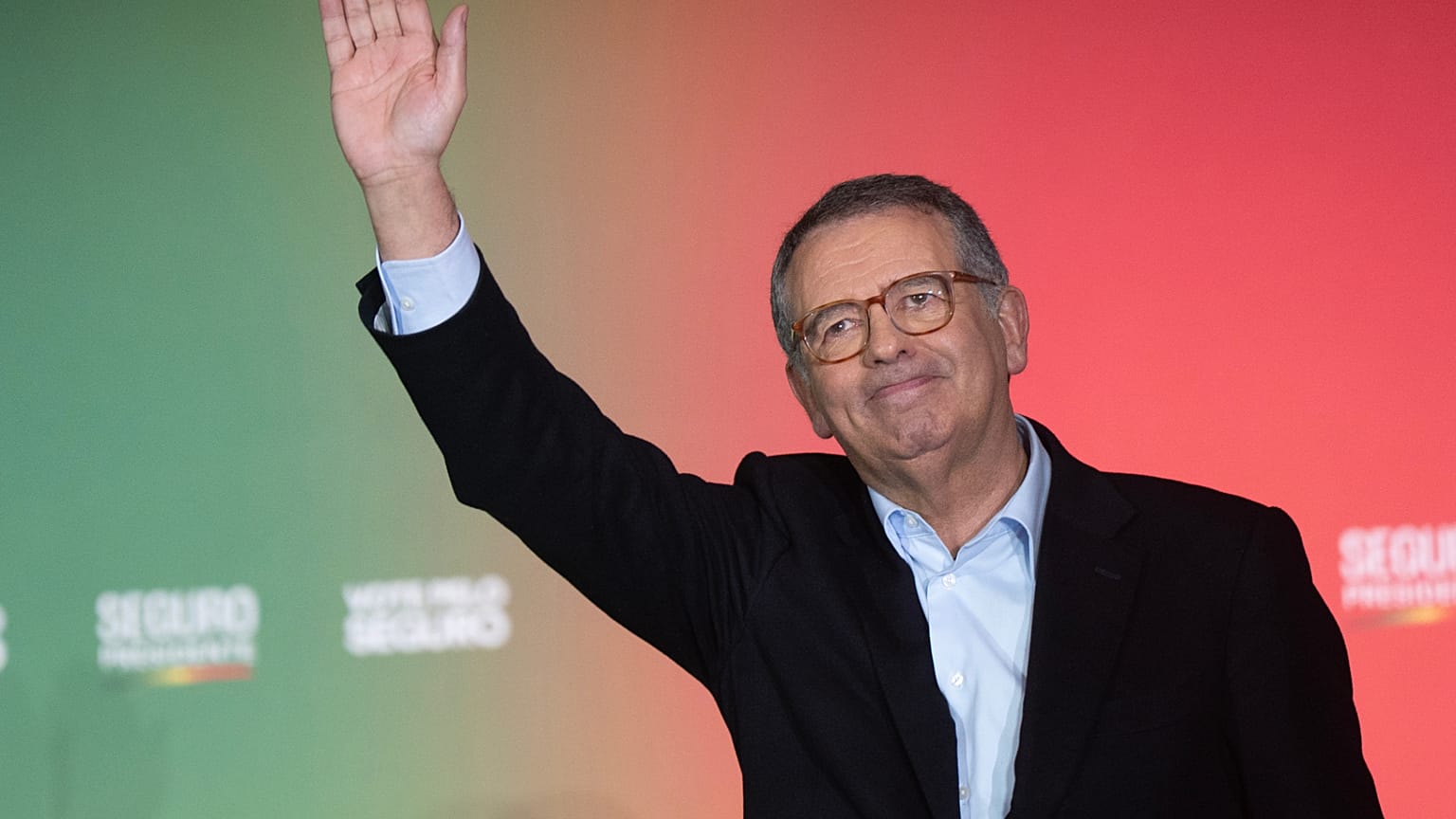
Presidential candidate António José Seguro, of the centre-left Socialist Party, waves to the crowd during a campaign rally ahead of the presidential election, 5 Feb 2026.
Copyright Ana Brigida/AP Photo

By João Azevedo & Joana Mourão Carvalho & Bruno Figueiredo Orestes Georgiou Daniel with AFP
Published on 

The Socialist Party candidate António José Seguro won with 66.7% of votes, compared with 33.3% for André Ventura's far-right Chega party according to official results with 99% of votes counted.

Centre-left Socialist candidate António José Seguro takes a convincing win over far-right rival André Ventura in Sunday’s Portuguese presidential election, according to official results with 99% of votes counted. He becomes the first president from the socialist camp in 20 years and now returns to the forefront of national politics. In his victory speech, he promised to be a demanding and vigilant president, but never a counter-power.

“I promised loyalty and institutional cooperation with the government, and I will keep my word. I will never be a counter-power, but I will be a president who is demanding when it comes to solutions and results,” said Seguro.

Seguro, 63, secured a five-year term in Lisbon with 66.7% of the vote, compared with 33.3% for Ventura’s Chega party. The new Socialist leader campaigned as a moderate candidate and pledged cooperation with Portugal’s centre-right minority government, rejecting Ventura’s anti-establishment and anti-immigrant rhetoric.

He gathered support from other mainstream politicians who want to halt the rising populist tide.

European Commission President Ursula von der Leyen took to social media to congratulate Seguro, writing: “Portugal’s voice for our shared European values remains strong.”

Meanwhile, André Ventura knew from the outset the night would not end in victory. Still, he recorded his strongest result to date, with Chega surpassing one and a half million votes for the first time. While falling short of the nearly two million won by the Democratic Alliance in the last legislative elections, Ventura secured 33 percent — higher than the 31 percent obtained by the governing parties in May.

André Ventura said he feels strengthened after election night. He claims to be the leader of an unstoppable movement that, sooner or later, will succeed in transforming Portugal, in the name of the people, against the elites.

Following the results, Ventura shared his optimism for his party. He said, “I think the message from the Portuguese people was clear. We lead the right in Portugal, we lead the right-wing space in Portugal, and we will soon govern this country.”

Eleven million people in Portugal and abroad were eligible to cast their ballots in the election.

António José Seguro was a favourite to win the runoff against André Ventura, whose Chega party was created in 2019 and is now the largest opposition force in parliament.

In the first round of the election, Seguro won 31.1% of the vote, while Ventura took 23.52%.

In Portugal, the presidency is largely a figurehead with no executive authority. Traditionally, the head of state remains above party politics, acting as a mediator to resolve disputes and ease tensions.


New trade routes in a fractured world

New trade routes in a fractured world
By bne IntelliNews February 6, 2026

US President Donald Trump has upended the liberal world order that promoted free trade agreement and cooperation, for a more selfish protectionist “me first” mindset. Trump is actively dismantling the rules-based international order, restricting competition and turning tools like tariffs into political weapons. As part of an new economic paradigm that is a return to a pre-world war imperialistic transactional approach he is also trying to divide the world into spheres of influence again as part of his updated Monroe Doctrine outlined in his National Security Strategy released at the end of last year. 

The result is a scramble to diversify away from US trade. In her speech announcing what she called the “mother of all trade deals” with India in January, European Commission President Ursula von der Leyen said the motivation was that “trade has been weaponised”. 

After 20 years of negotiation, the EU suddenly felt compelled to close the agreement, which will slash duties on Indian imports and pry open a long-protected market. Brussels feels exposed to the increasingly unpredictable US, Europe’s biggest trade partner, accounting for 20% of exports and $4.5 trillion in annual trade.

In the same week, the EU also moved to finalise a near-identical deal with Mercosur in Latin America, likewise decades in the making. Neither deal offsets reliance on the US market, but both mark the start of a long process to spread risk and diversify global business.

However, the process started well before Trump took office. After two decades of prosperity fuelled by “globalisation” following the collapse of the socialist experiment in 1991, the “rise of the rest” reached a point at the start of this decade where tensions between east and west were starting to grow as countries like Russia and China began to flex their economic muscles.

That led a fractured world where smaller countries began to coalesce into groups in either the US-led or China-led camps. This process was accelerated by the global pandemic in 2020 when companies suddenly had to shorten supply chains and reshoring operations. Trump has only catalysed a breaking up of global trade that was already well underway, amply illustrated by the slow death of the WTO, which at one point a decade ago was supposed to be regulator of globalised trade, but today is totally dysfunctional.

Russia’s invasion of Ukraine and ensuing sanctions further redirected investment into new Eurasian trade routes. The Middle Corridor, linking Europe and East Asia via Central Asia and the Caucasus while skirting Russia’s southern flank, has gained prominence. Trump has only catalysed a fragmentation of global trade that was already underway, illustrated by the slow decline of the WTO, once the regulator of globalised trade, now largely paralysed.

South-South trade grows

As bne IntelliNews has reported, the Global South is now rapidly forming alternatives to the Western-led global order, which Chinese President Xi Jinping and Russian President Vladimir Putin has criticised as the “unipolar” world – a US hedgemony. In their alternative multipolar world order, Global Emerging Markets Institutions (GEMIs) are being rapidly rolled out or beefed up to manage geopolitics, trade and security – new institutions that the Western powers are largely excluded from such as the BRICS+ or G20.  It’s still a work in process, but trade is already rapidly shifting to follow the contours of the new realities.

Entering 2026, trade tensions are rising between the US and its partners, while trade is on the increase within partnerships and blocs that do not include Washington, as set out in a map shared by analysts from research firm BMI in a recent webinar.
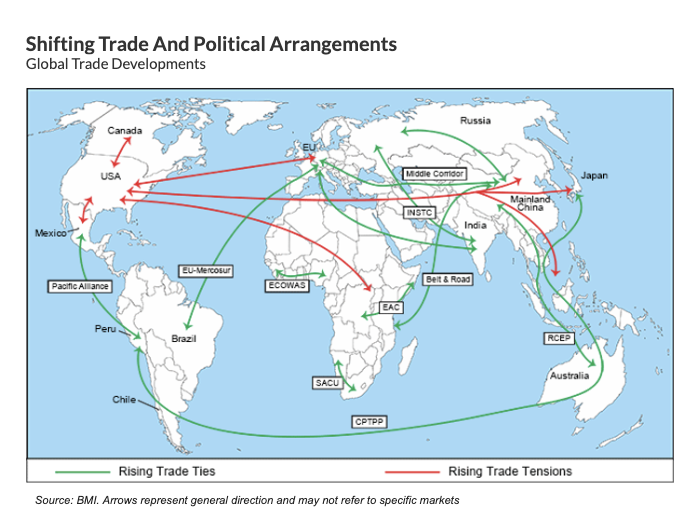
 

A new report from the United Nations Conference on Trade and Development (UNCTAD) also says that global trade “enters 2026 under mounting pressure from slower growth, geopolitical fragmentation, accelerating digital and green transitions and tighter national regulations”. 

According to UNCTAD, “These forces are reshaping trade flows, investment decisions and global value chains, with the greatest risks and opportunities concentrated in developing economies … Nearly two-thirds of global trade now occurs within value chains reshaped by geopolitics, industrial policy and new technologies.”

UNCTAD data indicates a sharp rise in South-South trade over the last three decades, from $0.5 trillion in 1995 to $6.8 trillion in 2025. More than half of Africa’s exports, for example, now go to other developing countries. The share of Brazil’s imports coming from Asia rose sharply after Trump’s tariffs were announced. 

However, as UNCTAD points out, interregional trade outside Asia, particularly between Africa and Latin America, remains underdeveloped. Strengthening these linkages could become a key driver of resilience in global trade networks.

Moreover, interdependence can fuel tension as much as growth, as shown by frictions in trade within Asia. As supply chains deepen locally and governments lean on industrial policy, economies increasingly clash, not only with the US or Europe, but with one another.

India has expanded anti-dumping duties and quality controls, hitting imports from China, Vietnam and South Korea, arguing the measures protect domestic manufacturing and reduce import dependence in electronics, chemicals, and steel. China has responded with similar tools, tightening controls on critical minerals and technologies, reverberating across Japan, South Korea and Southeast Asia. Since late 2025, much of China’s trade friction has targeted Japan following Prime Minister Takaichi’s comments on Taiwan.

In Southeast Asia, Indonesia’s restrictions on raw minerals and push for onshore processing have unsettled Japan and South Korea. Thailand and Vietnam face complaints over pricing in sectors from tyres to solar panels. Even within ASEAN, competition for investment is rising.

Yet trade is still expanding in digital services, finance, tourism, EVs, batteries and semiconductors, as companies hedge risks by spreading production. Australia is warming to trade with China again, and LNG supplies to Japan have risen with the Santos gas project. Trade agreements such as RCEP and bilateral deals, including Japan-Vietnam and South Korea-Indonesia, keep channels open despite disputes.

Europe’s trade partners 

As bne IntelliNews has reported, the EU has rushed to seal long-planned agreements with both India and the Mercosur bloc, while leaders of EU countries are also courting China. 

After more than 20 years of negotiations, the EU and Mercosur — Argentina, Brazil, Paraguay, Uruguay — concluded a major trade partnership in January, creating one of the world’s largest free-trade areas, covering roughly 700mn people.

The agreement is designed to dismantle up to 91% of tariffs on European goods entering Mercosur markets and 92% of levies on South American exports to the EU. The deal will significantly expand the access of European goods and companies to the South American market and resources, including rare earths. Brussels estimates it will save European exporters over €4bn annually in duty payments.

Safeguards are included for sensitive sectors, with final approval depending on a decision by the Court of Justice of the European Union.

The EU-India free trade agreement, finalised on January 27 after two decades, cuts duties on 97% of EU exports and grants preferential access for 99% of Indian exports, while protecting sensitive sectors like European automobiles.

Leaders from both sides framed the accord as a landmark step following intensified negotiations as India and Europe sought supply chain resilience together. Under the pact, tariffs on almost all EU goods exports to India will be removed or reduced, delivering up to €4bn in annual duty savings. 

India will gain improved access for textiles, leather and marine products, while lowering barriers on automobiles, and wines and spirits over time for consumers globally. The is part of India’s broader trade diversification, as New Delhi increasingly uses free-trade agreements (FTAs) and bilateral trade deals as an important tool to increase its geo-economic influence. 

Crossing Eurasia 

Efforts to improve transit times between Europe and East Asia across the Eurasian landmass have been underway for years, but Russia’s invasion of Ukraine and subsequent sanctions have altered priorities, in particular raising the emphasis on the Middle Corridor. 

China’s Belt and Road Initiative (BRI) spans over 140 countries with estimated investments up to $8 trillion, linking Asia, Europe, Africa and parts of Latin America. Going far beyond trade, it covers transport, energy, industrial, urban, digital and space projects. In the first half of 2025, Chinese firms committed $124bn to BRI projects, highlighting its ongoing strategic importance, according to a report by Australia’s Griffith Asia Institute. However, while some participants have benefitted from enhanced growth, concerns have been raised about debt and governance challenges.

The Middle Corridor (Trans-Caspian International Transport Route) links western China with Europe via Central Asia, the Caspian Sea, the South Caucasus, and Turkey. Bypassing Russia and the Suez Canal, it shortens journeys by 2,500 km and cuts transit times to 10-15 days. Trade is rising quickly, spurring investment in ports, railways and logistics hubs. However, capacity, costs, and political risks remain constraints.

The International North-South Transport Corridor (INSTC) links the Indian Ocean and Persian Gulf with Russia and northern Europe via Iran, the Caucasus and Caspian Sea. It can reduce transit times between India and Europe by 40% and freight costs by 30%. Growing cargo volumes and new agreements highlight the corridor’s rising geopolitical and economic significance.

Russia’s partners

As sanctions have reduced trade with Western countries, Russia has pivoted east, bolstering its relations with China, India and other countries from the Global South. 

When Russia and China declared a “no limits” partnership in 2022, the symbolism was powerful — but the economic reality has proven very different. Despite deepening ties in energy, defence and diplomacy, the commercial relationship is now showing signs of strain across trade, investment and financial channels.

Bilateral trade surged to a record $244bn in 2024, but has since contracted by around 10% in the year to September 2025. China remains Russia’s dominant trading partner, accounting for 30% of its exports and half its imports. Yet Russia accounts for just 3% of China’s goods exports.

The strong relationship between Russia and India was highlighted by Russian President Vladimir Putin’s visit to Prime Minister Narendra Modi of India in December 2025, as Putin has broken with the West completely and taken a big bet on the Global South Century.

As bne IntelliNews reported, Putin brought a planeload of big Russian businessmen with him, with the aim of setting up Russian JVs — to find a use for the pile of rupees accumulated from Russian oil sales to India and supercharge India’s industrial and manufacturing prowess at the same time.

South-South blocs 

Reflecting the increase in South-South trade, blocs uniting countries across Asia, Latin America and Africa have grown in prominence, and also attracted interest from outside the region. 

The Regional Comprehensive Economic Partnership (RCEP) unites 15 Asia-Pacific economies that together account for about 30% of global GDP, trade, and population. It brings together the ten ASEAN states with China, Japan, South Korea, Australia, and New Zealand. Signed in 2020 and in force since January 2022, RCEP is widely seen as strengthening Asian supply chains and deepening intra-regional trade, while enhancing China’s economic influence. The bloc has opened to new members, with Sri Lanka advancing its accession bid in 2025.

The Comprehensive and Progressive Agreement for Trans-Pacific Partnership (CPTPP) links 12 Asia-Pacific and European economies, eliminating tariffs on over 99% of goods and easing trade in services, digital commerce, and investment. The UK joined in 2024, and several other countries including Indonesia have applied or expressed interest.

Uniting Africa 

Despite recent growth, trade between African countries remains modest as a share of total trade, but the African Continental Free Trade Area (AfCFTA) is intended to change this pattern. 

It unites all 55 African Union member states and eight regional blocs. Its goal is to form a single continental market of around 1.3bn people with a combined GDP of about $3.4 trillion. As a flagship initiative of the AU’s Agenda 2063, it supports Africa’s long-term transformation and global competitiveness. AfCFTA seeks to remove trade barriers, expand intra-African trade, and promote value-added production and services. By strengthening regional value chains, it encourages investment, job creation, and industrial development. The agreement entered into force in May 2019, trading began in January 2021, and its secretariat is based in Accra, Ghana. 

The Economic Community of West African States (ECOWAS) is a regional bloc founded in 1975 under the Treaty of Lagos to promote economic integration, political cooperation, and stability across West Africa. Headquartered in Abuja, it unites 15 member states, with Nigeria, Ghana, and Côte d’Ivoire as its largest economies. Its mandate spans trade, transport, energy, agriculture, finance, and social policy, but progress toward a fully integrated market has been uneven, with intra-regional trade remaining low due to tariff resistance and fiscal concerns. ECOWAS has also become a key regional security actor, notably through its ECOMOG interventions in Liberia and Sierra Leone. Today, it enforces a zero-tolerance stance on military coups, threatening sanctions and intervention as instability spreads in the Sahel, where junta-led states have formed a rival bloc aligned with Russia.

The Southern African Customs Union (SACU) comprising Botswana, Eswatini, Lesotho, Namibia and South Africa is the world’s oldest functioning customs union. Revenue-sharing is vital to smaller members. Trade represents over two-thirds of GDP, and the bloc maintains agreements with the EU, UK, MERCOSUR, Mozambique, and the US.

The East African Community (EAC) — Burundi, the DRC, Kenya, Rwanda, Somalia, South Sudan, Tanzania and Uganda — has strong intra-regional trade. Cross-border digital payments and plans for a single regional currency by 2031 signal growing integration and dynamism. The region has also adopted the East African Payment System (EAPS), a real-time gross settlement system designed to ease cross-border payments and facilitate trade.
Made with Flourish


Trans-Saharan gas pipeline gaining momentum

Trans-Saharan gas pipeline gaining momentum
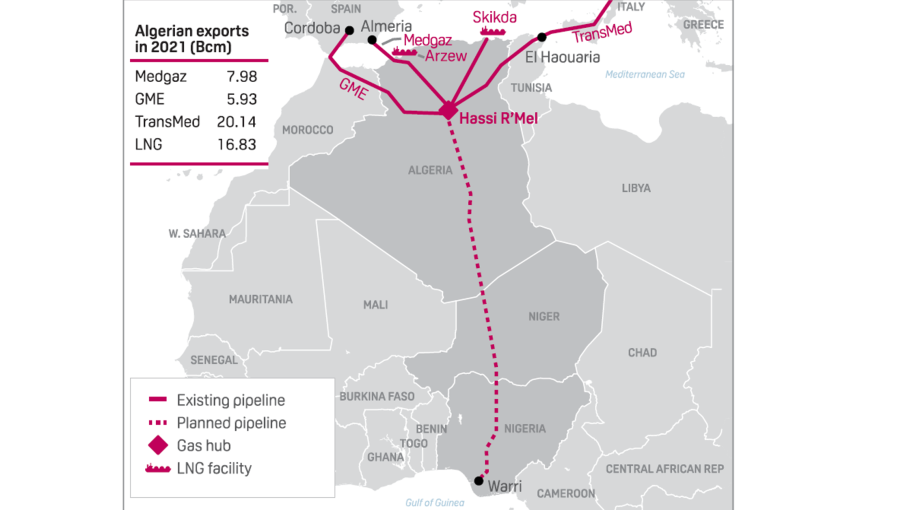
A gas pipeline to connect the vast gas fields in Nigeria with Europe is now 60% completed at a time when the EU is hunting for new reliable sources of gas. / bne IntelliNews
By Ben Aris in Berlin February 8, 2026

The Trans-Saharan Gas Pipeline (TSGP) project is making steady progress after Algeria, Nigeria and Niger reaffirmed their commitment to the 2024 agreements and are accelerating construction.

The three countries endorsed updates to the project’s feasibility study by UK engineering consultancy Penspen, alongside a new compensation agreement and a confidentiality pact at a recent meeting in Algiers. The agreements mark a renewed push to complete the 4,128 km pipeline, which is designed to transport up to 30bn cubic metres of natural gas annually from Nigeria to Algeria’s Mediterranean coast for export to European and global markets.

“The Trans-Saharan Gas Pipeline project is moving forward steadily,” officials from the Algerian Ministry of Energy and Mines said in a joint statement after the meeting.

The TSGP, first conceived in the early 2000s, is aimed at replacing some of the Russian gas which is no longer being sold to Europe. It will bolster energy cooperation in West and North Africa and provide an alternative supply route to Europe, which intends to ban Russian gas imports next year as part of the nineteenth sanctions package.

Once completed, the pipeline will connect Nigeria’s vast gas reserves to Algeria’s pipeline network, enabling onward delivery through the Trans-Mediterranean and Medgaz pipelines.

According to project backers, about 60% of the TSGP’s route has already been completed, with approximately 2,400 km of pipeline laid, primarily in Algeria and Nigeria. The remaining 1,800 km will be constructed across all three partner countries, traversing difficult terrain including the Sahara Desert and regions with security challenges.

The pipeline’s projected capacity of 30bn cubic metres per year represents a significant addition to regional and international supply, at a time when European demand for diversified gas sources remains high following the sharp reduction of Russian pipeline imports. At the same time, the EU has woken up to is dependency on American LNG and is seeking to diversify away from and increasingly unpredictable White House.

Algeria’s national energy company Sonatrach, the Nigerian National Petroleum Company (NNPC), and Niger’s Ministry of Petroleum are jointly managing the development phase. Technical, financial and environmental updates are ongoing as part of a revised roadmap.

Industry analysts say the project, if realised, could transform West Africa’s gas export profile. However, the TSGP has faced repeated delays due to financing hurdles, regional instability, and shifting global gas market dynamics.