Thursday, February 12, 2026

 Maritime Union of Australia (NMU)

Carnival Australia Says NMU is Recruiting by Filing “Whistleblower” Report

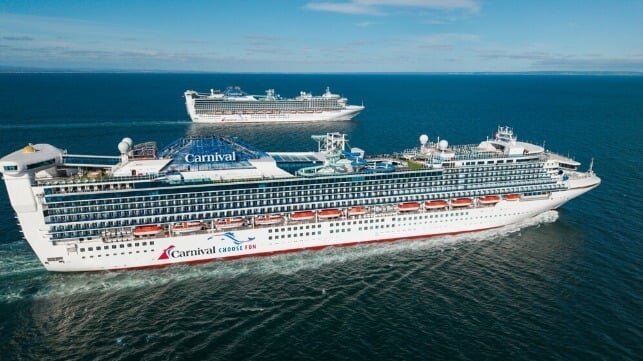
Carnival Australian cruise ships
Carnival Cruise Line rebranded two P&O Cruise ships for its Australian cruise operation (Carnival Cruise Line Australia)

Published Feb 10, 2026 7:43 PM by The Maritime Executive


Carnival Cruise Line’s Australia operations have become the target of a campaign by the Maritime Union of Australia (NMU), which this week resulted in an unscheduled inspection by the Australian Maritime Safety Authority (AMSA). The cruise line is calling the MNU’s actions an effort to get attention and launch a membership drive, while the union is accusing the cruise line of low wages and poor working conditions aboard its ship homeported in Australia.

Carnival Cruise Line has operated in Australia since 2012, and in 2025, it consolidated its operations with the storied P&O Australia, which had been cruising from Australia for more than a century. Carnival rebranded two P&O cruise ships as Carnival Adventure and Carnival Encounter. The ships, each 108,865 gross tons with accommodations for 2,500 passengers, were built in 2001 for Princess Cruises and operated from Australia since 2022. Each ship has over 1,100 crewmembers. Carnival also operates one of its large ships year-round from Australia and has a second ship seasonally in Australia.

The MNU launched its campaign in January, charging “extreme exploitation” of the crew working on Carnival’s ships. They alleged low wages, tight living conditions, and poor working conditions. They were quick to point out that the cruise line employs mostly people from India, Indonesia, and the Philippines, calling them some of the “poorest economies on the earth.”

The MNU had announced it would stage a demonstration in the Port of Melbourne on January 21. They demonstrated in front of the Carnival Adventure while the ship was docked in the port to coincide with the Australian Open tennis match.

Carnival Cruise Line has consistently said it has nothing to hide. It says it adheres to the standards set by the International Labour Organization for pay and treatment of the crews aboard its ships. 

The union, however, elevated it, claiming it had received an anonymous complaint from a worker aboard the ship about working conditions. It asserted that it had received hundreds of complaints about the ships and reported that it was passing the “whistleblower” complaint to the authorities.

"This is exactly what happens when you allow foreign-owned and controlled companies to sail the Australian coast, using Australian ports, carrying Australian passengers paying Australian fares, but who are completely immune from Australian law,” said the MNU in a statement.

The Australian Maritime Safety Authority, which is well-known for its strict enforcement, especially on issues of crew welfare and safety, sent inspectors for the Carnival Encounter while the ship was in Darwin on February 2. AMSA responded to media questions, emphasizing that it ensures international crew welfare standards are met through regular port state control inspections. Ot said the results of its inspection were presented to the captain.

Carnival Cruise Line told the Australian Broadcasting Corporation after the inspection that it had confirmed that AMSA found “no deficiencies” and that “no follow-up actions were required.”

The union, however, asserts the investigation is ongoing. It said there are “broader, systemic problems across the cruise industry.” The MUA also reiterated its call for Carnival Cruises to recognize the right of crew members to organize and bargain collectively in line with international labor standards.


USCG “Strongly Recommends” Safety Steps for Vessels During Cargo Ops

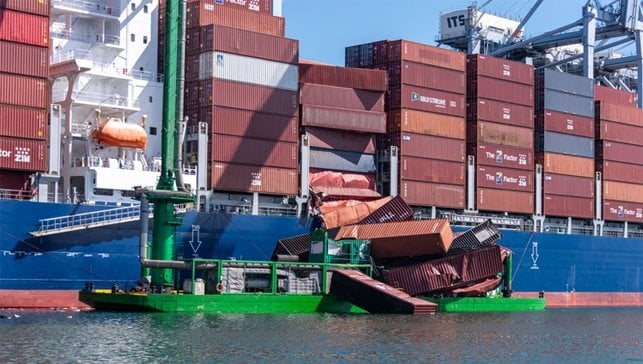
container stack collapse hitting barge alongside
USCG is calling for better planning and coordination for vessels alongside during cargo operations after the container collapse hit an emissions barge in the Port of Long Beach (USCG)

Published Feb 10, 2026 4:56 PM by The Maritime Executive


The U.S. Coast Guard issued a Marine Safety Alert for vessels alongside during cargo operations based on recent incidents with containers going overboard. While the investigations are ongoing into the incidents, USCG says, based on its findings of no established policies or planning and ad-hoc communications, it issued the alert with its strong recommendations.

In the Safety Alert, the USCG reveals that there were two recent incidents. The collapse of 95 containers from the vessel Mississippi operated by Zim made headlines in September 2025. At least a dozen of the containers falling from the midship stack landed on an emission control barge that was alongside the vessel. The crew aboard the barge reported “running for their lives,” and one of the crewmembers suffered minor injuries. The barge sustained significant damage.

USCG, however, reveals there was a second incident in October in the Port of Los Angeles. In this second instance, USCG reports, “four containers nearly landed on a separate emission control barge after ineffective container securing methods were used.”

The investigations’ preliminary findings indicated that there were no established policies or planning tools in place to account for vessels alongside during cargo operations. It says that the reliance on ad-hoc communications protocols has been identified as a contributing factor in both cases.

While the two incidents involved the emission control barges that are becoming more prevalent in California’s ports, the USCG warns for all vessels that might be coming alongside during cargo operations. For example, it might concern the positioning of tugs or other harbor vessels that could be alongside a containership during cargo operations.

The Coast Guard “strongly recommends” efforts to coordinate between managers and operators of the vessels and shoreside facilities. It calls for developing and implementing written procedures for both shoreside and shipboard management of vessels positioned alongside during active cargo operations. They call for optimally positioning the vessels while maintaining awareness of the ongoing cargo operations.

“Vessel placement should minimize the risk of falling containers striking the vessels alongside,” recommends USCG. “In situations where repositioning is not possible, operational priorities should focus on safeguarding the vessels and crew positioned alongside the vessel being actively loaded or offloaded.”

Further, it recommends establishing a pre-cargo operations meeting that includes representatives from the vessel, vessels being positioned alongside, and shoreside personnel responsible for cargo operations. 

The recommendation says the cargo discharge plan should account for the presence of vessels alongside. It calls for establishing clear communication and notification protocols for addressing any issues related to cargo handling or stability and trim concerns.

The U.S. Coast Guard and National Transportation Safety Board are leading the investigation into the cause of the incident on the Mississippi, which took place on September 9. They only reported the one minor injury to the crewmember on the barge and none to the crew on the containership or the cargo handlers and dockworkers. However, it took two and a half weeks to secure the ship, clear all the debris, and fully restore operations at the port.

TARIFFS

U.S. Container Imports Expected to Fall in First Half of 2026

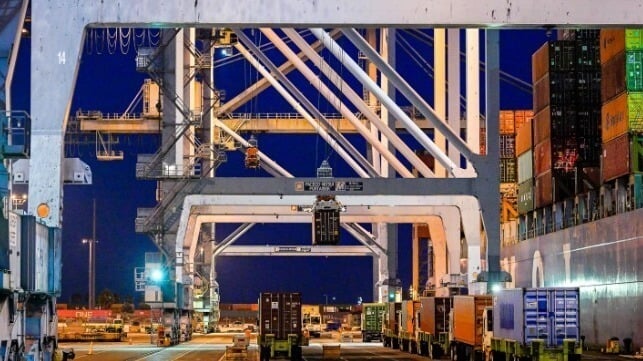
container imports
Forecast for U.S. imports expects declines for the first half of 2026 (Port of Long Beach file photo)

Published Feb 9, 2026 8:01 PM by The Maritime Executive


While there appear to be signs of a normalization in the U.S. container import flows and less impact from frontloading, the expectations are that volumes will continue to fall at least through the first four months of 2026. Uncertainty about the U.S.’s tariffs, policy issues, and geopolitical developments all continue to weigh on the outlook for trade.

Both the National Retail Federation and Descartes Global are pointing to a weak start to 2026 import volumes. Descartes calculates that January container volumes were at a total of 2.3 million TEU, which was up more than 90,000 TEU versus December, but down nearly seven percent versus a year ago. Last year, importers were believed to be frontloading ahead of the return of Donald Trump to the White House.

The retail trade association is forecasting January’s retail import figure at 2.11 million TEU, which it says is down more than five percent from a year ago. It suggests that the month-over-month increase was importers advancing orders to get ahead of the Lunar New Year holiday, which begins next week, and when factories across Asia will be closed.

Analysts have forecast that carriers would take between 10 and 14 percent of capacity out of the market around the Lunar New Year. The major lines typically begin blanking sailings from their schedules around the holiday and afterward and are further encouraged this year, with freight rates already weak.

Imports from China specifically were down nearly 23 percent in January 2026, according to Descartes. It notes that China accounted for a third of U.S. trade but believes the tariff policies and uncertainties are showing in the current levels of imports.

“With tariffs still a matter of debate in the courts and in Congress, their effect on imports is being clearly seen,” said Jonathan Gold, the NRF Vice President for Supply Chain and Customs Policy. “The situation underscores the need for clear and predictable trade policies that support supply chain certainty and reliability, business planning, and consumer affordability.”

The NRF reiterated its earlier projections that imports will show significant year-over-year declines during the first half of 2026. It projects container volumes under two million TEU per month until April. For the first half, it projects a total of 12.27 million TEU, which would be down two percent from 2025.

The first improvements, however, could begin in May 2026, a year after Trump’s so-called “Liberation Day,” when the tariff levels were first rolled out. Retailers and other shippers rushed to get their goods into the U.S. ahead of the policies or during some of the pause windows created as tariff negotiations were proceeding.

Descartes, however, also highlights that with the lack of a decision from the U.S. Supreme Court on the tariffs, “policy uncertainty for importers remains elevated, with no near-term change to tariff conditions.” The Trump administration has also threatened new moves if the U.S. Supreme Court strikes down its current tariff policies.


Environmental Remediation at Aging Ports

A Practical Approach to Managing Legacy Contamination

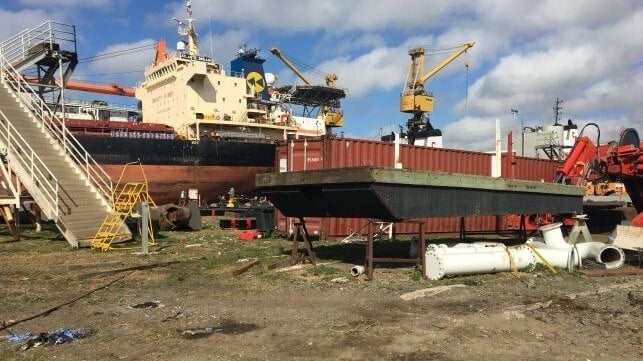
Port remediation
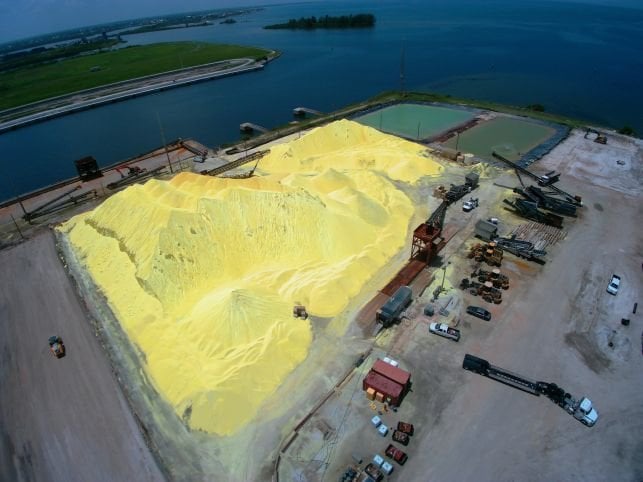
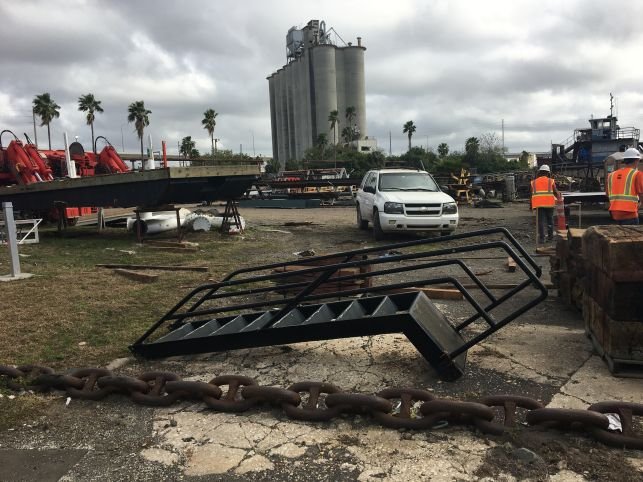
(Photos courtesy of GHD)

Published Feb 10, 2026 1:52 PM by GHD


Ports face a dual challenge: modernizing aging infrastructure while managing environmental contamination from decades of industrial use. In a conversation, GHD’s Tony Hoffman, Railway Remediation Project Director, and Brian Moore, Manager of Contamination Assessment and Remediation, discussed practical approaches to environmental remediation that keep operations running.

Q: What environmental issues do you typically encounter when ports need to replace aging infrastructure?

Tony: Replacing aging infrastructure presents challenges beyond capital costs and operational impacts. Since many port properties have endured more than a century of heavy industrial use, there are inherent environmental issues that must be addressed during infrastructure upgrades—usually in the form of impacted soil and groundwater.

Infrastructure replacement on environmentally impacted properties typically requires soil management, dewatering, and air monitoring plans approved by local regulators before starting work. Because many port properties are constructed using dredged material, they're impacted by an array of contaminants from sediment brought up from the bottom of adjacent water bodies. This can include heavy metals, polychlorinated biphenyls (PCBs), organic hydrocarbons, and other industrial pollutants.

Q: Are there specific contaminants that are particularly concerning at port sites?

Brian: Two anthropogenic contaminants (pollutants introduced into the environment directly or indirectly by human activities) are of particular concern: arsenic and polycyclic aromatic hydrocarbons, or PAHs.

A common source of arsenic is dredging sediment. As many port properties were filled or enhanced with dredge sediments, arsenic is commonly encountered. The contamination is often widespread and not limited to specific hot spots, which makes targeted cleanup challenging.

Q: Why are PAHs so challenging to address?

Brian: PAHs are of high concern because of their carcinogenic and toxic nature. Since PAHs are often found in nature, it's difficult to determine if the sources of PAH impacts are related to human activity. Natural sources include wildfires, volcanic activity, or the presence of fossil fuels. Anthropogenic sources largely result from fuel storage and distribution systems, the production of asphalt and asphalt sealants, and automobile and other emission sources.

Without proper differentiation between anthropogenic and naturally occurring PAH impacts, timely regulatory closure can become a challenge.


Q: How do regulatory requirements affect port remediation projects?

Brian: Ports typically maintain leases with multiple tenants who are responsible for maintaining regulatory compliance. Often, the port becomes a responsible party for cleanup of legacy contamination originating during operations by a previous tenant. If contamination is identified during due diligence, remediation may delay tenant occupancy or limit operations.

Port remediation projects are designed and implemented to accommodate tenant occupancy and operations. In many cases, contamination may be left in place and controlled versus removed or treated. Engineering controls are commonly used to prevent leaching and direct contact by site users. Most groundwater contamination is managed through simple groundwater use restrictions since shallow groundwater typically isn't utilized for supply due to its saline content.

Q: What innovative approaches help balance cleanup needs with operational realities?

Tony: Risk management is an innovative approach to closing impacted sites at port facilities. Physical remediation is often impractical due to costs, impacts on operations, or practicality. It's our responsibility to analyze our clients’ operations and find the best path to clean up that will minimize their economic commitment.

One of the most important requirements for ports is maintaining awareness of contamination, so proper planning can occur if excavation or dewatering is being contemplated. Many ports incorporate contamination information within their GIS systems, so project coordinators are aware of potential contamination. Once excavation is planned in a known contaminated area, soil and groundwater management plans can be generated for use by contractors.


Q: Can environmental remediation be integrated with broader port modernization efforts?

Brian: The biggest challenges facing ports are aging infrastructure and future sea level rise. Oftentimes, environmental remediation efforts are undertaken as part of broader upgrades to port infrastructure. Green infrastructure, flood protection, energy efficiency, and smart technologies can all be implemented along with environmental remediation.

We assisted Port Everglades with environmental support during the replacement of 9,000 linear feet of aging deep water bulkheads at six separate locations. In locations where soil impacts were identified, we prepared soil management plans to be utilized during construction to ensure worker safety and mitigate the potential spread of contamination. The bulkhead replacement is part of Port Everglades' efforts to enhance operations while mitigating against sea level rise. Designs for the bulkheads are based on a projected sea level rise of 4.36 feet by 2095.

GHD combines strategic planning advisory services with infrastructure engineering to help ports navigate complex challenges from energy transition to funding innovation. Discover how GHD is shaping the future of maritime infrastructure here


This article is sponsored by GHD.

The opinions expressed herein are the author's and not necessarily those of The Maritime Executive.


Smuggling Chief Who Was Implicated in Beirut Blast Steps Down

The severe damage from the Beirut blast in the immediate aftermath (UNIFIL)
Severe damage from the Beirut blast, seen in the immediate aftermath (UNIFIL)

Published Feb 9, 2026 4:43 PM by The Maritime Executive


A key figure in Hezbollah’s smuggling operations in Lebanon, and a godfather figure in particular in the Beirut docks, Wafiq Safa resigned his formal position on February 6 as head of Hezbollah’s Liaison and Coordination Unit.

Wafiq Safa is regarded as having had a crucial role for at least 25 years in the organization of Hezbollah smuggling activities through the Port of Beirut. In all likelihood, he was behind a scheme to pilfer the cargo of 2,750 tons of ammonium nitrate stored in the Port of Beirut dockside warehouse where it had been offloaded from the impounded MV Rhosus (IMO 8630344) in 2014. By the time the remaining estimated 552 tons exploded on August 2020, most of the ammonium nitrate had probably been shipped to the Syrian government for use in explosives manufacture. 


Wafiq Safa, Hezbollah’s Head of Liaison and Coordination, in happier times. After recovery from an Israeli air strike, one of the few senior Hezbollah figures to survive 2024, Wafiq Safa until recently remained a key figure in Hezbollah’s smuggling operations (Tasnim / CC BY)


What is less in doubt is that since the explosion in 2020, which killed 218, injured thousands and devastated the port and a wide area of central Beirut, Wafiq Safa has played a key role in sabotaging the investigation of the incident. This involved getting the investigation by the resolutely brave Judge Tarek Bitar temporarily closed down, but also the murder of four witnesses with crucial evidence who would have testified to Judge Bitar.

Israeli sources reported that journalist Lukman Slim, photographer Joe Bejjani, and two Beirut Port customs officials, Joseph Skaff and Mounir Abou Rjeily, had been murdered by Hezbollah’s internal security Unit 121, to prevent them from testifying.

Unit 121 has a history of murdering even loyal Hezbollah members as a preventative measure to ensure that secrets remain secret, and Wafiq Safa is probably lucky to have avoided a similar fate – so far. By unusually allowing Wafiq Safa to step down, Hezbollah may be signaling that it seeks to reset its relationship with the Lebanese authorities, which in recent months has become increasingly strained as the Lebanese government asserts national sovereignty. Hezbollah has nominated Ahmed Muhanna to be Wafiq Safa’s replacement.

This may be good news for the continuing clampdown on Hezbollah’s smuggling operations. Wafiq Safa’s portfolio of talents covered smuggling (working with the IRGC’s Unit 190) and clandestine control of the Port of Beirut, as well as political liaison. But Ahmed Muhanna’s CV is weak on smuggling and more focused on political and diplomatic engagement. Moreover, with Israel wary of renewed threats from the north, Hezbollah leaders and operatives tend to remain alive only if they are relatively ineffective.

Management and development of the Port of Beirut was taken over by CMA CGM in March 2022, with the French firm having previously taken control of the Tripoli container port in 2021. Under the new CMA CGM regime, these ports are less likely to be used for bulk importation of obviously military items, but smaller and dual-use items will still be sneaked through, albeit in lesser volumes. 

The focus for seaborne smuggling may now switch to coastal tramps sailing from Turkey and using small unregulated ports and fishing harbors along the length of the Lebanese coast. Syrian security forces continue to make seizures in border areas of arms and ammunition destined for Hezbollah.

The opinions expressed herein are the author's and not necessarily those of The Maritime Executive.


Maersk Goes Big Capacity with Innovative Next Boxship Order

Maersk containerships
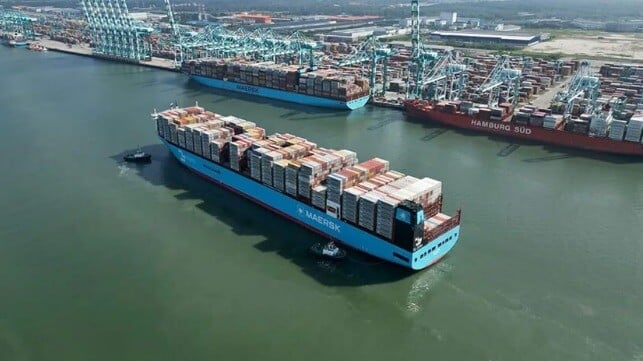
Maersk ordered new large vessels as part of its fleet renewal strategy (Maersk)

Published Feb 9, 2026 4:28 PM by The Maritime Executive


Maersk confirmed its next shipbuilding order, reporting it will build a series of large vessels that will maintain efficiency while increasing flexibility. It said the latest order is part of its ongoing fleet renewal program.

The order is with China’s New Times Shipbuilding Company and calls for eight large vessels for delivery in 2029 and 2030. The ships will be equipped with dual-fuel engines for conventional bunker fuel or liquefied gas and have a capacity for 18,600 TEU. 

Maersk highlights that the ship will have a similar capacity to its current largest vessels but will be more compact in design. The new ships will measure 368 meters (1,207 feet) compared to the current vessels of the Triple E Class, which are 399 meters (1,309 feet) with a capacity ranging between 18,270 TEU and 20,568 TEU between the two groups in the class.

“Deployment flexibility has been a key factor in our decision-making,” explains Anda Cristescu, Head of Chartering & Newbuilding at Maersk. “Although these vessels are large, they offer greater flexibility than the largest ships currently being built in our industry. This provides us with multiple deployment options across both our current and future networks.”


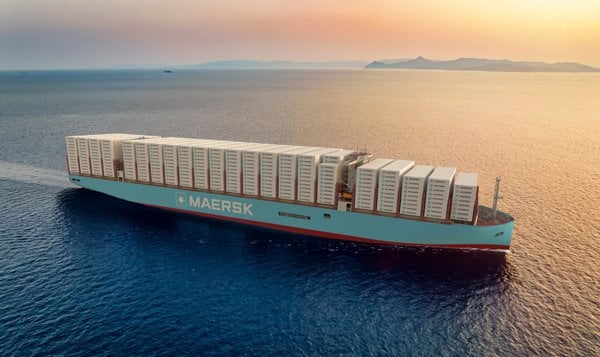
Maersk's rendering for the next class shows a more traditional layout but uses a shorter hull (Maersk)


Maersk built the Triple E as its largest class starting in 2013 and deployed 20 ships by 2015, followed by a second grouping of 11 ships between 2018 and 2019. It has resisted the industry trend for ultra-large vessels with a capacity of around 24,000 TEU, deployed by peers including MSC Mediterranean Shipping Company, CMA CGM, Hapag-Lloyd, and HMM.

This class follows the completion at the beginning of this year of the dual-fuel methanol vessels, which have a capacity of up to 17,480 TEU. The final ship, Barcelona Maersk, was introduced at the beginning of January and completed the series of 18 ships built in South Korea. Unlike the methanol vessels, which adopted a design with a forward bridge and accommodation block and moved the funnel to one side all the way aft, the new order shows a more traditional design with the split midship bridge and funnel casing.

Maersk launched its fleet renewal strategy in 2021 and updated it in 2024, reporting its goal is to maintain its current total capacity around the current 4.6 million TEU. It said newbuilds would be split between owned and chartered vessels and would be used to replace older vessels, which would be scrapped. Last week, talking about the market’s current overcapacity, CEO Vincent Clerc called for more scrapping to manage industry capacity.


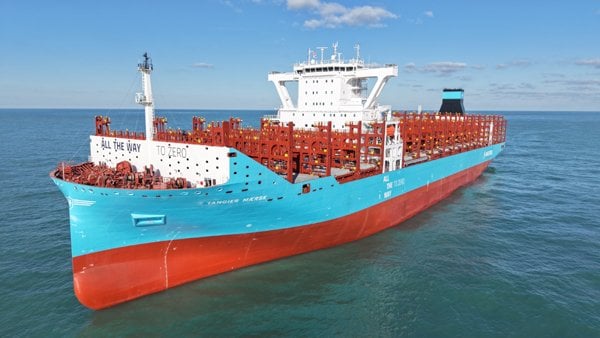
Tangier Maersk, introduced last month, is a new methanol dual-fuel midsize class (Maersk)


The company reports it currently has 33 vessels on order, with Alphaliner reporting Maersk's total at 87 vessels with a total capacity of 1.2 million TEU, including charters. The company had said in 2024 that it was targeting an annual rate of 160,000 TEU and contracts totaling 800,000 TEU of capacity between 2026 and 2030.

In January, Maersk unveiled its other new class, a series of six midsize vessels. They are being built at Yangzijiang Shipbuilding Group in Jingjiang, China, and have a capacity of 9,000 TEU. The vessels are dual-fuel capable of operating on methanol. The first ship, Tangier Maersk, was introduced in January, with four more due this year and one in 2027.

MONOPOLY CAPITALI$M

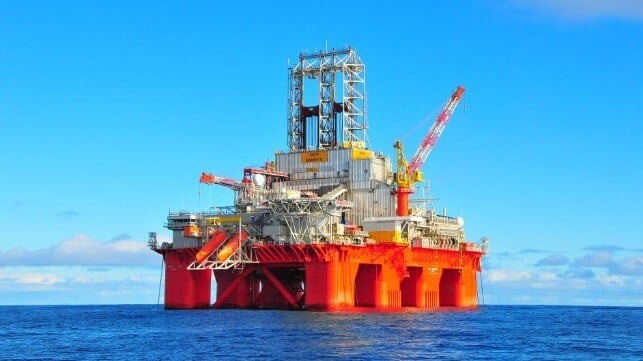
Transocean Buys Valaris for $6 Billion, Creating New Industry Leader

Transocean Barents
File image courtesy Transocean

Published Feb 10, 2026 2:28 PM by The Maritime Executive


Offshore drilling company Transocean has struck a deal to acquire competitor Valaris for $6 billion in stock, giving Transocean shareholders a 53 percent stake in the combined company. 

The transaction creates the largest drilling company in the world, valued at $17 billion. It will operate 33 ultradeepwater drillships, nine semisubs and 31 jackups - 73 rigs in total - across global markets. Transocean CEO and President Keelan Adamson suggested that the combination makes for "a very attractive investment" in offshore drilling, with the "best fleet, proven people, leading technologies and unequaled customer service."

Both companies' boards have approved the deal, and it is expected to close in the second half of the year. It should create about $200 million in identified cost synergies, and the firm expects to have enough cash flow to pay down its debt to a leverage ratio of 1.5x by about 2028.

The addition of Valaris brings jackup operations back into Transocean's portfolio of services. The company sold its previous jackup fleet to Borr Drilling nine years ago for $1.4 billion, reflecting the prevailing pricing for equipment during the late-2010s offshore downturn. The new merger agreement with Valaris creates a "combined company that is capable of operating any rig at any water depth in any offshore environment around the world," Valaris CEO Anton Dibowitz said in a statement. 

Valaris' stock jumped by 22 percent Monday on news of the buyout. Both companies' share prices fell about eight percent in midday trading Tuesday. 


PaxOcean Opens New Singapore Shipyard to Handle Larger Projects

Singapore shipyard
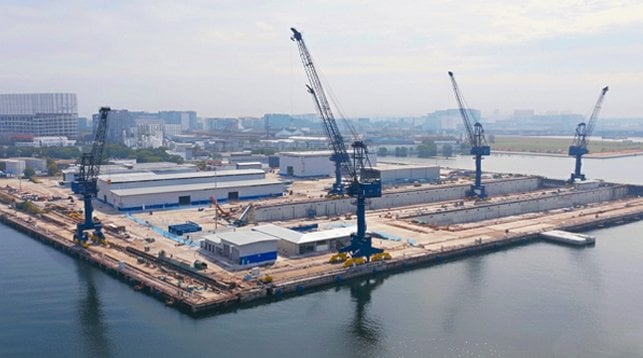
PaxOcean marked the completion of its new, larger shipyard in Singapore (PaxOcean)

Published Feb 9, 2026 6:39 PM by The Maritime Executive


PaxOcean marked the opening of its new Singapore shipyard, which is larger and incorporates the latest technologies to strengthen Singapore’s newbuilding, fabrication, conversion, and repair capabilities. The yard replaces the older yard launched in 2007 and will feature a center for R&D, along with a purpose-built innovation hub.

The company reports it spent two years developing the new facility located in the Jurong Industrial Estate and invested more than S$200 million (US$158 million) in its development. At 17.26 hectares, it replaces the smaller facility that was located in the 33 Tuas Crescent.

The new facility features two large graving docks, one floating dock, expanded quayside capacity, and dedicated, integrated workshops to support complex and high-value maritime and offshore assets. PaxOcean says it will be able to handle more complex projects, ranging from repair and upgrades to newbuilding and conversion projects.

It is also a highly energy-efficient facility with other elements anticipated in the design. It has an energy-efficient infrastructure and greener operations and a phased roadmap that includes electrification initiatives, smart energy, and logistics solutions.

The company has committed to a further S$3.5 million investment in R&D over the next three years. It says its new Centre of Excellence will strengthen capabilities in carbon capture, utilization, and storage, systems integration, simulation, and digital twin applications. It will have positions for 12 engineering and research roles. A first for a shipyard in Singapore, it will also have a purpose-built innovation hub, which will permit it to accelerate the development of practical marine solutions for its parent company, Kuok Maritime Group.

PaxOcean currently has five shipyards operating across three countries: Singapore, China, and Indonesia. It is also currently building a Maintenance, Repair, and Operations (MRO) facility in Saudi Arabia.

GLOBALIZATION

French Private Equity Firm Buys Vigor Industrial

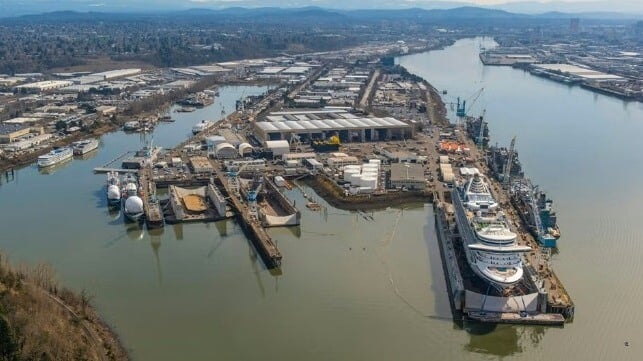
Vigor
Press handout courtesy Vigor, Industrial

Published Feb 8, 2026 3:17 PM by The Maritime Executive


French private equity firm Antin Infrastructure Partners has reached an agreement to buy the American shipyard company Vigor Marine Group, bringing new foreign ownership to a key ship repair partner for the U.S. Navy and Coast Guard. 

Vigor, previously owned by Lone Star Funds, has expanded through serial acquisitions in recent years. It now includes five yards on the West and East Coasts near key fleet concentration areas: Seattle, Portland and Vancouver, within reach of the constellation of bases in Puget Sound; San Diego, home of 3rd Fleet; and Norfolk, the world's largest naval base complex. In addition to government ship repair services for sealift ships, warships, icebreakers and cutters, the yards conduct specialty vessel construction and commercial ship repair.

Vigor Marine Group brought in $1 billion in revenue in 2024, and has about 2,700 employees across all of its sites. It has deep roots in U.S. defense work: its home-office site at Swan Island, Portland was developed by Kaiser Shipbuilding to construct tankers for the war effort in 1942, and the original assembly sheds remain today. 

The current management team under CEO Francesco Valente will remain in charge of the firm under new ownership. 

"We’re thrilled to be partnering with Vigor Marine Group, which represents exactly the kind of long-term investment we pursue – essential U.S. infrastructure assets that require sustained capital commitment and operational continuity," said Ryan Shockley, senior partner at Antin. 

The new owner says that it plans to invest in technology, capacity and workforce development to grow Vigor's business, with specific interest in "the growing importance of the U.S.'s Pacific seaports."

"Antin takes a disciplined, long-term approach to investing in facilities, technology and workforce development to ensure operational continuity and resilience," said Valente. "This partnership provides the added resources we need to take the next step in our long-term strategy."

Vigor is an important component of the U.S. industrial base for small and unmanned combatants. It recently began production for the U.S. Army's new landing craft design at its Vancouver facility, and it has a joint-venture agreement with American drone boat builder Saronic on boat repair services. It also has a ship-repair agreement with Samsung Heavy Industries, which wants to break into the U.S. Navy's maintenance, repair and overhaul (MRO) business. 


Navigating the Deadlock: Accelleron’s Daniel Bischofberger on Green Fuels

Ship
iStock

Published Feb 11, 2026 1:11 PM by The Maritime Executive


Accelleron, a leading provider of turbocharging, fuel injection, and digital solutions for marine engines and ships, recently released a study on the multifaceted, multi-industry challenges slowing shipping's transition to carbon-neutral fuels. TME recently spoke with CEO Daniel Bischofberger about the current state of marine decarbonization, regional developments in Asia-Pacific, and the path forward for the industry.

Can you describe the current state of shipping's transition to carbon-neutral fuels?

The ships are ready, but the fuel is not. The technology exists – we have ships that can run on methanol, ammonia, and other alternative fuels. The engines are ready, the systems are in place, and there's movement towards hydrogen-based fuels. But these ships aren't able to run on the fuels they were designed for, because the fuels are not yet there.

We're seeing a concerning trend in dual-fuel ships. The dual-fuel portion of the orderbook is decreasing, while the share of conventional petroleum-fueled ships has increased. Within dual-fuel vessels, LNG is now dominant. This shows we're at a deadlock.

What are the key barriers?

Our report identified five interlinked, systemic deadlocks, based on more than 50 interviews with shipowners, ports, bunkering, gas fields, e-fuel developers, and maritime suppliers.

First, there are too many fuels. Between conventional options, LNG, biofuels, methanol, ammonia, and others, investment is diluted. The industry has essentially chosen two long-term pathways – methanol and ammonia – but to scale, it would probably be preferable just to have one clear choice of fuel we want to go after.

Second, production facilities for e-fuels need to be large-scale to be cost-effective. This creates centralized fuel hubs, but we have numerous ports worldwide that need these fuels. Distribution infrastructure becomes a massive challenge.

Third, while there's approximately $3.5 trillion in ESG financing available globally, shipping has only attracted about $14.5 billion. That's a drop in the ocean.

Fourth, regulation doesn't match ambition. The regulatory framework hasn't caught up to the industry's decarbonization goals.

Finally, port infrastructure needs to manage multiple fuel types for bunkering and storage. The investment required is enormous.

How significant is the investment challenge?

For marine alone, fully decarbonizing with hydrogen-based fuels would require 100-150 million tonnes of hydrogen per year – an investment of $2-3 trillion. But shipping isn't alone. Hard-to-decarbonize sectors like aviation, agriculture, cement, steel, chemicals, and power generation need 500-600 million tonnes of hydrogen total, representing about $9 trillion in investment.

The key insight is that no one sector can do this alone. All these industries need production facilities and distribution networks. This is why cross-sector collaboration is essential. We all need production sites and ships to transport fuel to ports, airports, and other facilities. The great thing is that shipping could play the role model, because it’s the only industry that has a global regulator.

What can the industry do during this transition period?

In the meantime, we have a 10-15 year transition period where we can significantly reduce CO2 emissions without waiting for full-scale e-fuels.

Biofuels can help at the beginning, though they're not scalable to the volumes we ultimately need. LNG offers about 30 percent CO2 reduction, though it's not zero emissions. Energy-saving technologies can achieve 35 percent reductions if widely implemented – air lubrication, wind assist devices, improved hull design, propeller optimization, heat recovery systems.

Operational measures matter too: speed optimization, weather routing, and proper maintenance. We offer digital solutions for weather routing where operators can choose between speed and fuel savings. We're also seeing more frequent hull maintenance rather than waiting five years between cleanings.

New ships are more efficient than older vessels, though we can't simply wait for fleet renewal. We need net-zero solutions, and we can't delay.

Are there some regions that are moving faster?

Asia-Pacific is where we're seeing real movement and solutions to the deadlock. Countries like Australia, Japan, Korea, Singapore, and China are moving ahead, driven primarily by government support and funding.

China's motivation is that they want energy security and reduced dependence on fossil fuels. They have abundant renewable energy capacity and can build electrolysis facilities. But it's also an industrial strategy. Just as they dominated wind turbines, photovoltaics, batteries, and rare earths, they want to be a major player in e-fuels because they believe the world needs them for climate goals.

On the production side, Australia and China are moving ahead with ammonia production. We're seeing smaller, modular production facilities being developed – not the massive facilities requiring millions of tons of hydrogen, but smaller 300,000-ton units. There are lots of subsidies, so the prices are not really correlating with the cost.

On the demand side, ports in Singapore, China, and Korea are advancing. They're developing this infrastructure first for uses outside marine. Japan, for example, wants to blend ammonia into the boilers of coal-fired power plants to reduce CO2 emissions. They're combining uses in power generation, agriculture, and marine – exactly the cross-sector approach we've been advocating.

They also have strong trade corridors. The iron ore route from Australia to Singapore and China is ideal – you have production hubs at both ends of the corridor.

What lessons can the global industry learn from Asia-Pacific?

The key lesson is that we don't have to wait for perfect global regulation before moving forward. The Asia-Pacific demonstrates this. However, they can only go so far without a global framework.

We need an IMO net-zero framework that makes fossil fuels more expensive through CO2 taxes while helping alternative fuels become cheaper through scaling and temporary subsidies. Some movement is happening, and we can learn tremendously from the Asia-Pacific region.

How does Accelleron fit into this transition?

We offer turbochargers, fuel injection systems, and digital solutions. Our technology is fuel-agnostic – it works with fossil fuels and alternative fuels alike. Our focus is on efficiency: vessel performance optimization and enabling new fuels.

Efficiency is crucial both today and tomorrow. In a fossil fuel world, it reduces CO2 emissions. In an e-fuel world, it's even more important because e-fuels have poor round-trip efficiency – you put in 100 units of energy and get about 20 units out. Given the massive investment required for hydrogen infrastructure, the best approach is to minimize fuel consumption. Efficiency matters today, tomorrow, and beyond.

What became clear when we started this report – and I come from the power generation and oil and gas sectors – is that nobody is connecting the dots. Aviation only thinks about aviation, power generation only about power. We're trying to change that mindset. Don't fight your own battle alone – join forces and get this done together.

We provide a small but important piece of the decarbonization journey, and through this report, we're using our network to spread information and help people find solutions.

What does the future look like for internal combustion engines in a decarbonized world? Do they have a long-term role?

When Accelleron went public about four years ago as a spin-off from ABB, potential investors questioned why we were listing when we supposedly had only a 10-year shelf life. The European idea at the time was no passenger cars with combustion engines by 2035.

We explained that shipping is hard to decarbonize. You can't fully decarbonize just by going battery-electric. Don't misunderstand – whatever we can electrify, we should, because battery efficiency is far superior to e-fuels. But for shipping, battery-electric has severe limitations.

Consider a large container ship traveling from China to Europe – it requires 40 gigawatt-hours of energy. Switzerland's largest nuclear power plant would need to run for a day and a half just to provide that electricity. With current battery technology, most of the ship's freight capacity would be used up by the weight of the batteries needed to store the energy. The ship would exist only to move and recharge batteries. Plus recharging would take days.

Unless battery weight decreases dramatically – which isn't on the horizon – batteries won't work for long-distance shipping.

Nuclear power is interesting, but it's land-based currently. Moving to ships requires societal acceptance, which takes time. Look at Switzerland – before Fukushima, we were planning new nuclear plants. Now we're reconsidering. Nuclear propulsion needs regulation, crew confidence, and broad acceptance.

We've looked at fuel cells, including turbocharged fuel cells, and we see technical challenges there too. Based on all this, I believe combustion engines will remain relevant well beyond 2050. Aviation and marine each need about 300 million tonnes of fuel annually. But shipping moves 90% of all goods with its 300 million tonnes of fuel, while aviation moves many people but relatively few goods. Shipping is extremely efficient, and combustion engines are highly efficient. They can run on net-zero fuels.

E-fuel costs will come down through scaling and temporary subsidies – probably to two or three times current bunker fuel prices. I think energy should cost something, or it gets wasted.

Will combustion engines with e-fuels be the only solution? No, most likely not. But I believe they'll be the main solution because I don't see viable substitutes at scale.

There will definitely be niche applications for other technologies. Ferries already run on batteries because they're short-distance, lightweight, and have sufficient charging time. There's no silver bullet, but one of the bigger solutions is definitely combustion engines with e-fuels, alongside other technologies.

Given all these challenges, are you optimistic about the industry's path forward?

I am. While global regulation may lag, some regions are moving ahead, and that creates competitive advantages. Countries that move first will benefit.

I believe climate change is real, and we should develop and invest in technologies that help now. We shouldn't wait. The good news is that even in this deadlock, we have solutions available today that can significantly reduce emissions while we work toward the longer-term transition.

The key is not waiting for perfection. Use what's available – wind assist, efficiency technologies, operational improvements, transition fuels. And critically, work across sectors. The hydrogen economy serves multiple industries, and collaboration will get us there faster and more cost-effectively than any sector going it alone.   - TME