It’s possible that I shall make an ass of myself. But in that case one can always get out of it with a little dialectic. I have, of course, so worded my proposition as to be right either way (K.Marx, Letter to F.Engels on the Indian Mutiny)
Thursday, February 12, 2026
As DHS Bill Showdown Looms, U.S. Coast Guard Could See Funding Delayed
The looming expiration of federal funding for the Department of Homeland Security could potentially slow down some of the U.S. Coast Guard's historic progress on procurement, but is unlikely to impact day-to-day operations and servicemember pay, according to observers of the appropriations process.
Democrats in Congress are not inclined to support funding for DHS as a whole without major changes at the top, given the recent immigration-enforcement mishaps in Minneapolis. Members of the opposition have called for stricter requirements for search warrants, an end to officer anonymity, and various civil-liberty-focused restrictions on federal agent behavior - along with the ouster of DHS Secretary Kristi Noem.
The Coast Guard happens to be among the agencies currently domiciled under DHS, where it has lived since its transfer from the Department of Transportation in 2003. Its current location is in large part a function of post-9/11 policy shifts, now 25 years old; in addition to its time at DOT and DHS, it was part of the Treasury for its first century and a half, and has twice been a subsidiary of the Navy, where it lives in time of war.
The clash over funding for DHS may not affect the Coast Guard as much as in previous funding lapses, which repeatedly threatened or delayed servicemember salary payments in recent years. This time, members of the Democratic caucus have acknowledged that the USCG has little connection to Immigration and Customs Enforcement and the Border Patrol, the agencies most under scrutiny. It is possible that a carve-out for the Coast Guard (and other less-controversial DHS functions, like the Federal Emergency Management Agency) might end up winning in internal negotiations. This would head off a political problem: Immigration and Customs Enforcement received a $75 billion cash infusion from the One Big Beautiful Bill Act (OBBA) last year, and will be able to continue operations unaffected for an extended period even if the DHS funding bill is delayed. Other agencies - like the Coast Guard, or the Transportation Security Administration - would be hit harder by a DHS funding showdown.
"Let’s take care of those agencies that are doing the right thing," Rep. Rosa DeLauro (D-CT) told Fox News in a recent interview.
If there isn't a carve-out for the Coast Guard, DHS leadership would be able to pull from a $10 billion supplemental funding pool that the department received in the OBBA in order to pay Coast Guard wages, notes Politico - as it did during the last shutdown. However, a drawdown on the supplemental funds could only cover costs for several months, likely would not pay civilian employees in real-time, and wouldn't guarantee back pay for contractors.
Saltchuk Agrees to Buy Great Lakes Dredge & Dock in $1.5B Deal
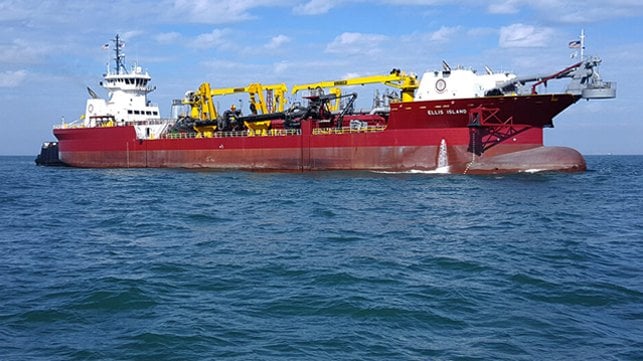
Great Lakes Dredge reports it owns and operates the largest fleet in the U.S. dredging industry (GLDD)
Saltchuk Resources, which continues to build a diversified holding in marine services, freight transport, and energy distribution, has agreed to buy Great Lakes Dredge and Dock Corporation, the largest provider of dredging services in the United States. The deal, which has a total value of $1.5 billion, is an all-cash offer for the public company, which will become a standalone business within the private, family-owned Saltchuk group.
A 136-year-old business, Great Lakes Dredge & Dock reports it has a fleet of approximately 200 specialized vessels, which it calls the largest and most diverse fleet in the U.S. dredging industry. As of the end of November, the company reported it had a substantial dredging backlog of $934.5 million with an additional $193.5 million in low bids and options pending awards. Among the major projects it is working on are the Port Arthur LNG Phase 1 project in Texas, the Brownsville, TX Ship Channel, and the Woodside Louisiana LNG project. The company is scheduled to report year-end financial results next week.
“After extensive review, we have determined that this transaction is in the best interests of Great Lakes’ shareholders as it delivers immediate and certain value at a premium to the company’s all-time high valuation,” said Lawrence R. Dickerson, Chairman of the Great Lakes Board of Directors.
Saltchuk and Great Lakes’ board agreed to the terms, which call for a $17 per share cash tender offer for all the outstanding shares of the company. The companies highlighted that it is a 25 percent premium to Great Lakes’ 90-day volume-weighted average price and a 5 percent premium to the company’s all-time high closing price. Investors drove the stock price up 5 percent today to $16.95, up nearly 30 percent since January 1.
Great Lakes has also been working to expand its business, including supporting the offshore energy industry. It ordered the first U.S.-flagged Jones Act-compliant subsea rock installation vessel, Acadia, from Philly Shipyard (now Hanwha Philly). The vessel was launched in July 2025 and is scheduled to be delivered in the first quarter of 2026.
The company is already handling rock placement work for Equinor at the South Brooklyn Marine Terminal in New York and for the Empire Wind 1 project. The Acadia is booked to support the Empire Wind 1 project and then Orsted’s Sunrise Wind project. Great Lakes said the projects provide full utilization for the vessel in 2026 while noting it can also be used in the international market.
“Our long-term growth strategy will continue with a partner who shares our vision while maintaining our leadership position in U.S. dredging and global offshore energy,” said Lasse Petterson, Great Lakes’ President and Chief Executive Officer, commenting on the acquisition by Saltchuk.
The group already owns a broad portfolio of shipping-related companies, including TOTE Group, Tropical Shipping, Young Brothers, the New Bedford Foss Marine Terminal, and Saltchuk Marine companies, which include AmNav, Cook Inlet Tug & Barge, Foss Maritime, and Foss Offshore Wind. In 2024, it also acquired OSG (Overseas Shipping Group). Headquartered in Seattle, Saltchuk reports consolidated annual revenues of approximately $5.6 billion.
The closing of the tender offer is subject to customary closing conditions, including the expiration of the Hart-Scott-Rodino Act. The companies said they expect the deal to close in the second quarter of 2026.
ARCTIC HEGEMONY
Davie and Helsinki Shipyard Ink Contract for Five More USCG Arctic Cutters
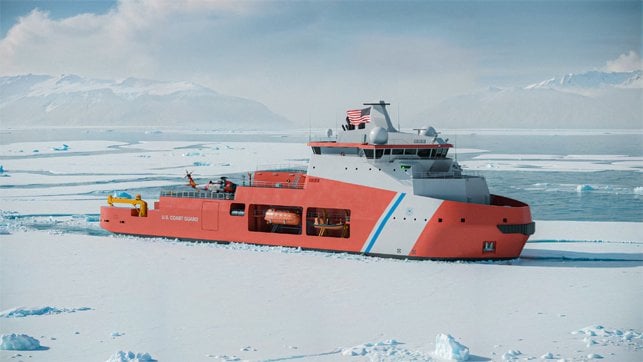
Davie Defense and Helsinki Shipyard were awarded a contract for five Arctic Security Cutters (USCG)
The U.S. Coast Guard completed the second tranche of its shipbuilding effort for the new Arctic Security Cutter program, awarding a contract to the U.S.-based subsidiary of Davie for five additional cutters. The order comes almost two months after the U.S. Coast Guard completed a similar order for six Arctic Security Cutters with Bollinger and Rauma Yards in Finland.
Davie’s Helsinki Shipyard in Finland will lead the project, starting work on the first two vessels and providing the design and expertise for the cutters. No details were offered on the specifics of the cutters, other than that they would be based on a proven platform with seven previous variants built by the Helsinki Yard.
Like the first order, the USCG is turning to Finland because of its developed expertise and supplier networks to speed delivery of the vessels. The Coast Guard says the first Arctic Security Cutter is expected in early 2028. American shipbuilders from Davie Defense will also work alongside the teams in Helsinki to learn from their Finnish counterparts, as Davie will build three additional cutters at its facilities in Galveston and Port Arthur, Texas.
The Biden administration laid the groundwork by launching the ICE Pact initiative in 2024, which called for Finland, Canada, and the U.S. to cooperate on the construction of a new generation of Arctic icebreakers. Donald Trump and Finnish President Alexander Stubb signed a Memorandum of Understanding in October 2025, and the three countries reiterated the trilateral effort in November 2025.
With this order, Homeland Security Secretary Kristi Noem emphasized that the USCG completed the awarding of a total of 11 Arctic Security Cutters, fulfilling Donald Trump’s directive to rapidly expand America’s icebreaker fleet. She said it is part of the effort to revitalize the U.S. icebreaker fleet for the Arctic and Alaska and that the vessels would be used to secure critical shipping lanes, protect energy and mineral resources, and monitor the Alaskan borders.
Helsinki Shipyard, which was acquired by Davie in November 2023, is already building Canada’s Polar Max icebreaker. The vessel will be 22,800 tonnes with a length of 138.5 meters (454 feet) and is due for delivery by 2030 and is based on Aker Arctic’s original Aker ARC 148 hull form.
The shipyard reported in November 2025 that it was making an investment of approximately €7.5 million ($8.9 million) for renovations, including two new intermediate gates to be installed in the 280-meter construction hall. It said it would improve the efficiency of the Helsinki Shipyard and increase the possibilities for the simultaneous construction process of several ships.
Davie Defense was launched last fall as the U.S. arm of INOCEA, a UK-owned maritime group that owns Davie in Canada and Helsinki Yard in Finland. The group also announced the acquisition of Gulf Cooper & Manufacturing’s shipbuilding assets in Galveston and Port Arthur. It said it intended to develop the yards into an “Icebreaker factory.”
Concurrent with the announcement of the order from the USCG, Davie Defense announced it will expand its shipbuilding capacity in Texas with 2,400 new jobs, representing more than $730 million in capital investment. A Texas Enterprise Fund extended a grant of $21.8 million to Davie Defense.
The USCG, at the end of December 2025, entered into a contract with Finland’s Rauma Marine Constructions for two Arctic Security Cutters to be built in Finland, with the delivery of the first vessel expected in 2028. The Finnish company will also work with Bollinger Shipyard, which will leverage the Finnish design and expertise in building four Arctic Security Cutters at its shipyard in Houma, Louisiana. The first domestic cutter, they report, is expected in 2029. All these vessels will be based on designs developed by Seaspan Shipyards in Canada in coordination with Finland’s Aker Arctic Technology.
Originally designed for the Canadian Coast Guard’s (CCG) long-range, multi-mission operations in extreme Arctic conditions, the Polar Class 4 icebreakers will have a capability to break through four feet of ice and travel 12,000 nautical miles, operating for up to 60 days. They are approximately 9,000 tons displacement (7,600 gross tons) with a length of 328 feet (100 meters). They will carry a complement of approximately 85.
Two Venezuela-Linked Tankers Detained in Dutch Caribbean Islands
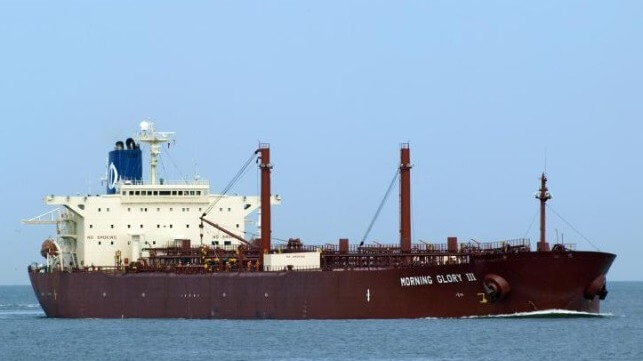
Morning Sun, seen here in previous livery as Morning Glory III (Aart van Bezooijen / VesselFinder)
With the resumption of Venezuela's oil trade under U.S. management, shipments from state oil company PDVSA have resumed, including some shipments aboard the same shadow fleet tankers that have carried Venezuelan cargoes for years. Under new orders, some of these vessels are now visiting ports with more stringent PSC inspection regimes, and at least two aging tankers have been detained in Caribbean jurisdictions.
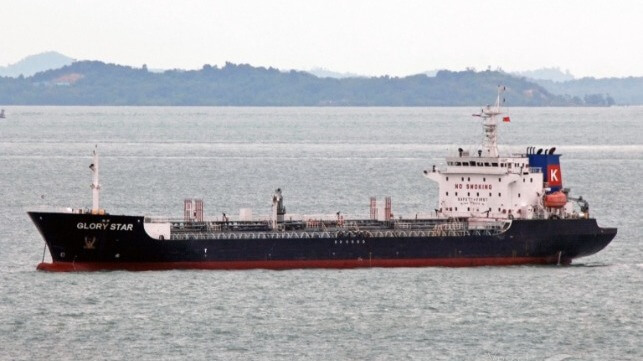
The Caribbean MOU on Port State Control (CMOU) reports that the small tankers Morning Sun and Regina have been detained in Dutch-affiliated jurisdictions, the former in St. Eustatius and the latter in Curacao. NRC, which first reported the development, says that both tankers were involved in delivering Venezuelan oil; Regina had previously carried at least one oil cargo associated with the joint Trafigura-U.S. marketing arrangement, according to the local government.
The detention of Regina could be a setback for Curacao, which wants to become a trading hub for newly-legitimate Venezuelan oil. Curacao prime minister Gilmar Pisas personally welcomed Regina's arrival on the tanker's first visit to the island, reflecting the value that his administration places on the Venezuelan oil trade. But if the jurisdiction's inspectors strictly enforce regulations, many aging shadow fleet vessels will not be able to call at its oil terminal.
Regina's problems extend beyond the usual PSC deficiencies. She arrived falsely flying the flag of East Timor, which does not have an international shipping registry. East Timor has previously asked port states to investigate vessels claiming to fly its flag. An investigation into the circumstances of the vessel's condition and flagging is under way.
Meanwhile, in St. Eustatius, Dutch officials have detained the product tanker Morning Sun for inspection deficiencies. Morning Sun is a 1996-built tanker declaring the flag of Panama; her last PSC inspection outside of Venezuela was in 2018, and the record shows that inspectors found issues with her fire doors, fire pump, and hatchway watertightness, among other items. The officials in St. Eustatius confirmed to NRC that on this inspection, they found too many deficiencies to allow the ship to sail.
Tankers from the "clean," non-shadow fleet have begun calling in Venezuela at scale, arriving on charters for American and European buyers. The experience of Morning Sun and Regina could accelerate Venezuela's transition to the use of tanker tonnage that can pass muster in a Western seaport, rather than aging shadow fleet vessels that make STS transfers in low-enforcement jurisdictions.
On Friday, the Indian Coast Guard busted three sanctioned tankers allegedly engaged in a "smuggling racket" in the Arabian Sea.
The agency identified and followed the three ships using surveillance and data analysis. Based on this information, it launched a coordinated raid and interdicted the three ships at a position about 100 nautical miles to the west of Mumbai - outside of Indian territorial seas and the ICG's coastal-state jurisdiction.
ICG personnel boarded the three ships on the high seas and conducted "sustained rummaging" to look for evidence. Further examination of electronic data and interrogation of the crew produced clues on the ship's "modus operandi and a global handler network," the ICG said.
The vessels in question are all under U.S. sanctions, according to TankerTrackers.com. The consultancy identified them as Al Jafzia (IMO 9171498; ex name Chiltern, broadcasting a Nicaraguan flag, formerly false-flagged in Guyana), Asphalt Star (IMO 9463528; falsely broadcasting a Malian flag, formerly false-flagged in Aruba) and Stellar Ruby (IMO 9555199; flagged in Iran).
AIS data provided by Pole Star Global shows the vessels performed an intricate pattern of voyages and meet-ups that connected known transfer regions for Iranian petroleum - the anchorage areas off Basrah and Khor Fakkan - with ports on India's west coast. Widespread AIS spoofing in the Iranian oil trade allows vessels to engage in Iran-linked activity while appearing to be on ordinary commercial voyages to other nearby nations.
All three ships are on the Treasury OFAC Iran sanctions list under EO 13902, and are believed to be linked to the network of sanctioned Indian national Jugwinder Singh Brar. According to the Treasury, Brar is a captain and shipowner who has a fleet of about 30 vessels, many operating in the Iran-linked shadow fleet. These ships engage in STS transfers to move Iranian petroleum from the Mideast to foreign buyers, concealing and falsifying its origins.
“The Iranian regime relies on its network of unscrupulous shippers and brokers like Brar and his companies to enable its oil sales and finance its destabilizing activities,” said Secretary of the Treasury Scott Bessent. “The United States remains focused on disrupting all elements of Iran’s oil exports, particularly those who seek to profit from this trade.”
As of Sunday, AIS data showed all three seized vessels in convoy and moving together towards a port on India's west coast.
Op-Ed: Iran Plays for Time, But U.S. Response Options Are Ready
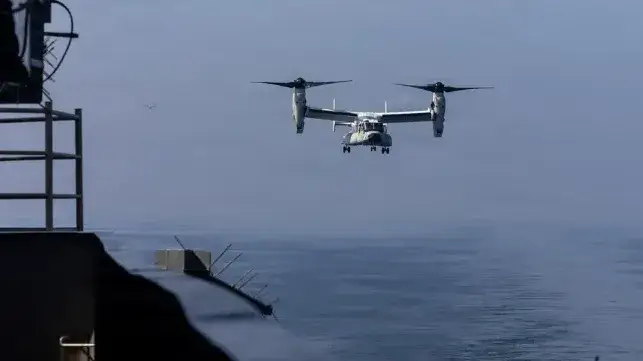
An Osprey lands aboard USS Abraham Lincoln during a visit of U.S. Central Command's top officer, Adm. Brad Cooper, February 7 (USN)
Iran has a standard playbook when dealing with a foreign policy crisis, a playbook that used to work well until its adversaries figured it out. The playbook involves portraying the political leadership in Tehran as split between hardliners adopting a maximalist, no-concession position and ‘reformists’ who say that they are in favor of negotiations and talk vaguely of possible compromises.
The trick is to lure the other side into negotiations, and string them out as long as possible, keeping alive the idea that an agreement could be possible. By prolonging the process, the Iranians hope the other side will grow weary and soften their demands – with the Iranian side making only marginal concessions and banking on the crisis dissipating as the world’s attention moves on.
These Iranian tactics are fully on display in the latest crisis, although the ‘reformist’ mask slipped recently when the supposedly reasonable President Masoud Pezeshkian re-appointed extreme hardliner retired Admiral Ali Shamkhani to the position of National Security Adviser. The IRGC hardliners have been threatening to use their ballistic missile fleet in retaliation, including to attack infrastructure targets in neighboring countries. The ‘reformists’ suggest Iran might make concessions on nuclear materials, but on nothing else, and want a complete lifting of sanctions in return. Domestically, the hardline rhetoric is played up, the ‘reformist’ messaging packaged primarily for foreign consumption.
After the first round of negotiations in Muscat last week, the Americans made it clear that they wanted a comprehensive deal, covering regional expansionism, the ballistic missile fleet, and an end to repression, regarding nuclear material almost as an irrelevant side issue now that most of Iran’s stock has already been neutralized. The American delegation reinforced the point by visiting the USS Abraham Lincoln off Duqm once the negotiations had closed, to emphasize that the military option was still very much on the table.
US discussions with Israel, with President Trump meeting Prime Minister Netanyahu at the White House on February 11, further reinforce the feasibility and possibility of military options.
The rash recently of Iranian-associated dark fleet tanker seizures, both by the United States and allies, is another indicator of robust and coordinated intent.
Iranian threats of ‘massive retaliation’, made by a series of retired generals, do not appear credible. Iranian defenses were severely degraded last year, and neither Russia nor China are rushing to help rebuild and replace. Moreover, any Iranian attack on the Gulf states, given that they have forbidden US attacks from bases on their territory, would invite a very substantial Emirati-Saudi response. Both have powerful, well-equipped and battle-tested air forces.
Pundits have looked at the current American force posture in the region. It is still small in comparison with last year. But this forgets the long-range capability that the United States can deploy. What the United States has done is enhance defensive measures within the region, both in terms of dispersal of assets and air defenses, which gives breathing space for whatever strike assets are needed for a scale-up of offensive capability flying in from US bases, should the need arise.
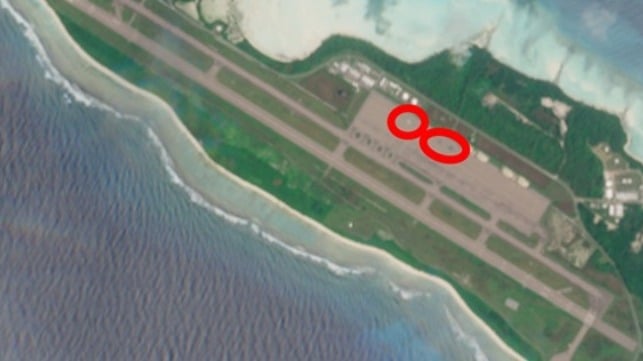
Not too busy: a US Navy P-8 and 2 x C-130s on the South Pan at Diego Garcia, February 4 (Sentinel-2)
The move of the USS Abraham Lincoln carrier strike group and other US assets into theater is a small but powerful reinforcement, sufficient for a number of offensive options. Interestingly, the United Kingdom has moved both additional air defense and strike aircraft into the region, broadening the profile of the offensive options. On January 31, the Astute Class attack submarine HMS Anson (S124) passed south through the Suez Canal en route to Australia, having loaded Tomahawk missiles in Gibraltar, and could now be somewhere in a vast area of the Indian Ocean from which any target in Iran could be attacked.
All options are very much on the table, without any further indicators or warnings.
The opinions expressed herein are the author's and not necessarily those of The Maritime Executive.
Innovative Low-Emission RoRo Launched in China for Airbus and LDA
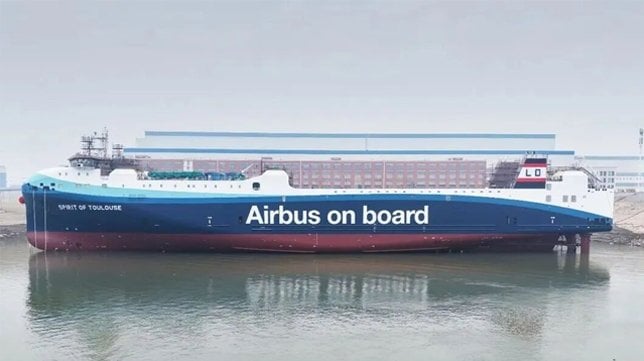
First of three RoRos designed to transport Airbus components in a low-emission operation (LDA)
The first of three innovative cargo RoRos was recently launched in China for LD Armateurs, which will operate the ships for Airbus. The vessels are designed to incorporate the latest technologies, including AI and wind-assisted propulsion, to reduce emissions.
LDA ordered the ships in January 2024, highlighting them as the next generation in low-emission shipping. LDA currently operates two ships on a transatlantic route carrying assemblies from the Airbus plant in France to the United States. The largest of the vessels currently has a capacity for six aircraft bodies. The new vessels will support an increase in capacity designed to meet Airbus’ plan to increase production of its A320 class of planes to 75 aircraft per month. The new vessels will have the capacity to transport around 70 40-foot containers and six aircraft subassembly sets. This will include wings, fuselage, engine pylons, and horizontal and vertical tails. Airbus has said any excess capacity could be used by other divisions or its partners.
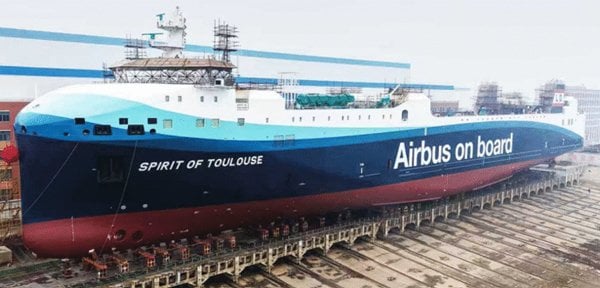
China’s Wuchang Shipbuilding, a division of China State Shipbuilding Corporation (CSSC), floated the first of the vessels, which is named Spirit of Toulouse. The sisterships, Spirit of Mobile and the Spirit of Mirabel, are currently under construction. Each of the vessels will have an overall length of 169 meters (554 feet).
Key among the features in the design, each will be equipped with six 35-meter (115-foot) tall Norsepower rotors. They are being constructed of aerospace-grade lightweight composite materials. The ships will also be outfitted with two bi-fuel engines capable of running on e-/bio-methanol or marine diesel. They are expected to have a service speed of 14 knots and a maximum of 17 knots.
From their inception, LDA highlights that the vessels were designed to minimize CO2 emissions through a comprehensive approach. This includes high-efficiency propellers and shaft lines made from recycled steel, ultra-low friction antifouling coatings, an intelligent energy management system, and a waste heat recovery system.
Equipped with advanced routing software, they will optimize their routes to maximize sail propulsion and reduce drag caused by adverse ocean conditions. Their performance will be further enhanced by an advanced control solution based on artificial intelligence, allowing the vessels to adapt in real time to weather and sea conditions and achieve aerodynamic optimization specific to each wind condition.
Each ship in this new fleet is expected to deliver a 70 percent annual reduction in CO2 emissions compared to the previous generation. Further emission reductions could be achieved through the use of low-carbon alternative fuels, such as hydrotreated vegetable oil (HVO) or e-methanol.
The shipyard reports the Spirit of Toulouse will now enter the mooring and sea trial phases. It will be undergoing a comprehensive commissioning of the propulsion system, methanol fueling, and sail installation and debugging. They had originally been scheduled to start delivery in 2025. No timeline was announced for the entry into service.
First Maersk – Gemini Cooperation Flagship Transits Suez Canal
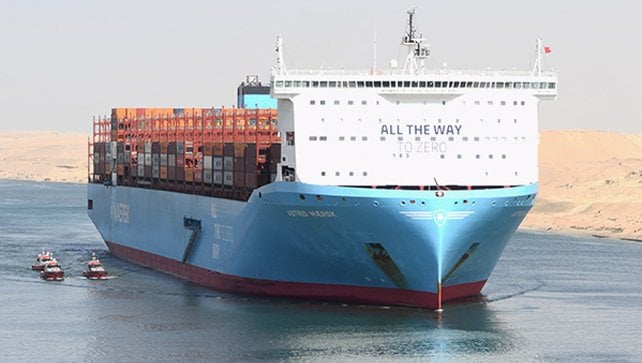
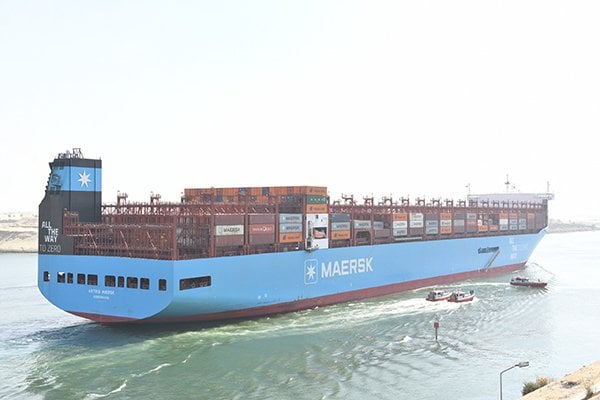
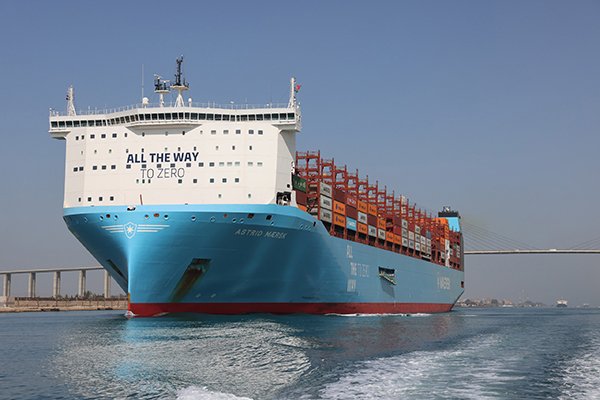
Astrid Maersk made her first transit of the Suez Canal as the Gemini Cooperation restored its first route (SCA)
The first of Maersk’s flagship dual-fuel methanol vessels made its scheduled eastbound transit of the Suez Canal, marking the return of one of the liner routes to the Suez – Red Sea corridor. Maersk had recently announced its Gemini Cooperation with Hapag-Lloyd would be restoring a route operating between the Mediterranean, Middle East, and India as the first since the beginning of 2024, and the start of the hostilities by the Houthis.
Maersk, in December and January, made trial trips through the region with the company’s vessels. However, it said that the transits through the Red Sea would continue to “be secured by naval assistance.”
Adm. Ossama Rabiee, Chairman and Managing Director of the Suez Canal Authority, witnessed the transit of the Astrid Maersk (16,592 TEU, built in 2024). It is a key part of the Suez Canal Authority’s efforts to rebuild traffic, highlighting the advantages of the canal and the renewed stability in the region. They noted that the transit completed on Tuesday, February 10, was one of 36 vessels, with a total gross tonnage of approximately 2 million tons, that made the transit. Volumes remain down by approximately half compared to the peak at the Suez Canal.
(SCA)
The ship is reported to have handled containers at the container terminal in East Port Said Port, then bunkered methanol fuel before proceeding through the Suez Canal as part of the southbound convoy on its voyage bound for Oman. Notably, the pictures show a vessel that is carrying a small load of containers compared to its capacity.
The Suez Canal Authority also highlighted that its incentives and flexible marketing policies adopted during 2025 succeeded in attracting 784 vessels with a total net tonnage of 36.6 million tons. The chairman said that the incentives and flexible marketing had helped the operation to generate revenues of over $170 million.
The Astrid Maersk received a 15 percent reduction on canal transit tolls as part of the program, which provides for containerships with a net tonnage exceeding 130,000 tons. The ships are receiving the reduction in tolls whether laden or in ballast. Since May, when the authority introduced the policy, it reports that it attracted 64 vessels with a total net tonnage of 9.9 million tons.
Coast Guard Catches Cocaine Smuggler Who Stowed Away on Barge in San Juan
Coast Guard Station San Juan has busted another barge-borne smuggler - this time, a trafficker of cocaine rather than people.
On January 28, the Jones Act tug Signet Thunder was inbound and approaching San Juan's Old Army Terminal, bringing the barge San Juan-JaxBridge in tow. At about 0548 hours, the crew of the tug contacted the Coast Guard on Channel 16. They reported that a crewmember from an assist tug had gone aboard the barge - standard for line-handling - and had spotted a stowaway.
To prevent the individual's escape, the tug crew held position in the harbor instead of berthing alongside at the terminal. Station San Juan launched a response boat to the scene, and alerted the San Juan office of Customs and Border Protection and the local police force. Multiple marine units responded to the call. As a precautionary measure, the station staff issued a broadcast to shipping to watch out for signs of distress in the harbor.
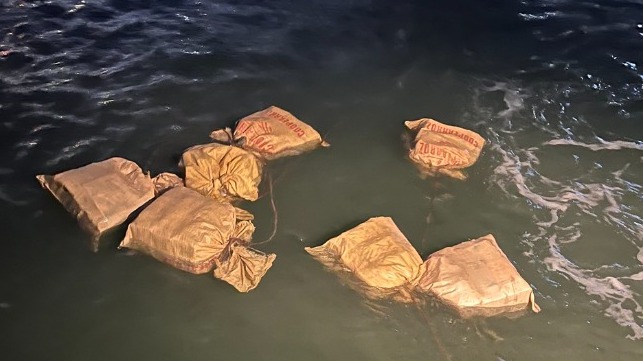
Shortly after arrival, the Coast Guard boat crew spotted one individual in the water, along with 10 bales of suspected drugs. They recovered the packages from the water and returned to the pier. On weighing, the packages turned out to come to about 358 kilos, valued at about $5 million wholesale.
Multiple agents boarded the tug and barge and conducted a thorough search. No further evidence of smuggling was found, nor other stowaways.
"We commend the actions of the tugboat Signet Thunder, which reflect positively on the maritime community and the important role they play in safeguarding our nation’s navigable waterways. We are proud to stand the watch alongside our Department of Homeland Security, Department of Justice and our local law enforcement partners," said sector response chief Cmdr. Matthew Romano (USCG).
Barge stowaways are an occasional issue in San Juan harbor, which receives traffic from around the Caribbean. Two stowaways were saved from the harbor's waters by coastguardsmen last December, then detained for processing. In 2023, three stowaways jumped off a barge under tow by the tug Sarah Dann, and nine others were found aboard the tow.
All would-be migrants face removal under federal policy, with repatriation either to their home nation or the place where they boarded as stowaways
Philippine Government Fires 14 Officials Over Deadly Ferry Disaster
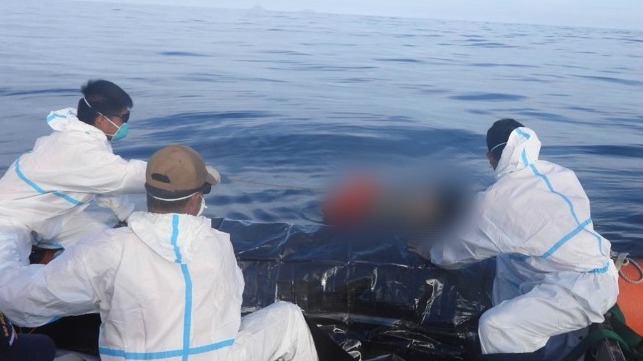
Philippine Coast Guard personnel recover a body at the wreck site of the Trisha Kerstin 3, February 10 (PCG)
An investigation into the deadly sinking of the ferry Trisha Kerstin 3 has determined that the vessel was overloaded on the casualty voyage, according to the Philippines' Department of Transportation. In a swift response, the Philippine government has fired the local chief of the Maritime Industry Authority (MARINA), the head of the Zamboanga station of the Philippine Coast Guard, and 12 other officials.
In addition, at least three people - including Zamboanga MARINA director Jedini Nur Sibal - face administrative charges and possible criminal investigation, said Transportation Secretary Giovanni Lopez.
"Here you will see that the Department of Transportation, including MARINA and the PCG, if even our colleagues are responsible, I am going to act on it," he said at a press conference.
Vessel operator Aleson Shipping Lines is also likely to face charges, according to Lopez. The secretary has ordered MARINA to open an administrative case against the company and evaluate whether it should be allowed to keep its franchise to operate on the route. Surviving crewmembers of the vessel could also potentially face investigation.
Lopez said that the initial inquiry had revealed a range of issues with the ferry's operation. He alleged that the vessel had problems with its passenger capacity certification, drydocking and maintenance record and seaworthiness certification. In addition, he claimed, Trisha Kerstin 3 was overloaded with both passengers and cargo; the weigh bridge at the terminal was not used for vehicle weights for ro/ro cargo; and the passenger manifest was inaccurate.
The casualty numbers continue to change as the search at the wreck site continues. One additional body was recovered on Tuesday, bringing the total number of fatalities to 52. Separately, a check on the passenger manifest revealed that there were 23 fewer survivors than initially believed: the number has been revised downward from 316 to 293. In a statement, the PCG said that the changes reflected multiple issues with the vessel's manifest, including surviving passengers and crewmembers who were not listed on the official document.
27 additional people are currently listed as missing, including six recovered bodies that have yet to be identified. Accounting for overlap, this puts the total number of people believed to be aboard on the casualty voyage at 372.
Guy Harvey Foundation and Coastal Conservation Association
The Guy Harvey Foundation (GHF) and Coastal Conservation Association (CCA) Florida, two leading conservation organizations, have partnered to expand environmental education, strengthen coastal ecosystem awareness and invest in the next generation of conservation leaders across the Sunshine State.
Through this partnership, the GHF has developed new, co-branded educational content aligned with CCA’s ecosystem restoration initiatives, spotlighting the critical role of oysters, clams, salt marshes and mangroves in protecting Florida’s coastal waters. The lessons will enhance GHF’s existing conservation education programming while introducing educators and students to CCA’s hands-on restoration efforts and driven stewardship.
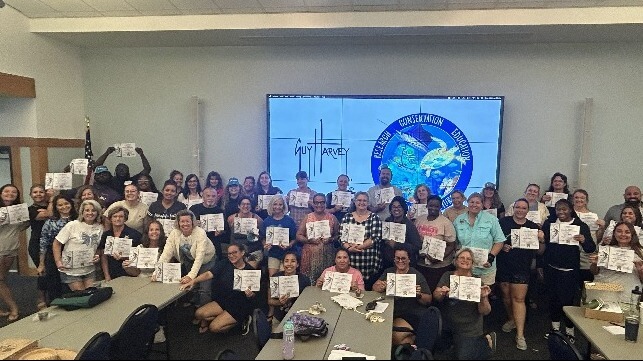
As part of the partnership agreement, CCA serves as sponsor of the Guy Harvey Foundation’s Conservation Education Training (CET) sessions for teachers. Last year, educators attended a CCA-sponsored CET at the Guana Tolomato Matanzas National Estuarine Research Reserve in Ponte Vedra Beach. The Guy Harvey Conservation Education program is open to all elementary, middle and high school educators and includes all the materials, classroom supplies and educational content they need to inspire, excite and encourage the next generation of ocean conservationists. Through this immersive, experiential program, educators, and by extension schools and school districts, can participate in regional professional development opportunities dedicated to environmental Science, Technology, Engineering, Arts and Mathematics (STEAM) education. Following their training in the program, participants become Guy Harvey Conservation Educators who are then empowered with the knowledge and resources they can share with students to foster environmental awareness and contribute to a sustainable future. The program also offers grants for field trips and supplies, enabling Guy Harvey Conservation Educators to further enhance their teaching and instill conservation values in students.
In addition, GHF has committed a sponsorship to provide a $25,000 Youth Scholarship in the 2026 CCA Florida STAR Youth Fishing Competition, further strengthening the partnership between Guy Harvey Foundation and CCA Florida’s youth-focused initiatives.
“This partnership with CCA represents a powerful alignment of shared values, education, conservation and long-term stewardship of our coastal ecosystems,” said Jessica Harvey, CEO of the Guy Harvey Foundation. “By combining our educational expertise with CCA’s restoration-focused mission, we are creating meaningful pathways for teachers, students and young leaders to understand, protect and advocate for Florida’s vital marine habitats.”
CCA’s support of GHF’s teacher training program further underscores the organization’s commitment to conservation education and community engagement. Through these collaborative efforts, educators are better equipped to bring ecosystem science into the classroom while students gain a deeper appreciation for the interconnected role coastal habitats play in Florida’s environmental and economic future.
“Partnering with the Guy Harvey Foundation allows us to amplify the impact of conservation beyond the water and into the classroom,” CCA Florida Executive Director Brian Gorski said. “By connecting hands-on ecosystem restoration with meaningful education and teacher training, we are investing in the next generation of conservation leaders.”
The products and services herein described in this press release are not endorsed by The Maritime Executive.