It’s possible that I shall make an ass of myself. But in that case one can always get out of it with a little dialectic. I have, of course, so worded my proposition as to be right either way (K.Marx, Letter to F.Engels on the Indian Mutiny)
Thursday, February 12, 2026
Army Corps and Eastern Shipbuilding Group Hold Keel Laying Ceremony
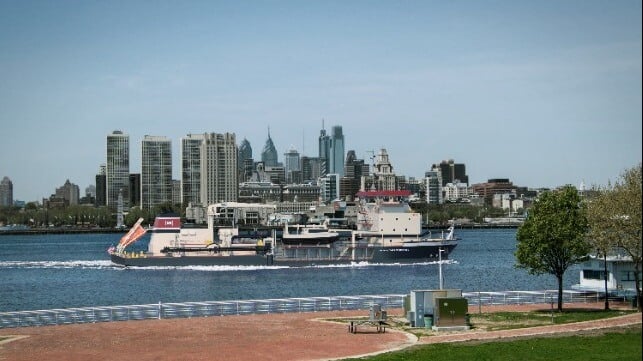
On January 22, 2026, Eastern Shipbuilding Group (ESG) and partners, U.S. Army Corps of Engineers (USACE) and Royal IHC, held a keel laying ceremony for the ongoing construction of the Dredge DONNELLY at Eastern’s Allanton Facility.
“As the shipbuilder for the DONNELLY, this keel laying represents an important production milestone for our team and a clear demonstration of the progress being made on this vessel,” said Joey D’Isernia, Chairman and CEO of Eastern Shipbuilding Group. “Our workforce is executing this program with a strong focus on quality, safety, and schedule performance, and we are proud to be building a hopper dredge that will support the U.S. Army Corps of Engineers’ mission for years to come. We value the close collaboration with USACE and Royal IHC as we move forward with construction.”
The DONNELLY is a Medium Class Hopper Dredge that has been under construction since April 2025. The vessel will replace the Dredge McFARLAND and will play a critical role in enabling USACE to continue to deliver its navigation mission and provide for safe, reliable, effective, and environmentally sustainable waterborne transportation systems for vital national security, commerce, and recreation needs.
The keel laying represents the ceremonial start of a ship’s life by commemorating the assembly of the initial modular construction units. Historically, shipbuilders would carve their initial into the keel to validate that the keel was properly laid and of excellent quality. This was memorialized by welding the ship’s sponsor’s initials into the keel authentication plate, by Trace Taylor, welder with ESG. Overseeing the weld was Russ Donnelly, representing the family of Ray Donnelly, the ship sponsor and vessel namesake.
In April 2025, construction of the DONNELLY commenced with a steel cutting ceremony, also at ESG’s Allanton Shipyard. Since then, modular construction has been progressing steadily, with unit builds and fabrication and assembly of various key components underway. Work is being carried out in close coordination with the USACE Marine Design Center, Eastern Shipbuilding Group, and Royal IHC, the designer of record. The new dredge is on track to be placed into service in Fiscal Year 2028.
In June 2025, USACE announced the new dredge will be named the DONNELLY after the late Ray Donnelly, who retired as Chief of Resource Management for the USACE Philadelphia District in 2020. He previously received the Army Engineer Association’s de Fleury Medal (Bronze Order) in recognition of his 44-year career with both the U.S. Navy and USACE. Donnelly was a key leader in the USACE Resource Management community and conducted a detailed analysis of the four USACE-owned dredges and the impacts of recapitalization on the national Civil Works program. He was also instrumental in the financial management of the Hopper Dredge McFARLAND.
Dredge DONNELLY Specifications:
Length: 320’
Beam: 72’
Hull Depth: 28’
Draft (hopper empty): 11’3”
Draft (hopper full): 25’6”
Maximum hopper capacity: 6000 cubic yards
Maximum dredge depth with suction tube at 45 degrees: 65’
The products and services herein described in this press release are not endorsed by The Maritime Executive.
Glamox Lights Way for 1st Night Landing of Foreign Partner Helicopter
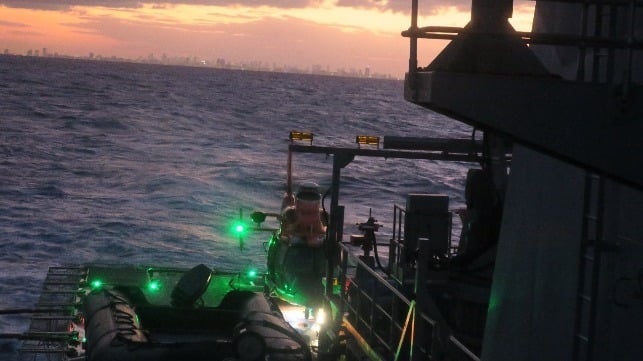
Glamox, a global leader in lighting, recently celebrated the first-ever night landing of a foreign partner helicopter on a UK Royal Navy Batch 2 Offshore Patrol Vessel. The landing of a US Coast Guard helicopter on HMS Trent was made possible by the Glamox Helicopter Visual Landing Aid System (HVLAS), installed last year to enhance HMS Trent’s ability to land helicopters in rough seas and at night from the UK and partner nations.
The landing of a US Coast Guard helicopter took place off the coast of Miami, Florida, providing valuable aviation training for day and night landings. This enhanced operational flexibility is important, particularly for disaster relief and aid operations in regions such as the Caribbean.
“It was a significant moment, demonstrating that our Helicopter Visual Landing Aid System works well with helicopters of coalition forces on unfamiliar flightdecks,” said Lou Lewis, a Business Development Manager at Glamox’s Defence and Security business in the UK. “We were contracted to supply systems for two Royal Navy vessels, HMS Trent and HMS Spey, and aspire to enhance the aviation capabilities of the remaining Royal Navy Batch 2 Offshore Patrol Vessels.”
The Glamox HVLAS is a complete flight deck LED lighting system that provides pilots with visual cues and information during approach and landing. It includes a stabilised horizon bar that indicates the horizon's position, regardless of the vessel's roll and pitch. Also, a glide path indicator helps pilots judge approach angles by using a three-colour light beam to show the correct path or whether the helicopter is too high or too low. Additional deck-edge lighting and focused LED beam lines provide precise positional cues for pilots operating in low-visibility conditions or using night vision goggles. Glamox also supplied both vessels with military-grade Night Vision Imaging System navigation lights.
The HVLAS was installed on HMS Trent in 2025 by Glamox’s customer du Pré Marine. Glamox also worked closely with the Defence Equipment & Support Organisation within the UK’s Ministry of Defence and with the vessel’s through-life support contractor, UK Docks Marine Services.
The products and services herein described in this press release are not endorsed by The Maritime Executive
Lockheed Unveils Drone That Can Hitchhike on Ship's Hulls
Lockheed Martin has unveiled a new autonomous unmanned vessel (AUV) class designed for long endurance, named Lamprey in a nod to its unique ability to hitch a ride on vessel hulls.
Lamprey is intended to fill a variety of mission sets for the Navy. The clearest application in peacetime is for ISR purposes, as small robotic submersibles can evade detection while gathering useful information. In conflict, the same stealth capability could be used for sea denial: the drones could get close enough to launch an attack without warning, or loiter on the bottom until needed, like a flexible and capable mobile mine. Other use options include electronic jamming, decoy deployment, aerial drone deployment and precision strike operations. Deployed en masse, the Lamprey could be used for sea denial, operating with AI and working in teams.
Most interestingly of all, the Lamprey is designed to hitchhike, unlike competing products. It can attach to a ship or a submarine and ride to its operating area, recharging on the way by catching the passing current with propeller-driven generators. No "host modification" is needed, suggesting that it could be used on vessels of opportunity (perhaps even unknowningly). The 24-cubic-foot payload bay is large enough for lightweight torpedoes or for launching aerial drones.
Lockheed's device arrives in a marketplace pioneered by others. Tech startup Anduril has developed a drone sub for Australian use, dubbed Ghost Shark, and Boeing has been working with the Navy on its XLUUV / Orca program for years. The MSubs/Royal Navy Excalibur program recently began testing and evaluation, and BAE Systems plans to have a market-ready large drone sub - Herne - by the end of this year. The Royal Navy has rapid and ambitious plans to use unmanned platforms to patrol the GIUK Gap, freeing up scarce manned assets.
China has extra-large unmanned underwater vehicles (XLUUVs) of its own, far larger than the Boeing XLUUV / Orca, their purpose and mission unknown in the public domain. Two have been spotted in testing near Hainan, according to Naval News.
Blue Water Uses a Damen Design to Speed Up Unmanned-Vessel Program
The American autonomous-vessel company Blue Water Autonomy has released the first renderings of its new contender for the U.S. Navy's oceangoing unmanned surface vessel procurement program, which was recently restructured and renamed "Modular Attack Surface Craft" (MASC).
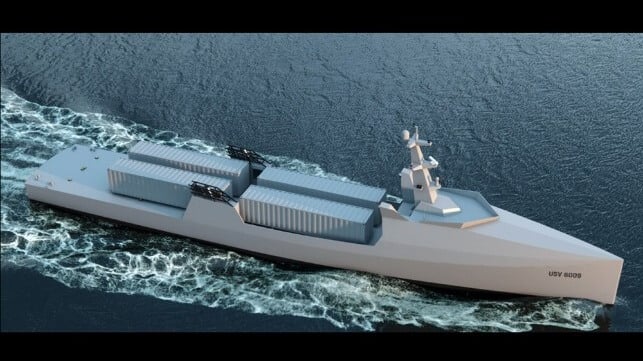
The new "Liberty-class" design - a nod to the mass-produced Liberty ships of World War II - is a 190-foot steel-hulled autonomous vessel, capable of carrying four 40-foot containerized systems for flexible loadout. The hull is based on a Damen Axe Bow patrol boat, the Stan Patrol 6009, which is designed for wave-piercing and reduced ship motion.
Blue Water's objective was to stay with a known and proven hull form in order to lower technical risk, but the company's engineers fully redesigned the interior and ship's systems for unmanned operation. All systems are designed to be fault-tolerant and highly automated, with the goal of building a boat that can go for months with little attention from human operators. The target operational range is 10,000 nautical miles.
Blue Water's design is set to begin construction at Conrad Shipyard next month, and will be ready before the end of the year, the company said. Conrad builds in volume - about 30 vessels of various sizes and types per year - and it has scale and experience for series production.
Blue Water says that it has been able to develop the Liberty-class design with private capital only, thanks to partnerships with companies like Conrad and Damen. After delivering the first hull, it wants to ramp up quickly to deliver 10-plus ships per year out of the Conrad yard complex in Louisiana.
The company's speed to market aligns with current Pentagon leadership's goals - leveraging private innovation, prioritizing autonomous systems, and building at scale. The design's manufacturability and intended use cases - including missile, sensor, and logistics payloads - make it a fit for the Navy MASC program, and specifically the four-FEU "High Capacity MASC" container-carrying vessel category. The High Capacity MASC solicitation requires enough room for four 40-foot containers, each weighing up to 36 tonnes and consuming up to 50 kW of power each. Minimum time to production, producibility at large numbers of shipyards, and "non-exquisite" design are key to the solicitation, so a proven steel hull aligns with requirements.
EU Moves Closer to a Full Ban on Russian Oil Shipping Services
The European Commission's latest proposal for sanctions on Russia includes a full ban on European maritime services for the shipping of Russian crude oil, driven by the EU's need to generate leverage at the negotiating table on the war in Ukraine. It is a retreat from the incrementalism of the G7 "price cap" policy, which was promoted by former U.S. Treasury Secretary Janet Yellen in 2022 as substitute for a full maritime services ban.
The price cap system created a window for EU-domiciled commodity traders, shipowners, insurers and service providers to engage in the Russian oil trade, without fear of sanctions - so long as the cargo is priced below the cap level, currently $47.60 per barrel in Europe. This window is wide enough that more than a third of Russian oil exports in the Baltic are loaded aboard "legitimate" tankers, per Brookings, with the balance carried by the non-EU shadow fleet.
"Until now, with a price cap, you'd still have exports of oil [with European participation]. With this ban, any export of oil from Russia will be made even more difficult," EC spokesperson Paula Pinho explained Monday. "So that's the logic underpinning this proposal."
In addition, the plan includes sanctions on two specific oil terminals in Georgia and Indonesia that handle Russian crude, sending a message that overseas stakeholders will also be targeted.
Negotiating leverage
The proposal comes against the backdrop of negotiations between the U.S. and Russia over the fate of Ukraine, which has so far offered only a diminished role for the EU. To regain influence and offset a perceived U.S. receptiveness to Russian persuasion, top EU diplomat Kaja Kallas thinks that Moscow must be pushed "from pretending to negotiate to actually negotiate" with Europe. Economic leverage in the form of oil sanctions, if actualized, could move that forward.
"If the Russians think they are getting their maximum goals from the Americans, why should they want to talk to the Europeans?" she told Euronews on Monday. "We will only make demands for them."
In the broader geopolitical context, some analysts are becoming confident that a full EU maritime services ban for Russian oil shipping is coming.
"It now looks increasingly certain that the EU (and likely the UK) will move to a comprehensive maritime service ban on the carriage of Russian crude oil to third countries," said Alexander Brandt, sanctions partner at global law firm Reed Smith, in a statement Monday. "Instead of gradually lowering the oil price cap, EU leaders have concluded that controlling Russia’s oil revenues through comprehensive restrictions on maritime services is necessary to squeeze state profits. Such steps build on measures taken by the UK and U.S. last year, to target the four largest producers of Russian oil."
There is one foreseeable risk, however. G7 price cap policy led Russian exporters (and their enablers) to build out a giant shadow fleet of under-regulated, under-insured tanker tonnage, bypassing Europe's near-monopoly on financial services for shipping. The safety and security risks of the shadow fleet are well-understood - and could get worse if every drop of Russian oil has to ship aboard a gray-market tanker, Brandt said.
"The impact of these measures, if introduced, remains to be seen and a key danger associated with a full-service ban, is that it might lead to further proliferation of the parallel [shadow] fleet, that has become a source of considerable international concern," he said in a statement.
Norway Flags Russian Cyber Espionage Campaign on Maritime Infrastructure
Norwegian security agencies have warned of increased Chinese and Russian intelligence operations in 2026, with maritime infrastructure a major target. This was revealed by the Norwegian Police Security Service (PST) in its 2026 national threat assessment, which was released last week. The report claims Norway is facing its most serious security situation since World War II.
In addition, PST noted that China and Russia have enhanced their abilities to conduct intelligence operations in Norway, primarily through the cyber domain. Iran has also infiltrated Swedish criminal networks with a presence in Norway for covert operations.
But Russia remains a major threat actor to Norway. The relations between the two countries have deteriorated in the past three years, especially due to Norway’s continued support for Ukraine. Norway is aligned with economic sanctions being implemented by the EU and the U.S against Russia. Other countermeasures by Norway include enforcing strict entry for Russian nationals and restricting access of Russian vessels to Norwegian ports. There is an exemption for Russian fishing vessels to access ports in Båtsfjord, Kirkenes and Tromsø.
PST sees Russian crews on civilian vessels registered in third countries representing a significant threat in 2026. There is a growing trend by Russia to use civilian vessels to perform reconnaissance on coastal and subsea infrastructure in Norway and other allied countries in Europe.
The assessment further highlighted the Chinese state-sponsored cyber espionage campaign, code-named Salt Typhoon, focused on breaching Norwegian critical infrastructure and telecommunication networks. PST said that Salt Typhoon has already targeted vulnerable network devices in Norway, although it did not name the organizations affected. China has also used Salt Typhoon to infiltrate telecom providers in Canada and the U.S.
The PST report coincided with a warning from Ukrainian computer emergency response team, CERT-UA, which flagged cyber breaches by a Kremlin-backed hacker group called Fancy Bear or APT28. The group is targeting public sector and logistics bodies in Romania, Slovakia and Ukraine. In a report last week, cyber security firm Trellix explained that APT28 is exploiting a vulnerability in Microsoft Office, which Microsoft revealed in late January. The vulnerability tracked as CVE-2026-21509 allows attackers to bypass critical security mitigations built into Microsoft Office and Microsoft 365.
Since the flaw was revealed, Trellix confirmed that it has observed an attack campaign by APT28, targeting maritime and transportation entities spread across Poland, Slovenia, Turkey, Greece and United Arab Emirates. These attacks were part of a concentrated 72-hour spear phishing campaign that sent around 29 distinct emails across nine Eastern European countries. The emails sent between January 28 and January 30, contained malicious Office documents, which triggered malware automatically without requiring user interaction.
Russian Military Cargo Ship Draws Attention Lingering for Days off Sardinia
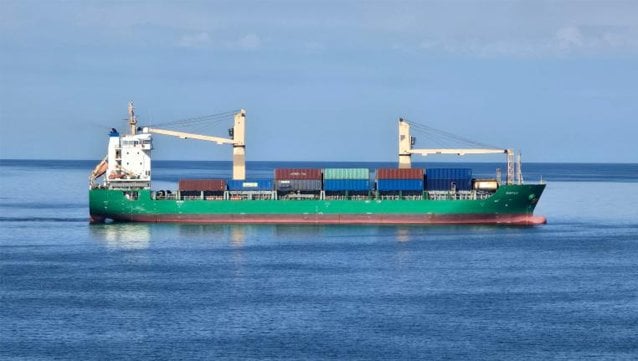
Russian-flagged cargo ship Sparta IV lingered off Sardinia (VesselFinder/Wanderer)
A Russian-flagged cargo ship, well-known for its military support operations, was lingering off the coast of Sardinia for nearly a week. While the ship has not violated any regulations, its unusual pattern of behavior has drawn attention, including it appears from the Italian Navy.
The Sparta IV (8,870 dwt) is one of a series of Russian cargo ships frequently linked to the movement of military equipment. The ship was spotted making numerous trips to Syria and, along with other ships of the series, was believed to have supported the withdrawal of Russian troops and material after the fall of the Asad government in Syria. The United States sanctioned the Sparta IV in May 2022, along with its owners SK-Yug, which is part of the Russian company Oboronlogistika.
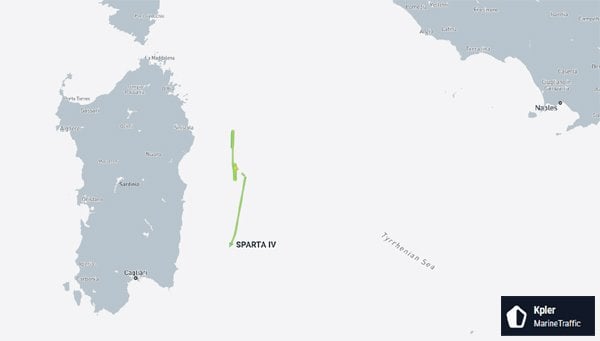
The vessel’s apparent diversion in the Mediterranean on February 4 into the Tyrrhenian Sea drew immediate attention. More so when the vessel was then spotted sailing back and forth in a close loop in the area south of Olbia, a coastal city in northeast Sardinia, Italy. The vessel’s AIS signal has consistently shown it heading for Kaliningrad, Russia.
Sparta IV was going back and forth for days off the coast (MarineTraffic)
Open source media quickly said the ship appeared to be sailing with the Russian destroyer RFS Severomorsk and the tanker Kama, which also supports the Russian military. Some speculation was that there was also a Russian submarine in the area.
Some of the media reports also speculated that the ship was near critical subsea infrastructure. They said there were cables for power and communications, while others said the area did not have critical assets.
Reporting quickly ruled out local weather as the cause of the vessel’s delay and apparent holding pattern.
The Italian Navy did not directly confirm the media reports and its interest in the vessel but did take the unusual step of making a social media posting stressing that its Safe Mediterranean Operation “continues without interruption with close-range surveillance activities of Russian Federation military vessels and merchant units.” One of the pictures included showed an Italian warship sailing in close proximity to the Severomorsk. Unconfirmed reports said Italy's Guardia di Finanza had a surveillance airplane circling over the region off Sardinia for about one hour.
The Italian Navy highlighted that Operate Safe Mediterranean had been underway to monitor the region since 2022. They said it was built on and expanded an effort that had been started in 2015.
The mystery of what was going on with the Russian vessel persisted through the weekend, drawing increased attention from the Italian media.
Late on Monday, February 9, the vessel appears to have gotten back underway. The AIS signal shows it sailing at better than 11 knots, and as of the evening, it appeared to be rounding Cagliari on the southern tip of Sardinia. What the vessel was doing while it was holding in the Tyrrhenian Sea remains unclear.
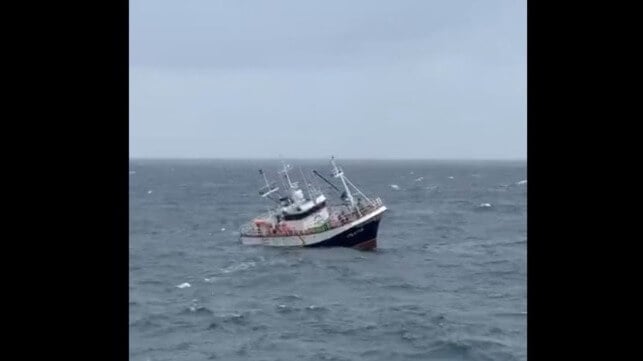
Seven fishermen from a stricken vessel were rescued by good Samaritans off the coast of A Coruña on Monday, according to Spanish SAR agency Salvamento Maritimo.
At about 1050 hours on Monday morning, the agency's rescue center in A Coruña received a distress call on VHF from a fishing vessel, the Abra de Muxia. The crew reported that they had just rescued seven people from another fishing vessel, the Itoitz, which had taken on a severe list.
Given the situation aboard, the master of Itoitz had ordered the crew to abandon ship into the liferaft, and the Abra picked them up shortly thereafter.
A Spanish rescue helicopter rendezvoused with the Abra and medevaced all seven crewmembers, delivering them to shore at A Coruña's local airport. No injuries were reported. (Mid-evacuation, though, the same helicopter stopped to pick up another fisherman who had suffered a head injury on a different vessel, per local media.)
After the evacuation, Itoitz remained afloat, though with a pronounced list. The Salvamento Maritimo had a SAR lifeboat maintain watch on scene for navigational safety, as the vessel continued to drift north of Cape Ortegal, making about two knots on a northeasterly course.
A tug has been chartered for a towing attempt, owner Javier Sar Romero told La Voz de Galicia. However, the forecast is not favorable for the coming days, with winds of 30-plus knots and waves of 15-plus feet expected, and the swell has prevented access.
Container Feeder Rescues Solo Sailor in Rough Weather off Bermuda
On Tuesday, the crew of a container feeder rescued a single-handed sailor from a disabled yacht off the coast of Bermuda, despite challenging surface conditions.
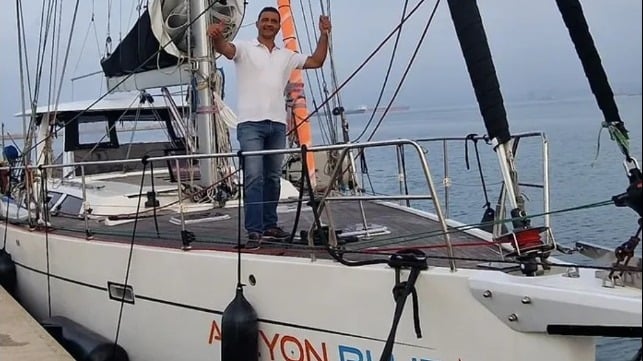
On Saturday, the rescue coordination center in Bermuda received word by email that the 52-foot sailing yacht Alcyon Blue was in distress. The vessel had suffered engine and generator failures in rough weather while on a voyage from Antigua to Bermuda. High winds had damaged the yacht's storm jib, and diesel fuel fumes were contaminating the interior of the yacht, leaving the single-handed sailor operating the vessel in a state of dizziness and nausea. He activated his EPIRB to summon help, and the message was passed to the Bermuda RCC.
Local media identified the sailor as Cypriot national Demetris Lappas, a former Olympic windsurfer. (Lappas' social media accounts identify him as the operator of the Alcyon Blue.) Lappas had a Garmin InReach device with him, which he was able to use to keep in touch with family members who relayed messages to the authorities.
By Sunday, Alcyon Blue had drifted to a location about 100 nautical miles to the southeast of Bermuda. Prevailing winds were in the range of 30 knots from the west, and conditions were rough enough that Lappas asked for assistance in abandoning ship. The Bermuda RCC asked a nearby passenger vessel, the floating-library shipLogos Hope, to divert to assist. The small container feeder Bermuda Islander also responded to the call.
The Islander arrived first at about 0100 on Tuesday morning. Conditions on scene were rough, with seas of 20-plus feet, and the master deemed it prudent to stand by to await calmer seas and the arrival of the Logos Hope. After multiple attempts by both vessels, the Islander managed to come alongside the stricken yacht, and the crew brought Lappas safely aboard. After assessing his condition and determining him to be uninjured, the Islander's crew resumed their commercial voyage to New Jersey. Logos Hope has now arrived in Bermuda for a weeks-long call, performing her mission of selling books to the public.
Chemical Tanker Collides With Fishing Vessel off Kobe, Injuring One
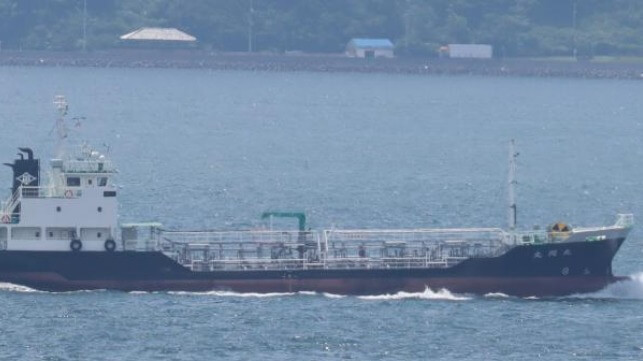
[Brief] On Wednesday afternoon, a chemical tanker collided with a fishing vessel off the coast of Kobe, Japan, according to the Japan Coast Guard.
At about 1215 hours on Wednesday, the master of the small tanker Maruoka Maru contacted the coast guard station in Kobe to report a collision with an unnamed fishing vessel. Both vessels sustained damage towards the bow, but no pollution has been reported, the agency said.
The skipper of the fishing boat sustained a non-life-threatening head injury in the collision, and he was medevacked to the hospital for evaluation and treatment. The cause of the collision is under investigation.
Maruoka Maru (IMO 9882774) is a 1,000 dwt chemical tanker built in 2020 and employed in coastwise trade between Kure, Kobe and Osaka. It is managed by a Japanese firm.
As of Thursday morning local time, Maruoka Maru had departed the region, headed westbound towards Kure.
The UK’s Marine Accident Investigation Branch issued its final report on the October 2023 collision of two cargo ships in the German area of the North Sea, calling the accident “wholly avoidable.” It was critical of the actions of both crews, calling their attitudes “reckless,” and also criticizing the efforts of the German Bight vessel traffic service.
The UK conducted the investigation because the five seafarers who perished were working aboard the Isle of Man-registered general cargo ship Verity, a smaller cargo ship built in 2001. The vessel had departed Germany bound for the UK with a crew of seven and carrying 3,262 tonnes of steel coils. It collided with the Bahamas-registered bulker Polesie at approximately 0500 on the morning of October 24, 2023, with the bulker traveling at a speed of 12 knots. The Polesie had a crew of 20 and was traveling from Germany to Spain with a cargo of 32,997 tonnes of feed barley and wheat.
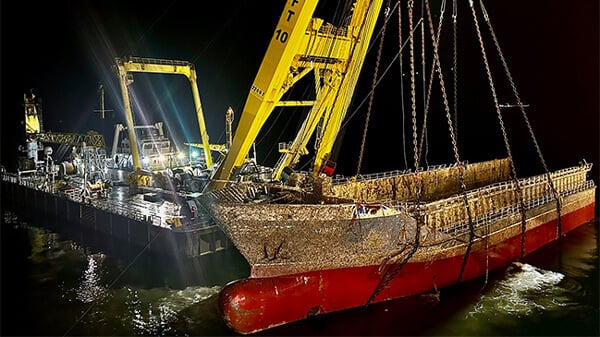
The Verity was badly damaged during the collision, with a large breach in its side, double bottom, and cargo hold. The ship immediately began to list and sank in less than five minutes. Although the crew had mustered after the accident, they did not have time to get into survival suits. Five of the crew were lost, with one body, the captain, recovered, and four missing after the sinking. The vessel was later salvaged and inspected during the investigation.
MAIB conducted an extensive review, releasing a detailed 82-page report. It notes that the Verity, because of its age, size, and regulations, did not have a Voyage Data Recorder. Because key members of the crew perished and because of restrictions on interviews, MAIB notes it was not fully able to explore the rationale behind the Polesie’s watchkeeper and the decisions of the staff at the German Bight vessel traffic services.
It was able to reconstruct many of the actions and conversations, concluding there were “significant shortcomings” by the watchkeepers on both vessels, specifically as it pertained to the application of the International Regulations for Preventing Collisions at Sea. It highlights that under the regulations, Verity was required to keep clear of Polesie.
“Specifically, both watchkeepers were willing to accept inappropriately close passing distances given that their room for maneuver was not overly constrained by navigational hazards or limited by other traffic,” writes MAIB. “The early use of very high-frequency radio could have avoided ambiguity as to each vessel’s actions. When actions were eventually taken to avoid a collision, they were neither positive, so as to be readily apparent to other observers, nor made in ample time.”
It also concluded that the vessel traffic services were late in their efforts to intervene. MAIB writes that the staff did not use “standard marine communications phrases, which might have helped alert the watchkeepers to the seriousness of the situation.” It also notes the use of a duplex radio channel that it says hampered the passing of critical information. The vessel traffic service made a second attempt at intervention, but it came too late, so that MAIB calls it “counterproductive.”
The recommendations from the report called for the shipping companies to remind crews to comply with regulations and the standards for keeping a safe navigational watch. It also recommended that the German Directorate General for Waterways and Shipping review the duplex VHF radio channels and improve guidance to its personnel on the international communication protocols. Finally, it recommended that the Isle of Man Ship Registry propose to the International Maritime Organization the extension of the VDR requirements.
MAIB believes the problems were not with the regulations and did not propose amendments. Instead, it cites the lack of adherence to critical “rules of the road” and the lack of clear actions by the crews to avoid the collision.
Singapore Jails Captain for Lying About Fatal Incident on Gas Tanker
The death occurred while the vessel was in the anchorage off Singapore (iStock)
A court in Singapore sentenced the captain of a gas tanker to 14 months in jail after he admitted to lying about a fatal incident aboard the vessel in 2024. He is the second officer from the ship sentenced to jail for the incident that took the life of a seafarer ordered to clean a gas tank, while the case against the chief officer of the vessel is still pending in the courts.
The charges stem from an incident aboard the chemical tanker GT Win (15,000 dwt), which had arrived in Singapore on May 11, 2024, transporting a cargo of naphtha. The vessel, which is registered in Vietnam, offloaded its cargo and moved into the anchorage.
While it was in the anchorage, the chief officer, Dao Tien Manh, ordered three crewmembers to clean the emptied tanks, although according to prosecutors, he had failed to check the oxygen levels and make the necessary safety checks. Further, he instructed the pump master, Le Thanh Dung, to make modifications to the mask of the breathing apparatus. He connected the mask’s hose to an air bottle on deck, which prosecutors called “impractical,” noting space constraints at a staircase, according to the Straits Times’ report.
One of the seafarers, Hoang Van Chau, became unconscious while working in one of the tanks. The crew attempted CPR and requested emergency medical assistance from shore. Chau was pronounced deceased at a local hospital, dying from exposure to volatile hydrocarbons, the newspaper reports.
The captain of the vessel, a Vietnamese national named Nguyen Duc Nghi, age 50, concealed the facts of the incident from the Singapore Police Force and the Maritime Port Authority of Singapore. After the fatality, the captain reportedly spoke with the vessel’s pump master, who showed him the altered breathing mask.
In the court filings, they alleged the master threw the mask overboard. Further, he told the crew that they should tell the investigators that the seaman had been found unconscious in the tank and lie about the details. He said that was the only way the family would get the insurance money.
Nghi was taken into custody the day after the incident. Crewmembers then told the investigators the truth about how the death happened. According to the report, when the police confronted the captain, he admitted to the lie and instructed the crew to lie. His actions were also equated to insurance fraud.
The captain pleaded guilty to one count of obstructing justice. He will be serving 14 months. The pump master pleaded guilty in July to one count of “performing rash acts that endangered lives.” He was sentenced to three months and two weeks in jail.
The chief officer of the GT Win is also facing charges for the incident. They allege he was the one who instructed the crewmembers to enter the tanks to clean them, knowing the air had not been checked and the safety procedures were not followed. His role was to check the oxygen levels. Further, the court papers allege that the chief officer, Dao Tien Manh, age 32, had instructed the pump master to make the alterations to the mask.
Captain Pleads Not Guilty as China Prosecutes for Baltic Cable Damage
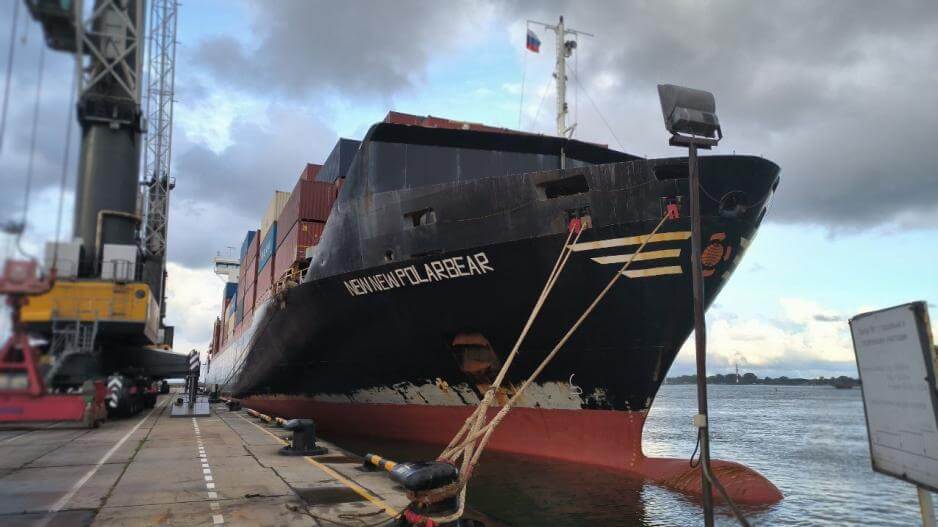
Containership NewNew Polar Bear dragged its anchor damaging subsea infrastructure in the Baltic (NewNew Shipping Co.)
The slow-moving prosecution of the master of the Hong Kong-registered containership NewNew Polar Bear took its next step on Wednesday, February 11. Captain Wan Wenguo officially entered a plea of not guilty in a Hong Kong court to the charges that his vessel, in October 2023, damaged telecom cables and a gas pipeline in the Baltic.
Chinese officials had promised to cooperate in the effort after Finnish prosecutors identified the containership as the suspect in the anchor-dragging incident that damaged the infrastructure. China announced it would prosecute Wan, a 44-year-old Chinese national, and he made his first court appearance in May 2025. In January 2026, the defense team requested more time to review the evidence against the captain.
Finland and Estonia conducted an investigation after the Russian communications cable and two cables between Estonia and Finland were damaged on October 7, 2023, followed by the damage to the Balticconnector gas pipeline the next day. Finland recovered a ship’s anchor from the seabed and identified extensive drag marks, and later the anchor was matched to the missing bow anchor of the containership. The NewNew Polar Bear was conducting a historic first trip for the Chinese using the Northern Sea Route, traveling from China to Saint Petersburg, Russia, and back to China.
The Hong Kong court charged Wan with one count of “reckless” operation of the vessel and two additional charges related to safety violations. One relates to operating the ship without an anchor and not reporting the loss of the anchor, and the other relates to not filing regular reports with the shipowner. Wan entered a plea of not guilty to each count.
Finnish prosecutors told Reuters that China has not responded to the outreach from their office or from Estonia. The Chinese defense lawyer said last month that they were expecting 18 witnesses to appear, including members of the vessel’s crew, Hong Kong officials, and maritime experts.
While the damage has been documented, experts highlight that the problem in each of the cases related to the damage of subsea Baltic assets has been proving intent. Finland last fall prosecuted the captain and two officers from another vessel, the shadow fleet tanker Eagle S, on similar charges of damaging subsea cables. The defense argued that it was an operational issue with the vessel and claimed the crew was not aware it was dragging its anchor. The case was dismissed by a court in Helsinki, however, on a jurisdictional issue after the court found the damage happened in international waters.
There have been several other instances of similar reports of ships dragging their anchors in the Gulf of Finland region. On December 31, 2025, Finland detained another ship, the Fitburg, also accusing it of dragging its anchor and damaging subsea infrastructure. Finland detained several members of the crew and continues to investigate the incident.
The 2023 incident with the NewNew Polar Bear and subsequent occurrences raised the awareness of the Baltic countries to the dangers and gave rise to accusations of hybrid warfare by the Russians. It resulted in increased monitoring efforts and patrols by the countries, along with NATO support. Russia continues to deny involvement in any of the incidents.