Saturday, February 21, 2026

Netherlands

Jetten 1: harsh neoliberal policies to continue

Wednesday 18 February 2026, by John Cozijn
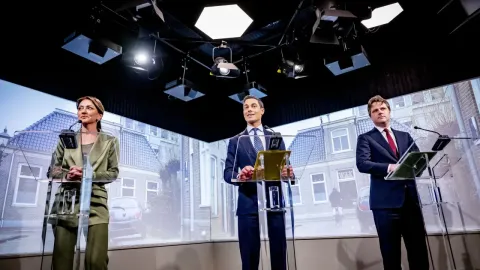


“With this agreement, we are setting a clear direction,” Rob Jetten [1] declared. That direction is hard right, outspokenly neoliberal, completely antisocial and a choice in favour of capital. It is a direction of severe cuts to social services, attacks on migrants and refugees, giving free rein to businesses and increasing militarization. In short, it is the same direction as the previous cabinet, only the rhetoric is different. A combative response from the trade unions is of the utmost importance.

Wennink Committee

The influence of the Wennink Committee report on the agreement is clear.

The Wennink Committee, former CEO of ASML, was set up in the autumn of 2025 by outgoing Minister Karremans (not coincidentally a member of the VVD) to come up with recommendations for the Netherlands’ future “earning model”. It is considered to be the Dutch version of the recommendations that former ECB President Mario Draghi formulated for Europe in September 2024 because it has fallen behind the US and China.

European and Dutch capital wants to be able to compete with these superpowers and is willing to take far-reaching measures to achieve this. In practice, this means as many subsidies as possible for the business community, the abolition or reduction of regulations for companies and the further dismantling of “expensive” social services. From a capitalist point of view, labour is an expensive factor in the competition with China and the US. Therefore, a further attack on the services provided to the working class must drive down this cost.

It is logical that it looks like another VVD cabinet. The VVD best serves the interests of capital. It is no surprise that D66 and the CDA are going along with this. D66 is first and foremost a neoliberal party. Now that a tougher neoliberal policy is needed, it is adapting effortlessly. The CDA has always been the party that, under the motto of class cooperation and “taking responsibility”, put society at the service of businesses.

Dismantling of social services

When it comes to the housing shortage, for example, this cabinet believes that the problem lies in the fact that the real estate sector is bound by too many rules. It is still “the market” that must provide the solutions, which is why landlords, for example, must be able to earn even more. It is mainly landlords and investors who will benefit from this policy. Mortgage interest relief remains untouchable, but “all forms of migration” (including refugees) are mentioned as a problem.

In healthcare, not only will the excess continue to rise, but less care will be reimbursed. People who need long-term care and the elderly in particular will bear the brunt of the new policy.

The CDA, VVD and D66 have chosen to place the heaviest burden on the weakest shoulders.

Climate policy at the service of business

When it comes to climate, the agreement has opted for “the government to take control”. That means nuclear energy, government funding for CO2 storage and so-called “green gas”. The EU target is a 90 per cent reduction in greenhouse gas emissions by 2040 compared to 1990 levels. That target was the minimum recommended by the European Scientific Advisory Council on Climate Change, and even to achieve that, the reduction will have to be faster in the coming years than before. However, the agreement is vague about an “additional effort” and, with its wording about “aligning as much as possible”, it already anticipates that this target will not be achieved either. Even when it comes to a concrete point such as the billions in subsidies for fossil fuels, for example in the form of tax breaks, the agreement remains vague. It merely refers to “phasing out financial incentives for fossil fuels” without setting any concrete targets.

Militarization

At the same time, defence spending is rising sharply, supposedly to protect “our free way of life”. What this is really about is ensuring that the Netherlands, as part of Europe, will arm itself to defend the interests of European capital. To make it more difficult to reverse this policy, the cabinet wants to enshrine the NATO standard of 3.5 per cent in law. That means 19.3 billion in 2035. And even with regard to the expansion of European nuclear weapons, the new cabinet is “positive”. But it is no coincidence that the enormous costs will largely have to be borne by the population: two-thirds by us, one-third by businesses.

Against the working class

Jetten 1’s plans are largely directed against the working class. The retirement age will rise faster as life expectancy increases; they want to reduce unemployment benefits (WW) to one year; they want to abolish full disability benefits; people will have to accept work sooner; companies will no longer be obliged to pay compenzation to people who are made redundant after two years of illness, and collective labour agreements will also be further eroded.

In response to these measures, Linda Vermeulen, FNV trade union representative for the retail sector, rightly commented on BlueSky ’What I find lacking in the debate about the deterioration of the #ww and the increase in the #aow-leeftijd... is the question: why is the government doing this? My argument is: to accommodate companies in their demand for more cheap labour.’

Continuation of PVV asylum policy

Much remains the same with regard to asylum. In other words, antisocial and racist. The asylum laws of PVV minister Faber will remain in place. In addition, efforts will be made to keep refugees in camps outside Europe. It is strikingly cynical that the agreement describes this policy as contributing to stability and “reducing the influence of Russia and China”. Outsourcing EU refugee policy to countries such as Libya means supporting authoritarian regimes and ongoing human rights violations.

Meanwhile, it remains to be seen how long the Jetten I cabinet will last. A coalition agreement that is so distinctly right-wing is, of course, welcomed by the business community and right-wing media. Little remains of the “progressive” aspects of D66 or the “social face” of the CDA other than rhetoric. Although the fierce, PVV-inspired tone has changed, the course remains right-wing and focused on undermining countervailing power, such as restricting the right to demonstrate.

What is the response from the left and the trade union movement?

Resistance from the left and the trade union movement will be sorely needed. On the one hand, to defend the immediate interests of the population, and on the other, to prevent the far right from capitalizing on the disappointments resulting from the deteriorating situation. But right now, those left-wing parties and the trade union movement are in a weak position.

GL-PvdA, led by Jesse Klaver [2], wants to be “constructive” and “responsible” because it believes that this is the shortest route to government participation. At the same time, Klaver also realizes that these measures go too far and that he must take his supporters into account. Which of the two – “constructively” contributing to the dismantling or resistance – the party will give in to will mainly depend on the extent of broader social resistance and outspoken discontent.

The SP [3] and PvdD [4] are both right to describe the agreement as one that favours the rich and attacks working people. But given the balance of power, much more is needed than voting against it in parliament. Large-scale resistance will have to come primarily from the FNV trade union. But this has been seriously weakened - structurally, by forty years of neoliberalism and the defeats it has incurred and currently, due to the decision of the Enterprise Chamber [5] and the intervention of PvdA luminaries Asscher and Heerts. The General Board has resigned and member democracy, and with it the influence of the grassroots, is being curtailed. It now remains to be seen what the new board, to be composed by the two PvdA members, will look like. They are looking for “professionals” who can represent the FNV in The Hague and in consultative bodies such as the SER.

However, FNV members are overwhelmingly rejecting Jetten 1’s plans, and this will have to be taken into account. The preliminary results of the union’s survey show that 80 per cent of FNV members are against the reduction in unemployment benefits, 87 per cent are against the increase in the retirement age and 90 per cent believe it is unfair that working people are bearing the brunt of the crisis, while companies are much less affected. The survey is still open for more than a week, but has already been completed by 35,000-40,000 members.

The best response actually comes from CNV chairman Piet Fortuin [6]. He said: “This way, we can already reserve the Malieveld.” [7]

The aim now is to try to reinforce the dissatisfaction among FNV members and to organize ourselves in order to put as much pressure as possible on the FNV leadership. Despite the limited direct influence of its members, the FNV will have to be pressured from the bottom up to come up with the necessary response to these serious attacks on the position of working people.

6 February 2026

Translated by International Viewpoint from Grenzeloos. French available on ESSF.

Footnotes

[1President of the social-liberal D66 party, he has led the coalition with the VVP (People’s Party for Freedom and Democracy), the main conservative-liberal party, and the CDA (Christian Democratic Appeal) since February 2026.

[2GroenLinks-PvdA (Green Left-Labour Party), a centre-left alliance led by this charismatic figure.

[3Socialistische Partij (Socialist Party), a left-wing party with Maoist origins that has become social democratic.

[4Animalist Party, which combines the defence of animal rights, the environment and global well-being.

[5A consultative body where representatives of employers and trade unions meet to negotiate collective agreements, settle disputes or give opinions, particularly in the event of an appeal against a trade union or employer decision.

[6President of the CNV (Christen Nationaal Vakverbond), a Christian-inspired trade union.

[7The Malieveld is the venue for large demonstrations.

Lessons from Minneapolis

Organization, spontaneity, and the mass strike


Thursday 19 February 2026, by Tempest Collective


Drawing lessons from Minneapolis and the day of protest on January 30, the Tempest National Committee argues that the only kind of action that can stop Trump is the kind that seriously impacts the economy: mass strikes. While workers in the U.S. currently lack the organizational capacity to launch mass strikes, campaigns in the here and now can help us develop and nurture that capacity. [1]

The murder of Alex Pretti—the day after workers shut down Minneapolis in protest of ICE’s invasion of their city–has raised the stakes for those resisting the war on immigrants. Masked government agents violently attacked Pretti moments after he helped a fellow protester who had been pushed down by ICE thugs. He was maced, beaten, and shot in the back.

All of this was captured on video from multiple angles by eyewitnesses, and the world watched in horror. Kristi Noem’s outlandish claims that the victim was a “domestic terrorist,” who “wanted to do maximum damage and massacre law enforcement” stood in stark contrast to the video evidence watched by millions who learned that Pretti was an intensive care nurse for military veterans.

Coming just sixteen hours after a massive march in subzero temperatures—the culmination of a day of mass civil disobedience, work stoppages, school closures, and business closings—Pretti’s murder left many wondering if it was in revenge for the Minneapolis resistance, and what it would take to defeat this kind of occupying force. As the movement confronts an entrenched and dangerous enemy, it is increasingly clear that protests and demonstrations are essential, but the only thing that will stop Trump is the kind of action that seriously impacts the economy: mass strikes.


No work, no school, no shopping


The mass actions of January 23 put tens of thousands in the streets in response to a call for “no work, no school, no shopping.” Almost one thousand businesses closed their doors, even if only for a few hours, in solidarity. Workers called in sick or took a “mental health day.” Some workplaces were forced to close by the collective will of employees. Even while labor unions stopped short of officially declaring a strike, many endorsed the day of action.

The protest was spurred by the murder of Minneapolis ICE resister Renee Good on January 7. The general strike, as it was widely referred to, was organized by a coalition of trade unions, faith organizations, and neighborhood rapid response networks. Some of these formations came together in 2011 around common bargaining demands. They also built on the long history of anti-racist mobilization in the wake of the George Floyd uprising. This organizational cross pollination combined with popular sentiment against ICE raids to produce a significant showing. One survey found that one in four voters in the state participated or had a loved one who did. This is all new territory for the movement.

When the administration sent 3,000 federal officials into Minneapolis—which, to put things in perspective, employs about 600 police officers—they declared war on the immigrant population. The Border Patrol officers who murdered Pretti were in pursuit of a delivery worker who was sheltering in a local business behind locked doors.

Immigrant unions and entire neighborhoods sprang into action to defend their community. Masked officers escalated their violent attacks, entering schools and confronting students and educators. The image of five-year-old Liam Conejo Ramos, arrested on his way home from preschool in the Minneapolis suburb of Columbia Heights on January 20, became a symbol of the cruelty of ICE. This only added to the indignation many already felt and drove more to take action on the 23rd.

The people vs. the billionaires

Thirty-five people have died while in federal custody since President Donald Trump began this campaign in July 2025, and eight have been murdered in the field by ICE officials.

Almost all of the people killed and injured by these agents so far have been immigrants and people of color. These individuals include Keith Porter, an African American father of two in Los Angeles, and Silverio Villegas González, also a father of two elementary school children in Franklin Park, Illinois—a Chicago suburb. Renee Good and Alex Pretti were outliers in that they were both white.

The “domestic surge” has deployed thousands of heavily armed, armored and masked agents mostly to cities in blue states, regardless of the actual concentration of immigrants. ICE has been met with popular community resistance, from Los Angeles to Chicago to the Twin Cities. In each case the opposition has learned new lessons, which have been shared with protesters elsewhere. Minnesota is the latest link in the chain of learning how to resist.

Communities across the Twin Cities and beyond have stood up to these racist attacks on people who are just trying to live their lives and raise families. Their actions are inspiring as they show the depth of opposition to MAGA and the potential for an alternative.

The outpouring of protest and support for immigrants is a multiracial fightback based in the working class with anti-racist politics at its heart. It is a powerful antidote to Trump’s use of anti-immigrant scapegoating to divert attention from the billionaire class while it cuts SNAP benefits, health care, and funding for education.

National Nurses United, a health care union representing 225,000 workers, organized vigils across the country for Alex Pretti. At an event outside a Veteran Affairs hospital in Chicago, one speaker called on us to recognize the “state sanctioned violence” of unaffordable health care as well as targeted murder by government agents.

The administration attacks immigrants in the name of fighting crime. But the true criminals are the richest one percent and their hired help in Congress. They spend billions of our tax dollars terrorizing immigrants and billions more on regime change in Venezuela and Israel’s ongoing genocide in Palestine. They fund their imperial projects by cutting domestic services at home.

In order to get away with this blatant theft, the billionaire class suppresses individuals and organizations that defend our rights. They have decimated public unions, criminalized outspoken organizers like Mahmoud Khalil, and murdered people in the streets in an attempt to scare people away from protest.

They have not succeeded in stemming mass protest by students, neighborhood organizations and workers, but they are forcing us all to confront the daunting question of how we can stop these attacks.

The power of the mass strike

More people than ever are asking how we can stop the war on immigrants and also address the raft of economic problems known as the “affordability crisis.” The pledge by Democrats to reform ICE and Border Patrol to refocus on their mission only reveals their complicity. Some Democrats sense the political winds are shifting. One candidate for Senator from Illinois, Raja Krishnamoorthi, voted as a member of the House to express “gratitude” to ICE in June 2025, when they were arresting union leaders in Los Angeles. He is now calling for ICE to be abolished.

ICE should be abolished, and the priorities of our society should be thoroughly recalibrated. But as we argued in our January editorial, we cannot expect these changes to come from above. Our collective ability to redirect funding away from war and occupation (domestically and internationally), towards health, housing, and education should look instead to the lessons from Minneapolis.

Our greatest power is in our potential ability to organize mass strikes.

Recent years have seen political strikes globally, such as in South Korea when martial law was declared in December 2024, or in France in January 2023 when the retirement age was raised. While the U.S has seen strikes over contractual or safety issues, such as the tens of thousands of health care workers on strike in New York and against Kaiser Permanente, strikes over political issues are not common here.

When a call for a general strike on January 30 went out via social media following the murder of Alex Pretti, the Google search for the word “strike” increased dramatically, as people across the country attempted to educate themselves. In multiple cities, students demonstrated, small businesses shut down, and people gathered to rally and march in solidarity with the resisters in Minnesota. This shows tremendous potential, but until labor is far better organized, most workers cannot simply walk out without risking their jobs. Most unions are far from ready to launch the kind of coordinated, disciplined strike action that could really make a difference, and most workers lack a union, given that unionization rates are below 10 percent.

So the pressing question is how we can harness the collective strength on display in Minnesota, and everywhere that people are standing up against ICE, in order to make a significant economic impact.

What do we do next?

The U.S. workforce does not currently have the organizational capacity to launch a mass strike on the scale of those in South Korea. But with the vision of this goal, we can plan and build campaigns in the here and now that will help us build this organizational capacity and the infrastructure to nurture and sustain it. These campaigns will vary depending on the particular location and context, but there are many available options for both union and non-union workers.

We can hold strike schools that help unionized and non-unionized workers to become strike ready. We can build emergency response networks to move into action against ICE and CBP. We can form workplace-based emergency response networks, especially in schools, which are powerful sites at the intersection between the community and workplace and therefore of great strategic importance for a mass strike. We can agitate to make every workplace a Fourth Amendment zone which refuses access to ICE and CBP. We can push to force towns and cities to pledge non-compliance with ICE and CBP, even if that means defying federal law (even Minnesota, a so-called sanctuary state, does not have such measures).

In the upcoming months we should join local organizing efforts for the March 28th No Kings protest, with the explicit plan of projecting mass actions for May Day—which is on Friday, a work day—including strikes and sickouts against the Trump regime.

Finally, we should join May Day Strong. 3,500 people participated in a virtual call on February 1, entitled “How We Build a General Strike,” where union leaders, organizers, and even the mayor of Chicago Brandon Johnson addressed this question. The focus of that meeting was building towards coordinated actions across the country on May 1, 2026.

We can draw inspiration from the anti-ICE movement and commit to building the kind of sustained, ongoing organizing in workplaces, schools, and neighborhoods that will increase our capacity and power. A better world is waiting to be born, and it will take all of us to help make that happen.

9 February 2026

Source: Tempest.

Attached documentslessons-from-minneapolis_a9422.pdf (PDF - 973.1 KiB)
Extraction PDF [->article9422]

Footnotes


[1] Photo: Detroit: Peoples Assembly volunteers put together whistle kits designed to alert community members when ICE is nearby. (Jim West) ATC.


Tempest Collective

The Tempest Collective sees the activity of the vast majority of the world’s population whose ability to work is their only means of survival as the crucial factor in building the socialist movement and winning reforms. The working class is the agent of social transformation – of ridding our society of capitalism, addressing the existential environmental catastrophe, and building a socialist society – if we can organize ourselves.


The revolutionary struggle in Russia, in which mass strikes are the most important weapon, is, by the working people, and above all by the proletariat, ...


 KASHMIR IS INDIA'S GAZA

The republic on trial: Militarised sovereignty and accountability in Kashmir


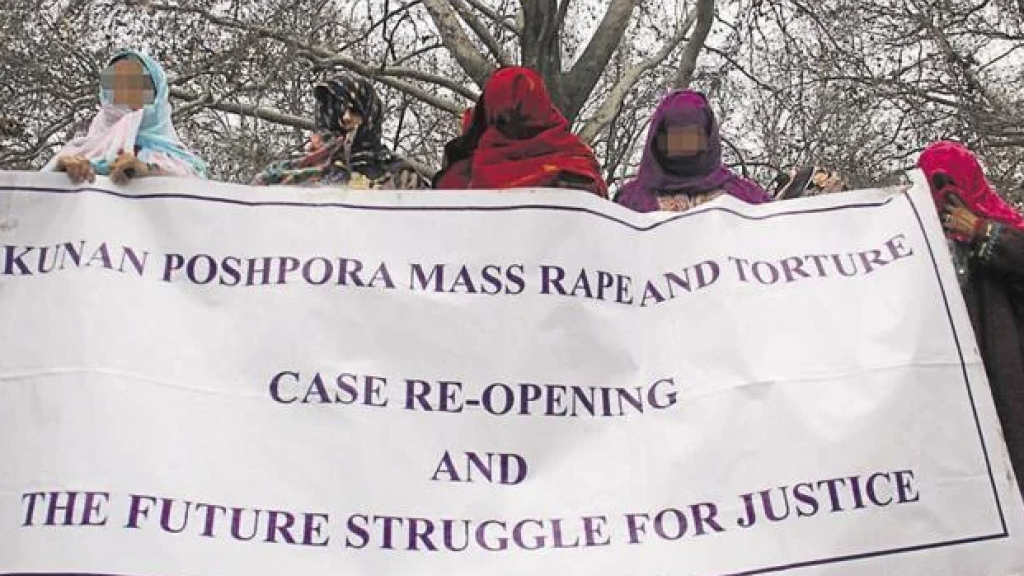
protest mass rapes Kunan and Poshpora

On the night of February 23–24, 1991, soldiers of the 4th Rajputana Rifles entered the villages of Kunan and Poshpora in Kupwara district in what was described as a routine cordon-and-search operation. By that point, such operations had become embedded in everyday life across Kashmir. 

Villages were sealed. Men were assembled outdoors for identification. Homes were searched through the night. The stated objective was counterinsurgency. The practical effect was the visible performance of state authority in a territory where sovereignty was under open challenge.

By morning, women in the two villages alleged that soldiers had entered their homes after separating the men and subjected them to sexual assault. The scale of the accusations was significant. The army denied the charges. 

Senior officials characterised the accusations as fabricated, implying that their purpose was to undermine counterinsurgency operations. Local police registered a First Information Report. A medical examination was conducted. 

The case entered the formal register of the criminal justice system. Investigations followed. Reports questioned the credibility of the allegations. A closure report was eventually filed. No full criminal trial ever tested the evidence in open court.

That absence is the defining feature of the case. Not conviction. Not acquittal. Not adversarial adjudication. No criminal courtroom has examined the allegations through cross-examination, evidentiary scrutiny and judicial determination for more than three decades. They have remained administratively contained.

Counterinsurgency as governance

To understand why, the events must be situated in the early 1990s, when armed insurgency in Kashmir escalated sharply, as demands for self-determination moved from protest to armed movements. 

The Indian state responded with a heavy troop deployment and institutionalised counterinsurgency as a governing framework. Emergency powers were not exceptional interventions; they became routine instruments of rule.

Counterinsurgency is often described as a military doctrine. In practice, it is a political order. It regulates mobility, domestic space, speech and suspicion. It redraws the boundary between civilian and suspect. 

Armed personnel physically enact sovereignty when they seal entire villages overnight and search households. Authority does not simply exist; it is staged.

In that setting, claims of sexual abuse have ramifications that extend beyond personal misconduct. They propose that the coercive rationale of counterinsurgency may have infiltrated personal domains. Sexual violence in conflict situations is not just assault; it shows who is in charge.

The state’s immediate response was denial, followed by investigative framing that foregrounded insurgency conditions and questioned credibility. From the outset, the case became entangled in a broader struggle over narrative: was Kashmir a site of necessary security operations, or a site where civilians were exposed to unchecked force?

Survivors and activists pursued reinvestigation through courts and petitions. The matter resurfaced periodically. But it never matured into a decisive judicial reckoning. The unresolved status hardened into a structural outcome. Kunan and Poshpora endure because they reveal the internal tensions of militarised governance.

When emergency powers become the grammar of rule, accountability narrows. The issue extends beyond the events of that night. It concerns how democracies respond when allegations implicate the coercive institutions tasked with defending territorial integrity.

The issue is of serious importance for Indian democracy. Undoubtedly, a democracy that is confident in its institutions is willing to subject them to scrutiny. A democracy that hesitates signals a different priority: preserving the apparatus before testing it.

AFSPA and immunity

The unresolved status of Kunan and Poshpora cannot be understood without examining the legal regime governing Kashmir. At the centre of that regime stands the Armed Forces (Special Powers) Act (AFSPA).

AFSPA authorises armed forces operating in “disturbed areas” to arrest without warrant, conduct searches and use force under broad conditions. Most consequentially, it requires prior sanction from the central government before any prosecution of armed forces personnel can proceed in civilian courts. Without that sanction, criminal proceedings cannot begin.

In theory, this provision is presented as protection for soldiers operating in high-risk environments. In practice, it has functioned as a structural bottleneck. Allegations against armed forces personnel remain contingent on executive approval, significantly limiting judicial autonomy in initiating proceedings.

In the wake of the Kunan and Poshpora allegations, investigations were initiated and a closure report generated, although survivors sought further reinvestigation. The legal proceedings encountered obstacles, primarily the sanction requirement, preventing the case from reaching a trial.

AFSPA embeds counterinsurgency logic within statutory law, altering legal priorities in disturbed regions and relaxing operational constraints on security forces. While defenders of the act maintain that such legal protections are essential to prevent debilitating litigation against soldiers, this narrative must not absolve the necessity of accountability.

Allegations of serious crimes should undergo transparent processes, rather than be obstructed by routine sanction clauses, which foster "immunity by design." This procedural impunity, though not formally declared, cultivates perceptions within communities that certain actors operate beyond judicial scrutiny.

The Kunan and Poshpora cases underscore the impact of emergency legislation on democratic accountability, wherein legal structures intended to curb power paradoxically become instruments of shielding it. 

The central issue transcends operational freedom for soldiers; it questions the legitimacy of a democracy that permits executive discretion in determining accountability for its own agents.

Gendered power in a militarised territory

It is easy for the discussion about Kunan and Poshpora to get mired in controversies about facts, figures, accounts and inconsistencies. But the underlying level is just as important: how sexual violence works in a militarised setting to maintain a hierarchy that favours the powerful.

Cordons and searches blur the distinction between public and private. Men are assembled outside; women remain inside; armed forces enter homes under the guise of the law. The home ceases to be a safe haven and becomes a site of surveillance and domination. Power enters the domain of the intimate.

Civil society reports, including documentation by the Jammu-Kashmir Coalition of Civil Society, have identified numerous cases of sexual violence linked to the conflict and have argued that legal immunity structures enable such abuses.

In a patriarchal world, the social implications of sexual violence are exponentially greater. A woman’s body is inextricably bound to her family's honour and the community’s identity. An act of violence has repercussions that reverberate beyond the survivor — shaking kinship, conjugal prospects and social status. Stigma multiplies the pain. Silence can be a shield, even as it conceals the injury.

This narrative plays out in the way charges are treated. Victims are confronted with both state power and social coercion. To speak out is to invite ostracism; to remain silent is to retain social status at the expense of justice. When women in Kunan and Poshpora turned to the law for redress, they challenged both militarised power and the social norms that regulate speech in their society.

The state’s response follows the usual pattern in war zones. Allegations are couched in terms of exaggeration or political motivation. In insurgency situations, allegations of abuse are frequently restated as disinformation. The onus is on the complainant to demonstrate injury and establish noble intentions.

However, emergency governance heightens gendered vulnerability. Armed men possess legal sanction, mobility and impunity; civilian women do not have a comparable level of leverage. Even in the absence of policy, the asymmetry creates risks.

Kunan and Poshpora remain important because they highlight this asymmetry. They expose how counterinsurgency obscures the distinction between security operation and social regulation.

The political question is not confined to the truth of individual allegations. It concerns whether emergency regimes adequately protect bodily autonomy. If domestic space becomes penetrable under state authority and allegations of abuse remain untested in court, then vulnerability is structural, not episodic.

Exceptional law and unequal citizenship

The Indian Constitution officially guarantees the principles of equal treatment before the law, due process, and judicial remedies against state wrongdoing. These principles form the normative foundation of republican legitimacy, under the assumption that independent courts can effectively check abuses of state power, regardless of their magnitude.

In regions governed under prolonged emergency legislation, that equilibrium shifts. The formal architecture of constitutional rights remains intact, but its operational character changes. The requirement of executive sanction before prosecuting armed forces personnel introduces an additional layer between allegation and adjudication. Legal accountability becomes conditional on administrative approval.

Kunan and Poshpora exemplify this structural tension. In ordinary criminal law, the filing of a First Information Report and the collection of evidence can culminate in trial if prosecutorial thresholds are met. In Kashmir, under AFSPA, the path from accusation to courtroom is mediated by executive discretion. The effect is not the suspension of the law but rather its recalibration in favour of operational protection.

This recalibration alters the citizen–state relationship. Constitutional equality presumes that public officials and civilians stand before the same judicial forums when accused of grave crimes. Where prior sanction operates as a gatekeeping device, that presumption weakens. Even when legally authorised, the appearance of differential accountability carries political consequences.

The 2019 reorganisation of Jammu and Kashmir into Union Territories intensified this contradiction. The stated objective was integration and normalisation. Yet the legal instruments that institutionalise exceptional security governance remain largely unchanged. Political autonomy contracted while emergency frameworks endured. The assurance of constitutional uniformity exists alongside differentiated layers of accountability.

Legitimacy in a democracy rests not only on territorial control but institutional credibility. Public confidence in procedural equality erodes when serious allegations against state agents fail to reach open judicial examination. The issue extends beyond the reputation of the armed forces. It concerns systemic questions: whether constitutional guarantees operate with the same force in frontier spaces as they do elsewhere.

A republic with strong institutions allows for scrutiny, especially when coercive power is at its highest. Shielding institutions from prosecution may preserve short-term operational strategies, but it carries long-term costs for constitutional trust. The persistence of unresolved cases such as Kunan and Poshpora underscores the tension between emergency governance and equal justice.

The republic on trial

Kunan and Poshpora cannot be treated as an aberration or tragic residue of a turbulent decade. What followed 1991 was not administrative drift; it was the structured outcome of a state that chose insulation over scrutiny. 

The long refusal to subject grave allegations to open trial reflects not institutional weakness but a political priority: preserving the coercive apparatus deemed essential to governing a contested territory.

At stake is not only justice for survivors. It is the character of the Indian state under conditions of internal conflict. Modern states claim a monopoly over legitimate violence. In democratic theory, that monopoly is justified by law, equality and accountability. 

But when the institutions that exercise sovereign force are shielded from ordinary judicial testing, sovereignty begins to detach from democracy. It becomes managerial, securitised and increasingly insulated from popular scrutiny.

AFSPA is not merely an emergency statute. It is an expression of how the state manages peripheral regions, where consent is fragile. In such spaces, coercion is normalised and legal exceptions become routine. 

While executive sanction regimes are defended as operational necessities, in practice, they produce stratified citizenship. One legal order for the core, another for the frontier where sovereignty is enforced through prolonged militarisation.

This hierarchy bears significant political implications. It indicates that the priorities of territorial integrity and strategic control take precedence over equal justice. It implies to citizens residing in militarised zones that constitutional guarantees are conditional and subject to security considerations.

Over time, such behaviour corrodes the ideological claim that the state represents a unified democratic community. Compliance may persist but political legitimacy erodes significantly.

From our perspective, the issue is not simply a question of procedural reform. It exposes the deeper logic of a state that defends property, territory and geopolitical standing with extraordinary powers while narrowing democratic accountability. Legal exceptionalism at the margins reshapes the centre, rarely limiting militarised governance to its original theatre.

Accountability, therefore, is not a liberal luxury. It is a material question of power. Either the armed apparatus of the state remains subject to the same judicial processes as the citizens it governs or a differentiated sovereignty takes root — one that reserves immunity for those who wield force in its name.

What would accountability entail? Enforced limits on executive sanction, independent prosecutorial authority in areas under emergency law, and sustained legislative review of exceptional security regimes are the minimum requirements for accountability.

But more fundamentally, it requires rejecting the premise that security and equality are mutually exclusive. A democratic state confident in its social foundations does not fear judicial scrutiny of its own agents.

Thirty-five years on, the unresolved status of Kunan and Poshpora is not merely a legal anomaly. It is a political marker. It reveals the tension between a constitutional promise of equal citizenship and a governing practice that privileges militarised order.

Until allegations of this magnitude are tested in open court, that contradiction remains active — a reminder that sovereignty without accountability drifts toward domination and that democracy without equality becomes rhetoric.