Saturday, February 21, 2026

France

In Lyons, the regrettable consequences of the fascist atmosphere

Tuesday 17 February 2026, by NPA-l’Anticapitaliste (NPA-A)
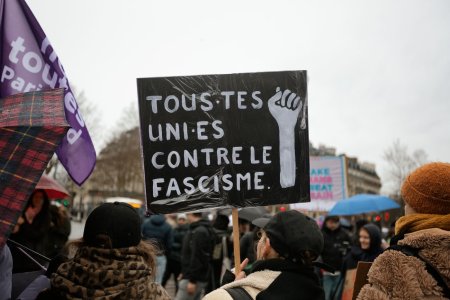


After years of warning about the establishment of violent neo-Nazi groups, the tragic death of a far-right nationalist activist – formerly a member of the royalist group Action Française and the neo-fascist splinter group Allobroges Bourgoin – has brought the situation of the social movement opposed to the far right in Lyon back into the spotlight. [1]

The Lyons context

It was on the sidelines of a public meeting with Rima Hassan, MEP for La France Insoumise, that the Némésis collective came to provoke, as it has been doing regularly for more than two years in many places. [2]

This time, it was in Lyons, where left-wing political groups, anti-racist collectives, Palestine solidarity groups, bookshops and people of colour have for years been victims of attacks by violent, racist and virilist groups. As a result, they are developing self-defence strategies.

These far-right groups attack places, events and people, without any reaction from the state.

The far right and racism kill

The far right and its ideas kill. According to studies, of the 53 ideologically motivated murders committed between 1986 and 2021, 90% were carried out by the far right. We think of Federico Martín Aramburú, shot dead in 2022 by Loïk Le Priol and Romain Bouvier, members of the GUD (a far-right fascist group). We also remember Clément Méric, an anti-fascist activist killed by the nationalist far right in 2013.

Let us not forget the recent racist murder of Ismaël Aali, south of Lyon, or those of Djamel Bendjaballah, Rochdi Lakhsassi, Mustafa and Ahmid, Hichem Miraoui and Aboubakar Cissé, also for racist motives, and in particular Islamophobic motives in the latter case.

The demonisation of the radical left

Media coverage is disproportionate. It serves the interests of those who, for several years, have been demonizing a left that refuses to give up and the activists who are fighting fascism on the ground.
Already, for the municipal elections [on 15 and 22 March], the Ministry of the Interior classified LFI as far left a few days ago. Today, Gérald Darmanin speaks of the “Mélenchon militia”.

The normalization and trivialization of the far right and its racist, masculinist and LGBTQIAphobic ideas have reached new heights over the past two years.

They are the result of anti-social and security policies pursued for decades by successive governments, which have taken up racist ideas and closed borders. They are the result of trade union and political opposition being silenced and repressed by the various Macron governments.

Building a mass front

For several days now, fascist groups have been calling for revenge. They have attacked the premises of political organizations such as LFI and, in Lyon, the premises of Solidaires trade-union and the La Plume Noire bookshop.

Anti-fascist activists, particularly those from the former Jeune Garde, are being publicly accused of murder and threatened with death, with their personal information being revealed online. We offer them our full support.

Fascists idealize and romanticize violence and death and threaten our side, that of the exploited and oppressed, while anti-fascism fights for equality and justice.

There are many forms of struggle. But there are no shortcuts in the fight against fascism. To oppose it, we need unity – and not just in elections – between trade unions and political forces committed to social transformation.

More than ever, we need to build a united mass front capable of pushing back the fascists at the ballot box, but above all in the streets, in neighbourhoods and in workplaces.

There is an urgent need to maintain a united, popular and mass anti-fascist line in the face of the coming brown wave. Anti-fascists for as long as it takes!

Montreuil, 17 February 2026

Translated by International Viewpoint from l’Anticapitaliste.

Footnotes

[2This far right collective calls itself feminist and in particular tries to insert itself into feminist demonstrations such as those on 25 November and 8 March.

Netherlands

Jetten 1: harsh neoliberal policies to continue

Wednesday 18 February 2026, by John Cozijn


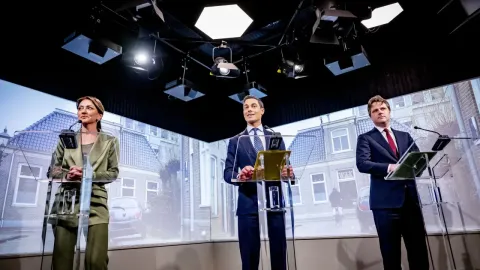
“With this agreement, we are setting a clear direction,” Rob Jetten [1] declared. That direction is hard right, outspokenly neoliberal, completely antisocial and a choice in favour of capital. It is a direction of severe cuts to social services, attacks on migrants and refugees, giving free rein to businesses and increasing militarization. In short, it is the same direction as the previous cabinet, only the rhetoric is different. A combative response from the trade unions is of the utmost importance.

Wennink Committee

The influence of the Wennink Committee report on the agreement is clear.

The Wennink Committee, former CEO of ASML, was set up in the autumn of 2025 by outgoing Minister Karremans (not coincidentally a member of the VVD) to come up with recommendations for the Netherlands’ future “earning model”. It is considered to be the Dutch version of the recommendations that former ECB President Mario Draghi formulated for Europe in September 2024 because it has fallen behind the US and China.

European and Dutch capital wants to be able to compete with these superpowers and is willing to take far-reaching measures to achieve this. In practice, this means as many subsidies as possible for the business community, the abolition or reduction of regulations for companies and the further dismantling of “expensive” social services. From a capitalist point of view, labour is an expensive factor in the competition with China and the US. Therefore, a further attack on the services provided to the working class must drive down this cost.

It is logical that it looks like another VVD cabinet. The VVD best serves the interests of capital. It is no surprise that D66 and the CDA are going along with this. D66 is first and foremost a neoliberal party. Now that a tougher neoliberal policy is needed, it is adapting effortlessly. The CDA has always been the party that, under the motto of class cooperation and “taking responsibility”, put society at the service of businesses.

Dismantling of social services

When it comes to the housing shortage, for example, this cabinet believes that the problem lies in the fact that the real estate sector is bound by too many rules. It is still “the market” that must provide the solutions, which is why landlords, for example, must be able to earn even more. It is mainly landlords and investors who will benefit from this policy. Mortgage interest relief remains untouchable, but “all forms of migration” (including refugees) are mentioned as a problem.

In healthcare, not only will the excess continue to rise, but less care will be reimbursed. People who need long-term care and the elderly in particular will bear the brunt of the new policy.

The CDA, VVD and D66 have chosen to place the heaviest burden on the weakest shoulders.

Climate policy at the service of business

When it comes to climate, the agreement has opted for “the government to take control”. That means nuclear energy, government funding for CO2 storage and so-called “green gas”. The EU target is a 90 per cent reduction in greenhouse gas emissions by 2040 compared to 1990 levels. That target was the minimum recommended by the European Scientific Advisory Council on Climate Change, and even to achieve that, the reduction will have to be faster in the coming years than before. However, the agreement is vague about an “additional effort” and, with its wording about “aligning as much as possible”, it already anticipates that this target will not be achieved either. Even when it comes to a concrete point such as the billions in subsidies for fossil fuels, for example in the form of tax breaks, the agreement remains vague. It merely refers to “phasing out financial incentives for fossil fuels” without setting any concrete targets.

Militarization

At the same time, defence spending is rising sharply, supposedly to protect “our free way of life”. What this is really about is ensuring that the Netherlands, as part of Europe, will arm itself to defend the interests of European capital. To make it more difficult to reverse this policy, the cabinet wants to enshrine the NATO standard of 3.5 per cent in law. That means 19.3 billion in 2035. And even with regard to the expansion of European nuclear weapons, the new cabinet is “positive”. But it is no coincidence that the enormous costs will largely have to be borne by the population: two-thirds by us, one-third by businesses.

Against the working class

Jetten 1’s plans are largely directed against the working class. The retirement age will rise faster as life expectancy increases; they want to reduce unemployment benefits (WW) to one year; they want to abolish full disability benefits; people will have to accept work sooner; companies will no longer be obliged to pay compenzation to people who are made redundant after two years of illness, and collective labour agreements will also be further eroded.

In response to these measures, Linda Vermeulen, FNV trade union representative for the retail sector, rightly commented on BlueSky ’What I find lacking in the debate about the deterioration of the #ww and the increase in the #aow-leeftijd... is the question: why is the government doing this? My argument is: to accommodate companies in their demand for more cheap labour.’

Continuation of PVV asylum policy

Much remains the same with regard to asylum. In other words, antisocial and racist. The asylum laws of PVV minister Faber will remain in place. In addition, efforts will be made to keep refugees in camps outside Europe. It is strikingly cynical that the agreement describes this policy as contributing to stability and “reducing the influence of Russia and China”. Outsourcing EU refugee policy to countries such as Libya means supporting authoritarian regimes and ongoing human rights violations.

Meanwhile, it remains to be seen how long the Jetten I cabinet will last. A coalition agreement that is so distinctly right-wing is, of course, welcomed by the business community and right-wing media. Little remains of the “progressive” aspects of D66 or the “social face” of the CDA other than rhetoric. Although the fierce, PVV-inspired tone has changed, the course remains right-wing and focused on undermining countervailing power, such as restricting the right to demonstrate.

What is the response from the left and the trade union movement?

Resistance from the left and the trade union movement will be sorely needed. On the one hand, to defend the immediate interests of the population, and on the other, to prevent the far right from capitalizing on the disappointments resulting from the deteriorating situation. But right now, those left-wing parties and the trade union movement are in a weak position.

GL-PvdA, led by Jesse Klaver [2], wants to be “constructive” and “responsible” because it believes that this is the shortest route to government participation. At the same time, Klaver also realizes that these measures go too far and that he must take his supporters into account. Which of the two – “constructively” contributing to the dismantling or resistance – the party will give in to will mainly depend on the extent of broader social resistance and outspoken discontent.

The SP [3] and PvdD [4] are both right to describe the agreement as one that favours the rich and attacks working people. But given the balance of power, much more is needed than voting against it in parliament. Large-scale resistance will have to come primarily from the FNV trade union. But this has been seriously weakened - structurally, by forty years of neoliberalism and the defeats it has incurred and currently, due to the decision of the Enterprise Chamber [5] and the intervention of PvdA luminaries Asscher and Heerts. The General Board has resigned and member democracy, and with it the influence of the grassroots, is being curtailed. It now remains to be seen what the new board, to be composed by the two PvdA members, will look like. They are looking for “professionals” who can represent the FNV in The Hague and in consultative bodies such as the SER.

However, FNV members are overwhelmingly rejecting Jetten 1’s plans, and this will have to be taken into account. The preliminary results of the union’s survey show that 80 per cent of FNV members are against the reduction in unemployment benefits, 87 per cent are against the increase in the retirement age and 90 per cent believe it is unfair that working people are bearing the brunt of the crisis, while companies are much less affected. The survey is still open for more than a week, but has already been completed by 35,000-40,000 members.

The best response actually comes from CNV chairman Piet Fortuin [6]. He said: “This way, we can already reserve the Malieveld.” [7]

The aim now is to try to reinforce the dissatisfaction among FNV members and to organize ourselves in order to put as much pressure as possible on the FNV leadership. Despite the limited direct influence of its members, the FNV will have to be pressured from the bottom up to come up with the necessary response to these serious attacks on the position of working people.

6 February 2026

Translated by International Viewpoint from Grenzeloos. French available on ESSF.

Footnotes

[1President of the social-liberal D66 party, he has led the coalition with the VVP (People’s Party for Freedom and Democracy), the main conservative-liberal party, and the CDA (Christian Democratic Appeal) since February 2026.

[2GroenLinks-PvdA (Green Left-Labour Party), a centre-left alliance led by this charismatic figure.

[3Socialistische Partij (Socialist Party), a left-wing party with Maoist origins that has become social democratic.

[4Animalist Party, which combines the defence of animal rights, the environment and global well-being.

[5A consultative body where representatives of employers and trade unions meet to negotiate collective agreements, settle disputes or give opinions, particularly in the event of an appeal against a trade union or employer decision.

[6President of the CNV (Christen Nationaal Vakverbond), a Christian-inspired trade union.

[7The Malieveld is the venue for large demonstrations.