Saturday, February 21, 2026

The Fourth Reich Rises While The People Resist

February 20, 2026
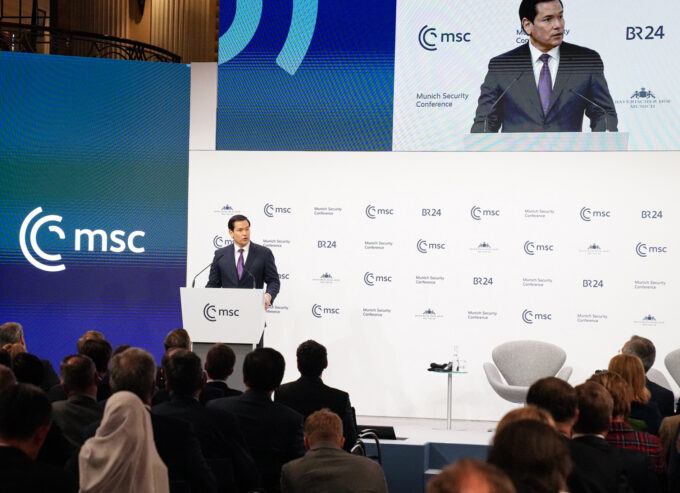
Photograph Source: U.S. Department of State – Public Domain

When Marco Rubio took the stage at the Munich Security Conference on February 15, 2026, and delivered his sputtering paean to “Western civilization,” the room of European leaders rose in a prolonged, obedient standing ovation. That applause was not for diplomacy; it was sycophantic submission, a pathetic spectacle of vassals cheering their own subjugation and complicity. Rubio’s speech—framed as a call for transatlantic renewal—was a manifesto for the Fourth Reich: a fascist resurgence rooted in European whiteness, ethnocentrism, and racist fearmongering, all under the false pretext of defending “civilization” against imagined barbarians. The ovation exposed the rotten core of the alliance—complicit in neocolonial conquest and genocide, desperate to perpetuate racial supremacy, and terrified of the Global South’s rise.

Rubio’s core thesis was brutally simple: the West is “one civilization,” bound by “centuries of shared history, Christian faith, culture, heritage, language, ancestry.” He exalted it as the source of “the rule of law, the universities, and the scientific revolution,” invoking “Mozart and Beethoven, Dante and Shakespeare, Michelangelo and Da Vinci”—a litany of European icons that conveniently omits the Enlightenment’s debt to Islamic scholarship, the Renaissance’s plunder from colonized lands, and the centuries of genocide, slavery, and exploitation that built Western wealth. His invocation of “the vaulted ceilings of the Sistine Chapel and the towering spires of the great cathedral in Cologne” as testaments to “faith in God” is ethnocentric crusader rhetoric, reducing non-Christian civilizations to footnotes while justifying endless domination in the name of “civilization.”

The racism deepened with Rubio’s assault on mass migration. He decried it as a “crisis which is transforming and destabilizing societies all across the West,” threatening “the cohesion of our societies, the continuity of our culture, and the future of our people.” This is the language of white replacement theory—pure ethnocentrism, framing non-white migrants as an existential threat to European purity. Controlling borders, he insisted, is “a fundamental act of national sovereignty,” not xenophobia or hate. Yet in the context of Fortress Europe—where migrants drown by the thousands in the Mediterranean while Italy attempts to criminalize rescues and the rest of Europe shrugs—this is neocolonial gatekeeping: the West hoards its stolen wealth, repels the dispossessed it created through centuries of theft and colonialism, and labels them invaders.

Rubio’s critique of international institutions revealed the neocolonial disdain for global equality. He mocked the UN as “powerless,” crediting “American leadership” for “solving” crises in Gaza, Ukraine, Iran, and Venezuela—through bombs, special forces, and unilateral force. The UN “has no answers and has played virtually no role,” he sneered, because it dares to hold the West accountable. This rejection of “moral equivalence” is the essence of Western exceptionalism: rules for thee, but not for me. The speech barely mentioned Gaza’s ongoing devastation—over 600 Palestinians killed since the supposed October 2025 “ceasefire”—because the point was never peace; it was supremacy.

Rubio has firmly stated that the US is doing all it can to neuter International law and legal institutions like the International Court of Justice and the International Criminal Court, with the lunatic and delusional Evangelical zionist and American ambassador to Israel, Michael Huckabee, stating that: “the United States is taking active steps to ensure that the nefarious International legal institutions are stopped from enforcing international law on those defending their country and cause,” completely disregarding the findings of probable genocide in Gaza, because according to the beliefs of these zealots, the genocide of the Palestinian people in Gaza and throughout what they call “Judea and Samaria,” is a just and righteous cause ordained by the lord.

Europe’s response was predictably spineless. The standing ovation from leaders like Germany’s Friedrich Merz and France’s Emmanuel Macron was Europe’s confession: it never truly repudiated colonialism; it merely rebranded it, outsourced it, and cloaked it in human-rights rhetoric until the mask could be dropped again. Germany arms Israel while Annalena Baerbock—now President of the UN General Assembly—cloaks massacres in “self-defense” rhetoric; France, Austria, Italy, and Germany team with Zionist Israeli front groups like UN watch to slander Francesca Albanese as “scandalous” for exposing the truth; Italy ships Leonardo weapons components to Israel while the Meloni government pushes IHRA laws to criminalize BDS and apartheid critiques. This is the new fascist international united in supremacist delusions, unleashing repression across the western world while threatening wars and conquest abroad.

The growing repression is the Fourth Reich’s signature. From ICE’s cold-blooded executions in Minnesota—killing Renee Good and Alex Pretti in broad daylight—to crackdowns on dissent across Europe, the noose tightens. In Germany, pro-Palestine protests are met with brutal police violence and labeled as “antisemitic”; in France, BDS activists face jail time; in Italy, Meloni’s security decrees criminalize road blockades and solidarity actions; In the UK the British government promises further persecution of Palestine Action despite recent court rulings in their favor. This is the machinery of neo-fascism: silence the critics, arm the oppressors, and call it “civilization.”

Trump’s fraudulent “Board of Peace” is the crowning farce—a criminal real estate cartel of genocide-supporting Zionists masquerading as diplomacy. A cabal of 25 countries and an executive board stacked with Jared Kushner, Marco Rubio, Steve Witkoff, Tony Blair, Marc Rowan, Ajay Banga, and others, it requires $1 billion donations for membership renewal and grants Trump “chairman for life” powers. Israel joined on February 11, 2026, during Netanyahu’s Washington visit—defying ICC warrants for genocide. The board denies Palestinians any agency or right to self-determination, reducing them to passive subjects for “reconstruction” without sovereignty or justice. It is colonialism 2.0: pay-to-play empire, with Gaza’s land and resources up for grabs under the guise of peace.

The Fourth Reich is not a conspiracy theory. It is the fusion of Western colonialism, neo-fascism, and Zionist settler supremacy into a global machine that starves Gaza, steals Venezuela’s resources, threatens war on Iran, silences dissent, and dismantles international law. Rubio’s Munich manifesto is its clarion call: a false pretext of “Western civilization” to justify genocidal conquest, racism, and ethnocentrism. The standing ovation was pathetic, obedient, sycophantic—Europe’s vassals cheering their own chains. For those of us sane enough to recognize what is happening, and we are in the millions around the world, continued organized resistance is our only option. The ovation in Munich may have echoed through the hall, but the voices of the oppressed will echo longer. Empires fall. The people rise.

Michael Leonardi lives in Italy and can be reached at michaeleleonardi@gmail.com


Francisco Franco: The Fascist Ego


 February 20, 2026

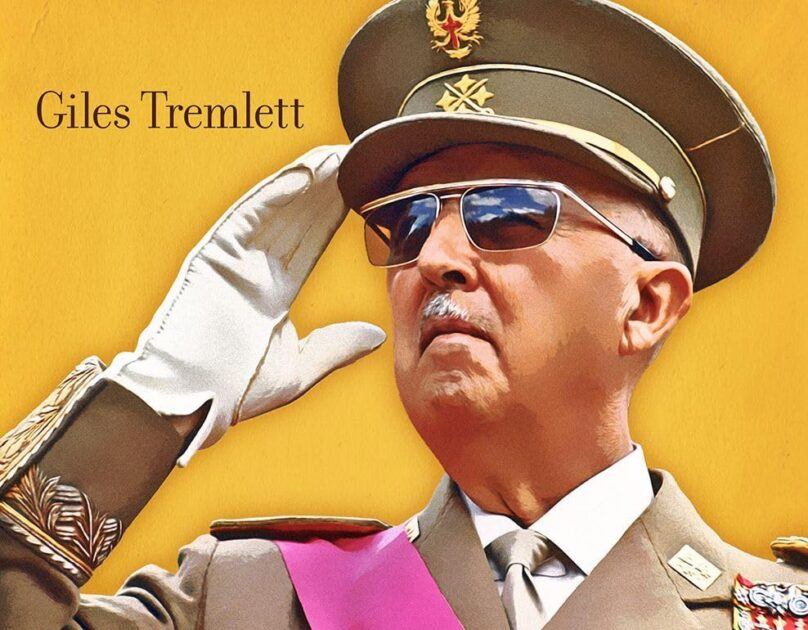
Cover art for the book El Generalísimo: A Biography of Francisco Franco by Giles Tremlett

In 2026, the United States is being ruled by an administration led by a wannabe dictator named Trump. His ego seems to dominate his decisions, while his paranoia encourages him to surround himself with authoritarian individuals eager to prove a strength they have always doubted existed in their persona. Not an intellectual by any measure, Trump’s position in the world of finance and politics is a testimony to the power of ego, cruelty and bombast in the sectors of society he has existed in his entire life. Often compared to Hitler, Mussolini, and other authoritarians familiar to the western media, a recent book titled El Generalísimo: A Biography of Francisco Franco and authored by Giles Tremlett on the life of the Spanish fascist Francisco Franco convinced me that Trump’s closest historical model could well be the man who liked to be called El Generalísimo. A professor of economics, a journalist and historian, Tremlett has provided the public with a comprehensive exploration of El Generalísimo’s life and politics well situated in the history of the historical moments Franco lived, ruled and died.

It’s a story of a man who believed he represented the one true Spain—a Spain that was Catholic and extremely conservative, with anyone not of that makeup fair game for detention and even death as enemies of Spain. This was especially true as regards leftists, anarchists, Catalan, Basque and other separatist groups and liberals. Not only were these people considered enemies of Spain, they were also enemies of Franco; in his mind the two were synonymous. Like other fascist rulers, Franco’s personal idiosyncrasies often frustrated his advisors, occasionally ruining military and political campaigns that would otherwise have succeeded. It’s clear from reading the biography that Franco needed to be in control.

Tremlett discusses Franco’s traits early on in the text, providing the reader with a biography of the man’s youth and family life. His philandering father left the home when Franco was still in school; his mother—already quite religious—turned even more to the Church after her husband’s departure. It is reasonably suggested that this helps explain Franco’s hatred of any type of sexual relationship outside of traditional monogamy in the Catholic tradition. The influence of the Catholic and military education he received (even desired) explains Franco’s fear of and loathing of the arts and politics of Spain’s leftist and liberal classes; a loathing that was publicly quite deep. Like most conservative Catholics then and now, Franco’s moral outrage focused more on sex and sexuality than on war and conquest.

In fact, Franco’s love of military action was deeply influenced by this belief that it was blessed by his God, from his colonial exploits in Morocco to his war on those Spanish people fighting for the Republic and against the fascist Falange. More grotesquely, Franco believed the killing of his Spanish opponents in the civil war were ordained by God and the Catholic Church, which had provided Franco with its approval. One can also assume from reading this biography that the corruption that ran rampant during Franco’s decades-long reign was part of God’s reward for his victory. Despite the corruption of Franco’s government, the author Tremlett makes it a point in stating that Franco was not much of a participant in it if at all. In other words, his moral beliefs forbade him from thieving, but not from killing.

The life told in these pages is of a man who reveled in violence, seeing it as a statement of and a testing of his virility. The history that is the foundation of the text is similarly violent, with the colonial campaigns described at the onset of Franco’s military career echoing throughout the civil war and its eventual dissolution into the bloody madness of World War Two. It is also the biography of a man whose conceit convinced him that his fate was Spain’s fate and that any other concept of Spain was treasonous and had to be neutralized by extermination, if he considered it necessary. The fact of his survival (and of the survival of his rule) is instructive. Once in power, Franco never intended to leave it, except via his death. Previous governmental norms and laws were ignored, overturned or reinterpreted to serve the agenda put forth by Franco. In his mind and the mind of most of his followers, Francisco Franco was not quite of this earth. I could not help but be reminded of the ongoing catastrophe emanating from the White House since January 2025, both in the executive assumptions employed by Trump and his administration and in their plans for the future.

Ron Jacobs is the author of several books, including Daydream Sunset: Sixties Counterculture in the Seventies published by CounterPunch Books. His latest book, titled Nowhere Land: Journeys Through a Broken Nation, is now available. He lives in Vermont. He can be reached at: ronj1955@gmail.com

The Cuban Revolution Holds Out Against US Imperialism


February 20, 2026

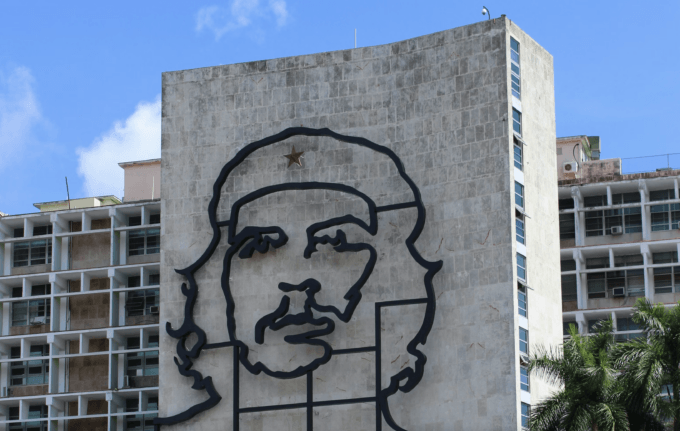
Photo by Jasmina Ajkic

In January 2026, US President Donald Trump declared Cuba to be an “unusual and extraordinary threat” to US security—a designation that allows the United States government to use sweeping economic restrictions traditionally reserved for national security adversaries. The US blockade against Cuba began in the 1960s, right after the Cuban Revolution of 1959 but has tightened over the years. Without any mandate from the United Nations Security Council—which permits sanctions under strict conditions—the United States has operated an illegal, unilateral blockade that tries to force countries from around the world to stop doing basic commerce with Cuba. The new restrictions focus on oil. The United States government has threatened tariffs and sanctions on any country that sells or transports oil to Cuba.

On 3 January, the United States attacked Venezuela and kidnapped President Nicolás Maduro Moros and National Assembly deputy Cillia Flores. As 150 US military aircraft sat above Caracas, the United States informed the Venezuelan government that if they did not concede to a list of demands, the US would essentially convert downtown Caracas to Gaza City. The remainder of the government, with no leverage in the conversation, had to effectively make a tactical compromise and accept the US demands. One of these demands was that Venezuela cease to export oil to Cuba. In 2025, Venezuela contributed about 34 percent of Cuba’s total oil demand. With Venezuelan oil out of the picture in the short run, Cuba already anticipated a serious problem.

But this was not all. Mexico supplied 44 percent of Cuba’s imported crude oil in 2025. Pressure now mounted from Washington on Mexico City to cease its oil exports to Cuba, which would then mean that almost 80 percent of Cuba’s oil imports would disappear. In a phone call between Mexico’s President Claudia Sheinbaum and Trump, he claimed that he told her to stop selling oil to Cuba, but she denied that, saying that the two presidents only talked in broad terms about US-Mexico relations. Either way, the pressure on Mexico to stop its oil shipments has been considerable. Sheinbaum has stressed that Mexico must be permitted to make sovereign decisions and that the Mexican people will not buckle under US pressure. Cutting fuel to Cuba would cause a humanitarian crisis, so Sheinbaum said her government would not accept the Trump demand.

Trump’s savage policy has effectively cut off much of Cuba’s oil imports, which has created a major energy crisis on the island of eleven million people. There are rolling blackouts, fuel shortages for hospitals, water systems, and transportation, and rationing of electricity. Due to the lack of aviation fuel, several commercial airlines—such as Air Canada—have stopped their flights to Havana.

The United Nations has warned that the US pressure campaign—especially the policy to target fuel—threatens Cuba’s food and water supplies, hospitals, schools, and basic services. UN officials, including the UN Special Rapporteur on human rights in Cuba, have condemned the US tightening of the blockade as a measure that directly harms ordinary citizens. They pointed out that restrictions make it harder for hospitals to obtain essential medicines, dialysis clinics to operate, and medical equipment to reach patients, worsening the health crisis on the island. The Special Rapporteur described the policy as “punitive and disproportionate”, emphasising that it violates international law and deepens socio-economic hardships. The UN has urged the United States to lift sanctions and prioritise humanitarian exemptions, stressing that dialogue and cooperation—not coercive measures—are necessary to protect Cuban lives and human rights.

A group of United Nations human rights experts condemned Trump’s executive order as a “serious violation of international law” and “a grave threat to a democratic and equitable international order.” They argued that Trump’s order seeks to coerce Cuba and third states by threatening trade sanctions, and that such extraterritorial economic measures risk causing severe humanitarian consequences. Their statement made it clear that no right under international law permits a State to impose economic penalties on third States for lawful trade relations, and they called on the Trump administration to rescind the illegal order. The UN General Assembly has voted overwhelmingly against the blockade every year since 1992, often with only the US and Israel opposed.

The Blockade by the US has had a grave impact on Cuba’s development paradigm. Since the start of the Blockade over sixty years ago, the US has cost Cuba $171 billion or if adjusted for the price of gold, $2.10 trillion. Between March 2024 and February 2025, the Cuban government estimates that the Blockade caused about $7.5 billion in damages, a 49 percent increase since the previous period. If you take the $171 billion number, the Cuban people lose $20.7 million per day or $862,568 per hour. These losses are grievous for a small country that attempts to build a rational society rooted in socialist values.

Response from Havana

Cuba’s President Miguel Díaz-Canel has strongly condemned the tightened US measures as an ‘economic war’ and has argued that the US policy is designed to weaken Cuba’s sovereignty. The government calls this an “energy blockade” and emphasises that the shortages on the island are a direct result of US coercive policies. In reaction, the Cuban Revolution has implemented emergency plans, including fuel rationing to prioritise essential services such as hospitals, water systems, and public transportation. Cuba has also announced state directives to manage diminished energy supplies, including shifts toward alternative and renewable energy sources where feasible. The Chinese government has donated equipment for large-scale solar parks to be built in Artemisa, Granma, Guantánamo, Holguín, Las Tunas, and Pinar del Río. In the long-term, China will assist Cuba to build 92 solar farms to add 2,000 megawatts of solar capacity. To assist households in remote areas, the Chinese government has sent 5,000 solar kits for rooftop energy harvesting. Fuel from Mexico and Russia, as well as other countries is now on the way to Cuba. Trump’s policy of isolation has not fully succeeded.

The Cuban government said that it is in touch with Washington, but not holding direct high-level talks yet. President Díaz-Canel has said that his government would speak to the United States but only under three important conditions. First, that the dialogue will be respectful, serious, and without pressure or preconditions. Second, that the dialogue must respect Cuba’s sovereignty, independence, and political system. And finally, that the Cuban government is unwilling to negotiate the Cuban Constitution (recently revised in 2019) or Cuba’s commitment to socialism. If the United States insists on a discussion on any of these three issues, there will be no dialogue. The Cuban Revolution’s defiance on these issues is rooted in its history—since the Revolution itself was an act of defiance against the US claim on its control over the Western Hemisphere through the 1823 Monroe Doctrine (now renewed by Trump in 2025 with his Corollary). This defiance has been contagious, building a Latin American resistance to US imperialism from the 1960s to the present—including at the heart of the Bolivarian process in Venezuela.

The Angry Tide

Latin America is going through a rapid and dangerous transformation. Country after country—from Argentina to El Salvador—have elected to power political formations from the Far Right of a Special Type. These are leaders who have committed themselves to strong conservative social values (rooted in the growth of reactionary Evangelical Christianity across the Americas), to a ruthless attack on the poor through a war on crime (shaped by a theory that calls for the arrest of any potential criminals and their incarceration, a policy pioneered by El Salvador’s Nabil Bukele), and by a sharply turn toward Western Civilisation that includes an orientation towards the United States and against China (this sentiment oscillates from a celebration of Western culture to a hatred of communism). The emergence of the Far Right of a Special Type appears as if it will be in charge for a generation if it can erase the left from power in Colombia, Cuba, Mexico, Nicaragua, and Venezuela (in Brazil, this Right has already taken charge of the legislature).

The parallel attacks on Venezuela and Cuba are part of the United States’s contribution to this rise of the Angry Tide across the Americas. Trump and his cronies would like to install their kind of leaders—such as Javier Milei—across the Americas as part of the Trump Corollary to the Monroe Doctrine. It is this that revives the idea of sovereignty in the Americas. When the Puerto Rican rapper Bad Bunny ended his performance at the US Super Bowl with a celebration of all the countries in the Americas, and when he named each of them, that gesture was itself part of the battle over the idea of sovereignty.

The Cuban Revolution holds out against US imperialism, but under great pressure. Solidarity with Cuba is for the Cuban people, for the Cuban Revolution, for the reality of sovereignty across the Americas, and for the idea of socialism in the world. This is now the frontline of the fight against imperialism.

Vijay Prashad’s most recent book (with Noam Chomsky) is The Withdrawal: Iraq, Libya, Afghanistan and the Fragility of US Power (New Press, August 2022).