Our Nuclear World, Up Close and Personal
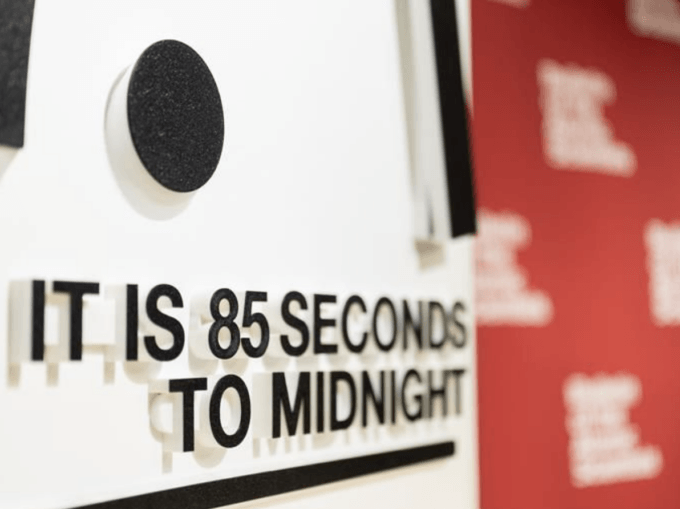
Image by Bulletin for Atomic Scientists.
“I’m not scared, you’re scared!” is the repeated line in a children’s story we recently read to the kids at the Unitarian Universalist version of Sunday school I attend with my children. In that story, a scared bear and a brave rabbit, who (naturally!) are best friends, go on a hike together. Rabbit has to cajole and encourage Bear through every imaginable obstacle, but in the end (of course!) it’s Rabbit who gets stuck at the crucial moment and has to call on Bear for help. Bear (no surprise) sets aside his fears to rescue his friend and (tada!) finds new depths of bravery and adventurousness in the process.
After we read the story, the kids worked together to build paths from blocks and Legos through the imagined obstacles in the story — a bridge over a rushing river, a path through a dark forest, a staircase up a steep mountain. It was one of our most engaging classes in recent memory, while the kids kept saying, “I’m not scared, you’re scared!” and laughing while they played. As we stacked blocks and fit Legos together, we adults were supposed to help the kids identify things they were afraid of and how they could confront those fears. For me, it was just one thing too many. I blanked on that part of the assignment.
Yes, I’m Scared
In fact, I was a little relieved to have done so. Of course, I have fears myself, but I’m not afraid of spiders or heights or small spaces like so many people. I am afraid of nuclear war — not something I would want to confess to a bunch of kids sitting on carpet squares.
What should I have said? “Okay, kids, I know some of you are afraid of monsters or werewolves or the Wither Storm in Minecraft, but I’ll tell you something truly terrifying: the Bulletin of the Atomic Scientists just moved its Doomsday Clock to 85 seconds to ‘nuclear midnight,’ four seconds closer than ever before.” I would have gotten blank stares and quick subject changes and yet, once I had started, I would undoubtedly have kept on sharing the telltale heart of my own bogeyman. “When I was a kid in the 1980s,” I would have said, “we were at three minutes to metaphorical midnight and my dad, who was an activist, wouldn’t even let me go to the movies. Now, they have pushed it even closer — closer than ever before. With nine countries armed with nuclear weapons, we’ve tick-tocked ourselves to 85 seconds to midnight. Yep, 85 seconds, by the way, is probably less time than it takes you to spell your full name or tie your shoes.”
Of course, I kept those long-winded, fact-filled fears to myself at that Sunday school. But I’ll tell you all that, in truth, it’s far worse than even what I thought that day. The Bulletin‘s scientists who made the announcement about those 85 seconds to midnight were contending with more than nuclear dangers (which have, by the way, never been more imminent). Those scientists were also responding to the speeding up of catastrophic climate change and the threats posed by artificial intelligence (AI). In the words of Daniel Holz on the Bulletin‘s Science and Security Board, “The dangerous trends in nuclear risk, climate change, disruptive technologies like AI, and biosecurity are accompanied by another frightening development: the rise of nationalistic autocracies in countries around the world. Our greatest challenges require international trust and cooperation, and a world splintering into ‘us versus them’ will leave all of humanity more vulnerable.”
Yes, all of humanity is vulnerable indeed — like my young friends building Lego bridges across felt rivers for a Bear and a Rabbit birthed in late night comedian Seth Meyers’s imagination.
The End of Arms Control as We Knew It
And as if all of that weren’t terrifying enough, Thursday, February 5th marked the end of arms control as we’ve known it. The last treaty controlling nuclear weapons between my country and Russia expired without a replacement on that day, leaving us all vulnerable to the whims of Donald Trump and Vladimir Putin. There are reports of a handshake deal between the two countries to extend the principles of the treaty, but haphazard and informal agreements are simply not “arms control” (at least as we once knew it).
The Strategic Arms Reduction Treaty, known as New START, was signed by U.S. President Barack Obama and Russian President Dmitry Medvedev in 2010 and set out a schedule for verifiable and commensurate nuclear arsenal reductions. It was renewed under Republican and Democratic administrations, but it is very “on brand” for strongmen Donald Trump and Vladimir Putin to deride international treaties of any sort.
Unfortunately, the sort of muscular bombast they’re known for isn’t what’s kept the world reasonably safe from nuclear war for the last eight decades, since the atomic bombings of the Japanese cities of Hiroshima and Nagasaki in 1945. Rather, it was a tight web of treaties — the Comprehensive Test Ban Treaty, START I and II, New START, the Anti-Ballistic Missile Treaty, and the Nuclear Nonproliferation Treaty — that kept the whole world safe (or as safe as we could be with ever more nuclear-armed powers proliferating across the planet). That alphabet soup of promises, schedules, and commensurate acts of disarmament, as fragile and incremental as it was, resulted in the dismantlement of 80% of the U.S. and Russian arsenals over the decades.
Now, we are all being dragged in the other direction.
Trump’s famous wrecking ball that blasted the East Wing and the Kennedy Center is now aimed at the nuclear treaty architecture built up over the decades. In its place, he proposes to construct a Golden Dome missile defense system to protect the United States from incoming nuclear weapons. And that fool’s errand could not only lead us toward nuclear war, but have a price tag in the trillions of dollars.
I Don’t Feel Fine
With his administration’s gold-plated, AI-enhanced sense of aggression, President Trump is now taking aim at NATO, an alliance the United States helped to build after World War II. His administration is abrogating agreements, leveling tariffs, and threatening to annex Greenland. Europe is getting the message that the United States is no longer a reliable ally, stoking concerns that yet more countries will move to create nuclear arsenals. Meanwhile, Vladimir Putin’s Russia is investing more money in nuclear weapons and the Russian strongman has actually threatened to use such weapons, while already at war in a part of Europe.
Of course, Russia and the United States are anything but the only nuclear states these days. China, France, the United Kingdom, Israel, India, Pakistan, and North Korea round out the rogue’s gallery of — to come up with a word of my own — Obliterables.
In 2024 alone, those nine nuclear-armed states spent more than $100 billion on such weaponry, an 11% increase over the year before, according to the Nobel Peace Prize-winning International Campaign to Abolish Nuclear Weapons (ICAN). For example, the Bulletin of the Atomic Scientists‘ Nuclear Notebook finds that China is rapidly and aggressively increasing its nuclear arsenal. Beijing, it points out, has “significantly expanded its ongoing nuclear modernization program by fielding more types and greater numbers of nuclear weapons than ever before.”
Throughout Asia and Europe, the leaders of all too many countries are openly discussing regional pacts and the need to develop their own nuclear weapons programs. They are reviving the moribund logic of proliferators — that only more nuclear weapons can protect us against nuclear weapons. And that is exactly the wrong conclusion to draw in this already endangered world of ours.
Another Treaty to the Rescue?
Instead of all this unilateralism and nuclear proliferation, nuclear and nuclear-adjacent nations should be signing on to the Treaty on the Prohibition of Nuclear Weapons. It’s clear and smart, and its goals are achievable. In essence, it prohibits countries from developing, testing, producing, stockpiling, transferring, or threatening to use (no less actually using) nuclear weapons. And if that seems remarkably comprehensive, it actually goes further, prohibiting nations from allowing nuclear weapons to be stationed on their territory. It also prohibits assisting, encouraging, or forcing any other country to engage in any of these activities.
Thursday, January 22nd marked five years since that Treaty entered into force as international law and was adopted by a significant majority of the countries on this planet. On that day, I joined a handful of people gathered at the General Dynamics complex in New London, Connecticut (where I live). We celebrated the 74 nations that have ratified the Treaty and the 25 more that have signed it and are in the process of ratifying it. My country, the United States, of course, stands outside of the global consensus on nuclear disarmament.
Panic and Fear, Fear and Panic
That same week after the Doomsday Clock moved four seconds closer to midnight, I wrote an essay for my local paper in New London. In less than 800 words, I tried to describe the massive nexus of decisions and dangers that went along with that four-second nudge closer to a metaphorical midnight for us all.
I shared my essay with my 11-year-old daughter Madeline while we sat in the bleachers at a local pool, watching her older brother swim with his swim team. She’s a wise little sixth grader who regularly pays attention when I least expect it. “Look what I did, Madeline,” I said, and showed her a screenshot of my article on my phone. The title was “Closing in on Nuclear Midnight; There’s Still Time to Disarm.” And then I explained to her that it was focused on how the Doomsday Clock had just moved closer to midnight.
“Oh,” she said, “I had a full-blown anxiety attack last week because Joanna told me that the flu shot wasn’t going to work.” Joanna is a seventh-grade friend of hers whose words carry a lot of weight.
I struggled to make the connection between that and what I had just shown her. Madeline added flatly, “A whole day of actual anxiety because of that news.”
“You’re going to be fine,” I said, far too quickly. “You’re healthy and, even if you get the flu, you’ll survive just fine.”
Then I slowed down. Of course, she was anxious. There was plenty to be anxious about in this Trumpian world of ours. Masked men in the streets, pulling some people out of cars through broken windows and shooting others in broad daylight. Tear gas, blockades, and crying kids on the nightly news (which we still watch sometimes).
But her fear of a flu shot and the flu she might still get was the right-sized fear for a sixth grader. Flagrant fascism, paramilitary violence, naked racism: those are massive fears for the preteen mind, as large as her mother’s fixation on nuclear war.
I need to tread carefully here, I thought, since panic and fear are contagious and erode rationality. Panic and fear cause isolation and paranoia. And while no one should panic about nuclear weapons, I thought, there’s certainly plenty to be afraid of. So, I pulled her a little closer to me, while remembering a professor at Rutgers who estimated that even a regional nuclear war would have a staggering global impact.
As a group of authors wrote in Nature Food in 2022, “In a nuclear war, bombs targeted on cities and industrial areas would start firestorms, injecting large amounts of soot into the upper atmosphere, which would spread globally and rapidly cool the planet.”
Such an upside-down atomic version of climate change would have a widespread impact on agriculture globally, leading to massive famines. They estimated that more than two billion people might die from a “limited” nuclear war between long-time nuclear rivals India and Pakistan.
What Can You Do in 85 Seconds?
Brutal, right? I chose to keep that information to myself in the bleachers at that swimming pool. The flu shot, not global famine, I thought to myself. Stay right-sized in this conversation with her.
But my little girl moves fast and she makes connections — and she’s fascinated by time. She’s worn a watch forever and always wants to know how long something will take. (“When?” is her favorite question.) So, it was no surprise to me that the Bulletin of the Atomic Scientists clock fascinated her.
“85 seconds is not a long time, Mom. I mean, look,” and she made a quick little circle with her hand. “That’s like 85 seconds, so what does it mean that we’re 85 seconds to midnight?”
“Well,” I began, my voice suddenly breaking as I imagined the hellscapes of Hiroshima, those grim graphs in the Nature Food paper, and my daughter’s future.
“No, Mom,” she said. (She didn’t want my big emotions.) “Just tell me what happens when we get to midnight.”
“Well,” I began again, “if we hit midnight on their clock, that is the end of the world as we know it.”
“But that isn’t going to happen, right, Mom?” She replied with her usual firm confidence that I always admire and am invariably curious about, wondering where it comes from.
“It hasn’t happened yet, love,” was the best I could muster. “And the reason it hasn’t happened is that so many people all over the world all the time are resisting, pushing back, passing legislation, holding up signs, making documentaries, urging divestment from nuclear-related corporations, being creative and brave, calling for disarmament in every language we human beings speak.”
I’m stirred by my own rhetoric! “Nice!” I think to myself, but I can see her attention has slipped away.
I had, however, said the thing she needed to hear — that people are working to keep nuclear midnight from happening. She sees me working to do so, too. She sees me suiting up for another frigid session of sign-holding at General Dynamics, the fourth largest weapons-maker in this country with a huge complex in our neighborhood in Connecticut. She sees me coming home from a long organizing meeting. She knows I have some of the answers to the questions that her tidy brain can’t quite yet put into words. She thinks I’ve got things under control, so she snuggles closer to me and goes back to worrying about her friend’s flu shot warning, or where she left her library card and what she’s going to wear to school tomorrow that will be warm, cute, and not too matchy.
Of course, I don’t have it under control. I can all too easily spin out into an anxiety attack if I don’t continue to anchor myself to that little speech I made to Madeline, reminding myself of the real work people are doing to make this world a more bearable place.
The International Campaign to Abolish Nuclear Weapons is engaged in the steady work of adding nations to the Treaty on the Prohibition of Nuclear Weapons, while continuing to build a global consensus for disarmament. Ira Helfand and the Back from the Brink network are working on public education, movement building, and the excruciating but important task of trying to get congressional legislation passed to prevent nuclear war. Leona Morgan and many other indigenous activists are working to protect the environment, halt uranium mining, and win compensation for “downwinders” from what were once nuclear testing sites. Makoma Lekalakala and other international activists are mobilizing to oppose nuclear proliferation, resist the mining of uranium, and deal with other affronts to our world and health. Don’t Bank on the Bomb is leading the effort of individuals, organizations, and financial groups to divest from nuclear industries. And all of that work is indeed yielding dividends!
So, I refuse to let myself be scared. And so should you.
We have to keep talking about, writing about, and organizing against nuclear weapons — not at the expense of all the other work that so desperately needs to be done right now in this dread-inducing world of ours, but to preserve at least those 85 seconds for our children and grandchildren.
This piece first appeared on TomDispatch.