The Iranian Left, the Right of Self-Determination, and the Question of Ethnic Particularism

The debate over the “right of nations to self-determination” within segments of the Iranian left is less the result of a concrete analysis of Iran’s social and political structure than a legacy of twentieth-century leftist theoretical traditions, often transferred into the Iranian context without critical reconstruction. In its original historical setting, this concept was a response to classical colonial systems and multiethnic empires. Extending it to Iran, however, without considering the historical formation of the nation-state and class relations in this country, has generated theoretical and political ambiguities.
One of the less examined aspects of this issue is the historical trajectory through which leftist thought entered Iran. A significant part of the early transmission of socialist ideas occurred through Azerbaijani migrant workers who, in the late Qajar period and early twentieth century, worked in the Caucasus and Tsarist Russia. These workers carried social-democratic and Bolshevik experiences with them. Yet this experience entered a social context in Iran that lacked a nationwide labor movement, stable class institutions, and cohesive national linkages.
As a result, the Iranian left, from the outset, was inadvertently accompanied by elements of regional and identity-based perspectives. This does not mean that the left was inherently ethnocentric; rather, it reflected the social conditions of its initial bearers. Nevertheless, at various historical junctures, this background contributed to theoretical slippages within parts of the left toward ethnically centered interpretations of concepts such as oppression, inequality, and even self-determination—interpretations that often replaced class analysis rather than complementing it.
This tendency, particularly after the 1979 revolution and in subsequent decades, gradually distanced itself from critiques of state capitalism, centralized power, and nationwide repression, moving closer to identity politics. Within this framework, “ethnicity” became the primary unit of analysis, while class position, relations of production, and economic structure were increasingly marginalized.
At this point, the Islamic Republic was able to exploit this theoretical gap. The state’s policy toward ethnic issues has not been one of outright negation, but of management and control. On the one hand, structural discrimination and political repression have persisted; on the other, a limited space has been allowed for the reproduction of non-radical ethnic identities and the cultivation of local elites. This dual strategy serves a clear function: preventing the formation of national-scale class and social solidarity.
Within this framework, ethnic particularism can become a tool for neutralizing nationwide protest. Horizontal divisions replace vertical contradictions, and social protest, instead of targeting the structure of power and economic relations, becomes dispersed into identity-based disputes.
A concrete manifestation of this dynamic could be observed in the protests of Dey 1404 (December 2025–January 2026), where the weaker and more fragmented participation of parts of the country’s northwest did not indicate an absence of discontent, but rather the result of years of disconnection from nationwide movements, the strengthening of controlled local networks, and the erosion of class linkages. This suggests that ethnic particularism, despite its oppositional appearance, can in practice contribute to containing broader collective action.
Under such conditions, an abstract defense of the “right of nations to self-determination,” without clear definition and without connection to a democratic and nationwide project, not only fails to address discrimination but may inadvertently align with the very strategy the ruling establishment pursues to fragment society.
Defending linguistic and cultural rights and eliminating regional discrimination is an undeniable necessity. Yet such a defense becomes genuinely progressive only when situated within a framework of civic equality, democratic decentralization, social justice, and class solidarity. Without this linkage, there is a real danger that emancipatory politics will be replaced by identity politics—a form of politics that, as regional experience has shown, more often reproduces domination in new forms than it leads to genuine freedom.

The debate over the “right of nations to self-determination” within segments of the Iranian left is less the result of a concrete analysis of Iran’s social and political structure than a legacy of twentieth-century leftist theoretical traditions, often transferred into the Iranian context without critical reconstruction. In its original historical setting, this concept was a response to classical colonial systems and multiethnic empires. Extending it to Iran, however, without considering the historical formation of the nation-state and class relations in this country, has generated theoretical and political ambiguities.
One of the less examined aspects of this issue is the historical trajectory through which leftist thought entered Iran. A significant part of the early transmission of socialist ideas occurred through Azerbaijani migrant workers who, in the late Qajar period and early twentieth century, worked in the Caucasus and Tsarist Russia. These workers carried social-democratic and Bolshevik experiences with them. Yet this experience entered a social context in Iran that lacked a nationwide labor movement, stable class institutions, and cohesive national linkages.
As a result, the Iranian left, from the outset, was inadvertently accompanied by elements of regional and identity-based perspectives. This does not mean that the left was inherently ethnocentric; rather, it reflected the social conditions of its initial bearers. Nevertheless, at various historical junctures, this background contributed to theoretical slippages within parts of the left toward ethnically centered interpretations of concepts such as oppression, inequality, and even self-determination—interpretations that often replaced class analysis rather than complementing it.
This tendency, particularly after the 1979 revolution and in subsequent decades, gradually distanced itself from critiques of state capitalism, centralized power, and nationwide repression, moving closer to identity politics. Within this framework, “ethnicity” became the primary unit of analysis, while class position, relations of production, and economic structure were increasingly marginalized.
At this point, the Islamic Republic was able to exploit this theoretical gap. The state’s policy toward ethnic issues has not been one of outright negation, but of management and control. On the one hand, structural discrimination and political repression have persisted; on the other, a limited space has been allowed for the reproduction of non-radical ethnic identities and the cultivation of local elites. This dual strategy serves a clear function: preventing the formation of national-scale class and social solidarity.
Within this framework, ethnic particularism can become a tool for neutralizing nationwide protest. Horizontal divisions replace vertical contradictions, and social protest, instead of targeting the structure of power and economic relations, becomes dispersed into identity-based disputes.
A concrete manifestation of this dynamic could be observed in the protests of Dey 1404 (December 2025–January 2026), where the weaker and more fragmented participation of parts of the country’s northwest did not indicate an absence of discontent, but rather the result of years of disconnection from nationwide movements, the strengthening of controlled local networks, and the erosion of class linkages. This suggests that ethnic particularism, despite its oppositional appearance, can in practice contribute to containing broader collective action.
Under such conditions, an abstract defense of the “right of nations to self-determination,” without clear definition and without connection to a democratic and nationwide project, not only fails to address discrimination but may inadvertently align with the very strategy the ruling establishment pursues to fragment society.
Defending linguistic and cultural rights and eliminating regional discrimination is an undeniable necessity. Yet such a defense becomes genuinely progressive only when situated within a framework of civic equality, democratic decentralization, social justice, and class solidarity. Without this linkage, there is a real danger that emancipatory politics will be replaced by identity politics—a form of politics that, as regional experience has shown, more often reproduces domination in new forms than it leads to genuine freedom.
Escalation of this War Could Shatter Iran into Ethnic Enclaves
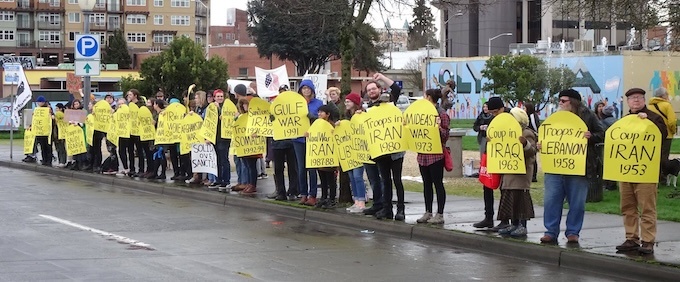
Antiwar rally in Olympia, Washington in 2020, with mock headstones representing Middle East interventions since 1953. Photo: Zoltán Grossman.
As a political-cultural geographer who has long been an antiwar organizer and studied the history of U.S. military interventions, it’s clear that the war on Iran could set into motion a regional conflagration, the violent break-up of Iran into ethnic enclaves, and a toll that would make the Iraq War look like a warm-up exercise.
The U.S. role in the Mideast began with the 1953 CIA coup that toppled a democratically elected government that had nationalized the oil industry for the benefit of its people, replacing him with the dictatorial monarch Shah Mohammad Reza Pahlavi, whom the U.S. backed with both weapons and nuclear technology. It’s in Iran that the U.S. regional domination began, and where it might confront the hardest obstacles, at home and abroad.
Most Americans concur with the country singer Alan Jackson, who sang in 2002, “I’m not a real political man… I’m not sure I can tell you the difference in Iraq and Iran.” But Iran has always been more geographically pivotal than Iraq, in land area, population, and economics. It was one of the few countries that retained independence through the colonial era, and one of the only Third World societies to keep control of its own resources.
Ever since the 1979 Iranian Revolution and seizure of hostages in the U.S. Embassy, Washington has sought to topple the Shi’a revolutionary government in Tehran. That moment was when the demonization of Muslims replaced anti-Communism as the main selling point for military interventions. I remember seeing U.S. sailors in the Philippines 40 years ago sporting t-shirts that read “I Got My Tan off the Coast of Iran,” and a string of U.S. bases with 40,000 troops has encircled Iran since then, now in Kuwait, Bahrain, Qatar, UAE, Israel, Saudi Arabia, Iraq, Jordan, Syria, Turkey, and Oman (all but the last two are now under Iranian missile retaliation).
The U.S. has already been at war with Iran during the Iran-Iraq War. In 1987-88, the U.S. Navy actively sided with Saddam Hussein in his war with Iran, by escorting tankers carrying Iraqi oil, attacking Iranian boats and oil rigs, and “accidentally” shooting down an Iranian civilian jetliner. This war with Iran is a continuation of a long-simmering conflict.
U.S. and Israeli threats have also encouraged a siege mentality among Iranian leaders, who repeatedly used them as a rationale for cracking down on internal dissent. The hardliners in Washington, Jerusalem, and Tehran have always reinforced and fed off of each other, and to create fear to build their own internal power and legitimacy.
Trump and Netanyahu may have thought the Sunni Gulf States, which have long been at odds with Iran, and the Iranian people would side with their current drive toward regime change. But it has had the exact opposite effect, causing stronger Muslim solidarity and rallying Iranians around the flag, even many who had protested and been imprisoned by the ayatollahs but don’t want a new Shah or other foreign puppet ruler. Much the same happened in Germany in World War II, when Allied fire-bombings that targeted civilian neighborhoods may have prevented internal dissent from growing.
Escalation beyond air war
Both the Iraq and Iran wars were justified with lies about weapons of mass destruction, lies told by the nuclear-armed states of the U.S. and Israel. But attacking Iran is far more disastrous than attacking Iraq. It will scuttle any chance of political reforms in Iran or regional agreement around Palestine. Iranian forces could block global oil lanes in the narrow Strait of Hormuz shipping chokepoint, clash with U.S. naval forces in the Gulf, or melt into an insurgency far deeper and longer than in Iraq. Trump’s War will be a self-fulfilling prophecy, because it could stimulate the terrorism and weapons programs it claims to oppose. If Russia takes the unlikely step of getting involved, it could even lead to World War III.
Yet in four decades of conflict, Iran has never sponsored an attack within the U.S., even as the U.S. has attacked its allies in Lebanon, Iraq, Syria, and Yemen, and directly attacked its own forces in the Gulf. Only Sunni terrorists (also opposed by Iran) have attacked targets in the U.S.
All our recent wars, such as in Iraq, began as bombing campaigns, but as they met resistance or retaliation, led to boots on the ground. Unlike Iraq, the U.S. has limited options to invade Iran. Iraq had largely flat terrain, and so has been repeatedly invaded by foreign armies. Iran has natural defensive barriers in its mountain ranges, and a political advantage in having complex neighbors that may not be willing to host invading forces.
Part of the neoconservative agenda for occupying Iraq was to have a staging area for regime change in Iran, but that is no longer possible. Ground forces invading Iran from Kuwait would have to pass through a slice of Iraqi Shi’a territory. An invasion from Pakistan or Turkey would be politically untenable.
These limited options means that a U.S. ground invasion of Iran is very unlikely, so there would not be a repeat of the 2003 Iraq invasion, followed by an occupation of the entire country. That’s why it may be dangerous for the antiwar movement to warn that an Iran War would be a repeat of the Iraq War, with massive U.S. casualties and a legacy of combat injuries and PTSD. During the Vietnam War, facing huge protests because of bodybags coming home, President Nixon switched from a ground war to an air war, reducing U.S. troop casualties, but vastly increasing civilian casualties. Already, reports are that an Israeli strike on a girls’ school has claimed at least 85 lives.
President Bush employed a similar strategy in the 1991 Gulf War, sanitizing air strikes on Iraq as a detached video game. Clinton’s 1999 air war on Serbia and Obama’s 2011 air war on Libya were the first time in human history that a one side in a major war had zero deaths by enemy fire. Trump has inherited these technological tactics of imperial impunity. If the antiwar movement mainly emphasizes the possibilities of U.S. military casualties, it only plays into the Pentagon’s hands and reinforces high-tech warfare that claims even more civilian lives.
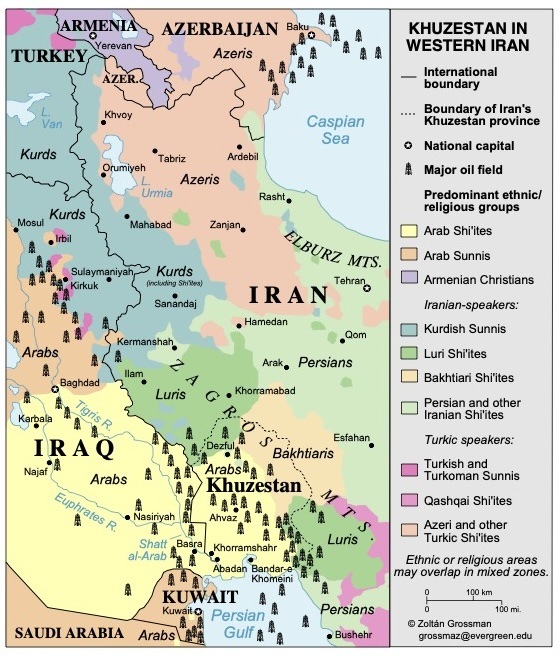
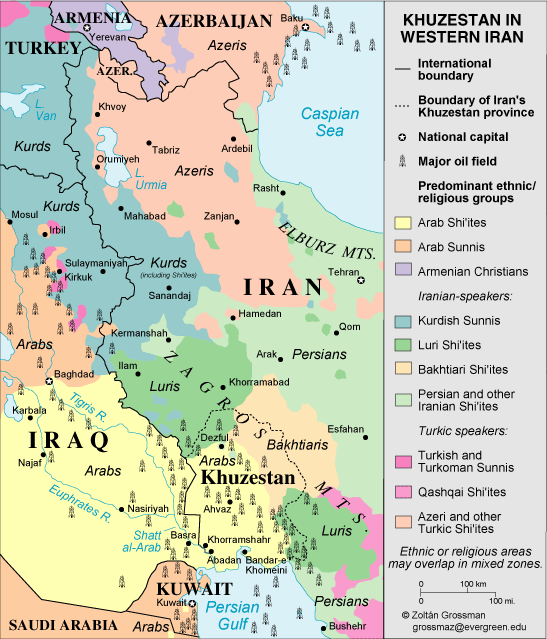
Map of western Iran ethnic groups and oil fields.(Zoltán Grossman)
Ethnic divisions for an oil grab
But there is one scenario that I fear could lead to boots on the ground in Iran. Watch for the U.S. and Israel again stoking ethnic divisions in the diverse country, where ethnic minorities form more than 40 percent of the population, such as Azeris and Kurds in the northwest, Baluchis in the southeast, and Ahwazi Arabs in the southwest, who have been oppressed by both the Shah and Ayatollahs. The most dangerous sign would be encouraging a rebellion in the province of Khuzestan, called “Al Ahwaz” by its Arab inhabitants.
Netanyahu today exclaimed, “The time has come for all segments of the Iranian people – the Persians, the Kurds, the Azeris, the Baluchis, and the Ahwazis – to throw off the yoke of tyranny and bring about a free and peaceful Iran.” Yet at the same time, Israel backs the Shah’s son Reza Pahlavi as a future ruler, who would not be welcome by the ethnic minorities that his father severely repressed, nor by most Persians living in Iran.
Two decades ago I wrote about the possibility that the U.S. would use an uprising as an excuse to occupy Iran’s oil-rich Khuzestan province (next to southern Iraq), with a so-called “humanitarian” rationale of protecting its ethnic Arab population from “ethnic cleansing.” Instead of occupying all of Iran, U.S.-allied forces could take control of the plains of western Khuzestan, where about 85% of Iran’s crude oil deposits are present, and hold the oil industry hostage for its demands.
The Arab Shi’as living on the plains of western Khuzestan share both their ethnicity and faith with the Arab Shi’as across the strategic Shatt al-Arab waterway in Iraq. Arabs make up only 3% of Iran’s population, but a plurality of about 3 million in Khuzestan. In 1897, the British Empire backed Ahwazi Arab rulers to secede from Persia and become the de facto British protectorate of “Arabistan” (much as the British did in neighboring Kuwait). The southern zone of Persia was declared a British “sphere of influence” in 1907, and the following year a British adventurer discovered oil at Masjed Soleyman in “Arabistan.” The discovery created the Anglo-Persian Oil Company, later renamed British Petroleum (BP). In 1925, Reza Shah’s forces retook “Arabistan,” and renamed it Khuzestan, as he renamed “Persia” as Iran a decade later.
British troops occupied Khuzestan during World War II, but after the war Iranians grew more concerned that Westerners had a stranglehold on their oil wealth. In 1951, the Iranian nationalist leader Mohammed Mossadegh nationalized the oil industry based mainly in Khuzestan (including Anglo-Iranian’s holdings), resulting in the 1953 coup that installed the Shah.
In 1978, Arab oil workers in Khuzestan went on strike against the Shah, and played a central role in the Iranian Revolution that toppled him the following year. They supported the revolution in its early months, when it included leftist and other secular parties (that were later crushed by the Islamic Republic). Encouraged by Western powers that were threatened by the revolution, Saddam Hussein launched a brutal invasion of Khuzestan in 1980, and occupied its western Arab oil region. He tried to engineer the secession of the province from Iran, and backed an Arab separatist rebel group (which also briefly seized the Iranian Embassy in London).
Yet in the Iran-Iraq War, most Iranian Arab Shi’ites fought on the side of Persian-ruled Iran, just as Iraqi Arab Shi’as fought on the side of Saddam’s Sunni-ruled Iraq. State territoriality trumped both ethnic and religious territoriality, in a massive slaughter. Iranian forces pushed the Iraqis out of Khuzestan in 1982, but the province’s cities and oil refineries were the most heavily damaged in the war, that finally ended in 1988.
My color map makes it clear that Khuzestan contains Iran’s largest oil reserves. In a 2008 New Yorker article, journalist Seymour Hersh exposed CIA assistance to Ahwazi Arab and other ethnic insurgents, later advocated by John Bolton, and a CIA analysis declassified in 2013 referred to Khuzestan as “Iran’s Achilles Tendon.” Tehran’s repression of Ahwazi Arab rights protests and separatist attacks stepped up in 2005, 2011, and 2018, and have recently been increasing again, so the possibility again exists of the U.S. exploiting their legitimate grievances for its own interests. The ethnic break-up of Iran would make the 1990s shattering of Yugoslavia into seven countries look like a cake walk, and would unleash regional violence that would reverberate for decades.
Even if ethnic minority grievances against Persian rule are legitimate, the timing of western interest in their grievances coincides too neatly with the larger desire to pressure and isolate Iran. Washington has a long history of championing the rights of ethnic minorities against its enemies (such as in Montagnards in Vietnam, Hmong in Laos, Miskitus in Nicaragua, and most recently Kurds in Syria), then abandoning or selling out the minority when it is no longer strategically useful. We love ‘em, we use ‘em, and then we dump ‘em.
Stopping this war
On one hand, Netanyahu pressured Trump on the timing of this particular attack. Netanyahu needs to avoid prosecution and feared the stability of an Iran nuclear deal, just as Trump needs this war to divert attention from the Epstein files. But on the other hand, Israel has always served as a U.S. aircraft carrier carrying out U.S. aims of controlling the economy of the oil-rich Middle East, doing our dirty work of preventing and crushing revolt.
The American public has developed a healthy “Iraq Syndrome” that abhors endless wars, much as the “Vietnam Syndrome” temporarily scaled back U.S. military interventions. Even though Iran is very different from Iraq, that strong public sentiment previously prevented both Obama and Trump from attacking Iran. This war is less popular than even the 12-day war last year, across the political spectrum.
This time, a clear majority of Democrats, Republicans, and Independents felt we should have stayed out of this war, so we start with far stronger support than in any war in living memory. At the same time, a clear majority opposes sending ICE and soldiers into our cities. The growing high school walkouts opposing the war at home could incorporate military counterrecruitment to slow youth enlistment into wars abroad. We have a responsibility to support veterans in groups such as About Face and Veterans for Peace, who are telling the truth to military personnel and their families, and support military personnel on their inevitable grievances, and when they refuse illegal orders or quietly frustrate the expansion of wars at home and abroad.
But to be effective, the movement has to focus on the horrendous effects of such a war on civilians, and not only on U.S. troops. And it should understand that this war may unfold in unpredictable ways that differ from previous conflicts. Just as “generals always fight the last war,” antiwar movements will lose if we merely fight against the last war.
Just as the Iranian people have a long, proud history of fighting against monarchy and theocracy, Americans are now facing a new monarchy and new theocracy at the same time. We should understand that tyrants like Trump always turn to war abroad to crush internal dissent at home. He is joining with messianic fascist allies like Netanyahu and Putin to stoke a religious nationalist crusade that will bring only suffering to civilians abroad and repression at home. It’s not just the future of the Middle East that’s at stake, but our own future as a democracy.
The old saying is that Truth is the First Casualty of War. Now we can turn that around to say that war should become a casualty of the truths that we tell about our country, and at long last we need to pull back from dominating other people to take care of all people in our own country.