Saturday, February 21, 2026

Lessons from Minneapolis

Organization, spontaneity, and the mass strike


Thursday 19 February 2026, by Tempest Collective



Drawing lessons from Minneapolis and the day of protest on January 30, the Tempest National Committee argues that the only kind of action that can stop Trump is the kind that seriously impacts the economy: mass strikes. While workers in the U.S. currently lack the organizational capacity to launch mass strikes, campaigns in the here and now can help us develop and nurture that capacity. [1]

The murder of Alex Pretti—the day after workers shut down Minneapolis in protest of ICE’s invasion of their city–has raised the stakes for those resisting the war on immigrants. Masked government agents violently attacked Pretti moments after he helped a fellow protester who had been pushed down by ICE thugs. He was maced, beaten, and shot in the back.

All of this was captured on video from multiple angles by eyewitnesses, and the world watched in horror. Kristi Noem’s outlandish claims that the victim was a “domestic terrorist,” who “wanted to do maximum damage and massacre law enforcement” stood in stark contrast to the video evidence watched by millions who learned that Pretti was an intensive care nurse for military veterans.

Coming just sixteen hours after a massive march in subzero temperatures—the culmination of a day of mass civil disobedience, work stoppages, school closures, and business closings—Pretti’s murder left many wondering if it was in revenge for the Minneapolis resistance, and what it would take to defeat this kind of occupying force. As the movement confronts an entrenched and dangerous enemy, it is increasingly clear that protests and demonstrations are essential, but the only thing that will stop Trump is the kind of action that seriously impacts the economy: mass strikes.


No work, no school, no shopping


The mass actions of January 23 put tens of thousands in the streets in response to a call for “no work, no school, no shopping.” Almost one thousand businesses closed their doors, even if only for a few hours, in solidarity. Workers called in sick or took a “mental health day.” Some workplaces were forced to close by the collective will of employees. Even while labor unions stopped short of officially declaring a strike, many endorsed the day of action.

The protest was spurred by the murder of Minneapolis ICE resister Renee Good on January 7. The general strike, as it was widely referred to, was organized by a coalition of trade unions, faith organizations, and neighborhood rapid response networks. Some of these formations came together in 2011 around common bargaining demands. They also built on the long history of anti-racist mobilization in the wake of the George Floyd uprising. This organizational cross pollination combined with popular sentiment against ICE raids to produce a significant showing. One survey found that one in four voters in the state participated or had a loved one who did. This is all new territory for the movement.

When the administration sent 3,000 federal officials into Minneapolis—which, to put things in perspective, employs about 600 police officers—they declared war on the immigrant population. The Border Patrol officers who murdered Pretti were in pursuit of a delivery worker who was sheltering in a local business behind locked doors.

Immigrant unions and entire neighborhoods sprang into action to defend their community. Masked officers escalated their violent attacks, entering schools and confronting students and educators. The image of five-year-old Liam Conejo Ramos, arrested on his way home from preschool in the Minneapolis suburb of Columbia Heights on January 20, became a symbol of the cruelty of ICE. This only added to the indignation many already felt and drove more to take action on the 23rd.

The people vs. the billionaires

Thirty-five people have died while in federal custody since President Donald Trump began this campaign in July 2025, and eight have been murdered in the field by ICE officials.

Almost all of the people killed and injured by these agents so far have been immigrants and people of color. These individuals include Keith Porter, an African American father of two in Los Angeles, and Silverio Villegas González, also a father of two elementary school children in Franklin Park, Illinois—a Chicago suburb. Renee Good and Alex Pretti were outliers in that they were both white.

The “domestic surge” has deployed thousands of heavily armed, armored and masked agents mostly to cities in blue states, regardless of the actual concentration of immigrants. ICE has been met with popular community resistance, from Los Angeles to Chicago to the Twin Cities. In each case the opposition has learned new lessons, which have been shared with protesters elsewhere. Minnesota is the latest link in the chain of learning how to resist.

Communities across the Twin Cities and beyond have stood up to these racist attacks on people who are just trying to live their lives and raise families. Their actions are inspiring as they show the depth of opposition to MAGA and the potential for an alternative.

The outpouring of protest and support for immigrants is a multiracial fightback based in the working class with anti-racist politics at its heart. It is a powerful antidote to Trump’s use of anti-immigrant scapegoating to divert attention from the billionaire class while it cuts SNAP benefits, health care, and funding for education.

National Nurses United, a health care union representing 225,000 workers, organized vigils across the country for Alex Pretti. At an event outside a Veteran Affairs hospital in Chicago, one speaker called on us to recognize the “state sanctioned violence” of unaffordable health care as well as targeted murder by government agents.

The administration attacks immigrants in the name of fighting crime. But the true criminals are the richest one percent and their hired help in Congress. They spend billions of our tax dollars terrorizing immigrants and billions more on regime change in Venezuela and Israel’s ongoing genocide in Palestine. They fund their imperial projects by cutting domestic services at home.

In order to get away with this blatant theft, the billionaire class suppresses individuals and organizations that defend our rights. They have decimated public unions, criminalized outspoken organizers like Mahmoud Khalil, and murdered people in the streets in an attempt to scare people away from protest.

They have not succeeded in stemming mass protest by students, neighborhood organizations and workers, but they are forcing us all to confront the daunting question of how we can stop these attacks.

The power of the mass strike

More people than ever are asking how we can stop the war on immigrants and also address the raft of economic problems known as the “affordability crisis.” The pledge by Democrats to reform ICE and Border Patrol to refocus on their mission only reveals their complicity. Some Democrats sense the political winds are shifting. One candidate for Senator from Illinois, Raja Krishnamoorthi, voted as a member of the House to express “gratitude” to ICE in June 2025, when they were arresting union leaders in Los Angeles. He is now calling for ICE to be abolished.

ICE should be abolished, and the priorities of our society should be thoroughly recalibrated. But as we argued in our January editorial, we cannot expect these changes to come from above. Our collective ability to redirect funding away from war and occupation (domestically and internationally), towards health, housing, and education should look instead to the lessons from Minneapolis.

Our greatest power is in our potential ability to organize mass strikes.

Recent years have seen political strikes globally, such as in South Korea when martial law was declared in December 2024, or in France in January 2023 when the retirement age was raised. While the U.S has seen strikes over contractual or safety issues, such as the tens of thousands of health care workers on strike in New York and against Kaiser Permanente, strikes over political issues are not common here.

When a call for a general strike on January 30 went out via social media following the murder of Alex Pretti, the Google search for the word “strike” increased dramatically, as people across the country attempted to educate themselves. In multiple cities, students demonstrated, small businesses shut down, and people gathered to rally and march in solidarity with the resisters in Minnesota. This shows tremendous potential, but until labor is far better organized, most workers cannot simply walk out without risking their jobs. Most unions are far from ready to launch the kind of coordinated, disciplined strike action that could really make a difference, and most workers lack a union, given that unionization rates are below 10 percent.

So the pressing question is how we can harness the collective strength on display in Minnesota, and everywhere that people are standing up against ICE, in order to make a significant economic impact.

What do we do next?

The U.S. workforce does not currently have the organizational capacity to launch a mass strike on the scale of those in South Korea. But with the vision of this goal, we can plan and build campaigns in the here and now that will help us build this organizational capacity and the infrastructure to nurture and sustain it. These campaigns will vary depending on the particular location and context, but there are many available options for both union and non-union workers.

We can hold strike schools that help unionized and non-unionized workers to become strike ready. We can build emergency response networks to move into action against ICE and CBP. We can form workplace-based emergency response networks, especially in schools, which are powerful sites at the intersection between the community and workplace and therefore of great strategic importance for a mass strike. We can agitate to make every workplace a Fourth Amendment zone which refuses access to ICE and CBP. We can push to force towns and cities to pledge non-compliance with ICE and CBP, even if that means defying federal law (even Minnesota, a so-called sanctuary state, does not have such measures).

In the upcoming months we should join local organizing efforts for the March 28th No Kings protest, with the explicit plan of projecting mass actions for May Day—which is on Friday, a work day—including strikes and sickouts against the Trump regime.

Finally, we should join May Day Strong. 3,500 people participated in a virtual call on February 1, entitled “How We Build a General Strike,” where union leaders, organizers, and even the mayor of Chicago Brandon Johnson addressed this question. The focus of that meeting was building towards coordinated actions across the country on May 1, 2026.

We can draw inspiration from the anti-ICE movement and commit to building the kind of sustained, ongoing organizing in workplaces, schools, and neighborhoods that will increase our capacity and power. A better world is waiting to be born, and it will take all of us to help make that happen.

9 February 2026

Source: Tempest.

Attached documentslessons-from-minneapolis_a9422.pdf (PDF - 973.1 KiB)
Extraction PDF [->article9422]

Footnotes


[1] Photo: Detroit: Peoples Assembly volunteers put together whistle kits designed to alert community members when ICE is nearby. (Jim West) ATC.


Tempest Collective

The Tempest Collective sees the activity of the vast majority of the world’s population whose ability to work is their only means of survival as the crucial factor in building the socialist movement and winning reforms. The working class is the agent of social transformation – of ridding our society of capitalism, addressing the existential environmental catastrophe, and building a socialist society – if we can organize ourselves.


The revolutionary struggle in Russia, in which mass strikes are the most important weapon, is, by the working people, and above all by the proletariat, ...


 KASHMIR IS INDIA'S GAZA

The republic on trial: Militarised sovereignty and accountability in Kashmir


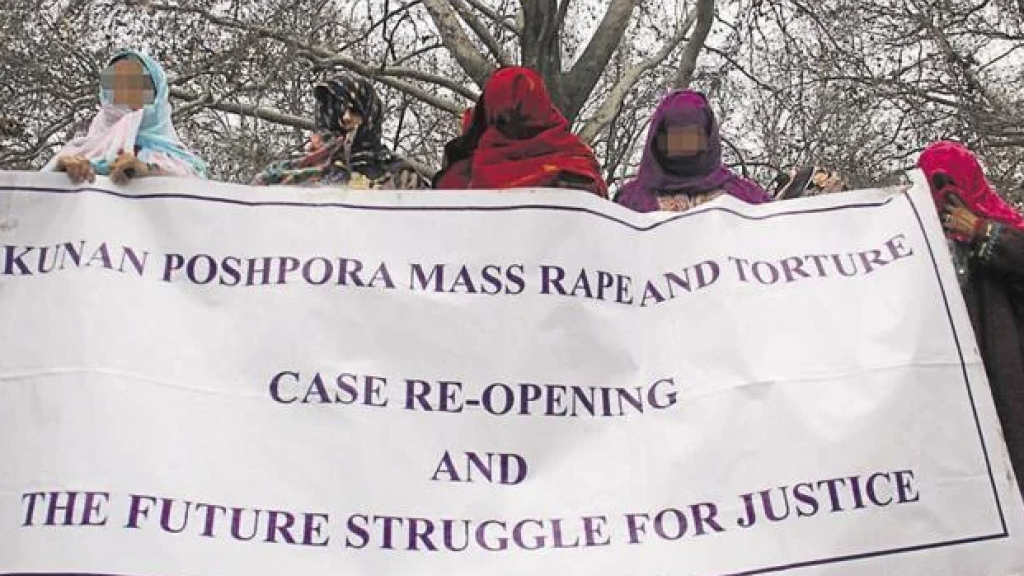
protest mass rapes Kunan and Poshpora

On the night of February 23–24, 1991, soldiers of the 4th Rajputana Rifles entered the villages of Kunan and Poshpora in Kupwara district in what was described as a routine cordon-and-search operation. By that point, such operations had become embedded in everyday life across Kashmir. 

Villages were sealed. Men were assembled outdoors for identification. Homes were searched through the night. The stated objective was counterinsurgency. The practical effect was the visible performance of state authority in a territory where sovereignty was under open challenge.

By morning, women in the two villages alleged that soldiers had entered their homes after separating the men and subjected them to sexual assault. The scale of the accusations was significant. The army denied the charges. 

Senior officials characterised the accusations as fabricated, implying that their purpose was to undermine counterinsurgency operations. Local police registered a First Information Report. A medical examination was conducted. 

The case entered the formal register of the criminal justice system. Investigations followed. Reports questioned the credibility of the allegations. A closure report was eventually filed. No full criminal trial ever tested the evidence in open court.

That absence is the defining feature of the case. Not conviction. Not acquittal. Not adversarial adjudication. No criminal courtroom has examined the allegations through cross-examination, evidentiary scrutiny and judicial determination for more than three decades. They have remained administratively contained.

Counterinsurgency as governance

To understand why, the events must be situated in the early 1990s, when armed insurgency in Kashmir escalated sharply, as demands for self-determination moved from protest to armed movements. 

The Indian state responded with a heavy troop deployment and institutionalised counterinsurgency as a governing framework. Emergency powers were not exceptional interventions; they became routine instruments of rule.

Counterinsurgency is often described as a military doctrine. In practice, it is a political order. It regulates mobility, domestic space, speech and suspicion. It redraws the boundary between civilian and suspect. 

Armed personnel physically enact sovereignty when they seal entire villages overnight and search households. Authority does not simply exist; it is staged.

In that setting, claims of sexual abuse have ramifications that extend beyond personal misconduct. They propose that the coercive rationale of counterinsurgency may have infiltrated personal domains. Sexual violence in conflict situations is not just assault; it shows who is in charge.

The state’s immediate response was denial, followed by investigative framing that foregrounded insurgency conditions and questioned credibility. From the outset, the case became entangled in a broader struggle over narrative: was Kashmir a site of necessary security operations, or a site where civilians were exposed to unchecked force?

Survivors and activists pursued reinvestigation through courts and petitions. The matter resurfaced periodically. But it never matured into a decisive judicial reckoning. The unresolved status hardened into a structural outcome. Kunan and Poshpora endure because they reveal the internal tensions of militarised governance.

When emergency powers become the grammar of rule, accountability narrows. The issue extends beyond the events of that night. It concerns how democracies respond when allegations implicate the coercive institutions tasked with defending territorial integrity.

The issue is of serious importance for Indian democracy. Undoubtedly, a democracy that is confident in its institutions is willing to subject them to scrutiny. A democracy that hesitates signals a different priority: preserving the apparatus before testing it.

AFSPA and immunity

The unresolved status of Kunan and Poshpora cannot be understood without examining the legal regime governing Kashmir. At the centre of that regime stands the Armed Forces (Special Powers) Act (AFSPA).

AFSPA authorises armed forces operating in “disturbed areas” to arrest without warrant, conduct searches and use force under broad conditions. Most consequentially, it requires prior sanction from the central government before any prosecution of armed forces personnel can proceed in civilian courts. Without that sanction, criminal proceedings cannot begin.

In theory, this provision is presented as protection for soldiers operating in high-risk environments. In practice, it has functioned as a structural bottleneck. Allegations against armed forces personnel remain contingent on executive approval, significantly limiting judicial autonomy in initiating proceedings.

In the wake of the Kunan and Poshpora allegations, investigations were initiated and a closure report generated, although survivors sought further reinvestigation. The legal proceedings encountered obstacles, primarily the sanction requirement, preventing the case from reaching a trial.

AFSPA embeds counterinsurgency logic within statutory law, altering legal priorities in disturbed regions and relaxing operational constraints on security forces. While defenders of the act maintain that such legal protections are essential to prevent debilitating litigation against soldiers, this narrative must not absolve the necessity of accountability.

Allegations of serious crimes should undergo transparent processes, rather than be obstructed by routine sanction clauses, which foster "immunity by design." This procedural impunity, though not formally declared, cultivates perceptions within communities that certain actors operate beyond judicial scrutiny.

The Kunan and Poshpora cases underscore the impact of emergency legislation on democratic accountability, wherein legal structures intended to curb power paradoxically become instruments of shielding it. 

The central issue transcends operational freedom for soldiers; it questions the legitimacy of a democracy that permits executive discretion in determining accountability for its own agents.

Gendered power in a militarised territory

It is easy for the discussion about Kunan and Poshpora to get mired in controversies about facts, figures, accounts and inconsistencies. But the underlying level is just as important: how sexual violence works in a militarised setting to maintain a hierarchy that favours the powerful.

Cordons and searches blur the distinction between public and private. Men are assembled outside; women remain inside; armed forces enter homes under the guise of the law. The home ceases to be a safe haven and becomes a site of surveillance and domination. Power enters the domain of the intimate.

Civil society reports, including documentation by the Jammu-Kashmir Coalition of Civil Society, have identified numerous cases of sexual violence linked to the conflict and have argued that legal immunity structures enable such abuses.

In a patriarchal world, the social implications of sexual violence are exponentially greater. A woman’s body is inextricably bound to her family's honour and the community’s identity. An act of violence has repercussions that reverberate beyond the survivor — shaking kinship, conjugal prospects and social status. Stigma multiplies the pain. Silence can be a shield, even as it conceals the injury.

This narrative plays out in the way charges are treated. Victims are confronted with both state power and social coercion. To speak out is to invite ostracism; to remain silent is to retain social status at the expense of justice. When women in Kunan and Poshpora turned to the law for redress, they challenged both militarised power and the social norms that regulate speech in their society.

The state’s response follows the usual pattern in war zones. Allegations are couched in terms of exaggeration or political motivation. In insurgency situations, allegations of abuse are frequently restated as disinformation. The onus is on the complainant to demonstrate injury and establish noble intentions.

However, emergency governance heightens gendered vulnerability. Armed men possess legal sanction, mobility and impunity; civilian women do not have a comparable level of leverage. Even in the absence of policy, the asymmetry creates risks.

Kunan and Poshpora remain important because they highlight this asymmetry. They expose how counterinsurgency obscures the distinction between security operation and social regulation.

The political question is not confined to the truth of individual allegations. It concerns whether emergency regimes adequately protect bodily autonomy. If domestic space becomes penetrable under state authority and allegations of abuse remain untested in court, then vulnerability is structural, not episodic.

Exceptional law and unequal citizenship

The Indian Constitution officially guarantees the principles of equal treatment before the law, due process, and judicial remedies against state wrongdoing. These principles form the normative foundation of republican legitimacy, under the assumption that independent courts can effectively check abuses of state power, regardless of their magnitude.

In regions governed under prolonged emergency legislation, that equilibrium shifts. The formal architecture of constitutional rights remains intact, but its operational character changes. The requirement of executive sanction before prosecuting armed forces personnel introduces an additional layer between allegation and adjudication. Legal accountability becomes conditional on administrative approval.

Kunan and Poshpora exemplify this structural tension. In ordinary criminal law, the filing of a First Information Report and the collection of evidence can culminate in trial if prosecutorial thresholds are met. In Kashmir, under AFSPA, the path from accusation to courtroom is mediated by executive discretion. The effect is not the suspension of the law but rather its recalibration in favour of operational protection.

This recalibration alters the citizen–state relationship. Constitutional equality presumes that public officials and civilians stand before the same judicial forums when accused of grave crimes. Where prior sanction operates as a gatekeeping device, that presumption weakens. Even when legally authorised, the appearance of differential accountability carries political consequences.

The 2019 reorganisation of Jammu and Kashmir into Union Territories intensified this contradiction. The stated objective was integration and normalisation. Yet the legal instruments that institutionalise exceptional security governance remain largely unchanged. Political autonomy contracted while emergency frameworks endured. The assurance of constitutional uniformity exists alongside differentiated layers of accountability.

Legitimacy in a democracy rests not only on territorial control but institutional credibility. Public confidence in procedural equality erodes when serious allegations against state agents fail to reach open judicial examination. The issue extends beyond the reputation of the armed forces. It concerns systemic questions: whether constitutional guarantees operate with the same force in frontier spaces as they do elsewhere.

A republic with strong institutions allows for scrutiny, especially when coercive power is at its highest. Shielding institutions from prosecution may preserve short-term operational strategies, but it carries long-term costs for constitutional trust. The persistence of unresolved cases such as Kunan and Poshpora underscores the tension between emergency governance and equal justice.

The republic on trial

Kunan and Poshpora cannot be treated as an aberration or tragic residue of a turbulent decade. What followed 1991 was not administrative drift; it was the structured outcome of a state that chose insulation over scrutiny. 

The long refusal to subject grave allegations to open trial reflects not institutional weakness but a political priority: preserving the coercive apparatus deemed essential to governing a contested territory.

At stake is not only justice for survivors. It is the character of the Indian state under conditions of internal conflict. Modern states claim a monopoly over legitimate violence. In democratic theory, that monopoly is justified by law, equality and accountability. 

But when the institutions that exercise sovereign force are shielded from ordinary judicial testing, sovereignty begins to detach from democracy. It becomes managerial, securitised and increasingly insulated from popular scrutiny.

AFSPA is not merely an emergency statute. It is an expression of how the state manages peripheral regions, where consent is fragile. In such spaces, coercion is normalised and legal exceptions become routine. 

While executive sanction regimes are defended as operational necessities, in practice, they produce stratified citizenship. One legal order for the core, another for the frontier where sovereignty is enforced through prolonged militarisation.

This hierarchy bears significant political implications. It indicates that the priorities of territorial integrity and strategic control take precedence over equal justice. It implies to citizens residing in militarised zones that constitutional guarantees are conditional and subject to security considerations.

Over time, such behaviour corrodes the ideological claim that the state represents a unified democratic community. Compliance may persist but political legitimacy erodes significantly.

From our perspective, the issue is not simply a question of procedural reform. It exposes the deeper logic of a state that defends property, territory and geopolitical standing with extraordinary powers while narrowing democratic accountability. Legal exceptionalism at the margins reshapes the centre, rarely limiting militarised governance to its original theatre.

Accountability, therefore, is not a liberal luxury. It is a material question of power. Either the armed apparatus of the state remains subject to the same judicial processes as the citizens it governs or a differentiated sovereignty takes root — one that reserves immunity for those who wield force in its name.

What would accountability entail? Enforced limits on executive sanction, independent prosecutorial authority in areas under emergency law, and sustained legislative review of exceptional security regimes are the minimum requirements for accountability.

But more fundamentally, it requires rejecting the premise that security and equality are mutually exclusive. A democratic state confident in its social foundations does not fear judicial scrutiny of its own agents.

Thirty-five years on, the unresolved status of Kunan and Poshpora is not merely a legal anomaly. It is a political marker. It reveals the tension between a constitutional promise of equal citizenship and a governing practice that privileges militarised order.

Until allegations of this magnitude are tested in open court, that contradiction remains active — a reminder that sovereignty without accountability drifts toward domination and that democracy without equality becomes rhetoric.

 UK High Court Blocks Starmer’s Effort to Label Palestine Action a Terrorist Group


 February 20, 2026

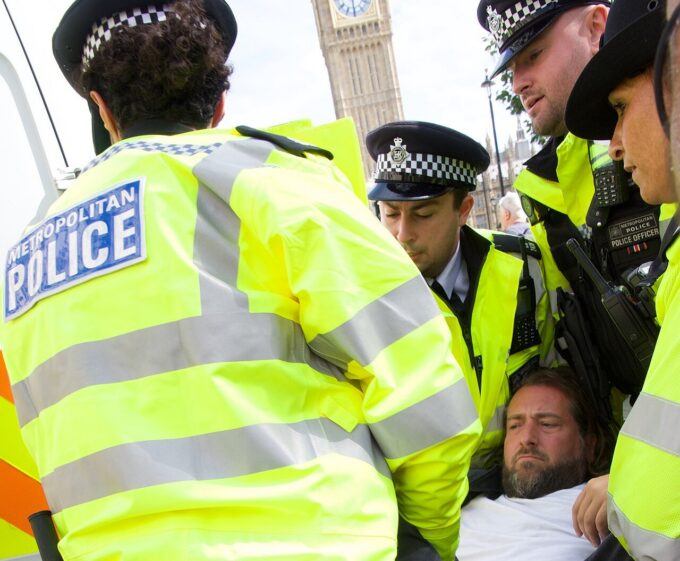
Police arresting a protester against the proscription in London, 6 September 2025. Photograph Source: indigonolan – CC BY 4.0

Last year, I was living in the UK when activists from the anti-Zionist, pro-Palestinian direct action group Palestine Action hugely. embarrassed the Royal Air Force and the British government by cutting their way through a security fence surrounding  an RAF Airfield in Oxfordshire and spraying red paint on the jet engines of two aircraft known to have assisted Israel’s aerial slaughter of Palestinians in Gaza.

While the action was only “damaging“ to the planes if one considers having to apply paint remover to the vandals’ handiwork to remove it, the Labor government of Prime Minister Keir of Starmer responded  by claiming the “repairs” would cost £7 million (about US$10 million) and as such justified labeling the avowedly non-violent protest group guilty of  “terrorism” under a rarely used  Anti-Terrorism Law  enacted in 2000, had targeted  the likes of  Al Qaeda and the Irish Republican Army that actually sought to kill people. Although it did list property damage, the law one the quarter of q century of its being on the books has never before been against an action or an organization involved in just property damage and not seeking to harm people.

Labeling Palestine Action a  terrorist group, as ludicrous as it was, in fact was  and remains a serious matter for the protest organization which has been trying to force the government to stop supporting Israel’s US and UK-backed genocide in Gaza and the West Bank which was at the time slaughtering tens of thousands of Palestinian civilians, including many children,  with bombs, planes and weapons supplied by the UK and US. The action also targeted those many British citizens who were protesting over the same issue and specifically the effort to silence and destroy Palestine Action. This is because not only does the Antiterrorism Act cary a penalty for being  part of a designated terror organization of up to 14 years in jail. It also makes simply protesting for or speaking or writing favorably about or even just holding a sign supporting a designated terror organization.

I was dismayed to see Britain’s long history of supporting freedom of speech and protest (a tradition dating back to the Magna Carta and that inspired the addition of the First Amendment  protecting freedom of speech, press, religion, association and protest to the US Constitution), so casually trashed by PM Starmer and his Labour majority, their fatuous labeling of Palestine Action as a terrorist organization.

 I was I should say, dismayed but not surprised. PM Starmer, whose official résumé highlights his past experience as a human rights lawyer — one  who ironically once in 2003 passionately and successfully defended another protest group’s similar break-in and damaging of RAF planes in protest against Britain’s joining in the Bush-Cheney US invasion of Iraq  based upon  the lie that Iraq was constructing weapons of mass destruction—chemical and germ and even nuclear weapons.

Then too, more recently, Starmer before his election as PM in July 2024 was the British government’s head prosecutor, in which post  he slavishly did the bidding  of three US presidents — GW Bush, Barack Obama and Trump—in keeping journalist and Wikileaks founder Julian Assange in prison for over a decade in solitary confinement much of he time, and without any trial, much less conviction, while the US attempted to extradite him to face a treason charge.

The Starmer government’s legal attack on Palestine Action backfired spectacularly as elders, including people with canes, crutches and in wheelchairs, began attending huge  protests in public spaces, including popular tourist sites. They all  hand-written signs,  most saying ,’“I oppose Genocide” and “I support Palestine Action!”  The 2700 protesters arrested over several months, essentially begging by displaying  those banned lines  to be arrested, have been subsequently taken or wheeled into custody,  sometimes in the hundreds at such actions over the last half year or so.

Often they found themselves being led to waiting vans by apologetic Metropolitan Police officers, who have had  to endure being berated by shocked locals and by European and US tourists remarking, “I thought Britain had freedom of speech!”

This High Court  ruling will be especially welcome to the 700 of those arrested sho were slapped with felony charges  for “supporting a terrorist group.” A number of these people have been on a hunger strike, with  some reportedly coming close to death as their cases made their slow way up through the lower courts. As their cases look likely to be tossed out, most have ended their protest fast.

Over six months after the case went to the High Court, a  panel of three Judges  issued their ruling: The application of the Terrorism Act to Palestine Action, which they found  “does not advocate violence” or acts of violence against people, was being “illegally applied “to the group and to its protesting backers..

It was a sharp slap-down of the prime minister, who has been facing more than his share of disastrous cock-ups requiring a reversals of policy decisions, with many  now predicting his early ouster as PM.

The High Court’s dramatic ruling wasnt, for all that,  a perfect win for free speech and the right to protest in the UK This is because, despite the High  Court’s strong language in condemning the use of the Antiterrorism Law against Palestine Action, the judges, noting that there would likely be an appeal by the government to the Court of Appeal, the equivalent of the US Supreme Court, said they would leave the ban on the group ion place pending the appeal (though the Metro Police say they will no longer be arresting people for expressing support for Palestine Action or for calling out Israel genocide.,  Starmer and the Home Secretary Mahmood, have both stated they plan to appeal the ruling.

The interesting thing to me is that in Britain, its is the highest or penultimate court that acts boldly , or perhaps semi-boldly, in reversing decisions by  the national government, while lower courts “kick the quid” upstairs to a higher court. Meanwhile, here in the US it is higher courts, the Appellate Circuit Court judges and  the Supreme Court justices (who all have lifetime tenure and are likely at the pinnacle of their legal careers, not having to worry about being passed over for nomination to a higher judicial station), who are showing obscene fealty to wannabe tyrant Donald Trump, while hopes for holding the line on the destruction of liberty and democracy, lie with with the lower federal magistrates and judges, who also have lifetime tenure but have to worry that bold rulings that oppose Trump’s destructive  executive orders and his cabinet secretaries’ actions shredding  . .  the Bill of Rights, could end their hopes of advancing to higher court appointments.

Logically, the UK situation makes more sense, but here in the US hoping for courage, principle and a lack of careerist concern in our lower courts is all we’ve got.

There’s also another thought:   Perhaps it is the UK’s lack of  a written Constitution, and the US’s venerated Torah-like written document that explain the difference in their approach to considering lower court decisions and government actions. . British jurists on the High Court look at the precedents of British Common Law and generally have a whole pallet of them go select from in coming to a ruling, In contrast, US Supreme Court Justices— particularly the “strict constructionist” jurists, all six of them Republican nominees to the bench, who spend their time parsing the exact meaning of the words in the text of the Constitution and its later Amendments in reaching their decisions  from the bench, while the three liberals on the court, look at the context of when those words were written, and how circumstances may have changed. Consider for example the 15th Amendment  on the right to vote, which states, in full: “The right of citizens of the United States to vote shall not be denied or abridged by the United States or by any State on account of race, color, or previous condition of servitude.”

“Strict constructionists, one would think, would be hard-pressed to find a way around that declarative sentence to find a way to justify keeping non-whites from voting. Yet in the intervening decades since tha amendment was approved, these justices  have found many ways, arguing for example that requiring proof of citizenship — a birth certificate, driver’s license or passport, for instance can be required since only citizens can vote.. But since many people have long ago lost their birth certificate, or, In the case of poor families and rural families where children were and sometimes still are born at home and their births remain unregistered, or some urban dwellers have never owned a car or needed a driver’s license, while many in the US have never traveled abroad  and thus have no passport,.Doesn’t     such a requirement constitute an “abridgment” of ther right to vote?

This article by Dave Lindorff appeared originally in ThisCantBeHappening! on its new Substack platform at https://thiscantbehappening.substack.com/. Please check out the new site and consider signing up for a cut-rate subscription that will be available until the end of the month.

Britain: Roots of the Labour crisis


Keir Starmer

First published at Anti*Capitalist Resistance.

Morgan McSweeney is gone. Peter Mandelson is gone. And if Labour loses the Gorton and Denton by-election on 26 February, Keir Starmer may not be far behind. Even if he survives that test, looming defeats in May’s local elections — and potentially in the Scottish Parliament and Senedd — could finish the job.

As things stand, Wes Streeting is the bookmakers’ favourite to succeed him — assuming Angela Rayner won’t stand because of her tax problems. Yet neither would break from Labour’s self-imposed fiscal straitjacket. If anything, Streeting would likely push further right: on public spending, on Palestine, and on the right to protest.

Every week brings a fresh scandal. But the real problem is deeper. The common thread is the deference shown by Britain’s major parties towards wealth and power. Even without controversies like the Mandelson-Epstein revelations, Labour would still be trapped in the contradictions of its economic strategy.

The depth of the Labour crisis is such that many are asking whether Labour can survive. When the Labour loyalist paper, Tribune, says the party is on its last legs, the situation is at least deadly serious.

The growth myth

Starmer and Rachel Reeves promised that economic “growth” would magically generate tax revenue. It did not. Partly that reflects a sluggish global economy. More importantly, it reflects a domestic context in which working-class households and poorer segments of the middle class lack spending power.

The result? Millions face low pay, inadequate benefits, and deteriorating public services. The NHS and transport systems are visibly struggling. Meanwhile, the housing crisis grinds on, locking people out of stable and affordable homes.

Yet despite this, Labour pressed ahead with deeply unpopular policies: keeping the two-child benefit cap, scrapping winter fuel payments, and attempting to cut disability mobility payments — moves withdrawn only after backbench revolts. Add to that the retreat on key net-zero pledges and the refusal to take meaningful action over Gaza, and the political damage becomes clearer.

Labour’s slide in the polls was predictable. So too was its failed attempt to deal with Reform UK by echoing it. In addition, the right’s obsession with small boats crossing the Channel, restrictions on care homes, and the NHS recruiting from abroad threaten drastic cuts in the availability of care home places and a further squeeze on the number of NHS workers.

If the aim is to encourage British people to take up these roles, this is unlikely to succeed. Unemployed people won’t want to take jobs that offer low pay and very long shifts, and need skills they don’t have.

New restrictions on international students, including restrictions on family reunion for graduates, will affect both higher education finances and the number of skilled workers and researchers who wish to remain in Britain. And why not go instead to Canada or Australia that are more welcoming?

Reform cannot be beaten by copying its ‘keep them out’ and ‘send them back’ sentiments. The policies of Enoch Powell and the National Front in the 1970s on ‘stop immigration, start repatriation’ are becoming the policies of all the main parties. It is shameful that these are now the policies of a Labour government.

And the widely held but utterly false view that immigrants are to blame for crisis-ridden services ignores the real causes: decades of under-investment, privatisation, and spending squeezes.

The tax taboo

Mention higher taxes and the major parties protest that ordinary people are already stretched. But this deliberately obscures where substantial tax revenue could actually come from.

Corporation tax remains low by international standards. Vast profits are lightly taxed or untaxed. Enormous personal wealth sits shielded in offshore havens. Britain is not short of money — it is short of political will. This is the case for dozens of transnational corporations that reap vast profits in the UK. They pay minimal tax by claiming to be headquartered in Ireland, Switzerland, or Luxembourg, and asserting that their UK subsidiaries must pay substantial licensing fees, leaving little or no taxable income in the UK.

High-tech giants such as Apple, Amazon, Jigsaw (Google), Meta (Facebook), Microsoft, X (Elon Musk), and OpenAI all benefit from a low or no-tax regime for their British operations. In addition, untold billions of taxable wealth globally, valued at £388 billion per year, evade tax in tax havens, the majority of which are British overseas territories.

Public services in decay

Because Labour has bound itself to strict fiscal rules, meaningful improvements to the NHS, elderly care, and housing remain elusive. Across public services, the picture is bleak.

Water is a glaring example. Privatisation has delivered vast profits for investors, rising bills for consumers, and chronic under-investment in infrastructure. The result: polluted rivers and sewage-strewn beaches.

Local government is near breaking point. Housing shortages deepen poverty. All of this creates fertile ground for Nigel Farage and Reform UK. The opposition hardly needs to try.

The shadow of New Labour

What is now unravelling is an attempt to recreate Tony Blair’s New Labour. Across Labour’s leadership — from Streeting to Miliband, Rayner to Starmer — there is broad agreement that the New Labour record is something close to sacred: pragmatic, modern, electorally successful.

But that account is a myth. New Labour’s support started to drain because of Tony Blair’s role in backing George W. Bush in the Iraq and Afghanistan wars. Domestically, it ended in 2010 with austerity and political collapse after years of indulgence towards banks and financial institutions.

When mortgage-backed investments imploded in 2008, the state bailed out Northern Rock, Lloyds, and the Royal Bank of Scotland and gave significant sums to other banks as well. The cost was in the hundreds of billions of dollars. Austerity followed — first under Labour chancellors Gordon Brown and Alistair Darling, which intensified under David Cameron and George Osborne.

Public-private partnerships have left long-term debt that continues to strain health budgets, with some hospital trusts paying millions annually in interest before funding frontline services.

The tight grip on spending is also evident in the slow compensation for victims of the Post Office scandal, the contaminated blood catastrophe, and the Windrush scandal. WASPI women, affected by the rapid rise in the state pension age, have been denied compensation entirely.

Mandelson and the party machine

There is little reason to shed tears for Morgan McSweeney or Peter Mandelson. Over different periods, both were instrumental in marginalising the Labour left and steering the party toward intensified neoliberal and anti-left-wing policies.

Morgan McSweeny rose up the ranks of the Labour hierarchy under the protective wing of Steve Reed, then leader of Lambeth Council, whose chief of staff he became. Latterly, he is said to have had close links with Peter Mandelson while advising Keir Starmer.

Mandelson — alongside Blair and Brown — was a principal architect of “Blairism”. The largely symbolic Clause 4 on common ownership was swept away, the policy shifted rightward, and relations with the wealthy elite flourished.

Mandelson’s close connections with the mega-rich and his strongly pro-American, pro-Israeli positions were positive credentials for an incoming ambassador to the US. After all, the American president also has multiple connections to the rich and famous internationally, a world where hostility to the needs and rights of ordinary people is taken for granted.

Mandelson once said: “Every morning I wake up and think about how to bring down Jeremy Corbyn.” The party’s right wing attempted to remove Corbyn for the first time in 2016 by standing Owen Smith against him. Smith’s campaign was backed by Keir Starmer, Yvette Cooper, Ed Miliband, Sadiq Khan, Margaret Beckett, Harriet Harman, and dozens of other Labour MPs and some trade unions, including the GMB and USDAW. The outcome was a humiliating defeat for Smith, who took only 38% of the vote.

But if you drill down into that figure, you find that Smith won 81% of MPs, 46% of trade unions, and 40% of constituency members. However, these votes were swamped by the 123,000 registered supporters, whose votes were permitted in 2015 and 2016. This was a shock to the Labour right, who decided that something much more serious had to be undertaken to undermine Corbyn, and it is a strong indication that Mandelson was involved in the subsequent witch-hunt against him.

The housing example

Housing is among the clearest failures of the Starmer era. Labour pledged to boost housebuilding dramatically and expand affordable housing, promising to sweep away planning “obstacles”. Yet little meaningful public investment has followed.

The housing crisis remains a major driver of poverty and insecurity. Promises of large-scale social housing construction have not materialised. Labour promised 300,000 new homes each year until 2029. Last year, only 122,500 were built, up slightly from the previous year and way off the 300,000 target.

Everyone knows that climbing onto the housing ladder is hugely difficult when the average house price in Britain is £300,000 and a staggering £553,000 in London. The rent for a two-bedroom flat is also extremely high.

Many private renters are paying 50% or more of their disposable income on rent or mortgage repayments. The housing crisis and low wages are graphically revealed in the figure, which shows that approximately 30% of people are still living at home at age 30.

The housing crisis and the high costs of utilities lead to a substantial transfer of disposable income to finance capital. This, in turn, means that hundreds of thousands of households are using their savings and credit cards to sustain household expenditure. They are, in effect, in debt bondage.

The core question

The crisis facing Labour is not just about personalities. It is about political economy. Public services are crumbling. Inequality is widening. Living standards are stagnant. And yet the party leadership refuses to challenge the structures that produce these outcomes.

There is an unavoidable conclusion: if Britain is to repair its public realm — from the NHS to housing, from local councils to environmental infrastructure — state revenue must rise.

Governmental spending is a lower percentage of GDP than in comparable states. In Germany, for example, it is 58% of GDP; in France, it is 57%. In Britain, it is around 40%, just above the US rate of 37-38%, while in Brazil, it’s just 20%. These are not just economic figures; they represent the extent to which public spending has been repressed in Britain.

Political movements advocating a realignment of the British economy towards working people and a shift towards supporting the poor and the victimised internationally face a major political struggle. Without it, the far right will walk into the political vacuum that the left has been incapable of occupying.

A government that works for the majority, the millions without significant wealth, who struggle from one payday to the next, must bite the bullet of a realignment of wealth and power. Until that question is confronted honestly, the cycle of disappointment will continue — and the political space will remain open to Reform UK, the Tories, or a coalition of both.