These Catholic sisters want to start a new order with a difficult mission: Helping clergy abuse survivors
(RNS and NPR) — Sister Theresa Aletheia and Sister Danielle Lussier are the only community of religious sisters in the Catholic Church fully dedicated to serving abuse victims.

Sister Danielle Lussier, left, and Sister Theresa Aletheia pose for a portrait on the front porch of their home on April 27, 2026, in Mt. Sterling, Ky. (Natosha Via for NPR)
Adora Namigadde
July 23, 2026
(RNS and NPR) — Sister Theresa Aletheia and Sister Danielle Lussier stand out at daily Mass at the Cathedral of Christ the King in Lexington, Kentucky. Their heads are covered in waist-length teal veils, and black canvas work aprons cover their gray habits. The aprons feature an embroidered image of Jesus on the cross, alive and gasping for air.
“It is an important moment for us, when Jesus calls out to the Father, ‘My God, my God, Why have you forsaken me?'” Aletheia said. “That’s the moment that we enter into with the people that we serve.”
Aletheia and Lussier call themselves the Sisters of the Little Way of Beauty, Truth and Goodness. They spend most of their time praying for and meeting with people who have experienced abuse of various kinds, including emotional, financial, spiritual or sexual. It’s a daunting and complex mission: serving the Catholic Church by caring for people harmed by it. Right now, Aletheia and Lussier are the only community of religious sisters in the Catholic Church fully dedicated to serving abuse victims.
And they have more plans for the future. The two sisters are working to establish themselves as an official, full-fledged order in the Catholic Church — a long process that depends on the cooperation of the local bishop, the growth of the order and, as the women say, “God’s timing.”
Catholic researchers say there are nearly 2,000 orders of Catholic nuns in the world, though the exact number is hard to know for sure. These communities of women devote their lives to becoming more like Jesus by living out vows of poverty, chastity and obedience.

Sister Danielle Lussier, left, and Sister Theresa Aletheia, Sisters of the Little Way, sing morning prayers in the chapel next to their home on April 27, 2026, in Mt. Sterling, Ky. (Natosha Via for NPR)
“In modern times, members of religious orders often have a ministry where they still are devoted to prayer and dedicate themselves to God, but that they also serve their fellow citizens through responding to the needs of the world,” said Kathleen Cummings, a history professor at the University of Notre Dame in Indiana.
The Franciscans, many of whom serve in ministries devoted to caring for poor people and the Earth, were founded in 1209. Other orders were founded more recently, such as Mother Teresa’s Missionaries of Charity, which started in 1950.
Cummings said religious sisters have dedicated their lives to serving vulnerable people as everything from battlefield nurses to inner-city educators.
“What we’re seeing here is really just a modern manifestation of that, a group of women who recognize a need in the church and want to dedicate their lives to fulfilling it, and to not do that part time, to make that their entire life,” she said.
Aletheia’s and Lussier’s mission is borne of their personal experience. In 2022, they left the Daughters of St. Paul, a different order they’d both been a part of for at least 10 years. They learned that their spiritual director, a priest, had been accused of sexually assaulting one of their sisters in 2017, and suspected he was grooming them for abuse as well. In their suffering, the sisters say that God called them to help others who had experienced harm at the hands of leaders in the church.
“How do we help the people in church to be aware of these patterns without going through the experience of being hurt?” Aletheia said. “Because that is the clearest education. But can we avoid that education for most people? Obviously we believe that you can, but we’re trying to figure out what that means concretely.”

Sister Theresa Aletheia has a video call scheduled with her attorney on April 27, 2026, in Mt. Sterling, Ky. (Natosha Via for NPR)
Right now, the two sisters are a private association of the faithful, which is the Catholic Church’s first formal step toward becoming a recognized religious order. The length of time that journey takes depends on how the community grows and takes root over time. It’s not a simple process — before his death, Pope Francis established rules making it more difficult to establish a new order. He was trying, in part, to prevent future abuse. In 2019, he publicly acknowledged for the first time that priests and bishops had sexually abused nuns.
Last year, the sisters moved just outside Lexington, where Bishop John Stowe of the Roman Catholic Diocese of Lexington gave the two women permission to set up their mission.
“I think a group of sisters who have experienced a form of abuse themselves, a spiritual abuse, who can identify with the victims and also be non-threatening, and take seriously what they hear from victims,” Stowe said, “I think that is very relevant.”
Most of the sisters’ meetings with survivors happen online. People reach out to them on a form on their website. They said they’ve spoken to people across the U.S.
John Bellocchio reached out to the sisters via their online form. He said he was abused as a young teen in New Jersey by Theodore McCarrick, a former cardinal who was defrocked in 2019 by Pope Francis after being convicted of sexual misconduct in a canonical trial.
“They just listened, and having somebody in a habit listen helped,” Bellocchio said. “I had to rebuild my faith life, and I’m doing that bit by bit, and the sisters are a big part of that.”
RELATED: How Andy Burnham’s religious roots shaped Britain’s first Catholic-born prime minister
The sisters said it’s both deeply meaningful and harrowing work.
“It is the fringes of the church that will heal the church, that are needed for her renewal in this present moment,” Lussier said. “We’re desperate for what they have to say. What they see that we can’t see is what we need to be able to live most authentically who we are in this moment as the church.”
This summer, the sisters are expecting to meet with a few women who have expressed interest in joining their community.
The first step is the same it’s always been for anyone thinking about joining a religious order in the Catholic Church: Come and see.
This story was produced through a collaboration between NPR and RNS. Listen to the radio version of the story.
The sisters said it’s both deeply meaningful and harrowing work.
“It is the fringes of the church that will heal the church, that are needed for her renewal in this present moment,” Lussier said. “We’re desperate for what they have to say. What they see that we can’t see is what we need to be able to live most authentically who we are in this moment as the church.”
This summer, the sisters are expecting to meet with a few women who have expressed interest in joining their community.
The first step is the same it’s always been for anyone thinking about joining a religious order in the Catholic Church: Come and see.
This story was produced through a collaboration between NPR and RNS. Listen to the radio version of the story.

Sister Danielle Lussier and Sister Theresa Aletheia, Sisters of the Little Way, explore different properties for their new convent as they consider all of the elements they are looking for and potential modifications to fit their needs on April 27, 2026, in Lexington, Ky. (Natosha Via for NPR)
Vatican defends secrecy in sensitive abuse case involving ex-Jesuit artist Marko Rupnik
ROME (AP) — The Vatican has long considered any sexual relations between a priest and an adult as sinful but consensual, and only criminalizes the behavior if the adult “habitually lacks the use of reason.”
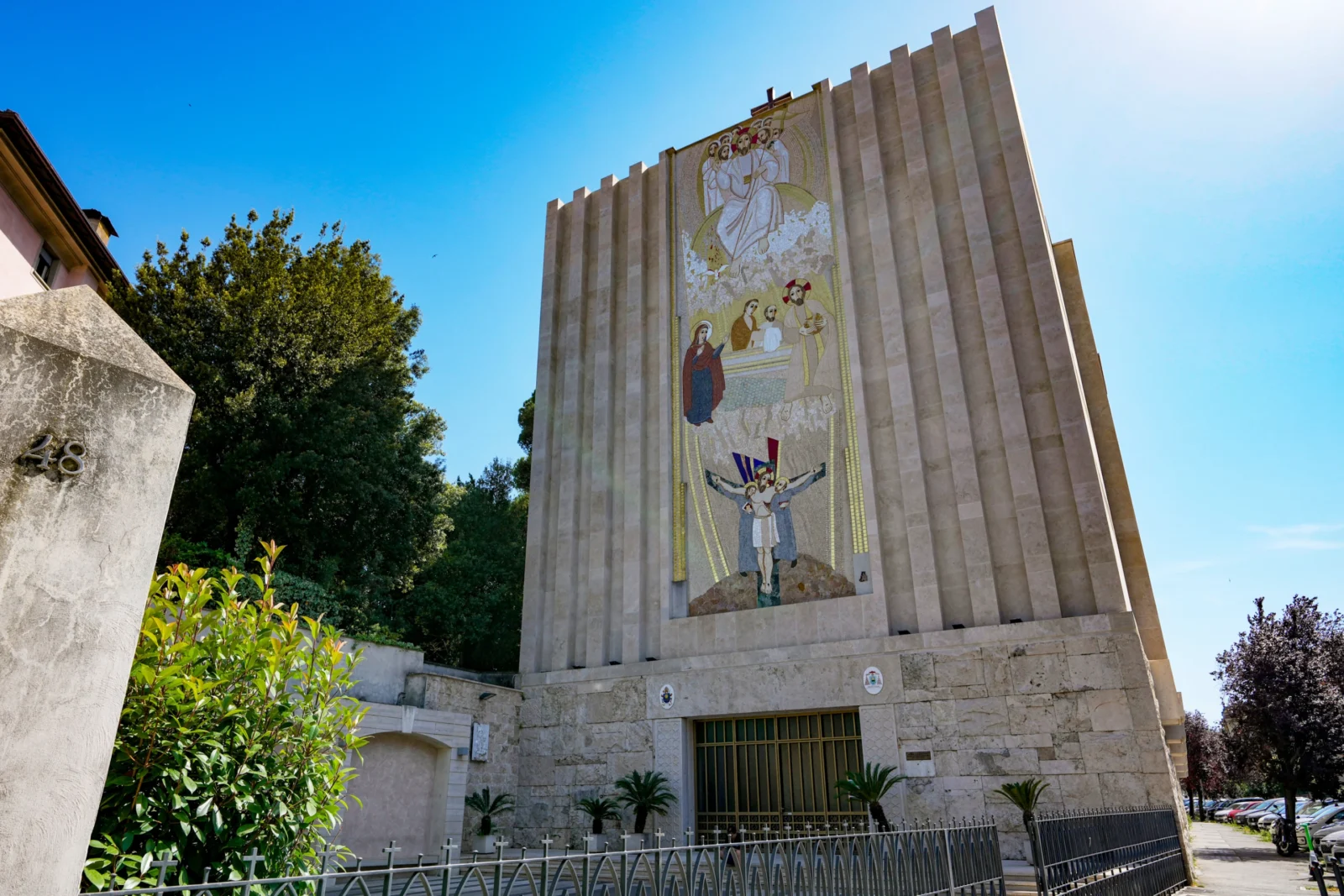
A mosaic by ex-Jesuit artist Marko Rupnik is seen on the main facade of the Church of Our Lady of the Canadian Martyrs, June 28, 2024, in Rome. (AP Photo/Andrew Medichini, File)
Nicole Winfield
July 24, 2026
ROME (AP) — The Vatican on Wednesday confirmed that a church trial against a famous ex-Jesuit priest accused of spiritual and sexual abuse of women is ongoing and defended the secrecy of the proceedings as necessary to guarantee the process.
An Italian blog reported Monday that an acquittal verdict had been reached in the case against the Rev. Marko Ivan Rupnik, a Slovenian artist whose mosaic designs decorate Vatican chapels and churches and basilicas around the world.
A statement from the Vatican press office said the report was “totally unfounded” and that judges were continuing to “examine documentation provided by the dioceses involved, the Jesuits, the parties concerned, and from the press.”
A scandal that calls into question Pope Francis
The Rupnik scandal exploded publicly in late 2022, when Italian blogs first reported claims by women and nuns of sexual, spiritual and psychological abuse by Rupnik dating back to the 1990s that had been consistently dismissed by the Catholic hierarchy.
The Vatican has long considered any sexual relations between a priest and an adult as sinful but consensual, and only criminalizes the behavior if the adult “habitually lacks the use of reason.”
Amid the #MeToo reckoning about adult abuse in the church, the Rupnik case has become one of the most sensitive matters for the Holy See, given suggestions that the priest was protected for over three decades by his Jesuit superiors and the Vatican hierarchy, up to and including the Jesuit Pope Francis.
The Jesuits admitted that Rupnik had been excommunicated briefly in 2020 for having committed one of the Catholic Church’s most serious crimes: using the confessional to absolve a woman with whom he had engaged in sexual activity.
But the Vatican later refused to prosecute claims of other women against him, arguing the allegations were too old and involved adult women, not minors, at the time of the alleged abuse.
The Jesuits expelled Rupnik from their order in 2023 and Francis, under pressure because of suggestions he had protected the priest, waived the statute of limitations on the older claims so that the Vatican could open a proper canonical trial.
Rupnik remains a priest and his supporters have denied he did anything wrong. Maria Campatelli, director of the Rome-based Aletti Center that Rupnik founded, has said the claims against him were “defamatory and unproven” and amounted to a form of media “lynching.”
A blog report sparks outcry by victims’ lawyer
The blog report prompted the lawyer for five women who have accused Rupnik to write a scathing critique of the Vatican’s in-house canonical system, in which victims have no right to information about the investigation.
Attorney Laura Sgro complained in a letter Tuesday to the head of the Vatican’s doctrine office, which appointed the external judges hearing the case, that no one had responded to two years of emails and requests for basic information about the status of the case.
She said the report that Rupnik had been absolved had greatly “discouraged and saddened” her clients, since they had never been interviewed by the tribunal about their claims.
In its statement Wednesday, the Vatican press office said no information can be shared about the proceedings to respect the process itself and avoid causing harm to all those involved.
“Should the panel determine that it requires further information, it will take the necessary steps on its own initiative to obtain it,” the statement said in a comment that suggested the victims might still be heard.
A legal system with limits
The statement also addressed Sgro’s complaints that she had received no information about the status of the case, as would be expected in a civil or criminal trial. It noted that a canonical trial concerns only matters within the church, is carried out in accordance with canon law and is not meant to replace civil or criminal justice outside the church.
In canonical abuse investigations, victims are mere third-party witnesses to their cases. They cannot participate in any of the secret proceedings, have no access to case files and no right to know if a canonical investigation has been started, much less its status.
Only due to a Francis reform in 2019 are victims allowed to know the ultimate outcome of their case, but nothing else.
Accused priests also have limited rights in canonical abuse trials and have long complained about secrecy and violations of basic rights afforded to defendants in civil or criminal processes outside the church.
The lack of rights owed to victims in particular has been repeatedly condemned by international commissions and inquests into clergy abuse that have found that the church’s judicial procedures retraumatize victims through their secrecy and opacity.
Part of the problem is that canon law was never meant to address the needs of abuse survivors or to help them heal. The official goal of the system is institution-centric: to restore justice, reform the offender and repair scandal.

No comments:
Post a Comment