Shipping Suspended on Ukraine’s Black Sea Corridor Due to Increased Attacks

Ukrainian officials reported that for the first time since 2023, there is no traffic on its shipping corridor on the Black Sea. Ship operators reportedly made the decision based on the increased attacks and deaths of seafarers since Russia and Ukraine escalated the attacks on shipping this summer.
Ukrainian government officials are emphasizing that the ports remain open and said it was the decision of individual ship operators. The government is working on a resolution, reported Agricultural Minister Taras Vysotskyi.
This action came after another vessel was struck on Wednesday and set ablaze off Odesa. Ukraine rescued 16 seafarers from the ship, but on Monday, it reported up to 10 were killed on another vessel that was attached. Russia’s Defense Ministry claimed it was attacking ships and ports being used to support Ukraine’s war effort.
Ukraine filed a request for the United Nations Security Council to immediately conduct an urgent investigation, asking for the meeting on July 27. It is calling Russia’s actions targeted terrorism and accuses Russia of endangering the world’s food supply.
Prosecutors in the Odesa region are asserting that Russia has struck 28 commercial ships in the past month. They said that 21 seafarers and port employees have been killed and others injured.
Ukraine established the safe corridor in August 2023 after a year-long effort set up by the United Nations and administered by Turkey collapsed. In the past three years, Ukraine shipped more than 197 million tonnes of cargo, according to the Ukrainian Seaport Authority. It said this included 117 million tonnes of grain. So far in 2026, more than 42 million tonnes of cargo have been handled at Ukraine’s seaports, including nearly 24 million tonnes of agricultural products. Volumes were reported to be running 20 percent ahead of last year.
President Volodymyr Zelenskiy has warned that Russia could further escalate the attacks. He repeated the earlier assertions by Russian President Vladimir Putin that Russia could cut off Ukraine from the sea.
Further adding to Ukraine’s challenges, Maersk announced on Wednesday that it was rerouting its feeder service to Romania from the fishing port at Chornomorsk. The move came after a Russian attack on the port of Chornomorsk.
S&P Global is reporting today that Ukrainian ag traders are looking to reroute their volumes to the western border and likely back onto the Danube. Earlier in the war, Ukraine had established shipping corridors from its ports on the Danube and inland to Constanta, Romania. S&P, however, points out that with the current low water levels and droughts in Europe, shipping on the Danube is more challenging. In addition, it notes the higher costs that would have to be borne by the Ukrainian farmers.
Russia is also feeling the pressure on shipping after weeks of attacks by Ukraine, primarily in the Sea of Azov. Reports had indicated that Russia had already restricted shipping on the Sea of Azov and in the Kerch Strait. Shippers reportedly had been redirecting cargo to Novorossiysk, but Reuters is reporting Russia has verbally communicated a new nighttime restriction on shipping from that port as well. Novorossiysk handles grain, metals, and containers, in addition to the large oil and energy terminals.
Before the war, Ukraine is reported to have accounted for around six percent of global wheat exports and more than 10 percent of corn exports. However, its capacity has declined by at least a third during the war. It is especially hard on less developed and third world countries, which had depended on Ukraine for basic food supplies.
Maersk Suspends Chornomorsk Service as Ukraine and Russia Increase Attacks

With both Russia and Ukraine intensifying attacks on the region’s ports and commercial shipping, Maersk on July 22 announced it was temporarily suspending its service to the port of Chornomorsk. It came after a deadly night, which saw several vessels reportedly struck, killing and injuring additional seafarers.
The major shipping companies had moved in 2024 and 2025 to restore container service to Ukraine after having stopped service at the start of the war. The carriers had been routing cargo through Romania and using barges on the Danube to maintain some services before the restoration of feeder service through Ukraine’s re-established shipping corridor.
Referencing the “current situation,” Maersk Ukraine issued the statement reporting that the vessel Medkon Mira (1,162 TEU) is diverting to Constanta, Romania. The Turkish-flagged feeder was coming from Port Said, Egypt, but will now land containers in Romania. Maersk is telling customers to contact it for rates for inland transportation between Ukraine and Romania, or that they can file a Change of Destination request for the cargo.
Ukrainian officials quickly emphasized that the port of Chornomorsk, however, remains open and is operating. This came despite reports that Russia overnight targeted the port. Russia’s Defense Ministry said it had targeted a dry cargo vessel unloading at the port as well as military cargo and fuel storage tanks. It also claimed attacks on Odesa, saying a dry cargo ship and a bulk carrier were hit, along with three warehouses it claimed were housing Ukrainian drones. Russia asserts it is attacking military targets and ships carrying military supplies.

Ukraine aiding in the evacuation of the crew from the Turkish bulker set on fire (State Border Guard Service)
Ukraine’s State Border Guard Service, however, asserted that Russia struck a bulk carrier named Golden Rose, a 9,900-dwt bulk carrier registered in Saint Kitts and Nevis that was set ablaze. The Border Guard detected a large fire after the vessel was struck in the stern and dispatched a rescue team. It reports 16 crewmembers, 14 from Egypt and two from Syria, were rescued without serious injury. Pictures, however, show the vessel fully engulfed in flames.
It comes after a series of Russian attacks on shipping, including striking the Golden Leo and killing 10 seafarers over the weekend. The vessel Venturo, registered in the Marshall Islands, was hit on July 17. Two ships were hit on July 14, killing the captain on one of the ships, and on July 13, Odesa was also struck.
Ukraine is continuing its strikes targeting, it says, the energy exports and supplies to occupied Crimea. In the past 48 hours, commanders said another 13 vessels were struck in the Sea of Azov. While Ukraine has not acknowledged casualties, Turkish officials reported that a vessel, Reyhan Sari (36,075 dwt), carrying coal from the Port of Taman in the Sea of Azov, was among those hit. They said one crewmember was killed and three others injured. They were taken ashore, and the vessel was able to continue its voyage.
Both sides appear to be continuing to escalate the attacks. Ukraine claims to have hit well over 150 vessels in the two weeks of its campaign. Reports, however, said that Russia also unleashed missile attacks on the ports of Odesa, Chornomorsk, and Mykolaiv. The attacks come as grain shipments were expected to increase as the growing season progresses, but now there are reports that shippers are considering moving exports back to the Danube based on the continuing attacks on the main ports.
Seafarer From Stricken LPG Carrier Gas Lisbon Dies of His Wounds
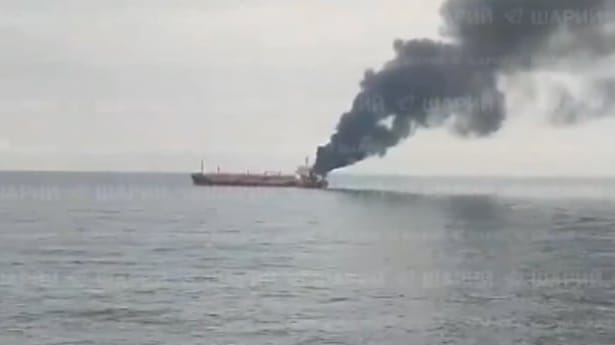
A sailor injured in the fire aboard the LPG carrier Gas Lisbon has died of his wounds, according to Romanian authorities.
Gas Lisbon was inbound for Ukraine last Sunday when she was likely struck by multiple Russian drones. The Turkish-owned vessel was arriving from Egypt and reporting her destination as Reni, Ukraine, with about 3,800 tonnes of propane on board.
On Sunday evening, while Gas Lisbon was about 20 nautical miles off the Romanian coast, the vessel reported an explosion and fire. The Romanian rescue vessels Apollo and Artemis were dispatched to meet her, and they retrieved 17 crewmembers from the ship, including three who were injured and required hospital treatment. Two of them had received severe burns covering about 10-15 percent of their bodies.
The survivors were brought ashore in Romania, and the injured were transferred to the Tulcea County Hospital for treatment. On Thursday, one of the victims - a 45-year-old Filipino sailor - died of complications related to burns to his respiratory tract. Two more of the injured survivors remain in intensive care, and are in stable condition, the hospital's director told RFI.
The fire aboard Gas Lisbon reportedly burned for an extended period after evacuation. Even as late as Wednesday, the ship was still too hot to board for inspection, according to AFP.
The attack on Gas Lisbon is just one part of a broader campaign of strikes and counterstrikes between Ukrainian and Russian forces in the Black Sea, which has turned deadly for seafarers. The intensity of Russian attacks on international shipping has risen enough that foreign-flag shipowners have effectively ceased port calls in the Odesa region, where Ukraine's main seaports are located - a major blow for Ukrainian agricultural exporters.

No comments:
Post a Comment