The “Great Transition Campaign” of the Boston-based Tellus Institute describes its mission as helping to “catalyze a global movement for systemic change” in the face of worldwide social and ecological crises. It invites leading figures to publish a lead essay on a particular topic of urgent concern, followed by responses that are then published as a global forum.
I contributed to the June forum, responding to the lead essay by Jeremy Brecher, “Society on Strike: A Last Defense Against Tyranny?”, a piece that draws from the report “Social Strikes: Can General Strikes, Mass Strikes, and People Power Uprisings Provide a Last Defense Against MAGA Tyranny?” published by the Labor Network for Sustainability and ZNetwork.org.
Jeremy Brecher’s call for a social strike is welcomed and timely. I support the call, and I thank him. Here I want to raise some concerns and place the discussion in the context of the historic conjuncture we face, focusing principally on the United States in the interests of brevity. Behind the shocking headlines shaking the world is the epochal crisis of global capitalism. It may be true, as Brecher says, that the MAGA offensive is an “assault on society,” but we need to be clear and specific on the nature of that assault and what has brought it about. Sustained resistance, including a mass strike if that can be pulled off, may be able to push back the fascist onslaught and restore momentarily the “democratic” status quo prior to Trumpism. But the problem cannot be reduced to the Trump regime, which is but a morbid symptom of a global capitalist system mired in unprecedented crisis.
If we don’t understand the nature of Trumpism and what brought it to power, we are going, at best, to be running in place. Unprecedented global social polarization and the extreme concentration of wealth on a world scale in the hands of the transnational capitalist class (TCC) over the past half century of capitalist globalization and neoliberalism has led to an economic totalitarianism that is now translating into a political totalitarianism of a new type. Trumpism in the United States constitutes an embryonic fascist state that is developing new alliances with repressive states around the world as the transnational elite continues to fracture.
Behind Trumpism is Project 2025, which sets out to culminate the neoliberal counterrevolution that the ruling classes have been waging now for nearly half a century. It calls for the liberation of capital from all constraints, including total deregulation and privatization, smashing what remains of the welfare state, compressing wages, attacking unions, reducing taxes on capital and the rich, disorganizing the working class through racism and xenophobia, and a radical restructuring of the capitalist state towards authoritarian and neofascist forms, including a vast expansion of the powers of the presidency and of the state apparatus of repression and surveillance. The Trump regime has been faithfully implementing Project 2025 come hell or high water.
But who is behind Project 2025? Here we find the most violent and reactionary faction within the TCC. As I showed in a recent article in The Philosophical Salon, there is a new hegemonic complex of transnational capital that brings together the giant tech corporations with transnational finance capital and the military-industrial-repression complex: a fusion of Silicon Valley, the Pentagon, and Wall Street. Increasingly dependent on state contracts, subsidies, deregulation, and other state policies that establish the conditions for tech, financial, and military expansion, the hegemonic complex of capital is coming to embrace the embryonic fascist state in its Trumpist form. A classic sign of fascism is precisely the fusion of the leading fractions of capital with repressive and reactionary political power in the state, legitimated by a millenarian discourse, hyper-nationalism, racism, xenophobia, militarism, and extreme masculinization, alongside a fascist mobilization in civil society.
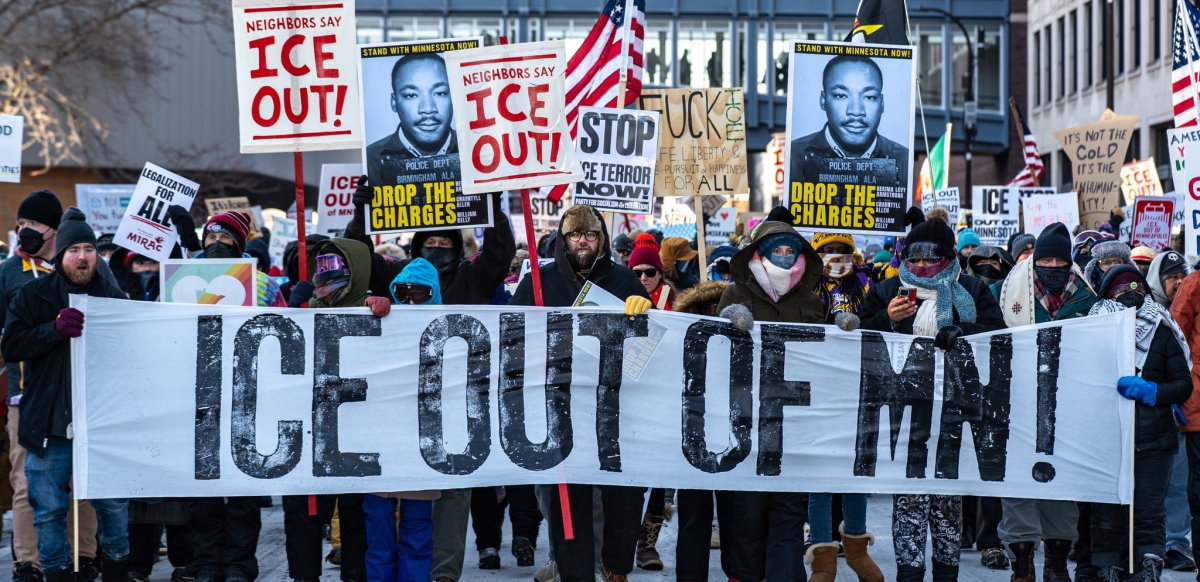
Within the United States, Immigration and Customs Enforcement (ICE) is emerging as a fascist paramilitary force: a modern iteration of the Brownshirts that serve as a bridge between the development of the fascist state and a fascist reorganization of civil society. ICE aggression, beyond an assault on immigrant workers, is aimed at normalizing paramilitary terror. But crucial to note is that the war on immigrants, as well as the false “war on drugs,” is an AI war waged through the new digital technologies as Silicon Valley pivots towards war and repression, backed by transnational finance capital and fused with military-industrial-repression capital servicing the global police state.
This emergent capital power bloc is at the center of this worldwide maelstrom as global capitalism enters a deadly new phase. The tech billionaires, financial billionaires, and the lords of war are becoming global geopolitical actors. They are wielding their enormous structural power through Global Trumpism, developing new modalities of control over civil society and seeking alternative forms of legitimacy founded on instability and chaos that facilitates control over countries and resources as global capitalism spirals into deeper crisis. This is a political crisis of state legitimacy, capitalist hegemony, and geopolitical confrontation. But to understand Global Trumpism, we must identify the structural dimension at the center of the crisis: that of overaccumulation, chronic stagnation, and a declining rate of profit.
The structural crisis can only be overcome by violently cracking open new spaces for accumulation, by transferring the cost of the crisis to the working and popular classes through wage compression and austerity, and by aligning states and political systems worldwide with the agenda of the new capital power bloc. Led by the new hegemonic capital complex, the TCC has unleashed a predatory round of digitally driven expansion around the world, pivoting towards more savage forms of extractivist accumulation as it seizes land, energy, and mineral resources to fuel the demands of AI technology and data centers. Global Trumpism is the instrument of the worldwide wave of violent capitalist expansion.
This is the big picture behind the global firestorm, from Venezuela to Iran, from Washington’s Greenland grab to ICE terrorism in US cities. It may appear on the surface that Trump operates on the basis of his own whim and psychopathy, but that is an illusion. The new hegemonic capital complex now relies on the fascist state to smash open access to resources, control restive populations, and adopt the deregulatory and other policies necessary for expansion. Savage global inequalities can only be contained through violent containment and transnational systems of mass social control. Democracy is an obstacle to pushing forward the agenda of the power bloc. Trump and his cronies get to use the state as a machine for their personal accumulation through theft, fraud, bribery, and corruption. Diagnosed with narcissistic personality disorder, Trump has his ego massaged by a layer of sycophants who also serve as intermediaries between capital and the regime.
This is for the larger backdrop to Brecher’s call for a social strike. But Brecher seems to suggest that the challenge we face now is how to restore the pre-Trump status quo. If a mass strike were simply to restore the Democrats, where would that lead us? The Trump regime may have upped the ante, but the crisis and, in tandem with it, the fascist project have been percolating since the turn of the century. It is the Democratic Party that delivered us to Trumpism. It abandoned the multiethnic, multinational working class many years ago. Since the Clinton years, it has been a party of neoliberalism, of Wall Street billionaires, of the military-industrial complex, and of war. Since 1948, it has been a party supporting Zionist settler colonialism, and it sponsored the first year of the genocide in Gaza.
The US working class has experienced an ongoing destabilization of its living conditions over this past half-century of capitalist globalization and neoliberalism. Trumpism is in large part the fascist response to this social and economic crisis of the working class and to the crisis of state legitimacy that this socioeconomic crisis produced. Trump managed to get elected a second time by putting forth a populist discourse that spoke to rising socioeconomic insecurity and mass social anxiety. He manipulated mass discontent with this populist, racist, nationalist, and neo-fascist discourse, with false promises to solve the socioeconomic problems of the masses. He turned immigrants into scapegoats and harvested the massive discontent with the Democrats and the establishment.
Brecher refers to the “leadership failure of the Democratic Party.” What accounts for this failure? The mainstream of the party—which remains firmly in control despite progressive challenges such as those of New York City mayor Zohran Mamdani—represents the same billionaire corporate and financial oligarchy as do the Republicans, including the emerging capital power complex. It is now trying to walk a tightrope: how to oppose Trump without losing control to a mass mobilization from below? Democratic Party–aligned forces have been the driving force behind organizing No Kings Day protests (although note: insurgent grassroots forces are also mobilizing for these protests). Five million people, myself included, participated in the first No Kings protest, in June 2025. Seven million participated in the second, myself included, in October 2025. By the time this comment is posted, we will have had a third No Kings protest (scheduled for March 28).
If the Democrats were really interested in bringing down Trumpism, why have they not attempted to organize rolling protests and to escalate resistance? The answer for me seems clear: the Democrats are more fearful of mass working-class mobilization than they are of Trumpism. Let us recall that twice, first in 2016 and then in 2020, the most popular Democratic presidential candidate in decades, Bernie Sanders, was on track to win the Party’s nomination until the party machinery violated its own internal rules and managed to undercut his candidacy. That machinery prefers Trumpism to a radical anti-corporate, working-class insurgency from below.
What comes after forcing Trump out? We need a mass strike not just against Trumpism, but for a popular agenda against neoliberalism, against the power of the billionaire class and the capital complex, against war and genocide, and for measures to radically redistribute wealth downward, meet urgent social needs (health care, housing, etc.), and rebuild shattered communities. Brecher recognizes that the sacrifice associated with a mass uprising cannot be for one or another political party. I agree. He goes on to say it would be in defense of democracy, of a government “of the people, by the people, and for the people.” It is not clear to me when we have ever had such a government in the United States, much less why this should be the sole organizing demand for a mass strike, that we do not just end up handing power back to a different sector of the political elite.
As Brecher notes, we must draw on the full panoply of forms of struggle aimed at self-defense and as disrupting the system, such as strikes, boycotts, commercial shutdowns, blockades, occupations, and civil disobedience. But no such mobilization will come about without broad and sustained enough participation to assure that the end result is not simply to return to pre-Trump “normalcy” rather than to a program of radical redistributive reform. A call to simply “establish or reestablish democracy” will not win over enough of the working class to such an uprising. And moreover, reestablishing the type of pre-Trump “democracy” we had will only buy us time only to have us return to a Trumpism without Trump.
Beyond a small but significant core of diehard racists and nativists, the MAGA base is made up of working-class people who face the same social and economic destabilization as the rest of the working class. They are not our enemy and must be won over not to the Democratic Party but to a working-class movement from below, and not by abstractions but by putting forth working-class social and economic demands.
Trumpism is the US variant of the same phenomenon we have seen in Europe, Latin America, and elsewhere with the rise of a populist and neo-fascist far right as the social fabric collapses and as the post–WWII international order crumbles. The hardships generated by decades of capitalist globalization and transnational class warfare from above combined with the failures of the traditional left have made working classes susceptible to the message of right-wing populism and neo-fascism. We cannot push back against the beast of global capitalism and its madmen without a global working-class project. Such projects emerge from the heat of struggle and must speak to the material reality of mass deprivation and insecurity, not through manipulation but by putting forth a viable alternative to the rule of capital through mafioso states and global gangsterism.
Lastly, let us recall that at times of crisis history seems to accelerate, contradictions ripen, and what seemed most unlikely, even impossible, may appear on the horizon of the possible. The situation in the United States and globally is very fluid and could go in many different directions. One need not be a Leninist to appreciate Lenin’s observation that “there are decades when nothing happens and there are weeks when decades happen.” We are very far from the overthrow of global capitalism. Right now, our most urgent concern must be to survive, to overthrow the Trump regime, and to prevent World War III. But we will not achieve these things without building up a correlation of social, political, and class forces more favorable to the working and popular classes and more able to challenge the power of capital. Social or mass strikes of the kind that Jeremy Brecher is calling for will be crucial to this effort.

No comments:
Post a Comment