Two Tankers Attacked: What Next in the Bab el Mandeb?
The Houthis are claiming attacks on two tankers in the Red Sea, furthering their threat to impose by force a blockade on Saudi ships or ships using Saudi ports. The Houthi threat is global in character, and not restricted to the Red Sea or Gulf of Aden.
The two Saudi-flagged tankers targeted by the Houthis are the VLCC Layla (IMO 9336098), and the 250-meter products tanker Encelia (IMO 9240172). The crew of the Layla, which had loaded at Yanbu, reported it was fighting a fire on board, and its present position is not known. Post the reported strike, the Encelia is at anchor off Jizan, and a strike on the vessel and its current condition have not been confirmed.
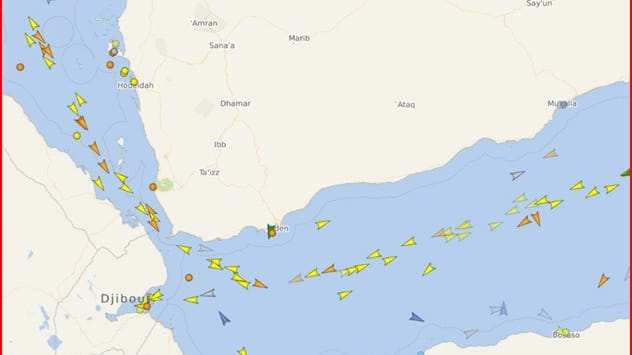
Notwithstanding the reported attacks, traffic still seems to be flowing at normal levels through the Bab el Mandeb, as seen at midday on July 23. The National carried a report that two Sinopec-chartered VLCC tankers carrying 4 million barrels of Saudi crude loaded at Yanbu to China, were still proceeding on passage through the Bab El Mandeb. Both are displaying their destinations on AIS as CHINA CREW & OWNER. The Singapore-flagged Xin Long Yang (IMO 9761463) is now through to the Gulf of Aden. The Hong Kong-flagged Cosnew Lake (IMO 9804289) was underway at 11 knots and was passing through the Bab el Mandeb at midday on July 23.
Attention now turns to how flag-nations and shipping owners will respond.
At the end of her visit to Operation Aspides in Djibouti, EU High Representative Kaja Kallas noted that “the situation in the Red Sea is once again deteriorating, and the missile threat by the Houthis for international shipping persists.” She also noted that forces currently allocated to Operation Aspides, the EU operation established in February 2024 as a response to Houthi attacks then on shipping, were insufficient for the task as it has evolved. She identified that spare naval capacity held in the Arabian Sea for the Coalition of the Willing might be a source of reinforcement. But it remains to be seen when and if such reinforcement arrives; EU decision–making processes can be very extended, and some EU nations will respond to the increased risk by withdrawing rather than increasing support.
Donald Trump has said that the United States “will take care of things” if the Houthis attack shipping, which they have now done. It remains to be seen, however, what capacity Central Command can spare from its campaign against Iran to re-open the Yemeni front.
Israel has in recent weeks tried to keep out of further entanglements in the Gulf region, to better focus on immediate problems closer to home in Lebanon and Gaza. Israel did not respond when the Houthis fired nuisance missiles and drones at Israel in the preceding months, confining itself to shooting down the incoming threats. A closure of the Bab el Mandeb might, however, elevate Israel’s concerns, and any strikes it might mount would be particularly effective, as the Israeli intelligence picture of Houthi dispositions is now much improved.
The biggest question remains, however, the Saudi response – particularly as the Houthi threat is specifically related to Saudi Arabia, and the true cause of the Houthi upset – the lack of progress it has made in negotiations to end the civil war in Yemen which has been rumbling on since 2014, and the prospect that if the Saudis are put under a bit more pressure, they might still settle the negotiations by offering the Houthis $14 billion in cash. While the Houthis accuse the Saudis of being behind the control of access to Houthi ports and airports – and of being the party which is empowered to lift these sanctions – the reality is that the Saudis are allowing large volumes of cargo under UN auspices to reach the Houthi-controlled ports of Hodeida, Ras Isa and Salif. The Saudi Ministry of Foreign Affairs reports that under its watchful eye more than 300 ships have off-loaded at these ports since the beginning of 2026. The Houthi action therefore threatens this continued flow of essential goods into the hunger-stricken areas of northern Yemen which it controls, with most of these cargos internationally-donated food aid.
The Houthis also risk triggering a rather different, and very much upgraded military response from the Saudis. The Saudi armed forces have spent the years of the ceasefire since March 2022 learning the lessons of their inconclusive clashes with the Houthis, and have in the meantime considerably improved their intelligence collection and the precision of their strike capability. In particular, they have improved the quality in particular of their naval efforts in the Red Sea, deploying their new Navantia-built corvettes. The Houthis may therefore get more than they bargained for by breaching the maritime ceasefire in the Red Sea and Gulf of Aden.
More Ships U-Turn to Avoid Houthi Threats

Further to vessels suspected of having reversed course on July 21 to avoid potential Houthi hostile action, more ships have been identified doing so on July 22.
Vanguard has identified six ships that may have U-turned overnight on July 21/22, who may be exercising discretion and switching to alternative orders, perhaps without commercial penalty:
- The Marshall Islands-flagged car carrier Liu Jiang Kou (IMO 9991795), now sailing East on the Maritime Transit Security Corridor (MTSC) exiting the Gulf of Aden.
- Russian-flagged products tanker Trust (IMO 9382798), sanctioned by the EU, UK and US (OFAC), and now at anchor off Jeddah.
- Singapore-flagged products tanker Navig8 Express (IMO 9976874), which appears to have reversed course and is now heading back to Yanbu.
- Liberia-flagged tanker Mica (IMO 9399935), which was on its way from Port Suez to Sohar, but now appears to have stopped off Jizan.
- Maltese-flagged Suezmax Agios Gerasimos (IMO 9693056), now heading for the head of the Sumed Pipeline at Ain Sukhna.
- Liberia-flagged Suezmax Amazon (IMO 9476654), is now heading North for the Suez Canal.
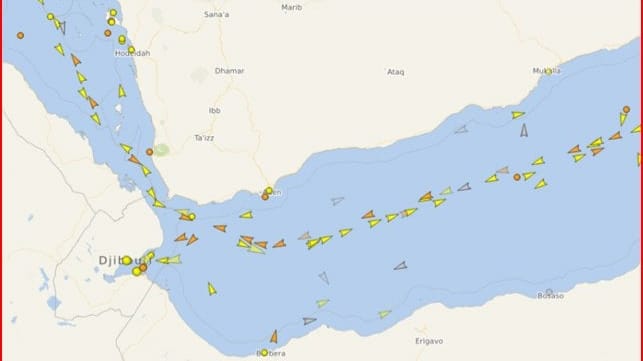
Traffic proceeding along the MTSC looks similar to yesterday, and there are still, as of midday on July 22, some 22 ships still underway, with AIS turned on, in the waters off the Houthi-held coastline in the Red Sea.
The Houthi Humanitarian Operations Coordination Center (HOCC) website has still not posted any warnings to mariners in connection with the blockade announced by the Houthi military spokesman, Brigadier Yahya Sare’e.

Heavy traffic on the Maritime Security Transit Corridor, July 21 (VesselFinder)

Heavy traffic on the Maritime Security Transit Corridor, July 22 (VesselFinder)
The British and U.S. governments have issued stern notes of disapproval concerning the Houthi intention to implement a blockade. While the UK has so far not taken any apparent concrete action, the United States has undertaken to respond if the Houthis physically interfere with shipping. The website of Operation Aspides, the EU operation established in February 2024 as a defensive operation in response to repeated Houthi attacks on international shipping, has so far not registered. Aspides recently marked 29 months since its launch, highlighting that it has supported more than 2,200 merchant vessels. It frequently posts photos of the warships assigned to the operation sailing with merchant ships passing through the Red Sea region.
The new Greek commander of Operation Aspides, Rear Admiral Vasileios Gryparis spent July 16 hosting the EU High Representative Kaja Kallas on board the Italian Carlo Bergamini Class frigate Bergamini (F590) off Djibouti, and the latest posting on the Aspides website focuses on the celebration of Belgian National Day on July 21. However, Reuters reports that it has seen an EUNAVFOR Aspides advisory recommending that merchant vessels linked to Israeli, U.S. or Saudi interests avoid transiting the Red Sea and Gulf of Aden until the threat level decreases. There is no indication that the EU is yet thinking of adjusting the force committed to Operation Aspides.
Houthi Blockade of Saudi Shipping Begins to Bite
The first indications have been seen that the Houthi blockade declared against ships traveling to Saudi ports is beginning to have an impact. As yet, however, there have been no known Houthi attacks on shipping in the Red Sea, Gulf of Aden, or elsewhere.
Three tankers are believed to have altered their intended destinations, although none of the ships are believed to have been threatened directly.
The Singapore-flagged tanker, 333-meter (1,092-foot) VLCC Xin Long Yang (IMO 9761463), and the Liberia-flagged 250-meter (820-foot) tanker Rodos (IMO 1024948) had both loaded crude at Saudi Arabia’s Yanbu terminal, and were proceeding in a southerly direction down the Red Sea, before reversing course. The Xin Long Yang is still indicating its destination on AIS as China, arriving on August 10, whereas the Rodos is now declaring that its destination is Port Suez.
To get through the Suez Canal, a VLCC has to offload about half its cargo at the Ain Sukhna head of the Sumed Pipeline, travel through the Suez Canal lightly laden, and reload the balance of its cargo at the northern end of the Sumed Pipeline at Sidi Kerir.
Also changing course, according to Vanguard, has been the Hong Kong-flagged 333-meter (1,092-foot) VLCC New Prime (IMO 9799123), which had been heading empty for Yanbu. While still showing up on AIS as destined for the Suez Canal, she made a U-turn off Salalah and is now apparently heading East.
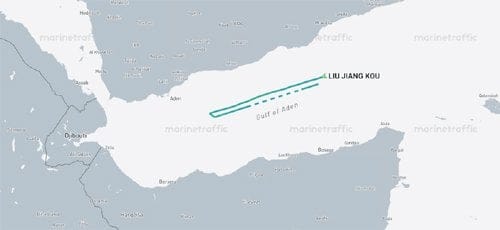
Chinese car carrier turning around after the Houthi threat (courtesy of Marine Traffic)
Lloyd's List Intelligence also spotted that a Chinese vehicle carrier, Liu Jiang Kou (19,000 dwt), made a U-turn in the Gulf of Aden. The vessel, operated by COSCO Shipping, turned away from the proceeding toward the Red Sea while it was still in the Gulf of Aden. The change is believed to be in response to the threat issued by the Houthis on July 20.
The course alterations follow generic email warnings sent to multiple shipping companies by the Houthi Humanitarian Operations Coordination Center (HOCC), the entity that in the past has presented itself as the communications medium with merchant shipping venturing into Yemeni waters. The HOCC website itself, unlike in the past, is still not showing the warning that has been sent by email to individual shipping companies.
In a non-statistical appraisal of the sea traffic using the IMO-delineated Maritime Transit Security Corridor (MTSC) through the Gulf of Aden and lower Red Sea, traffic using the MTSC, if anything, seems to be a bit heavier on July 21 than it was five days ago on July 16.
The Houthi blockade has been imposed in part to help out the IRGC who are facing increased pressure and a deteriorating situation in the Strait of Hormuz area, but primarily because of the impasse over flights into and out of the country generated by the blocking of a return flight from Tehran, bringing mourners home from the funeral of the late Supreme Leader Ali Khamenei; the flight to Sana’a instead had to land at Hodeida. In turn, the argument over the blockade of Houthi-controlled areas of Yemen is part of the stalled negotiations between the Houthis, the Saudis, and the Internationally Recognized Government of Yemen over a final concluding settlement of the civil war, which began in 2014. The Houthis are holding out in the negotiations for a $13 billion pay-off from the Saudis.

No comments:
Post a Comment