The Sordid Politics of Defense Spending

Photograph by Nathaniel St. Clair
The mainstream media argues that increased spending on defense in peacetime is predicated on military necessity and military objectives. In actual fact, the major increases in defense spending that I have studied relate to political and economic requirements, having very little to do with military requirements.
I was on the faculty of the National War College in 1998, when key congressional Republicans and the Chairman of the Joint Chiefs of Staff, General Hugh Shelton, invited President Bill Clinton to the college for a “closed-door briefing” on new requirements for military procurement and military pay. Over the previous six years, Clinton had been an easy mark for the Pentagon because he typically yielded to the political right-wing leaders of the Congress (e.g., Rep. Newt Gingrich and Senator Jesse Helms) as well as to the military brass on defense spending and on opposition to such important arms control and disarmament issues as the Comprehensive Nuclear Test Ban Treaty and the Anti-Personnel Mine Ban Convention.
Clinton was particularly vulnerable regarding military demands in 1998 because of his sexual relationship with Monica Lewinsky, particularly his many lies about that relationship. Clinton was never a favorite among my military students at the war college. They were particularly livid about his sexual escapades and his deceit because they knew that similar behavior on their part would compromise and presumably end their military careers.
It was no surprise to me that one week after the meeting at Fort Lesley J. McNair, Secretary of Defense William Cohen signaled there would be a significant increase in defense spending and that the “men and women of our armed forces will have the resources they need to do their jobs.” (Stephen Lee Myers, “Clinton is Seeking More Money for Military Readiness,” The New York Times, September 23, 1998.)
There was a greater political scandal regarding defense spending in the 1980s, when there was no threat to U.S. national security. President Ronald Reagan was seeking the largest peacetime increase in defense spending at that time and wanted the Central Intelligence Agency to produce the intelligence to support such an increase. I was a senior political analyst on the Soviet Union at that time, and spent many hours arguing with CIA director William Casey and deputy director of intelligence Robert Gates that intelligence was being politicized to support such defense spending at a time when our only threat, the Soviet Union, was in political, economic and even military decline. It was my lack of success in those debates that led me to end a 25-year career at the CIA and to join the faculty of the NWC.
Twenty years later, Gates turned up as Secretary of Defense for both Presidents George W. Bush and Barack Obama, and took advantage of additional opportunities to support unnecessary wars in Iraq and Afghanistan in order to demand greater defense spending. Gates has rebranded himself more recently as a defender of U.S. “soft power,” but over the years as an intelligence professional and a Pentagon chieftain, he had used every opportunity to argue for greater military power and greater military spending. As secretary in both administrations, he briefed Congress on the need for efficiencies but regularly increased the size of the Army and overemphasized the challenge of irregular warfare. Secretary of Defense Gates was known for crushing the alternative views of senior officers that would have led to lighter, more mobile weapons systems that would have occasioned savings in defense spending.
Once again, we are facing exorbitant increases in defense spending (e.g., total spending of $1.5 trillion) and are engaging in an exaggeration of the national security challenges for justification. U.S. spending on defense would exceed the spending of all countries, and would weaken any U.S. efforts to supply the funding for needed social and economic reforms.
Political and military analysts are exaggerating the threat of the Sino-Russian relationship as well as the possible likelihood of a Russian threat against a NATO country or a Chinese invasion of Taiwan. These possible scenarios are primarily “marketing devices” for increased military spending. Meanwhile, there are serious deficits regarding the management of the Pentagon under Secretary of Defense Pete Hegseth; a strategic deficit in assessing the near-term defense challenges; and the unwillingness of Congress to apply rigid standards of oversight regarding defense spending.
Trump and Hegseth are Demanding Big Bucks for Their Wars
Photograph Source: The White House – Public Domain
Trump is asking for $1,500,000 million for the military for next year. That’s close to $600 billion (adjusted for inflation) more than we were spending on the military in fiscal year 2025, before Trump took office.
This increase is huge by any measure. It comes to around $4,600 per household. It is around 8 percent of the total budget. This spending request dwarfs sums that are often the subject of major debates in Washington.
For example, last year Democrats pushed to have the enhanced subsidies in the Affordable Care Act exchanges extended. This would have cost $30 billion a year, one twentieth of what Trump and Hegseth are demanding.
People may recall Elon Musk gleefully putting the USAID into the “wood chipper” last spring. While ending this program is expected to lead to 4 million additional deaths over the next four years, it only saved around $35 billion a year. That is less than 6 percent of the increase in military spending that Trump is asking for.
The annual cost of extending the enhanced child tax credit, which cut child poverty in half, was around $100 billion a year, less than one-fifth of Trump’s proposed increase. And the annual appropriation for the Corporation for Public Broadcasting was $550 million, less than one thousandth of the additional spending for the military that Trump is demanding. (It’s in the chart, just small to see.)
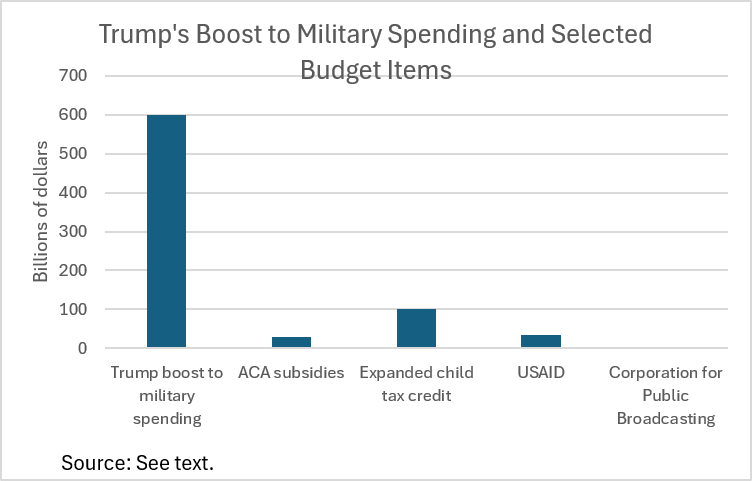
People need to know that Trump’s military spending request is really big money, compared to almost anything else that ever comes up for public debate for Congress. Unfortunately, because of incompetent or corrupt budget reporting, few news accounts make any effort to put these huge numbers in a context that makes them understandable for their audience. As a result, most people will probably have little idea of what is at stake with this military request.
Any self-proclaimed deficit hawk who is not all hair on fire about Trump’s budget demand is a lying hypocrite who only uses concerns about the deficit to argue against programs they don’t like. We got along fine with the former level of military spending, which almost everyone, including Donald Trump in his first term, considered adequate.
Is the argument that in just 18 months in office, Trump has made the world so much less safe that we have to increase the defense budget by two-thirds? Most of us knew that making our former allies into enemies was not a good idea, but Trump is placing a huge price tag on this mistake. And remember, this is Trump’s own number, not his critics’.
This first appeared on Dean Baker’s Beat the Press blog.

No comments:
Post a Comment