Marine Insurers May Ban Payments to Iran for Hormuz Transits
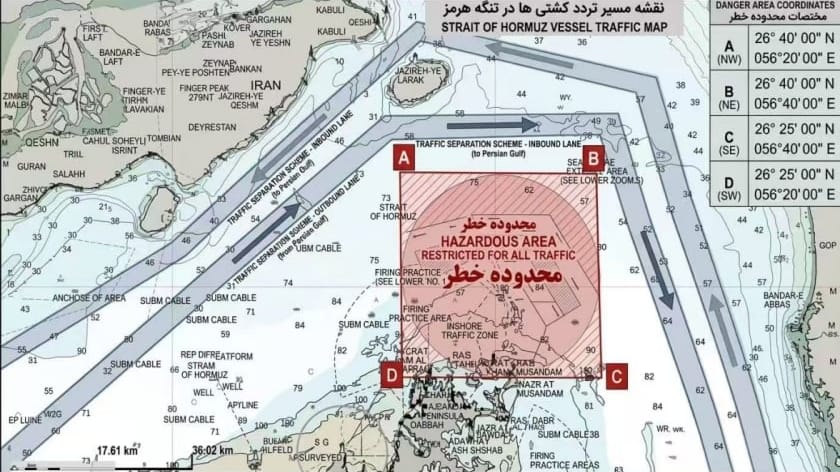
Getting insured for a Strait of Hormuz transit is getting more expensive, and there are more strings attached to staying insured as well. Underwriters at Lloyd's Market Association have come up with an additional, optional clause that can be inserted into policies for passages through the waterway; it allows the insurer to cancel the policy if it turns out that the shipowner has paid a toll to Iran. Meant to protect the insurer from compliance risks, in future it could prevent neutral shipowners from using the route through Iranian waters, where Iran does not attack shipping.
For the insurer, the hazard is clear. The Islamic Revolutionary Guard Corps Navy oversees Iran's section of the strait, and the IRGC is a U.S.-designated foreign terrorist organization. The administrative transactions for passage are handled through Iran's so-called Persian Gulf Strait Authority (PGSA), not itself part of the IRGC but still a division of Iran's government.
Iran is not currently charging for transits of the strait, but its leaders have expressed a clear interest in turning the waterway's operations into a revenue stream in the long term. As tolling is questionably legal in an international strait, the charges could be presented as a "fee" structure, linked to some form of services rendered for safe transits. At least one prominent shipowner has suggested that it would be a good business decision to accept Iranian control and simply pay the fee as a cost of operations.
Payments to the PGSA might be rendered in bitcoin or yuan to keep a low profile, but the funds would ultimately end in the hands of the Iranian banking system and government - and quite possibly the IRGC. Any payment would be a U.S. sanctions violation, and might have other compliance ramifications as well.
For an insurer, this would be a reputational and legal risk. A spokesperson for the LMA told Insurance Business that the new tolling clause sets out "a clear contractual position for insurers and insureds" on the acceptability of such payments. If they are discovered, the ship's cover would be canceled.
"The LMA has developed the clause in response to concerns about applicable sanctions and terrorism legislation arising where insurers become aware, or through appropriate due diligence ought reasonably to become aware, that any financial or non-financial payment has been given by the insured," the association said in a statement. ""Under the clause, insurers will not cover any such payment. In addition, where a payment has been made, cover for the relevant vessel will cease due to the risk of a breach of sanctions and/or terrorism legislation in the US, UK or EU."
Meanwhile, costs of cover are escalating. Reuters reports war risk premiums for Gulf coverage at 3 percent of hull value in early July, and after more recent attacks, some sources indicated that pricing would likely be quoted at 5 percent or more. Prices in this range are a deterrent for trade, as they raise the cost of shipping and can effectively price some commodity trades out of the market.
Per Insurance Business, in the southern sector of the Red Sea - where Houthi rebels have initiated a campaign against Saudi shipping - premiums have risen to 1 percent of hull value. This is north of $1 million per transit for a newer VLCC.
The costs are human, as well. On Thursday, IMO Secretary General Arsenio Dominguez asked vessel operators to put the safety of crewmembers at the forefront when weighing the business decision to transit through conflict zones.
"Seafarers are civilians performing essential work that sustains economies and communities worldwide.?Ship operators must?thoroughly?assess risks?before?transiting the?region.?Seafarers?must never be placed in harm’s way or targeted in situations of conflict or instability," Dominguez said.
Two Tankers Spill Oil off the Coast of Iran
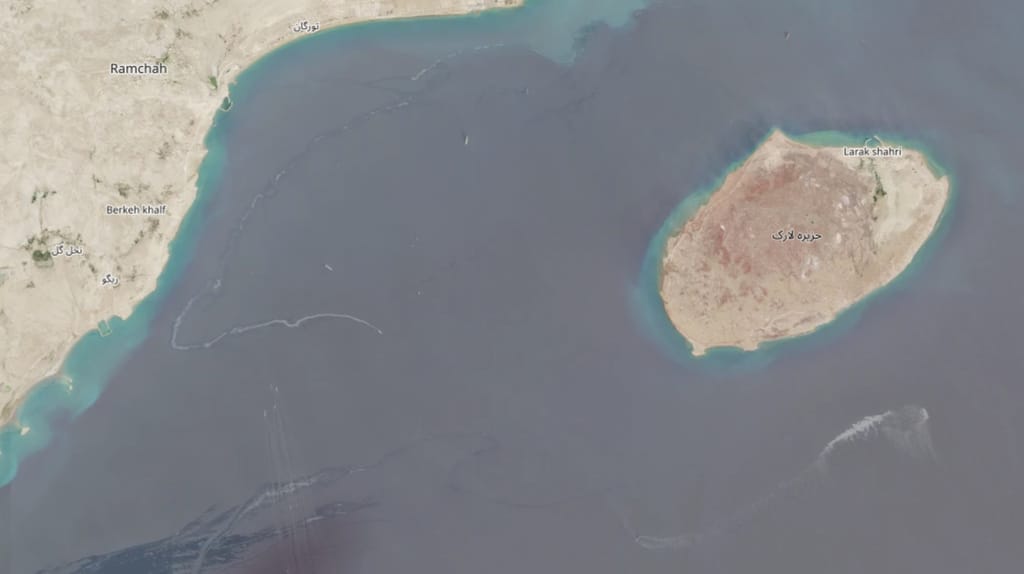
Two tankers off the coast of Larak Island are spilling oil into the waterway, according to maritime data consultancy WindWard.
One of the leaks was identified previously, and comes from the Greek-owned tanker Kavomaleas. It was hit in an IRGC attack on the south side of the strait, then captured and towed into Iranian waters.
The other leak is linked to an AIS-dark tanker, name unknown, which appears to have been in the same location since May, according to the consultancy. Both of the two oil slicks appear to be drifting towards Larak and Qeshm.
The spills are among the first significant oil releases linked to shipboard sources in the Hormuz conflict. Though Iran and the U.S. have both launched multiple attacks since the start of active hostilities, there have been no sinkings of full-size, oceangoing merchant vessels in civilian service. Many of the attacks have struck the superstructure, stack or engine room, limiting the potential for a full-scale spill.
Traffic continues to move at a low rate through the Strait of Hormuz, despite the risks. Windward identified 19 vessels moving without AIS in the waterway - a large cluster in the Iranian half of the strait, and a smaller number that SAR satellite imaging spotted in the southern, U.S.-protected lane along the Omani coast.
More strikes on shipping appear likely in the days ahead, part of the pattern of retaliatory exchanges between the U.S. and Iran.
The large-scale U.S. Air Force transport plane airbridge is back in motion between Europe and U.S.-linked air bases in the Mideast, typically a logistical step taken to prepare for escalating military operations. A larger series of American airstrikes could occur soon, President Donald Trump telegraphed in a conversation with Axios' Barak Ravid, who speaks frequently with the president.
"I am considering a massive attack. Bigger than ever before. I am close to making a decision. We are all set for it," Trump told Ravid.
Dubai and DP World Confirm Plans to Expand Fujairah Port to Bypass Hormuz

DP World, the government-controlled ports and logistics giant, confirmed it is pushing forward with a plan to build a new port for Dubai that will bypass the Strait of Hormuz and increase the UAE’s role in shipping across the region. The new terminals will be placed at Fujairah located on the Gulf of Oman with construction requiring just two years for the first phase of the operation.
Rumors had been circulating that plans were being accelerated for a new container and general cargo operation that would be outside the Gulf and could bypass the volatile Strait of Hormuz. Similar efforts have already been announced to expand oil pipelines to reach the Gulf of Oman coast.
DP World and Fujairah Ports Authority reached agreement in principle under a new 50-year concession to develop the new terminals on the UAE’s east coast. The Al Rugaylat terminal will handle containers and in addition there will be a new multi-purpose cargo terminal, the Dubba General Cargo terminal.
"The partnership with DP World marks an important milestone in Fujairah's continued development as one of the region's most important maritime gateways,” said Sheikh Saleh Bin Mohamed Al Sharqi, Chairman, Fujairah Ports Authority. They declined to reveal the financial investment to create the new port, but reports have said a high priority has been placed on the develop which expands on Fujairah and will provide a critical alternate route.
DP World says the project will establish a new deep-water trade gateway on the UAE's east coast, capable of handling the latest generation of Ultra Large Container Vessels. Al Rugaylat is designed to handle up to 2.5 million TEUs annually, alongside 1.7 million tonnes of general cargo and 190,000 Car Equivalent Units (CEUs), while Dibba will add up to 3.6 million tonnes of annual general cargo capacity.
Once operational, the development will increase DP World's total container handling capacity in the UAE from 19.4 million TEUs to almost 22 million TEUs, while significantly expanding general cargo and Ro-Ro capability.
DP World said it will position Fujairah to become “a leading center for maritime services.” They highlight it will be connected to the UAE’s primary port, Jebel Ali, through DP World’s inland logistics network. They said it will enable them to move cargo more efficiently between ports, logistics hubs and end markets.
Construction will be in phases and is expected to take approximately 24 to 30 months once it starts.
Jebel Ali has long been considered the flagship of the operations and the region. It is built on the world's largest man-made harbor with 67 berths and a capacity to handle over 22 million TEU annually. Fujairah, by comparison, is mostly an oil terminal and general port with reports it currently handles just over 720,000 TEU annually.

No comments:
Post a Comment