Spain’s Balenciaga Shipyard Restarts Work Under AD Ports Ownership
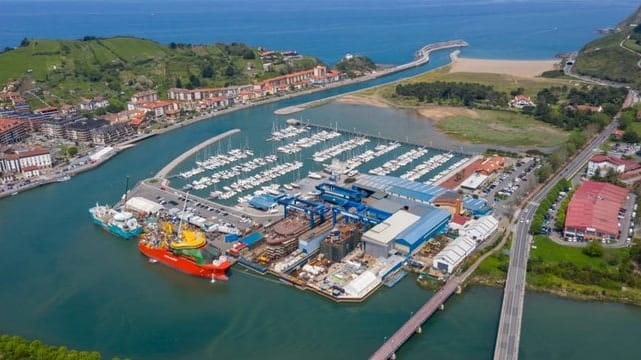
Six months after it was announced that SAFEEN Drydocks, part of the AP Ports Group, was acquiring the Spanish shipyard, Balenciaga restarted work with its first keel laying. The historic yard located in the Basque region of Spain looks to rebuild its operations, focusing on the offshore sector with specialized tugs and support vessels.
The shipyard, which had been known as Astilleros Balenciaga, traces its origins to 1921, reporting that it has built hundreds of vessels, including for the Spanish navy. In recent years, it has focused on the offshore sector before falling into financial difficulties that threatened to close the yard in late 2024.
SAFEEN Drydocks, which is part of AD Ports’ Noatum Maritime, announced in January that it had acquired the Spanish shipbuilder for €11.2 million (US$13.1 million) as part of a strategy to expand its shipbuilding and repair operations and consolidate its position in Spain and the Mediterranean. SAFEEN Drydocks was launched in June 2023 as a joint venture 51 percent owned by AD Ports and working with Premier Marine Engineering Services, which was developing a shipyard at the Khalifa Port.
“Today we celebrate that Balenciaga is back,” said Mikel Jauregi, Minister of Industry, Energy Transition, and Sustainability for the Basque Government. “It’s been a long and arduous journey, but we never gave up.”
The first project is an offshore support tug, one of two offshore tugs that were ordered at the yard. Balenciaga Shipyard reports it has an “active orderbook” that positions it as a “credible and competitive” builder for the European offshore and renewable energy sector. The yard will be targeting further contracts in the offshore wind sector and will look to leverage SAFEEN’s partnership with Masdar, a United Arab Emirates state-owned renewable energy company. Masdar has been increasing its investments in European offshore renewable energy.
Under its new ownership, the yard reports it will invest in its workforce, facilities, automation, and supply chain. Balenciaga Shipyard has two dry docks, a 105-meter slipway, and a fabrication factory, as well as a cutting plant.
During the keel laying ceremony on July 16, officials referred to it as a “recovery and renewal” of one of the Basque region’s most historic shipbuilding facilities. It also looks to build its position by focusing on other offshore support vessels, tugs, and specialized maritime vessels. In the past, it also built commercial fishing vessels and, most recently, SOVs for companies including North Star Shipping and Edda Wind.
Turkey’s First Domestically-Built LNG and Largest Containership Sails on MV

Turkey’s first domestically built LNG-fueled containership, which is also the largest ever built in Turkey, entered service last week. It is operating for a family-owned company, Turkon Line, and is part of an expansion strategy for the carrier.
The company was launched in 1997 and today maintains services to the United States, Northern Europe, and India. Its website shows a total of seven containerships ranging in age from having been built in 1996 to 2012. The vessels range in size, with two over 30,000 dwt, four approximately 26,000 dwt, and smaller 12,200 dwt vessels.
The new ship, named Ka?if Kalkavan, is the first of two vessels the company is building and marks a significant milestone in its long-term growth strategy. With a capacity of 4,400 TEU, including 600 reefer slots, the company points out that the two new vessels will increase its capacity by 50 percent.
The ships are being built at the Sedef Shipyard in Turkey, which has been part of Turkon Holdings since 2000. The company highlights that the vessels were designed in Turkey and are being built entirely with Turkish capital. They measure approximately 200 meters (656 feet) with a service speed of 18 knots.
The ships are using advanced technologies, including being designed to be capable of using five different fuels. While they will primarily sail on LNG, they are also capable of operating on marine gas oil, heavy fuel oil, very-low-sulfur fuel oil, and ultra-low-sulfur fuel oil. The ship is also equipped with selective catalytic reduction and scrubber systems to manage nitrogen oxide and sulfur emissions.
It notes that through the introduction of the ships, it will expand capacity and be able to offer customers a more reliable service. The first ship, Ka?if Kalkavan, departed on its maiden voyage on July 17 and is making its first port calls in Turkey.
It is being deployed on the company’s route to western India. Management notes that the India service is quickly becoming one of the company’s most strategic routes. It makes calls in Turkey and Europe as well as the Red Sea region and India. They note it will also connect to the company’s routes to the East Coast of the United States.
ABS Joins Landmark Korea-U.S. Initiative to Advance Future of Shipbuilding
[By: ABS]
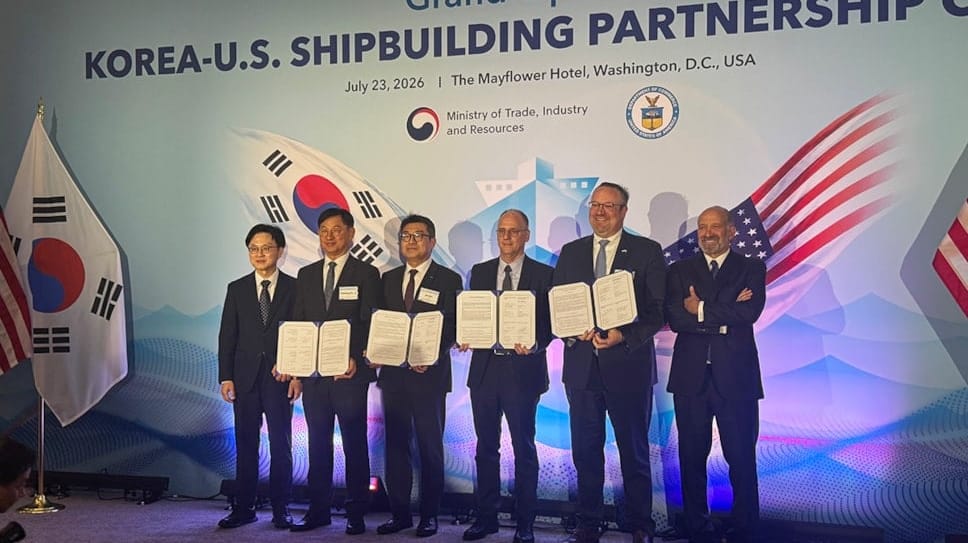
ABS joined leading Korean and U.S. research institutions in signing a memorandum of understanding (MOU) to advance technical innovation and collaboration across the shipbuilding and maritime sectors as part of the opening of the Korea-U.S. Shipbuilding Partnership Center (KUSPC).
The Korea Research Institute of Ships and Ocean Engineering (KRISO), the Korea Institute for Advancement of Technology (KIAT) and Texas A&M University (TAMU) joined ABS in the MOU, which establishes a framework for cooperation in next-generation technologies, joint research, knowledge exchange and industry-academia collaboration.
The KUSPC is designed to serve as a hub for bilateral cooperation connecting industry, academia and research institutions to advance shared innovation priorities.
“Strengthening the connection between leading institutions in Korea and the United States is an important step in advancing the next generation of shipbuilding and maritime technology. Innovation succeeds when research, industry insight and practical application come together. By bringing together world-class partners across research and technology, this initiative creates a strong foundation for collaboration that can support safer, smarter shipbuilding in both countries,” said John McDonald, ABS Chairman and CEO.
Under the MOU, KRISO will contribute its expertise in ship and ocean engineering research and development, KIAT will support industrial technology innovation and international cooperation, Texas A&M will bring research and education capabilities and ABS will provide its expertise in classification, certification, verification, maritime safety and international regulatory frameworks. Together, the parties aim to strengthen Korea-U.S. shipbuilding research and development capabilities and promote long-term industrial competitiveness.
With decades of engagement across the Korean shipbuilding industry and a central role in efforts to revitalize U.S. shipbuilding, ABS is uniquely positioned to support this bilateral initiative. Through collaboration with industry, academia and research, ABS continues to help develop the technologies, standards and safety frameworks needed for the future of the maritime industry. Learn more about ABS here.
The products and services herein described in this press release are not endorsed by The Maritime Executive.

No comments:
Post a Comment