It’s possible that I shall make an ass of myself. But in that case one can always get out of it with a little dialectic. I have, of course, so worded my proposition as to be right either way (K.Marx, Letter to F.Engels on the Indian Mutiny)
Tuesday, August 04, 2026
D.E.I. IS MERIT
Portland State biologist wins NSF CAREER Award to study the ocean's most abundant microbe
Portland State marine biologist Anne Thompson has received one of the National Science Foundation's top honors for early-career scientists, the CAREER Award.
A Portland State University professor has received one of the National Science Foundation's top honors for early-career scientists. Anne Thompson, an associate professor of biology, won a nearly $1.2 million NSF CAREER Award to answer a basic question about the ocean that science has largely left open: who eats the most abundant photosynthetic life form on Earth?
That life form is Prochlorococcus, a microbe so small it cannot be seen well with a microscope, but is so common it is the most numerous light-harvesting cell on the planet. Scientists know a great deal about what helps it grow. They know far less about what kills it. Thompson's project, funded over five years, will study how single-celled ocean predators hunt Prochlorococcus and what that predator-prey relationship means for the ocean's food web, its carbon, and the way the sea supports life on Earth. The award also reflects Portland State's push, as a federally designated Emerging Research Institution, to compete for and win the country's most competitive research grants.
“Prochlorococcus makes up a huge share of life in the open ocean, and we still cannot say very much about what other cells eat it, or why some cells get eaten while others escape,” Thompson said. “This award gives my students and me five years to chase that question. We get to ask who the ocean's smallest predators pick on, and what that choice means for the whole system.”
Thompson studies the question with a pair of microbes she can grow and watch in the lab. The predator is a choanoflagellate, a single-celled hunter that lives throughout the ocean and is often studied for clues about how animal life first evolved. It feeds by beating a whip-like tail to draw a current of water toward its body, pulling prey into a collar of tiny finger-like structures, then swallowing the cell whole. Her lab has developed methods to precisely measure which Prochlorococcus cells get caught and which slip away. Over the course of the project, her team will test about 40 types of Prochlorococcus to see whether the predator prefers some over others, whether a cell's size or health affects its odds, and whether the prey can sense a predator and respond.
The award supports more than research. Thompson will build the experiments into two microbiology lab courses at Portland State, where roughly 200 undergraduates — many of them headed for nursing, pharmacy, and other health fields — will run real predation experiments and help produce the project's data. Standout students can join her lab for paid summer research and continue into graduate study. She is also writing a popular-science book about Prochlorococcus and how scientific discovery works, in development with Princeton University Press, to bring ocean and microbe literacy to readers outside the university. The project reflects Portland State's focus on public impact research — work tied directly to real questions facing society — and its goal of giving students hands-on research experience early.
“Winning a CAREER Award at Portland State says something I care about,” Thompson said. “It says frontier science belongs here, and that our students can help do it. That is exactly who I want in the lab with me.”
The award comes from the National Science Foundation's Faculty Early Career Development (CAREER) Program (NSF Award No. OCE-2543440) for $1,165,130 over five years. Thompson will obtain many of the Prochlorococcus strains from Sallie “Penny” Chisholm's lab at the Massachusetts Institute of Technology. The book is in development with Princeton University Press. The project builds on equipment from a prior NSF award to Portland State, including a high-throughput flow cytometer that lets researchers study cells one at a time.
ABOUT PORTLAND STATE UNIVERSITY
Portland State University is Oregon’s Urban Research University, located in the heart of downtown Portland. Guided by its mission to “let knowledge serve the city,” PSU combines world-class research, hands-on learning, and deep community partnerships to turn ideas into action — in the Pacific Northwest and around the world. Learn more at pdx.edu.
A microscopy picture of Prochlorococcus, Pro for short. The cyanobacterium that Thompson will be studying, it's the most abundant life-harvesting cell on Earth.
A graphic of how the choanoflagellate feeds.
Credit
Anne Thompson
Researcher’s work to improve neuroinclusive design in Wales boosted by Livery Company award
A Swansea University researcher whose work could help create more inclusive icons and symbols for neurodivergent people has been awarded a prestigious scholarship to present her findings at a leading international psychology conference.
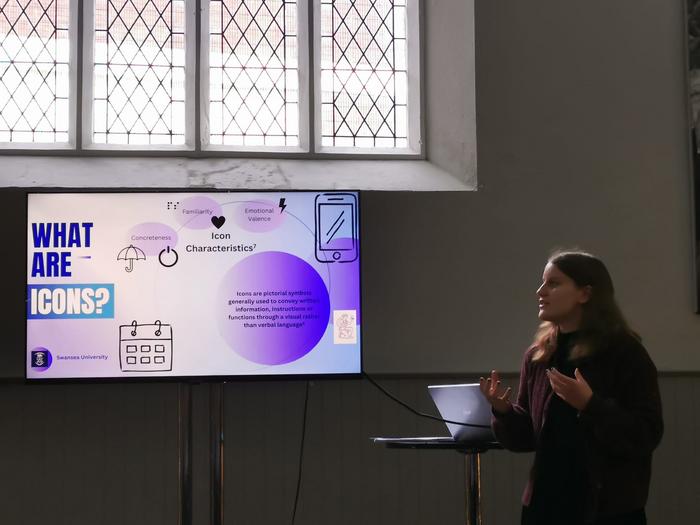
Zoe's research explores how neurodivergent people understand and process the icons and symbols used in everyday life, from public signage and transport systems to websites, apps and digital communications.
These visual symbols are increasingly relied upon to convey information without the need for text, yet relatively little is known about whether they work equally well for neurodivergent and neurotypical users.
Her latest findings revealed that neurodivergent participants responded to visual symbols more quickly and more accurately than neurotypical participants, highlighting important differences in cognitive processing that could help inform more inclusive design practices.
The findings have growing relevance in Wales, where organisations and public bodies are increasingly seeking ways to improve accessibility and create more neuroinclusive environments and services.
Zoe said: "As someone with autism spectrum disorder (ASD) and attention deficit hyperactivity disorder (ADHD), I am passionate about improving understanding of how neurodivergent people experience the world around them. Icons and symbols are used every day to communicate meaning, yet our understanding of how different groups process them remains limited.
“Thanks to this award from The Worshipful Livery Company of Wales, I will be able to share my findings with leading international experts, gain valuable feedback and develop collaborations that will strengthen my future research.”
The research is already attracting interest beyond academia. Following a previous conference presentation, Zoe was invited to discuss her findings with representatives from the Welsh Government and how they might help shape future accessibility initiatives in Wales.
Zoe was selected for the scholarship through a competitive process open to Swansea University researchers at an early stage of their careers.
Sylvia Robert-Sargeant, a member of The Worshipful Livery Company of Wales Awards Committee, said: “One of The Company's aims is to encourage and support students to progress with a specific project. This timely opportunity for Zoe illustrates how such valuable work can make a vital contribution to organisations and public bodies in Wales who are increasingly seeking ways to improve accessibility and create more neuroinclusive environments for the community.
“We raise funds through various charitable events and also by reaching out, not only to our Liverymen for financial support, but also to the wider community in Wales. We encourage like-minded Welsh organisations interested in promoting education, science, technology and the arts in Wales to support our activities. We are delighted to be able to support Zoe in taking this project forward and sharing her important research work with a wider international and influential audience.”
Founded in 1993, The Worshipful Livery Company of Wales promotes education, science, technology and the arts across Wales. Through its annual awards programme, it supports young people in developing their talents and skills by offering scholarships and bursaries to students, apprentices and members of the armed forces.

No comments:
Post a Comment