EXPLAINER: Will Israel's election be the end for Netanyahu?
.png)
Israel will face a historic moment on October 27, when its citizens head to the polls to select their next government for the first time in the post-October 7 world.
While personality politics have been at the forefront of Israeli elections for multiple election cycles, with political blocs being divided according to their view of Prime Minister Benjamin Netanyahu, multiple key issues have arisen since Israel has been engaged in a multi-front war, including in Gaza and Iran.
The key political question on Israelis’ minds is whether or not Netanyahu will have the ability to hold onto power for another four-year term.
In order to determine the answer, two aspects of the Israeli elections need to be addressed. Firstly, there are the policy issues that are now at the forefront of the national political discussion. Secondly, there is the coalition question, namely whether parties from both sides of the aisle can indeed work together should another political deadlock occur, as was the case in multiple elections leading up to the 2022 vote.
The key issues
With the third anniversary of the October 7 Hamas attacks fresh in the minds of Israelis, voters will be asking themselves whether to put their trust in a government that campaigned heavily on its hawkish security stance, only for the country’s largest-ever security failure to happen under its watch.
Given the uncertainty around who is directly responsible for this failure, there have been theories suggesting that Netanyahu may have used subsequent military actions against Hamas, Hezbollah in Lebanon, Iran, and Syria to exhibit military might and therefore redeem himself in the eyes of voters after October 7, 2023. In fact, the United States’ ambassador to Turkey and Syria, Tom Barrack, went so far as to suggest that the recent Israeli strikes on Syria’s Abu al-Duhur air base may have been a “very aggressive but well-received pre-election concept” by Netanyahu.
Although Barrack’s claim remains unsubstantiated and has not gained popularity in Israel, particularly after Israel’s security establishment claimed that it had intelligence justifying the strike, accountability for the October 7 attacks remains at the forefront in voters’ minds.
There has been a movement in Israel to establish an independent state inquiry into the security failures that allowed the October 7 attacks to occur. While Netanyahu has yet to fulfil this request, Israel's Constitution Committee convened on January 19 to discuss establishing a political investigation committee into the October 7 attacks. For supporters of the opposition, this move appeared suspicious, given that the prime minister only seemed willing to sanction an investigation that is performed under his watch.
Immediately, the question arose: what is Netanyahu trying to hide? Is he directly responsible for the security failure, or is there perhaps another unforeseen controversy in play?
With the question of responsibility for October 7 unresolved, another key issue has been drawn into the spotlight, namely the military exemption for the ultra-Orthodox.
Since October 7, 2023, the Israel Defense Forces (IDF) called up an operational force of 530,000 troops at its peak, according to military figures. This included around 360,000 reservists in the first few days of the conflict.
With so many Israelis being called to the front lines, and their families understandably affected, Israelis consider it unjust that ultra-Orthodox citizens receive an exemption from military service.
As Netanyahu’s rifts with political leaders continue to increase, the prime minister was essentially forced to rely on the support of two ultra-Orthodox political parties in order to form a government coalition: Shas and United Torah Judaism.
In the lead-up to the election, this partnership has been at the centre of controversy, particularly after the coalition sought to pass the Haredi draft conscription law in May, after the two ultra-Orthodox parties threatened to withdraw from the coalition and collapse the government.
The bill sought to appease both sides by seeking to implement annual enlistment targets for ultra-Orthodox men, gradually increasing each year. With the bill failing to secure a majority of support in parliament, a stopgap measure was implemented, namely a freeze on the arrest of draft evaders.
With Netanyahu’s Likud party being viewed as hamstrung on the issue due to its reliance on ultra-Orthodox parties, other right-wing voices such as Naftali Bennett and Ofer Winter are looking to capitalise on Netanyahu’s perceived vulnerability.
The main contenders
Given the aforementioned political divide, Israeli political blocs are not cleanly separated by differences in ideology, but rather by personality politics.
According to election poll, former IDF chief of staff Gadi Eisenkot has emerged as Netanyahu’s fiercest competitor, rapidly rising in the polls.
Eisenkot has positioned himself as more centrist than Netanyahu, albeit still right-leaning, yet highly critical of the incumbent government. Among his key policies are the establishment of a State Commission of Inquiry into the October 7 security breaches, universal military service (including ultra-Orthodox and Arab citizens of Israel), and reassessing the country’s defence strategy.
Naftali Bennett is another strong contender for the prime minister mantle. In April, Bennett made waves in the media by uniting with the leader of the opposition, Yair Lapid, to form the Beyachad party. This union was particularly notable given Bennett’s stance as a hard-right candidate and Lapid’s appearance as a centrist, sometimes even left-leaning.
While Netanyahu, Eisenkot, and Bennett all seem to have amassed high levels of support according to polls, the formation of a government could prove problematic due to a key mathematical issue.
The coalition crisis
In order to form a government, the party with the highest number of votes needs to form a coalition consisting of at least 61 of the total 120 seats in parliament. Should this party fail to do so, the Israeli president will pass the mandate to the next largest party.
Current polling makes it clear that both Netanyahu and his opponents will struggle to reach the 61-seat mark.
State broadcaster Kan 11 compiled an aggregate of polls for the seven days ending October 9, as depicted in the graph below (created with Google Gemini):
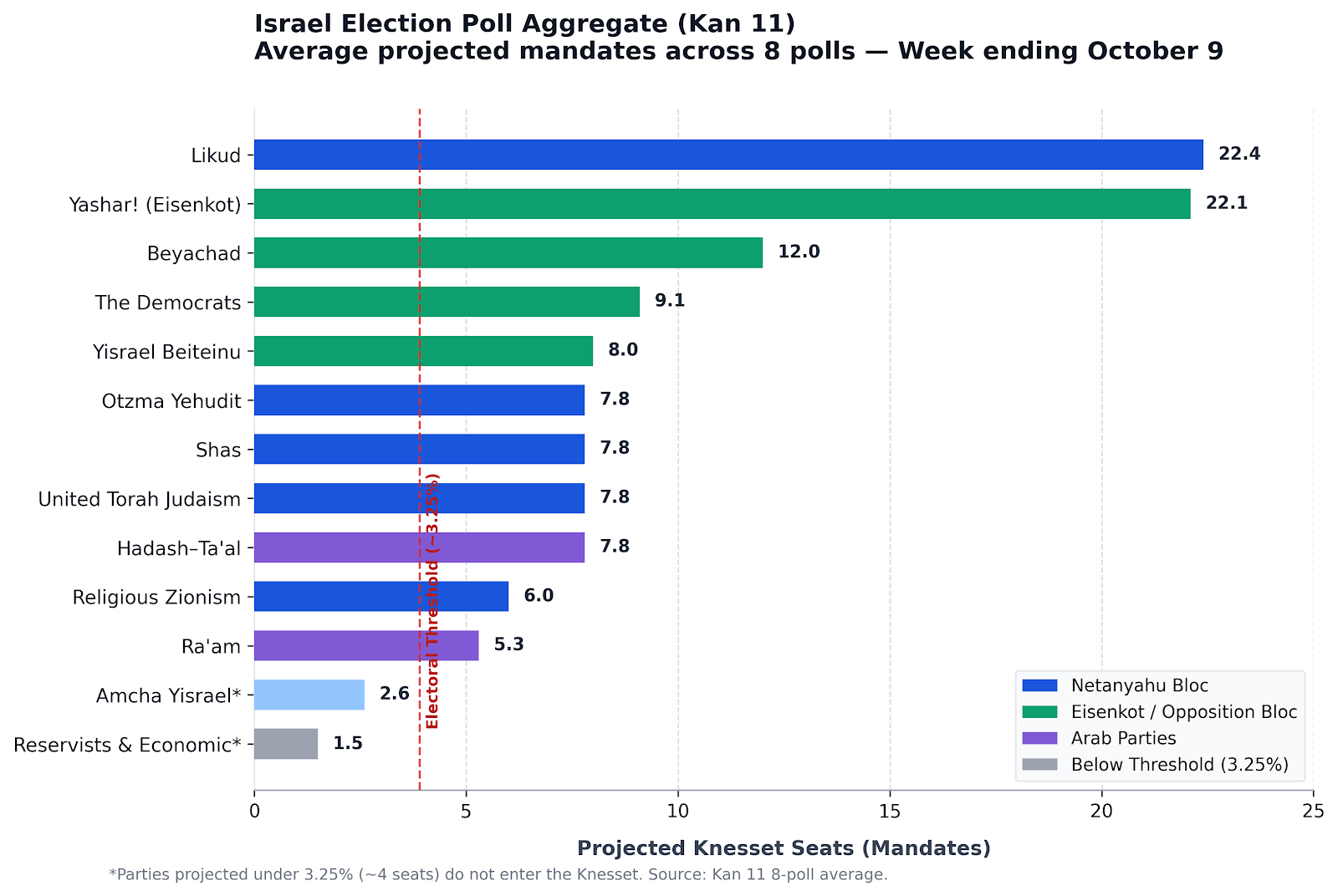
According to this aggregation, the coalition bloc is averaging 51.8 seats, still 10 short of a majority, while the opposition bloc of right-wing, centrist, and left-wing Zionist parties finds itself at 51.2, producing an almost exact deadlock.
Still, there are some kingmakers who could break away from either bloc and crown the next prime minister.
Potential kingmakers
While Bennett finds himself in the opposition camp after crossing the floor in 2021 to become the prime minister of the unity government, he remains a staunch right-winger in terms of policy. Given his opposition to the ultra-Orthodox parties, there could still be a scenario where Netanyahu’s Likud brings its numbers over to Bennett and a coalition agreement between Netanyahu, Bennett, Eisenkot, and potentially Avigdor Lieberman comes into effect.
Despite personal gripes, all four of these parties have commonalities in terms of policies, with Lieberman, Eisenkot, and Bennett all calling for ultra-Orthodox enlistment and hard-line security policies.
The main issue with cobbling together a coalition of this nature is getting the parties to agree on who the prime minister will be.
Another potential kingmaker could be Ofer Winter’s Amcha Yisrael (People of Israel) party. A staunch right-wing military man, Winter has called for ultra-Orthodox enlistment and a hawkish security stance, looking to even facilitate the “voluntary migration” of residents of Gaza.
While Winter has highlighted the vulnerabilities of the current administration, he admitted that he would still recommend Netanyahu as prime minister after election day. Still, he happens to have good ties with some Netanyahu rivals such as Lieberman, having started working together in 2018 when Lieberman served as minister of defence while Winter was his military secretary.
Although Kan News’ aggregation has Winter’s party polling below the electoral threshold, with the most accurate poll ahead of the 2022 election, polls published by i24NEWS, Channel 13, Maariv, and Kan 11 itself have it passing the threshold, indicating that there is still a chance that he could have an impact on the final outcome, potentially becoming a peacemaker who could bring together right-wing voices from both the government and the opposition bloc.

No comments:
Post a Comment