Warren Lays Out How Democrats Can Deliver for the Working Class—Even With Trump in the White House
“Democrats won this election by claiming we are on the side of working people, and working people are counting on us to deliver.”
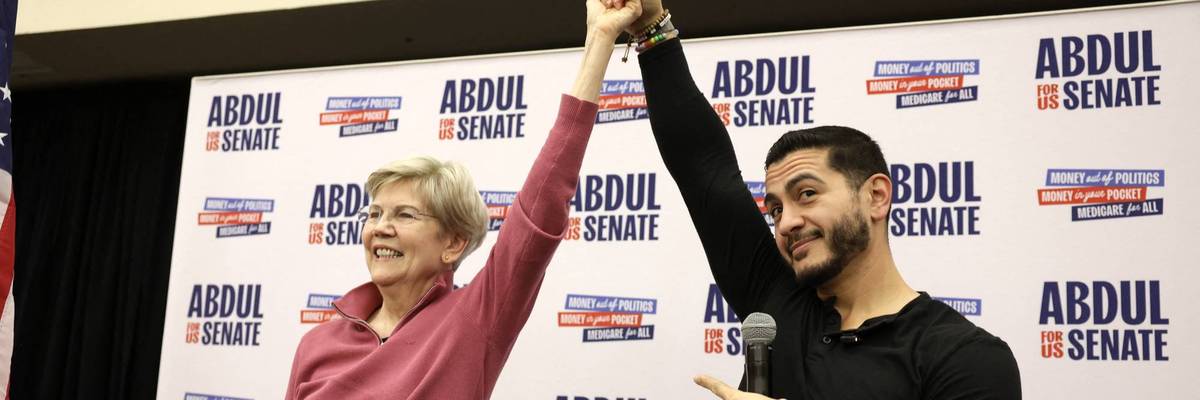
US Sen. Elizabeth Warren (D-Mass.) joined Abdul El-Sayed at a midterm campaign rally in Ann Arbor, Michigan on November 2, 2026.
(Photo by Jeff Kowalsky/AFP via Getty Images)
Jake Johnson
Nov 05, 2026
COMMON DREAMS
“Americans need Democrats to deliver now, not in two years.”
That was US Sen. Elizabeth Warren’s (D-Mass.) post-election message to her fellow congressional Democrats on Thursday as she outlined how the party can use its impending control of the House and Senate to deliver real gains for the working class—even with corrupt billionaire President Donald Trump in the White House
In an op-ed for TIME, Warren argued Democrats succeeded in midterm contests across the country “by being populist economic fighters who were unafraid to call out the corrupt politicians and corporate interests who have rigged the system at the expense of everyone else.”
“Now, Democrats must deliver,” the progressive senator wrote, urging her party to push Trump to live up to his vow to work with Democrats in the new Congress. “We should force him to do that on the affordability and corruption issues that drove this election—or call his bluff.”
Warren laid out what she views as top priorities for the new Democratic majority, including: Ending Trump’s illegal war in Iran, cutting costs for working families, moving to cancel Trump-GOP cuts to Medicaid and nutrition assistance, reversing Trump’s tax cuts for the rich, and holding “Big Tech CEOs, Wall Street executives, and giant corporations” accountable for “ripping off the American people to make themselves richer.”
The senator expressed openness to working with Republicans but wrote that Democrats must be willing to use the filibuster-proof reconciliation process—or eliminate the Senate’s 60-vote filibuster entirely—to advance an ambitious agenda.
But what if Trump decides to wield his veto power against Democratic legislation, as he has suggested he could do?
Warren argued that Democrats must “test that out by passing legislation the American people support to make life more affordable and our government less corrupt.”
“It would be a breach of faith with the people from South Carolina to Texas, who voted for us to address costs and corruption, to spend the next two years waiting for some future Democratic trifecta to hopefully deliver meaningful change,” Warren wrote. “Democrats won this election by claiming we are on the side of working people, and working people are counting on us to deliver.”
Another leading progressive in the Senate Democratic caucus, Bernie Sanders (I-Vt.), similarly argued that Democrats’ historic midterm wins were “important,” but “not enough.”
“The American people want change. Real change. And the midterm election confirms just that,” Sanders said in a video message, pointing to the urgent need to address out-of-control income and wealth inequality, the starvation-level federal minimum wage, unfettered artificial intelligence, the corrupt campaign finance system, the broken for-profit healthcare system, and more.
The solutions to those crises, he argued, “are not radical,” pointing to broad public support for Medicare for All, expanding Social Security, and other progressive proposals.
“What we are talking about now is not only the need to fight for economic justice,” said Sanders. “We are fighting to give hope to the American people—to allow them to understand that their government can work for them, can address the crises that they face, and will pay attention to the needs of the men, women and children in our country who are struggling, and not just the very, very wealthy campaign contributors.”
“That is, in my view, what Democrats have got to do when they assume power in January,” he added. “We can do it. We must do it.”
“Democrats won this election by claiming we are on the side of working people, and working people are counting on us to deliver.”
US Sen. Elizabeth Warren (D-Mass.) joined Abdul El-Sayed at a midterm campaign rally in Ann Arbor, Michigan on November 2, 2026.
(Photo by Jeff Kowalsky/AFP via Getty Images)
Jake Johnson
Nov 05, 2026
COMMON DREAMS
“Americans need Democrats to deliver now, not in two years.”
That was US Sen. Elizabeth Warren’s (D-Mass.) post-election message to her fellow congressional Democrats on Thursday as she outlined how the party can use its impending control of the House and Senate to deliver real gains for the working class—even with corrupt billionaire President Donald Trump in the White House
In an op-ed for TIME, Warren argued Democrats succeeded in midterm contests across the country “by being populist economic fighters who were unafraid to call out the corrupt politicians and corporate interests who have rigged the system at the expense of everyone else.”
“Now, Democrats must deliver,” the progressive senator wrote, urging her party to push Trump to live up to his vow to work with Democrats in the new Congress. “We should force him to do that on the affordability and corruption issues that drove this election—or call his bluff.”
Warren laid out what she views as top priorities for the new Democratic majority, including: Ending Trump’s illegal war in Iran, cutting costs for working families, moving to cancel Trump-GOP cuts to Medicaid and nutrition assistance, reversing Trump’s tax cuts for the rich, and holding “Big Tech CEOs, Wall Street executives, and giant corporations” accountable for “ripping off the American people to make themselves richer.”
The senator expressed openness to working with Republicans but wrote that Democrats must be willing to use the filibuster-proof reconciliation process—or eliminate the Senate’s 60-vote filibuster entirely—to advance an ambitious agenda.
But what if Trump decides to wield his veto power against Democratic legislation, as he has suggested he could do?
Warren argued that Democrats must “test that out by passing legislation the American people support to make life more affordable and our government less corrupt.”
“It would be a breach of faith with the people from South Carolina to Texas, who voted for us to address costs and corruption, to spend the next two years waiting for some future Democratic trifecta to hopefully deliver meaningful change,” Warren wrote. “Democrats won this election by claiming we are on the side of working people, and working people are counting on us to deliver.”
Another leading progressive in the Senate Democratic caucus, Bernie Sanders (I-Vt.), similarly argued that Democrats’ historic midterm wins were “important,” but “not enough.”
“The American people want change. Real change. And the midterm election confirms just that,” Sanders said in a video message, pointing to the urgent need to address out-of-control income and wealth inequality, the starvation-level federal minimum wage, unfettered artificial intelligence, the corrupt campaign finance system, the broken for-profit healthcare system, and more.
The solutions to those crises, he argued, “are not radical,” pointing to broad public support for Medicare for All, expanding Social Security, and other progressive proposals.
“What we are talking about now is not only the need to fight for economic justice,” said Sanders. “We are fighting to give hope to the American people—to allow them to understand that their government can work for them, can address the crises that they face, and will pay attention to the needs of the men, women and children in our country who are struggling, and not just the very, very wealthy campaign contributors.”
“That is, in my view, what Democrats have got to do when they assume power in January,” he added. “We can do it. We must do it.”
What American workers—and American democracy—need most is a larger, more powerful labor movement. Unions should take advantage of this moment to build one.

Democratic Michigan Senate candidate Abdul El-Sayed speaks to members of United Auto Workers (UAW) Local 600 in Dearborn, Michigan on March 9, 2026.
(Photo from Abdul El-Sayed/X)
Lowell Peterson
Nov 06, 2026
Common Dreams
Union activists like me can be forgiven a certain degree of giddiness after Donald J. Trump’s agenda got walloped in the midterm election. After all, Trump has been one of the most anti-worker presidents in history. He stripped millions of federal employees of the right to bargain collectively, he gutted the National Labor Relations Board, and he sliced back regulations that gave overtime to millions of employees and that protected people from being improperly classified as independent contractors without labor rights. He cut taxes for corporations and billionaires and slashed food and medical benefits for working Americans.
Congress is now in the hands of Democrats, including many who trend younger and more progressive, and even more who proclaim themselves to be the friend of the working person (some even say “working class”). Alas, Trump remains in place. It would take some extraordinary parliamentary maneuvering to undo all—or perhaps any—of Trump’s anti-worker policies. There is no reason to shy away from uphill battles, but we cannot expect complete victory in the next two years.
Anyway, the agenda is broader than a few immediate policy initiatives. As I argue in my upcoming book, Building Power: Collective Action, the Writers’ Strike Against Hollywood, and Organizing for the Future (Cornell University Press), what American workers—and American democracy—need most is a larger, more powerful labor movement. That is the key to making sure the federal government acts in the interest of working people over the long haul. (By “working people” I mean everyone who earns a living by their own labor, whether by putting up buildings or tending to patients or teaching kids or writing software or working on the assembly line.)
If unions and their members (and potential members) want to make meaningful, sustainable advances, now is the time to commit to doing the hard work of organizing.
Here is the painful truth: Only about 10% of American workers are represented by unions. In the private sector, it’s closer to 6%. It is difficult to get corporate chieftains and elected politicians to fight for working people in the face of corporate opposition when union density is such a small fraction of the overall labor force and economy.
Things were this bad when Franklin Delano Roosevelt was elected. Union density was about 11% in 1934. The New Deal transformed federal labor law, FDR proclaimed that every worker should join a union, and the labor movement got to work organizing the unorganized. By 1945, density skyrocketed to nearly 35%.
Union density remained between 30-35% for decades, and tens of millions of union members won a measure of economic security. Wages and productivity increased at about the same rate, roughly doubling from 1948 to 1973 (Sven Beckert, Capital: A Global History (Penguin Press 2025) at p. 949). In other words, working people won a reasonable share of the wealth they created.
Union density nosedived after the early 1970s, and economic inequality exploded. From 1980 to 2020 income gains for the top 1% were more than triple those in the middle. The gap became even larger between the truly wealthy and the less well-off; the top 0.1% saw gains 12 times as large as those of the lowest 20% between 1979 and 2022.
A recent Economic Policy Institute study estimated the gains working people would make if union membership tripled to about 30%: $1.2 trillion a year, or about a third of the increase in economic inequality since 1979. Thus, if union density returned to where it was during the New Deal, this would put a serious dent in the economic inequality that has roiled American politics and ruined household finances. It is difficult to imagine a more powerful outcome for the Blue Tsunami than a New Deal for unions.
However (and sorry, this is a distinctly non-giddy point), one midterm election does not lock in a long-term political realignment. We need politicians to support pro-worker legislation for as long as it takes—decades, not years. The first legislative step would be to transform federal labor law to support, rather than hinder, unionization. That would make it vastly less difficult to increase union density.
None of this will happen by itself. Political candidates and consultants do not build movements. Organizers and leaders and activists and members do. Political winds shift and elections swing like pendulums. More important, politicians respond to leverage, not good vibes. They will only adopt labor law reforms if they feel sustained pressure to do so. If unions and their members (and potential members) want to make meaningful, sustainable advances, now is the time to commit to doing the hard work of organizing and bargaining, of engaging working people directly, of building their power in a sustainable way. They can use that power to exert leverage on whichever politicians seek their support. That is the surest way to capitalize on the gains that working people made in the midterm elections.
Our work is licensed under Creative Commons (CC BY-NC-ND 3.0). Feel free to republish and share widely.
Lowell Peterson
Lowell Peterson was the executive director of the Writers Guild of America East from 2008 to 2023. Cornell University Press is publishing his book, Building Power: Organizing for the Future, with Lessons from the Writers’ Strike Against Hollywood, later this year.
Full Bio >

No comments:
Post a Comment