Showing posts sorted by date for query Armistice Day. Sort by relevance Show all posts

Friday, November 13, 2026

Make Armistice Day Great Again


by | Nov 11, 2026 |

At “the eleventh hour of the eleventh day of the eleventh month” of 1918,  guns officially fell silent across Europe and World War One came to a military end (the political finish came in 1919 with the Treaty of Versailles).

The following November 11, the winning nations commemorated the final ceasefire with the first “Armistice Day” events,

Not celebrations as such, mind you: The observances were — and in some countries at least partially remain — somber remembrances (the UK now calls November 11 “Remembrance Day”) of 20 million dead in “the war to end all wars,”  driven by sentiment against ever returning to that kind of carnage.

That sentiment, unfortunately, proved insufficient to prevent World War 2 and hundreds or thousands of subsequent deadly conflicts, which is bad enough.

Worse, though, is what America did with “Armistice Day.” In 1954, Congress replaced the traditional “Armistice Day” observance with a celebratory “Veterans Day.”

Instead of mourning war, we now celebrate warriors. Parades. Air shows. Political speeches. Free meals, drinks, haircuts, etc. for veterans.  A lot of “thank you for your service” to everyone identifiable as a veteran of the US armed forces; quite a bit of mutual back-slapping among those of us who “served.”

To me, the best way to celebrate veterans would be stop making so many of us — especially, but not only, of the dead, maimed, traumatized, and homeless varieties.

Since the first Armistice Day, the US has fought a second “world war” and countless smaller wars — declared and undeclared — around the globe, at the cost of hundreds of thousands of American lives and millions of foreigners’ lives.

The US armed forces maintain a global network of military bases, remain bogged down in the Middle East after a quarter century of the “global war on terror,” and have now been at on-again, off-again open war with Iran for a year-and-a-half.

The US government constantly rattles its saber, actively seeks excuses to militarily intervene in other countries’ internal affairs and international disputes, and fuels even the wars it doesn’t actively participate in with foreign aid and arms sales.

Two-time Medal of Honor recipient Smedley Butler tallied up the cost in his book, available free online, War is a Racket: “Newly placed gravestones. Mangled bodies. Shattered minds. Broken hearts and homes. Economic instability. Depression and all its attendant miseries. Back-breaking taxation for generations and generations.”

None of that is worth celebrating. It’s a cost, not a benefit.

The US armed forces’ oath of enlistment binds future “veterans” to “support and defend the Constitution of the United States against all enemies, foreign and domestic.”

Even if one accepts that as a worthy goal, when’s the last time it actually turned out to be the job?

Not during my lifetime, at least that I can think of, and I turn 60 the day before “Veterans Day.” The war I fought in was premised on kicking one tyrant out of Kuwait so another tyrant could return and rule again. Constitution? Nowhere in sight.

Commemorating “Armistice Day” — and making that commemoration a call for peace and a rejection of the American war racket — makes far more sense to me than celebrating “Veterans Day.”

If we want to thank veterans “for their service,” the first step is to bring them home and stop letting politicians put them in morally bankrupt jeopardy of life and limb.

Thomas L. Knapp is director and senior news analyst at the William Lloyd Garrison Center for Libertarian Advocacy Journalism, publisher of Rational Review News Digest, and moderator of Antiwar.com’s commenting/discussion community.

Wednesday, November 11, 2026

World leaders begin talks at Cop31 climate conference but big names missing

World leaders take the stage at Cop31 in Turkey on Wednesday but despite global warming intensifying some prominent names, including the French president, are missing from this year's annual UN climate summit.


Issued on: 11/11/2026 - RFI

High level talks continue at the COP31 climate summit in Antalya, but without the leaders of some of the world's biggest polluting nations. REUTERS - Murad Sezer

The two-week conference kicked off earlier this week in the Mediterranean resort city of Antalya, with governments under pressure to tackle the climate crisis after a year of heatwaves in Europe, deadly floods in Nepal and major wildfires in Indonesia.

Dozens of leaders will speak during the "high-level segment" taking place on Wednesday and Thursday, including Turkish President Recep Tayyip Erdogan, Brazilian President Luiz Inacio Lula da Silva and Iran's Masoud Pezeshkian.

But some big names are missing – British Prime Minister Andy Burnham is the only leader from a G7 country scheduled to address the summit.

While European Union chief Ursula von der Leyen is attending, French President Emmanuel Macron, German Chancellor Friedrich Merz and Italian Prime Minister Giorgia Meloni are skipping the event.

The French government said Macron would be absent because November 11 is World War I Armistice Day and the president will attend an EU summit in Ireland on Thursday.

The prime ministers of both Canada and Japan are also absent from the most recent list.

'Expectations not necessarily high'


"It is a shame that some of the bigger European leaders aren't coming. We need Europe to be showing up strongly at this COP," Cosima Cassel, a climate diplomacy expert at think-tank E3G, told AFP.

"If top leaders want influence over where the global (energy) transition is going, showing up is a pretty good place to start," said Chiara Martinelli, director of Climate Action Network Europe.

"I am afraid that Ursula von der Leyen will be lonely on the stage while the leaders of the biggest EU economies are a no-show," Martinelli said.

Wopke Hoekstra, the EU's top climate official, said the absences were "not completely atypical" as leaders may have "practical" reasons for not being able to attend a summit.

But he also told reporters in Brussels that "expectations are not necessarily high" for this climate conference.

Iran's Pezeshkian said he would use the event as an opportunity to express Tehran's position on environmental destruction in war.

"At this conference, we will speak about the actions of the United States and Israel in destroying the environment," he said before departing for Turkey, according to Iranian state television.

Push for electrification

US President Donald Trump, who pulled the United States out of the Paris Agreement in 2017 and has not sent officials to climate talks since his re-election in 2024, is not attending the summit.

Chinese President Xi Jinping, who rarely attends COPs, will be represented by Vice President Han Zheng.

The United States and China are the world's top economies and biggest emitters of planet-heating emissions, making their presence at climate talks crucial to the process.

Climate campaigner Cassel said she took heart in the presence of Lula – a defender of cutting deforestation rates and who defeated right-wing rival Flavio Bolsonaro in last month's Brazilian presidential election.

COP31 host Turkey is championing a voluntary initiative to accelerate the electrification of transport, buildings and industry, with a target of raising electricity's share of global energy consumption to 35 percent by 2035.

The EU has stressed that electrification must be "clean", which could spark debate over the role of oil, gas and coal in the Turkish proposal.

Since agreeing in 2023 for the first time to transition away from fossil fuels – the main driver of climate change – nations have struggled to advance that goal at the annual COP conferences.

(with newswires)


UN chief urges world leaders to tackle fossil fuels at COP31

UN Secretary-General Antonio Guterres railed against the oil and gas lobby on Wednesday, telling world leaders fossil fuels "must go the way of the dinosaurs" at a climate summit missing several prominent figures.


Issued on: 11/11/2026 - RFI

UN Secretary-General Antonio Guterres urged world leaders to tax the windfall profits of fossil fuel companies at COP31. © OZAN KOSE / AFP


The two-week COP31 talks kicked off in Turkey this week with governments under pressure to tackle climate change after a year of searing heatwaves and wildfires in Europe, and deadly floods in Nepal.

"The brutal truth is that the climate crisis is outrunning us," Guterres told dozens of world leaders assembled in the Mediterranean city of Antalya for two days of speeches by heads of state and government.

But few major breakthroughs are anticipated at the COP31 negotiations, which run until November 20, as countries grapple with an oil price shock and geopolitical tensions fuelled by the US war with Iran and Russia's invasion of Ukraine.

Since agreeing in 2023 for the first time to transition away from fossil fuels -- the main driver of climate change -- nations have struggled to advance that goal at the annual UN conferences.

"Fossil fuels must go the way of the dinosaurs, but that won't happen on its own. The dinosaurs did not have a lobby, but fossil fuels do," Guterres said, urging governments to tax the windfall profits of oil companies.

"Their strategy is simple: Distort the science. Delay the policy. Delay the action. Delay the accountability. It's time to kick the habit - and end the fossil fuel addiction," he said to sustained applause.
Leaders missing

Guterres, who has made the climate change fight a central issue since taking office in 2017, is attending his last COP before his term ends in December.

Brazilian President Luiz Inacio Lula da Silva told COP31 that 'climate change has disappeared' from global leadership. © Ozan KOSE / AFP

Some big names are missing at COP31, with British Prime Minister Andy Burnham the only leader from a G7 country scheduled to address the summit.

"Since the start of this year, climate change has disappeared from speeches and documents from our global leadership," recently re-elected Brazilian President Luiz Inacio Lula da Silva told fellow leaders.

"We've turned to talking more about arms and tariffs than the survival of future generations," he said.

Climate campaigners breathed a huge sigh of relief when Lula, who has overseen a dramatic drop in deforestation in the Amazon, defeated right-wing rival Flavio Bolsonaro in last month's presidential election.

"Brazil is back to defend the continuity of a healthy planet," Lula said.

While European Union chief Ursula von der Leyen is coming to Antalya, French President Emmanuel Macron, German Chancellor Friedrich Merz and Italian Prime Minister Giorgia Meloni are staying away. COP31 coincides with an EU leaders' summit in Ireland on Thursday.

Canadian Prime Minister Mark Carney and Japanese counterpart Sanae Takaichi are also absent from the most recent list.

Cop31 opens in Turkey as climate funding and fossil fuels divide nations

Unsurprisingly, President Donald Trump, who pulled the United States out of the Paris Agreement and has not sent officials to climate talks since his re-election in 2024, is not attending the summit.

Chinese President Xi Jinping, who rarely attends COPs, will be represented by Vice President Han Zheng. Indian Prime Minister Narendra Modi is also absent.

The United States and China are the world's top economies and biggest emitters of planet-heating emissions.
Low expectations

"It is a shame that some of the bigger European leaders aren't coming. We need Europe to be showing up strongly at this COP," Cosima Cassel, a climate diplomacy expert at think-tank E3G, told AFP.

Wopke Hoekstra, the EU's top climate official, said the absences were "not completely atypical" as leaders may have "practical" reasons for not being able to attend a summit.

But he also told reporters in Brussels that "expectations are not necessarily high" for this climate conference.

COP31 host Turkey is championing a voluntary initiative to accelerate the electrification of transport, buildings and industry, with a target of raising electricity's share of global energy consumption to 35 percent by 2035.

The EU has stressed that electrification must be "clean", which could spark debate over the role of oil, gas and coal in the Turkish proposal.

Turkish President Recep Tayyip Erdogan said the world needs a "fair" energy transition that "takes into account the energy security and different development needs of different countries".

Saturday, November 07, 2026

Democrats, Please Take Note: Peace Is Good Politics

The message of voters is the same everywhere: diplomacy is safer, more effective, and trillions of dollars cheaper than war.


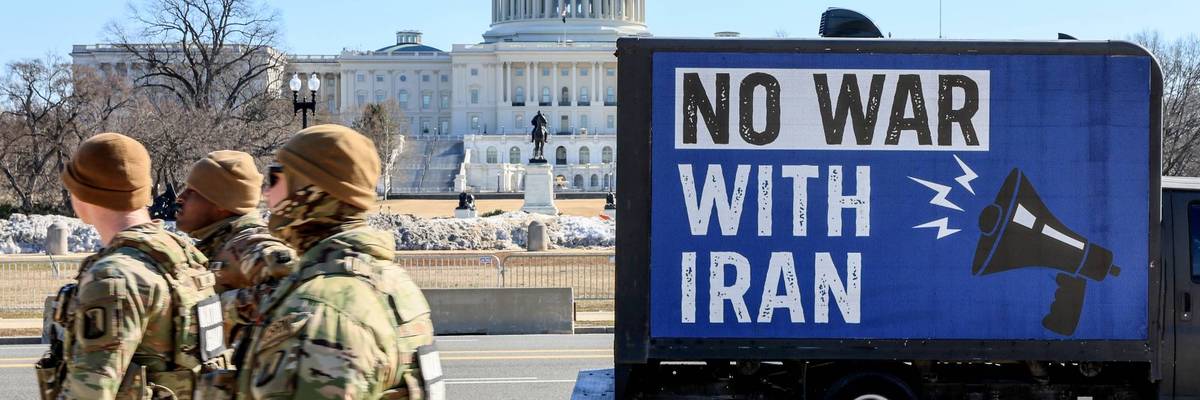
A group of National Guardsmen walk past the Win Without War Billboard Truck displaying the message “No War With Iran” in front of the U.S. Capitol on State Of The Union Day on February 24, 2026 in Washington, DC.
(Photo by Jemal Countess/Getty Images for Win Without War)

Jeffrey D. Sachs
Nov 05, 2026
Common Dreams

Voters across the United States were loud and clear on Tuesday in their historic drubbing of Trumpism. The election was a decisive rejection of Trump’s war on Iran and its staggering costs at home. While savoring their victory and the historic opportunity to restore America’s constitutional order, the Democrats should take the anti-war message of the election to heart, because they suffered the same verdict two years ago, when voters rejected the Biden administration’s wars in Ukraine and Gaza. Last week Israeli voters rejected Netanyahu’s reckless wars, and European voters are also rejecting parties that prolong the Ukraine War. The message of voters is the same everywhere: diplomacy is safer, more effective, and trillions of dollars cheaper than war.

On election night Trump conceded to Fox News, “I think a part of it was Iran.” The next day Vice President JD Vance was far blunter, posting on X: “The reason we lost is the war. The president himself said so last night.... everyone knows why we lost.” In the AP Voter Poll, about 60 percent of voters said the decision to use military force against Iran was wrong, and about 90 percent called the cost of living a crucial or major factor in their vote.

The war and the cost of living were of course utterly intertwined. Gasoline prices, around $2.80 per gallon before the war began on February 28, had risen by about 55 percent by mid-May and reached a monthly average of $4.43 in September. The 10-year Treasury yield climbed from below 4 percent before the war to above 5 percent in the autumn, and the Pentagon sought more than $200 billion in supplemental war funding. Every family with a mortgage, a car loan or a credit card balance suffered from the war.

Voters everywhere are sending the same message: peace through diplomacy.

The first duty of the new Congress is to restore its constitutional authority over war and its power of the purse to ensure that US forces are not sent back into combat in Iran or anywhere else on the whim of a president and the behest of domestic or foreign lobbies. Trump must of course refrain from restarting the war, which was never remotely necessary or justified. Remember that on February 28, the day the US and Israel launched the war, Oman’s foreign minister, who was mediating the U.S.-Iran talks, had said that a deal was within reach.

The Democrats should not imagine that the anti-war lesson applies only to Republicans. Kamala Harris lost in 2024 because voters held the Biden administration responsible for the costs of its own wars. The energy shock that followed the escalation of the Ukraine war in 2022 drove up inflation, and gasoline topped $5 per gallon for the first time in June 2022. Biden twice rejected negotiations that could have ended the conflict: in December 2021, when his administration refused to negotiate on NATO enlargement in response to Russia’s draft security treaty, and in April 2022, when the Istanbul talks were abandoned at the behest of the US and UK.

The Gaza genocide also cost the Democrats directly. Among Americans who voted for Joe Biden in 2020 but not for Harris in 2024, 29 percent named ending Israel’s violence in Gaza as the main factor in their decision, the most frequently cited issue. The party’s voters have moved far ahead of its leaders. A New York Times/Siena poll in May 2026 found that roughly three-quarters of Democratic voters oppose US military and economic assistance to Israel.

Voters everywhere are sending the same message: peace through diplomacy. On October 27, after Israeli wars in Gaza, Lebanon and Iran, Netanyahu lost his majority. Similarly, European leaders who have tied themselves to open-ended war in Ukraine are being rejected by the voters. Only 10 percent of Germans are satisfied with Chancellor Friedrich Merz, the lowest rating ever recorded for a German chancellor. Emmanuel Macron’s approval fell to 15 percent in October. In Bulgaria, Iliana Iotova, who favors dialogue with Moscow, won the presidency on November 1 with more than 58 percent of the vote.

A key upcoming key test for the Democrats will be Ukraine. They must stop their party’s typical Russia-bashing and instead support a diplomatic end to the war.

As a start, the Democrats should remember why the war started. In 1990 the United States assured Mikhail Gorbachev that NATO would not move “one inch eastward.” The Clinton administration broke that promise. In 2008 the Bush administration pushed through the Bucharest declaration that Ukraine and Georgia “will become members of NATO,” despite Ambassador William Burns’s warning that this was the brightest of all red lines for Russia. In 2014 the United States backed the coup against Ukraine’s elected president, Viktor Yanukovych, as the leaked Nuland-Pyatt call made clear. In April 2022, when negotiators in Istanbul came close to a peace agreement based on Ukrainian neutrality, the US and UK actually intervened to block the agreement. Today 75 percent of Ukrainians support negotiations with Russia to end the war.

The Democrats should not mistake their victory for a mandate to pursue their own wars.

In view of these causes of the war, I have recently set out a straightforward diplomatic framework for peace in Ukraine that would end the war. NATO would end its eastward expansion. Ukraine would adopt permanent neutrality on the model of Austria in 1955. An armistice line would be drawn, with both sides renouncing the use of force to change it. Ukraine would pursue membership in the European Union as a permanently neutral state. The Democrats should support such a diplomatic approach. It’s what can end the war, save Ukraine, and win the backing of both the Ukrainian and American people.

Most importantly, the Democrats should not mistake their victory for a mandate to pursue their own wars. The new Democratic majority should quickly reassert the constitutional authority of Congress over war and peace, champion a negotiated peace in Ukraine, end support for Israel’s wars, cut the military budget, and redirect the savings toward lowering the cost of living and repairing the public finances.

These positions are not only right but are good politics. For the Democrats to win the White House in 2028, they should become the party of peace. Better yet, both parties should become parties of peace and conduct the 2028 campaign on which party will best address America’s needs for decent jobs, affordability, healthcare, housing, a safe environment, and quality education.


Our work is licensed under Creative Commons (CC BY-NC-ND 3.0). Feel free to republish and share widely.


Jeffrey D. Sachs
Jeffrey D. Sachs is a University Professor and Director of the Center for Sustainable Development at Columbia University, where he directed The Earth Institute from 2002 until 2016. He is also President of the UN Sustainable Development Solutions Network and a commissioner of the UN Broadband Commission for Development. He has been advisor to three United Nations Secretaries-General, and currently serves as an SDG Advocate under Secretary-General Antonio Guterres. Sachs is the author, most recently, of "A New Foreign Policy: Beyond American Exceptionalism" (2020). Other books include: "Building the New American Economy: Smart, Fair, and Sustainable" (2017) and "The Age of Sustainable Development," (2015) with Ban Ki-moon.
Full Bio >


With 74% of Voters Saying Iran War Was Big Factor in Midterms, Dems Urged to Become Peace Party

“Will Democrats finally get it?” asked one progressive expert. “Americans are tired of war. They want a new foreign policy.


People oppose US war on Iran and support for Israel’s genocide in Gaza during a June 22, 2025 protest in Los Angeles.
(Photo by David McNew/Getty Images)

Brett Wilkins
Nov 04, 2026
COMMON DREAMS


Nearly three-quarters of Americans who voted in Tuesday’s midterm elections said that President Donald Trump’s illegal war of choice on Iran was a significant factor in their vote, a figure that opponents of US militarism said underscored the need for the Democrats to become a true anti-war party.

According to NBC News exit polling, 74% of voters called the ongoing US-Israeli war on Iran a “crucial” or “major” factor in their vote, with Democrats winning 63% of people who responded that way. Meanwhile, 63% of voters said the Trump administration made the wrong decision in taking military action against Iran, compared with 37% who said it was the right decision.

“There will be a lot of infighting and arguing over what happened and why that is,” Vice President JD Vance said Tuesday in a lengthy social media post. “One of the pollsters I really respect told me that our economic messaging wasn’t sharp enough down the stretch. I’m sure that’s true.”

“But the real reason we lost is obvious to almost everyone,” the vice president continued. “The reason we lost is the war. The president himself said so last night.”

Indeed, Trump acknowledged that the war harmed Republicans, telling Fox News, “I think a part of it was Iran,” but nevertheless defended the 35-week military campaign, insisting that “people understood the importance of what I’ve done with Iran.”

In an interview with The Wall Street Journal, Trump was similarly unapologetic, declaring: “I did the right thing. I would have done it again.”

Numerous observers contended that Tuesday’s results offered an opportunity for Democrats to do more than simply capitalize on Republican mistakes.

“Among other things, this is an absolute rebuke of the war in Iran. Democrats would be wise to heed that lesson and truly become the anti-war party,” said commentator Ben Rhodes—who, while serving as a senior national security adviser to then-President Barack Obama, supported US intervention in countries including Iraq, Libya, and Syria, as well as Obama’s wider drone war campaign.

Geopolitics scholar Van Jackson opined on social media that “if Democrats remain the party of the national security state, they will lose everything in 2028. If they become the anti-war party, they’ll consolidate this wave with the presidency.”

A Wednesday analysis on the libertarian site Reason by Matthew Petti argued that Democrats now have an opportunity to exercise Congress’ constitutional power over the war, including by withholding military funding.

Petti noted that Rep. Ro Khanna (D-Calif.) told Fox News last week, “The House and the Senate should stop the funding for any further actions in the Iran War,” just like “we did to stop the Vietnam War.”

However, Petti cautioned that Democratic electoral victories usually don’t lead to anti-war foreign policy.

“Party leadership that is willing to attack Republicans’ execution of the war may not share a principled anti-war commitment,” he wrote, recalling how Democrats who swept the 2006 midterms over public anger with the Iraq War but then struggled to use their control of both chambers of Congress to end it.

Sen. Chris Van Hollen (D-Md.) wants his party to cut off funding for Trump’s war and said Democrats can do so by demanding explicit restrictions on war spending as a condition of supporting the fiscal year 2027 government funding bill that expires next month.

“Right now, the continuing resolution goes through December 11,” Van Hollen told The Lever on Tuesday. “And my view is that Democrats should not advance spending to continue to fund this war.”

“The Vietnam War ended only when Congress defunded it,” he added. “This is an illegal war, and we need to make sure that taxpayer monies are not used to continue an illegal war.”

Institute for Middle East Understanding executive director Margaret DeReus pleaded on social media, “For the love of all that is good, Democrats, do not squander this.”

“The voters have given you a mandate. Use it. Be the party of working people. Be the anti-war party. Be the anti-corruption party,” she added. “We cannot go back to business as usual.”

Matt Duss, a former top aide to US Sen. Bernie Sanders (I-Vt.) who serves as executive vice president at the Center for International Policy, noted that “Trump ran and won as an anti-war candidate in 2024 because Democrats left that lane wide open for him.”

“Voters have just brutally punished him and the GOP for breaking that promise. Will Democrats finally get it?” Duss added. “Americans are tired of war. They want a new foreign policy.”

Tuesday, September 01, 2026

EU expected to lobby member states to give Patriot interceptors to Ukraine

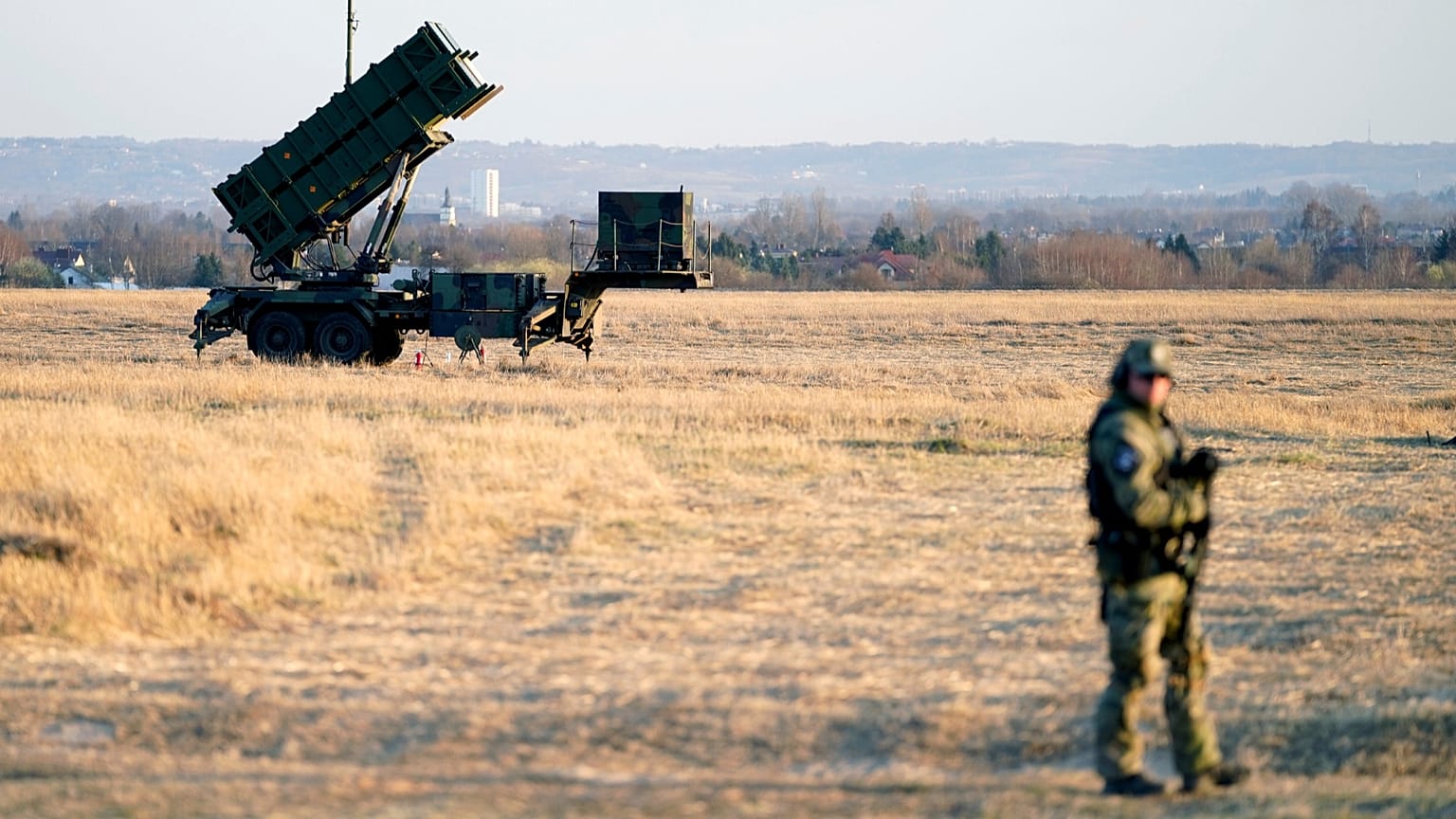
FILE - Patriot missiles at the Rzeszow-Jasionka Airport in Jasionka, Poland, 25 March 2026.
Copyright AP

By Angela Skujins
Published on

Ukraine is running out of Patriot interceptors to shoot down Russian missiles and other airborne threats. The EU executive is expected to put pressure on Mediterranean nations, like Greece and Spain, to give theirs up at a defence meeting on Tuesday.

European countries that still hold significant stocks of interceptor missiles are expected to face pressure from the European Commission to transfer them to Ukraine, as Kyiv’s need for air-defence systems grows increasingly urgent, EU officials told Euronews.

Spain and Greece, in particular, are expected to come under pressure at a defence meeting on Tuesday in County Wicklow, Ireland, to provide some of their stocks.

Ukrainian President Volodymyr Zelenskyy said late August that deliveries of Patriot interceptors had declined even as Russian missile attacks on Ukraine intensified. He said Kyiv needs an estimated 300 interceptors to fend off what is already shaping up to be a bitter winter battling another year of Russia's full-scale invasion.

The war with Iran has forced the US to draw heavily on its own Patriot reserves, shrinking the pool of interceptors available to replenish allies — including Ukraine — at precisely the moment Kyiv needs more.

Spanish Prime Minister Pedro Sánchez said earlier this year Madrid pledged to donate five Patriot missiles to Ukraine amid the shortage. Greek Prime Minister Kyriakos Mitsotakis said Athens has “resisted” pressure to transfer any of its six Patriot batteries to the war-torn nation in the past. He argued they are critical for defending the country’s own airspace.

One EU diplomat speaking to Euronews on condition of anonymity, due to the sensitivity of the matter, said the issue of Madrid and Athens keeping a tight grip on their Patriot interceptors is not new. But the issue is gaining pace with Zelenskyy voicing louder requests for interceptors, with the air defence system proving to be the “debate of the summer”, they said.

The European External Action Service (EEAS), the EU's diplomatic arm, is currently speaking with Japan and South Korea to convince them to share some of their stocks with Ukraine.

However, diplomats are wary that potential tensions with China are due to limit how much the two Asian countries are willing to share. Greece may also be reluctant to draw down its stockpile amid rising tensions with Turkey in recent months.

Three EU diplomats agreed that Ukraine’s shortage of Patriot interceptors is a “big issue” with broader questions about how to fill the gap. “What this will look like, I am not sure,” one EU diplomat said, adding that Tuesday's meeting is informal and therefore not expected to produce any formal conclusions.

The effectiveness of Europe’s own defences, particularly in the wake of a series of hybrid threats, is also expected to be a key focus of the talks.

Moldova, an EU candidate country, was recently rocked by a series of drone incursions. Five unmanned aerial vehicles entered the country’s airspace on 27 August, with the president Maia Sandu offering a defiant statement in response.

The meeting comes after media reports also reveal the director of the CIA, John Ratcliffe, embarked on a secret trip to Moscow.

In the wake of the visit, which reportedly centred on warning the Kremlin against any form of aggression towards Baltic nations, various leaders from the region have insisted their threat assessments of a Russian attack on Latvia, Estonia and Lithuania remains the same.

The former president of Estonia, Toomas Hendrik Ilves, went so far as to tell Euronews he is sceptical that Ratcliffe was dispatched to warn Russia against escalation. He argued that Washington remains more concerned about Iran

Meanwhile, one European Commission official revealed to Euronews that Kyiv is mulling whether to use the next funding envelope of the €90 billion support loan to purchase anti-ballistic systems, which could either be Patriots or the Franco-Italian version, the SAMP/T NG system.

To find other ways of plugging Ukraine’s anti-ballistic gap, the EU executive recently rubber-stamped a €6.1 billion defence procurement to supply the country with air and missile defence systems, missiles, ammunition and radars.


Russia-Ukraine War: Frozen Front, Burning Hinterland – Analysis


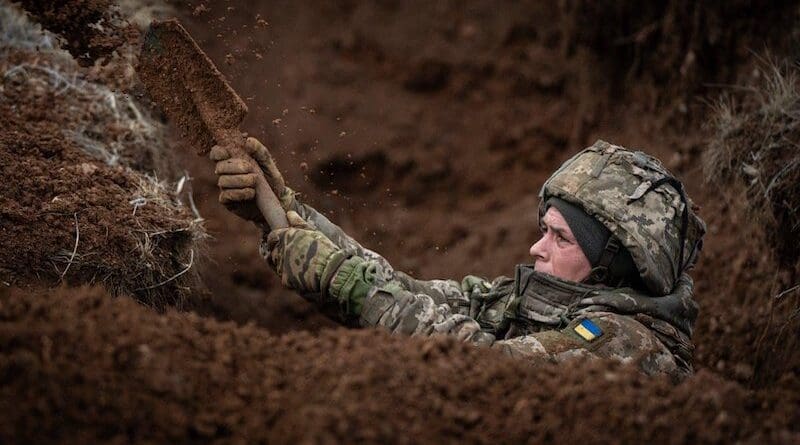
A Ukrainian soldier digs a trench. Photo Credit: Ukraine Defense Ministry

August 30, 2026

 Observer Research Foundation

By Nandan Unnikrishnan and Aleksei Zakharov

Key Takeaways:

After four-and-a-half years, the authors say the 2025 “Anchorage” talks are dead and the front is barely moving: Russia still wants all of Donbas, claims on Kostiantynivka are disputed, and drones have made big assaults rare.

A late-June 40-day Ukrainian deep-strike campaign hit Crimea supply lines, distant refineries (Omsk is cited), warehouses, and Black Sea shipping; Russia answered with ports, grain terminals, petrol stations, and Kyiv-area raids as interceptor stocks run short.

The predicted endgame is a ceasefire on the line of contact, a heavily armed Ukraine outside NATO, and a fragile European security deal—only after both sides decide more fighting no longer pays.


There appears to be no endgame in sight after four-and-a-half years of fighting in Ukraine, with peace negotiations making no progress in 2026. If anything, with both Russia and Ukraine escalating strikes on energy facilities, logistics infrastructure, warehouses, as well as ports and vessels in the Black Sea, a protracted war looks increasingly likely.

The so-called “Anchorage formula”, or, as the Russians call it, “the spirit of Anchorage”, referring to the understandings Russia claims were reached at the 2025 Trump–Putin summit in Alaska, is firmly dead, while a new baseline for negotiations remains undefined. Both Moscow and Kyiv remain confident that they can sustain the war for several more months and gain the upper hand in negotiations through military pressure. So far, however, the escalation has produced no tangible results. Rather, it is creating a more dangerous situation in which the war could spill over into new territories and draw in new actors and domains.

A Stalled Battlefield

The dynamics across the line of contact have not seriously shifted over the past several months. Russian armed forces continue to inch forward but with little to suggest that Moscow will achieve its military goals anytime soon. Russia’s main objective remains the capture of the entire Donbas region, which still requires seizing some of the most heavily fortified settlements in Donetsk oblast. Even though Russian forward-deployed groups are, by various estimates, 5 to 15 kilometres from Kramatorsk and Sloviansk, Ukrainian defence lines there appear to be holding, and the scattered villages, together with natural obstacles such as rivers and hills, will only make it more difficult.

The Russian Ministry of Defence’s announcement of full control over Kostiantynivka (Konstantinovka), an important stronghold in the Donetsk oblast that has seen fierce fighting for more than ten months, has been contested by Ukraine. The same appears to be true for some other locations, which, despite Russian advances and Ukrainian counterattacks, remain largely in a grey zone that neither side has managed to bring under firm control.


The nature of warfare has also changed dramatically. Various types of drones dominate the so-called ‘kill zones’, making massive assaults not viable, and most forward movement is now carried out by small tactical groups. Even when such units succeed in advancing and planting their flag, the effect is not always lasting—they are quickly targeted with drones and forced to retreat.

Meanwhile, Ukraine has upped the cost of war for the Kremlin with spectacular strikes deep into Russian territory on refineries, warehouses, and military infrastructure. Russia has responded in kind. If anything, this tit-for-tat escalation is only blurring the lines between civilian and military targets.

This is not entirely new in the current conflict, as many major industrial sites, particularly military production facilities and dual-use infrastructure, have already been targeted. Russia had long been the more active party, owing to its capability to strike Ukrainian regions far from the frontline. This situation is now shifting.
An Economy Under Strain

In late June 2026, Kyiv launched a 40-day operation aimed at “pressuring Russia to end its war.” First, Ukraine has acquired mid-range strike drones, which have enabled it to hit supply chains into Crimea, effectively isolating the peninsula and exacerbating the food and energy situation there.

Second, Ukraine has made progress in developing drones capable of striking facilities deep inside Russian territory, as well as establishing stable satellite navigation access. This is evident in sustained attacks on energy infrastructure, particularly oil refineries. The longest-range strike of this campaign hit a refinery in the city of Omsk, almost 2,500 kilometres from the Russia-Ukraine border. Kyiv has also launched a series of attacks on warehouses belonging to Russia’s largest online retailers across several Russian regions and has disrupted the passage of oil tankers, grain-carrying bulk carriers and container ships travelling to and from Black Sea ports. This has impacted Russia’s exports of crude oil and grain, compelling it to rearrange supply chains.


The results of Kyiv’s operation have been mixed. It has definitely posed serious challenges to Russia’s wartime economy: sustained strikes on refineries have triggered a fuel crisis across the country, with refining capacity falling and Moscow being forced to import petrol and diesel from abroad. The growing number of drone strikes, and their ability to reach distant regions, have brought the war home to many ordinary Russians, with recent surveys showing that anxiety levels have risen markedly compared to earlier years of the conflict.

However, the 40-day operation has done little to change the situation on the ground. It has done economic damage to Russia but has not shaken Moscow’s resolve to end the war on its own terms. It has also provoked Russia into intensifying attacks on Ukrainian logistics.

In recent weeks, for instance, Russia has stepped up strikes against Ukrainian ports, grain terminals on the Black Sea and commercial vessels heading to them—dealing a heavy blow to Ukrainian agricultural exports, one of the country’s few remaining sources of income. Russia has also destroyed nearly 250 petrol stations across various Ukrainian regions, particularly in the frontline-adjacent areas of the Kharkiv, Dnipro and Zaporizhzhia oblasts. Finally, capitalising on the Ukrainian shortage of interceptors for Patriot air defence systems, Russian forces have escalated strikes on the greater Kyiv area, home to many military and industrial facilities.

If the current trend of escalation continues without new agreements, Russia and Ukraine may be facing a brutal winter, in which economic strain inevitably spills over into a humanitarian crisis.

A Possible Endgame

Although the outlook for peace remains bleak, with previous attempts to craft a peace framework failing, the broader contours of how the war will end are discernible. For one, this will be a ceasefire along the line of contact rather than any land swaps presumably envisaged by the US-Russia discussions in Anchorage last year. It is a different matter that Russia may gain more territory by the time an agreement is signed. Second, Ukraine will likely become one of the most militarised countries in Europe, closely tied to Western security arrangements, albeit without formal NATO membership.

Despite neither side achieving its objectives, both could claim a form of victory: Kyiv for preserving its sovereignty, independence, and potential to further integrate into the European space; Moscow for creating a buffer zone on its borders and preventing Western military deployment on Ukrainian soil. The latter, however, would hinge on security guarantees offered to Ukraine, likely to be a point of hard negotiation.

Beyond Ukraine, Russia and European nations will also need to coordinate a new framework for coexistence—one that cools mutual hostility and brings more pragmatism to the relationship. Without a solid agreement on the future of European security architecture—itself likely to be the subject of protracted negotiations that may ultimately fail—the relationship will remain fraught with the risk of a new conflict flaring up.


Additional factors that will keep any peace deal fragile include domestic developments in both Ukraine and Russia, two countries that will suffer a post-war hangover. The loss of territory will bedevil Ukraine’s domestic politics for years to come, fuelling a sense of revanchism among constituencies pushing to regain lost lands. An economically weakened Russia, having expended vast resources in the war, would also seek clear mutual guarantees or deterrence mechanisms from the West. Beyond long-term economic issues, the country is likely to face deep social challenges in reintegrating all the demobilised soldiers back into society—something the Soviet Union grappled with in the late 1980s following the war in Afghanistan. Additionally, the social contract—a relatively high standard of living in exchange for reduced political freedoms—will come under further pressure in post-war Russia.

Although the Russia-Ukraine war is at an obvious deadlock, the conditions for the endgame have not yet ripened. For the diplomatic path to prevail, both sides must come to feel that continuing the war—wasting lives and economic and military resources—serves no strategic or political purpose. Kyiv and Moscow clearly are not there yet: both still hope to turn the tide of war in their favour.

Whether this ‘escalate to de-escalate’ approach can force a peaceful solution remains to be seen. One thing is clear: the Russia-Ukraine war will end in an armistice or a peace agreement rather than a total victory for either side.

About the authors:

Nandan Unnikrishnan is a Distinguished Fellow at the Observer Research Foundation.

Aleksei Zakharov is a Fellow, Russia & Eurasia, with the Strategic Studies Programme at the Observer Research Foundation.

Source: This article was published at the Observer Research Foundation.


About Observer Research Foundation
ORF was established on 5 September 1990 as a private, not for profit, ’think tank’ to influence public policy formulation. The Foundation brought together, for the first time, leading Indian economists and policymakers to present An Agenda for Economic Reforms in India. The idea was to help develop a consensus in favour of economic reforms.
View all posts by Observer Research Foundation →


Putin’s Monopoly On ‘Russianness’ Has Allowed Him To Continue To Wage War In Ukraine And Must Be Challenged – OpEd


Russia's President Vladimir Putin. Photo Credit: Kremlin.ru

August 30, 2026
By Paul Goble


Key Takeaways:

Denis Bilunov argues the West still treats “ethnic Russians” as one bloc, which lets Putin claim a monopoly on “Russianness” and justify the Ukraine war.

He says those labeled Russian are politically, culturally, and even linguistically diverse; breaking that monopoly would weaken the regime more than treating all Russian-speakers as Moscow’s constituency.

His prescription is a Western strategy of institutional recognition—separate flags, seats, and voices for multiple “Russias” abroad—modeled on earlier shifts that recognized union republics and then non-Russian regions inside the federation.


Ever more people around the world recognize that the Russian Federation includes a variety of non-Russian nations who make up an increasing share of that country’s population and aspire to greater autonomy and in some cases even independence from Moscow.

But they still treat those whom the Russian census counts as “ethnic Russians” as an undifferentiated whole and even accept the idea that even those who speak Russian should be included part of that community. That is no small thing, and Denis Bilunov argues that it has given the Kremlin the ability to continue its war in Ukraine (region.expert/monopoly/).

The former editor of Kasparov.ru who is now a graduate student at Prague’s Charles University says that the Kremlin leader’s “monopoly on ‘Russianness’” is so strong that many in both the Russian Federation and the West accept it as somehow natural and fail to recognize that those called Russians are extremely diverse culturally and politically.


As long as Putin can successfully make this claim, his regime will remain stable and he will be able to conduct aggressive wars as now in Ukraine. But, Bilunov says, “if this monopoly can be challenged convincingly enough, the regime will lose its stability, and the chances for real change for the better will emerge.”

To that end, the West must adopt “a proactive strategy” aimed at challenging Putin’s claims to have a monopoly on the representation of ‘Russianness,’” depriving him of the chance to claim to speak for all Russians and Russian speakers and supporting the diversity of people lumped together as ethnic Russians so that these can lead to “an organic process capable of garnering mass support.”

These must involve first of all the recognition of how diverse those labelled ethnic Russian by Moscow in fact not only politically but culturally and even linguistically as well are and then on “institutional recognition” by such means as allowing representatives of these multiple Russias to compete under their own flags or have their own places in activities of various kinds abroad.

That is going to be difficult given Moscow’s media campaign and the inertia of western thinking, but the fact that there has been so much change first in recognizing that the union republics of the USSR were different and now in acknowledging that the non-Russian republics within the Russian Federation gives hope that Bilunov’s call will gain support.

Friday, August 21, 2026

Korean Peninsula: One Small Step in the Right Direction

by | Aug 19, 2026 | 

“President Donald Trump’s decision to scale back joint military exercises with South Korea,” Matthew Lee and Ben Finley write for the Associated Press, “does not just slight a longtime ally but raises broader concerns about the security interests of the United States in Asia and elsewhere.”

Trump’s reason for supposedly, and in unspecified ways, downsizing the annual “Ulchi Freedom Shield” exercise is that South Korea has been insufficiently supportive of his  war against Iran. That doesn’t seem like a very good reason … but there ARE good reasons, and it’s a tiny move in the correct direction of drawing down US military entanglement on the Korean Peninsula.

The history, in brief:

After World War 2, Korea — which had been occupied by the Japanese — was split into two states. In the north, a Soviet/Chinese-backed communist regime under Kim Il Sung held power, while the south  was ruled by a US-backed  fascist regime under Syngman Rhee. Each side wanted to invade, conquer, annex, and absorb the other’s territory, but the US held Rhee back from doing so and Kim beat him to the punch.

The resulting war technically goes on to this very day, although it’s been in a tense state of ceasefire since 1953. More than 35,000 American troops, hundreds of thousands of South Korean, North Korean, Chinese, and Soviet soldiers, and millions of civilians died to reach that stalemate.

North Korea remains “communist” in name and pageantry while actually embodying absolute , quasi-religious monarchy under the Kim dynasty’s third generation.

South Korea is theoretically a “democracy,” but mostly just a big state capitalist enterprise operating under military protection from, and advantageous trade deals with, the US . The US spends $5-6 billion per year to support 80 military bases and 27,000 deployed US troops, and has now been doing that much or more for 80 years.

Interestingly, the AP story quotes Dan Fried, an official in George W. Bush’s administration, to the effect that “there is no American interest I can see” in reducing US military commitments to South Korea.

But in 2004, Bush himself proposed a much bolder plan than small cuts to joint military exercises. He wanted, he announced, to completely withdraw US forces from the Korean peninsula over the course of ten years.

Granted, Bush made that proposal under duress after rushing to New Mexico when his campaign learned that Libertarian Michael Badnarik was polling at 5% in the state, that Democrat John Kerry had scheduled a speech of his own there, and that New Mexico’s electoral votes might hang in the balance. He needed an olive branch to the growing anti-war movement, and quickly dropped the plan once he was re-elected.

But it was a good idea then, and it’s a great idea now.

American taxpayers have been throwing blood and treasure at South Korea for most of a century even as it has become an economic powerhouse that competes with US producers, and that commitment also feeds into US entanglement in every regional argument involving not just the Koreas, but China, Taiwan, Japan, the Philippines, etc. It’s a raw deal for America.

South Korea possesses abundant means to provide for its own defense , especially since Kim Jong-Un  certainly understands that even success at military conquest of a population twice the size of the one he already rules would eventually bring his own regime down.

I hope that President Trump will continue on, and accelerate ambitiously along, this course. The US armed forces should stand down in South Korea. Whether the South Korean regime stands up in their place, and if so in what ways, isn’t a matter for the US regime to decide. Bring the troops home.

Thomas L. Knapp is director and senior news analyst at the William Lloyd Garrison Center for Libertarian Advocacy Journalism, publisher of Rational Review News Digest, and moderator of Antiwar.com’s commenting/discussion community.


Another Trump-Kim Carnival?


by | Aug 21, 2026 |


A Trump-Kim summit would be a spectacle like no other. A carnival extravaganza with the Korean Peninsula holding center stage, and every handshake, expression, seating arrangement, and stray remark dissected by troupes of North Korea pundits across the world’s news networks. But like any great traveling carnival, a few days later ticket holders will be left with an uncomfortable queasiness and a sense that they’ve somehow been cheated. Spectacle, not strategy.

As the media fawned over the prospect of another Trump-Kim carnival, Chinese Foreign Minister Wang Yi arrived in Seoul for two days of talks with South Korean Foreign Minister Cho Hyun. Strategy, not spectacle.

Washington is lost in spectacle, Beijing is focused and strategic. The differing approaches will transform the region.

Iran as a warning

The decision to attack Iran demonstrated that U.S. decision-making was driven less by strategic or operational considerations than by personal motivations. The conflict was poorly planned, employing the wrong military tools at the wrong time. Earlier operations had already exposed these limitations: the United States struggled to achieve its objectives against Houthi positions in Yemen between March and May 2025, and again against Iranian targets during the Twelve-Day War in June 2025. These warnings went unheeded. The resulting conflict exposed a deeper problem: an inability to match military means to strategic ends.

The continuation of the conflict appears to be shaped by political, financial, and reputational incentives as much as a coherent assessment of strategic costs and benefits. The distinction between the national interest and personal interests is increasingly difficult to discern. The problem therefore extends beyond poor strategy or operational failure: the machinery of war itself has become a vehicle for presidential profit.

The failure to come to terms has demonstrated that the U.S. is “agreement incapable”. The weakening of the State Department and the reliance on poorly qualified presidential envoys has hollowed out the institutional capacity needed to negotiate, conclude, and sustain credible agreements.

Then there’s the treatment of allies, such as South Korea. Start with removal of the Patriot and THAAD platforms, their effective failure in high-intensity conflict, the departure of the last U.S. carrier group from East Asia, and unilateral changes to long-planned military exercises, and the value of the U.S. alliance begins to look very different. Add the ever-present demand that South Korea play a larger role in containing China, and the alliance itself begins to look like a risk.

Awaiting Washington’s move?

Unarguably, South Korea currently needs the U.S. – and Donald Trump in particular. Securing an end to the Korean War would replace a temporary armistice with a permanent peace regime, reduce the risk of renewed conflict, and open space for a more stable relationship with North Korea. Achieving this requires U.S. participation and presidential authority, as well as the narcissism and recklessness to break with decades of established policy.

An end to the Korean War would also fit nearly two decades of South Korean preparation to survive a weakening of the U.S. alliance or its end.

South Korea regained peacetime OPCON in 1994, while the formal process for transferring wartime OPCON began in 2006, when Roh Moo-hyun and George W. Bush agreed on the basic principles of the transfer. Twenty years later, the process remains incomplete, but its direction has not changed: greater South Korean responsibility for its own defense and less dependence on U.S. command.

The growth of South Korea’s arms industry points in the same direction. Once dependent on U.S. weapons, South Korea now produces and exports tanks, artillery, aircraft, warships, missiles, and air-defense systems. More than an export success, this is building the industrial capacity for greater strategic independence.

The nuclear “wish list” points further in the same direction. South Korea currently moving toward a domestically produced nuclear submarine, with the first planned for the mid-2030s. At the same time, public support for an independent nuclear deterrent remains strong, even though the government currently formally rejects the development of nuclear weapons.

All three point in the same direction: greater autonomy, military-industrial independence, and ultimately independent deterrence. South Korea still needs the alliance, but it is preparing for a future in which it may no longer have one.

However, the current South Korean push for Trump to play a role on the Korean Peninsula is more about cognitive and institutional reflex than strategic foresight – and this reflex is rapidly weakening. South Korea is increasingly aware that this is Beijing’s region.

The future lies in Beijing?

America’s greatest supporters in Seoul are aware that that the Iran conflict suggests the U.S. no longer has the capacity to decisively shape events on the Korean Peninsula. The deeper strategic logic is difficult to ignore: the long-term dynamics of East Asia increasingly point toward U.S. departure.

The regional balance is shifting from maritime toward continental power, while technological change is making forward bases, surface fleets, and extended supply lines increasingly vulnerable. At the same time, the military and political costs of maintaining regional primacy are rising faster than the benefits it provides. Withdrawal will not be immediate, but the strategic trajectory is clear.

Across the West, it’s assumed that middle powers seek to balance nearby great powers by securing the support of more distant great powers. South Korea’s alliance with the U.S. fits this logic. But East Asian history shows that accepting and even profiting from a nearby great power sometimes makes more sense. Much of Southeast Asia’s more acquiescent approach to China fits this logic.

For South Korea, coming to terms with this is politically and socially difficult. Yet, in strategic terms, it makes sense to “negotiate” the departure of the U.S. with Beijing before, rather than after. Waiting until the U.S. leaves of its own accord, or is pushed out in a region-changing diplomatic failure, will not improve South Korea’s position. Time is not on Seoul’s side.

Another Trump-Kim carnival may take place. If it soothes and engenders favor with President Trump, then it serves a purpose. If it supports immediate objectives, such as securing greater military independence or an end to the Korean War, then it serves a purpose. But beyond the immediate spectacle, the future of the Korean Peninsula will not be decided on Trump’s social media, but by talks at the Zhongnanhai.

Jeffrey Robertson previously worked for the Australian government in the fields of foreign policy and diplomacy with a focus on East Asia. He now writes from the other side of the line as an academic at Yonsei University in Seoul, South Korea. His updates can be found at https://junotane.com.