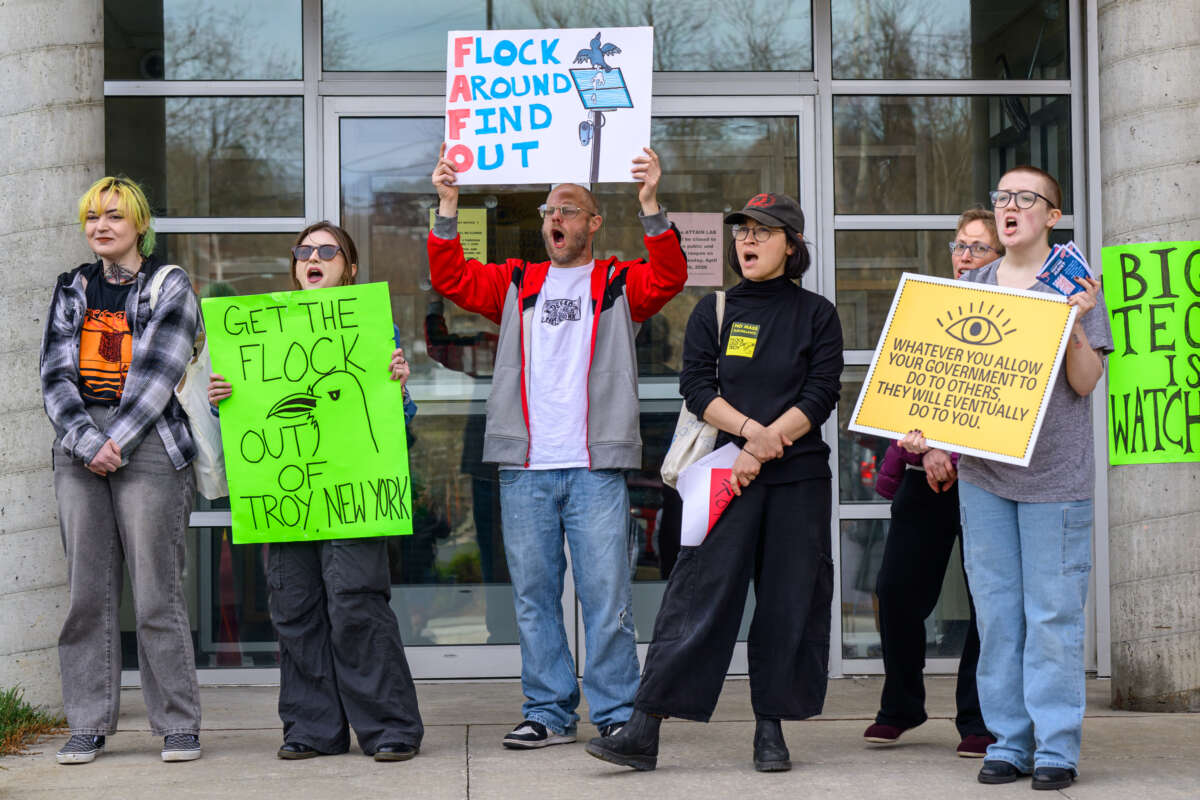
As spying becomes big business, more people are mobilizing to resist mass surveillance.

A Flock Safety automated license plate reader is seen in Aurora, Colorado on June 27, 2024.
(Photo by Tony Webster/flickr/cc)
Tim Karr
Sep 03, 2026
Common Dreams
For many, Labor Day signifies a time of transition, the end of summer and the return to business as usual, whether it be school or work. But the holiday weekend was born out of a more radical past, and at a place charged with a history of protest and free expression.
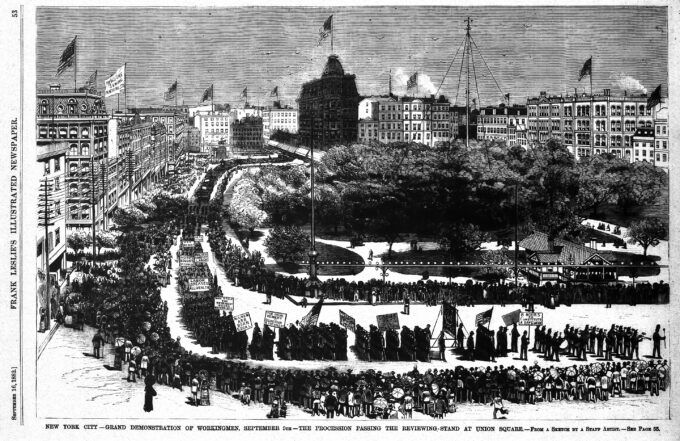
On September 5, 1882, more than 10,000 workers sacrificed a day’s pay to march on Union Square and demand an eight-hour workday and an end to child labor. The success of their protest paved the way for Labor Day to become a federal holiday in 1894.
Initially a gated garden enclave for New York’s wealthiest, architects Frederick Law Olmsted and Calvert Vaux redesigned Union Square in 1872 as an open plaza for public assembly and patriotic demonstration.
By the beginning of the 20th century, Union Square became the epicenter of radical American politics, a setting for protests by anarchists and socialists. Noted activist Emma Goldman frequently used the public plaza to challenge government censorship and advocate for women’s reproductive rights and free speech.
Fenced in by Surveillance Technology
Today, however, Union Square has been fenced in by a barricade of a different sort. Ringing the plaza is a spiky array of cameras, installed on streetlights by a New York Police Department seeking to surveil New Yorkers and anyone else who happens by the square.
The cameras include automatic license-plate recognition technology, which captures data on every car that passes the square down Broadway or across busy 14th Street.
Whether you’re driving to the grocery store for a quart of milk or attending a local No Kings protest, odds are that law enforcement has recorded, processed, and archived your activities for future reference.
Such setups are so ubiquitous to cities and major intersections that they’re easy to dismiss as normal features of a busy streetscape. But that’s changing.
The company that produces many of these surveillance cameras—Flock Group Inc.—has become a focus of concern among activists, advocates, and people of every political stripe who don’t want law enforcement documenting and archiving their every activity.
For many, Labor Day signifies a time of transition, the end of summer and the return to business as usual, whether it be school or work. But the holiday weekend was born out of a more radical past, and at a place charged with a history of protest and free expression.
On September 5, 1882, more than 10,000 workers sacrificed a day’s pay to march on Union Square and demand an eight-hour workday and an end to child labor. The success of their protest paved the way for Labor Day to become a federal holiday in 1894.
Initially a gated garden enclave for New York’s wealthiest, architects Frederick Law Olmsted and Calvert Vaux redesigned Union Square in 1872 as an open plaza for public assembly and patriotic demonstration.
By the beginning of the 20th century, Union Square became the epicenter of radical American politics, a setting for protests by anarchists and socialists. Noted activist Emma Goldman frequently used the public plaza to challenge government censorship and advocate for women’s reproductive rights and free speech.
Fenced in by Surveillance Technology
Today, however, Union Square has been fenced in by a barricade of a different sort. Ringing the plaza is a spiky array of cameras, installed on streetlights by a New York Police Department seeking to surveil New Yorkers and anyone else who happens by the square.
The cameras include automatic license-plate recognition technology, which captures data on every car that passes the square down Broadway or across busy 14th Street.
Whether you’re driving to the grocery store for a quart of milk or attending a local No Kings protest, odds are that law enforcement has recorded, processed, and archived your activities for future reference.
Such setups are so ubiquitous to cities and major intersections that they’re easy to dismiss as normal features of a busy streetscape. But that’s changing.
The company that produces many of these surveillance cameras—Flock Group Inc.—has become a focus of concern among activists, advocates, and people of every political stripe who don’t want law enforcement documenting and archiving their every activity.
Spying on the Haystack
But Flock is not alone. Surveilling everyday Americans is now a multibillion-dollar business that’s growing fast.
Flock has struck license-plate reading camera contracts with 7,000 law-enforcement agencies, accounting for 40% of all such departments nationwide. There are more than 130,000 of these cameras deployed across 49 states, likely at a busy intersection or gathering point near you.
Whether you’re driving to the grocery store for a quart of milk or attending a local No Kings protest, odds are that law enforcement has recorded, processed, and archived your activities for future reference.
The philosophy behind such mass surveillance is that authorities need to capture data on everyone’s movements to identify those few who step out of line. It’s as though you need to know the habits of every blade of grass in the haystack to cull out the one wayward needle.
If that’s not disturbing enough, there have also been extensive reports of abuse, including local police officers deploying department surveillance technology to stalk romantic interests—including strangers—while innocent people have been thrown in jail based on a misread license plate or an inaccurate biometric scan.
“The constant and ongoing surveillance of people in public places raises serious First and Fourth Amendment concerns,” says Jenna Ruddock, Free Press’ advocacy director. “Even decisions about where to install these cameras map onto well-established practices of racist policing, aside from the fact that facial-detection technology has an alarming track record when attempting to identify people of color.”
Mass Surveillance Is Big Business
Still, more major tech companies are getting in on the expanding surveillance business. Powerful artificial intelligence companies are marketing AI-enabled video analytics with facial-recognition capacities for real-time threat detection (think Minority Report).
And while Meta doesn’t directly market its Ray-Ban smart glasses to law enforcement, local police departments and immigration agencies have been buying them in bulk via Amazon.
For its part, Amazon is chasing multimillion-dollar contracts to provide law enforcement with cloud infrastructure for data storage, analytics, and biometric systems, including more than $250 million from the Department of Homeland Security to host many of the databases and systems used to track, monitor, and deport immigrants.
Though he once promised that he wouldn’t allow anyone to use company technology to harm people, Google CEO Sundar Pichai is now seeking to profit from mass surveillance. The company is already doing business with Immigration and Customs Enforcement while vying with Amazon and other tech giants for government cloud-computing contracts. Google is also under contract to provide the tech at the center of federal projects to upgrade the “virtual wall” that surveils US borders.
Lost to the Surveillance State
As more cameras sprout up in more locations, the movement to oppose such government spying is spreading. Dozens of cities across the country have cut ties with Flock over their residents’ data-privacy concerns. People have flocked to public hearings and city council meetings to pressure local elected officials to turn the cameras off. Some have taken matters into their own hands, covering nearby Flock and other surveillance cameras with trash bags—or even cutting down camera-attached light poles with electric saws.
DeFlock, an anti-surveillance activist group, has been mapping locations of Flock and other cameras nationwide. (This author used this tool to identify the many non-Flock surveillance cameras surrounding Union Square).
In August, privacy advocates organized the DeFlock National Week of Action, which featured a series of protests, town halls, and informational events to oppose automated license-plate readers and other mass surveillance technology.
The pushback against local surveillance cameras is occurring alongside the fast-spreading movement to stop the unchecked construction of data centers. There’s a common culprit in both popular uprisings: the unholy alliances struck between Big Tech and government. Others are rightfully suspicious of the billionaire class pushing the rapid, reckless development of advanced AI and surveillance tools without first seeking the consent of surrounding communities.
In Union Square on a recent Monday, I asked local busker Lawrence Kidwell whether he knew what all of the nearby police cameras were about. “The NYPD just wants to listen to my music,” he said.
Perhaps. But the cameras are also in place to discourage other forms of expression and muzzle voices of dissent. Something that Union Square has long welcomed may become lost to the new deprivations of the surveillance state.
This piece was originally published at Pressing Issues.
Our work is licensed under Creative Commons (CC BY-NC-ND 3.0). Feel free to republish and share widely.
Tim Karr
Tim Karr is a senior director at Free Press, the U.S.-based organization that advocates for more just and democratic media.
Full Bio >
It’s Not Just Flock. Police Can’t Be Trusted With Our Data.
An Illinois State Police database available online listed personal information, including Social Security numbers.
By Brian Dolinar ,
A growing movement has been campaigning against surveillance cameras from companies like Flock Safety, which allow local police to gather mass surveillance data, often citing the possibility of misuse of that data. But for years police have steadily been building a digital infrastructure with personal information on people with criminal backgrounds in the name of public safety — and often without proper digital security
Since 2020, the state police in Illinois have maintained a publicly accessible online map of 30,000 people that it has labeled as “offenders” in 685 nursing homes across the state. The map included the first and last names, dates of birth, home addresses, phone numbers, FBI numbers, and Social Security numbers of people listed. These are elderly people who are vulnerable to scammers. It’s not stated what they have been convicted of. They may have a drug charge from decades ago before marijuana was legalized in Illinois, but their past still follows them.
Matt Chapman, a researcher with the Chicago-based Lucy Parsons Labs, stumbled across the map when he was researching license plate readers maintained by the Illinois State Police (ISP). “Anybody can find this,” Chapman told Truthout. “Anybody can use this for nefarious purposes.”
“Why do these agencies have all this information?” Chapman questioned. “Why are they not protecting it? It really speaks to the lack of care that Illinois State Police have for the information of sensitive folks — the people they’re supposedly supposed to protect.”
Registries, Databases, and Shackles
As police build an increasingly sophisticated surveillance apparatus, they have been shown to be poor stewards of the mass amounts of information they collect on the public. Police have also wrongly entered people into gang databases. In 2020, a scandal erupted in Los Angeles after cops there falsified records in a gang database, which led to the suspension of several officers with the city’s police department. Last year, Kilmar Abrego Garcia was sent to CECOT, the mega-prison in El Salvador, after Immigration and Customs Enforcement accessed information from a disgraced Maryland cop who put him into a gang database linking him to M-13 for wearing a hoodie and Chicago Bulls baseball cap.
What DeFlock? A Week of Action Confronts the AI Surveillance State
A Kansas activist discovered that police tracked him with Flock-style cameras after he wrote an op-ed criticizing them. By Mike Ludwig , Truthout/TheAppeal August 19, 2026
In 2021, Protocol, a company owned by BI Incorporated (a subsidiary of the private prison builder GEO Group), which supplies the Cook County Sheriff’s Office with electronic monitors, leaked the personal information of thousands of people across Chicago wearing the devices, what expert James Kilgore calls “ankle shackles.” Chapman, who also uncovered this data leak, said it included “an enormous amount of private information,” such as names, email and home addresses, and the “detailed movement schedules” of people on these digital tracking devices.
“Any scammer could have an absolute field day with this data.”
States have been expanding the use of registries to track individuals — most commonly people convicted of sexual offenses, but also those found guilty of murder, arson, methamphetamine production, and other crimes. In Kansas City, a multi-jurisdictional police operation recently rounded up nearly 100 people on the state sex offender registry who were living within 1,000 feet of a school, which is a violation. Police claimed they were protecting children heading back to school. Thirty years after they were first established, research shows there is little proof that registries make people safer.
Last year, a company that sells an app to monitor the phones of people convicted of sex offenses had the information publicly leaked in what a hacker called “one of the easiest” breaches they had ever done.
Formerly Incarcerated People Still Have Rights
The map of 30,000 names, which the Illinois State Police took down after being notified about it by Truthout, was an interactive map of nursing homes across the state. Nursing home facilities in Illinois are mandated by law to do background screenings and notify the Illinois Department of Public Health (IDPH) of what are referred to as “identified offenders.” The department is then supposed to alert the Illinois State Police, who conduct an investigation and assess the risk.
Alan Mills, an attorney at Kaplan & Grady who advocates for incarcerated and formerly incarcerated people, told Truthout: “That has meant that a lot of nursing homes simply won’t take anybody with a criminal history, and that has been a real serious problem for people getting out of prison.”
“The sharing of private information about thousands of Illinois nursing home residents is a violation of state law.”
To his knowledge, there is no stipulation that this personal information be made publicly available — and especially no justification for publicizing Social Security numbers. “That sounds completely outrageous and has nothing to do with public safety,” said Mills.
As the IDPH website states, the program is ostensibly meant to “prevent abuse and promote the safety” of its residents and staff. The release of this private data about “identified offenders” raises the question — what about the safety and abuse of those with criminal histories who are living in nursing homes?
“Convicted felons still deserve privacy rights,” said Cooper Quintin, Senior Staff Technologist with the Electronic Frontier Foundation. The list includes people who were born in the 1940s — far more likely to struggle with technology and be vulnerable to harm, rather than causing it themselves. “Any scammer could have an absolute field day with this data,” Quintin told Truthout.
“They haven’t even taken the basic steps here to secure this data,” said Quintin. “It’s open on the internet to anyone, and that’s just incredibly irresponsible.”
“Trust Us”
This breach could be dismissed as a clerical mistake. It could be claimed that laws are failing to keep up with increasingly sophisticated technology. But this pretty simple violation throws into question whether police can be trusted with our information.
In an email to Truthout, Benjamin Ruddell, a lawyer and director of criminal justice policy at the ACLU of Illinois, stated:
The sharing of private information about thousands of Illinois nursing home residents is a violation of state law. Illinois residents should be able to trust that ISP would take seriously its legal duty to secure personal information that could be exploited to do real harm — including identity theft, stigmatization, fraud, or harassment of thousands of people across the state. In recent years, we have been told repeatedly that we must trust law enforcement with ever-increasing surveillance capabilities — often enabled with artificial intelligence — to collect an ever-increasing volume of data about all of us to enhance public safety. This example shows that their mishandling of this surveillance data has the potential to make people less, not more, safe.
“The Illinois State Police … should immediately halt its expansion of its statewide surveillance infrastructure.”
Truthout reached out to inform Illinois State Police about the map, and the Illinois State Police responded to the data breach by immediately removing the map from their website. According to the Illinois Personal Information Protection Act, any state agency that collects personal information on an Illinois resident must notify them of a data breach within 45 days and provide notice to the attorney general.
When asked for comment, Melaney Arnold, the chief public information officer for the Illinois State Police, told Truthout: “This specific dashboard was initially created as part of an internal pilot data source and it was not intended for public dissemination. The data has been decommissioned and is no longer accessible to the public. ISP is in the process of notifying impacted parties.”
“With how trivial it was to find,” said Chapman, who is the first known person to have found the information online, “it fills me with dread knowing that the Illinois State Police have no idea what information it’s exposing to the public — they’re simply not looking. ISP should immediately halt its expansion of its statewide surveillance infrastructure and any agency in Illinois that works with ISP should truly reconsider whether their trust in a such a reckless agency is justified.”
This article is licensed under Creative Commons (CC BY-NC-ND 4.0), and you are free to share and republish under the terms of the license.

Brian Dolinar
Brian Dolinar is an independent journalist based in Urbana, Illinois. His articles have appeared at The Appeal, In These Times, The Nation, and Truthout. You can follow his stories by subscribing to his Substack newsletter called “Sentences.”
An Illinois State Police database available online listed personal information, including Social Security numbers.
By Brian Dolinar ,
September 3, 2026
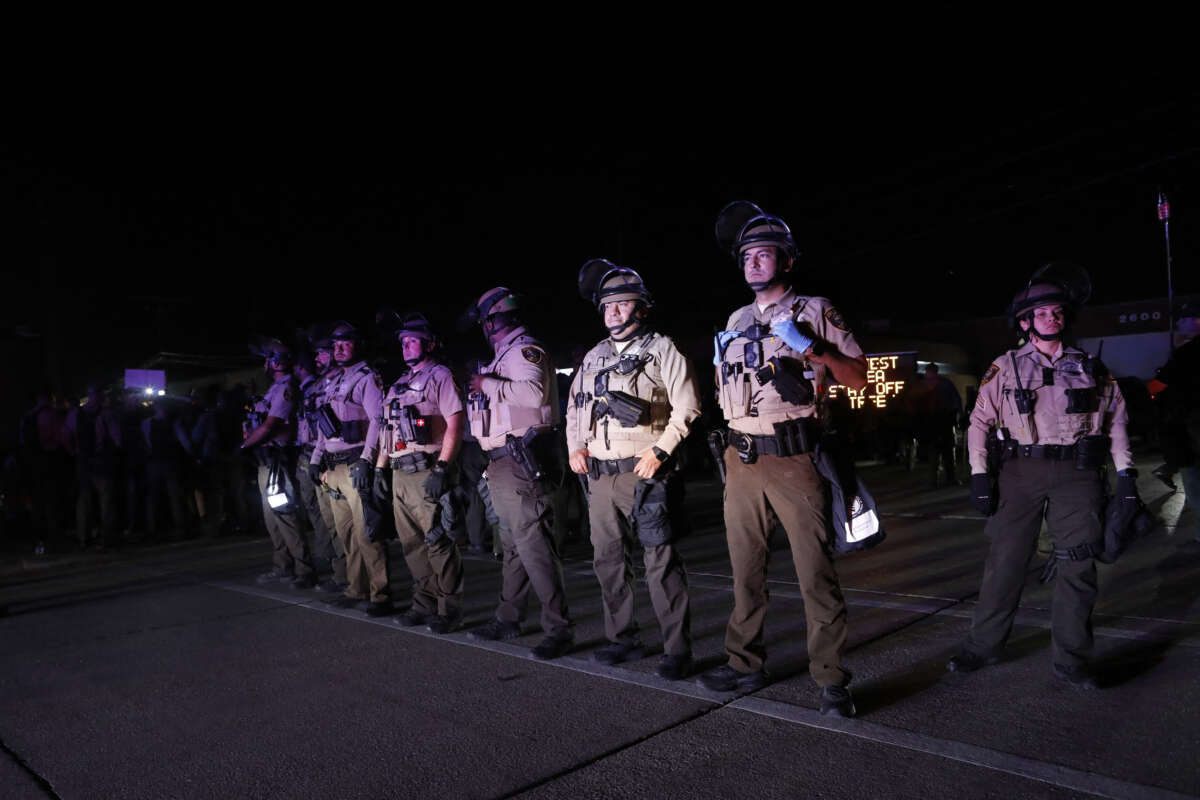
Illinois State Police stand guard while monitoring protesters gathering near an Immigration and Customs Enforcement facility in Broadview, Illinois, on October 4, 2025.OCTAVIO JONES / AFP via Getty Images
A growing movement has been campaigning against surveillance cameras from companies like Flock Safety, which allow local police to gather mass surveillance data, often citing the possibility of misuse of that data. But for years police have steadily been building a digital infrastructure with personal information on people with criminal backgrounds in the name of public safety — and often without proper digital security
Since 2020, the state police in Illinois have maintained a publicly accessible online map of 30,000 people that it has labeled as “offenders” in 685 nursing homes across the state. The map included the first and last names, dates of birth, home addresses, phone numbers, FBI numbers, and Social Security numbers of people listed. These are elderly people who are vulnerable to scammers. It’s not stated what they have been convicted of. They may have a drug charge from decades ago before marijuana was legalized in Illinois, but their past still follows them.
Matt Chapman, a researcher with the Chicago-based Lucy Parsons Labs, stumbled across the map when he was researching license plate readers maintained by the Illinois State Police (ISP). “Anybody can find this,” Chapman told Truthout. “Anybody can use this for nefarious purposes.”
“Why do these agencies have all this information?” Chapman questioned. “Why are they not protecting it? It really speaks to the lack of care that Illinois State Police have for the information of sensitive folks — the people they’re supposedly supposed to protect.”
Registries, Databases, and Shackles
As police build an increasingly sophisticated surveillance apparatus, they have been shown to be poor stewards of the mass amounts of information they collect on the public. Police have also wrongly entered people into gang databases. In 2020, a scandal erupted in Los Angeles after cops there falsified records in a gang database, which led to the suspension of several officers with the city’s police department. Last year, Kilmar Abrego Garcia was sent to CECOT, the mega-prison in El Salvador, after Immigration and Customs Enforcement accessed information from a disgraced Maryland cop who put him into a gang database linking him to M-13 for wearing a hoodie and Chicago Bulls baseball cap.
What DeFlock? A Week of Action Confronts the AI Surveillance State
A Kansas activist discovered that police tracked him with Flock-style cameras after he wrote an op-ed criticizing them. By Mike Ludwig , Truthout/TheAppeal August 19, 2026
In 2021, Protocol, a company owned by BI Incorporated (a subsidiary of the private prison builder GEO Group), which supplies the Cook County Sheriff’s Office with electronic monitors, leaked the personal information of thousands of people across Chicago wearing the devices, what expert James Kilgore calls “ankle shackles.” Chapman, who also uncovered this data leak, said it included “an enormous amount of private information,” such as names, email and home addresses, and the “detailed movement schedules” of people on these digital tracking devices.
“Any scammer could have an absolute field day with this data.”
States have been expanding the use of registries to track individuals — most commonly people convicted of sexual offenses, but also those found guilty of murder, arson, methamphetamine production, and other crimes. In Kansas City, a multi-jurisdictional police operation recently rounded up nearly 100 people on the state sex offender registry who were living within 1,000 feet of a school, which is a violation. Police claimed they were protecting children heading back to school. Thirty years after they were first established, research shows there is little proof that registries make people safer.
Last year, a company that sells an app to monitor the phones of people convicted of sex offenses had the information publicly leaked in what a hacker called “one of the easiest” breaches they had ever done.
Formerly Incarcerated People Still Have Rights
The map of 30,000 names, which the Illinois State Police took down after being notified about it by Truthout, was an interactive map of nursing homes across the state. Nursing home facilities in Illinois are mandated by law to do background screenings and notify the Illinois Department of Public Health (IDPH) of what are referred to as “identified offenders.” The department is then supposed to alert the Illinois State Police, who conduct an investigation and assess the risk.
Alan Mills, an attorney at Kaplan & Grady who advocates for incarcerated and formerly incarcerated people, told Truthout: “That has meant that a lot of nursing homes simply won’t take anybody with a criminal history, and that has been a real serious problem for people getting out of prison.”
“The sharing of private information about thousands of Illinois nursing home residents is a violation of state law.”
To his knowledge, there is no stipulation that this personal information be made publicly available — and especially no justification for publicizing Social Security numbers. “That sounds completely outrageous and has nothing to do with public safety,” said Mills.
As the IDPH website states, the program is ostensibly meant to “prevent abuse and promote the safety” of its residents and staff. The release of this private data about “identified offenders” raises the question — what about the safety and abuse of those with criminal histories who are living in nursing homes?
“Convicted felons still deserve privacy rights,” said Cooper Quintin, Senior Staff Technologist with the Electronic Frontier Foundation. The list includes people who were born in the 1940s — far more likely to struggle with technology and be vulnerable to harm, rather than causing it themselves. “Any scammer could have an absolute field day with this data,” Quintin told Truthout.
“They haven’t even taken the basic steps here to secure this data,” said Quintin. “It’s open on the internet to anyone, and that’s just incredibly irresponsible.”
“Trust Us”
This breach could be dismissed as a clerical mistake. It could be claimed that laws are failing to keep up with increasingly sophisticated technology. But this pretty simple violation throws into question whether police can be trusted with our information.
In an email to Truthout, Benjamin Ruddell, a lawyer and director of criminal justice policy at the ACLU of Illinois, stated:
The sharing of private information about thousands of Illinois nursing home residents is a violation of state law. Illinois residents should be able to trust that ISP would take seriously its legal duty to secure personal information that could be exploited to do real harm — including identity theft, stigmatization, fraud, or harassment of thousands of people across the state. In recent years, we have been told repeatedly that we must trust law enforcement with ever-increasing surveillance capabilities — often enabled with artificial intelligence — to collect an ever-increasing volume of data about all of us to enhance public safety. This example shows that their mishandling of this surveillance data has the potential to make people less, not more, safe.
“The Illinois State Police … should immediately halt its expansion of its statewide surveillance infrastructure.”
Truthout reached out to inform Illinois State Police about the map, and the Illinois State Police responded to the data breach by immediately removing the map from their website. According to the Illinois Personal Information Protection Act, any state agency that collects personal information on an Illinois resident must notify them of a data breach within 45 days and provide notice to the attorney general.
When asked for comment, Melaney Arnold, the chief public information officer for the Illinois State Police, told Truthout: “This specific dashboard was initially created as part of an internal pilot data source and it was not intended for public dissemination. The data has been decommissioned and is no longer accessible to the public. ISP is in the process of notifying impacted parties.”
“With how trivial it was to find,” said Chapman, who is the first known person to have found the information online, “it fills me with dread knowing that the Illinois State Police have no idea what information it’s exposing to the public — they’re simply not looking. ISP should immediately halt its expansion of its statewide surveillance infrastructure and any agency in Illinois that works with ISP should truly reconsider whether their trust in a such a reckless agency is justified.”
This article is licensed under Creative Commons (CC BY-NC-ND 4.0), and you are free to share and republish under the terms of the license.
Brian Dolinar
Brian Dolinar is an independent journalist based in Urbana, Illinois. His articles have appeared at The Appeal, In These Times, The Nation, and Truthout. You can follow his stories by subscribing to his Substack newsletter called “Sentences.”