Monday, July 27, 2026

Argentina

The Malvinas and the National Question


Monday 27 July 2026, by Martí­n Mosquera


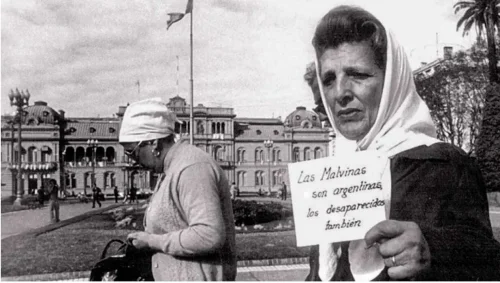
A banner at the World Cup reopened a debate that goes beyond the Malvinas/Falklands issue. Faced with an internationalism that underestimates imperial hierarchies and an anti-imperialism that erases the class struggle, the left needs to recover a democratic conception of nation, sovereignty, and internationalism. [1]

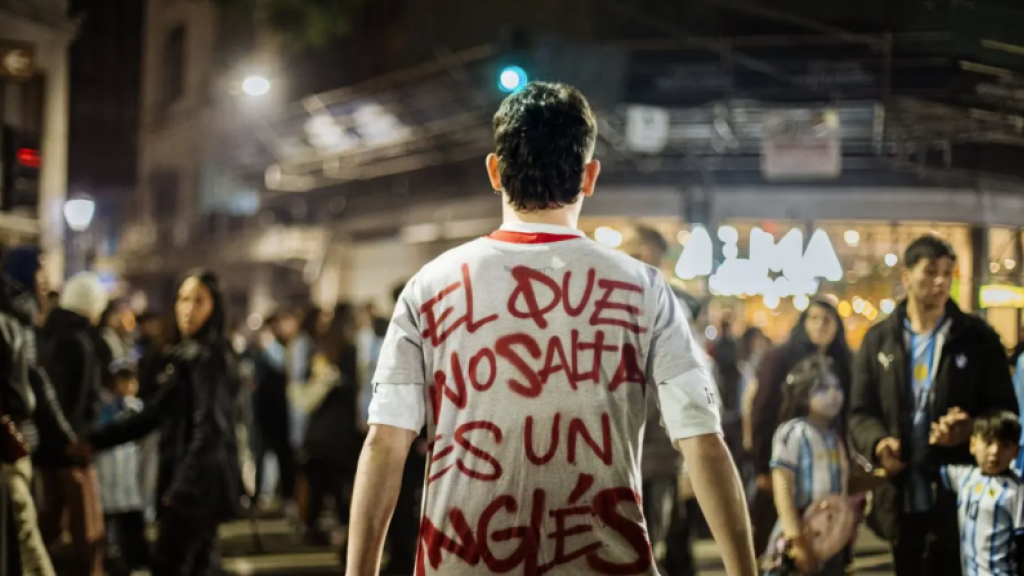
The World Cup semi-final between Argentina and England produced an unexpected scene. At the final whistle, several Argentine players unfurled a banner on the pitch that read “Las Malvinas son argentinas (The Falkland Islands are Argentine.)” The gesture was surprising coming from a team that, in recent years, had at best shown apathy towards politics and, in the few public statements made by some of its members, had often been openly right-wing.

This time, however, the players defied an explicit FIFA ban, which had prevented the entry of flags and symbols linked to the Malvinas, a measure supported by the far-right Argentine government itself. Milei, who like any president hoped to benefit from the atmosphere of optimism created by a sporting victory of that magnitude, suddenly found himself uncomfortable with the political turn the celebrations had taken. After the display of the flag, he went so far as to call the players “one-track minded,” in a reaction typical of his excessive nature.

The players knew they could face sanctions, as FIFA indeed began to consider after the match. But they grasped something fundamental: against England, the Malvinas resonated with a popular sentiment that predated the game and extended far beyond football.

Upon seeing this image, Bhaskar Sunkara, founder of Jacobin in the United States, observed that “The Malvinas are Argentine” had been the slogan of a military dictatorship that murdered thousands of activists and sought to save itself through an irredentist adventure. He argued that there had never been a displaced native population and that, in any case, it was a matter of two equally colonial states disputing a territory. He added that the will of the islanders should be respected and that the left should not get lost in an unnecessarily nationalistic stage of the political struggle.

The Argentine responses were immediate, massive, and often aggressive. Many went beyond questioning their interpretation of the Malvinas/Falklands issue. They denied the existence of a left wing in the United States or Europe that is not, ultimately, an instrument of imperialism. In the relatively moderate version, the American left would be merely an appendage of the Democratic Party; in the most rudimentary, an extension of the CIA. I will return to this reaction later, as it reveals a different, though complementary, problem to Bhaskar’s error. First, it is necessary to establish the basic elements of the Argentine claim.

A colonial issue

Bhaskar’s position stems from a misinterpretation of the Argentine claim. In 1833, the United Kingdom occupied the islands by force, expelled the authorities and the core population of gauchos, Creoles, [2] and workers established under the jurisdiction of Buenos Aires, and instituted a colonial administration that Argentina never recognised. Since 1965, the UN itself has considered this to be an outstanding case of decolonisation and does not recognise the kelpers (islanders) [3] as a people with the right to settle the dispute through self-determination.

The kelpers are not an indigenous population, but a community formed under the occupying power and whose composition was shaped by it. To make the demographic outcome of colonisation the foundation of sovereignty would be tantamount to recognising the completed colonial act as a source of law. The criminal war of 1982 neither created nor nullified Argentina’s claim; it merely allowed the dictatorship to attempt to appropriate a cause that predated it.

Nor are we dealing with a mere cartographic relic. The Malvinas Islands are a British military enclave in the South Atlantic. The Mount Pleasant complex houses air, naval, and land infrastructure and forms part of the overseas military apparatus of one of NATO’s major powers. Its position facilitates British power projection in the South Atlantic and access to Antarctica.

Territorial control also allows for the management of fishing, maritime, and hydrocarbon resources. The Falklands/Malvinas issue thus encompasses territory, military force, resources, and strategic position. It is not merely a dispute inherited from the 19th century, but a still-active colonial relationship.

None of this alone explains the unique place the Malvinas occupy in Argentine political culture. While numerous territorial disputes survive only in diplomatic archives, the Falklands/Malvinas issue has transcended governments, generations, and very diverse political cleavages. It has long since ceased to be merely an occupied territory, becoming instead the focal point of multiple unmet demands, articulated around the aspiration for a still incomplete national sovereignty.

Socialism and the national question

The issue of the Malvinas, therefore, transcends the territorial dispute. It compels us to revisit a question that socialist politics has still insufficiently explored: what meaning does the nation and national demands have today for an emancipatory project?

For much of the 20th century, the nation occupied a central place in Marxist thought. The controversies between Lenin, Rosa Luxemburg, and Austro-Marxism, Gramsci’s elaboration on the national-popular, or anti-colonial theories all stemmed from a shared assumption: the nation constituted a political reality that could not be ignored. This debate, however, gradually faded over the decades.

The nation does not have a political content fixed in advance. Nations do not act or speak. There are always social forces that speak on their behalf, dispute their representation and try to identify their own interests with those of the group. The nation does not constitute a homogeneous subject. It is the terrain on which a struggle to define the general interest is waged.

The Austro-Marxist Otto Bauer defined the nation as a “community of character” historically formed by a “community of destiny.” The emphasis was on material history, not on nature. The nation is not a race, a language, or an immutable essence, but the sediment of a shared experience. Bauer understood the nation as the historical space in which profoundly different groups, united by the material conditions of their common life, forge an intertwined culture and destiny.

In this sense, the nation should not be understood primarily as a cultural identity. It is, above all, the historical form that the aspiration to democratic self-government takes. Globalisation has not altered this fact. Rights, citizenship, political representation, taxation, public goods, and distributive conflicts continue to be organised, in essence, within national communities. The nation is not the ultimate horizon of emancipation, but it remains the primary scale at which societies attempt to govern themselves.

In a similar vein, Gramsci shifted the discussion from national identity to hegemony. The crucial question is not what the nation expresses, as if it possessed a voice of its own, but rather what force manages to construct a collective will capable of presenting itself as national. The term “national-popular” designates the process by which initially particular interests are transformed into a project for organising the entire society. The nation ceases to be a static tradition and becomes a political construct.

That is why it is wrong to hand over patriotism to the right, as Jacopo Custodi has pointed out. Withdrawing from the national sphere allows others to occupy one of the most resilient sentiments of modern societies and define common belonging in ethnic, authoritarian, or exclusionary terms. The risk is even greater in a context of crisis of partisan and ideological identities, when the nation retains a capacity to engage that other forms of belonging have lost.

The Malvinas then take on a different meaning. They do not merely represent the return of some islands. They embody the aspiration of a political community to collective self-determination. Its persistence stems from a historical experience: the widespread perception that fundamental decisions about the country are too often made outside of it. “In” Gramscian terms, this perception contains a kernel of common sense, even if it appears imperfectly formulated. Unpopular decisions are not made solely by external powers, but also by a local ruling class that actively participates in these relations of subordination. But this kernel still offers a point of reference within the realm of common sense for a socialist policy.

Imperialism after Lenin

The importance of the Malvinas/Falklands issue thus points to the unequal relationship between a military and colonial power and a peripheral society. Classical theory on imperialism (Hilferding, Bukharin, Lenin) correctly demonstrated that capitalism does not produce a homogeneous world market, but rather a hierarchy of states with highly unequal economic, political, and military capabilities. But that theory is insufficient today. Concentration and monopolies did not eliminate competition; the export of capital does not in itself imply stagnation in the periphery; capitalism did not enter a phase of definitive exhaustion; and rivalry between powers does not inevitably lead to direct wars, as shown by a postwar period without inter-imperialist conflagrations comparable to those of the first half of the 20th century. Many of these weaknesses led some Marxists (from Hardt and Negri to William I. Robinson) to consider the very category of imperialism outdated. But the limitations of classical theory do not imply that imperialism has disappeared; rather, it must be understood differently. Although this would be a topic for another article, I will limit myself to clarifying a few points.

David Harvey proposed a useful distinction between the logic of capitalist accumulation and the territorial logic of states. The former seeks profits, markets, and resources; the latter, strategic control, security, and geopolitical position. Imperialism can be understood as the always unstable point of intersection between the two. An updated theory must retain Lenin’s insight, but recognise that these logics are not identical and have distinct origins: the territorial expansion of states predates capitalism, while bourgeois accumulation responds to competition for profitability. It must also abandon any notion of the definitive exhaustion of capitalism. Imperialism thus designates the variable interplay between the global expansion of capital and competition within an unequal system of states.

The Malvinas make this connection visible. The British military enclave, its projection over the South Atlantic and Antarctica, respond to a geopolitical logic; the control of fishing, maritime, and hydrocarbon resources, to a logic of accumulation. The occupation persists because both dimensions reinforce each other.

Fake anti-imperialism

The reactions to Bhaskar’s comment highlighted a reverse problem. An old idea within Argentine conservative nationalism holds that in the core countries there is no true left, but only different political variants of imperialism.

The thesis, of course, lacks historical support. Since the 19th century, the working classes of Europe and the United States have built trade unions, socialist parties, communist organisations, and movements against war and colonialism. Some of the largest contemporary campaigns of international solidarity have also emerged from within these societies and against their own governments - from the mobilisations against the invasion of Iraq to the current movement in support of Palestine.

Behind this supposedly anti-imperialist denial, a familiar topic reappears: left and right are foreign categories, incapable of capturing Argentina’s uniqueness. This "exceptionalism" often recycles the anti-communist clichés of right-wing nationalism: Marxism as an imported doctrine and the conviction that all left-wing movements in core countries ultimately end up being a political expression of their own imperialism. The journey is undeniably paradoxical. It begins by denying the existence of a left wing in the United States or Europe and ends by questioning the very distinction between left and right. Those who deny the existence of a genuine left in developed countries end up denying the left itself, even in their own country, and emptying anti-imperialism of its meaning, which requires internationalism and solidarity among the struggles of different peoples. As Alain Touraine ironically observed, when someone claims that left and right no longer exist, they are most likely right-wing.

The political effect is clear. If the nation constitutes a homogeneous unit facing external enemies, an alliance with some faction of the local bourgeoisie or with a right wing that proclaims itself patriotic appears as a natural consequence. Outside, everyone is an imperialist; inside, everyone is a brother. The most simplistic nationalism replaces the class struggle.

It is very common in these debates to invoke the name of José Carlos Mariátegui [4] against Marxism originating from developed countries. His formula "neither imitation nor copy" is often repeated like a mantra to distrust any category produced outside of Latin America. But Mariátegui, an author far more often cited than read, as Martín Bergel insists, was the exact opposite of a thinker confined to Peruvian particularity. He analysed his country in dialogue with the best of Marxism and European culture of his time. His originality did not arise from isolation, but from a cosmopolitan and creative appropriation. “Neither a copy nor an imitation” meant critical translation, not confining oneself to Latin American particularity.

Anti-imperialism and class struggle are not mutually exclusive. Some erase the former and reduce the world to an abstract opposition between capitalists and workers. Others erase the latter and transform the nation into a unified entity devoid of antagonisms. The former fail to distinguish between an imperial power and a subordinate society. The latter erase the class struggle in the name of anti-imperialism and subordinate the popular classes to the local bourgeoisie or a nationalist right wing in the name of national interest.

Sovereignty as a democratic undertaking

The Malvinas matter because, in a peripheral country, they embody deeply rooted aspirations for national and popular sovereignty. That undertaking goes beyond territorial restitution. It includes control of resources, the capacity to resist external pressures, and the possibility of organising collective life without imperial tutelage. These are precisely the dimensions that a far-right government, unconditionally aligned with the United States, jeopardises.

This does not make every national claim progressive. The national question is always a terrain of dispute. It can take militaristic, xenophobic, or authoritarian forms. It can be instrumentalised for reactionary ends, as happened when the dictatorship tried to appropriate the Malvinas banner in 1982. But it can also become the political language of a demand for democratic emancipation.
That is precisely the political significance of the Malvinas in contemporary Argentina. It expresses the deeply rooted perception that the country’s sovereignty remains incomplete. That is why the flag unfurled by the players after the match against England found a much broader consensus than any government or political force. It represented a shared historical experience.

The Malvinas survived the dictatorship because they never truly belonged to it. The Junta attempted to appropriate a cause that predated it, but failed to definitively define its meaning. Reducing the claim to the 1982 military adventure is, paradoxically, tantamount to accepting that the dictatorship was able to transform the Malvinas into the exclusive domain of its reactionary nationalism.

The task of an internationalist left is not to abandon this terrain, but to contest it. It must link national sovereignty with popular sovereignty, anti-imperialism with the class struggle, and democratic patriotism with solidarity among peoples. As long as imperialist relations exist, the national question will remain one of the fundamental forms that the struggle for democracy and socialism takes.

19 July 2026

Translated and annotated by David Fagan for International Viewpoint from Jacobin América Latina.

Footnotes

[1] Photo: Amado Becquer Casaballe / Archivo General de la Nación

[2] Gauchos are skilled horsemen of Argentina, Uruguay and other countries and form part of the national folklore of those areas similar to the cowboy in USA. The word Creole (criollo in Spanish) originally referred to people of Spanish descent born in the areas of the “New World” under the Spanish crown. It now is more commonly used to refer to the locally born.

[3] "Kelpers" is a nickname given to Falkland Islanders because the islands are surrounded by large amounts of kelp.

[4] José Carlos Mariátegui, born June 14, 1894, died April 16, 1930 was a Peruvian born Marixist writer and acrivist considered one of the key theorists of an essential Marxist understanding of Latin American reality.

 WORLD CUP

How social media invented the ‘world’s most racist country’

Argentina world cup racism

First published in Spanish at Revista Jacobin. Translation by Federico Fuentes for LINKS International Journal of Socialist Renewal.

During the recent World Cup, the clash between national teams quickly escalated into an international campaign against Argentina. A diverse range of figures, from musicians Rosalía and Patti Smith to actor Samuel L Jackson, former Greek finance minister Yanis Varoufakis and writer and activist Etan Thomas, joined the mass condemnation of Argentina's alleged exceptional racism. This was amplified by social media and much of the Western press, both conservative and progressive. Support for Argentina’s opponents was presented as an anti-racist cause, with Argentine society reduced to a caricature of a white, xenophobic and supremacist society.

Gabriel Vera Lopes spoke to Argentine socialist and Revista Jacobin editor-in-chief Martín Mosquera to analyse the emotional and political origins of the campaign, discuss the reality of racism in Argentina and question the role played by some of the global progressive intelligentsia.

What do you make of the global anti-Argentine backlash?

It was quite a striking phenomenon. For a few days, Argentina even appeared on social media as the world’s most hated country, above even the United States. To some extent, none of this should be too surprising. Football stirs up intense national rivalries, and social media amplifies them within an ecosystem dominated by aggression and fake news. But it soon escalated to another level.

What began as a fairly typical reaction to sporting competition grew to encompass a large part of the international media. The right wing revived the old portrayal of the Argentine as a cheating barbarian. After Argentina’s defeat to Spain in the final, for example, Conservative British newspaper The Telegraph ran the headline “Football 1 — Criminals 0”. The match stopped being a sporting contest and became a moral confrontation between Spain’s supposedly civilised style of play and the Argentine’s inherent violence.

Even more surprising was the coverage by progressive or liberal Western media. The New Yorker, The Guardian, The Los Angeles Times and El País — to varying degrees and with different nuances — ran a narrative portraying the tournament as a struggle between a white, racist Argentina and the multiculturalism embodied by European teams. This approach differed from, yet complemented, the conservative one. While some denounced Argentine barbarism, others framed Argentina as expressing racial supremacy.

The scene was, to say the least, paradoxical. When the campaign reached its peak, the semi-final line-up featured three teams from Global North nations, with long colonial histories and well-documented contemporary problems of racism, pitted against a team from a Global South country. Yet a section of the international progressive movement presented support for Spain, England or France as an anti-colonial and anti-racist stance against Argentina.

I think this was a pretty characteristic case of our time. Within a few days, a completely delusional image of Argentina collectively emerged. Perhaps it can be summed up by Samuel L Jackson’s comments, which portrayed Argentina as “one of, if not, the most racist country in the world” and suggested Black people should not support its national team. Jackson is an actor genuinely committed to civil rights living in a country whose history of slavery and segregation still casts a shadow, where deep-rooted traditions of white supremacy persist and hate crimes are common. His words illustrate the extent of the campaign’s distortion.

This was an extremely powerful global cultural apparatus that built on a campaign of harassment originating on, and amplified by, social media. A Global South society such as Argentina has little capacity to influence global public discourse. Countering a narrative of that magnitude proved practically impossible. There were critical voices, but they were a minority and failed to achieve comparable reach. Among those voices were, in fact, many of the very people on whose behalf the campaign supposedly spoke — from Afro-Argentine organisations to Latin American migrant groups. They described experiences very different from the caricature circulating abroad.

I believe the start of all this was far more prosaic than later political rationalisations. The raw material of our behaviour — all of ours — is emotion. Reasons tend to come later, as an alibi or disguise for our passions. And at the heart of this lay a very intense emotion, reignited in the context of the World Cup.

The starting point was many people’s irritation at the Argentine national team’s latest progress, having “endured” its supporters’ arrogance after the 2022 World Cup win in Qatar. There was, quite simply, an emotional rejection of the prospect of another Argentine victory. In Spain, this was likely compounded by the long-standing hostility towards Lionel Messi from a significant section of Real Madrid supporters. For years they had built a sporting and media culture centred on rivalry with the Argentine player who starred for FC Barcelona.

In Latin America, there was a pre-existing anti-Argentine sentiment, linked to its arrogant reputation. Added to this was the frustration of huge nations with far larger budgets and populations. Mexico has a long history of footballing disappointments, while Brazil is enduring the longest World Cup drought in its history, just as its main regional rival enjoys a run of success. Brazil was, in fact, one of the most active focal points of the campaign.

Football is an extraordinary catalyst for emotions and, during a World Cup, it combines with that enigmatic and powerful force of modernity known as national sentiment. The origin of the anti-Argentine phenomenon was largely a mixture of sporting rivalry and wounded pride at the prospect of another Argentine victory. This was all amplified by technology designed to reward aggression and outrage. Social media, and particularly X under Elon Musk’s leadership, functions as a machine to amplify such rhetoric.

Three political rationalisations were built upon this emotional foundation. The first was alleged FIFA favouritism towards Argentina, a conspiracy theory with very little substance. Any favourable refereeing decision was presented as proof of a plot, while mistakes that disadvantaged Argentina or benefited other sides were ignored.

FIFA’s lack of transparency is no surprise to anyone, and was exacerbated by Donald Trump’s influence at a World Cup hosted in the US. That closeness was laid bare when the president intervened to have US player Folarin Balogun’s suspension lifted. Somali referee Omar Abdulkadir Artan’s exclusion was also outrageous, as were highly controversial refereeing decisions, such as those in the match between Croatia and Portugal, with the Croatian Football Federation lodging a formal protest. None of this benefited Argentina. The tournament confirmed the extent to which FIFA is riddled with commercialisation and corruption.

The second issue was the link between Javier Milei’s far-right government and Trump and [Israeli Prime Minister Benjamin] Netanyahu. This Argentine government alignment is a real political orientation, the consequences of which are borne by the country’s population. However, its use in the anti-Argentine campaign was selective and misleading. For example, attention was drawn to Messi’s participation in an official meeting between Inter Miami [for whom he plays in the US] and Trump — a reprehensible act. By contrast, far more personal encounters — such as [English player] Harry Kane golfing with Trump or [Portuguese player] Cristiano Ronaldo’s private visit — did not provoke the same outcry.

While the Argentine national team was condemned for this alleged political closeness, gestures pointing in the opposite direction were ignored. Alongside the beautiful image of Lamine Yamal celebrating with the Palestinian flag [which occurred during FC Barcelona’s celebrations of its league title, not the World Cup — FF], Argentina staged one of the tournament’s few acts of political defiance. Following the semi-final against England, several players unfurled a banner stating “The Falklands are Argentine”, defying an explicit ban by FIFA that was even backed by Milei’s government. The gesture tapped into a deep-seated popular sentiment and exposed the players to potential sanctions. It also caused unease within Argentina’s ruling party, which reacted with hostility. It was a brief but powerful act.

The third theme was racism. On this point, the backlash found a nobler and far more effective justification. The campaign stopped presenting itself as a footballing rivalry, and instead as a moral struggle against a country portrayed as white, colonial, racist, violent and deceitful.

This is not to say Argentina is free from racism. Racism exists, alongside other forms of discrimination and inequality. Various racialised groups, including indigenous peoples, people of African descent and regional migrants, suffer from prejudice and exclusion. And football is one arena where these manifest themselves in an unpleasant and exaggerated way. But reality bears little resemblance to the image constructed by this campaign.

It was truly surprising to read increasingly delusional posts written by people I know, many of whom I am close to and who are intelligent and well-educated. They shared easily debunked fake news making generalisations they would never accept if directed against other peoples. It was also disturbing to observe the growing aggressiveness in language. A Marxist activist among my contacts on X even called for Iran to bomb Buenos Aires. He clearly was not serious, but it showed just how normalised collective hostility became.

The experience was eye-opening. We could observe from the inside how the networks of hate that fuel the far right operate. It all begins with an intense emotion. Then, some true facts taken out of context and mixed with falsehoods were shared within a community that only listens to whatever confirms their preconceptions. In a very short space of time, a completely imaginary reality was constructed and intelligent people were persuaded to repeat it with conviction.

It is not an exaggeration to speak of this as hate speech. It exhibited several characteristic features: it stemmed from heightened emotion, spread via social media, was fuelled by fake news and half-truths, and attributed moral characteristics to an entire population. As is often the case, such stigmatisation had consequences beyond social media, with incidents of aggression against Argentines in Spain, Mexico and Brazil. So far, these have been isolated cases, but they show such narratives are never harmless.

Most strikingly, a section of the left and the global progressive intelligentsia — primarily in Europe and the US — provided the campaign with respectable language and a political justification.

I would say it was hate speech disguised as progressive discourse. A perfectly understandable football rivalry was transformed into a moral condemnation of an entire population, and a section of the international progressive movement granted it political legitimacy.

What is the situation regarding racism in Argentina?

Racism exists in Argentina, but it is not the exceptionally racist society portrayed during this campaign. Both statements must be acknowledged.

There is discrimination against indigenous peoples, people of African descent and migrants from the region. There is selective police violence and a football culture that includes very strong racist and xenophobic expressions. For a long time, moreover, the official narrative portrayed Argentina as a purely white and European nation, downplaying the population’s ethnic and racial diversity.

But if you look beyond impressions and viral incidents to examine institutions, social history and comparative studies, the international caricature starts to crumble.

To begin with, Argentina established one of the most advanced civil rights systems in Latin America. It was the first country in the region to recognise same-sex marriage and full adoption rights for same-sex couples. Its Gender Identity Act allows people to change their registered name and gender without judicial authorisation or medical or psychiatric requirements, and was regarded as globally pioneering legislation. It also recognised migration as a human right and established a relatively open system, granting foreigners access to public services.

Nor did Argentina implement anything comparable to the wall between the US and Mexico or the European border regime in Ceuta and Melilla, where migration containment policies have led to deaths and serious human rights violations under both conservative and social democratic governments. I raise this not to downplay Argentine racism, but because Spain was presented as the embodiment of a multicultural and integrated society, in contrast to a closed and supremacist Argentina. This requires us to brush aside a large part of European reality.

Milei’s government is attacking a considerable part of that institutional framework and promoting a more restrictive and punitive policy. So far, however, its ability to dismantle it has been limited. Its offensive constitutes a regression precisely because there is a particularly advanced tradition of civil rights.

Argentine history also presents significant structural differences. The Assembly of Year XIII was a political assembly convened in Buenos Aires during the Río de la Plata independence movement in the early 19th century. It did not completely abolish slavery, but decreed that the children of enslaved women should be born free and limited the slave trade. Definitive abolition was enshrined in the 1853 Constitution. The US, for its part, abolished slavery in 1865, but maintained legal racial segregation under the Jim Crow laws for almost another century.

The Río de la Plata region’s economy never had a structure centred on slavery comparable to Brazil or the US south. This was not because the Argentine elites were anti-racist; they were openly racist. The difference came from a different economic and social structure. But that difference had historical consequences.

Added to this was a powerful egalitarian tradition. Historians of very diverse persuasions have linked this to labour migration’s politicisation, the trade union movement’s strength and the mestizo working classes’ integration into political life, particularly during the Peronist era [under President Juan Peron between 1946-55]. They also point to the unifying role of state education and a highly active and densely organised civil society.

This egalitarianism coexisted with racism, but helped to mitigate some of its effects. It also helps explain Argentina’s relative position compared with societies plagued by far deeper racial inequalities. Argentina has enormous material and symbolic inequalities. At the same time, there is a strong cultural norm against the open assertion of superiority based on birth, a phenomenon widely documented and studied by political scientists and historians. This tension forms part of the country’s history.

Available comparative studies do not support the image of Argentina as a racist outlier either. In the World Values Survey, which asks whether people would object to having neighbours of a different race, Argentina usually ranks among the countries with the lowest levels of declared racial prejudice. Its results are generally better than much of the region and comparable to European societies with low levels of intolerance. Depending on the question, Argentina usually ranks close to Spain or Britain, and frequently above France.

The Project on Ethnicity and Race in Latin America provides another comparison. The study examines the relationship between skin colour and socio-economic status in several countries across the region. Its findings show that racial hierarchies permeate all Latin America, albeit to varying degrees, and the gaps associated with skin colour are particularly pronounced in Brazil, Colombia, Mexico and Peru. This does not disprove the existence of racism in Argentina, but it contradicts the image of Argentina as an exception, contrasting with neighbouring countries which, in reality, exhibit very deep ethnic and racial inequalities.

In much of Latin America, ethnic and racial inequalities are deeper and more visible than in Argentina. Brazil has very pronounced racial divides in both living conditions and exposure to incarceration and police violence. Mexico faces deep inequalities that particularly affect the indigenous population and, to a lesser but nonetheless documented extent, Afro-Mexican communities. In other countries in the region, being Indigenous or Afro-descendant is closely linked to poverty and social marginalisation.

France and Britain, for their part, have abundant evidence of discrimination in the labour market and police treatment. Spain has significant racism against African migrants and a border policy associated with serious human rights violations.

In response to the claim that Argentina is more racist than the major Latin American societies or France, Spain or England, the immediate question should be: according to which indicator? Comparative studies of attitudes do not support that conclusion. Nor do civil rights organisations. Ethnic and racial inequalities are considerably more pronounced in other countries in the region, while several European societies face widely documented problems of institutional discrimination.

This does not allow us to draw up a definitive ranking of racist societies. But it allows us to dismiss the caricature circulating during the campaign. There is no serious evidence to suggest that Argentina is a racist anomaly compared with those countries. On several indicators, the available evidence points in the opposite direction.

How, then, did the external image of a particularly racist Argentina come about? I believe there were two decisive factors.

The first is, precisely, football. Stadiums are one place where Argentine racism manifests itself in the most exaggerated way. Racist chants have become normalised within the local football culture. Furthermore, Argentines who regularly travel to the World Cups are not a sociological cross-section of the country. They largely belong to the upper-middle and upper classes, among whom classism and racism are expressed in a particularly crude manner.

The second factor is the difficulty in recognising Argentina’s diversity when it does not take the phenotypic and categorical forms seen in the US. Argentine society is profoundly mixed-race, although this mixed heritage has been obscured for decades by an ideology of whiteness. From the outside, this ideology is often taken at face value. Argentina once claimed to be white, and its critics chose to believe it.

Argentine categories of race and class do not correspond to those in the US either. The word negro, for example, can function as a racial category and a classist insult, but also, and very often, as an affectionate form of address. This makes it essential to consider the context. One example was the English Football Association’s sanction on [Uruguayan player] Edinson Cavani for writing “gracias, negrito” to a friend [on social media]. An affectionate use of Río de la Plata Spanish was interpreted as a racial slur. An affectionate use of the term ended up being sanctioned because an English institution transposed its own code regarding racial language into a different linguistic context.

The challenge lies in avoiding two oversimplifications. The first is the long-standing local denial of racism, based on the idea that, since there is no racial division here identical to that in the US, there is no discrimination. The second is the opposite caricature, which portrays Argentina as a supremacist anomaly and ignores its diverse, mixed-race population, as well as the egalitarian tradition reflected in many of its institutions.

International comparison allows us to reject an empirically false claim without downplaying Argentina’s real problems of racism. Moreover, this falsehood has negative political consequences worth examining. Argentina — neither in its institutions nor in the main international attitude studies — does not appear to be more racist than other Latin American countries or the major European powers that spearheaded this campaign. In several indicators, the exact opposite is true.

What do you think of the role of the global progressive intelligentsia?

It was one of the most disappointing aspects. A large section of progressive European and American intelligentsia replicated precisely the Eurocentric attitude that Anglo-Saxon departments of decolonial studies claim to denounce: they spoke from a moral high ground without bothering to understand the specific history or social reality of the country they were condemning. In doing so, they turned a Global South society into the object of scorn, rendering the racism characteristic of their own societies invisible.

An excellent article, “Against Geopolitical Football Moralizing,” published by Jacobin in the US — one of the few major left-wing media outlets that openly opposed this wave, and an article that Revista Jacobin translated — highlighted a fundamental point: many of these interventions did not seek to understand an unfamiliar reality, but to force it into pre-established Global North categories.

The authors put it better than I ever could:

Racial inequalities in our country do not, and could never, fit the US pattern. Seeing them as lesser versions of the US fits the very definition of “imperial,” the practice of “ruling over” a multiplicity of otherwise disparate cultures. This “ruling over” disregards specificities, ignores alien ways of seeing, and generally expects all this diversity to be subordinate to this monolithic dominant view. This is not an exclusive feature of right-wing ideologues; it sadly extends to some of those who would in other contexts denounce empire.

Argentina’s racial history cannot be understood as an incomplete or flawed version of the US experience. Turning a particular national history into a universal model and forcing other societies to recognise themselves in it is an act that can ultimately be considered imperial.

Historically, the US organised its racial system around plantation slavery and, later, legal segregation, within a relatively binary classification between whites and Blacks. Brazil followed a different trajectory, characterised by an enormous slave economy and more gradual hierarchies of colour. Argentina’s development took a different course, characterised by the reduced economic centrality of slavery and a process of miscegenation whose visibility was subsequently overshadowed by the demographic and symbolic weight of mass European immigration. Added to this was rendering invisibilise people of African descent and Indigenous peoples, and a tradition of social integration that coexisted with concrete forms of discrimination.

Applying, even implicitly, a US-imported binary racial classification leads to scrutinising the faces and skin tones of Argentine players to decide whether they are Black enough. Failing to fit a stereotypical image of Blackness, the national team is then declared white. Yet the Argentine national team is mixed-race and socially from below, composed overwhelmingly of players from working-class homes in the provinces and urban outskirts. Society, for the most part, identifies with them because of their backgrounds and recognising a shared sense of belonging, not because they represent a fantasy of white purity.

The Argentine national team is also multicultural, although its diversity does not match the expectations of a US university department. It reflects internal migration, as well as diverse ancestry fostered by grassroots institutions such as neighbourhood clubs.

There was also a clear asymmetry in the criteria applied. Argentina was subjected to an absolute moral scrutiny, while Spain, France and England were exempt from any historical or contemporary assessment. Their colonial histories and contemporary violence against migrants and racialised populations were overlooked.

Is Spain a multicultural society and Argentina a racist one? Spain is a society with a significant migrant population, and Lamine Yamal, as well as an exceptional player, has taken courageous political stances, championing his humble origins and expressing support for Palestine. Many Argentines saw in him something of Diego Maradona, probably the footballer who most openly stood up to FIFA and adopted recognisable political and popular causes.

But we also saw the Spanish team captain celebrating with his supporters shouting “For the king and for Spain”, when the very idea of Spain is associated with subordinating Catalan, Basque and Galician national identities. In Spain, there is also systematic violence against African migrants and a xenophobic right wing that still feeds on the cultural legacies of the Franco dictatorship. France is characterised by widely documented discrimination against people of African and Maghreb origin. In Britain, there are racial disparities in living conditions and significant inequality in incarceration rates and police treatment.

This is not about defending one’s own country by replacing one stigma with another. It is, quite simply, highlighting the arbitrariness of a Western intelligentsia that turned those societies into emblems of multiculturalism and anti-racism while subjecting Argentina to an absolute moral judgement.

None of this makes those societies inherently racist. That is precisely the standard that should also apply to Argentina. Societies are contradictory, shaped by power relations and internal conflicts. They cannot be reduced to a moral essence derived from a football team.

Yanis Varoufakis’s comment was a particularly telling example of such simplification, although the list is, regrettably, very long. Varoufakis celebrated Spain’s victory by asserting football had triumphed over its own commodification, and Spain’s collective brilliance prevailed over Argentine individualism.

But why should Argentina represent commodification and Spain its transcending? The Spanish Football Federation is one of the richest and most powerful football industries in the world, dominated by clubs such as Real Madrid and Barcelona. Argentina, by contrast, occupies a peripheral position, training players who are snapped up by European leagues. Turning the subordinate pole into a symbol of the market, and one of its main centres into an emblem of resistance, shows how sporting preference was arbitrarily imbued with political content. It also reveals considerable ignorance, both on the structure of world football and the relations between the Global North and South — something one might expect considerably more from a figure of Varoufakis’s intellectual and political stature.

It is also arbitrary to equate Argentina with individualism simply because of Messi. It is true the national team benefited from a providential figure, historically comparable only to Pelé or Maradona. But the Argentine team of recent years is deeply collective, built on solidarity among its players and subordinating its star players to a common project. What matters, however, is not the discussion about football, but the distortion of reality shared by prominent figures from the European intelligentsia. Varoufakis’s comment says far less about Argentina’s style of play than the need to turn a sporting event into a moral and political victory, in an irresponsible manner contributing to the global harassment of a country.

This is not necessarily a case of bad faith. Rather, these were irresponsible acts that say much about our times. A person of intellectual authority must be particularly careful when speaking about a society they do not know. They cannot turn intuitions formed from viral posts into generalised assertions about the history and character of a people. Prestige increases that responsibility, because their words lend legitimacy to behaviours that subsequently spread in a far more aggressive manner.

There was also a form of political ventriloquism at play. People spoke on behalf of various racialised groups in Argentina, but those groups were rarely heard. Many of these voices rejected the international caricature without denying real problems of discrimination in Argentina. However, they received far less attention than the opinions of foreign celebrities. This so-called anti-racism once again placed international cultural centres in the position of explaining a Global South society, rather than those who live in it.

A truly internationalist intelligentsia should be less quick to judge and have a better understanding of the national histories on which it comments. It should also resist irresponsibly spouting opinions and the narcissistic stage presence social media fuels. Anti-racism loses its power when it becomes an arbitrary distribution of moral certificates, and it becomes outright imperial when it transforms Global North categories into the universal yardstick by which Global South societies must be judged.

Why does this campaign constitute a political problem, and not merely an unfair portrayal of Argentina?

Because the problem goes far beyond the country’s international reputation. My concern is not to defend national honour or to demonstrate any supposed moral superiority on the part of Argentines. The serious issue is that a section of the left and the international progressive movement has adopted the tactics of a hate campaign and presented them as a form of anti-racism.

This mechanism harms, first and foremost, those fighting racism in Argentina. Racialised communities have been confronted with an external caricature bearing little resemblance to their actual experiences. The right can now exploit this exaggeration to deny the real problem. If it is absurd to claim that Argentina is the most racist country in the world, then, they will say, any accusation of racism is false. Extreme moralising ultimately provides them with an alibi.

The campaign also divides peoples who should be allies. Latin American societies are marked by specific problems of racism, but also by histories of workers’, indigenous, democratic and anti-colonial struggles. Turning football rivalries into a moral contest between peoples is politically disastrous, particularly amid the far right’s rise and renewed US pressure on the region.

The underlying problem is what sort of left is taking shape when it can so readily participate in campaigns of national stigmatisation. Internationalism is hollowed out when solidarity between peoples is replaced by a competition to prove who occupies the morally correct position. Racism must be combated and denounced wherever it appears. But a left that cannot distinguish between combating racism and stigmatising a people ends up pushing people who are neither racist nor right-wing towards reactionary positions. The far right has been very adept at exploiting this experience of moral humiliation.

Internationalism has always meant building solidarity between different peoples based on an understanding of their histories and the structures that pit them against one another. A campaign that turns marginalised people into a collective object of hatred destroys that bond.

That is why it must be clearly denounced. Argentina is not free from racism, but no form of racism is combated by stigmatising a nationality. Criticism from abroad is legitimate, but must be based on facts and on a historical understanding capable of applying symmetrical criteria. Solidarity among oppressed peoples is far too important to be subordinated to moralising and the logic of social media.

Mizoram’s Chin Refugees From Myanmar – Analysis

File photo of Myanmar Chin women and children.
Photo Credit: DANIEL JULIE, Wikipedia Commons

July 27, 2026
Gateway House
By Sifra Lentin


Key Takeaways:

Significant Refugee Influx: Mizoram currently hosts an estimated 40,000 Myanmar Chin refugees (plus about 1,000 from Bangladesh’s Chittagong Hill Tracts), representing roughly 3.75% of the state’s population (and sometimes up to 5%), driven by Myanmar’s post-2021 civil conflict and unrest in Bangladesh.

Community-Led Humanitarian Response: Support is coordinated through a resilient informal partnership led by the Young Mizo Association (YMA), the state government, church organizations, and international donors; ethnic kinship, shared culture, language, and Christianity motivate Mizos to welcome the refugees as “cousins.”

Emerging Tensions: Despite hospitality, challenges include rising drug trafficking and addiction linked to the Golden Triangle trade, limited legal livelihood options for refugees, remittance-driven land price increases, and regulatory measures such as the reimposed Protected Area Regime affecting mobility.


Aizawl, capital of India’s northeast state of Mizoram, is a sprawling, densely built city that sits atop high mountains and gently slopes down to deep, lush, forested valleys. Its buildings, with few exceptions, are built on stilts and appear to cling precariously to the mountainsides. They flank both sides of its narrow, winding mountain roads – the only connectivity between its far-flung corners.


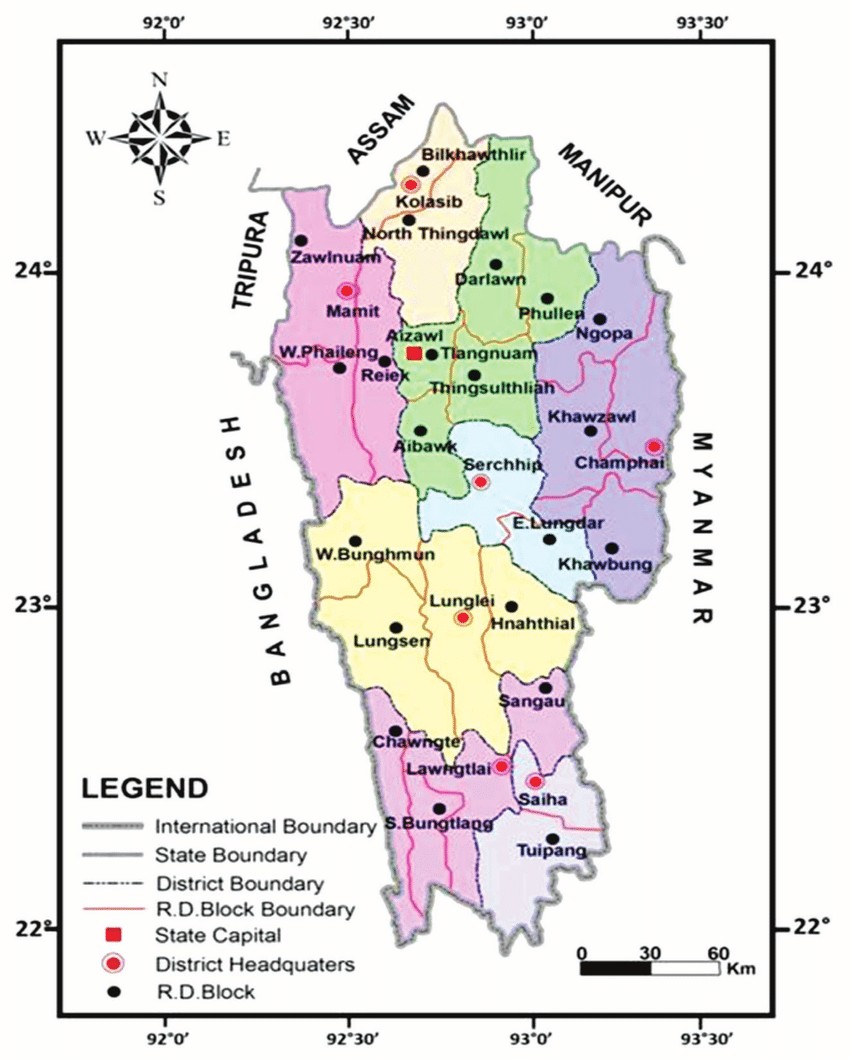
A district map of India’s northeast state of Mizoram. Champai district witnesses the highest refugee influx from Myanmar Source: ResearchGate


Aizawl and the rest of Mizoram are ideal destinations for the nature-loving tourist. But because it is one of India’s four northeast border states that require an Inner Line Permit (ILP) for even Indian citizens to visit, it is quite rare to encounter tourists on Aizawl’s streets.[1] [2] Flights into Aizawl are filled with Mizos returning home, as well as a sizeable number of Indian Army servicemen reporting back for duty at the Assam Rifles battalion base camp and administrative headquarters.[3]


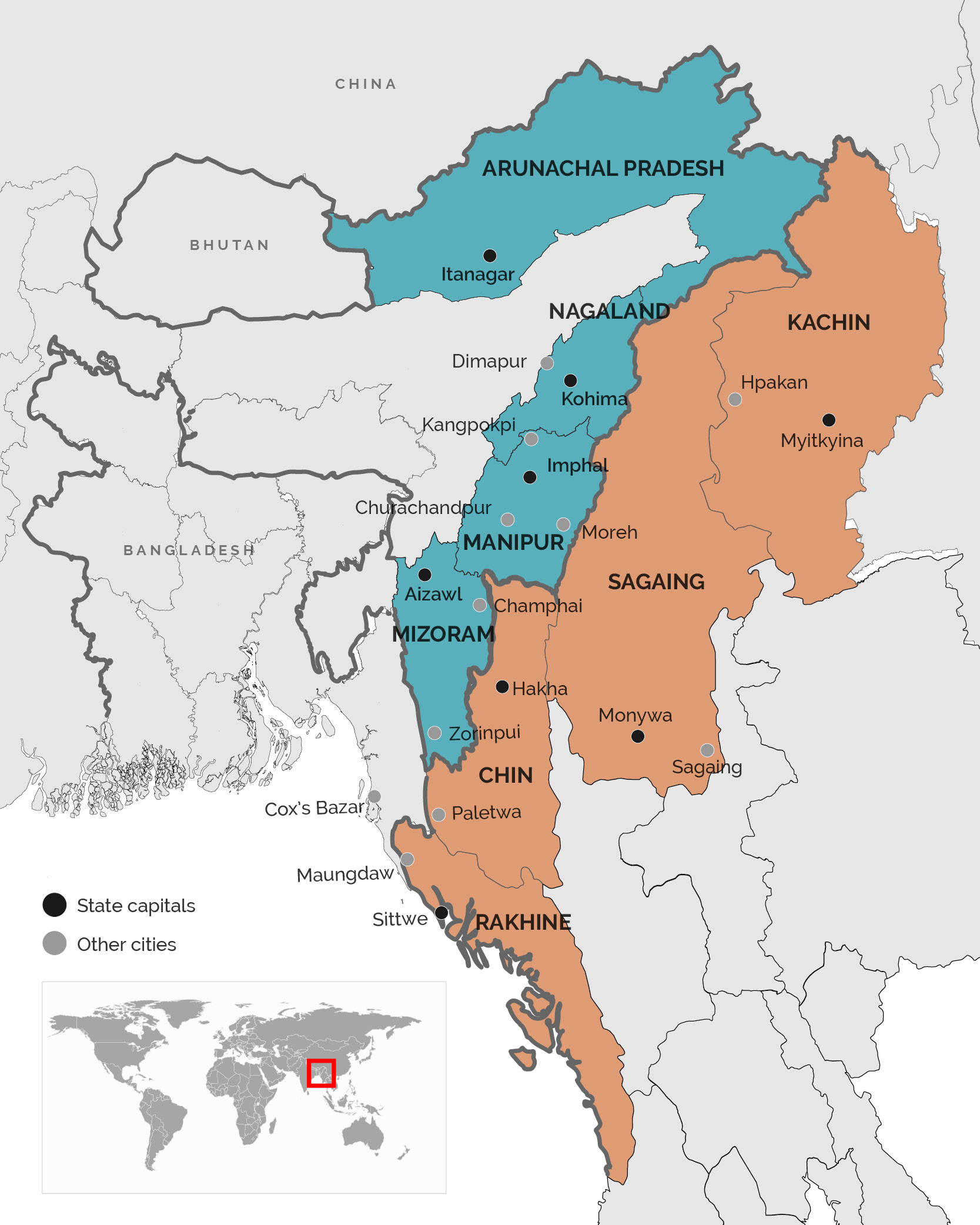
A Gateway House map showing the border regions of Northeast India (blue) and Myanmar (brown) Source: Gateway House


Mizoram shares a border with Myanmar and Bangladesh. It is currently home to an estimated 40,000 Myanmar Chin refugees, many living in Aizawl, and about 1,000 Bawm and Chakma tribals from the Chittagong Hill Tracts (CHT) of Bangladesh, all of whom look like indigenous Mizos.[4] This is not surprising, as they all belong to the same ethnic family of tribes, share a common culture, language (Tibeto-Burman family of languages), and religion; most are Presbyterian Christians.[5] [6] The foreign tourists in Aizawl are usually expatriate Myanmar Chins from the U.S. who are visiting family living there or crossing the border to their home villages.[7] Many entered the U.S. under the (now largely suspended) United States Refugee Admissions Program (USRAP) from 1980 to 2025.[8][9]

The refugee influx from Myanmar into India, Thailand, and Malaysia, though ongoing since the mid-1980s ethnic conflicts, has peaked with the 2021 military coup in Myanmar. But a wave of refugees crosses over when clashes escalate between the Myanmar military and Ethnic Armed Organisations (EAOs) in its northeast border states of Chin, Sagaing, and Shan. The ongoing civil unrest in Bangladesh since 5 August 2024 has also brought Bawm refugees from the Chittagong Hill Tracts (CHT) into Mizoram’s southeast border villages.

These refugees are putting a strain on a state which is just 12 lakhs in population. Already, refugees form 3.75% of the state,[10] and their numbers sometimes hit 50,000 to 60,000, or 5% of its population, as they did in May 2023 when the Myanmar Army began bombing the EAOs in its northwest. Manipur, another Indian Northeast state, which also shares a border with Myanmar, currently hosts just 8,000 Myanmar Chin refugees after deporting many home in 2024.[11]

So, how does Mizoram, India’s most remote state, bordered by two neighbours in political turmoil – Bangladesh and Myanmar – cope with the ebb and flow of refugees? And what drives its people to host them?


The answer to the first is the resilient informal partnership among civil society organisations, various church denominations, the state government, and international funding agencies and donors, which pool their resources and expertise to address the humanitarian crisis whenever it erupts.

The Young Mizo Association (YMA) flag Source: Wikipedia

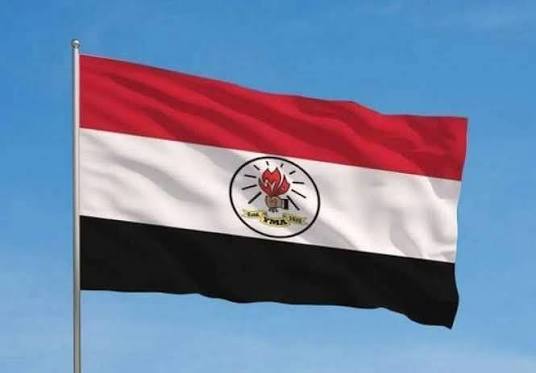
In this quartet, the foremost civil society association in refugee aid is the Young Mizo Association (YMA), with its vast network of 830 district groups and village branches in Mizoram. The presence of YMA (pronounced Y-mah) is everywhere. In Aizawl, the YMA flag, with its three consecutive horizontal stripes of red, white, and black, is everywhere – very different from the political party flags and hoardings that are common in most Indian cities. YMA flags are painted on traffic police islands and flutter from rooftops. It is a community-based, non-political organisation, founded in 1935 by Christian missionaries and Mizo Christians, with a membership of 500,000 in Mizoram and with a presence in Manipur, Nagaland, Meghalaya, Assam, and Tripura. It even has a branch in Bangladesh.[12]


The second pillar is the Mizoram state government, which funds a large share of humanitarian aid. In the first year after the 2021 coup, it disbursed Rs 3.80 crore.[13] It has been approaching the central government for aid, which last month disbursed Rs 10 crore in rice aid to Mizoram’s refugees. Also, state-run schools provide free education through the 10th and 12th standards to refugees.[14] The next pillar is the many church organisations, such as the international Adventist Development and Relief Agency (ADRA), which fund health camps at local hospitals and classes for refugee children.[15] The last are international agencies and donors, like the Chin Health Organisation, operated by former Chin refugees in the U.S.

What motivates the Mizo to host these refugees? Prof. Malsawmliana, the secretary general of the Central YMA, Aizawl, says they consider the Chin as “our ethnic relatives or cousins”. We welcome them with open arms and administer humanitarian assistance.” According to him, the initial aid when the influx began was deployed by YMA village branches, especially those in Champai District, which always bears the brunt of any humanitarian crisis in Myanmar. As regards the recent Bawm refugees from Bangladesh, given their smaller numbers, the Group YMA in southeast Mizoram looks after them.

In addition to tribal and familial loyalties, a key convergence is Christianity.

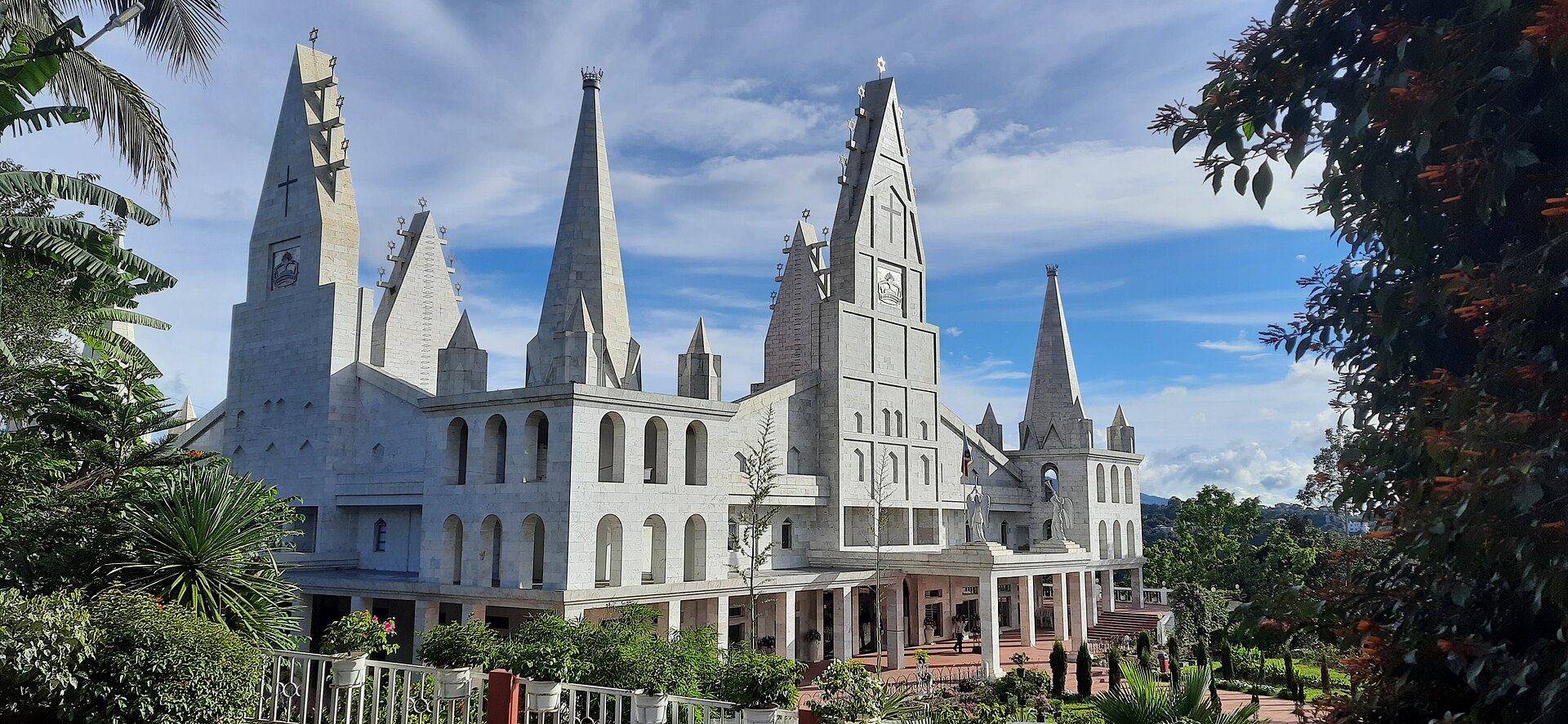
Like a majority of Mizos, the Chin too are Christians. Christian missionaries arrived in this region after it was finally subdued by the British Indian Army in 1896, in a campaign that began in 1871 after the abduction of six-year-old Mary Winchester, the child of a Scottish tea estate manager in the Cachar Hill Tracts (Assam), by one of the Mizo tribal chiefs.[16] Within 50 years, the hill tribes, whether Kuki, Zo, Hmar, Ralte, Chin, or Naga, were largely converted to Christianity, mostly Presbyterianism.[17] The influence of church pastors on the daily lives of their flock is profound even today. It is visible in the number of churches of different denominations at almost every traffic turn in Aizawl.

Solomon’s Temple, a church and tourist attraction in Aizawl Source: Wikipedia

Despite this commonality between the local Mizo and Chin refugees, there are several areas of unease.

Ever since the 1980s, when Myanmar’s ethnic conflicts began, its illicit drug economy has grown in financial heft and spread across the land. Myanmar is part of the ‘Golden Triangle’ of illicit drug-exporting countries of Southeast Asia, which include Laos and Thailand. Since the military takeover in 2021 and with northwest Myanmar in the hands of EAOs, YMA secretary general Malsawmliana says the drug manufacturing units have shifted from Laos to the Indo-Myanmar border. This makes the Chin refugees both vulnerable and useful. They are used as carriers across the border and as peddlers. The local availability of drugs has increased addiction amongst local Mizo youth. Locals say the street price in Aizawl for a shot of heroin is just Rs 200 (USD $2).[18] “This”, says Lalduhthlana Ralte, a local Mizo from the Ralte tribe who, after retirement from the Indian foreign service – he was India’s ambassador to the Philippines and India’s High Commissioner to Brunei – has settled in Aizawl, “is of grave concern for Mizos who have largely lived protected lives as part of India, unlike their Chin brothers and sisters who have had it rough.”


A large part of this problem, locals say, is because Chin refugees have no legal avenues to earn a living, leaving the informal economy as their only source of income. Most refugees work as house help, taxi drivers, and day labourers and loiter in the bazaars; they often come across as ‘rude’ to the soft-spoken, courteous local Mizo.[19]

To tackle the drug menace, the state home department, police, excise, and narcotics launched ‘Operation Jericho’ in 2025 with the Central YMA, which has been very successful. Mawlsawmliana of YMA says, “The aim was that the 14 border villages should put in more effort to stop the transit of drugs through their villages.” The police have now also been posted here. The grassroots intelligence has led to increased drug seizures, resulting in a shift of routes to the Myanmar-Manipur border.[20]

Another point of unease is Chief Minister Lalduhoma’s outreach to overseas Mizos for FDI. There are a small number of Mizo families residing abroad. “This is something the people of Mizoram don’t like. We view Mizos outside Mizoram with a jaundiced eye,” observes Ralte. The two types of ‘outside’ money entering the state are drug money and refugee money. The refugee dollars are remittances from Chin refugees settled in the U.S. and Canada, resulting in their refugee relatives in Mizoram having plenty of money. Refugee dollars are rapidly buying up land in Aizawl and its surroundings, driving up prices beyond the reach of locals. Ralte points to the introduction of two flights a day on the New Delhi-Aizawl route. ‘Mizoram’s population alone would not justify the economics,’ he says, adding that the people returning ‘home’ for a visit are not Mizos but Myanmar Chins, who are identifiable to locals by their distinct dialect but are not recognisable by ordinary Indians.


To regulate the influx of foreigners, the Indian government reimposed the stringent Protected Area Regime (1958) in 2025, after relaxing it in 2011. A foreign tourist must have a Protected Area Permit before travelling to Mizoram. An unintended fallout has been on the few international students studying at Mizoram University who must leave and can return only once they have this permit.[21]

For most Indians, Mizoram is the most remote Indian state and one they may never visit. But even a brief sojourn to this green mountainous state reveals its strategic importance in India’s Act East policy, sandwiched as it is between Bangladesh and Myanmar. Though distant from the peninsular mainland, the problems faced by local Mizos like drug abuse amongst young adults share a common angst with some of India’s bigger and more developed states.

References:

The other three border states requiring ILPs are Manipur, Nagaland, and Arunachal Pradesh.

Most locals spoken to commend the Indian government’s northeast connectivity push, especially the newly operational railway line to Sairang, a terminus 17 km by road from Aizawl. The last segment – Bairabi-Sairang – was completed in June 2025 and inaugurated by Prime Minister Narendra Modi on 13 September 2025. Building this segment was challenging and an engineering feat due to the susceptibility of its mountainous terrain to landslides. Of note is the towering 114-metre bridge 196, which is 42 metres taller than the Qutub Minar.

The Assam Rifles operational base has recently shifted 15 kms away from Aizawl to Zokhawsang, although some operations and key administrative offices still function from Aizawl city. Its 95-acre base within the city was handed over to the state government under a 2024 agreement.

Many Myanmar refugees seek protection in neighbouring Thailand and Malaysia. Thailand is currently home to 90,000 refugees housed in nine camps in its bordering Tak district. The earliest refugees arrived here in the mid-1980s. Voice of America (VOA), “White House Order Halts Myanmar Refugee Resettlement Deal with Thailand,” February 8, 2025. https://www.voanews.com/a/white-house-order-halts-myanmar-refugee-resettlement-deal-with-thailand/7967957.html

The previous umbrella term used to refer to the northeast mountain tribes was the Lushai Hill tribes. After the 1986 Peace Accord with the Mizo National Front, which envisaged the formation of a new state – Mizoram – the tribes within this state’s territory (Kuki, Zo, Ralte, Hmar, Chin, etc.) all call themselves ‘Mizo’ (Mi = Mountain, Zo = People, or people of the mountains).

The Chin and Mizo dialects differ, although they belong to the same Tibeto-Burman family of languages. Only a Mizo speaker can distinguish the local dialect from its close cousin dialect spoken by the Chin.

The Free Movement Regime (FMR) on the India-Myanmar border, meant to facilitate border trade, is greatly curtailed, with only one (Zokhawthar) functional border crossing in the State of Mizoram. The current FMR permits only residents living within 10 kms to cross over to Myanmar, and they must return within seven days at the same border crossing to return their temporary pass.

See Gateway House’s CFR Fellow Purvi Patel’s article ‘US’s Temporary Protected Status for Myanmar’ (4 April 2024) Gateway House, “Understanding Myanmar’s Temporary Protected Status,” February 13, 2025. https://www.gatewayhouse.in/understanding-myanmars-temporary-protected-status/


The USRAP was introduced under the Refugee Act of 1980 and signed into law by President Jimmy Carter on 17 March 1980. Today, it is greatly curtailed (only 7500 refugees permitted in 2026) and suspended, except for specific groups like white South Africans, by an executive order signed by President Donald Trump in January 2025. The United States of America has a few thousand (~35,000) Myanmar-origin citizens and residents, many of whom are refugees from Chin, Shan, and Sagaing states of Myanmar. They are concentrated largely in Indianapolis, Indiana, with some in the state of Texas. Indianapolis Monthly, “Welcome to Chindianapolis,” December 12, 2020.
https://www.indianapolismonthly.com/arts-and-culture/welcome-to-chindianapolis/
People interviewed by the author spoke of about 12 lakh-plus persons. The India Census 2011 data states 10,97,206 persons, while the projected population for 2026 is 13,08,967 according to https://indiacensus.net/states/Mizoram

The civil unrest in the State of Manipur caused by clashes between the Meitei and Kuki has resulted in the Ministry of Home Affairs closing Manipur’s border with Myanmar. Many Myanmar Chin refugees from this state were deported home in 2024, in light of the ongoing civil unrest.

The legal status of YMA is that it is registered as a society under the Indian Societies Registration Act (Act XXI, 1860). It has five lakh members and 830 branches in Mizoram. The branch in Bangladesh came up in this author’s interview with Central YMA’s general secretary, Prof. Malsawmliana. This interview took place on 11 June from 3 to 4 pm.
See the Mizoram Finance Minister’s speech in the state assembly on the refugee crisis. https://www.youtube.com/watch?v=ncuteHdNc10

The state government in the initial stage of the humanitarian crisis deployed its own funds, but as the conflict in Myanmar and Bangladesh (the CHT has an ethnic insurgency movement) borders continues, it applies for central funding. The latest tranche of Rs 10 crore is under Security Related Expenditure (SRE) scheme to Mizoram. The Hindu, “Centre to Provide ₹10 Crore Rice Aid for Refugees in Mizoram,” June 14, 2026. https://www.thehindu.com/news/national/centre-to-provide-10-crore-rice-aid-for-refugees-in-mizoram/article71098587.ece

ADRA is an international humanitarian aid network, established by the Seventh-Day Adventist Church, and is headquartered in Silver Springs, Maryland.

The first inroad by the British Indian government was in 1871 to rescue Mary Winchester, a six-year-old abducted by one of the Mizo tribal chiefs during a raid into Alexandrapur in the Cachar Hill Tracts (Assam). Mary Winchester, called Zoluti in the tribal chief’s household, was recovered from the tribe she lived amongst. Local lore says that at first she refused to return home to England but finally relented.

The Presbyterian Church appealed to the tribals because it combined tribal structures (a committee of elders) with evangelical elements. There are different Christian denominations like Welsh Presbyterian, Baptist, Pentecostal, Salvation Army, Adventist, and Roman Catholic and sects (like the white-marbled Solomon’s Temple, which is listed as a tourist site).

Myanmar’s northwest border states are under the control of Ethnic Armed Organisations, and conditions here are disturbed; drug manufacturing facilities have also shifted from Laos closer to the India border. They enter India’s border states via traditional forest trails. What has led to unease among Mizos is that most drug carriers arrested so far have been Chin refugees, who undertake this work out of desperation to support their families. The heads of these drug cartels are not necessarily Chin, and they are difficult to nab, as they are often located overseas.

India is not a signatory to the UN Refugee Convention (1951) and its 1967 Protocol, which defines the rights of refugees and the responsibilities of the host nation.
Drugs are not the only items being smuggled across this border. Arms smuggling is also sizeable, as indicated by the recent arrest of an American and a Ukrainian attempting to cross into Myanmar from Mizoram.

The Diplomat. “India Reimposes Restrictions on Foreign Nationals Visiting Three Northeastern States.” January 13, 2025.


About the author: Sifra Lentin is Bombay History Fellow at Gateway House.

Source: This article was written for Gateway House: Indian Council on Global Relations.


About Gateway House
Gateway House: Indian Council on Global Relations is a foreign policy think-tank established in 2009, to engage India’s leading corporations and individuals in debate and scholarship on India’s foreign policy and its role in global affairs. Gateway House’s studies programme will be at the heart of the institute’s scholarship, with original research by global and local scholars in Geo-economics, Geopolitics, Foreign Policy analysis, Bilateral relations, Democracy and nation-building, National security, ethnic conflict and terrorism, Science, technology and innovation, and Energy and Environment.
View all posts by Gateway House →