
July 27, 2026
Gateway House
By Sifra Lentin
Key Takeaways:
Significant Refugee Influx: Mizoram currently hosts an estimated 40,000 Myanmar Chin refugees (plus about 1,000 from Bangladesh’s Chittagong Hill Tracts), representing roughly 3.75% of the state’s population (and sometimes up to 5%), driven by Myanmar’s post-2021 civil conflict and unrest in Bangladesh.
Community-Led Humanitarian Response: Support is coordinated through a resilient informal partnership led by the Young Mizo Association (YMA), the state government, church organizations, and international donors; ethnic kinship, shared culture, language, and Christianity motivate Mizos to welcome the refugees as “cousins.”
Emerging Tensions: Despite hospitality, challenges include rising drug trafficking and addiction linked to the Golden Triangle trade, limited legal livelihood options for refugees, remittance-driven land price increases, and regulatory measures such as the reimposed Protected Area Regime affecting mobility.
Aizawl, capital of India’s northeast state of Mizoram, is a sprawling, densely built city that sits atop high mountains and gently slopes down to deep, lush, forested valleys. Its buildings, with few exceptions, are built on stilts and appear to cling precariously to the mountainsides. They flank both sides of its narrow, winding mountain roads – the only connectivity between its far-flung corners.
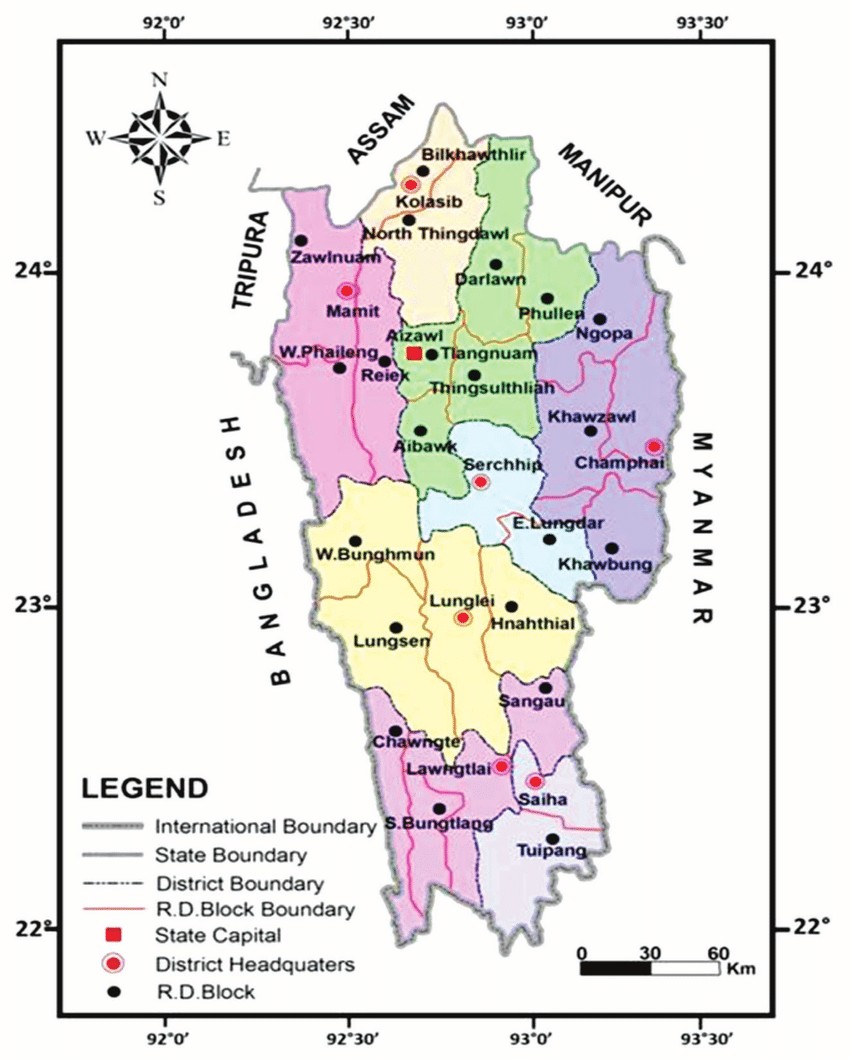
A district map of India’s northeast state of Mizoram. Champai district witnesses the highest refugee influx from Myanmar Source: ResearchGate
Aizawl and the rest of Mizoram are ideal destinations for the nature-loving tourist. But because it is one of India’s four northeast border states that require an Inner Line Permit (ILP) for even Indian citizens to visit, it is quite rare to encounter tourists on Aizawl’s streets.[1] [2] Flights into Aizawl are filled with Mizos returning home, as well as a sizeable number of Indian Army servicemen reporting back for duty at the Assam Rifles battalion base camp and administrative headquarters.[3]
Aizawl and the rest of Mizoram are ideal destinations for the nature-loving tourist. But because it is one of India’s four northeast border states that require an Inner Line Permit (ILP) for even Indian citizens to visit, it is quite rare to encounter tourists on Aizawl’s streets.[1] [2] Flights into Aizawl are filled with Mizos returning home, as well as a sizeable number of Indian Army servicemen reporting back for duty at the Assam Rifles battalion base camp and administrative headquarters.[3]
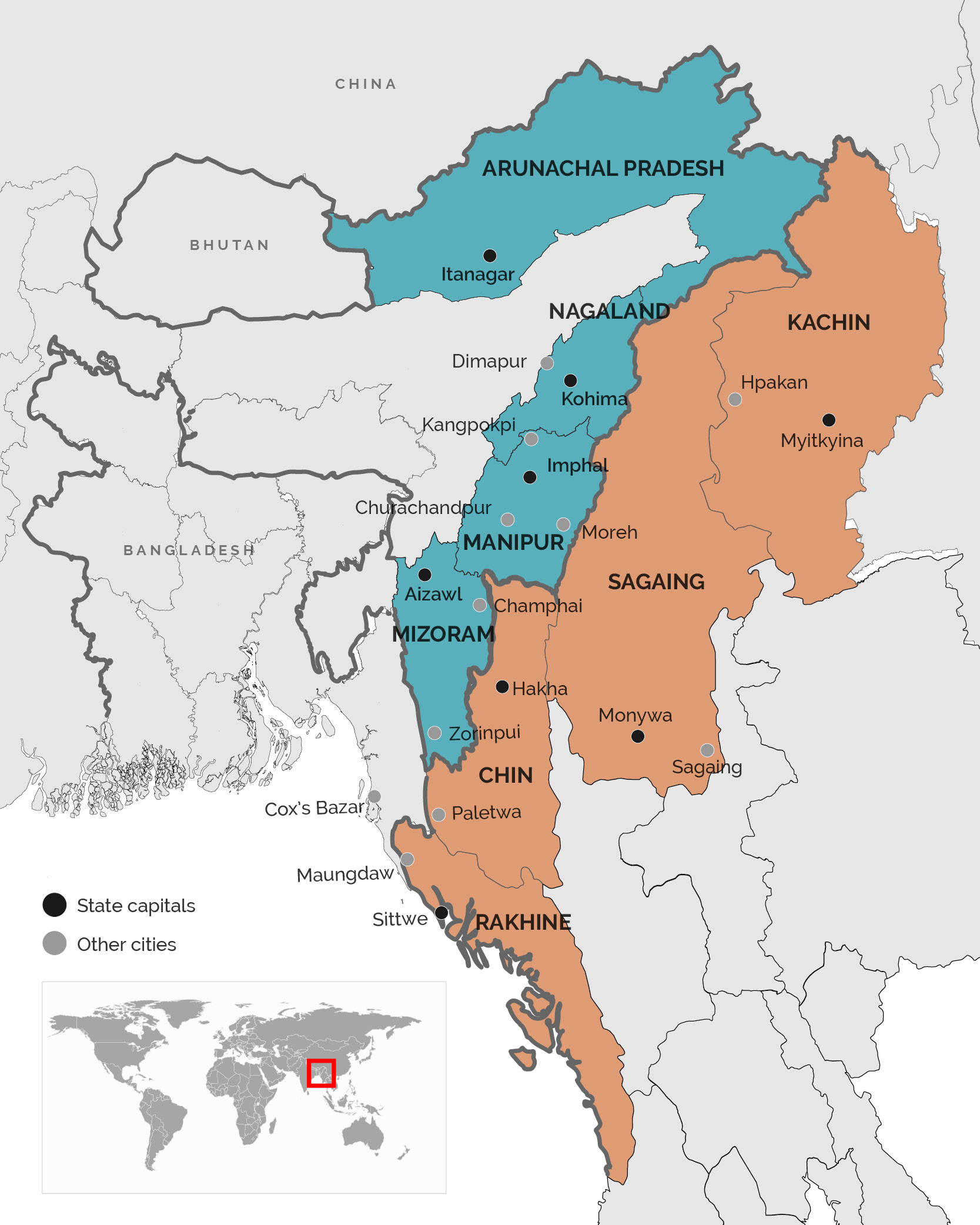
A Gateway House map showing the border regions of Northeast India (blue) and Myanmar (brown) Source: Gateway House
Mizoram shares a border with Myanmar and Bangladesh. It is currently home to an estimated 40,000 Myanmar Chin refugees, many living in Aizawl, and about 1,000 Bawm and Chakma tribals from the Chittagong Hill Tracts (CHT) of Bangladesh, all of whom look like indigenous Mizos.[4] This is not surprising, as they all belong to the same ethnic family of tribes, share a common culture, language (Tibeto-Burman family of languages), and religion; most are Presbyterian Christians.[5] [6] The foreign tourists in Aizawl are usually expatriate Myanmar Chins from the U.S. who are visiting family living there or crossing the border to their home villages.[7] Many entered the U.S. under the (now largely suspended) United States Refugee Admissions Program (USRAP) from 1980 to 2025.[8][9]
The refugee influx from Myanmar into India, Thailand, and Malaysia, though ongoing since the mid-1980s ethnic conflicts, has peaked with the 2021 military coup in Myanmar. But a wave of refugees crosses over when clashes escalate between the Myanmar military and Ethnic Armed Organisations (EAOs) in its northeast border states of Chin, Sagaing, and Shan. The ongoing civil unrest in Bangladesh since 5 August 2024 has also brought Bawm refugees from the Chittagong Hill Tracts (CHT) into Mizoram’s southeast border villages.
These refugees are putting a strain on a state which is just 12 lakhs in population. Already, refugees form 3.75% of the state,[10] and their numbers sometimes hit 50,000 to 60,000, or 5% of its population, as they did in May 2023 when the Myanmar Army began bombing the EAOs in its northwest. Manipur, another Indian Northeast state, which also shares a border with Myanmar, currently hosts just 8,000 Myanmar Chin refugees after deporting many home in 2024.[11]
So, how does Mizoram, India’s most remote state, bordered by two neighbours in political turmoil – Bangladesh and Myanmar – cope with the ebb and flow of refugees? And what drives its people to host them?
The answer to the first is the resilient informal partnership among civil society organisations, various church denominations, the state government, and international funding agencies and donors, which pool their resources and expertise to address the humanitarian crisis whenever it erupts.
Mizoram shares a border with Myanmar and Bangladesh. It is currently home to an estimated 40,000 Myanmar Chin refugees, many living in Aizawl, and about 1,000 Bawm and Chakma tribals from the Chittagong Hill Tracts (CHT) of Bangladesh, all of whom look like indigenous Mizos.[4] This is not surprising, as they all belong to the same ethnic family of tribes, share a common culture, language (Tibeto-Burman family of languages), and religion; most are Presbyterian Christians.[5] [6] The foreign tourists in Aizawl are usually expatriate Myanmar Chins from the U.S. who are visiting family living there or crossing the border to their home villages.[7] Many entered the U.S. under the (now largely suspended) United States Refugee Admissions Program (USRAP) from 1980 to 2025.[8][9]
The refugee influx from Myanmar into India, Thailand, and Malaysia, though ongoing since the mid-1980s ethnic conflicts, has peaked with the 2021 military coup in Myanmar. But a wave of refugees crosses over when clashes escalate between the Myanmar military and Ethnic Armed Organisations (EAOs) in its northeast border states of Chin, Sagaing, and Shan. The ongoing civil unrest in Bangladesh since 5 August 2024 has also brought Bawm refugees from the Chittagong Hill Tracts (CHT) into Mizoram’s southeast border villages.
These refugees are putting a strain on a state which is just 12 lakhs in population. Already, refugees form 3.75% of the state,[10] and their numbers sometimes hit 50,000 to 60,000, or 5% of its population, as they did in May 2023 when the Myanmar Army began bombing the EAOs in its northwest. Manipur, another Indian Northeast state, which also shares a border with Myanmar, currently hosts just 8,000 Myanmar Chin refugees after deporting many home in 2024.[11]
So, how does Mizoram, India’s most remote state, bordered by two neighbours in political turmoil – Bangladesh and Myanmar – cope with the ebb and flow of refugees? And what drives its people to host them?
The answer to the first is the resilient informal partnership among civil society organisations, various church denominations, the state government, and international funding agencies and donors, which pool their resources and expertise to address the humanitarian crisis whenever it erupts.
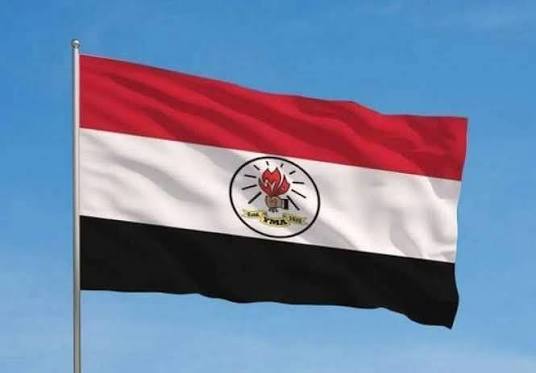
The Young Mizo Association (YMA) flag Source: Wikipedia
In this quartet, the foremost civil society association in refugee aid is the Young Mizo Association (YMA), with its vast network of 830 district groups and village branches in Mizoram. The presence of YMA (pronounced Y-mah) is everywhere. In Aizawl, the YMA flag, with its three consecutive horizontal stripes of red, white, and black, is everywhere – very different from the political party flags and hoardings that are common in most Indian cities. YMA flags are painted on traffic police islands and flutter from rooftops. It is a community-based, non-political organisation, founded in 1935 by Christian missionaries and Mizo Christians, with a membership of 500,000 in Mizoram and with a presence in Manipur, Nagaland, Meghalaya, Assam, and Tripura. It even has a branch in Bangladesh.[12]
The second pillar is the Mizoram state government, which funds a large share of humanitarian aid. In the first year after the 2021 coup, it disbursed Rs 3.80 crore.[13] It has been approaching the central government for aid, which last month disbursed Rs 10 crore in rice aid to Mizoram’s refugees. Also, state-run schools provide free education through the 10th and 12th standards to refugees.[14] The next pillar is the many church organisations, such as the international Adventist Development and Relief Agency (ADRA), which fund health camps at local hospitals and classes for refugee children.[15] The last are international agencies and donors, like the Chin Health Organisation, operated by former Chin refugees in the U.S.
What motivates the Mizo to host these refugees? Prof. Malsawmliana, the secretary general of the Central YMA, Aizawl, says they consider the Chin as “our ethnic relatives or cousins”. We welcome them with open arms and administer humanitarian assistance.” According to him, the initial aid when the influx began was deployed by YMA village branches, especially those in Champai District, which always bears the brunt of any humanitarian crisis in Myanmar. As regards the recent Bawm refugees from Bangladesh, given their smaller numbers, the Group YMA in southeast Mizoram looks after them.
In addition to tribal and familial loyalties, a key convergence is Christianity.
Like a majority of Mizos, the Chin too are Christians. Christian missionaries arrived in this region after it was finally subdued by the British Indian Army in 1896, in a campaign that began in 1871 after the abduction of six-year-old Mary Winchester, the child of a Scottish tea estate manager in the Cachar Hill Tracts (Assam), by one of the Mizo tribal chiefs.[16] Within 50 years, the hill tribes, whether Kuki, Zo, Hmar, Ralte, Chin, or Naga, were largely converted to Christianity, mostly Presbyterianism.[17] The influence of church pastors on the daily lives of their flock is profound even today. It is visible in the number of churches of different denominations at almost every traffic turn in Aizawl.
In this quartet, the foremost civil society association in refugee aid is the Young Mizo Association (YMA), with its vast network of 830 district groups and village branches in Mizoram. The presence of YMA (pronounced Y-mah) is everywhere. In Aizawl, the YMA flag, with its three consecutive horizontal stripes of red, white, and black, is everywhere – very different from the political party flags and hoardings that are common in most Indian cities. YMA flags are painted on traffic police islands and flutter from rooftops. It is a community-based, non-political organisation, founded in 1935 by Christian missionaries and Mizo Christians, with a membership of 500,000 in Mizoram and with a presence in Manipur, Nagaland, Meghalaya, Assam, and Tripura. It even has a branch in Bangladesh.[12]
The second pillar is the Mizoram state government, which funds a large share of humanitarian aid. In the first year after the 2021 coup, it disbursed Rs 3.80 crore.[13] It has been approaching the central government for aid, which last month disbursed Rs 10 crore in rice aid to Mizoram’s refugees. Also, state-run schools provide free education through the 10th and 12th standards to refugees.[14] The next pillar is the many church organisations, such as the international Adventist Development and Relief Agency (ADRA), which fund health camps at local hospitals and classes for refugee children.[15] The last are international agencies and donors, like the Chin Health Organisation, operated by former Chin refugees in the U.S.
What motivates the Mizo to host these refugees? Prof. Malsawmliana, the secretary general of the Central YMA, Aizawl, says they consider the Chin as “our ethnic relatives or cousins”. We welcome them with open arms and administer humanitarian assistance.” According to him, the initial aid when the influx began was deployed by YMA village branches, especially those in Champai District, which always bears the brunt of any humanitarian crisis in Myanmar. As regards the recent Bawm refugees from Bangladesh, given their smaller numbers, the Group YMA in southeast Mizoram looks after them.
In addition to tribal and familial loyalties, a key convergence is Christianity.
Like a majority of Mizos, the Chin too are Christians. Christian missionaries arrived in this region after it was finally subdued by the British Indian Army in 1896, in a campaign that began in 1871 after the abduction of six-year-old Mary Winchester, the child of a Scottish tea estate manager in the Cachar Hill Tracts (Assam), by one of the Mizo tribal chiefs.[16] Within 50 years, the hill tribes, whether Kuki, Zo, Hmar, Ralte, Chin, or Naga, were largely converted to Christianity, mostly Presbyterianism.[17] The influence of church pastors on the daily lives of their flock is profound even today. It is visible in the number of churches of different denominations at almost every traffic turn in Aizawl.
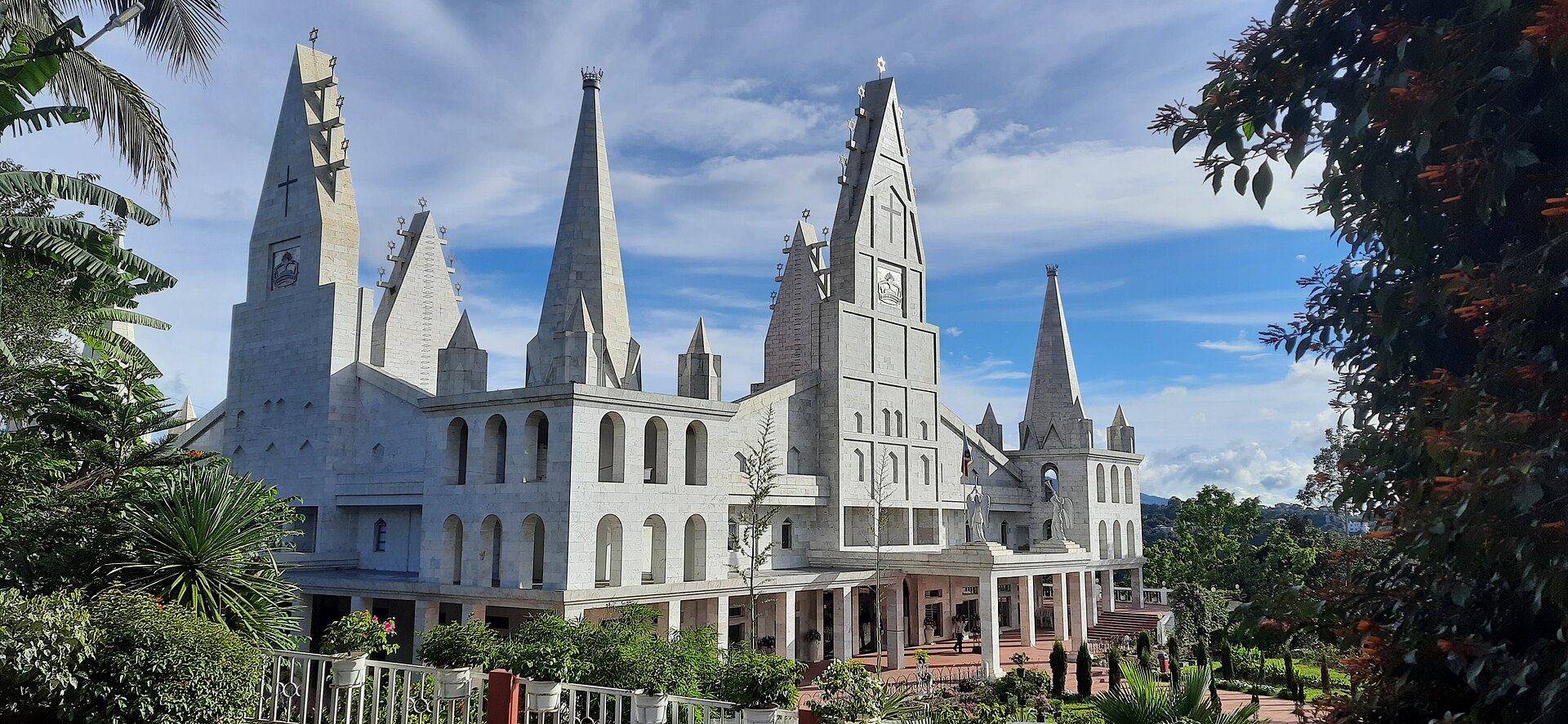
Solomon’s Temple, a church and tourist attraction in Aizawl Source: Wikipedia
Despite this commonality between the local Mizo and Chin refugees, there are several areas of unease.
Ever since the 1980s, when Myanmar’s ethnic conflicts began, its illicit drug economy has grown in financial heft and spread across the land. Myanmar is part of the ‘Golden Triangle’ of illicit drug-exporting countries of Southeast Asia, which include Laos and Thailand. Since the military takeover in 2021 and with northwest Myanmar in the hands of EAOs, YMA secretary general Malsawmliana says the drug manufacturing units have shifted from Laos to the Indo-Myanmar border. This makes the Chin refugees both vulnerable and useful. They are used as carriers across the border and as peddlers. The local availability of drugs has increased addiction amongst local Mizo youth. Locals say the street price in Aizawl for a shot of heroin is just Rs 200 (USD $2).[18] “This”, says Lalduhthlana Ralte, a local Mizo from the Ralte tribe who, after retirement from the Indian foreign service – he was India’s ambassador to the Philippines and India’s High Commissioner to Brunei – has settled in Aizawl, “is of grave concern for Mizos who have largely lived protected lives as part of India, unlike their Chin brothers and sisters who have had it rough.”
A large part of this problem, locals say, is because Chin refugees have no legal avenues to earn a living, leaving the informal economy as their only source of income. Most refugees work as house help, taxi drivers, and day labourers and loiter in the bazaars; they often come across as ‘rude’ to the soft-spoken, courteous local Mizo.[19]
To tackle the drug menace, the state home department, police, excise, and narcotics launched ‘Operation Jericho’ in 2025 with the Central YMA, which has been very successful. Mawlsawmliana of YMA says, “The aim was that the 14 border villages should put in more effort to stop the transit of drugs through their villages.” The police have now also been posted here. The grassroots intelligence has led to increased drug seizures, resulting in a shift of routes to the Myanmar-Manipur border.[20]
Another point of unease is Chief Minister Lalduhoma’s outreach to overseas Mizos for FDI. There are a small number of Mizo families residing abroad. “This is something the people of Mizoram don’t like. We view Mizos outside Mizoram with a jaundiced eye,” observes Ralte. The two types of ‘outside’ money entering the state are drug money and refugee money. The refugee dollars are remittances from Chin refugees settled in the U.S. and Canada, resulting in their refugee relatives in Mizoram having plenty of money. Refugee dollars are rapidly buying up land in Aizawl and its surroundings, driving up prices beyond the reach of locals. Ralte points to the introduction of two flights a day on the New Delhi-Aizawl route. ‘Mizoram’s population alone would not justify the economics,’ he says, adding that the people returning ‘home’ for a visit are not Mizos but Myanmar Chins, who are identifiable to locals by their distinct dialect but are not recognisable by ordinary Indians.
To regulate the influx of foreigners, the Indian government reimposed the stringent Protected Area Regime (1958) in 2025, after relaxing it in 2011. A foreign tourist must have a Protected Area Permit before travelling to Mizoram. An unintended fallout has been on the few international students studying at Mizoram University who must leave and can return only once they have this permit.[21]
For most Indians, Mizoram is the most remote Indian state and one they may never visit. But even a brief sojourn to this green mountainous state reveals its strategic importance in India’s Act East policy, sandwiched as it is between Bangladesh and Myanmar. Though distant from the peninsular mainland, the problems faced by local Mizos like drug abuse amongst young adults share a common angst with some of India’s bigger and more developed states.
Despite this commonality between the local Mizo and Chin refugees, there are several areas of unease.
Ever since the 1980s, when Myanmar’s ethnic conflicts began, its illicit drug economy has grown in financial heft and spread across the land. Myanmar is part of the ‘Golden Triangle’ of illicit drug-exporting countries of Southeast Asia, which include Laos and Thailand. Since the military takeover in 2021 and with northwest Myanmar in the hands of EAOs, YMA secretary general Malsawmliana says the drug manufacturing units have shifted from Laos to the Indo-Myanmar border. This makes the Chin refugees both vulnerable and useful. They are used as carriers across the border and as peddlers. The local availability of drugs has increased addiction amongst local Mizo youth. Locals say the street price in Aizawl for a shot of heroin is just Rs 200 (USD $2).[18] “This”, says Lalduhthlana Ralte, a local Mizo from the Ralte tribe who, after retirement from the Indian foreign service – he was India’s ambassador to the Philippines and India’s High Commissioner to Brunei – has settled in Aizawl, “is of grave concern for Mizos who have largely lived protected lives as part of India, unlike their Chin brothers and sisters who have had it rough.”
A large part of this problem, locals say, is because Chin refugees have no legal avenues to earn a living, leaving the informal economy as their only source of income. Most refugees work as house help, taxi drivers, and day labourers and loiter in the bazaars; they often come across as ‘rude’ to the soft-spoken, courteous local Mizo.[19]
To tackle the drug menace, the state home department, police, excise, and narcotics launched ‘Operation Jericho’ in 2025 with the Central YMA, which has been very successful. Mawlsawmliana of YMA says, “The aim was that the 14 border villages should put in more effort to stop the transit of drugs through their villages.” The police have now also been posted here. The grassroots intelligence has led to increased drug seizures, resulting in a shift of routes to the Myanmar-Manipur border.[20]
Another point of unease is Chief Minister Lalduhoma’s outreach to overseas Mizos for FDI. There are a small number of Mizo families residing abroad. “This is something the people of Mizoram don’t like. We view Mizos outside Mizoram with a jaundiced eye,” observes Ralte. The two types of ‘outside’ money entering the state are drug money and refugee money. The refugee dollars are remittances from Chin refugees settled in the U.S. and Canada, resulting in their refugee relatives in Mizoram having plenty of money. Refugee dollars are rapidly buying up land in Aizawl and its surroundings, driving up prices beyond the reach of locals. Ralte points to the introduction of two flights a day on the New Delhi-Aizawl route. ‘Mizoram’s population alone would not justify the economics,’ he says, adding that the people returning ‘home’ for a visit are not Mizos but Myanmar Chins, who are identifiable to locals by their distinct dialect but are not recognisable by ordinary Indians.
To regulate the influx of foreigners, the Indian government reimposed the stringent Protected Area Regime (1958) in 2025, after relaxing it in 2011. A foreign tourist must have a Protected Area Permit before travelling to Mizoram. An unintended fallout has been on the few international students studying at Mizoram University who must leave and can return only once they have this permit.[21]
For most Indians, Mizoram is the most remote Indian state and one they may never visit. But even a brief sojourn to this green mountainous state reveals its strategic importance in India’s Act East policy, sandwiched as it is between Bangladesh and Myanmar. Though distant from the peninsular mainland, the problems faced by local Mizos like drug abuse amongst young adults share a common angst with some of India’s bigger and more developed states.
References:
The other three border states requiring ILPs are Manipur, Nagaland, and Arunachal Pradesh.
Most locals spoken to commend the Indian government’s northeast connectivity push, especially the newly operational railway line to Sairang, a terminus 17 km by road from Aizawl. The last segment – Bairabi-Sairang – was completed in June 2025 and inaugurated by Prime Minister Narendra Modi on 13 September 2025. Building this segment was challenging and an engineering feat due to the susceptibility of its mountainous terrain to landslides. Of note is the towering 114-metre bridge 196, which is 42 metres taller than the Qutub Minar.
The Assam Rifles operational base has recently shifted 15 kms away from Aizawl to Zokhawsang, although some operations and key administrative offices still function from Aizawl city. Its 95-acre base within the city was handed over to the state government under a 2024 agreement.
Many Myanmar refugees seek protection in neighbouring Thailand and Malaysia. Thailand is currently home to 90,000 refugees housed in nine camps in its bordering Tak district. The earliest refugees arrived here in the mid-1980s. Voice of America (VOA), “White House Order Halts Myanmar Refugee Resettlement Deal with Thailand,” February 8, 2025. https://www.voanews.com/a/white-house-order-halts-myanmar-refugee-resettlement-deal-with-thailand/7967957.html
The previous umbrella term used to refer to the northeast mountain tribes was the Lushai Hill tribes. After the 1986 Peace Accord with the Mizo National Front, which envisaged the formation of a new state – Mizoram – the tribes within this state’s territory (Kuki, Zo, Ralte, Hmar, Chin, etc.) all call themselves ‘Mizo’ (Mi = Mountain, Zo = People, or people of the mountains).
The Chin and Mizo dialects differ, although they belong to the same Tibeto-Burman family of languages. Only a Mizo speaker can distinguish the local dialect from its close cousin dialect spoken by the Chin.
The Free Movement Regime (FMR) on the India-Myanmar border, meant to facilitate border trade, is greatly curtailed, with only one (Zokhawthar) functional border crossing in the State of Mizoram. The current FMR permits only residents living within 10 kms to cross over to Myanmar, and they must return within seven days at the same border crossing to return their temporary pass.
See Gateway House’s CFR Fellow Purvi Patel’s article ‘US’s Temporary Protected Status for Myanmar’ (4 April 2024) Gateway House, “Understanding Myanmar’s Temporary Protected Status,” February 13, 2025. https://www.gatewayhouse.in/understanding-myanmars-temporary-protected-status/
The USRAP was introduced under the Refugee Act of 1980 and signed into law by President Jimmy Carter on 17 March 1980. Today, it is greatly curtailed (only 7500 refugees permitted in 2026) and suspended, except for specific groups like white South Africans, by an executive order signed by President Donald Trump in January 2025. The United States of America has a few thousand (~35,000) Myanmar-origin citizens and residents, many of whom are refugees from Chin, Shan, and Sagaing states of Myanmar. They are concentrated largely in Indianapolis, Indiana, with some in the state of Texas. Indianapolis Monthly, “Welcome to Chindianapolis,” December 12, 2020.
https://www.indianapolismonthly.com/arts-and-culture/welcome-to-chindianapolis/
People interviewed by the author spoke of about 12 lakh-plus persons. The India Census 2011 data states 10,97,206 persons, while the projected population for 2026 is 13,08,967 according to https://indiacensus.net/states/Mizoram
People interviewed by the author spoke of about 12 lakh-plus persons. The India Census 2011 data states 10,97,206 persons, while the projected population for 2026 is 13,08,967 according to https://indiacensus.net/states/Mizoram
The civil unrest in the State of Manipur caused by clashes between the Meitei and Kuki has resulted in the Ministry of Home Affairs closing Manipur’s border with Myanmar. Many Myanmar Chin refugees from this state were deported home in 2024, in light of the ongoing civil unrest.
The legal status of YMA is that it is registered as a society under the Indian Societies Registration Act (Act XXI, 1860). It has five lakh members and 830 branches in Mizoram. The branch in Bangladesh came up in this author’s interview with Central YMA’s general secretary, Prof. Malsawmliana. This interview took place on 11 June from 3 to 4 pm.
See the Mizoram Finance Minister’s speech in the state assembly on the refugee crisis. https://www.youtube.com/watch?v=ncuteHdNc10
The state government in the initial stage of the humanitarian crisis deployed its own funds, but as the conflict in Myanmar and Bangladesh (the CHT has an ethnic insurgency movement) borders continues, it applies for central funding. The latest tranche of Rs 10 crore is under Security Related Expenditure (SRE) scheme to Mizoram. The Hindu, “Centre to Provide ₹10 Crore Rice Aid for Refugees in Mizoram,” June 14, 2026. https://www.thehindu.com/news/national/centre-to-provide-10-crore-rice-aid-for-refugees-in-mizoram/article71098587.ece
ADRA is an international humanitarian aid network, established by the Seventh-Day Adventist Church, and is headquartered in Silver Springs, Maryland.
The first inroad by the British Indian government was in 1871 to rescue Mary Winchester, a six-year-old abducted by one of the Mizo tribal chiefs during a raid into Alexandrapur in the Cachar Hill Tracts (Assam). Mary Winchester, called Zoluti in the tribal chief’s household, was recovered from the tribe she lived amongst. Local lore says that at first she refused to return home to England but finally relented.
The Presbyterian Church appealed to the tribals because it combined tribal structures (a committee of elders) with evangelical elements. There are different Christian denominations like Welsh Presbyterian, Baptist, Pentecostal, Salvation Army, Adventist, and Roman Catholic and sects (like the white-marbled Solomon’s Temple, which is listed as a tourist site).
Myanmar’s northwest border states are under the control of Ethnic Armed Organisations, and conditions here are disturbed; drug manufacturing facilities have also shifted from Laos closer to the India border. They enter India’s border states via traditional forest trails. What has led to unease among Mizos is that most drug carriers arrested so far have been Chin refugees, who undertake this work out of desperation to support their families. The heads of these drug cartels are not necessarily Chin, and they are difficult to nab, as they are often located overseas.
India is not a signatory to the UN Refugee Convention (1951) and its 1967 Protocol, which defines the rights of refugees and the responsibilities of the host nation.
Drugs are not the only items being smuggled across this border. Arms smuggling is also sizeable, as indicated by the recent arrest of an American and a Ukrainian attempting to cross into Myanmar from Mizoram.
The Diplomat. “India Reimposes Restrictions on Foreign Nationals Visiting Three Northeastern States.” January 13, 2025.
About the author: Sifra Lentin is Bombay History Fellow at Gateway House.
Source: This article was written for Gateway House: Indian Council on Global Relations.
About Gateway House
Gateway House: Indian Council on Global Relations is a foreign policy think-tank established in 2009, to engage India’s leading corporations and individuals in debate and scholarship on India’s foreign policy and its role in global affairs. Gateway House’s studies programme will be at the heart of the institute’s scholarship, with original research by global and local scholars in Geo-economics, Geopolitics, Foreign Policy analysis, Bilateral relations, Democracy and nation-building, National security, ethnic conflict and terrorism, Science, technology and innovation, and Energy and Environment.
View all posts by Gateway House →

No comments:
Post a Comment