Sunday, August 23, 2026

‘Eight Million Americans Have Lost Their Healthcare’: Trump-GOP Cuts Wreak Havoc in All 50 States

New fact sheets detail how people in every US state are suffering from the Republican Party’s assault on Medicaid and the Affordable Care Act.


Workers protest Republican Medicaid cuts on June 23, 2025 in Washington, DC.
(Photo by Joe Raedle/Getty Images)

Jake Johnson
Aug 18, 2026
COMMON DREAMS

The unprecedented healthcare cuts that President Donald Trump and the Republican Party enacted last summer have impacted people in all 50 US states, stripping insurance coverage from around 8 million Americans total and wreaking havoc on hospitals and other providers nationwide.

The advocacy group Protect Our Care on Tuesday released state-by-state fact sheets detailing how many people have lost Medicaid, Children’s Health Insurance Program (CHIP), and Affordable Care Act coverage due to Republican policy decisions, including the party’s roughly $900 billion in cuts to Medicaid and decision to let enhanced ACA subsidies expire, sending premiums skyrocketing.



“Eight million Americans have lost their health care because Donald Trump and Republicans decided they would rather hand out tax breaks to billionaires than protect working families,” said Brad Woodhouse, the president of Protect Our Care. “Every day that healthcare becomes more expensive, a family is forced to make an impossible choice between putting food on the table and staying covered, a senior is forced to ration their medication, and an expectant mother has to travel farther to access maternity care.”

In Maine, where Democrats are looking to finally unseat vulnerable Sen. Susan Collins, more than 18,700 people have lost Medicaid, CHIP, or ACA coverage under the Republican budget law. Included in that total are the more than 7,500 Mainers who dropped ACA marketplace coverage after premiums soared due to the lapse of enhanced subsidies at the end of 2025.

Collins voted to advance GOP budget legislation that included the devastating Medicaid cuts, but voted against final passage.

Protect Our Care noted that “Maine hospitals and clinics are facing a $38 million loss in funding and a 6.7% spike in uncompensated care demand that will affect their ability to keep their doors open.”

“As of August 2026, 20 Maine healthcare providers are at-risk, announced cuts, are closing, or have closed,” the group added.
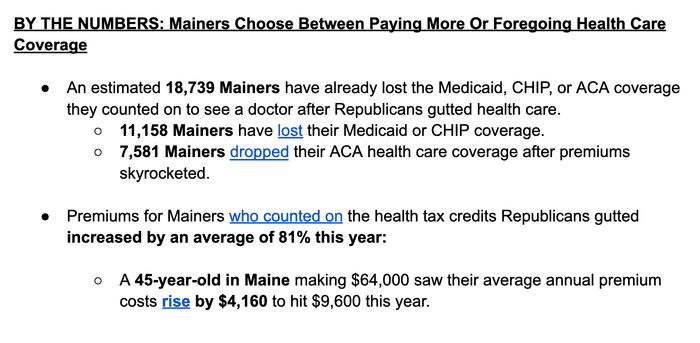


More than 25,600 Alaskans have lost health coverage under the Republican budget law and premiums have surged by an average of 346% this year, according to Protect Our Care’s fact sheets.

US Sen. Dan Sullivan (R-Alaska), who along with Collins is seen as one of the most vulnerable Republicans this election cycle, voted for the more than $900 billion in Medicaid cuts.

“From Alaska to Florida, these people are our neighbors, our parents, our kids, and they’re sick of paying the price for Republicans’ greed,” Woodhouse said on Tuesday. “They deserve better, and in November they will demand it at the ballot box.”
Over a Month After ICE Killing in Biddeford, Maine; Grieving Family Waits for Answers

“I ask only of God and of the justice system that my son’s case be brought to light, along with the cases of the many others who have had to go through something like this,” said the father of Johan Sebastián Durán Guerrero.


The parents of Johan Sebastián Durán Guerrero, Omar Durán and Dora Guerrero, attend a hearing at Biddeford High School on August 17, 2026.
(Photo by Suzanne Kreiter/The Boston Globe via Getty Images)

Julia Conley
Aug 18, 2026
COMMON DREAMS

With Republican lawmakers refusing to use their congressional authority to investigate a federal agent’s fatal shooting last month of Johan Sebastián Durán Guerrero in Biddeford, Maine, Democratic leaders assembled a “shadow hearing” on Monday at a local high school, where the 25-year-old’s grieving father was among those who spoke to a crowd of about 200 people and pleaded for answers about his son’s killing.

“The death of Johan Sebastián, under those conditions, at the hands of ICE, filled our community with fear and uncertainty,” said Omar Durán, referring to US Immigration and Customs Enforcement. “That is why I ask only of God and of the justice system that my son’s case be brought to light, along with the cases of the many others who have had to go through something like this.”

Durán Guerrero was at least the 11th person to be fatally shot by federal agents since President Donald Trump began deploying ICE and other agencies under the Department of Homeland Security (DHS) to cities and towns across the US to carry out his mass deportation operation.

Federal agents have shot at more than 20 people on US streets under the Trump administration; Durán Guerrero was among several who have been shot at while driving a vehicle, which is against ICE’s own policies.

Rep. Chellie Pingree (D-Maine) reported Monday that the ICE agents who were operating in Durán Guerrero’s neighborhood in Biddeford on the morning of July 13 were actually looking for his roommate, who owned the car he was driving.


Pingree said agents did not have a final removal order for the person who was the target of their operation, contrary to what DHS has said about the case.

“This shocking revelation in clear contradiction to what ICE and DHS have been saying about the operation raises fundamental questions,” Pingree said. “How is ICE deciding who to target and detain in Maine? What information are agents relying on?”

“If ICE cannot accurately determine a person’s immigration status or circumstance before taking enforcement action, that is a profound failure of competence and accountability,” the congresswoman added.

Even in cases where ICE has a deportation order for a person, agents are prohibited from using deadly force unless they have reason to believe the target of the operation poses an imminent threat to an officer’s or someone else’s safety.

An agent identified as David Michael Brouillette shot Durán Guerrero, who had a 3-year-old daughter with his partner, and DHS has claimed that the officer fired his weapon because Durán Guerrero was trying to flee and Brouillette feared “for public safety.”

The agents involved in the operation were not wearing body cameras that were turned on at the time of the shooting, but an eyewitness reported that Durán Guerrero said, “I tried to stop” when the officers pulled him out of his vehicle, bleeding profusely from his head. Surveillance footage taken from a nearby store showed a white car circling an intersection after the shooting before agents stopped it.

“If there were active body cameras on every law enforcement member who was participating there, we wouldn’t be looking at some scratchy videos from one store that’s over here, or one person that’s standing in their doorway that’s trying to get it,” Pingree said at a news conference after Monday’s hearing. “We would actually know every moment that’s happened at the scene.”

Durán Guerrero worked as a delivery driver and a cleaner at a veterinary clinic, and had a valid work permit and a pending asylum case.

A lawyer for Durán Guerrero’s family said state investigators have interviewed his partner, Karolina Rojas, but no federal agencies have ever contacted her following the killing.

“Any reasonable investigation would include interviewing the family and eyewitnesses,” the lawyer, Ben Gideon, said Monday.

DHS said after the shooting that its inspector general would investigate, but both the agency and the Justice Department refused to answer questions from The New York Times about whether the probe had begun.

The office of Maine Attorney General Aaron Frey is investigating the shooting, and is expected to present its findings to the Maine Deadly Force Review Panel. The panel can make recommendations to DHS, but it does not have jurisdiction over the federal agency.

Durán Guerrero’s parents traveled from his home country of Colombia for the shadow hearing. His mother did not speak publicly, while his father described the “deep pain” of hearing his young granddaughter ask where Durán Guerrero is.


“Our dream was always to be reunited and to hold each other again,” he said. “Today, that dream can no longer come true.”

Saturday, August 22, 2026

ICC Denounces US Sanctions as ‘Flagrant Attack’ on International Legal Order

“When judicial actors are threatened for applying the law, it is the international legal order itself that is placed at risk.”


A woman walks into the International Criminal Court ICC in The Hague, the Netherlands, April 23, 2026.
(Photo by Shao Haijun/Xinhua via Getty Images)

Brad Reed
Aug 19, 2026
COMMON DREAMS


The International Criminal Court on Wednesday hit back at the Trump administration one day after US Secretary of State Marco Rubio announced new sanctions against ICC officials.

The ICC described the new sanctions, which target President Tomoko Akane and senior trial lawyer Abdoulaye Saye, as “a flagrant attack against the independence of an impartial judicial institution.”

“When judicial actors are threatened for applying the law, it is the international legal order itself that is placed at risk,” the ICC said. “Threats and coercive measures also impact the ability of victims to seek justice, as they turn to the court when all other avenues have been exhausted.”

However, the court said that it is “undeterred” from pursuing its mission, while pledging to stand “firmly behind its personnel and behind victims of unimaginable atrocities.”

In total, the US has now sanctioned half of the ICC’s 18 judges, as well as both of the court’s deputy prosecutors, a former prosecutor, and a staff member.

The sanctions on the ICC also drew condemnation from the government of the Netherlands, where the court is physically located.

In a social media post, Dutch Foreign Minister Tom Berendsen insisted that “international courts and tribunals must be able to freely carry out their mandates,” and pledged to “fully support the court and its staff.”

Balkees Jarrah, the Middle East and North Africa director at Human Rights Watch, said the sanctions were “just the latest example of the Trump administration’s utter contempt for international law and a naked attempt to shield American and Israeli officials implicated in serious crimes from justice.”

Although no American is currently under investigation or being tried by the ICC, the Trump administration has been targeting ICC officials who have been investigating alleged war crimes committed by Israel with the backing of the US government.

Saye, a target of Tuesday’s US sanctions, was charged with investigating war crimes allegedly committed by Israel during its yearslong assault on Gaza.

The Trump administration also sanctioned then-ICC prosecutor Karim Khan, who obtained arrest warrants for Israeli Prime Minister Benjamin Netanyahu and former Israeli Defense Minister Yoav Gallant for alleged war crimes and crimes against humanity in Gaza, last year.


‘Deranged Behavior’: Marco Rubio Slammed for US Sanctions on ICC President

“When you are shameless, contemptuous of international law, and morally bankrupt, you boast of disgrace as though it were an achievement,” said one critic.


Brad Reed
Aug 18, 2026
COMMON DREAMS

US Secretary of State Marco Rubio on Tuesday drew an outraged reaction from critics after he unveiled sanctions against Tomoko Akane, president of the International Criminal Court.

In announcing the sanctions, Rubio described the ICC as “a corrupt and fatally politicized” institution that has supposedly “abused its authority and exceeded its mandate.”

Rubio said the ICC “has repeatedly attempt to assert authority over... the United States and other countries that have not consented to its jurisdiction,” which he said “sets a dangerous precedent for all nations.”

In addition to sanctioning Akane, Rubio said the US would also be sanctioning ICC senior trial lawyer Abdoulaye Saye.

While Rubio did not mention what specific actions the ICC has taken to warrant such sanctions, a Tuesday report in The Guardian noted that Saye was charged with investigating war crimes allegedly committed by Israel during its years-long assault on Gaza.

The Trump administration had previously sanctioned then-ICC prosecutor Karim Khan—who obtained arrest warrants for Israeli Prime Minister Benjamin Netanyahu and former Israeli Defense Minister Yoav Gallant—and an additional eight ICC officials.

The social media account of Drop Site News accused Rubio of attacking the court solely to protect Netanyahu from war crimes prosecution, pointing out that “there is currently not a single American citizen under indictment, investigation, or facing an arrest warrant” from the ICC.

The sanctions earned the praise of the Israeli American Public Affairs Committee (AIPAC), which accused the ICC of conducting “politically motivated investigations and prosecutions targeting America and Israel.”

Rutgers Law School professor Adil Haque said the ICC sanctions showed the US was acting like a “rogue government” and engaged in “deranged behavior.”

Michael Karanicolas, law professor at Dalhousie University, didn’t just point fingers at the US over the sanctions, but at US allies who have sat back as international institutions have come under assault.

“I’m no longer surprised by the Trump administration’s efforts to destroy the ICC,” wrote Karanicolas. “What I keep waiting for is any response from Canada or the European governments who ostensibly still believe in international law to defend these institutions.”

War correspondent and international political analyst Elijah Magnier delivered a withering rebuke of Rubio’s announcement.

“When you are shameless, contemptuous of international law, and morally bankrupt,” wrote Magnier, “you boast of disgrace as though it were an achievement.”
Amnesty Warns of Right-Wing Argentinian Government’s AI-Driven Surveillance State

“When powerful people don’t want accountability, they attack those who ask questions and use whatever is at their disposal to monitor, control, and repress.”


Argentine President Javier Milei waves to supporters next to the spokesperson for the Presidency Manuel Adorni at the ruling party’s La Libertad Avanza headquarters in Buenos Aires on October 26, 2025.
(Photo by Luis Robayo/AFP via Getty Images)

Brad Reed
Aug 19, 2026
COMMON DREAMS


Amnesty International on Wednesday released a report detailing how the Argentine government under the leadership of right-wing President Javier Milei has created a massive artificial intelligence surveillance state that the human rights group described as “a techno-authoritarian infrastructure of social control.”


According to Amnesty, Argentina’s Military of National Security invested in several pieces of surveillance technology between 2024 and 2025, including licenses for Maltego, an open-source investigator platform that collects and organizes data from “social media, websites, the dark web, personal data, technical infrastructure, and other open sources”; and Clearview AI, a facial recognition platform with “a widely known track record of mass exploitation of biometric data without sufficient legal grounds.”

The government also procured drones equipped with automated tracking capabilities and thermal cameras capable of providing real-time image transmission, Amnesty found.

This surveillance state, Amnesty said, has created a “chilling effect” across the country that has reduced participation in protests and forced activists to reduce their public exposure and take further precautions when planning demonstrations.

Ana Tapia, an activist who has been protesting against pension cuts made by Milei’s government, described the government’s aggressive surveillance tactics against herself and her fellow demonstrators.

“We’ve all been fully identified for a long time now,” Tapia explained. “Sometimes as you’re walking... and suddenly you see the drone hovering just above your head. Sometimes within six feet. Why so close? Why is it so invasive?”

Matías Darabós, an activist who documents police abuses, similarly described the omnipresence of the surveillance state.

“There is a very strong feeling that you are being controlled and watched,” said Darabós. “In fact, when we go to marches to record what goes on, they are constantly pointing at us or filming us.”

Journalists described being subjected to what they believe are coordinated harassment campaigns in which they are swarmed with violent rhetoric and threats which they believe are related to increased state surveillance.

Paula Cejas, director of the Latin America Office of the International Federation of Journalists (IFJ), told Amnesty that “social media and the streets are no longer a safe space for journalists.”

“Even I myself think about what I’m going to post to the IFJ account,” Cejas explained, “what language to use so that I’m not put on a list and get us all harassed.”

Another journalist who spoke anonymously with Amnesty similarly said she had grown incredibly careful of what she posts on social media compared to the past.

“Before, I used to comment and give my opinion on everything, now I just use it recreationally,” the journalist said. “I think a lot about the words I use, I moderated my rhetoric and reduced my interaction 100%, especially on Twitter,” the platform Elon Musk renamed X.

Paola Garcia Ray, deputy director of Amnesty International Argentina, summed up the report by arguing that “pervasive surveillance is being used against Argentinians in both physical and digital spaces, to devastating effect” on civil society.

“These technologies have become an integral part of the infrastructure of state control, targeting dissent, deterring protest movements, and harassing marginalized groups, among other authoritarian practices,” Garcia Ray emphasized. “When powerful people don’t want accountability, they attack those who ask questions and use whatever is at their disposal to monitor, control, and repress.”

Milei is a political ally of US tech billionaire Peter Thiel, a co-founder of AI surveillance company Palantir whose presence in Argentina has resulted in protests demanding his ouster from the country.


Bring Back the Sears Home! Proposal Calls for 500,000 High-Quality, Affordable Starter Houses to Ease Crisis

“Policymakers must pursue creative, tangible, and lasting solutions that bring homeownership back into reach.”


A manufactured home in Syracuse, New York constructed as part of the state’s MOVE-IN NY program, on September 22, 2025.
(Photo by New York State Homes and Community Renewal)

Stephen Prager
Aug 19, 2026
COMMON DREAMS

As young families are increasingly priced out of the housing market, a group of economic researchers is pushing to revive an idea from the past to bring the distant dream of homeownership back within reach: mass-produced homes.

A report published Wednesday by the Groundwork Collaborative proposes a federal program to subsidize the creation of 500,000 prefabricated houses over the next eight years—starter homes that they estimate would be drastically more affordable than the ones currently on the market.

The report was written by three economic policy analysts who served under former President Joe Biden: Noah Ball-Burack and Emily DiVito, who worked on policy for the Treasury Department, and Alex Jacquez, who was Biden’s special assistant for economic development and industrial strategy at the White House National Economic Council.


The proposal draws from history: From 1908-40, around 75,000 Americans ordered mass-produced homebuilding kits from Sears, Roebuck & Co. through catalogs, which provided pre-cut lumber, doors, windows, and other materials to construct a home that ended up being considerably cheaper to build than those constructed conventionally.

These “Sears homes” were not only fully functional but also durable: More than 80 years after the program was discontinued, thousands of them are still standing today.


Groundwork’s researchers argued that marshaling the government’s resources, a modern Sears home program could go great lengths toward combating the housing affordability crisis.

“For too many families, homeownership has gone from a milestone to a mirage. Decades of under-building have left us with an affordable housing shortage that’s pricing people out of their communities,” DiVito said. “Policymakers must pursue creative, tangible, and lasting solutions that bring homeownership back into reach. The Modern Sears Home program does just that.”

The group called for the Congress to appropriate between $44 billion and $75 billion over eight years---less than the US spends on the military in a single month---to guarantee large orders of factory-built homes, acquire and prepare land for them, and then sell the completed houses to eligible buyers with government-backed affordable mortgages.

They estimate that factory-produced single-family homes could be sold for roughly $170,000-$215,000 each. That’s around half the median price of a new single-family home, which has increased nearly 25% since the start of the decade.

“Sears offered these homes for profit,” the researchers wrote. “The federal government—with greater resources, lower borrowing costs, and unmatched power to scale—can do it better.”

Unlike private capital, the Department of Housing and Urban Development (HUD), which would administer the program, doesn’t have a profit motive and is capable of guaranteeing large amounts of demand so that manufacturers can build scale.

And since the goal is to ensure that people are housed rather than to increase profit margins, the researchers argued that the homes are less vulnerable to the fluctuations of the housing market, which currently disincentivizes lowering rent.

“Private developers build only when projects pencil, meaning that expected rents, net of construction, and financing costs, clear the rate of return their investors demand,” the report explains. “This math ties new housing supply to high rents. If rents begin to fall, private capital will walk away.”

The researchers argued that their proposal would not just benefit those who are able to purchase new Sears homes, which HUD would target at households earning 60%-100% of a local area’s median income, but everyone in the housing market, by driving up supply.

“Sustainably lowering housing prices relative to other prices in the economy requires public investment,” they wrote. “The government can either build housing itself or finance private construction at below-market returns. It should do both.”

The proposal comes as pre-fab homes are being viewed increasingly as a policy solution to confront the housing crisis and as an opportunity for developers looking to attract young homebuyers.

Eager to build cheap starter homes fast, developers are experimenting with entire subdivisions of factory-built houses, as The Washington Post reported on Wednesday.

New York state, meanwhile, is trying out a miniature version of what Groundwork has proposed, building 1,500-square-foot homes in Syracuse, Schenectady, and Newcomb. The state has completed three homes so far and awarded funding for 211 more.

According to a 2023 report by the Harvard Joint Center for Housing Studies, these kinds of higher-end manufactured homes, known as “CrossMods,” cost 27% less on average compared to an identical home built on-site.

The ones that have gone up in New York have borne out these cost-saving projections. They took about a third of the time to construct as traditional homes and cost about $250,000 to build and install, about half the cost for a comparable house, according to the state’s affordable housing agency.


An affordable housing law that passed Congress in June also took steps toward expanding factory-built housing with a bipartisan bill passed last month that removed regulatory barriers to manufactured homes and sought to make construction easier to finance. However, the law does not provide any new federal funding for housing production.

The researchers said this was a good start that could help speed up the process of building homes. But they said it was far too narrow to really address the problem.

“It will take a government willing to act not at the margins of the market, but at its center—financing cheaply, building at scale,” they wrote. “The technology and policy levers to realize this vision already exist. The question is not whether the federal government can act at this scale—but whether it will.”
House Democrats Probe Use of Trump’s NSPM-7 to Target ‘Left-Leaning Political Groups’


“We are deeply troubled by public commitments to deploy the full force of the State and Treasury departments against loosely defined ‘far-left networks’ and their alleged ‘enablers.’”


Jessica Corbett
Aug 19, 2026
COMMON DREAMS
\
Dozens of Democrats in the US House of Representatives this week announced a congressional inquiry into the use of a widely decried memo from President Donald Trump to persecute “political dissent” and target “left-leaning political groups.”

Democratic Reps. Jim McGovern (Mass.), Ayanna Pressley (Mass.), and Delia Ramirez (Ill.) revealed Tuesday that they, along with over 20 others, wrote to Secretary of State Marco Rubio and Treasury Secretary Scott Bessent earlier this month to demand answers about the recent “Ministerial on the Resurgence of Political Terrorism” and directives under National Security Presidential Memorandum 7 (NSPM-7).


‘Outrageous’: Trump Officials Investigated Left-Wing Groups After Alex Pretti Killing in Minneapolis

“Specifically, we are alarmed by the Department of State’s new ideologically driven visa restriction policy and the Department of Treasury’s pledged financial enforcement mechanisms directed against civil society,” they wrote. “These policies dramatically escalate the administration’s deliberate and targeted attempts to silence any person, organization, or institution critical of its policies and abuses of power on a global scale.”

“We are deeply troubled by public commitments to deploy the full force of the State and Treasury departments against loosely defined ‘far-left networks’ and their alleged ‘enablers’ and urge you to immediately reverse course,” the lawmakers continued. “Rather than relying on law enforcement data—which consistently identifies right-wing violent extremists and white supremacist organizations as the predominant domestic terrorism threat—this administration has instead taken actions that manufacture an ideological enemy.”

The visa policy “bars foreign nationals from entry who ‘finance, recruit, incite, or otherwise enable terrorist, violent, and criminal far-left terrorist networks’ and defines ‘far-left terrorist networks’ as those with explicit aims to ‘undermine the political foundations of free and self-governing societies,’” the letter details. “This rhetoric and policy embody the core characteristics of fascist statecraft—using the security apparatus of the state to repress and criminalize political opponents and dissenters rather than specific violent acts.”

The letter notes the impacts of the administration’s policies beyond the United States, warning that “seeking to export an ideological mandate to more than 65 countries creates a dangerous precedent that authoritarian governments will eagerly exploit to delegitimize and criminalize political dissent and justify their own crackdowns on peaceful opposition.”

“Foreign nationals fleeing political persecution abroad—including persecution by governments that label peaceful dissidents ‘leftist terrorists’ to discredit them—may find themselves barred from the United States under the very same vague and subjective standard,” the lawmakers wrote. “Expanding transnational intelligence-sharing under this ill-defined and hyper-politicized definition of violent extremism opens the door to transnational repression—including cross-border monitoring and harassment—of international activists, researchers, and political dissidents, as well as potentially any individual within their networks.”

“We also risk fracturing critical alliances with governments whose own laws strictly protect political speech, civil liberties, and human rights—protections that these very policies are undermining here at home,” the Democrats stressed.

The letter also calls out White House Deputy Chief of Staff Stephen Miller’s description of leftists as “the enemies of civilization” and a “cancer” that can “destroy a society,” as well as Bessent’s comparison of leftists to the Islamic State and al-Qaeda—when he said that “the unified front between international Marxism and the radical Islamic movement need not share the same ultimate vision to share the same immediate enemy of free and self-governing societies.”

Rubio has similarly called leftists “the enemies of civilization” and recently faced criticism for a “McCarthyite” State Department report claiming that the Cuban government has, for decades, “infiltrated the highest reaches of the US government, recruited and cultivated generations of American activists, backed an unprecedented wave of left-wing terrorism on American soil, and carried out one of the most durable and damaging foreign intelligence penetrations in American history.” The document is seen as a signal that Trump may deliver on his threat to try to take over the island nation by force.
Dutch Pension Fund Pulls Nearly Half a Billion Euros From Climate ‘Megapolluter’ BlackRock

“This is a massive win for Dutch pensioners—not to mention all living creatures on Earth.”


A protester holds a sign reading “Climate Action Now” at BlackRock’s office in New York City on October 18, 2021.
(Photo by Erik McGregor/LightRocket via Getty Images)

Jessica Corbett
Aug 20, 2026
COMMON DREAMS


Pensioenfonds Recreatie just became the latest Dutch pension fund to ditch US-based BlackRock, the world’s largest asset manager and a leading investor in climate-wrecking fossil fuels.

Recreatie, which is for workers in the Netherlands’ recreation sector, last Friday named Cardano as the new manager of its €450 million—or $525 million—equity portfolio.

Xander den Uyl, a board member at the pension fund, told the Dutch publication Pensioen Pro that AF Advisors “assessed a long list of asset managers—including BlackRock—based on a dozen criteria,” including cost as well as environmental, social, and governance (ESG) policy, and Cardano was the strongest.

BlackRock announced in February 2024 that it was transferring its Climate Action 100+ membership to its international arm and last year, just before anti-ESG President Donald Trump returned to power, it left the Net Zero Asset Managers Initiative.

Den Uyl said BlackRock’s ESG controversies did not help the asset manager in the review process but “were not decisive,” and described the switch to Cardano as “a business decision.”

Asked about the development by IPE, a BlackRock spokesperson said: “We respect the fund’s decision. We remain proud to manage more than €350 billion on behalf of Dutch clients.”

However, as journalists and campaigners have noted this week, Recreatie’s decision followed similar moves by other Dutch pension funds. PFZW said last September that it had stopped investing in stock funds managed by BlackRock, and PME in December pulled around €5 billion, or $5.9 billion.

By abandoning “megapolluter” BlackRock, Recreatie “is sending an important message,” Fossil Free Netherlands said Tuesday. “Powerful entities that backtrack on climate policy under pressure from Trump will lose European clients. It matters who you partner with as a pension fund—and whose power you strengthen.”

“BlackRock is one of the largest investors in fossil fuel companies worldwide and profits from the genocide in Gaza,” Fossil Free Netherlands stressed. “BlackRock is one of the largest shareholders in many companies and, as a result, wields enormous influence over both the stock prices of individual companies and the global economy. Moreover, the company consistently prioritizes short-term profits over what matters to us all: a livable climate, fair working conditions, and human rights.”


In addition to the decisions by PFZW and PME, Fossil Free Netherlands pointed to European pension funds cutting ties “with the equally unscrupulous and powerful State Street,” and an ongoing search for asset managers for New York City’s pension funds, the latter of which was also highlighted by US campaigners this week.

New York Communities for Change senior director Jose Gonzalez said in a statement that Recreatie’s “exit from BlackRock is the latest in a string of international funds that understand the urgency and long-term fiduciary responsibility resulting from climate change,” and comes after NYC Comptroller Mark Levine announced the search, which is considering “ESG factors and limits on carbon.”


“In the US context, although heartened by Comptroller Levine’s June announcement that the pension systems will bid out contracts for its money managers, it is imperative that the comptroller is serious about meeting its 2040 net zero goals,” the campaigner said. “NYC should continue to lead domestically on divestment, and with other pension funds as a universal owner. The proof will be when the comptroller’s office moves AUM out of dirty managers like BlackRock and State Street to cleaner ones.”

Alec Connon, Stop the Money Pipeline coalition director, also welcomed that “as much of the country swelters under extreme heat and breathes in toxic wildfire smoke, more and more major pension funds are moving money away from the world’s dirtiest asset managers.”

“As it continues its search for a new asset manager,” he added, “New York City and Comptroller Levine have a great chance to continue the funds’ climate leadership by divesting from BlackRock and selecting a new asset manager that takes the climate crisis and climate financial risk seriously.”

Continued Fossil Fuel Emissions Could Nearly Triple the Destruction of European Wildfires by 2100

“Fire management,” said one researcher, “cannot replace climate mitigation.”


A firefighter runs as wildfire intensifies in the village of Sidiro and Yannuli in Evros, Greece on August 31, 2023.
(Photo by Ayhan Mehmet/Anadolu Agency via Getty Images)


Julia Conley
Aug 20, 2026
COMMON DREAMS

Wildfires raging across Europe this summer have burned through more than 1.4 million acres across France, Spain, Italy, and even countries with typically milder climates, including the United Kingdom and Belgium—and a study published Thursday warned that the continuation of high carbon emissions would nearly triple the amount of burnt land from wildfires by the end of the century.

Climate action that reduces emissions, including a transition away from fossil fuel extraction and toward solar, wind, and other renewable energy sources, would mean about 39% more land would be burned through during fire seasons across the European Union by 2100, according to the research by the Potsdam Institute for Climate Impact Research (PIK).


Human-Caused Climate Emergency Made Canada’s Summer Wildfires Twice as Likely: Study


Historic ‘Monster’ Wildfires Scorch France and Spain

But if policymakers fail to take sufficient action, according to the researchers’ models, an estimated 192% more land would be burned each year by the end of the century.

The massive increase in wildfire destruction would likely mean major upheaval across Europe; as wildfires tore through Spain and France last month, nearly 270,000 people were forced to evacuate.

Hundreds of people have been killed in European wildfires over the past decade, including at least 14 people in Spain’s recent blazes, which grew rapidly amid soaring temperatures, and three firefighters in Greece.

The researchers at PIK compared the projected annual burnt area for 2070-2100 with a model of results for the period between 2000-2030. An increase in hot, dry weather, which scientists have linked to fossil fuel emissions, was the biggest driver of wildfire destruction in the model.

“If fires become really extreme, our ability to contain them might break down, and we do not know yet where this point is.”

“Our results indicate there could be widespread increases in burned area even under comparatively low warming of around 1.8°C. But if we emit more, and global temperatures rise by roughly 3.6°C, we see fires become much more prevalent, especially around the Mediterranean and across much of Western and Central Europe, including areas that to date have not experienced many fires,” said Maik Billing, a researcher at PIK and lead author of the study, which was published Thursday in Global Change Biology.

A global temperature rise of 3.6°C would mean fire weather would intensify “virtually all of Europe” by 2100, the scientists said.

Currently, 2.6°C of global heating is expected by the end of the century under climate policies now in place.

The researchers also examined how human action to improve fire management, including training emergency crews and improving equipment and coordination, could mitigate some damage.

“Continued improvements in fire management have the potential to reduce burned area by 92% in a 1.8°C future and 72% at roughly 3.6°C,” said PIK. “However, the authors cautioned that the results could be optimistic when it comes to the efficacy of fire management in a much warmer climate.”

Thomas Hickler, a scientist at the Senckenberg Society for Nature Research and a co-author of the study, said: “We see fire conditions are increasing, so we need to invest more... Our projections show that this can make a significant difference.”

“But if fires become really extreme, our ability to contain them might break down, and we do not know yet where this point is,” said Hickler. “The recent record fires in France clearly show that we cannot simply extrapolate from the experiences of the past.”

Billing emphasized that regardless of investments in firefighting, “if we go on a path of high emissions... we still see strong increases in burnt area.”

“Fire management,” said Billing, “cannot replace climate mitigation.”
Critics Slam Trump FDA Pick Heidi Overton as ‘Anti-Reproductive Rights, Anti-Vax, Anti-Science’

“The American people deserve someone who will put science and facts FIRST, not another Trump sycophant who will make it their mission to attack medication abortion,” said one Democratic senator.


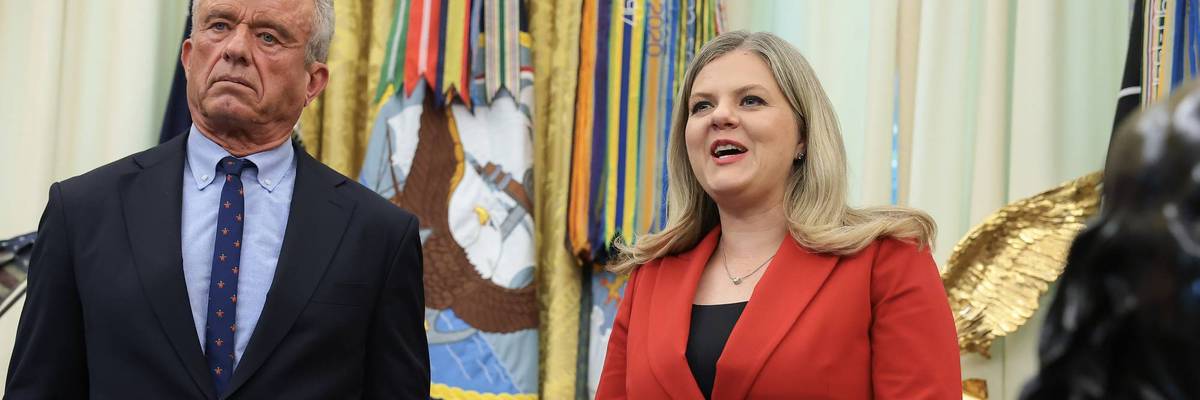
Deputy Assistant to the President for Domestic Policy Dr. Heidi Overton is accompanied by Health and Human Services Secretary Robert F. Kennedy Jr. in the Oval Office of the White House in Washington, DC on August 10, 2026.
(Photo by Anna Moneymaker/Getty Images)


Brett Wilkins
Aug 19, 2026
COMMON DREAMS

President Donald Trump on Wednesday tapped White House health policy adviser Dr. Heidi Overton to lead the Food and Drug Administration, a move that drew fierce opposition from Democratic lawmakers, reproductive rights advocates, and public health experts, who pointed to her opposition to abortion rights and support for controversial changes to federal vaccine policy as cause for alarm.

Trump took to his Truth Social network to announce his pick of Overton, a physician and deputy director of the White House Domestic Policy Council, to replace former FDA Commissioner Marty Makary, who resigned in May following months of turmoil at the agency. The president described Overton as a “ROCKSTAR” in his administration who will “deliver on the MOST TRANSFORMATIVE Health Agenda in History.”

“Heidi is ‘ALWAYS RIGHT,’ Secretary Kennedy recently said in the Oval Office!” Trump continued, referring to Health and Human Services chief Robert F. Kennedy Jr. “We need her leadership at the FDA now to ensure that the US remains the WORLD LEADER for Scientific Discovery and CURES.”

The president also said Overton would work with Centers for Medicare & Medicaid Services Administrator Mehmet Oz to advance his agenda of faster drug approvals, increased innovation, clinical trial reforms, and lower prescription drug prices.

However, skeptics argue that Overton’s policy record raises serious questions about whether she would maintain the FDA’s scientific and regulatory independence in an administration in which critics say loyalty to Trump is of paramount importance.

Reproductive Freedom for All—formerly the National Association for the Repeal of Abortion Laws and NARAL Pro-Choice America—noted that “Overton has an extensive anti-abortion record.”

The group continued:
She celebrated the overturning of Roe v. Wade as a “huge victory,” and has advocated for the politicization of government agencies to help advance a nationwide anti-abortion agenda. She previously worked at America First Policy Institute, an extreme conservative think tank made up of former Trump administration officials, where she authored a brief pushing disinformation about the safety of medication abortion and calling for additional, medically unnecessary restrictions on access to mifepristone.

“Donald Trump is trying to put an anti-abortion extremist in charge of any agency that could seriously undermine reproductive healthcare—including the agency that could roll back access to mifepristone nationwide,” Reproductive Freedom for All president and CEO Mini Timmaraju said. “Her nomination is another alarming step in Trump’s plan to weaponize every part of the federal government to restrict abortion nationwide.”

Overton’s shifting stance on vaccines also raised eyebrows.

Endpoints News senior senior reporter Max Bayer highlighted how, while working at AFPI, Overton “and others praised Operation Warp Speed, the massive government initiative to expedite development and manufacturing of the Covid-19 vaccines” during Trump’s first administration.

But less than a year later, Bayer said, Overton “advocated against Covid-19 school vaccine mandates, writing in an editorial the data supported more parental choice in the decision.”

“Overton stood by Trump earlier in August as he announced a sweeping and contentious new executive order amending the childhood vaccine schedule and advising that the [measles, mumps, and rubella] vaccine be broken up into individual components,” he added. “Makers of the vaccine pushed back on the directive, but now with Overton in line to lead the FDA, there could be enhanced pressure for drugmakers to follow through on the request.”

Democratic US lawmakers also voiced opposition to Overton’s nomination.

“Heidi Overton is a far-right, anti-abortion extremist who has no business leading the FDA,” Sen. Patty Murray (D-Wash.) said on social media. “The American people deserve someone who will put science and facts FIRST, not another Trump sycophant who will make it their mission to attack medication abortion. I will vote NO.”


At least one Republican lawmaker—who chairs the Senate Health, Education, Labor, and Pensions Committee—also questioned Trump’s pick.

“While I respect Dr. Overton’s experience as a physician, I have strong concerns about her nomination to be FDA commissioner,” Sen. Bill Cassidy (R-La.), a gastroenterologist, said on X. “Her lack of managerial experience does not prepare her well for leading a large organization that is already dealing with staffing and morale issues.”

“Additionally, Dr. Overton’s active role in last week’s nonsensical vaccine executive order calls into question her commitment to standing up for sound science and protecting children’s health. That alone is almost disqualifying,” added Casisdy, who earlier this year lost a primary race to a Trump-backed challenger.

Overton’s nomination comes amid turmoil at an agency that has seen thousands of employees fired by Kennedy since last year amid Trump administration efforts to shrink the government in line with Project 2025, the Heritage Foundation-led framework for a far-right federal overhaul.

Chris Meekins, a former Trump health official who is now an analyst at the investment bank Raymond James, told clients that Overton would be “like Makary, but probably worse.”

“Being seemingly inexperienced and unqualified is fine if you have self-awareness and humility and a strong team around you,” Meekins wrote. “Based off of our DC channel checks, she does not seem to have either.”


Federal Judge Blocks Trump and RFK Effort to Get More Teens Pregnant

The ruling, said the government watchdog Public Citizen, is “a win for young Americans’ well-being.”


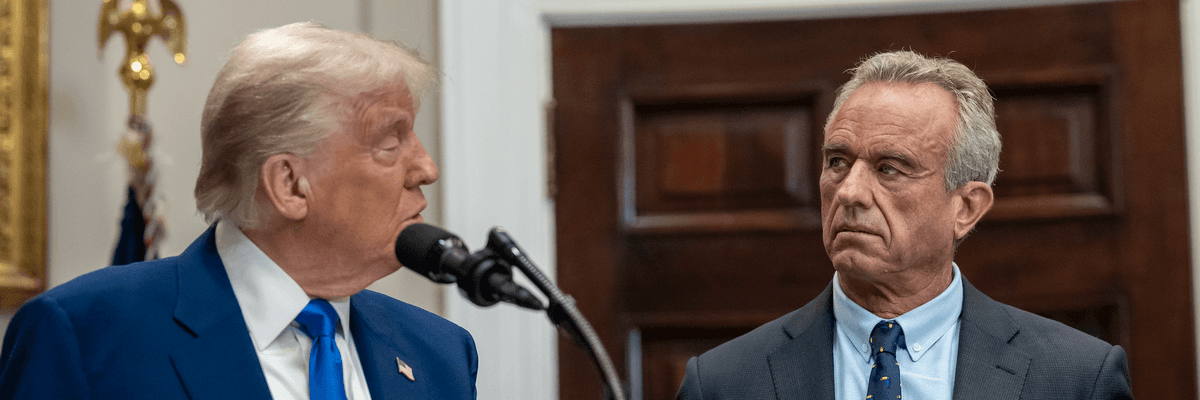
US President Donald Trump speaks while Health and Human Services Secretary Robert F. Kennedy Jr. looks on in the White House in Washington, DC 
(Photo by Joyce N. Boghosian/White House/flickr/cc)

Julia Conley
Aug 19, 2026


The Teen Pregnancy Prevention program, first authorized through bipartisan legislation in 2009, has been credited with helping to dramatically reduce the number of American teenagers who have experienced unwanted pregnancies in the past decade and a half, dropping by more than 65% over 16 years, according to one congressional report.

Despite the best efforts of President Donald Trump and Health and Human Services Secretary Robert F. Kennedy Jr., a federal judge’s ruling on Wednesday sent the message that the push to reduce teen pregnancy in the US will continue, with the administration’s limits on the program’s federal grants paused.

Judge Christopher Cooper of the US District Court for the District of Columbia granted a preliminary injunction in the case of Hennepin County, Minnesota v. US Department of Health and Human Services, in which officials joined King County in Washingtin state, Planned Parenthood of the Heartland, and the Sexuality Information and Education Council of the United States (SIECUS) in challenging HHS’s changes to the program’s grant policy. The plaintiffs were represented by Public Citizen and Democracy Forward.

The changes, said Cooper, were “likely arbitrary and capricious.”


The new policy, announced in June, canceled 53 of 66 active grants that had gone to public universities, health departments, and nonprofits for programming related to sex education, including information that was given to teens on contraception and communication with sexual partners.

In Trump’s 2027 budget, the grants are described as promoting “radical leftist ideology,” and officials claim there is no evidence that teen pregnancy prevention programs that go beyond educating young people about abstinence have “contributed to the historic decline in teen pregnancy, which is now at an all-time low.”

Under new guidance issued in June, Teen Pregnancy Prevention (TPP) program grantees are required to focus lessons on abstinence, deemphasize contraception, and teach teens about fertility and “body literacy.”

“HHS is perfectly entitled to formulate its own views about how to stem teen pregnancy—or even whether it is worth preventing at all—and to pursue policy initiatives consistent with its viewpoint. But it is not at liberty, under the Administrative Procedure Act (APA), to impose conditions on grant recipients that Congress did not intend or that are unreasonable or unexplained. The preliminary record suggests that HHS has done just that,” wrote Cooper in the ruling.

“Through the TPP, Congress sought to fund a range of evidence-based teen pregnancy prevention strategies, not just abstinence. According to unrebutted record evidence, programs that teach abstinence to the exclusion of all other approaches are ineffective in delaying sexual initiation and reducing adolescent pregnancy, at least as a general matter,” Cooper continued.

The judge took aim at the administration’s promotion of “body literacy,” which he called “a nebulous concept that appears to elevate fertility and marital procreation over well-tested forms of contraception and pregnancy prevention.”

Cooper also suggested that HHS had not bothered to find genuine evidence of its claims about “body literacy,” instead “remarkably” referencing “public health studies that appear either not to exist or not to support the propositions for which they are cited—a hallmark of AI-generated citations.”

The judge stopped short of reinstating the dozens of grants, amounting to about $67 million, that have been terminated, saying it was unclear whether he had the authority to do so.

The plaintiffs and other advocates of comprehensive sex education have called for a permanent injunction; Cooper called on both parties in the case to propose a schedule for next steps by September 1.

Callie Simon, executive director of SIECUS, said the group was “encouraged that the court has halted implementation of the new harmful policy” but emphasized that “the impacts of terminating existing grants remain.”

“Today’s decision sends a clear message that the Trump-Vance administration cannot replace the proven, bipartisan Teen Pregnancy Prevention program with an ideologically driven alternative that harms young people,” said Simon. “Communities across the country are still without the evidence-based programs they relied on, and we will continue fighting to ensure young people have access to the sex education they deserve.”

Sandra J. Valenciano, director and health officer for public health in Seattle and King counties, said local communities were facing a measurable loss due to HHS’ stripping of TPP grants

“This federal action threatened our ability to complete a study on a new science-based, community-informed sex education curriculum specifically for young men and boys,” said Valenciano. “This ruling gives us hope that we may still be able to get to the finish line with this study and ultimately empower more young people to build healthy families if, when, and how they choose.”

Ruth Richardson, president and CEO of Planned Parenthood North Central States, said the ruling “reaffirms the value of trusted, evidence-based education programs that help youth make informed choices and plan for their futures.”

“Attacks on the Teen Pregnancy Prevention program not only put young people at risk, they also risk increasing costs for taxpayers,” said Richardson. “No one benefits from these politically motivated attacks. It’s time for them to end.”
Seething MAGA reminds Trump who voted for him after 'slap in the face' to ranchers


Matthew Chapman
August 21, 2026 
RAW STORY

President Donald Trump's plan to lower sky-high beef prices before the midterms has triggered a rare rebellion from within his own party, with ranchers, senators, and even his health-food allies calling it a betrayal.

Trump announced Friday he'll remove duties on 300,000 metric tons of imported beef, claiming suppliers agreed to sell at a 25% discount that consumers will feel at checkout. The tariff relief lasts just 90 days, conveniently expiring right after November's midterm elections. A formal executive order is expected within two weeks.

But according to Politico, many of Trump's supporters and sympathetic special interests aren't happy.

United States Cattlemen's Association president Justin Tupper didn't hold back, saying, "You don't put America first by putting U.S. cattle producers last."

Sen. Deb Fischer (R-NE) called herself "extremely disappointed," while Sen. Tim Sheehy (R-MT) warned the move would hurt ranchers, who are "most of whom are MAGA Republicans." Rep. Thomas Massie (R-KY) went further, branding it a "slap in the face" to ranchers and consumers alike, and Sen. Pete Ricketts (R-NE) said the plan "compromises Nebraska farmers and ranchers."

One anonymous agriculture industry insider offered a blunt diagnosis of Trump's strategy.

"This is Donald Trump in purgatory," the industry representative said, describing it as trading long-term strategy for a short-term fix that won't meaningfully lower prices.

Even Agriculture Secretary Brooke Rollins had spent months publicly opposing similar import plans, instead blaming Biden-era policies for the beef shortage driving up costs. Industry insiders say they weren't briefed on Trump's announcement beforehand and remain unsure which countries could even supply that much beef. Meanwhile, MAHA movement figures like Alex Clark blasted the move as anti-health messaging, given the administration's own guidance pushing Americans to eat more beef as a protein source.

With ground beef prices near $7 a pound and no clear path to lasting relief, Trump's gambit risks alienating ranchers without delivering the grocery-store savings voters are demanding.