Monday, October 26, 2026

REVISIONIST HISTORY

How U.S.  Party Politics Fueled The Militarization Of  Race Relations – OpEd

October 25, 2026

MISES


By Dr. Wanjiru Njoya


Key Takeaways:


The article rejects the conventional Reconstruction narrative that Democratic violence was pure aggression and Republican force pure self-defense, arguing that both sides’ claims of “defense” and wartime propaganda produced reciprocal racial violence rather than a simple party-line moral divide.

Drawing on Richard Nelson Current’s Those Terrible Carpetbaggers and contemporary sources, it contends that Radical Republicans militarized race relations by arming black militias while denying arms to whites, promoting the belief that only federal troops could prevent a race war, and using black votes to sustain carpetbagger governments.

Applying the non-aggression principle, the piece maintains that genuine self-defense requires clear evidence of imminent violent threat and cannot justify aggressive or preemptive force, a standard it says Republican policy in the South failed to meet.


According to the non-aggression principle, aggressive violence is never justified. But stating the principle is the easy part. Identifying the aggressor is more difficult when the facts are contested and when both sides, in their respective political parties, claim to be “defending” themselves against their aggressive enemies.

In the history of the Reconstruction era, the official narrative is that the Democrats were the aggressors, and Republican violence was “self-defense.” This is often presented as a moral justification for the militarization of race relations under Republican governments. The rationale of the non-aggression principle is then lost, wrongly subverted into its opposite—that violence is justified for those on “the right side of history” fighting against racism.


A closer examination of the facts reveals that the blame for racial violence cannot be assigned superficially along political party lines. Rather, in the aftermath of war, the same propaganda that fueled the war spawned Reconstruction violence.

In the foreword to his book Those Terrible Carpetbaggers, Professor Richard Nelson Current recounts some of these events from the perspective of the “carpetbaggers.” He argues that this history is important, observing that, “Anyone who claims to know anything about American history can tell you who the carpetbaggers were.” He attempts to give an objective analysis, explaining that,


. . .the story is told from the standpoint of these participants in it, not from the usual standpoint, which has been that of their enemies. While trying to see things as the carpetbaggers saw them, the book strives for objectivity in the sense of relying on the critical use of sources and revealing the pertinent facts whether favorable or unfavorable to the subjects.

By focusing on individuals who were influential during Reconstruction, he shows that not all Republicans—and, indeed, not all Democrats—were the same. Some tried to restore peace and prosperity, while others were in politics for selfish reasons. The “good Republican, evil Democrat” narrative is shown to be woefully simplistic.


While most historians focus on the corruption and mismanagement of the era, it is less often observed that the era had a disastrous effect on race relations in the South. Too often the violence of the era is simply blamed on “racism,” with little effort to understand the contested political issues and the role played by the Republican militarization of race relations. The Republicans promoted the belief that only federal troops could prevent a race war in the South.

The fact that black people could not vote in most states in the North belies the claim that giving blacks the vote in the South reflected a principled Republican belief in civil rights. A genuine belief in civil rights would have insisted on the vote for blacks in the North too.

Further, if the Republicans had a principled desire to give land to the freedmen, why not give them federal owned land in the North or West, rather than give them the plantations seized from white Southerners? Expropriation of white planters, promoted in congress by Thaddeus Stevens, was hardly a course of action likely to yield lasting peace and harmony.

The declared need for blacks to vote in the South, which in practice meant voting for the very same carpetbaggers who called for military occupation, created the need for military protection of black voters. The cure—military rule—came first, and the problem—protecting blacks who supported military rule—was then created to justify the desired cure.

Black Southerners were not in danger purely because their skin was black, as the radical Republicans claimed—they were in danger because they were propping up the carpetbaggers. The fact that the Democrats also campaigned in black communities and protected blacks who voted for them shows that the objection was not to the mere thought of blacks voting but to the fact that blacks—who outnumbered whites in many counties—voted for the carpetbaggers.

For example, in South Carolina, at the 1868 constitutional convention, 51delegates were white and 73 were black—and the black delegates were all Republicans. The spectators, who were there to observe proceedings, were nearly all black.


The first Republican Governor of South Carolina, Robert K. Scott, relied on the black vote to sustain Republican control. He wrote that he did not see any way for harmonious life in the South other than by military occupation. He believed his job was to deploy the state militia to keep white and black apart for their own protection:


The Negro predominates in this state about three to two whites and while he holds the balance of power numerically he will refuse to submit to the demands of his former master. And on the other hand this generation of white men will not overcome the education of two centuries, and therefore I regard a compromise as almost hopeless. Hence the two races can only live together by the presence of a sufficient military force to protect both.

Having persuaded the black population that they were under constant threat of extermination by their former masters, much effort and expenditure was directed to military “self-defense.” Republicans then blamed the Democrats for the ensuing hostilities.

Governor Scott singled out a former slave owner, General Francis Preston Blair, a Lincolnite and leading Missouri Republican who fought on the Union side during the war. Blair decamped to the Democratic Party after the war, as he opposed the Radical Republican view of Reconstruction.


Scott blamed the top Democratic leaders, state and national, for the violence. He had in mind, for one, the Democratic vice-presidential candidate, Frank Blair, whom he had known personally as his superior in Sherman’s army, and who recently had called for the overthrow of the carpetbag governments in the South.

Scott insisted that the best course of action would be to arm the state militia: “To raise an adequate militia, he would have to rely on black recruits and he would have to find the means to arm them.” This was deemed justifiable because use of force by the black militia was deemed “legal,” while retaliation from the white population would be “illegal.”


By the fall of 1870 the militia consisted of fourteen regiments of infantry, each containing nearly a thousand men. . . Except for some of the officers, all the militiamen were black. Scott started to arm a few white companies, but blacks objected so strongly that he soon desisted.

The reason the black militia objected to white companies being armed was that they feared that armed whites would not work with them and would, instead, constitute an armed opponent to contend with—precisely as Scott himself had worked so hard to convince them.

Benjamin Franklin Perry—a Democrat and former governor—wrote to Scott to warn against deploying the state militia to prop himself up in office. Although Perry was a distinguished lawyer and statesman who had campaigned against secession, as a Democrat he was now on the “wrong side of history” so he was ignored. He cautioned that:


There are two things which you can do, and should do, the sooner the better. Disarm your militia and appoint good and intelligent men to office. All the lawlessness and violence which has disgraced the State has been owing to these two sources of mischief. Never was there a more fatal mistake nor a more diabolical wrong committed than when you organized colored troops throughout the State and put arms in their hands with powder and ball, and denied the same to the white people. . .

The colored people of South Carolina behaved well during the war and would have continued to do so but for the unprincipled carpet-bagger, who came among them and stirred up hatred to the white race by the most artful and devilish appeals to their fears. . .

Professor Current is right to observe that this course of action by the Republicans—insisting that whites are a threat to blacks and that militarization was, therefore, necessary—was unwise, and contributed to the deteriorating situation:


All the while, they incited the blacks to such extremes of self-assertion as to destroy the harmonious relations that would otherwise have prevailed between the former masters and the former slaves.

While self-assertion is part of basic human integrity, taken to extremes it blurs the moral boundary between defense and attack, crossing over into unjustified violence. The same type of self-assertion is seen today among black people who believe that using racial slurs is an “attack” that merits a violent response from them in “defense.”

As Murray Rothbard argued, the right to self-defense must never be used to justify aggressive violence. To avoid this danger, those who seek to use force in self-assertion must hold themselves to the highest standard of proof of a violent threat against them, before resorting to violence in purported defense.


About the author: Dr. Wanjiru Njoya is the Walter E. Williams Research Fellow for the Mises Institute. She is the author of Economic Freedom and Social Justice (Palgrave Macmillan, 2021), Redressing Historical Injustice (Palgrave Macmillan, 2023, with David Gordon), “You Stole Our Land: Common Law, Private Property, and Rothbardian Principles of Justice” (Journal of Libertarian Studies, 28 (1): 91–119 (2024) and “Individual Liberty, Formal Equality, and the Rule of Law” (Palgrave Handbook of Classical Liberalism, forthcoming, 2026).


Source: This article was published by Mises

About MISES
The Mises Institute, founded in 1982, teaches the scholarship of Austrian economics, freedom, and peace. The liberal intellectual tradition of Ludwig von Mises (1881-1973) and Murray N. Rothbard (1926-1995) guides us. Accordingly, the Mises Institute seeks a profound and radical shift in the intellectual climate: away from statism and toward a private property order. The Mises Institute encourages critical historical research, and stands against political correctness.
View all po

  Audi chief's appearance at Trump rally sparks outrage in Germany

26.10.2026,  DPA

Photo: Daniel Löb/dpa

By Julian Weber and Christof Rührmair, dpa

An appearance by Audi chief executive Gernot Döllner at a US campaign event alongside President Donald Trump has triggered major backlash in Germany, with political and industry figures slamming the VW subsidiary's boss on Monday.

Left Party co-leader Luigi Pantisano called for the Audi boss to resign, as the executive faced accusations of actively supporting the election campaign of Trump's Republicans ahead of the November 3 midterms.

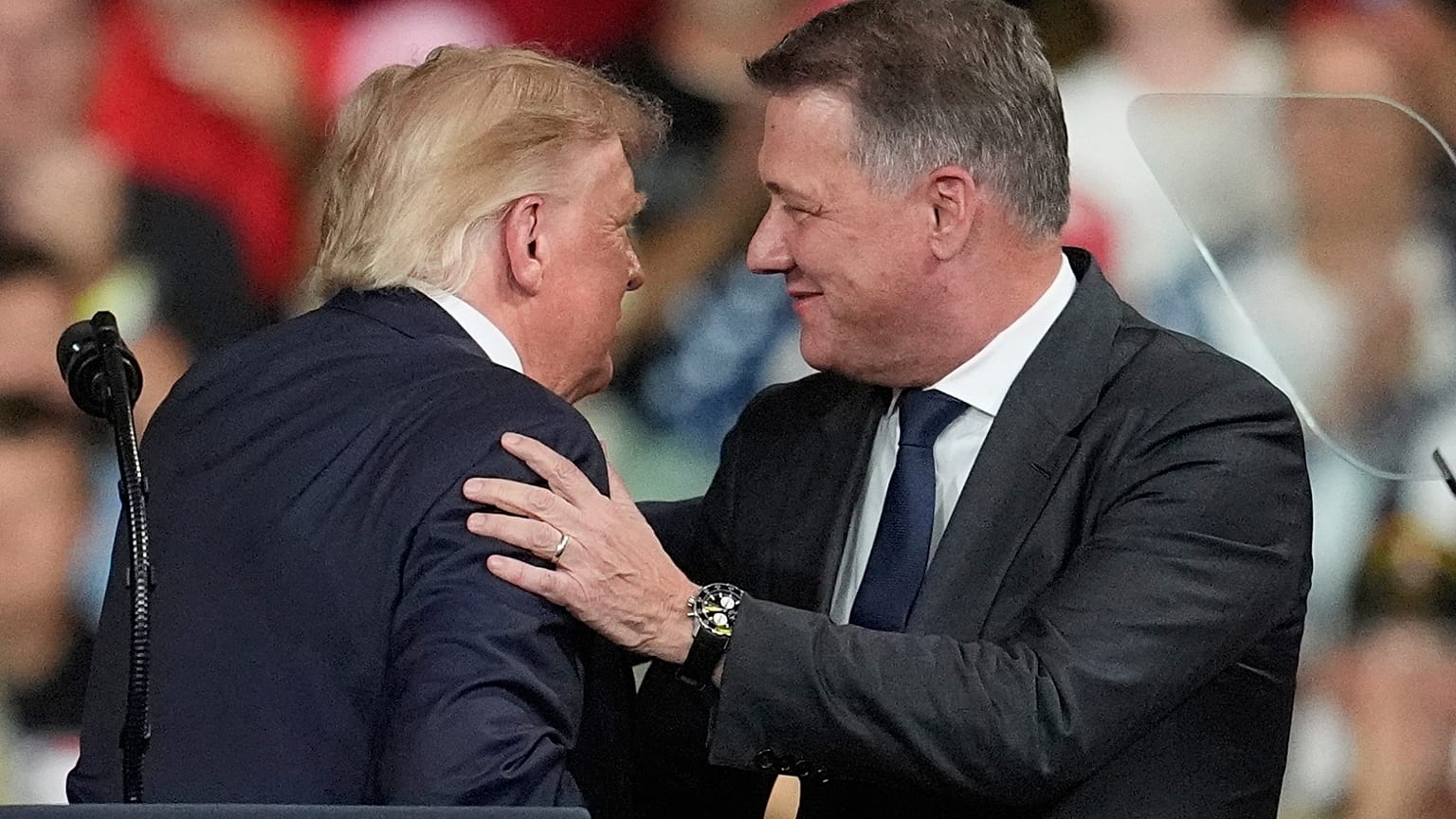
At a campaign rally in Georgia on Saturday, Trump unexpectedly announced Audi's plans to build its first US production facility in the state. Döllner, who is a member of the VW group board, then took the stage and thanked the US president for his support.

"I think it’s clear: Audi chief executive Gernot Döllner must step down," Pantisano told news website t-online.

Pantisano accused Trump of pursuing policies that serve the interests of the rich and powerful, while scorning labour rights.

"And then a German chief executive takes to the stage and campaigns on behalf of this autocrat," he said.

Criticism also came from Chancellor Friedrich Merz's conservatives, with lawmaker Dennis Radtke describing the appearance as "a campaign stunt for Donald Trump" which was "disturbing and pathetic."

While it was understandable for a German company to invest in the US market, Trump's policies are causing massive damage to German industry, he added.

'Political spectacle'

Christiane Benner, leader of the powerful IG Metall union that represents German autoworkers, described Döllner's appearance as "highly embarrassing, politically unacceptable and unworthy of the company - but above all of Audi’s employees."

Following the announcement, Benner had issued a statement welcoming the opening of a new plant in the US.

On Monday, she criticized the Audi chief for violating the company's internal guidelines, which ban the carmaker's employees from making public appearances with parties or candidates standing for election in the three months before a vote.

The US midterm elections are next week, with the Republicans' narrow majorities in both chambers of Congress at stake.

Olaf Lies, state premier of Lower Saxony, who is also a member of the Volkswagen supervisory board, also criticized the choice of venue for announcing the new plant.

"This display has caused consternation, not only among employees here who fear for their jobs, but far beyond," he said, accusing Döllner of having been "made part of a political spectacle."

Volkswagen works council chief Daniela Cavallo has also lashed out at Döllner following his appearance alongside Trump.

"Several minutes full of racism, sexism, xenophobia, transphobia, denigration of democracy - and then one of our top group representatives steps on stage and engages in active campaign support," she said in an interview on Sunday, which was made available to dpa.

Works council to weigh possibility of US plant

Cavallo took a more sober view of the plans for the US plant, which she said could make sense from a business perspective. The US market is among the largest and most lucrative in the world and VW's market share there is far too small, she said.

Audi intends to invest $4 billion in the Georgia plant, which is expected to produce around 200,000 sport utility vehicles (SUVs) annually and create some 4,500 jobs.

However, the works council representative noted that many questions remained following Audi's announcement, including whether the plant would bring tariff relief for the entire VW group.

She said employee representatives would only consider giving approval for a new US factory once there was clarity about its impact on other plants, especially in Germany.

In addition to Audi, the VW group includes the luxury brands Bentley and Lamborghini, as well as the motorcycle maker Ducati.

Audi's first US production plant: carmaker strikes deal with Trump

US President Donald Trump welcomes Audi CEO Gernot Döllner at a campaign event in Perry, Georgia, on 24 October 2026.
Copyright AP Photo

By Nela Heidner
Published on

Audi is planning its first car factory in the United States, with the Ingolstadt-based manufacturer set to invest billions in a new plant in Georgia.

Audi is taking a major step into the United States: the premium carmaker from Ingolstadt plans to invest around four billion US dollars in its first own US car plant in the state of Georgia.

The announcement was made on Saturday, 24 October 2026, at a campaign rally by US President Donald Trump in Perry, Georgia. Trump appeared alongside Döllner and stressed in his speech that his trade policy was prompting companies to move their production to the United States. The announcement is likely to play well in the battle for the midterm elections on 3 November.

Audi CEO Gernot Döllner justified the investment in his address by pointing to the company’s long-term ambitions in the US: the American market is one of the world’s most important premium car markets, but Audi has not yet fully tapped its potential there.

Production scheduled to start in the early 2030s

The plan is for an annual capacity of up to 200,000 vehicles and around 4,500 jobs. The plant is to be built at the Middle Georgia Megasite in Peach County, near the city of Macon. According to the state authorities, Georgia won out as a location partly because of its existing supplier base, its transport links and its pool of skilled workers. The option to expand the facility at a later date also played a role in the choice.

According to the company, preparatory work is due to begin in 2027, with series production to start in the early 2030s. The government of Georgia is naming 2031 as the target date for full-scale production.

With around 4,500 planned jobs, the project would be a major industrial development for the region. Additional posts at suppliers, logistics firms and service providers would come on top.

Large SUVs for the American market

The new plant will mainly build large, high-end sport utility vehicles. Reuters reports, citing a US government official, that the Audi Q7, Q8 and Q9 models are planned. Audi itself speaks of particularly large and upmarket SUVs tailored to the needs of North American customers.

For Audi, the move is strategically significant, as until now the company has imported its vehicles for the US market from Europe or Mexico. Local production would reduce its dependence on international supply chains and exchange-rate fluctuations. At the same time, Audi would be producing closer to its American customers and strengthening its competitive position against manufacturers with their own US plants, as the carmaker stresses in an official statement.

Trump claims the move as a success for his tariff policy

Trump imposed additional tariffs on imports of cars and car parts and repeatedly called on foreign manufacturers to produce more in the United States. For companies such as Audi, this policy increases the cost of imports, making local manufacturing more economically attractive. According to Reuters, Trump’s tariffs cost Audi around 1.2 billion euros last year.

However, this does not mean that the tariffs alone explain the choice of location: Audi also points to the long-term expansion of its US business, access to the sales market, the existing infrastructure and the regional supplier base.

What does this mean for Germany?

The decision raises questions for the German sites of the Volkswagen Group. Additional production in the US does not automatically mean job losses in Germany, but it does alter the geographical distribution of future investment and increase the importance of North America.

Audi emphasises that Germany and Europe are to remain the company’s industrial backbone; the existing expertise in development, engineering and production is merely to be complemented by the new site.

According to Tagesschau, the IG Metall union broadly welcomes the stronger push into the US market, but at the same time is calling for firm long-term prospects for employees at the German sites. The union also says that the final decision is still subject to approval by the relevant Volkswagen bodies.

Georgia: an industrial hub with a car-making tradition

Georgia has long been a centre of the American car industry. South Korean carmaker Kia has been producing in West Point since 2009, while Hyundai, also from South Korea, has built a multibillion-dollar plant for electrified vehicles near Savannah. Added to this are the powerful ports of Savannah and Brunswick, through which vehicles and components can be shipped internationally.

For Trump, the investment would be another trump card in his strategy of bringing more industrial production back to the United States. For Audi, it marks a step closer to one of the world’s most important car markets.

VW works council slams Audi chief's appearance at rally with Trump


26.10.2026, DPA


Photo: Julian Stratenschulte/dpa

Volkswagen works council chief Daniela Cavallo has sharply criticized Audi chief executive Gernot Döllner after the boss of the VW subsidiary appeared at a campaign event alongside US President Donald Trump.

"Several minutes full of racism, sexism, xenophobia, transphobia, denigration of democracy - and then one of our top group representatives steps on stage and engages in active campaign support," Cavallo said in an interview on Sunday, which was made available to dpa.

At a campaign rally in Georgia on Saturday, Trump unexpectedly announced Audi's plans to build its first US production facility in the state. Döllner, who is a member of the VW group board, then took the stage and thanked the US president for his support.

Cavallo said Döllner's appearance contradicted internal Audi guidelines, which ban the carmaker's employees from making public appearances with politicians standing for election in the three months before a vote. Döllner had signed these principles only a few months ago, she said.

The US midterm elections are on November 3, with the Republicans' narrow majorities in both chambers of Congress at stake.

Cavallo also levelled criticism more generally at the Volkswagen board under chief executive Oliver Blume. He had let himself be turned "from a highly questionable political figure, who violates pretty much every one of our corporate values, into a puppet in [Trump's] propaganda show," she said.

The works council head recalled the history of VW, which was founded during the Nazi era and served as a flagship company for Adolf Hitler's regime.

The Lesser Known Environmentalists Of Ladakh – OpEd


October 25, 2026

By Nilesh Kunwar

Key Takeaways:

The Indian Army and Border Roads Organisation recently cleared 7–8 tonnes of plastic waste from the Ghost Temple shrine on the Manali-Leh Highway and, through “Operation Cleanup,” are retrieving decades-old airdropped metal scrap from forward areas via reverse logistics that generates no extra cost and yields scrap-sale revenue.

Despite hyper-arid conditions, the Army has advanced arboriculture by supporting Forest Department and NGO programmes and using discarded tyres and tubes to improve sapling survival, while also formalising wildlife conservation through a March memorandum of understanding with the Ladakh administration to protect species including the snow leopard and black-necked crane.

The Ladakh administration has hired 100 former soldiers for its Environment Protection Force, drawing on the military’s long-standing presence and environmental engagement to promote cleanliness, biodiversity conservation and responsible tourism in the high-altitude region.


Preserving Natural Beauty


The Union Territory of Ladakh which comprises Leh, Kargil, Indus, Nubra River Valleys and the Zanskar range is India’s largest cold desert with altitudes ranging from 3,000 to 5,000 meters and more. While this region has a short and dry summer season, the winters are long with heavy snowfall and chilling high velocity winds that causes the temperatures to fall far below sub-zero.

Despite the difficult terrain, rarefied air and harsh climatic conditions, Ladakh has its unique charm of its own that attracts a large number of international as well as domestic tourists, especially during the summer months. As we all know, with tourists comes litter, and despite repeated efforts to educate them on the importance of keeping the environment clean, discarding waste material carelessly continues unabated.

Waste plastic containers of packaged water and beverages, metallic foil wrappers of snacks and expanded polystyrene [commonly referred to as Thermocol in India] not only mar Ladakh’s natural beauty but also pose a serious threat to its fragile environment. Luckily, various environmental non-government organisations [NGOs] have volunteered to help the civil administration in tackling this problem.

The army too has been working on the mission to clean and green Ladakh for years. Besides physically removing waste material, it has been providing excellent administrative support to NGOs so that they can fully concentrate on their task. This very month, the Indian army and Border Roads Organisation cleared about 7 to 8 tonnes of plastic waste from the Ghost Temple shrine on the Manali-Leh Highway at an altitude in excess of 4,500 meters.

Operation Cleanup

It’s not only the careless attitude of tourists visiting Ladakh that causes accumulation of litter in the area. In the past, the India army was also responsible for littering certain areas, but this wasn’t due an irresponsible attitude but insurmountable compulsions and

When the Indian army was rushed into Ladakh to evict irregular forces commanded by the Pakistani army in early 1948, this area had no motorable roads. Though a few arterial roads came up in the hinterland subsequently, many areas bordering Pakistan and China still remained inaccessible for vehicular traffic.

Consequently, sustenance of a large percentage of troops deployed on the Indo-Pak and Sino-Indian borders perforce had to be done through airdrops. Ammunition, rations, kerosene and fuel were packed in metal containers and dropped by parachutes. With the passage of time, these empty containers piled up and created massive junkyards which unfortunately couldn’t be removed due to lack of any means of transportation.

The army put empty metal containers [referred to as ‘jerricans’] and ammunition boxes to good use for constructing field fortifications and even billet walls. However, due to regular airdrops, the landscape adjoining military posts was pockmarked with ugly piles of discarded rusting metal, which posed a threat to the environment. Thanks to the recent road connectivity push in the border areas in Ladakh, this problem has found a solution.

Udhampur based Northern Command has initiated a comprehensive programme to retrieve metal waste from forward areas through “reverse logistics.” Transport carrying military hardware, ammunition and supplies to these locations carry metal waste on their return trip to the bases that have adequate facilities for handling and disposal of this junk.

Code named “Operation Cleanup,” this initiative is commendable for two reasons. One, since the metal scrap is carried by vehicles that would otherwise be returning empty, this project does not entail any additional financial burden on the exchequer. On the contrary, scrap metal sale through government portals will provide a token monetary return to the government. Two, removing rusted metal will help in reclaiming the environment and restore the pristine beauty of the area.

Arboriculture

Arboriculture in Ladakh’s cold desert is a major challenge due to hyper aridity caused by scanty rainfall and aggravated on account of rapid moisture evaporation thanks to rarefied atmosphere and intense solar radiation. Furthermore, plants taking root and their growth are significantly retarded by extreme seasonal temperature fluctuations and nutrient deficient soil.

However, this is the type of challenge in which the Indian army revels, and ask any local and you’ll be told that the army has done yeoman service in greening Ladakh. It has also supported and participated in various arboriculture programmes undertaken by the Forest Department and various NGOs.


An important contribution of the army is using innovative means to increase sapling survivability rate in an area where the summers are both short and dry. One example is using discarded tyres and tubes to aid sapling growth by trapping moisture and reducing need for manual watering.

Wildlife Preservation

The army’s role in preserving wild life needs no emphasis. Legendary ornithologist Dr Salim Ali [1896-1987], who was actively involved studying migratory habits of the elusive Black-necked crane had visited Chushul and other border areas in Ladakh and had praised the army for effectively turning its frontline forward positions into ‘accidental’ wildlife sanctuaries.

In March this year, the Indian army formalised its wild life preservation efforts by signing a memorandum of understanding with the Ladakh administration to help preserve the fragile high-altitude ecology of the region and conserve key wildlife species including the snow leopard, Himalayan wolf, ibex, bharal [blue mountain goat], marmot and black-necked cranes.

Environment Protection

The army is a key player in environmental protection in Ladakh. Impressed with their dedication in preserving the environment, the Ladakh administration has employed 100 former army men in its Environment Protection Force [EPF].” Lt Governor V K Saxena has opined that “The EPF brings together the discipline, integrity and commitment of our ex-servicemen to protect this fragile ecosystem.” He is also sanguine that they will “also become ambassadors of cleanliness, biodiversity conservation and responsible tourism across Ladakh.”

Soldiers and Nature

Call of duty takes soldiers to different places and they often spend a considerable time along India’s vast borders alone in the wilderness. This brings them close to nature and creates an enduring bond with the environment which explains why there are such a large number of environmental groups comprising ex-servicemen in the country.

The men in green are doing a fantastic job in keeping the environment clean and turning Ladakh green.


About Nilesh Kunwar
Nilesh Kunwar is a retired Indian Army Officer who has served in Jammu & Kashmir, Assam, Nagaland and Manipur. He is a ‘Kashmir-Watcher,’ and now after retirement is pursuing his favorite hobby of writing for newspapers, journals and think tanks.
View all posts by Nilesh Kunwar →
After Taliban Opium Ban, New Global Hub Emerges In Afghan Borderlands With Iran, Pakistan – Analysis

Cultivating poppies in Afghanistan for opium. Photo Credit: Tasnim News Agency.


October 25, 2026
 RFE RL
By Frud Bezhan and Daud Khattak


Key Takeaways:

Afghanistan’s opium production has dropped under the Taliban’s 2022 ban, but cultivation has shifted into Pakistan’s Balochistan and Iran’s Sistan-Baluchistan, forming a new regional production center.

Satellite imagery found over 9,000 hectares of poppy in Balochistan, with Afghan farmers bringing expertise and capital for expanded, often monoculture plots also reported across parts of Iran.

Experts warn of further rises in 2027 that could increase heroin supply and fund armed groups, while limited rebounds inside Afghanistan suggest Taliban enforcement may be easing under economic strain.

Afghanistan’s opium output, long the world’s largest, has plunged since the Taliban imposed a sweeping ban on illicit narcotics in 2022.

But the militant Islamist group has failed to eradicate cultivation completely, while production appears to have increasingly shifted to neighboring Pakistan and Iran.


Pakistan’s southwestern province of Balochistan and Iran’s southeastern province of Sistan-Baluchistan, both bordering Afghanistan, have seen a sharp rise in poppy cultivation in recent years, according to satellite imagery and interviews with local farmers.

“The Taliban drugs ban, combined with growing instability in the tri-border area, has created the conditions for widespread poppy cultivation in Pakistan’s Balochistan Province and parts of Iran,” said David Mansfield, a leading UK-based expert on Afghanistan’s illicit drugs industry.

As a result, the remote and volatile borderlands of Afghanistan, Pakistan, and Iran have become “a global center for opium production,” added Mansfield, author of A State Built On Sand: How Opium Undermined Afghanistan.

Experts warn of higher levels of poppy cultivation in the region in 2027, which they say could increase the supply of heroin on the international market, generate revenue for armed groups, and fuel violence.

Pakistan At The ‘Core’

Balochistan Province appears to have become the main hub of opium cultivation in the Afghanistan-Pakistan-Iran border region.

Pakistan’s largest and poorest province, Balochistan has endured a decades-long insurgency by separatist groups and other militants drawn largely from the ethnic Baluch minority. Violence has escalated in recent years as armed groups intensify their campaign against the state.

Islamabad has denied reports of opium cultivation in the country and maintained that any poppy crops discovered have been eradicated. Pakistan’s Interior Ministry and the Balochistan provincial government did not respond to RFE/RL’s requests for comment.

The United Nations Office on Drugs and Crime (UNODC) has estimated that opium production in Pakistan remains marginal.

“UNODC has said in the past that there were indications of displacement of poppy to countries around Afghanistan,” the agency said in a statement sent to RFE/RL.

“What we currently observe is that data from countries around Afghanistan is still scarce, as only two countries report on eradication. And while eradication figures do not directly reflect cultivation patterns, the sharp increases in recent years point towards a certain degree of spillover effects.”

But satellite imagery from Alcis, a British firm specializing in satellite analysis, along with interviews with local farmers suggests that opium cultivation is widespread across the province and is expanding.


“Satellite imagery assessments identified more than 9,000 hectares of poppy cultivation in Balochistan alone,” said Mansfield, who authored an August report for Alcis.

Most of the opium cultivation appears to be concentrated in the districts of Loralai and Killa Abdullah in Balochistan.

Abdul Qahar Wadan, a former member of Pakistan’s National Assembly representing Balochistan’s Killa Abdullah district, told RFE/RL that poppy cultivation is rampant in the province, allegedly with the backing of senior military officials and local pro-government power brokers who collect commissions from growers.

Monawar Hussain, the chief administrative officer in Killa Abdullah, rejected the allegation, telling RFE/RL that poppy cultivation had declined following an eradication campaign last year. However, Alcis’s 2026 satellite imagery shows no clear evidence of eradication.

A farmer in Killa Abdullah who spoke to RFE/RL on condition of anonymity said poppy growers pay bribes to local authorities through influential intermediaries, who collect commissions and pass on a share to officials.

The farmer alleged that when media reports trigger pressure from higher authorities, growers and their backers sometimes agree to cultivate poppies on barren land so officials can destroy the crop and publicize the eradication effort.

For years, Lala Jan Kakar resisted the lure of poppy cultivation, but mounting insecurity, drought, and flash floods have devastated traditional fruit farming.

“It’s not possible to resist it anymore. The demand for poppies is much more than fruits, and so is the income,” Kakar, who lives in Killa Abdullah, told RFE/RL.

The surge in production in Pakistan, experts say, has been driven by a growing number of Afghan opium farmers crossing the border to lease land and cultivate poppy.

Since the Taliban banned poppy cultivation in Afghanistan, growers from neighboring Kandahar and Helmand provinces have brought their expertise across the border, striking deals with local farmers.

“The Afghan poppy growers have both money and expertise,” Kakar said, explaining that they invest millions of Pakistani rupees in solar-powered wells and share profits with landowners.

With groundwater scarce and conventional crops less profitable, poppies offer a quicker return and can be harvested twice a year, he said.

“Many farmers have doubled the land they cultivated in 2026 — a stark indication of the scale and pace of this expansion and that we should expect much higher levels of poppy cultivation in 2027,” said Mansfield.

Cultivation Spreading In Iran

A similar pattern has emerged in Iran, where Afghan farmers have crossed the border to cultivate poppies as tenants and sharecroppers, drawing on family ties and local contacts.

Opium cultivation has been reported across a growing number of Iranian provinces in recent years, including Razavi Khorasan in the east, Kermanshah and Lorestan in the west, and Fars in the south.

Sistan-Baluchistan, one of Iran’s largest and poorest provinces, remains the country’s main opium-producing region. Satellite imagery from 2026 appears to show extensive poppy cultivation across parts of the province, with large fields often devoted exclusively to the crop.

Some farms also appear to use drip irrigation for poppy cultivation. Given the substantial upfront cost of installing these systems, their use suggests that farmers who planted in late 2025 expected a low risk of eradication.

“Unlike in Afghanistan, where they cultivated a variety of crops, these farmers are increasingly devoting large plots in Pakistan and Iran entirely to poppy,” said Mansfield. “The shift is not just across borders; it is from mixed farming to large-scale poppy monoculture.”

Iranian authorities, preoccupied with the war against the United States and Israel since late February, have been unable or unwilling to destroy the 2026 poppy crop, reinforcing growers’ confidence.

Sistan-Baluchistan has also been the site of an intensifying insurgency by separatists and militants who have exploited the longstanding grievances of the Baluch minority, which has faced disproportionate discrimination and violence at the hands of the authorities.

As the Iran war continues, the economy teeters on the brink of collapse, and the state’s attention remains focused elsewhere, poppy cultivation in Iran is expected to increase further in 2027, according to experts.

Experts say rising drug production in the border region of Iran, Pakistan, and Afghanistan both reflects and fuels violence.

“Armed groups compete for tax revenues from the drugs trade and other cross-border activities, including people smuggling and trade in fuel, minerals and other goods,” said Mansfield.
Resurgence In Afghanistan

Opium cultivation also appears to be rebounding in Afghanistan despite the Taliban’s ban, underscoring the country’s continued importance in the global opium trade.


Production is concentrated in the northeastern province of Badakhshan, which is estimated to account for around a half of the country’s opium output, and several southwestern provinces.

Driven by drought, mounting debt, and economic hardship, farmers in Badakhshan and Helmand have protested and defied the ban even in the face of the Taliban’s forceful enforcement.

“In 2026, poppy cultivation remained widespread across Badakhshan’s rainfed and irrigated land,” said Mansfield. “In the southwest, cultivation almost doubled between 2025 and 2026, though it remained limited, concentrated in remote areas, and concealed within wheat fields and behind household compound walls.”

Hostile reactions to crop eradication suggest the Taliban is wary of provoking further unrest as Afghanistan’s economic crisis deepens.

A Taliban directive barring the authorities from searching homes for poppy or opium without a court order appears to be a significant concession.

“But there is a clear risk: Growing numbers of farmers in the southwest may read the concession as a signal that the authorities will tolerate cultivation beyond walled compounds,” said Mansfield. “If so, Afghanistan could see a dramatic rise in opium production in 2027.”


Frud Bezhan is Senior Regional Editor in the English-language Central Newsroom at RFE/RL, leading coverage of the Middle East, South Asia, and Central Asia. Previously, he was the Regional Desk Editor for the Near East, with a primary focus on Iran, Afghanistan, and Pakistan. As a correspondent, he reported from Afghanistan, Turkey, Kosovo, and Western Europe.

Daud Khattak is a senior international correspondent covering the Near East in RFE/RL’s Central Newsroom. He was previously the managing editor of RFE/RL’s Radio Mashaal.


About RFE RL
RFE/RL journalists report the news in 21 countries where a free press is banned by the government or not fully established.
View all posts by RFE RL →


The Spreading Ebola Crisis – OpEd


By Dan Steinbock

Key Takeaways:

The Bundibugyo Ebola outbreak that began in the Democratic Republic of Congo has become a regional crisis, with WHO figures exceeding 9,400 cases and 4,500 deaths by 20 October and confirmed imported cases in Nigeria and Kenya, underscoring cross-border travel risks and weak health-system preparedness.

A September international meeting produced $2.9 billion in pledges, including a stated U.S. contribution of $886 million, yet Africa CDC reported that more than $700 million of roughly $962 million disbursed to implementing organizations in the DRC remained unaccounted for in national records, with frontline workers unpaid.

The article warns that without sustained surveillance, transparent financing, and coordinated implementation of the WHO–Africa CDC preparedness plan, the epidemic risks prolonged regional transmission or further spread, and argues that global health security depends on continuous investment rather than episodic emergency mobilization.


The Ebola crisis in Central Africa has crossed another dangerous threshold. What began as an outbreak in DR Congo has spread across national borders, exposed weaknesses in international preparedness, and the management of emergency assistance.

On October 20, Nigeria confirmed an imported case in Abuja. Kenya, meanwhile, reported nine cases linked to a single cluster. The epidemic is no longer merely a Congolese emergency. It is a regional crisis with international implications.

The danger is not that Ebola will necessarily become another COVID-19. The Bundibugyo virus responsible for this outbreak is not known to spread through the air like a respiratory virus, and there is no evidence of such a transformation. The danger is more immediate: continued transmission, delayed detection, overloaded health systems, and the possibility of further cross-border infections.


The world has been warned before. The question is why its response remains so vulnerable to delay, fragmentation and political neglect.
From outbreak to regional emergency

By October 6, the World Health Organization (WHO) had recorded 8,728 confirmed cases and 4,205 deaths in the DRC, with infections reported across 64 health zones in seven provinces. Subsequent reporting indicates that the totals have risen further, exceeding 9,400 cases and 4,500 deaths by October 20.

The epidemic has become one of the largest Ebola outbreaks on record and the deadliest in the country’s history.

The geographical expansion matters as much as the cumulative toll. Transmission has persisted across multiple provinces, while conflict, displacement, weak health infrastructure and difficulties tracing contacts complicate containment.

The regional implications are now unmistakable. Kenya confirmed an imported case in early October, followed by additional infections linked to the same cluster. Nigeria’s confirmed case on October 20 represents another warning: an outbreak originating in Central Africa can reach distant population centers through ordinary travel networks. Nigerian authorities have identified 44 contacts and begun monitoring them.


These developments do not establish uncontrolled transmission across Africa, much less a global pandemic. They do demonstrate how quickly an epidemic can become an international coordination problem.
Situation as of Oct 20, 2026

American health power: resources without consistency?

The United States remains an important source of financing, scientific expertise, laboratories, emergency logistics and epidemic-response capacity.

In September, Washington convened an international meeting on accelerating collective action against Ebola. Africa CDC subsequently reported $2.9 billion in commitments associated with the meeting, including a stated US contribution of $886 million. These commitments could make a substantial difference if translated into timely, accountable assistance.

Yet the larger question concerns consistency. The effectiveness of emergency spending depends on the surveillance systems, trained personnel, laboratories and local health services that exist before an outbreak becomes a crisis.

When international health programs are weakened, the consequences may not become visible immediately. They emerge when a virus goes undetected, contact tracing falls behind, or treatment capacity proves inadequate. Emergency intervention then becomes more expensive, more difficult and less certain to succeed.

Episodic mobilization cannot substitute for dependable prevention. Nor can emergency announcements compensate automatically for earlier institutional erosion.
China’s role: cooperation, not a geopolitical contest

China has expanded its health cooperation with African countries through medical teams, emergency supplies and bilateral partnerships. Its assistance during the current outbreak has added to the international response and demonstrated the operational value of state-to-state cooperation.

The United States and China bring different strengths, but neither can independently provide everything required. American financing and scientific networks, Chinese medical cooperation and bilateral relationships, African public-health institutions, and WHO coordination can reinforce one another.

The alternative is deeply counterproductive: turning epidemic control into another arena of strategic rivalry.

For African governments, the relevant questions are practical. Who supplies diagnostic equipment? Who trains health workers? Who supports hospitals and local laboratories? Who helps identify contacts, maintain essential services and sustain surveillance after international attention fades?

Diplomatic visibility matters less than measurable results. The ability to deliver equipment is valuable; the ability to keep it functioning, train personnel and strengthen local institutions is more valuable still.
The funding scandal: money is not the same as protection

The most disturbing recent development may be the controversy over emergency financing.


On October 15, Africa CDC reported that international donors had disbursed approximately $962 million directly to organizations implementing the Ebola response in the DRC. Yet more than $700 million remained unaccounted for in the financial information available to national authorities. Only about 30% of the organizations concerned had participated in a meeting to share financial information. The Congolese government did not receive the $962 million.

Reports of frontline workers going unpaid and protesting dangerous working conditions make the discrepancy particularly alarming. Resources announced internationally must translate into salaries, protective equipment, diagnostic capacity, treatment and community outreach.

Every preventable delay in delivering assistance carries a potential human cost.
Three scenarios—and one urgent priority

Three outcomes remain possible.

First, containment with a prolonged human cost. Intensified surveillance, effective treatment, community engagement and sustained international support gradually interrupt transmission. This remains achievable, but it requires more than emergency declarations and funding pledges.

Second, a protracted regional epidemic. Transmission continues in parts of the DRC while imported cases require repeated interventions elsewhere. Even without widespread international transmission, prolonged disruption could weaken health services, displace communities and divert resources from maternal care, vaccination and other essential services.

Third, wider regional spread. Additional cross-border infections establish new transmission chains, forcing multiple countries to mount simultaneous responses. The consequences would depend on how rapidly cases are detected and isolated, whether contacts can be traced, and whether health systems have sufficient capacity.

WHO and Africa CDC have already established a joint continental preparedness and response plan. The challenge is to turn coordination into implementation and commitments into effective protection.
Preparedness is security

The Ebola crisis exposes a fundamental weakness in the international system. Governments recognize the shared dangers of infectious disease, yet collective action too often depends on political attention that arrives only after infections and deaths have mounted.

Epidemics are generally easier to contain when cases are detected early, transmission chains remain traceable and local health services are functioning. Once an outbreak spreads through fragile communities and interconnected transport networks, the response becomes harder, costlier and less predictable.

Global health security cannot be built on emergency declarations, geopolitical competition or funding announcements alone. It requires sustained investment, transparent institutions, trusted local engagement and international cooperation that survives the news cycle.


Ebola is a warning, not an isolated event. The next health emergency may involve a different pathogen, a different region and a different set of political calculations. The underlying vulnerabilities, however, will remain the same unless governments address them now.

The time to strengthen global preparedness is before the next emergency, not after it has crossed another border.


About Dan Steinbock
Dr Dan Steinbock is an recognized expert of the multipolar world. He focuses on international business, international relations, investment and risk among the leading advanced and large emerging economies. He is a Senior ASLA-Fulbright Scholar (New York University and Columbia Business School). Dr Dan Steinbock is an internationally recognized expert of the multipolar world. He focuses on international business, international relations, investment and risk among the major advanced economies (G7) and large emerging economies (BRICS and beyond). Altogether, he monitors 40 major world economies and 12 strategic nations. In addition to his advisory activities, he is affiliated with India China and America Institute (USA), Shanghai Institutes for International Studies (China) and EU Center (Singapore). As a Fulbright scholar, he also cooperates with NYU, Columbia University and Harvard Business School. He has consulted for international organizations, government agencies, financial institutions, MNCs, industry associations, chambers of commerce, and NGOs. He serves on media advisory boards (Fortune, Bloomberg BusinessWeek, McKinsey).
View all posts by Dan Steinbock →