Wednesday, October 28, 2026

High turnout ousts Vucic’s allies in Serbia and saves Lula in Brazil


AS IT DID WITH ORBAN
High turnout ousts Vucic’s allies in Serbia and saves Lula in Brazil
High turnout ended the Serbian Progressive Party’s 14 years in government and helped Lula win a fourth term in Brazil. / bne IntelliNewsFacebook
By Ben Aris in Berlin October 27, 2026

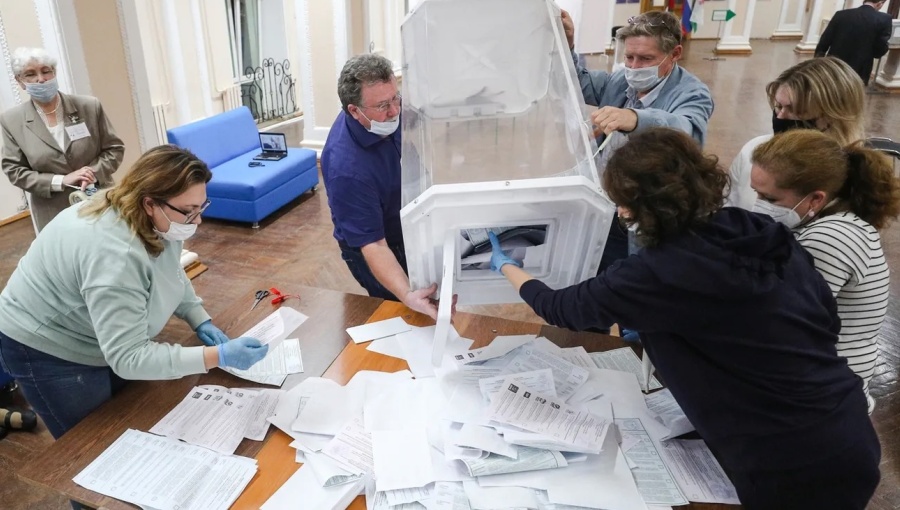
A surge of stay-at-home voters ended Aleksandar Vucic’s Serbian Progressive Party’s 14 years in government on October 25, as a late turnout jump carried Brazil’s Lula past the Bolsonaro clan.
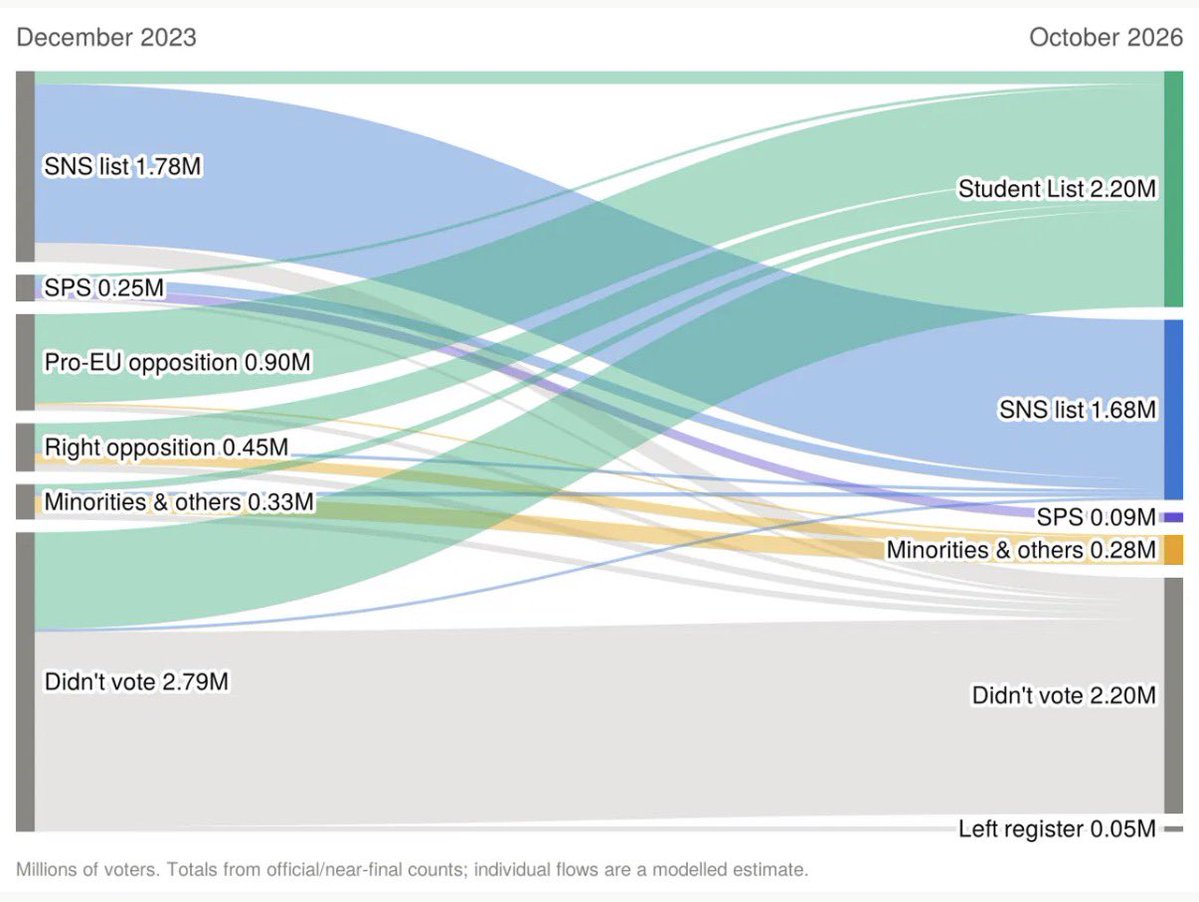
Serbian voters, December 2023 and October 2026, millions. Totals from official or near-final counts; individual flows are a modelled estimate. Source: unattributed voter-flow model circulated on X.

High voter turnout makes all the difference in closely contested elections and can be crucial in votes held in less than democratic countries. Incumbents in under developed countries where the state controls access to the media of indulge in vote-buying can swing the count their way, but as there are limits to the size of the fix they can put in, a surge of votes by genuinely disgruntled citizen can still force an unpopular leader out of office.

And Serbs were heartly fed up with Vucic. Some 4.3mn of the 6.45mn registered voters cast a ballot, with 97.6% of polling stations processed, according to preliminary figures from the Republic Electoral Commission (RIK). Pollster CeSID put final turnout at 69.3% excluding the diaspora and monitor CRTA expected more than 70%, against 58.8% in the December 2023 election. The Student List won 52.7% and 140 of the 250 seats, while Vucic's Serbian Progressive Party (SNS) list took 39.2% and 104 seats.

Vucic did not lose his voters. The SNS list took 1.69mn votes, down only modestly from about 1.78mn in 2023. What changed was the size of the electorate that showed up: some 600,000 more Serbians voted than three years ago, and the Student List collected 2.27mn votes, more than any party has won since the largest protest in the country's history in March 2025 turned a student movement into an electoral machine.

The pattern stretches from the Balkans to the former Soviet Union and Latin America. Electoral autocracies are built to win low-turnout contests, where a loyal base of pensioners, state employees and the beneficiaries of patronage is enough. When turnout surges, the regime faces a binary choice: concede, as Vucic did and as Hungary's Viktor Orban did in April, or falsify the count on a scale that is impossible to hide - which almost always brings people onto the streets, as Belarus found out in 2020 and Russia in 2011.

"That degree of democratic participation is just too difficult to invalidate, even with the most earnest electoral engineering," Bosnian-American political scientist Jasmin Mujanovic wrote in Odgovor on October 26. "There were too many votes against both regimes for their apparatchiks to be able to hijack the result. They tried, but they could not overcome the overwhelming force of the democratically mobilized masses."

The stay-at-homes decide Serbia

Turnout climbed through the day. CRTA counted 67.8% by 7pm, an hour before polls closed, against 55.5% at the same point in 2023, Politico reported. European Commission President Ursula von der Leyen said Serbians had "turned out in record numbers". Diaspora voters queued for hours in Chicago, Toronto, Vienna and Zurich.

The vote was held under pressure: police closed the street leading to the electoral commission before noon and armoured riot-control vehicles rolled into central Belgrade, and in the run-up the Student List said police were targeting its activists. The last time Serbia saw this level of participation was in 2000, when voters ousted Slobodan Milosevic.

Then, an hour after the polls closed, Vucic went on every television channel in the country to concede. "Based on a stratified sample, it is clear that we lost these elections," he said at SNS headquarters. Croatian Prime Minister Andrej Plenkovic said Vucic's early concession suggested the handover would be peaceful.

Hungary followed the same script six months earlier. Turnout of 79% on April 12, up from about 70% in 2022 and a record, gave Peter Magyar's Tisza party 53.2% and a two-thirds majority, and Orban conceded within an hour of the polls closing. Mujanovic drew the contrast with Bosnia and Herzegovina, where official turnout in the recent general election was under 45% and the parties that have dominated for 20 years won again.

Brazil's comeback in the runoff

In Brazil, where voting is compulsory but abstention is common, the swing came between rounds. Turnout in the first round on October 4 was 78.9%, with 33.4mn voters staying at home - the highest first-round abstention since 1998. Lula finished second, behind Senator Flávio Bolsonaro, the son of former president Jair Bolsonaro, who is under house arrest for plotting a coup, and trailed or tied him in polls until the final days.

In the runoff on October 25 turnout rose to 80.8%, bringing roughly 3mn more Brazilians to the polls. Lula took 64.26mn votes, about 10.4mn more than in the first round, while Bolsonaro added about 3.7mn to reach 59.83mn. Lula won by 4.43mn votes and 51.8% to 48.2%, becoming the first candidate since direct presidential elections returned in 1989 to win after finishing second in the first round.

Election1st round turnoutRunoff turnoutChange, points
Brazil 202279.05%79.41%+0.36
Brazil 202678.92%80.78%+1.86

Brazilian presidential elections, turnout as a share of registered voters. Source: Superior Electoral Court (TSE), via Brazilian media.

Lula's allies credit a WhatsApp channel called Lula's Army, run by Congressman André Janones, which grew to 10.8mn followers between the rounds, the BBC reported. Colombian President Gustavo Petro hailed the channel on X as the "genius" behind the win. Political scientists were more cautious. "The physical world enabled a form of mobilisation capable of reducing abstention and persuading undecided voters," Mayra Goulart, a professor at the Federal University of Rio de Janeiro, told the BBC.

Brazil's count held. Bolsonaro first said he would seek to have the result annulled because the Supreme Court extended voting by two hours, but just over 34,000 votes were cast after regular hours against a margin of 4.4mn, Bloomberg reported. On October 26 his Liberal Party formally conceded and he dropped the challenge. "I wasn't the one who lost. The system won," he said. Lula's fourth term keeps Brazil, the region's largest economy, on the left of a continent that has swung sharply to the right.
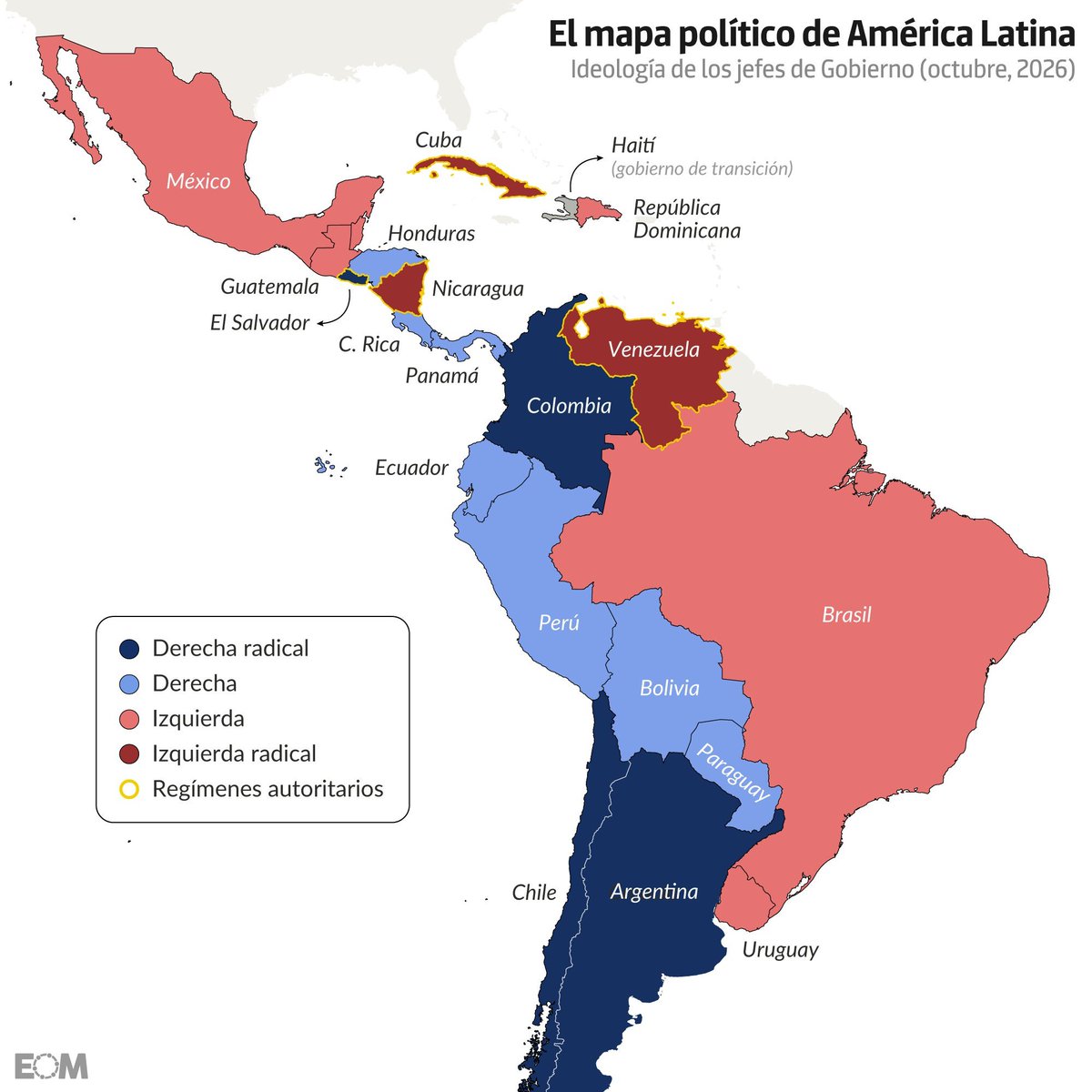
Ideology of Latin American heads of government, October 2026: radical right (dark blue), right (light blue), left (pink), radical left (dark red); authoritarian regimes outlined in yellow. Source: El Orden Mundial.

When the count is rigged, the street fills

Belarus in 2020 demonstrated that even a massive turnout at the polls is not enough to unseat an entrenched authoritarian regime. Former English teacher Svetlana Tikhanovskaya drew huge crowds to her rallies, and the Central Election Commission said a record 41.7% of voters cast ballots early, over the five days before polling day. The commission gave Alexander Lukashenko 80.08% and Tikhanovskaya about 10%, on official turnout of about 84%.

A statistical study of precinct results by Vadim Zipunnikov of Johns Hopkins University found early voting was the main vehicle for fraud: every 7% of early ballots cut Tikhanovskaya's result by about 8%. Stripping out stations with more than 25% early votes put her ahead of Lukashenko, and suggested the election would at least have gone to a second round.

The falsification brought the biggest crowds in the country's history onto the streets. At least 100,000 people rallied in Minsk on August 16, while local outlet tut.by put the crowd at 220,000, and at least 250,000 joined the March of New Belarus a week later. Workers at the MZKT truck plant chanted "Get out" at Lukashenko in his Ceausescu moment, but with Moscow's backing the security services held and he stayed in power.

Russia's 2011 Duma election followed the same arc, although national turnout actually fell, to 60.1% from 63.7% in 2007. The anger came from the cities. United Russia officially took 49.3%, down from 64.3%, barely clinging on to its majority, while estimates of its real result ran from 25% to 35%. A FOM exit poll gave the party 25% in Moscow, where its official score was 45%.

A Moscow precinct chairman told the Associated Press that his staff stuffed ballots all day and still fell short of the target, so the commission simply awarded United Russia 65%. Videos of ballot-stuffing spread online, and on December 10 police counted 25,000 people on Bolotnaya Square while organisers claimed 100,000. On December 24 police put the crowd on Sakharov Avenue at 29,000 and organisers at up to 120,000, The Moscow Times reported. IntelliNews reporters put a February rally on Bolotnaya Square at at least 100,000. The protests were billed as the biggest since the fall of the Soviet Union, but Vladimir Putin returned to the Kremlin in March 2012.

ElectionTurnoutOfficial resultChallenge to the countAftermath
Serbia, Oct 2026c.69-70% (2023: 58.8%)Student List 52.7%None, Vucic concededChange of government
Hungary, Apr 202679.0% (2022: c.69.6%)Tisza 53.2%None, Orban concededChange of government
Brazil, Oct 2026 runoff80.8% (1st round: 78.9%)Lula 51.8%Annulment bid droppedIncumbent re-elected
Belarus, Aug 2020c.84% (41.7% early)Lukashenko 80.1%Study puts Tikhanovskaya aheadUp to 250,000 on streets; regime survives
Russia, Dec 201160.1% (2007: 63.7%)United Russia 49.3%Real share estimated at 25-35%Up to 120,000 on streets; Putin returns
Georgia, Oct 202460.2%Georgian Dream 53.9%Observers say vote riggedMonths of protests; ruling party holds
Venezuela, Jul 202457.9% (CNE)Maduro 52.0%Opposition tallies: Gonzalez 67%2,000+ arrests; Gonzalez in exile
Kyrgyzstan, Oct 202056.5%Pro-presidential parties winResult annulled October 6President resigns October 15
Bolivia, Oct 201988.3%Morales 47.1%OAS alleges manipulation (disputed)Morales resigns November 10

High turnout and disputed counts. Sources: national electoral commissions, CRTA, CeSID, IntelliNews archive.

In Georgia in October 2024 the ruling Georgian Dream party officially won 53.9%, but statistical analysis found a "Russian tail" of about 400 polling stations reporting near-unanimous support, and three domestic monitoring missions later said the vote was rigged in the ruling party's favour. Protests over the vote grew into months of nightly demonstrations after the government froze EU accession talks in November 2024.

In Venezuela in July 2024 the electoral council gave Nicolas Maduro 52%, while tally sheets collected by opposition volunteers from more than 80% of polling stations gave Edmundo Gonzalez 67%. More than 2,000 people were arrested in the crackdown and Gonzalez fled to Spain. Maduro stayed until US forces captured him in January this year.

In Kyrgyzstan the street won outright. The October 2020 parliamentary vote, which let only four parties into parliament, three of them close to President Sooronbay Jeenbekov, set off protests that followed the Belarus template: the election commission annulled the result two days after the vote and Jeenbekov resigned nine days later. In Bolivia in 2019, on turnout of 88%, Evo Morales resigned after an Organization of American States audit alleged manipulation of the count, although later academic studies disputed its findings.

Vucic, like Orban, chose not to test the second path. With Serbia's presidential election due in December and more than 100 SNS deputies still in parliament, the Student List now has to hold the voters who turned out on October 25 - the same people who will decide whether it lasts longer than the regime it replaced.


What does voter suppression have to do with health?


How access to the ballot box can influence community health


University of California - Davis Health


Public health researchers have long examined how societal forces can shape health outcomes. Decades after redlining was outlawed, for example, researchers continue to document its lasting effects on life expectancy, chronic disease and access to healthcare resources in many communities.

UC Davis psychiatrist Ruth Shim, a contributing author for JAMA Health Forum, suggests that another structural force deserves the same scrutiny: voter suppression.

In her latest article, Shim makes the case that voting is a social determinant of health. She asserts that voter suppression is a structural determinant of health, one of the policies and practices that shape who has access to the conditions for good health.

"We have spent two decades bringing the social determinants of health into clinical practice, but we have paid far less attention to the structures that create them," said Shim, professor in the UC Davis Department of Psychiatry and Behavioral Sciences. "Voter suppression is one of those structures, and it can be changed."

Shim notes that U.S. voter turnout lags behind many other countries, in part because states administer elections and set their own registration rules. She also points to the Supreme Court's 2013 decision in Shelby County v. Holder, which was followed by polling place closures that reduced voting access in communities of color, lower-income communities and rural areas.

Shim highlights studies showing links between voter participation and population health.

Research has found that states with lower voter turnout have worse health outcomes, while people in poor health are less likely to vote. Together, those findings point to what Shim calls a vicious cycle of voter suppression and poor health.

Some of the most striking evidence comes from historical analyses.

One study cited by Shim found that passage of the Voting Rights Act of 1965 was associated with significant reductions in Black infant deaths in Jim Crow states.

Other studies have examined the health consequences of voting restrictions.

Shim points to research linking felony disenfranchisement laws with increased depressive symptoms among Black people, but not among White people.

Shim notes that health professionals, who are trusted messengers in the communities affected by health disparities, can support voter registration in health care settings. She points to nonpartisan resources such as Vot-ER and the Civic Health Alliance. Both organizations advance public understanding of the relationship between voter access and health.

"These inequities are not accidental," Shim said. "When people are blocked from voting, they lose a voice in the decisions that shape their health. Protecting the right to vote is a public health intervention."

Resources


Fighting cancer also means fighting against social stigma


Flinders University


Cancer-related discrimination arises from long-lasting cultural and institutional misconceptions, with significant impacts on every part of a person’s quality of life and health – and Flinders University researchers say it requires coordinated policy, legal, institutional and public education responses for change to occur.

“Cancer can affect much more than a person’s physical health. Our research shows that a cancer diagnosis can also change how people are treated at work, when looking for a job, accessing insurance or financial support, and even within their own social networks,” says lead author Dr Andi Agbejule, a radiation therapist and Cancer Care researcher with Flinders University’s College of Health and Enablement.

“Surviving cancer should not mean having to fight a second battle against stigma, outdated assumptions and unfair treatment.”

Researchers examined more than 100 studies on cancer-related discrimination – which is defined as direct and recurring experiences of enacted stigma, behaviours or unfair treatment based on an individual's cancer history, current cancer diagnosis, perceived cancer risk or cancer caregiving role.

Discrimination stemmed from misconceptions that cancer is contagious, employer concerns about productivity and costs attached to a person with cancer, rigid financial and welfare regulations, along with reduced empathy from the public, and even clinicians, towards cancers perceived as being ‘self-inflicted’ (such as smokers being diagnosed with cancer).

In financial and welfare systems, discrimination includes people being denied insurance because of their cancer history, facing difficulties accessing superannuation or disability entitlements, and navigating eligibility rules that did not reflect the reality that the effects of cancer can change over time. Some people continued to be treated as a financial risk even years after completing treatment.

In healthcare settings, this led to blame judgement and strained patient-clinician interactions. Other impacts of discrimination included self-isolation, concealment of diagnosis, internalised stigma, psychological distress and financial burden.

“Discrimination is not just an unpleasant experience – it can have real consequences,” says Dr Agbejule. “People reported losing jobs, being overlooked for employment, struggling to access insurance, superannuation or financial support, and in some cases taking lower-paid work, using their savings or going into debt.

“It can contribute to financial hardship, including people having to use their savings or take on debt, affect how they are treated by family, friends and the wider community, influence the quality of healthcare they receive, and even make people reluctant to disclose their cancer diagnosis or seek healthcare when they need it.

“This results in social withdrawal, people hiding their cancer diagnosis, and in some cases, fear of discrimination was also linked to people delaying their healthcare.”

The researchers say this points to a need for greater public and private sector education.

“Cancer-related discrimination is not only interpersonal, but also structurally embedded and intersectional,” says Dr Agbejule. “Addressing cancer-related discrimination requires coordinated interventions across individual, community, organisational and policy levels.

“We need to challenge outdated assumptions about what people affected by cancer can and cannot do, while improving awareness among financial institutions employers, organisations, healthcare professionals and the broader community.”

The researchers are now building on this initial research to help change cancer-related discrimination in Australia.

“The goal is to move from documenting the problem to developing practical solutions, including better education, workplace practices, policies and protections for people affected by cancer,” says Dr Agbejule.

“Ultimately, people should not be defined by a cancer diagnosis. As more people live with and beyond cancer, we need to make sure our workplaces, systems and communities evolve with them.”

The research – “From Mechanisms to Manifestations: A Scoping Review Exploring Cancer-Related Discrimination”, by Oluwaseyifunmi Andi Agbejule, Fiona Crawford-Williams, Ria Joseph, Kim Hobbs, Carla Thamm, Sue Woodall, Ashleigh Sharman, Joe Wing Pun, Monique Bareham, Jenny Richards, James Scheibner, Catherine Paterson and Raymond Chan – has been published in Psycho-Oncology journal. DOI: 10.1002/pon.70614


Little evidence that common workplace ergonomics help


An updated Cochrane review has found that ergonomic interventions show no meaningful benefit for pain, function, recovery or sick leave in workers with work-related complaints of the arm, neck or shoulder (CANS), compared with no treatment.


Cochrane


An updated Cochrane review has found that ergonomic interventions show no meaningful benefit for pain, function, recovery or sick leave in workers with work-related complaints of the arm, neck or shoulder (CANS), compared with no treatment.

CANS covers disorders that develop from repetitive movements, awkward postures or external forces such as vibrating tools. They significantly affect working populations worldwide.

Workplaces heavily invest in ergonomic interventions, such as office furniture changes and biomechanical or ergonomic education, to help office workers with CANS.

No clear benefit for pain, function or sick leave

Led by researchers from the University of Technology Sydney, the review analyzed 20 trials, 16 of which looked at non-specific CANS, involving a total of 2,478 people with work-related CANS. The participants included workers who frequently use computers in their job.

The review found that, compared with no treatment, usual care or placebo, ergonomic interventions may make little to no difference to short-term pain. They probably make little to no difference to functional status, sick leave or recovery.

Low-certainty evidence points to possible benefits for quality of life and health care use. Results were mixed, however, and one analysis showed a reduction in health care consumption while another showed little to no difference.

Overall, ergonomic approaches appear less effective than exercise, though small benefits may occur in specific subgroups, such as people with rotator cuff tendinitis.

“When we pooled the best available trials, ergonomic interventions made little to no difference to pain, function, recovery or sick leave compared with no treatment. The certainty of that evidence ranges from low to moderate, so this is a clear signal that the case for these interventions is weaker than many people assume,” says Dr Poonam Mehta, lead author from University of Technology Sydney. “We’d need more evidence to confirm this, as there is not much high-quality research in this area.”

A big investment for companies

Many companies push for and invest heavily in ergonomic interventions. Some examples include ergonomic training, sit-stand desks and specialized equipment such as mouses and ergonomic keyboards.

Repetitive strain injuries can lead to worker absenteeism, a higher turnover and more compensation claims. Workers can also be less productive when they’re in pain.

“Ergonomic interventions can be a big financial burden for organizations,” continues Dr Mehta. “Our findings suggest that, on current evidence, these measures alone shouldn’t be expected to reduce pain or sick leave in the short term. Employers may want to weigh that against the cost.”

Co-author Dr Peter Stubbs also stated that "the methodological flaws and high risk of bias downgrade the confidence in the results.”

No data were available on recurrence of injury or complaint, and little data on work-related outcomes beyond sick leave.

Ergonomic strategies may still have value in specific subgroups, or as part of a broader workplace or rehabilitation program, but supporting evidence is limited and uncertain.

The authors call for high-quality, well-designed trials to establish the role of ergonomic strategies in managing CANS.

Many non-drug and non-surgical therapies for low back pain are cost-effective


Interventions like yoga, cognitive therapy, and self-management support were more cost-effective than standard medical advice


PLOS

Many non-drug and non-surgical therapies for low back pain are cost-effective

image: 

Interventions like yoga were potentially more cost-saving compared to more effective than standard medical advice.

view more 

Credit: Annie Spratt, Unsplash (CC 0, https://creativecommons.org/publicdomain/zero/1.0/)


Non-drug and non-surgical treatments for low back pain, including psychological support, exercise and self-management strategies are cost-effective interventions, according to a study published October 27th in the open access journal PLOS Medicine by Manuela Loureiro Ferreira from the George Institute for Global Health, Australia, and colleagues.

Low back pain is the leading cause of disability worldwide, with significant costs to both individuals and healthcare systems. There are pharmacological or surgical interventions—including drug prescriptions, spinal injections and surgery, but non-invasive methods such as cognitive therapy, physical therapy, exercise and yoga or dietary interventions are also available. Understanding which options provide best value for the money is important for determining where to allocate healthcare funding.

To better understand the cost-effectiveness of non-invasive interventions for low back pain, the authors of this study reviewed research studying treatments recommended by the World Health Organization, the United Kingdom’s National Institute for Health and Care Excellence (NICE), and the North American Spine Society. They included 20 studies conducted between 2005 and 2026, with a total of 14,884 participants. Those studies compared non-pharmacological and non-surgical interventions such as yoga, acupuncture, massage, psychological therapy, spinal manipulation, exercise and diet plans to some first contact care or no treatment.  

The authors found that six single therapies—yoga, cognitive behavioral therapy, self-management support, fear reduction education and mindfulness stress reduction, could reduce health care costs and improve outcomes compared with usual care. They also observed that two multi-modal therapies—combining advice and graded activity in the workplace, and diet plus physical activity—were more cost-effective than usual care, at a willingness to pay threshold of £20,000 (meaning that costs were below that maximum price, a threshold recommended by the NICE). While all of the studies examined were from high-income countries and there were differences in how cost effectiveness was measured, the authors suggest that improving access to these non-surgical and non-pharmacological treatments could benefit patients with low back pain.

Senior author Prof Manuela Ferreira adds, “Low back pain is the world’s leading cause of disability, but many effective treatments can also save healthcare dollars. Our review found that approaches such as exercise, yoga, acupuncture and psychological support can help people recover while providing good value for money.

“The good news for people with back pain is that some of the most effective treatments are also among the most cost-effective. Investing in evidence-based care such as exercise, physical therapies and psychological support could help more people get better while reducing pressure on health systems.”


In your coverage, please use this URL to provide access to the freely available paper in PLOS Medicine: https://plos.io/46Sw68S

Citation: Mathieson S, Underwood M, Ibrahim M, Hua Z, Zhu Z, Ferreira PH, et al. (2026) Cost-effectiveness of recommended interventions for managing low back pain: A systematic review. PLoS Med 23(10): e1005273. https://doi.org/10.1371/journal.pmed.1005273

Author countries: Australia, United Kingdom

Funding: The author(s) received no specific funding for this work.


Against all expectations, Delft researchers control the magnetic core of a single atom


Delft University of Technology


Researchers at Delft University of Technology (The Netherlands) have succeeded in controlling the magnetism in the nucleus of a single atom with radio waves. This came as a surprise: until now, physicists believed that this nuclear spin could not be manipulated directly. The discovery could open up new possibilities for storing and reading quantum information. The research is published in the journal Nature Communications.

In metals such as iron and nickel, every atom is slightly magnetic. But inside the atom, different magnetic “compass needles”, known in quantum mechanics as spins, are also at work. “By far the strongest magnetism comes from the electrons,” says lead researcher Sander Otte. “But in some atoms, the nucleus also carries a spin. That spin is much weaker, but it is also much better shielded from the outside world.”

Otte’s group studies spins using a converted scanning tunnelling microscope. This enables electrical signals to be directed with extreme precision at a single atom. In the past, the researchers mainly focused on the electron spin, which is the easiest to read out. The nuclear spin appeared only indirectly, through the so-called hyperfine interaction. This causes the spins of the nucleus and the electron to become slightly entangled.

Control against expectations

In their latest experiment, main author Hester Vennema and her colleagues sent two different signals to an atom simultaneously: one targeting the electron and one targeting the nucleus. This allowed them to study the influence of each signal independently. To their surprise, they found that they could flip the nuclear spin even when the two spins were largely disentangled.

That result came unexpectedly. “According to our simple understanding, this should not really happen,” says Otte. “The nuclear spin should not be sensitive at all to the electrical signals from a scanning tunnelling microscope.”

Guitar strings

For this research, the team refined an established measurement technique known as double magnetic resonance for use on a single atom. This enabled them to address the magnetism of the atomic nucleus and that of an orbiting electron independently.

In magnetic resonance, the orientation of a spin is altered using a wave signal. According to quantum mechanics, only a limited number of such rotations are possible. As a result, the signal must have exactly the right frequency. “You can compare it to the strings of a guitar,” Vennema explains. “Each possible spin rotation is like a string with its own note. You have to play precisely the right note to make a particular string vibrate. The “notes” of a nuclear spin are a hundred to a thousand times lower than those of an electron spin.”

Secure quantum information

The nuclear spin of atoms is of particular interest for applications in which quantum information needs to be stored securely. The ability to control nuclear spins could provide new opportunities for storing and reading out quantum information. For now, however, the research mainly raises new questions about the mechanism driving the nuclear spin. “Back to the drawing board, then,” says Otte. “That is really how science works. There is always something new left to figure out.”