Wednesday, October 28, 2026

Starlink Is A Lifeline, Its Rules Are Now A Global Security Issue – OpEd


By Burak Oktenli

Key Takeaways:

Ukraine’s October 2026 Starlink and Starshield restrictions, which briefly impaired frontline operations, illustrated that a satellite service can remain technically functional while contractual or policy limits suddenly remove authorized access.

The episode underscores three distinct risks—technical compromise (as in the 2022 Viasat attack), malicious use of working terminals by scammers, and abrupt loss of access through provider or government decisions—each requiring different controls.

Governments and operators should pre-negotiate mission-specific service terms, enable targeted rather than blanket suspensions, test independent fallbacks, and treat diversification (including Europe’s future IRIS² constellation) as essential to resilience.


Ukraine’s October service restrictions and international scam crackdowns show why satellite resilience requires more than coverage: secure networks, predictable access decisions and credible alternatives.

On October 24, Ukraine said its Starlink and Starshield connections were again working at speeds needed for frontline operations. The Ukrainian Defense Ministry reported stable service on equipment moving at more than 400 kilometers per hour, following restrictions that had affected drone missions, communications and logistics. The satellites had not fallen out of the sky, and Ukraine was not reporting a hack of the constellation. A service restriction, whatever its disputed origin, had nonetheless become an operational problem for a country fighting a war.

Elon Musk said commercial Starlink service had been restricted because Ukraine was using it contrary to conditions governing weapon-related activity. Ukrainian officials disputed his account. Responsibility for restrictions involving the distinct military-focused Starshield service was also publicly contested. These disputes deserve careful reporting rather than premature verdicts. What they reveal is broader than the argument between any government and provider: a communication service can remain technically functional while the terms under which a user can rely on it change.


Two weeks earlier, the U.S. Justice Department named Starlink among technology companies supporting an international operation against scam centers in West Africa. The participating companies collectively reported removing more than 3.7 million fraudulent accounts, pages and groups. Those collective removals must not be credited to Starlink individually. But its presence among the partners underscores the other side of the dilemma: the same cross-border connectivity that helps emergency responders can also sustain criminal organizations.

Global satellite internet is becoming a tool of national resilience and a channel that states and private providers must sometimes restrict. Cybersecurity policy needs to manage both facts at once. A dish on a roof is not the same thing as dependable, authorized and secure connectivity.

A useful lifeline can become a strategic dependency

Starlink earned its standing as crisis infrastructure through real service, not advertising. A 2025 USAID inspector general review documented how terminals helped restore civilian internet access in Ukraine and supported government and emergency communications after Russia attacked terrestrial networks. The same inspection found that safeguards and oversight for 5,175 U.S.-provided terminals had been insufficient. It called for assessing units at risk of misuse or theft and coordinating narrowly targeted suspension. It did not establish that every terminal in a risky location had been misused.


That experience captures the dilemma better than a demand that a private provider never suspend service. A provider must comply with law, sanctions and contractual conditions and must be able to counter misuse. A government, hospital or emergency operator must also know which service it actually purchased, what uses it authorizes, which changes may affect it and what recourse is available when essential work is interrupted.

Starlink’s published service terms distinguish ordinary commercial connectivity from use in offensive or defensive weapons and describe export-control obligations. Starlink and Starshield do not have identical purposes or contractual arrangements. Treating a commercial subscription as an unconditional military right would be untenable. Treating every consequential service change as an ordinary customer-support matter would be equally shortsighted where governments have built vital functions around the connection.

The cyberattack, the abusive user and the access decision are different risks

The first risk is technical compromise. In February 2022, an attack on Viasat’s KA-SAT network disrupted internet service across Ukraine and parts of Europe. Viasat described intrusion through a misconfigured virtual private network appliance into its management environment and malicious commands that disabled customer modems. This was a Viasat incident, not a Starlink breach, and Viasat reported no evidence that the satellite itself had been compromised. It demonstrated why the ground and management layers can be decisive even when the network has assets in orbit.


A March 2026 joint advisory from the United States, Australia and other partners treats low-Earth-orbit satellite security as a problem spanning spacecraft, ground stations, terminals, user devices, communications links and the supply chain. A remote satellite cannot clean ransomware from a hospital computer. Nor does a functioning antenna protect an organization whose administrator credentials or endpoint devices have been stolen. Availability, integrity and confidentiality require different controls.

The second risk is malicious use of otherwise functioning connectivity. An Associated Press and FRONTLINE investigation found Starlink-linked connections among scam operations in Myanmar even after previous enforcement efforts. A terminal used in fraud is not evidence that the satellite network was penetrated. It is evidence that legitimate infrastructure can be purchased, diverted or concealed by an abusive customer. The October operation in West Africa shows that network providers, financial firms, technology platforms and police can make better progress when they coordinate on specific evidence instead of treating every user in a troubled region as suspect.

The third risk is loss of access through policy or contracts rather than technical failure. Ukraine’s October dispute illustrates this risk, although responsibility for Starshield restrictions remains contested. No hack was reported, and a firewall could not resolve such a service restriction. The response must involve clear contracts, transparent responsibility where feasible, valid emergency contacts and practical alternatives. It must also respect the need for immediate intervention when the service is being used unlawfully or presents serious security risks.

Build a crisis service, not just a backup connection

Governments buying satellite access for essential services should require a mission-specific service annex before a crisis. It should distinguish civilian relief, ordinary government connectivity and security operations, identify the responsible public and private officials, describe lawful restrictions and escalation routes, and state what notice or urgent review is possible when access changes. No agreement can promise continued service regardless of sanctions, attacks or misuse. It can make the decision process less ambiguous and reduce avoidable surprises for legitimate users.

Providers and authorities should also be able to restrict abuse as precisely as the evidence permits. Terminal identity, account verification and a traceable incident process can help isolate suspect devices or activities rather than disconnecting whole populations. Where feasible, especially for protected emergency uses, suspension decisions should allow rapid correction of mistaken identity. Cross-border information sharing must remain consistent with law and data minimization, rather than creating a centralized list of everyone who needs to stay online.

Customers have an equally important duty. A satellite backup should be tested with the principal internet link gone, corporate identity services unavailable and a compromised device removed from the network. Staff should demonstrate that they have trusted devices, independent access credentials, power, procedures and the ability to use a different communications route when necessary. Two providers that depend on the same authentication platform, terminal-management service or local electricity supply may still fail together. The test of resilience is the essential work completed, not the number of antennas purchased.


Diversification is becoming a strategic policy choice. In August, the European Union advanced its 348-satellite IRIS² program to strengthen independently governed secure connectivity for public institutions and emergency services. Its first launches are planned for 2029, so it is not a replacement for today’s emergency links. Its relevance is that governments increasingly regard the governance and availability of satellite service, not only signal strength, as part of infrastructure security. Other regions will need options suited to their resources and laws, not necessarily a copy of Europe’s public investment.

This is not a case for nationalizing Starlink or making any provider an international utility by decree. Competition, innovation and provider discretion have helped bring satellite service to places terrestrial networks cannot reliably reach. The policy opportunity is narrower: public purchasers and providers can agree in advance on authorized use, targeted enforcement, incident notification, safe restoration and independently tested fallbacks.

The next global cyber emergency may involve an attack on a ground control system, the exploitation of terminals by criminal networks, or a legitimate user losing a service on which an urgent operation depends. Those are different failures. A country that treats them all as a question of satellite coverage will prepare for none of them adequately.

Starlink can help keep a nation connected in crisis. Real resilience begins when that nation knows how the connection can be protected, restricted and, when necessary, replaced.


About Burak Oktenli
Burak Oktenli holds an MBA and a Master of Professional Studies in Applied Intelligence from Georgetown University. His research addresses the governance of authority in autonomous and AI-enabled systems, and his writing has appeared at the Modern War Institute at West Point, RUSI, RealClearDefense, RealClearMarkets, and Geopolitical Monitor. He is the author of Authority Architectures for Autonomous Systems, a ten-volume series on how authority in autonomous systems is delegated, monitored and recovered, at authority-architecture.me.
View all posts by Burak Oktenli →


Norway says 'successful' cyberattacks against the country have tripled in last six months

This June 19, 2017 file photo shows a person working on a laptop.
Copyright Copyright 2017 The Associated Press. All rights reserved.

By Nathan Rennolds
Published on

The country's National Security Authority said the rapid growth of artificial intelligence technology also posed a "serious risk" to Norwegian businesses and organisations.

Norway's National Security Authority (NSM) said on Tuesday that the number of "successful" cyberattacks targeting Norwegian organisations had trebled in the last six months as it warned of a continued threat to national security.

In a new report, the NSM - which is involved in efforts to counter espionage and hybrid threats - said the country's defence industry and space sector were particularly exposed to cyber risk.

"This also applies to critical infrastructure and service providers to organisations that are important to national security," it said.

"NSM has not previously made this type of assessment public," director Arne Christian Haugstøyl added. "We are doing so now because it is absolutely necessary to strengthen both the resilience and the ability to handle cyber operations in Norwegian organisations."

The report follows increasing warnings across Europe of suspected Russian hybrid attacks, including cyber operations.

In August, Norwegian media reported that a Russian hacker group had declared war on Norway while also claiming responsibility for a distributed denial-of-service (DDoS) attack that had reportedly impacted multiple government digital services.

In its report published on Tuesday, the NSM did not point to a specific actor but said that certain businesses and organisations were being increasingly subjected to reconnaissance and ransomware and DDoS attacks.

The agency also warned of the threat posed by artificial intelligence technology, which it said posed a "serious risk" to Norwegian businesses and organisations.

“AI analyzes large amounts of data and identifies vulnerabilities faster than humans have been able to," Haugstøyl said. "These vulnerabilities open up new opportunities for cyberattacks at a faster pace and on a larger scale.

"This means that the risk is increasing, and the pace at which security measures are implemented must be accelerated."


Norwegian media sue Meta over plans to use their journalism for AI

Source: AP Photo
Copyright Copyright 2026 The Associated Press. All rights reserved

By Jonathan Benton with AFP
Published on

Publishers say new terms for Facebook and Instagram business accounts could allow Meta to collect articles, images and videos from their websites without permission.

A coalition of Norwegian media organisations has launched legal action against Meta, arguing that the company’s new terms for business accounts could undermine publishers’ control over their own journalism and allow it to be used in AI products without their agreement.

According to the 10 media groups, the new terms would give Meta — which owns Facebook, Instagram, WhatsApp and Threads — the right to collect their articles, photos and videos, including those behind a paywall, and use them to develop artificial intelligence products, among other things.

Meta quietly announced it was changing its Commercial Terms on 8 October, with plans to roll out on 30 October. However, the company postponed the roll-out after receiving widespread pushback from European publishers and antitrust authorities.

The launch is now set for 20 November, "to allow more time for us to explain to our partners and stakeholders what's changing and what's not", said Meta.

Critics say news publishers are being forced into an "all-or-nothing" choice by the US tech giant: allow Meta to scrape their journalism, potentially for AI training, or lose their Facebook and Instagram presence entirely.

The Norwegian media groups’ legal challenge will test whether publishers can block the changes before they take effect.

"The fear is that the companies will use this power to secure rights over journalistic content," the head of the Norwegian Media Businesses' Association (MBL), Lene Eltvik Vindfeld, said in a statement.

"Meta uses media groups' investments to develop artificial intelligence services that compete with them directly. This is both unacceptable and distorts competition," she added.

According to the plaintiffs, Meta’s new terms of use would apply to all professional account holders — media outlets as well as companies and retailers — and would leave them no way to opt out other than deleting their accounts.

They said they had filed a request with the Oslo District Court for a provisional injunction against the entry into force of the terms of use, pending a ruling on the substance of the case.

The plaintiffs include public broadcaster NRK, media groups Schibsted, Amedia, Polaris and Aller, as well as Norwegian news agency NTB.

On 14 October, MBL and NRK had also threatened to sue Meta, accusing the American tech giant of profiting from fraudulent advertisements impersonating them in order to defraud internet users.

A global shift

The Norwegian case reflects a broader dispute over the rights of publishers whose journalism appears on major tech and AI platforms.

Since May this year, more than 340 local and national news sites including the Guardian, the New York Times and USA Today have blocked internet archive crawler bots to prevent them from collecting data for training AI models.

And in June, France’s competition authority warned Meta that its approach to copyright talks with news outlets could "seriously harm" the press.


Neil Young sues Donald Trump's political committee for copyright infringement - again

Neil Young sues Donald Trump's political committee for copyright infringement - again
Copyright AP Photo

By David Mouriquand
Published on

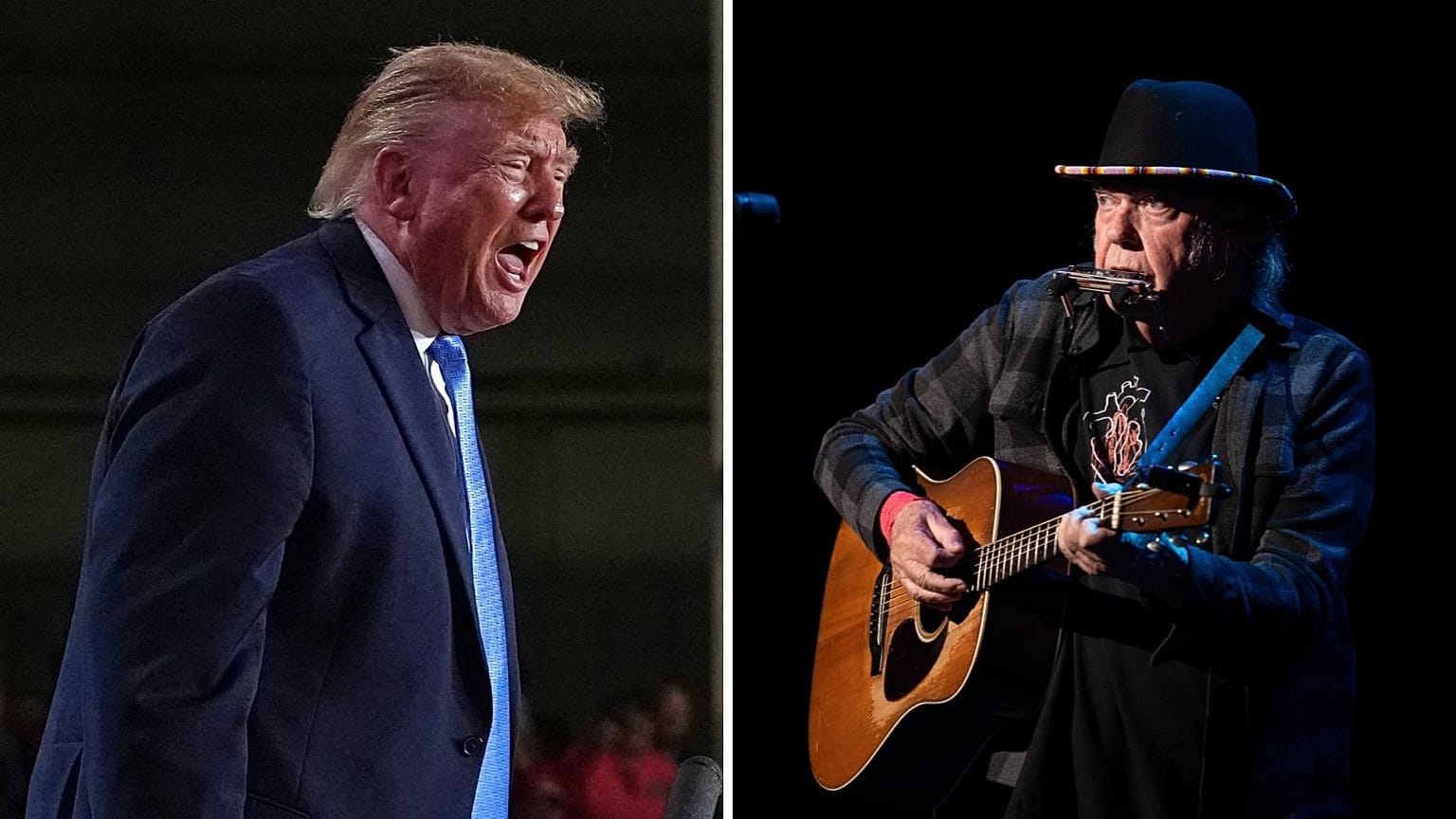
Neil Young has filed a $10 million suit against Donald Trump's political action committee, Trump 47 Committee Inc., for using his hit song ‘Rockin’ in the Free World’ - six years after a prior settlement over the same song.

Legendary Canadian rocker Neil Young has filed a lawsuit against Donald Trump’s political committee, alleging copyright infringement over the organisation’s ongoing use of his song ‘Rockin’ in the Free World’ during midterm election rallies. The 1989 hit is frequently used as Trump's walk-on music.

Young’s camp is requesting $10 million (approx. €8.9m) in damages and that Trump’s team be barred from playing the song in public.

The lawsuit, filed on Monday and seen by Variety, highlights how Trump 47 Committee Inc.’s unsanctioned use of Young’s song violates the terms of a past settlement, as the musician and his publishing company, Silver Fiddle Music, filed a copyright infringement suit against Trump’s presidential campaign in 2020.

Young later dismissed the lawsuit, but only after reaching a settlement with the Trump campaign – which included the promise that they would not use ‘Rockin’ in the Free World’ without permission.

“The Committee does not now have, and did not at the time of the Youngstown Rally or any other rally financed and conducted by the Committee, have a license or Young’s permission to play the Song at any public political event,” states the new lawsuit.

The lawsuit also highlights that Trump has clearly not listened to (or bothered to read) the song’s lyrics, as it is a famously anti-Republican.

Young wrote the track as a critical commentary on politics and American society during the George H.W. Bush years. The song clearly paints the contradictions and pitfalls of the so-called "American Dream".

“‘Rockin’ in the Free World’ is a blistering anthem that contrasts the hollow promises of American political rhetoric with the harsh realities faced by the poor, homeless and forgotten,” the document states. “The lyrics paint vivid street-level portraits - a mother discarding her baby, addicts lost in despair, garbage piling in the shadows of prosperity -while the repeated chorus delivers a savage irony, celebrating freedom that clearly isn’t shared by all.”

“In short, the song is the opposite of everything that Donald J. Trump stands for."

The opening lyrics to the song are: "There's colours on the street / Red, white and blue / People shufflin' their feet / People sleepin' in their shoes / But there's a warnin' sign on the road ahead / There's a lot of people sayin' we'd be better off dead / Don't feel like Satan, but I am to them / So I try to forget it any way I can...”

For most, it's hardly a difficult metaphor to grasp...

The suit also alleges that Young “has suffered and continues to suffer from great injury” over the alleged infringement, adding that he also “suffered damage to his reputation and brand as a result of the implication that he supports Donald J. Trump in any way.”

Young has been a longstanding and vocal critic of Trump. Last year, he came to the defence of Bruce Springsteen and Taylor Swift, both of whom Trump had criticised and even threatened.

At the time, Young shared a new blog post on the Neil Young Archives website, where he defended his fellow musicians.

“Bruce and thousands of musicians think you are ruining America. You worry about that instead of the dyin’ kids in Gaza. That’s your problem. I am not scared of you. Neither are the rest of us.”

He continued: “You shut down FEMA when we needed it most. That’s your problem Trump. STOP THINKING ABOUT WHAT ROCKERS ARE SAYING. Think about saving America from the mess you made.”

“Taylor Swift is right. So is Bruce. You know how I feel. You are more worried about yourself than AMERICA. Wake up Trump!! Remember what the White House is?”

He finished his blog entry by writing: “You are forgetting your real job. You work for us. Wake up Republicans! This guy is out of control. We need a real president!”

Earlier this year, Young even offered Greenlanders free access to his music in the wake of Trump's threats of annexation.

He wrote on his website: “I’m honoured to give a free year’s access to neilyoungarchives.com to all of our friends in Greenland. I hope my music and music films will ease some of the unwarranted stress and threats you are experiencing from our unpopular and hopefully temporary government.”

Young is far from the only high-profile musician to take legal action against the Trump administration for playing their songs without authorisation.

Everyone from Creedence Clearwater Revival to Tom Petty, via The Rolling Stones, Adele, Foo Fighters, Céline Dion, The White Stripes, ABBA and many more have called out Trump for using their songs without permission.

Other cases include Bruce Springsteen objecting in 2016 to Trump blasting 'Born in the U.S.A.' as a patriotic anthem, when it’s actually a scathing indictment of the treatment of Vietnam vets; Rihanna demanding that Trump stop playing 'Don’t Stop the Music' after the song played at a 2018 rally; and R.E.M. being outraged that their tracks 'Losing My Religion', 'Everybody Hurts' and 'It’s the End of the World as We Know It (And I Feel Fine)' were used at rallies.

In 2020, Leonard Cohen’s estate issued a statement criticizing Trump's unauthorized use of Cohen’s ‘Hallelujah’ at the Republican National Convention – having specifically rejected permission for its use. The estate, rather brilliantly, added that they would have only realistically considered approving Cohen's song ‘You Want It Darker’.

In June, Ariana Grande became one of the latest artists to protest Trump's antics, calling out the White House for using one of her songs in a social media post promoting ICE arrests.

She wrote: “Please do not ever use my music in relation to this barbaric, inhumane, heinous nonsense. F*** ICE."

The 2026 United States midterm elections are scheduled to be held on Tuesday 3 November.


Will Trump Take Millions Of Hostages Like Me For Big Pharma? – OpEd

Starting 20 January the FDA and Customs and Border Protection will effectively ban almost all personal prescription imports, eliminating a channel that millions of Americans, especially those over 65, have used to obtain drugs from Canadian pharmacies at roughly one-third of U.S. prices.

U.S. prescription prices are roughly triple those in other affluent nations; surveys show six in ten adults worry about affording drugs, and personal imports have also reduced Medicare outlays by allowing seniors to avoid high domestic prices that trigger the $2,100 catastrophic threshold.

The author argues the ban protects pharmaceutical price-gouging rather than public safety, notes that prior state-import proposals stalled under industry opposition, and contends that the freedom to buy lower-priced medicines abroad should not be treated as a threat.


President Trump loves protectionism but he gives Americans the same “protection” that the wolf gave to the lamb. On January 20, the Food and Drug Administration and Customs and Border Protection will effectively ban almost all personal prescription imports, bushwhacking millions of Americans who rely on Canadian pharmacies.

Trump often brags that the US has the world’s lowest drug prices. He also brags that he has lowered drug prices by 500% so he starts out with a helluva cloud over his credibility.

In reality, prescription drug prices in the US are roughly triple the cost in other affluent nations. A recent Kaiser Family Foundation survey found the highest rate ever of Americans worried about affording prescription drugs – six out of ten adults. Almost half said they had not filled prescriptions, skipped doses, or took other steps to curtail their costs.


The Washington Post reported the case of 76-year-old Linda Klonsky suffering from meibomian gland dysfunction. She previously paid $250 for three months of eye drops shipped from Canada to her Silver Spring, Maryland home. But restrictions on drug imports this summer sent the price of her drugs up almost ninefold. Klonsky lamented: “I’m being squeezed between the American drug company and Trump’s tariffs.”

I’m in the crosshairs of this trade battle. Eight years ago, I was diagnosed with glaucoma. With daily eye drops and regular ophthalmologist visits, my vision has remained fairly stable. I’ve tried numerous prescription eye drops but Lumigan is the only effective one that doesn’t give me butt-kicking headaches. Lumigan costs ten times more in the US than in Canada.

I found a trustworthy Canadian online pharmacy that delivers Lumigan for barely a third of the US price. That is typical of the savings pocketed by Americans purchasing from licensed Canadian pharmacies, according to the Campaign for Personal Prescription Importation.

Six years ago, when he was running for re-election, Trump touted a plan to permit state governments to “go to Canada and buy your drugs for a fraction of the price” in the US. Secretary of Health and Human Services Department Alex Azar certified that permitting states to import Canadian drugs “poses no additional risk to the public’s health and safety and will result in a significant reduction in the cost of covered products to the American consumer.” But that program was stillborn in large part due to opposition from US pharmaceutical manufacturers.


Federal policies have created many perverse incentives on pharmaceutical pricing. Prior to turning 65, I could use various discounts and rebates to get Lumigan in the US much cheaper than the full retail price. However, once a person becomes eligible for Medicare, no discounts or rebates are permitted. Medicare turbocharges drug price inflation while often providing only an illusion of a safety net for recipients. I had good reasons for vigorously opposing the creation of Medicare drug subsidies in 2004 – to no avail.

I am effectively subsidizing Medicare by buying Canadian. Medicare now covers the cost of any recipient’s prescription drug expenditure above $2,100 per year. If I bought Lumigan at the full US price of $265 each month, my annual cost would be $3,180 and Medicare would pay $1,080. Medicare Part D plans I have used did not offer decent discounts on Lumigan. Thanks to my Canadian escape valve, Medicare pays zero for my Lumigan regardless of the extortionate price at CVS.

I have scant other prescription costs, and I can save a thousand dollars a year by buying Lumigan abroad without coverage from Medicare. The vast majority of Americans who order prescription drugs from Canada are over 65 and are paying out-of-pocket, providing windfall savings for Medicare. But practically nobody in Washington has given a damn about saving tax dollars since the Reagan era.

Big Pharma lobbyists warn that permitting Americans to directly import the drugs they need is too risky. Indeed, tainted eye drops have been a big problem in recent years. The FDA recently recalled almost 4 million eye drop bottles due to possible contamination. But those bottles were produced in Illinois and California, not the Yukon or Nova Scotia.

“Why would the FDA want to prosecute people just trying to afford their blood pressure, asthma, diabetes medicine?” said Lucia Mueller, president of PharmacyChecker, an organization that vets online pharmacies. Here’s a woman who doesn’t know the history of high-profile raids designed to make FDA officials famous. FDA has a “zero tolerance except for price-gouging” policy.


In the past, the FDA usually turned a blind eye to prescription drug imports of less than 90 days’ personal supply, which may be in a legal gray zone. Perhaps this article will spur the FDA to target me and my bootleg eye drops. Whatever – I’m accustomed to the feds denouncing my articles, from the chief of the FBI to the Secretary of Agriculture and even the Postmaster General. I’ve been thrashing protectionist schemes and the FDA for more than 35 years and it is too late to stop now.

I recently thumped Trump’s pending Canadian embargo in the New York Post. Plenty of people responded by finger-wagging that I should be happy with the lower-priced generic version of Lumigan. But “generic” is a pharmaceutical term that often means “close enough for government work.” Until very recently, the generic version of the eye drops had triple the dose of the active ingredient – with no extra charge for those durn headaches.

If Trump bans Americans from purchasing their prescriptions abroad, I will survive. The patents on Lumigan expire next summer and the price will likely fall sharply unless rascally lawyers find a new pretext to screw American consumers on the price. But hundreds of thousands or maybe millions of other Americans will suffer severe hardship from Trump’s border closure. Tim Smith, general manager of the Canadian International Pharmacy Association, said that people “are coming to us because they can’t afford the drugs where they live.” Unfortunately, that is not a problem for Washington bureaucrats and political appointees.

I am looking for no subsidy or favors from Washington. All I want is the freedom to purchase the drugs I need without getting blindsided by Uncle Sam.

We don’t need federal eye-drop police to protect Americans against low prices. If the United States actually had the lowest drug prices in the world, Trump would not need to take Americans hostage to allow Big Pharma to continue gouging them with high prices.


This article was published at Brownstone Institute


About James Bovard
James Bovard, 2023 Brownstone Fellow, is author and lecturer whose commentary targets examples of waste, failures, corruption, cronyism and abuses of power in government. He is a USA Today columnist and is a frequent contributor to The Hill. He is the author of ten books, including Last Rights: The Death of American Liberty.
View all posts by James Bovard →
HIV Has Reached ‘Epidemic Proportions’ In A Third Of Russia’s Federal Subjects – OpEd


October 28, 2026

By Paul Goble

Key Takeaways:

HIV has reached epidemic levels in 27 Russian federal subjects, infecting up to 3 percent of men in their 40s and 1 percent of pregnant women, mostly via heterosexual transmission.
Only half of those infected receive antiretroviral therapy, leaving at least 600,000 untreated sources of spread and missing the WHO 95-95-95 target.

Hospitals are again transmitting the virus, and hard-hit regions lack the funds to fill the drug-supply gap despite lifted federal restrictions.

HIV infections have reached “epidemic proportions” in 27 of Russia’s federal subjects, with transmissions increasingly occurring through heterosexual contacts and the failure of medical facilities to prevent the spread. As a result, as many as three percent of Russian men in their 40s are infected and one percent of pregnant women.

Those are just some of the dire reports of Russian experts surveyed by Mikhail Sergeyev, who monitors economic developments for Nezavisimaya Gazeta, reports that suggest that while mortality rates from HIV have fallen there in recent years, that may not continue if the rate of the spread of HIV increases (ng.ru/economics/2026-10-25/1_9610_hiv.html).

One reason for pessimism is that many who are infected do now know that, and “only half of the people living with HIV” are getting anti-retroviral treatments, experts say. That low coverage means that “at least 600,000 HIV sources continue to actively participate in the transmission of the virus,” they continue.

According to the World Health Organization, controlling the spread of HIV requires that countries achieve what is known as the 95-95-95 benchmark, with 95 percent of those infected knowing their status, 95 percent receiving ART treatment, and 95 percent of those achieving viral suppression. At present, Russia is not close to any of those figures.

Russian medical officials say that “two thirds of the new HIV transmissions in Russia are the result of heterosexual contact” rather than drug abuse or homosexual activity;” and they note that hospitals and other medical institutions “are one again becoming channels of transmission of the virus.”

Moscow has lifted restrictions on ART medications, but the problem of a lack of the availability of such drugs is still so great that the hardest hit regions are now trying to fill in the gap, although they rarely are able to do so not only because of the high cost of such drugs but also because of their lack of funds for such things.

The American Government’s Shameful Economic Warfare Against Cuba – OpEd

A man rides a bicycle by a vibrant Cuban flag mural in Havana. 
Photo Credit: Mehmet Turgut Kirkgoz, Pexels

October 28, 2026
MISES
By Dr. Birsen Filip


Key Takeaways:

The Trump administration has continued coercive economic measures against Cuba and, through recent statements by President Trump and Secretary of State Marco Rubio, has left open the possibility of more forceful regime-change efforts, including military options, aimed at replacing President Díaz-Canel and the Communist Party.

Díaz-Canel has rejected resignation under pressure, warned that an invasion would trigger guerrilla resistance and regional destabilization, and called for respectful dialogue while opposing externally driven regime change of the kind pursued elsewhere.

The article contends that attempting to impose a free-market order through embargo and external coercion contradicts classical-liberal and Rothbardian principles, which treat markets as spontaneous outcomes and require states to refrain from interfering in other countries’ affairs.


The Trump administration has shown no interest in pursuing a policy of peaceful engagement with Cuba based on respect for national sovereignty and the principle of self-determination, during either his first term in office or his current presidency. In fact, on both occasions, the US government has implemented coercive economic measures designed to increase pressure on the Cuban government, with the broader objective of weakening the existing political system and encouraging political change without direct military intervention.

More recently, however, there has been a noticeable shift in attitude, as President Trump suggested that there could be “a friendly takeover, it may not be a friendly takeover.” Other provocative and undiplomatic statements included: “whether I free it, take it, I think I can do anything I want with it”; and, “You want to know the truth? They’re a very weakened nation now.” President Trump even went so far as to state that he believed he would have the “honor of taking Cuba.” These comments imply that the administration has not ruled out the possibility of even more coercive measures, including the use of military force.


Speaking to reporters after a G7 meeting in France on March 27, 2026, Secretary of State Marco Rubio argued that Cuba was a disaster due to the failure of its economic system and asserted that improving the future of the country would require replacing its leadership, transforming the political regime, and restructuring its economic model. Accordingly, the Trump administration is seeking the removal of Cuban President Miguel Mario Díaz-Canel Bermúdez and the transfer of power away from the Communist Party to a more compliant leadership that would be willing to pursue the economic restructuring long advocated by foreign investors and Cuban exiles in South Florida.

On May 18, President Miguel Díaz-Canel responded by stating that,


. . .the threats of military aggression against Cuba by the world’s most powerful nation are well known. The threat itself constitutes a violation of international law. If carried out, such aggression would result in a bloodbath with incalculable consequences and would have a profoundly destabilizing impact on regional peace and security.


In fact, he has consistently argued that a US invasion of Cuba would entail significant costs and have far-reaching implications for the security of Cuba, the United States, and the wider region. According to Díaz-Canel, such an intervention would be met with guerrilla resistance, as Cubans are prepared to defend their sovereignty even at the cost of national sacrifice. Libertarians should be fully supportive of Cuba in the event of such an altercation, as Rothbard stated that:


. . .revolutionary guerrilla war can be far more consistent with libertarian principles than any inter-State war. By the very nature of their activities, guerrillas defend the civilian population against the depredations of a State; hence, guerrillas, inhabiting as they do the same country as the enemy State, cannot use nuclear or other weapons of mass destruction. Further: since guerrillas rely for victory on the support and aid of the civilian population, they must, as a basic part of their strategy, spare civilians from harm and pinpoint their activities solely against the State apparatus and its armed forces. Hence, guerrilla war returns us to the ancient and honorable virtue of pinpointing the enemy and sparing innocent civilians. And guerrillas, as part of their quest for enthusiastic civilian support, often refrain from conscription and taxation and rely on voluntary support for men and materiel. (emphasis in original)

President Díaz-Canel has also maintained that the United States would be unable to achieve regime change through economic pressure, including the ongoing embargo or other forms of coercion. He reaffirmed that he would not resign under external pressure and has reiterated his commitment to defending Cuban sovereignty and self-determination. At the same time, he has called for mutually respectful dialogue with the United States and opposed efforts to bring about regime change in Cuba, similar to those pursued in Venezuela and Iran.


The belief that an economic siege can bring about the collapse of socialist Cuba and facilitate the establishment of a free-market system rests on a particular assumption: that economic and social transformation can be deliberately engineered through external pressure. Such a view suggests that a market order does not need to emerge organically from domestic institutions, individual choices, and voluntary exchange, but can instead be imposed through coercive measures directed by a foreign state.

This presents a fundamental tension with the principles of classical liberal and libertarian thought. If free markets are understood as outcomes of spontaneous processes, as opposed to conscious design, then the notion that a foreign government can create a capitalist order through economic sanctions and political pressure is difficult to reconcile with the invisible-hand thesis and the principle of laissez-faire. Ultimately, a system based on voluntary cooperation and decentralized decision-making cannot be easily brought into existence through policies aimed at restriction, economic control, and collective punishment.

The case of Cuba illustrates this contradiction. For decades, the economic embargo imposed by Washington has been justified as a means of weakening the socialist government and encouraging a transition towards a market-oriented economy. Yet, the political and economic system of Cuba has demonstrated resilience in the face of this sustained external pressure, which raises important questions about the effectiveness of economic coercion as a tool for social transformation. Instead of producing the political outcomes sought by Washington, these measures have imposed significant costs on the Cuban population, while demonstrating the limitations of attempting to engineer institutional change from outside.

From a libertarian perspective, the broader lesson extends beyond the specific case of Cuba. The pursuit of freedom and market exchange cannot be advanced through policies that rely on coercion and external control. If liberty depends on voluntary action and decentralized decision-making, then attempts to impose a particular social order through state power—whether domestic or foreign—risk contradicting the very principles they claim to promote. Rothbard argued that, within the libertarian tradition, the goal in foreign affairs is “to keep government from interfering in the affairs of other governments or other countries.” That is to say, it aims to “shackle government from acting abroad just as we try to shackle government at home.” Rothbard specifically stated that:


For the libertarian is interested in reducing as much as possible the area of State aggression against all private individuals. The only way to do this, in international affairs, is for the people of each country to pressure their own State to confine its activities to the area it monopolizes and not to attack other States or aggress against their subjects. In short, the objective of the libertarian is to confine any existing State to as small a degree of invasion of person and property as possible. And this means the total avoidance of war. The people under each State should pressure “their” respective States not to attack one another, or, if a conflict should break out, to withdraw from it as quickly as physically possible.

Rothbard insisted that “libertarians in the United States must center their critical attention on the imperial and warlike activities of their own government.” Moreover, Rothbard also reminded libertarians that, in “the twentieth century as a whole, the single most warlike, most interventionist, most imperialist government has been the United States.” In doing so, he recognized that “such a statement is bound to shock Americans, subject as we have been for decades to intense propaganda by the Establishment on the invariable saintliness, peaceful intentions, and devotion to justice of the American government in foreign affairs.”


About the author: 

Dr. Birsen Filip is an economist and a philosopher. She is specialized in the history of economic thought, philosophy of economics, political philosophy, philosophy of science, and continental philosophy. She has published numerous academic articles and chapters on a range of topics, including the neo-liberal school of economic thought, the Austrian School of Economics, the German Historical School of Economics, German Idealism, liberalism, ordo-liberalism, imperialism, and socialism. She is also the author of two books: The Early History of Economics in the United States: The Influence of the German Historical School of Economics on Teaching and Theory (Routledge, 2022); and, The Rise of Neo-liberalism and the Decline of Freedom (Palgrave McMillan, 2020).
Source: 


This article was published by Mises


About MISES
The Mises Institute, founded in 1982, teaches the scholarship of Austrian economics, freedom, and peace. The liberal intellectual tradition of Ludwig von Mises (1881-1973) and Murray N. Rothbard (1926-1995) guides us. Accordingly, the Mises Institute seeks a profound and radical shift in the intellectual climate: away from statism and toward a private property order. The Mises Institute encourages critical historical research, and stands against political correctness.
View all posts by MISES →


Israel election: Netanyahu bloc leads with more than half of votes counted but short of majority


By Nathan Rennolds & Emma De Ruiter
Published on

The partial results are likely to change, and several exit polls showed the camps neck-and-neck without a majority.

The camp of Prime Minister Benjamin Netanyahu was ahead of the opposition on Wednesday after 50% of votes were counted in Israel's pivotal general election, figures from the Central Elections Committee showed.

Netanyahu's bloc was projected to win 56 of the 120 seats in the parliament, compared with 49 for the opposition bloc and 15 for the Arab parties.

The partial results are likely to change, and several exit polls showed the camps neck-and-neck without a majority.

Initial exit polls suggested no clear victor, with both Prime Minister Benjamin Netanyahu and main rival Gadi Eisenkot falling short of a majority.

Israel's Channel 13 news initially projected the opposition bloc would have the edge with 53 seats in the 120-seat Knesset, with Netanyahu's bloc set to win around 50.

The three mainstream Israeli television networks later gave the two blocs each around 51 seats.

Netanyahu's Likud party would be the largest single party, with 27 seats.

Arab parties make gains

Israeli Arab lists were projected to win 15 seats, a sharp gain, with some Israeli Arab communities reporting near-universal turnout driven by outrage to often derogatory rhetoric against them by Netanyahu's far-right allies.

Key Israeli Arab leader Mansour Abbas said he believed the right had "suffered a major loss" and was open to working with Eisenkot.

But Eisenkot said during the campaign he would not govern with Israeli Arab lawmakers -- and Netanyahu again suggested that a government relying on Arab votes would lack legitimacy.

Arab lawmakers could give Eisenkot support in parliamentary votes to maintain a minority government without joining a coalition. If not, Israel could head to new elections.

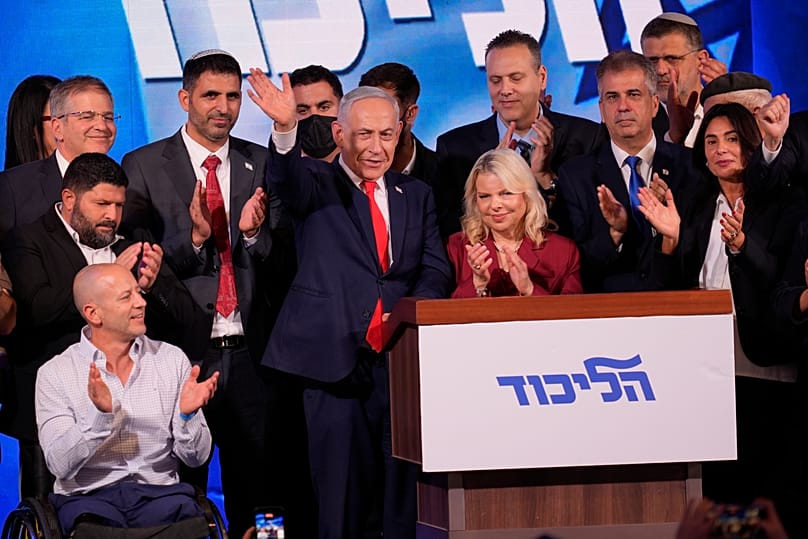
Israeli Prime Minister Benjamin Netanyahu waves to supporters following the release of the first exit poll results in Israel's general election, Wednesday, Oct. 28, 2026.
Israeli Prime Minister Benjamin Netanyahu waves to supporters following the release of the first exit poll results in Israel's general election, Wednesday, Oct. 28, 2026. AP Photo/David Goldman

Itamar Ben Gvir, a far-right firebrand who according to exit polls did not gain as much as many expected, warned Netanyahu against another option -- a unity government with Eisenkot.

"It would be a terrible mistake," said Ben Gvir, who champions the expulsion of Palestinians and would likely be excluded from any unity government.

In a post on X, Eisenkot said the exit poll results showed a "complete lack of confidence in Netanyahu and the October 7 government."

Yair Golan, the leader of Israel's left-wing Democrats party, added that the public had "spoken" and "ousted the Netanyahu government."

But Israeli Foreign Minister Gideon Sa'ar warned that celebrations from the left were "premature."

"One thing seems quite clear: The Likud is the largest party in Israel," he wrote on social media.

Netanyahu and Eisenkot each claim mandate

At an appearance early Wednesday, Netanyahu was upbeat and already trying to position himself to remain prime minister, listing off military achievements of the past three years.

He called on his opponents to line up behind him and dismissed the idea of a partnership with Arab parties — whose constituents make up 20% of Israel's population — as treasonous.

“We must establish a strong, right-wing, nationalist government,” said Netanyahu, who was facing off in the vote against his former military chief, centrist Gadi Eisenkot. “We must not endanger Israel and establish a government that relies on anti-Zionist Arab parties.”

"Israel has a unique opportunity with our partner President Trump to forever eliminate the existential threat of Iran," Netanyahu said.

Gadi Eisenkot waves an Israeli flag onstage following the release of the first exit poll results in Israel's general election in Tel Aviv, Israel, Wednesday, Oct. 28, 2026.
Gadi Eisenkot waves an Israeli flag onstage following the release of the first exit poll results in Israel's general election in Tel Aviv, Israel, Wednesday, Oct. 28, 2026. AP Photo/Baz Ratner

Eisenkot, speaking to his own supporters in Tel Aviv, issued a veiled warning to Netanyahu, who observers say could use a war to push for a unity government.

"Netanyahu, don't you dare use Israel's security for your political needs," Eisenkot said.

Addressing Israel's security establishment, Eisenkot said that they served the state and not Netanyahu, calling him "a caretaker prime minister, without a mandate or the people’s trust".

Turnout for the election - Israel's first since Hamas' 7 October 2023 attacks - hit over 77%, according to Israel's Central Elections Committee.

Netanyahu had spent much of the day calling on supporters to get out and vote, painting the election as a "matter of life and death."

The vote is widely seen as a referendum on Netanyahu's leadership.


Ex-Israel government spokesperson: 'Extraordinary comeback' by Netanyahu

Euronews
By Sasha Vakulina
Published on

Despite the fallout from the 7 October attacks, three years of war and widespread public dissatisfaction, Benjamin Netanyahu emerged from Israel's election with his political position strengthened, even as neither political bloc is assured of a parliamentary majority.

Israel faces three possible outcomes following an inconclusive parliamentary election: a unity government, a minority administration or fresh elections, according to former Israeli government spokesman Eylon Levy.

The political deadlock comes as Prime Minister Benjamin Netanyahu stages what Levy described to Euronews as an "extraordinary comeback".

"All of those are going to require someone to surrender on some very serious coalition promises," Levy said.

Netanyahu's political survival

For Netanyahu the election represents a remarkable political recovery after years of mounting pressure over the security failures surrounding the Hamas-led attacks of 7 October 2023, the subsequent war and domestic divisions.

"This is an extraordinary comeback for Netanyahu, despite the October 7th massacre that happened on his watch, despite three years of war since then, despite huge public unrest and dissatisfaction over his alliance with the ultra-orthodox parties and their demand for an exemption from military service," Levy told Euronews.

Yet his electoral gains do not necessarily translate into a governing majority.

"Netanyahu has lost his majority. It seems it's unlikely that he will hold on to a majority. But unless someone else manages to form a government, he remains the caretaker prime minister," Levy said.

That leaves Netanyahu in a potentially advantageous position: his rivals must assemble an alternative coalition, while failure to do so could extend his tenure as caretaker prime minister.

Could Arab parties decide who governs Israel?

Arab parties have made substantial gains in Israel's parliamentary election, with early projections pointing to potentially record representation in the Knesset.

Their performance has brought the politically sensitive question of their role in forming the next government back into focus.

Their support could prove decisive in determining whether Gadi Eisenkot, Netanyahu's main opposition challenger, can assemble an alternative government, although several opposition figures have ruled out governing with them.

Levy said the possibility of an Eisenkot-led minority government supported by some Arab parties had been discussed, but warned that such an arrangement could provoke a political backlash.

"Leaders within the change block are warning that would be extremely unpopular and would backlash and end up giving Netanyahu an even bigger majority in the next election," he said.

Levy pointed to deep ideological divisions between mainstream Israeli parties and Arab political factions, particularly over Hamas.

He singled out Mansour Abbas, leader of the Arab Ra'am party, which participated in Israel's 2021–2022 governing coalition.

Although Abbas has condemned the Hamas-led attacks of 7 October, he has repeatedly declined to explicitly describe Hamas as a terrorist organisation, a position Levy cited as an obstacle to political cooperation.

"So they are still kryptonite for most of the mainstream parties," Levy said.

"Either we go back to elections or someone folds and sues for peace and joins his coalition," Levy said.


Israeli Opposition Gains Ground As Exit Polls Leave Netanyahu Short Of A Majority


October 28, 2026
Al Bawaba News
By Mansour Al-Maswari

(Albawaba) — Initial Israeli election exit polls indicate that Prime Minister Benjamin Netanyahu’s right-wing bloc is falling short of the 61 seats needed for a Knesset majority, with opposition leader Gadi Eisenkot emerging as a potential candidate to form the next government, Israel’s Channel 12 reported.

Preliminary projections put Netanyahu’s bloc at 50 seats, compared with 53 for the opposition and 17 for Arab parties. Across six exit-poll projections, Netanyahu’s coalition was estimated to win between 50 and 60 seats, with none reaching the 61-seat threshold required for a parliamentary majority. The results remain projections, not official election results.

Voter turnout reached 74.3% by 8 p.m., according to Israel’s Central Elections Committee, marking exceptionally high participation. Earlier, turnout had reached 55.7% by 4 p.m., amid reports that Arab voter participation was surging and threatening the electoral prospects of smaller right-wing parties.


Netanyahu intensified his campaign in the final hours of voting, using a TikTok livestream to urge supporters to vote for Likud. He warned that low turnout could result in a left-wing government backed by the Muslim Brotherhood. National Security Minister Itamar Ben Gvir also canvassed voters, knocking on doors and using a loudspeaker to encourage participation.

Finance Minister Bezalel Smotrich reportedly cut short visits to polling stations and called an emergency meeting amid concerns over Arab voter turnout. Meanwhile, Israeli media reported that Likud had requested an extension of voting hours, but the Central Elections Committee rejected the request.

Tensions were also reported at a polling station amid allegations of deliberate delays in Arab communities. Ahmad Tibi, head of the Joint List bloc, accused election staff of slowing the process and demanded that people waiting outside, including patients and journalists, be allowed to vote. The allegations had not been independently verified.

The election has become a critical test for Netanyahu’s right-wing coalition, with the final distribution of seats and the role of Arab parties likely to shape negotiations over the formation of the next government. Official results are awaited.


About Al Bawaba News
Al Bawaba provides top stories and breaking news about the Middle East and the world. The Al Bawaba network consists of several web portals and media platforms.
View all posts by Al Bawaba News →